Showing posts with label 10th century. Show all posts

Sunday, May 14, 2017

Lordship in the Tenth-century – What was its Political and Social Function?

by Annie Whitehead

“No man can make himself king, but the people have the choice to select as king whom they please, but after he is consecrated as king, he then has dominion over the people and they cannot shake his yoke from their neck.”

So said Aelfric of Eynsham, (c955-c1010), and he tells us here of the absolute nature of kingship. The king is the lord of all the English, so if we are to discover the function of lordship, we should begin by examining the role of the king.

King Edgar

By the tenth-century ideas  about the spiritual role of kingship had developed along Carolingian lines. A well-documented example of this is Edgar’s coronation at Bath in 973. One school of thought is that Edgar delayed his coronation until he had reached the canonical age of thirty, but it is unlikely that he could have reigned successfully for so long (he succeeded his brother Eadwig in 959) without having been consecrated earlier in his reign, particularly in view of what Aelfric has to say about consecration. [1]

It is more probable that this coronation was based on the Frankish notion of ‘imperium’, stressing the king’s duty before God. Wulfstan, Archbishop of York, expanded this idea in his Institutes of Polity. His view was that a Christian king should be a just shepherd to his Christian flock, he was to help the righteous and to afflict the evil-doers, especially thieves and robbers. His true function was to purify his people before God and the world. [2]

The mutual obligation between the king and his subjects is illustrated by an incident in Aethelred the Unready’s reign. With the death of Swein Forkbeard, Aethelred was asked to return from exile in Normandy by the Witan (council), who declared that “no lord was dearer to them than their rightful lord, if only he would govern his kingdom more justly than he had done in the past."[3] The king was king, but his subjects would not allow him to neglect his duty to them.

Yet neither would they neglect to exalt a praise-worthy monarch. Florence of Worcester* summed up the virtues of King Edgar thus:-
“In the winter and spring, he used to make progress through all the provinces of England and enquire diligently whether the laws of the land and his own ordinances were obeyed, so that the poor might not suffer wrong and be oppressed by the powerful…Thus his enemies on every side were filled with awe, and the love of those who owed him allegiance was secured.”
There were, of course, more personal relationships, not only between the king and his subjects, but between the lord and his man. The argument continues among historians as to whether pre-conquest England was feudal; suffice to say that there was an English equivalent to the Frankish oath of vassalage, this being the Hold-Oath. The oath was essentially negative, a promise to do nothing to harm the lord. It included a gesture of bowing to the lord. The lord in his turn had certain obligations to his man.
“By the Lord, before whom this hallowed thing is holy, I will be steadfast and true to X, to love all he loves and shun all that he shuns, and never, by will or by thought or by deed do aught of what is loathsome to him, as long as he upholds me as I am willing to earn and fulfil all that our understanding was, when I bowed to him and took his will.” 
Naturally, the king could not rule without counsel. The witenagemot, or witan, was the royal council, and had the right, rather than the privilege, to advise the king. The king’s thegns owed their status and position to the king and were rewarded for their service (the word thegn originally meant servant.) It was usually the king’s thegns who were appointed as reeves, responsible for administration in the localities as a check on the powerful ealdormen.

The king with his witan

The most usual form of reward was that of a land grant. Many charters confirming these land grants still exist, such as King Edgar’s grant of land at Kineton to his thegn Aelfwold in 969. These grants, known as bookland, were not the same as the fief of feudal Frankia. They were granted by the king in the form of a book (charter) for services rendered. Aelfwold was granted the land at Kineton for all his life and could leave it to whomever he chose. The estate was free from all service except “fixed military service and the restoration of bridges and fortresses.”

Many grants were made to the Church, who in turn leased out land in return for service. A good example of this comes from Oswald of Worcester, who lists the service required of the beneficiaries of the land. They should fulfil the law of riding as riding men should, they should pay dues to the Church, swear to be humbly subject to the bishop and lend horses, build bridges, and send hunting spears.

Initially these endowments were made to the Church from the king, and only he could turn folkland into bookland. It soon became, however, the most common way for a lord to reward his man.

A grant by Aethelred the Unready shows how far he was prepared to support his men. His thegn, Aethelwig, gave Christian burial to men killed fighting in defence of a thief. Rather than censure Aethelwig, as Ealdorman Leofsige advised, Aethelred granted his thegn the forfeited land of the brothers who had been killed. [3]

Not all thegns were king’s thegns; many of them had another lord to whom they owed their allegiance. When these thegns died, the heriot (war gear) was surrendered to their lord and not to the king.

Aethelred the Unready

There was another aspect to lordship, an extension of the personal bond into the field of law. In the reign of Edward the Elder (899-924) a letter was written to the king explaining the history of an estate at Fonthill, Wiltshire. It describes how a thief, Helmstan, was required to give an oath to clear himself of the charges brought against him. He asked his lord Ordlaf to intercede for him, which Ordlaf did, even though his man was guilty. [4] This illustrates how a lord was bound to protect his man, whether innocent or guilty. Though the law codes might have forbidden the lord from doing this, often it was more beneficial for a man to appeal to his lord in this way than to appeal in the hundred courts.

By the middle of the tenth-century it was becoming customary for lords, ecclesiastical or lay, to receive grants of jurisdiction from the king. Usually these grants were laid down in the charters as ‘sake and soke’. The term implied jurisdiction and control of a court. It was not granted lightly, and these delegated rights were intended to emphasise rather than undermine royal authority. While the landowner enjoyed immunity from public courts, the court over which he presided was not held for his men, but was attended by men drawn from the neighbourhood.

There was also a much more specific form of private jurisdiction. All lords, be they bishops, earls, thegns or abbots, were held responsible for the behaviour of their men. “Such a responsibility involved an exercise in judgement, which would easily be formalised into the giving of judgement.” (HR Loyn) Fortunately, the monarchy was strong enough to ensure that the worst abuses were avoided.

Along with sake and soke, other judicial rights were specified. ‘Toll’ gave the lord the right to take toll on goods sold within the estate, and ‘team’ gave the right to supervise the presentation of convincing evidence that goods for sale actually belonged to the person selling them. ‘Infangenetheof’ gave the lord the right to hang a thief if he had been caught on the estate with the stolen goods still in his possession. By the end of the period, large numbers of hundred courts were in private hands.

A charter of King Aethelred's to his 'faithful man' 

Lords, of course, had always been involved with the public courts. Earls and bishops presided over the shire courts. It was here that arrangements were made for the collection of taxes. It was in the interests of landowners to be represented, as the king always was by his servant the shire-reeve. It was also important for lords to establish a presence at the hundred court, where much money could be lost and won. They were also commanded to give full support to the hundredsmen, whose job it was to supervise legal trading and to discourage cattle theft. King Edgar specifically ordered ealdormen Oslac, Aelfhere, and Aethelwine to give such support. “And they are to send them in all directions, that this measure may be known to both the poor and the rich.” [5]

Military duties were linked with the social function of lordship. From the time of King Ine (688-725) forfeiture of land and a heavy fine of 120 schillings was the penalty for a lord neglecting military service. After 899, as well as national obligations to fyrd service, and building bridges and fortifications, men were now to group themselves into tithings and hundreds to protect themselves. Ealdormen and thegns not only formed the select body of the king’s household retainers, but were, as landlords, responsible for the organisation, the summons and the assembling of the fighting forces. They were also involved in the financial and personal organisation which was essential to ensure that competent levies turned out to perform military duties on behalf of their estate. Lords, then, led their men and were responsible for them in times of peace and war and were at both times high up on the social scale, just beneath the king.

Although it was not necessarily a feudal society, a constant theme runs throughout tenth-century English society, that of mutual obligation. At the highest level, the king could demand loyalty and service from his subjects, but in return must rule them justly and protect them. The thegns, earls, and other landowners owed service to the king in judicial, military and personal capacities, for which they were rewarded. They in turn could expect loyalty and service from their men, but they were responsible for them and must protect them. Running though society in this way, the organised system which developed from the simple notion of personal loyalty was an integral part of all areas of central and local administration.


[1] DJV Fisher – The Anglo-Saxon Age Ch 12
[2] HR Loyn – The Governance of Anglo-Saxon England Ch4
[3] EHD – i 117
[4] EHD- i 102
[5] IV Edgar ‘Wihtbordesstan’ Code EHD i 41

* The authorship of the work of Florence is considered to owe more to a fellow monk, John of Worcester

~~~~~~~~~~

Annie Whitehead is an historian and novelist who writes about the Anglo-Saxon era. The author of two award-winning novels set in Anglo-Saxon Mercia, she was also a contributor to 1066 Turned Upside Down, a re-imagining of the events leading up to the Battle of Hastings. She is a member of the Royal Historical Society and an editor of the EHFA blog. Currently she is working on a contribution to a non-fiction book to be published by Pen & Sword Books in the summer of 2017. Her novel Alvar the Kingmaker is set in the tenth-century during the reigns of Eadwig, Edgar and Aethelred the Unready and contains many scenes where the above-mentioned laws and charters were put into effect.

Saturday, October 1, 2016

Government in the Reigns of Edgar and Aethelred II

by Annie Whitehead

Neither Edgar (959-975) nor his son Aethelred (978-1016) came to the throne free from controversy. Both of them succeeded their elder brothers, who reigned only briefly. King Eadwig (Edwy) succeeded his uncle in 955, while his brother Edgar was declared king in Mercia and the Danelaw. With the existence of two royal courts it seems likely that civil war was not far away when Eadwig died on this day - 1st October - in 959. He had issued so many charters that a degree of irresponsibility is probable, and he had quarrelled with Abbot, later Archbishop, Dunstan and driven him into exile.

King Edgar

Aethelred was Edgar’s younger son, and succeeded his (step) brother Edward when he was murdered at Corfe. Throughout his reign he was never entirely able to escape from the fact that the murder had been committed for his sake.

King Aethelred

The youth of these kings produced an environment where faction could arise. Powerful ealdormen could be found influencing politics and the monarch, even changing the face of war, as was the case at the end of Aethelred’s reign.

This then was the political situation over which Edgar and Aethelred had to govern.

The king normally stayed in the south, and his presence in the north was made to be felt by his appointed ealdormen. Within the royal court there was a strict hierarchy, evidence of which comes from a scrutiny of the witness lists of Aethelred’s reign, where athelings, ealdormen, thegns and bishops subscribed in strict order of seniority. This order normally changed only when one subscriber died, but the witness lists of Aethelred’s reign show how powerful particular ealdormen could become. Eadric Streona headed the lists from 1009x12 to 1016, in the lifetime of other ealdormen who had once been his seniors. The king had no choice but to rely on these men for their cooperation and support, which was to some extent ensured by their attendance at the royal council, the Witan, where laws were deliberated upon and promulgated.

The Witan

Edgar relied heavily on the bishops and abbots within the Witan. He was the great patron of the monastic revival, overseen by bishops Oswald, Dunstan and Aethelwold. Many grants of land were made to the Church, and the ecclesiastical support thus ensured gave Edgar the means to check the power of the ealdormen. Oswald was given the triple-hundred* of Oswaldslow to the exclusion of Aelfhere of Mercia, and the leases of Oswald are an indication of his power. The Anglo-Saxon Chronicle records that in 975 “Ealdorman Aelfhere had very many monasteries destroyed...” This action arose more out of political rivalry it seems, than anti-monasticism.

In contrast, the early years of Aethelred’s reign show him undoing much of Edgar’s work, with lands being taken away from religious foundations, such as Abingdon, Rochester and Winchester. Until 993 it seems that Aethelred was being led astray by ealdormen who took advantage of his youth and ignorance. Fortunately for the church, these lands were restored after 993, when, with different ealdormen emerging, Aethelred was seen to mend his ways with the restoration of the privileges of Abingdon.

A charter from Aethelred's reign

There was a long tradition of financial organisation in Anglo-Saxon England. In the tenth century traditional renders gave way to the Geld. The payment of Geld involved the handling of coinage; King Athelstan (924-939) decreed that each burh (borough/fortified town) would have a mint, and he attempted to limit the number of moneyers. Edgar reinforced this legislation in his own law codes. “There shall run one coinage throughout the realm.” [2]  Every borough was expected to issue coinage.

Edgar’s reforms set the standard and the system was continued under Aethelred. During his reign there were more than 60 mints in operation. Of course, there was a great increase in the output of the mints at this time because of the payment of the Danegeld, something with which Edgar was not confronted. It was probably at the instigation of Archbishop Sigeric after Byrhtnoth of Essex was killed at Maldon (991), that the decision was taken to pay the Danes in the hope that they would go away.

“In this year it was decided to pay tribute to the Danes … on this occasion it amounted to £10,000. This course was adopted on the advice of Archbishop Sigeric.” [3]

The payment of the Danegeld indicates two things: the amount of fluid wealth in England and the capacity of the English to tap it.

Another form of taxation (albeit strictly a military tax) was the Ship Soke. Most of the evidence we have for this comes from the reign of Aethelred. The much quoted entry for 1008 in the Anglo-Saxon Chronicle tells us that

 “In this year the king gave orders that ships should be speedily built throughout the whole England: namely one large warship was to be provided from every 300 hides, and a a cutter from every ten hides, while every eight hides were to provide a helmet and a corselet.”

Aethelred was reacting sensibly to the Danish threat, but there is evidence to suggest that this was no innovation. FE Harmer (Anglo-Saxon Writs) pointed out that in 1003/4 Archbishop Aelfric made a bequest of ships and HPR Finberg [4] credited Edgar with the invention.  He cited the Triple Hundred of Oswaldslow created by Edgar, and said that Edgar organised efficient naval patrols around the shores of Britain.

The origin of the Hundred is somewhat hazy. Most of what we know about this administrative unit is derived from a document known as the Hundred Ordinance. Dated somewhere between 939 and 960, the Ordinance is the subject of controversy among historians who are unable to agree upon its author. But the Ordinance was definitely in existence by Edgar’s reign. It decrees that the hundred court should meet every four weeks, and that each man should do justice to other men there. II&III Edgar reinforces the Ordinance, by stating that the borough court is to be held thrice a year and the shire court twice, and the hundred court is to be attended as was ‘previously established.’

My very battered student copy of the translation of the Hundred Ordinance

Aethelred’s laws make frequent reference to the hundreds, in particular the importance of oath-taking. In III Aethelred, the ‘Wantage code’, which deals mainly with the Danelaw, we find what Finberg calls the earliest known reference to the sworn jury of presentment: “and the twelve leading thegns … are to come forward and swear on the relics which are put forward into their hands that they will accuse no innocent man nor conceal any guilty one.”

Edgar’s dealings with the Danelaw can be found in IV Edgar, the Wihbordesstan Code. It had often been said that Edgar was creating something new with this code. But technically speaking this is a letter to the Danes, showing Edgar eager to respect an autonomy which was already a fact.

It is probable that Edgar became king of England in 959 with the help of a powerful group of magnates who wanted a king who would not encroach on the customary law. Niels Lund [5] says that the whole point of the letter is to notify the Danelaw that he wishes a new law to apply to all his kingdom, that he knows that this is a violation of their privileges but nevertheless he asks them to accept it. Edgar stresses five times that he has every intention of respecting the Danelaw. It is possible that although IV Edgar is a recognition of established fact, Edgar himself created the Danelaw, as there are no earlier references to it. In all probability these privileges were granted by Edgar in 957, in gratitude for the support given him in the north against his brother Eadwig.

King Eadwig, who died 1st October, 959

It has been said that Aethelred also recognised the validity of the Danelaw, but in fact his dealings with these provinces sharply contrast with those of Edgar. In IV Edgar the king is careful not to offend the Danes to whom he owes a great deal. Aethelred was not so subtle. Whitelock suggests that he appointed to office men he had himself advanced, rather than men belonging to old established families. He was quick to seize lands in the Danelaw, for example those of the murdered Sigeferth and Morcar.

In the Wihtbordesstan code, sanctions against lawbreakers are left to be decided by the Danes, while Edgar and his councillors provide the rules for the rest of England. “And it is my will that secular rights be in force among the Danes according to as good laws as they can best decide upon. Among the English, however, that is to be in force which I and my councillors have added to the decrees of my ancestors.”

A comparison of Aethelred’s Wantage and Woodstock codes, shows that Aethelred on the other hand, attempted to impose English law on the Danelaw. Known respectively as III and I Aethelred, these codes were issued at more or less the same time, Wantage being specifically for the Danelaw.

I Aethelred says, “If, however he (the accused) is of bad reputation, he shall go to the triple ordeal.”
III Aethelred says, “And each man frequently accused is to go to the triple ordeal and pay four-fold.”

Not only did Aethelred set out the sanctions he imposed in the Danelaw, but he took a portion of the fines as well. Fines in the Danelaw were heavier than elsewhere in the country. It has been said that these measures show how much Aethelred was firmly in control of the Danelaw. Lund argues that rather it shows how Aethelred was attempting to gain firm control. He had no reason to think that he could rely on the north for support. On the contrary, he feared treachery, which led to his securing hostages from Northumbria in 991, and to the notorious massacre of St Brice’s day in 1002. His relations with the Danes are highlighted by the readiness with which the north accepted the Danish conquerors. The murdered Sigeferth and Morcar belonged to a northern family so powerful that Aethelred’s son Edmund Ironside’s marriage to Sigeferth’s widow gained him enough power to become the accepted king of the Five Boroughs. [6] It was people like these whom Aethelred, in total contrast to Edgar, managed to alienate by his attempts to impose English law on them.

Edmund 'Ironside'

Edgar’s was a peaceful reign, free from invasion. All he had to do was respect the Danelaw; he had already been shown their loyalty in 957. Aethelred on the other hand was plagued by raids from the sea. He had to pay tribute to the raiders from Denmark, and was never assured of the loyalty of the Danes in his own country. It is possible that Edgar introduced the Ship Soke, but is was certainly highlighted in Aethelred’s reign, because of the wretched situation in which he found himself. In short, the differences in the administration of these two kings stems from the difference in their reigns. One was always at peace; the other seemed permanently to be fighting off invasion.

[1] EHD (English  Historical Documents) 1 113
[2] II&III Edgar 59-963 EHD 1 40
[3] The Anglo-Saxon Chronicle (E) 991
[4] The Formation of England 550-1042
[5] King Edgar and the Danelaw, Med. Scand. 9
[6] The five main towns of the Danelaw: Derby, Leicester, Lincoln, Nottingham, Derby
* Triple hundred - an area of land, three times the administrative unit of the hundred
(All above images are in the public domain)

~~~~~~~~~~

Annie Whitehead is a history graduate and prize-winning author. Her novel, To Be A Queen, is the story of Aethelflaed, daughter of Alfred the Great, who came to be known as the Lady of the Mercians. It was long-listed for the Historical Novel Society’s Indie Book of the Year 2016 and has been awarded an indieBRAG medallion. Her current release, Alvar the Kingmaker, which tells the story of politics, intrigue, deceit and murder in the time of King Edgar, has also been awarded an indieBRAG medallion. She has recently contributed to 1066 Turned Upside Down, an anthology of short stories in which nine authors re-imagine the events of 1066 and ask 'What If'.

Sunday, March 6, 2016

The Jomsvikings: Legendary Viking Mercenaries

by Kelly Evans

Thorkell the Tall (also referred to as Thorkell the High in the Anglo Saxon Chronicle due to his great height), was truly a great Dane. He fought alongside Canute the Great, the Danish invader who became King of England, Denmark and Norway and achieved much success in life, becoming a lord in his own right. But what of his early years, and how did he learn the skills that made him such a successful warrior?

Rune Stone mentioning Thorkell the Tall (source: Wikipedia) 

Little is known of Thorkell’s early life, but what we do know is mainly through his association with the legendary Viking mercenaries, the Jomsvikings.

We know about the Jomsvikings from the Icelandic sagas, particularly The Jomsvikinga Saga and King Olaf Tryggvasson’s Saga. They were staunchly pagan, worshipping Odin and Thor, but would fight for Christian rulers if the price was right. Hiring themselves out to the highest bidder, they nonetheless followed a very strict set of rules and regulations.
1,000 year old Mjolnir pendant, 
similar to those possibly worn by the Jomsvikings
for protection (source: National Museum of Denmark
Their stronghold, Jomsborg, is said to have been located on the southern shore of the Baltic Sea. The exact location has never been found and is still the cause of great debate amongst scholars and amateurs alike as there are no primary sources that mention the place. There are, however, three contemporary rune stones that mention their battles and hint at a central location.

Thorkell the Tall would have had to follow the code by which the Jomsvikings ruled themselves. They were extremely selective when deciding whom to admit to their group, with membership being restricted to men aged 18 to 50 who had proven their bravery. This usually took the form of a display of strength, with a ritual duel, or holmgang, with an existing Jomsviking. (Normally these duels would be to the death, but in the case of proving yourself to the Jomsviking, besting your opponent was enough).

Once admitted to the group, a Jomsviking would continue to follow the strict code used to maintain order and instill military discipline.
- a Jomsviking was bound to defend his brothers and avenge their deaths.
- quarrelling or speaking ill of fellow Jomsvikings was forbidden
- blood feuds, if they arose, would be adjudicated by senior Jomsvikings
- a Jomsviking was forbidden to show fear in the face of the enemy, or run from battle (orderly retreat when against an enemy of superior strength, however, was permitted)
- spoils from a battle were shared equally amongst the entire order
- no Jomsviking could be absent from Jomsborg for more than 3 days without permission from the order
- no women or children were permitted within the Jomsborg fortress walls
- no women or children were to be taken captive

Non-adherence to any of these rules resulted in the offender being expelled from the group.

A few sources state that Harald Bluetooth, who ruled Denmark from 958 to c985, and from whom we get the Bluetooth symbol used in today’s technology (the Norse runes for ‘H’ and ‘B’ are combined to create the Bluetooth symbol), was the founder of the Jomsvikings. Another source claims the Jomsvikings were given their land by mythological ruler of Denmark. But no one really knows for certain where or why the group was started.

Curmsun Disc – 
Commemorating the death of Harald Bluetooth
at Jomsborg (Source: Wikipedia)

There is also very little known about what happened to the Jomsvikings. One story tells us that Magnus I, King of Norway (from 1035) and Denmark (from 1042) until his death in 1047 may have destroyed Jomsborg and the Jomsvikings as a show of control the year after he conquered Denmark. But without primary sources and with the lack of archaeological evidence, this legendary group of warriors will remain just that: legendary.

~~~~~~~~~~~~~

Kelly Evans was born in Canada of Scottish extraction but spent much of her life in London, England. She obtained degrees in History and English in Canada and continued her studies in London, focusing on Medieval Europe, landscape archaeology, and the Icelandic Sagas.

Kelly moved back to Canada eight years ago, shortly after which her first short stories were published. The Northern Queen is her first novel. Her work can be found on kellyaevans.com or via Nordland Publishing
Twitter: @chaucerbabe
Facebook

Sunday, February 28, 2016

King Edgar, his earls, and the birth of politics in England

by Annie Whitehead

In AD937 King Athelstan was declared king of not only England but of the Scots and Irish too. For whatever reason (and there's been surprisingly little conjecture about this) he never married. Upon his death the throne passed very quickly to his two brothers and then, in 955, to his young nephew, Edwy (Eadwig) who reigned for only four years and was succeeded by his brother, Edgar "the peaceable".

Detail of New Minster Charter, showing Edgar

Athelstan's brother Eadred had subdued the Viking kingdom of York, chasing Erik Bloodaxe to his death atop Stainmore, and Edgar was able to rule a kingdom which was free from Viking attack and, ostensibly, united.

But Edgar's succession had only been possible by initially splitting the kingdom, with the old kingdom of Mercia allying itself to him against his brother in Wessex. And nature abhors a vacuum; so too, it seems, does human nature. Anglo-Saxon history now becomes one not of warring kingdoms and marauding invaders, but in-fighting, back-stabbing, and courtly intrigue.

Putting aside the unfortunate but very timely (for some) death of Edwy at just 19, Edgar's court soon filled up with men seeking favour, power, wealth and influence. Edgar was young (14 or 15) and seemingly pious - he recalled the exiled Bishop Dunstan (Who'd been banished by Edwy after he caught Edwy in bed with his wife, and her mother!) and he supported Dunstan and Bishop Aethelwold in their campaign for monastic reform.

The old kingdoms had transmuted into earldoms and the earls of Mercia, East Anglia and Northumbria became the first 'over-mighty barons'. The old kingdoms might have vanished but tribal sensibilities and border disputes had not (the Mercians, particularly, had rallied behind a nationalist flag when they rose up in support of Edgar)

The Churchmen had the chroniclers on their side, but there is evidence which points to their feathering their own nests, taking land unlawfully, and there is an account of Archbishop Oswald feasting royally in his abbey at Ramsey while outside, folk starved, unable to pay the food rents owed to the Church.


Ramsey Abbey gatehouse - 15thc (nothing remains of the original building)

The earls of East Anglia were members of what amounted to a dynasty, descended from a man whose epithet "Half-king" tells all we need to know about his power.

The earl of Mercia, Aelfhere, was a minor member of the royal family and equally well-connected. Notoriously tempestuous, he took exception to the bishop of Worcester's increasingly frequent attempts to establish centres of power and authority within his earldom. That same bishop, Oswald, also illegally held in duality the archbishopric of York, and thus trod on the toes of the earl of Northumbria, too.

Bickering was kept to a minimum by Edgar. Strong, cocksure, he played the factions against one another and inspired devotion from them all. He recognised the Danelaw, he built up the fleet, and was famously rowed along the River Dee by several kings who bowed in homage to him.


But he, too, died young, although not childless. He left sons - one begotten through a nefarious relationship with a woman who had been promised to the Church and was on the brink of taking holy orders, the other to his queen, the powerful but fragile Aelfthryth.

The factions divided, with the Church and the East Anglians supporting the firstborn son, Edward, while Aelfhere of Mercia supported the queen, citing her son as having been born 'in the purple'. What followed has been labelled the 'anti-monastic reaction' but was essentially a politically driven righting of perceived wrongs.

And there it might have ended, with squabbling and a few land-grabs. But someone, and many pointed fingers at the queen, decided to remove Edward from the scene. Permanently.


"Aelfthryth looks on as Edward is stabbed" Foxe's Book of Martyrs

And so the years of 'peace' had seen the growth of politics, self-serving nobles and the development of sharp elbows in the corridors of power. Now, the king of England was Aethelred. He was young, he was badly-counselled, (as Christopher Brooke puts it, "Dissidence and half-suppressed revolt ... in Aethelred's time now walked openly") and the Vikings were getting ready to sail again. So many young, strong, and politically astute Anglo-Saxon kings had died young, while Aethelred was to live long enough to see all their hard work unravel, in spectacular fashion.

(All illustrations public domain/Wiki Commons)
Select bibliography:
Papers: An Outing on the Dee (Mediaeval Scandinavia 14) & Princeps Merciorum gentis: the family career and connections of Aelfhere, ealdorman of Mercia (Anglo-Saxon England 10) by Ann Williams
Athelstan 'Half King' and his family - Cyril Hart (Cambridge Journals)
The Saxon and Norman Kings - Christopher Brooke
Anglo-Saxon Chronicle - ed Garmonsway


Annie Whitehead studied Anglo-Saxon history under the tutelage of Professor Ann Williams. She wrote her first book, To Be A Queen, in order to tell the often overlooked story of Aethelflaed, daughter of Alfred the Great. It was long-listed for HNS Indie Book of the year 2016. Her new release, Alvar the Kingmaker, tells the story of Aelfhere, earl of Mercia, described both as "The blast of the mad wind from the western territories" and as "The glorious earl".
To Be A Queen - Kindle
Alvar the Kingmaker - Kindle
Paperbacks/Hardbacks

Wednesday, December 28, 2011

The Secrets of a Saxon King


 By Nancy Bilyeau


“Holy King Athelstan, renowned through the whole world, whose esteem flourishes and whose honour endures everywhere,” said a 10th century Latin poem.

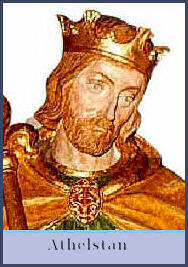
In his own lifetime, Athelstan, the grandson of Alfred of Great, was praised as  “the English Charlemagne.” By defeating the combined armies of Danes, Scots and Welsh in the Battle of Brunanburh in 937 AD, Athelstan could rightly claim the title of “King of all Britain.” In his 15-year reign, he also established laws, financed Catholic monasteries, and made key alliances with European royalty.


Yet today, Athelstan is mostly forgotten.

While researching this Anglo-Saxon king, who plays a crucial role in my historical thriller The Crown, I puzzled over why Athelstan dissolved into obscurity. It’s not all attributable to the time in which he lived—those ill-documented, striving, brutish yet sporadically dazzling centuries between the Roman Occupation and the Norman Conquest. Everyone has heard of Alfred the Great. Why not Athelstan, who arguably accomplished just as much?

I concluded that it was the mysteries surrounding Athelstan—ones that the most determined historians have not been able to solve—that made him too blurry for easy familiarity. His secrets make him tantalizing. But they also prevent his life from hardening into the simple outlines that propel a legend through time.

1.)   Was Athelstan’s mother a concubine?
This is hotly disputed, with biographer Sarah Foot convinced that Athelstan’s mother was an obscure but highly born young woman who had a child or two and died. Sort of a Dark Ages version of a starter wife.  Yet the story persists that Athelstan’s father, Prince Edward, fell in love with a beautiful young shepherdess while visiting his former wet nurse and conceived Athelstan that very night. It’s quite the erotic tale, putting to rest that stereotype of10th century men only caring for their swords. More practically, if there were any truth to Athelstan being illegitimate, it would explain why he did not have strong support when he succeeded his father to the throne at age 30—and it would also explain a serious problem he had with one of his half-brothers…

2.)   Did Athelstan have a half-brother killed?
The story goes that Athelstan suspected young Edwin, the son of his father’s undoubted queen, of conspiring against him with disaffected nobles. As punishment, Edwin was put in an oarless boat without food or water and set out to sea. He threw himself overboard rather than continue to suffer. Later Athelstan is said to have expressed remorse and performed penance. This whole story is far from confirmed but it’s persistent—and historians believe that it flung a shadow across the character of Athelstan.

3.)   Why did Athelstan never marry or have any children?
Thanks to chronicler William of Malmesbury, we know what Athelstan looked like: handsome, slim and blond. He was well educated. He was personally brave—Athelstan “won by the sword’s edge undying glory in battle.” In short, the man is King Arthur material. So why wasn’t there a Guinevere? Historians struggle to explain it: “Athelstan’s decision to remain unmarried seems more readily explicable as a religiously motivated determination on chastity as a way of life.” Still, the concept of celibate warrior monks—such as the Knights Templar—did not come along for another two centuries. A king was expected to marry and beget heirs, in Athelstan’s time and throughout the succeeding dynasties (see Henry the Eighth).  Lacking a Dark Ages Dr. Phil--which is perhaps for the best--we’ll never get to the truth of this one.

4.)   Where did the Battle of Brunanburh take place?
Athelstan’s enemies, determined to put an end to Wessex domination, drew him north for a cataclysmic encounter. Winston Churchill, as only he could, summed up the odds against Athelstan in The Birth of Britain: “The whole of North Britain—Celtic, Danish and Norwegian, pagan and Christian—together presented a hostile front under Constantine, king of the Scots, and Olaf of Dublin, with Viking reinforcements from Norway.” And yet…Athelstan won. Where this battle was fought, no one knows, though Yorkshire is a solid guess. Most of our information about Brunanburh comes from a rapturous Anglo-Saxon poem. There is a great deal of “they hewed the battle shafts with hammered weapons,” but no identifiable landmarks.


5.)   Why did Athelstan request burial at Malmesbury Abbey?
Almost every king of the House of Wessex was laid to rest in Winchester, the family’s seat of power. But Athelstan arranged to be buried at Malmesbury Abbey in Wilstshire. The king had "such a veneration for the place that he thought nowhere more desirable or more sacred." Whatever his reasons, Malmesbury rose to the occasion, and dedicated itself to the memory of the great king. Today you can visit Athelstan's tomb and glimpse his effigy, though his corpse is long gone. Some say it disappeared a few decades after his death, others that it was removed shortly before the Dissolution of the Monasteries.
Malmesbury Abbey today

6.)   Did Athelstan possess the most sacred religious relics of his time?
This was the age of relic collecting, and no one pursued them with greater passion than Athelstan. He was so famous for his love of relics than when Hugh Capet, descendant of Charlemagne, was interested in marrying Athelstan’s most beautiful sister, he is said to have delivered an amazing amount of treasure to England—as well as relics that date back to Golgotha. The most famous one was the Spear of Destiny, also known as the Lance of Longinus, that pierced Jesus’s side. 

But Athelstan is said to have possessed other objects of mystical value, too, and that is what I delve into in my novel, The Crown


"The Crown" is the first in a trilogy of historical thrillers, published by Simon & Schuster in North America and Orion in the UK. To learn more, go to www.nancybilyeau.com