Showing posts with label Gunpowder Plot. Show all posts

Monday, November 5, 2018

The Man in the Tower Suite ~ Henry Percy, the Ninth Earl of Northumberland

by Linda Root

Henry Percy, Ninth Earl of Northumberland, {{PD-Art}}

For seventeen years (1605-1622)  the Martin Tower Suite in the Tower of London complex housed a most illustrious guest. He was a gentleman of high fashion,  undisputed good looks, and a keen intellect, loyal to his friends and congenial to his hosts. We can hardly call his keepers jailers since they went to considerable lengths to assure his comfort and entertainment.

There are 21 towers in the complex known as the Tower of London and vague records as to which prisoners were housed in which ones. However, the Ninth Earl of Northumberland Henry Percy's occupancy of the Martin Tower was well known. Apparently, his rooms occupied most if not all of it.  He entertained often and lavishly and used it as the center of operations for his widespread business enterprises. Among his frequent guests were his son and heir, his pet fox and Sir Walter Raleigh. From his arrival at his lodgings on the 27th of November, 1605, the man his contemporaries called The Wizard Earl made himself very much at home. November 1605 was the month of the Gunpowder Treason, which brought Northumberland to the Tower. If rumors circulating in 1622 held a modicum of truth, when he was released, he was loathed to leave.

At one point the Northumberland apartment housed much of his celebrated library. His was one of the largest collections of books in Britain. They covered a broad range of topics, many related to his strong interest in alchemy.  His interest in natural philosophy, what we call science, earned him the moniker The Wizard Earl.

By the time of his arrest in 1605, Percy had adopted an urban lifestyle and made Sion House in Isleworth, a London suburb, his principal residence.  The magnificent mansion was inherited through his wife Dorothy Devereux, daughter of the Earl of Essex.  It remains in the family to this day.

Wikimedia-{{PD-Art}}

Earlier, as a young man living in Paris, he had been captured by a young man's traditional fancies--the riding, the hunt, the gaming, and the many mistresses, he confessed.  But he professed to having returned to  England with only one mistress claiming him, and that was Knowledge.

Northumberland was drawn into the Gunpowder Treason investigation due to his association with his second cousin Thomas Percy, indisputably one of the principals in the plot.  1605 was not the first time the earl's conduct regarding Cousin Tom got him into trouble.  He had made him Constable of Alnwyck, the Percy ancestral home in Northumberland, with it many acres of adjoining farm land. Alnwyck was but one of many of his real estate holdings in Northumberland, an income producing enterprise for the Earl.

Wikimedia Commons

No one is quite certain as to why Northumberland chose Thomas Percy as its overseer. In addition to making him his Constable, he gave Thomas Percy control over his accounts and the responsibility for collecting revenues and land rents.  Accusations from the tenants of misappropriation of rents and other acts of overreaching abounded, but the earl did not investigate. Charges were actually brought against Thomas by his benefactor's tenants, and they, too, were overlooked.

J.M.W. Turner -Wikimedia Commons -{{PD-=Art}}

Tom Percy was also involved with Robert Devereux, Earl of Essex in a failed murder plot targeting the warden of the Scottish Middle Marches, none other than the firebrand reiver laird Robert Kerr of Cessford, who later became Baron Roxburghe, one of King James I's favorites. Sir Robert Kerr of Cessford was both anti-Catholic and anti-Marian, which put him at odds with Percy and Essex.

In spite of his controversial conduct, in 1601 Thomas accompanied Northumberland on a military expedition to the Low Countries where he is said to have comported himself well. Northumberland received some criticism, possibly from Lord Robert Cecil, for having given Percy positions for which he should have been vetted without requiring him to attest to his religion or sign a Declaration of Faith. Thus, even before the Gunpowder Treason was uncovered, Northumberland's lenient treatment of his cousin had placed him at odds with Cecil, an avid anti-papist like his father Lord Burghley had been.

Northumberland had been raised in his aunt's house as a Protestant but was believed by many to be sympathetic to the Catholic cause. There were also rumors that Cousin Thomas was more than a cousin, perhaps an illegitimate brother. Thomas Percy, like the other principals in the Gunpowder Treason, was a militant Papist to a degree his powerful cousin either did not admit or truly did not realize.

For those unfamiliar with the scheme, the purpose behind the Gunpowder Plot was to replace King James I with a sovereign sympathetic to the Catholic cause but palatable enough to English Protestants to avoid civil war. That pointed to another Stuart. There is no direct evidence that Northumberland was personally involved in the conspiracy, but there is a strong suspicion the plotters had reserved a role for him in their pro-Catholic post-Jacobean government.

The Gunpowder plotters had settled on the king's daughter Elisabeth, who was nine as a replacement for her father.  Her older brother Henry Frederick, Prince of Wales, was eleven, a student at Oxford, and already an outspoken Protestant with a priggish moral sense, critical of his father's religious tolerance and his mother's thinly veiled Catholicism. The conspirators expected him to be in the royal entourage at the opening of Parliament and would die along with his father. The nine-year-old princess lived in the country and was not expected to attend. Her younger brother Charles, Duke of York was a slow-developing child who failed to thrive at birth and at age five had only recently begun to walk and talk, albeit with a shuffle and a stutter,  living in relative seclusion in the home of Robert Carey. He was sufficiently lackluster to earn no consideration from anyone, including the plotters.  Elisabeth, being female, could be made a puppet of the Catholic faction and eventually married off to an appropriate Catholic European prince.  While she was herself a Protestant, so young a female would be malleable and easily controlled by an appropriate Regent. Northumberland was the logical nominee.

The question perplexing modern scholars is the same one that kept him in the Tower Suite instead of laying headless on the Tower Green. No one could prove he was in on it.

Without revisiting the failure of the plot, what confined Northumberland to the Tower of London was not so much what happened on the infamous November 5, but what happened on the day before, November 4, 1605. On that day, Thomas Percy visited the earl at Sion House, ostensibly on business.  He had all of those cumbersome accounts from Northumberlandshire to review.  Whether he was really there to warn his kinsman from attending the opening of Parliament is open to conjecture. It is difficult to believe that he was spending the day before the big event reviewing ledgers with his kinsman, but there is no proof to the contrary.

When Percy arrived,  Northumberland was entertaining another guest, Thomas Hariot, a noted scholar, mathematician and astronomer who lived at Sion House and enjoyed Northumberland's patronage.  The three gentlemen had a pleasant late lunch together and thereafter, Percy left.  He next met with Catesby, the mastermind behind the plot, and thereafter left for the country to kidnap Princess Elisabeth. That evening Guy Fawkes, the plotter with the most military experience and knowledge of explosives, was discovered with the gunpowder in a search of the underpinnings of the Houses of Parliament, and the jig was up. When news reached the countryside, Tom Percy found himself running for his life, which did not last long.
When the law caught up with Thomas Percy and a cluster of the others who escaped the city, he soon was dead of a sniper's shot and unavailable to confirm or deny his cousin's complicity. Astute Northumberland was admitting nothing.

Engraving of Henry Percy-{{PD-Art}}
Fortunately for the earl,  his friend Thomas Hariot confirmed Northumberland's averments concerning the subject matter discussed at lunch on November 4th. There had been no talk of explosions or plots to kill the king. It may well be Hariot's presence thwarted Thomas's plan to warn his cousin off. Whatever the truth may have been, by the end of the week Thomas Percy's tongue was silenced. Thus, what ultimately saved Northumberland from the headsman was a lack of evidence. No one could dispute his planned attendance at the opening of Parliament on the following day.

The Earl remained out of custody until November 27th while he and others, including his personal secretary, his wife, and his friends, were interrogated. By December, Robert Cecil's focus had shifted to blaming the plot on Jesuits. When Northumberland was finally charged it was not with treason, but contempt. And there he languished.
Or did he?

Richard Lomas in A Power In The Land (Tuckwell Press, 1999) and other sources on the fate of the Gunpowder plotters speaks of the Earl's suite in the Martin Tower as having multiple dining rooms, a drawing room, gardens with access to a  tennis court, and enough space to accommodate twenty servants. And of course, there was the essential addition of a bowling alley.  His scholarly friends including Thomas Hariot maintained apartments at Sion House so they could appropriately tutor Northumberland's children.  Servants ran from Sion House to the Martin Tower with the latest imported delicacies.

While the Earl of Northumberland perfected his games of Ten Pins and read his beloved books, poured fine wine and smoked tobacco with Walter Raleigh and later dined and gambled with his fellow prisoners Lord Robert Carr, Earl of Somerset and his murderous countess Lady Frances Howard, Jesuit priests were convicted on scant evidence often gleaned from torture and treated to grisly deaths. Cecil had his scapegoats, the plotters got their just deserts, and the Earl had spare time to devote to the pursuit of knowledge and the management of his vast estates, and when he needed a distraction, he played tennis.

This article is an Editor's Choice and was originally published on August 19, 2014.

~~~~~~~~~~~~~

Linda Root is the author of The First Marie and the Queen of Scots, a tale of the life and love of Lady Marie Flemyng, The Last Knight and the Queen of Scots,  the fictionalized adventures of the colorful Sir William Kirkcaldy of Grange to whom the queen surrendered at Carberry, and the books in The Legacy of the Queen of  Scots Series, The Midwife's Secret: the Mystery of the Hidden Princess,  The Other Daughter, and 1603: The Queen's Revenge. 
She recently has written a paranormal historical fantasy The Green Woman under the name J.D. Root.
Root lives in the high desert community of Yucca Valley, above Palm Springs, with her husband Chris and her two mixed giant woolly Alaskan Malamutes. The Legacy of the Queen of Scots, and is presently working on the fourth book in the legacy series, In the Shadow of the Gallows.


Saturday, May 6, 2017

Who was Robert Catesby? A look at the real Man Behind the Mask

by Linda Root

Why May and not November?

One would expect a post about the mastermind behind the Gunpowder Treason to appear on November 5 rather than in May, but like so much else about the plot, it had not been planned for November. The original plot was to be sprung in February and designed to reach fruition by the end of spring.

Had the conspiracy gone forward as originally projected, by the end of May  James I would be dead, the crown would be tottering on the head of his nine-year-old daughter Elizabeth, the Earl of Northumberland or some other peer sympathetic to the Catholic cause would be Protector of the Realm, and the man who is widely blamed for it all--Guy Fawkes-- would have been in the Spanish Netherlands explaining the necessity for the regicide to the Archdukes Albert and Isabella.

Then the king went and ruined it all by delaying the opening of parliament until autumn because he feared the lingering plague, unaware of greater dangers lurking.

In the months between the Spring of 1605 and infamous November 5, the original plan was refined and in a sense, improved, but it was also weakened as the circle of conspirators expanded. Then, on October 26, 1605, William Parker, Lord Monteagle, received an anonymous letter warning him not to attend the opening of Parliament. According to traditional histories, he passed the letter on to Robert Cecil, then known as Salisbury,  and consequently saved the day.

National Archives -{{US-Public domain - expired copyright.}}
Or did he?
There is an alternative history that propounds a different theory --one in which Cecil had been watching Guido (aka Guy) Fawkes for months based on warnings from English spies in the Netherlands who had documented his visits there. Fawkes had been placed on Cecil's watch list, and thus, Cecil had been aware of the plot all along. He simply had not acted  until he had  conceived of a way to net all of the culprits and designed a way to implicate the Jesuits in the evil deed.

According to that version, the Monteagle letter was a hoax concocted by Cecil and Lord Monteagle, taking advantage of one of the plotters who was Monteagle's relative, a cousin who had spilled the beans to Parker. The authorship of the letter was pinned on him and he mysteriously died of poison while languishing in the Tower, a very convenient act of damage control if Cecil actually was behind the ruse.

Lord Monteagle benefited from grants of interests in England's overseas enterprises at the cost of the life of a mere cousin. In the aftermath, Cecil got his vengeance against England's leading Jesuits, Catholics were again persecuted by a less tolerant King James than the one who had arrived from Holyrood two years earlier, and the false hero Monteagle got to keep the change.

So, how did Guy Fawkes figure in all of this?

The statement that Guy Fawkes almost blew up Parliament is about as accurate as when those of us who are Americans call George Washington the father of our country or claim that Abraham Lincoln fought the Civil War to free the slaves. There is much more to the Gun Powder Treason than a conspiracy to bring down the government, and it involves issues that plague us today. To put the caper at the feet of Guy Fawkes is about as complete an analysis as blaming 9/11 on Abdulaziz-a-Omari. How many readers recognize the name well enough to identify what part Omari played in it? Likewise, Fawkes was not the instigator of the Gunpowder Plot--he was the bloke who got caught.

Public Domain -Anonymous, from work already in the public domain.

Fawkes had two specific roles to play, both of them suited to his talents. His experience as a soldier made him the ideal choice when it came to spreading the explosives and lighting the fuse. But he also was a veteran of the wars waged against the rebellious Dutch, and in the Spanish Netherlands he was regarded as a loyal Catholic soldier whose interests aligned with those of Spain.

His projected duties went well beyond the event planned at Westminster. In modern terms, he was the conspirators' public relations man. His role was to plant the seed before the explosion and after the deed was done, market it to the crowned heads of Europe in the least offensive terms imaginable.

He was suited to the task because during the time he had spent in Flanders he had established many friendships among the Catholic English exiles and had performed well in services of the Spanish in their war against the Dutch. He had comported himself with honor and bravery exceptional in a mercenary,  and thus would be a persuasive apologist  in defense of what would otherwise appear a heartless regicide.

His was an important mission, designed to combat two features of the Gunpowder Plot that made it particularly odious.

 First, it threatened the concept of Divine Right of Monarchy, a fact certain to offend Philip III and Henry IV as well as the Archdukes Albert and Isabella Clara Eugenia, co-rulers of the Spanish Netherlands. Killing kings was the job of other kings and to be done with honor, not by knaves hunkering in dark basements stockpiled with explosives.

The other troublesome feature of the Gunpowder Treason is what we call collateral damage, and collateral damage of the worst kind, because among the intended victims would be women and children and many souls sympathetic to the conspirators. It was the aspect of the plot that even the most radical among the group found difficult to accept and for which they sought counsel from representatives of the Pope.  It was Fawkes' assigned duty to minimize the stigma by spreading the doctrine that had evolved as the plot progressed--the concept of necessary evil.

In spreading the propaganda, Fawkes was not the orchestrator but the messenger. Blaming him is like blaming a guy named Bernard Barker for Watergate.

Exclusive image: ID 16858073 © Steve Allen | Dreamstime.com 

Who was Robert Catesby?

Fawkes was a principal in the commission of the crime, but he was not the mastermind. That dishonor falls on the head of a man named Robert Catesby. He doesn't have a day named for him. No one goes running about on November 5 in a Robert Catesby Mask. No one stages public protests in his name, and to my knowledge, no one burns him in effigy. He was never tried of convicted or racked or disemboweled. He was fortunate to get himself killed while trying to escape arrest.

He was the ringleader, a member of the landed gentry, as were most of the others. And while he was firm in his Catholic faith, there was nothing that pointed him out as a man who would kill a king. He was known to be one of many recusants but he was not considered instrumental in any current Papist plot.

Catesby was an Oxford man who left before graduation, apparently to avoid having to take the Oath of Supremacy that would have forced him to betray his faith. He had taken part in the Essex Rebellion of 1601, and escaped Elizabeth's wrath by paying a substantial fine  that caused him to divest himself of his estate. By the time of Elizabeth Tudor's death, he had become radicalized. When hopes that James would lift restrictions on the mass when he ascended to the English throne in 1603 were dashed, Catesby decided it was time to act.

Ashby-Saint -Ledgers, home of Anne Catesby - Wikimedia Commons, P.D.

Parts of his early planning occurred at the family estate at Ashby-Saint Ledgers, Catesby's mother's home. It was centrally located to the residences of  the others he had drawn into the plot.

Among his earliest recruits were men he knew from the Essex Rebellion. Clearly it was Catesby and never Fawkes who was the principal in the evolving plot. And as other men were brought into it, it was Catesby who had the final word as to their suitability to join. Fawkes was accepted into the group  by virtue of his devout Catholicism, his contacts in Europe and his military expertise. When the Parliament set for February 1605 was cancelled due to the king's fear of plague in London, the plot had expanded from the original five--Catesby, Thomas Wintour, John Wright, Thomas Percy and Guy Fawkes-- into one involving a group of thirteen men, many of whom were aristocrats.

The thirteen Gunpowder Plot conspirators- Wikimedia Commons-P.D.

The plan called for most of the participants to be far away in the Midlands when the Houses of Parliament exploded,which of course resulted in Fawkes being caught with the power keg. Part of the gang was posing as a hunting party near the manor house where the Princess Elisabeth resided. Their objective was to take possession of the princess and make her titular queen, possibly under a regency with the Earl of Northumberland as Protector.

News of Fawkes' arrest sent them into flight. When news of Fawkes's capture and the discovery of the explosives reached Catesby, he lied about it to his followers and those he hoped to recruit to his cause, declaring that the king was dead. When that deception failed, he changed his tactics and sought to build his own revolt. When he declared that his rebel group stood for God and Country, a resident of the village he tried to bring into his ranks replied, "We stand for King, God and Country." That indeed was the prevalent sentiment.

 It was not the first time that radical Catholic dissidents misjudged the sentiments of England's moderate Catholics. From the time when Catholic dissidents colluded with the King of Spain to place imprisoned Marie Stuart on the English throne, the loyalty of most English to their sovereign was underestimated.

Sadly, it was not the first time that moderates became the scapegoat of the royal wrath. After all, many English peers, protestant and Catholic, some with their wives and families in attendance,  were scheduled to attend the opening day of Parliament, including not just the king, but Queen Anne, the formidable and much admired Prince of Wales Henry Frederick and possibly the frail five year old Charles, Duke of York, who at last had learned to walk.  It is the strike against their own coreligionists and the entire royal household that so inflamed not just James but the common English.

In judging the heat of their passion, one recalls that the concept of a royal family was a new thing in the life experience of English men and women of the time. Elizabeth had been an independent childless woman. Her closest relatives were cousins, nephews and nieces. The Stuarts were still a romantic phenomena to the average English man and woman.  The plotters had attacked a popular new institution - that of the Royal Family.

While James opened the following year's Parliament with conciliatory words and assured the Catholic kings of Europe that he bore no ill will to his common Catholics, his policy of looking through his fingers at the activities of recusants ended. Thus, the plotters were defeated  in principal as well as in design.

One died and another was blinded in an accidental fire when gunpowder moved from other locations to Holbeche House in Staffordshire caught fire. Others, including Catesby, died the following day when the Sheriff of Worchester arrived with 200 armed men with no intention of extending leniency. Many depictions show Catesby being injured in close combat, but most historians report that he was shot.

Public Doman Art ((US)) -
Anonymous drawing of the death of Robert Catesby,
Wikimedea Commons 
Some say he died clutching a small statue of the virgin or at a larger statute of the virgin's feet. The men who died at Holbeche House were luckier than the survivors who suffered the indignities and horrors of a traitor's death. 

Fawkes did not give up his comrades until he was tortured by increasingly gruesome means. Others who were only peripheral to the plot also suffered. The mighty Earl of Northumberland was imprisoned in the Latham Tower for his association with his cousin Thomas Percy, one of the original five, with whom he had lunched on November 4th. Thomas Percy had died along with Catesby, some say from the same bullet, leaving no one to condemn or exonerate the earl, who eventually was released upon levy of a substantial fine but who never  regained his former prominence.

A second version shows Caesby in close combat over the death of his comrade Percy. Public Domain from Wikimedia Commons {{US-Art}}Add caption

The Death of Guy Fawkes:

King James personally participated at the initial interrogations of Fawkes,who was arrested under an alias he commonly used--John Johnston. James approved the use of what was called 'the gentle tortures' at first, and eventually allowed the more severe. Fawkes held out until he had been racked repeatedly, and when he did confess, his former proud signature was barely legible.

He met his death as he had lived his life, in the manner of a soldier. When Guy Fawkes and the others who suffered with him were taken to their place of execution at a site within view of the Houses of Parliament, unlike the others, Fawkes died from a broken back during his hanging and was dead before they cut him down. Thus the man whose likeness is a symbol of anti-establishment protest met his end.

Just as it so often happens today,  as it happened then, few remember the man who had set the conspiracy in motion,. It is Fawkes who is burned in effigy. Even the art of the day, as shown below, misrepresents the truth. When Fawkes met his death, there is no way he would have been able to climb the ladder on his own.


 John Cruikshank,Wikimedea Public Domain Art

Was Robert Catesby a Terrorist?
Much has been written about the relationship of the Gunpowder conspirators to modern terrorists. Certainly the act meets most definitions, all but one. It has been said in different words and in different contexts that the goal of terrorism is terror, and that terrorist acts target civilian non-combatants.

That was not the objective of Robert Catesby and the others involved in the Gunpowder Treason. In modern terms, what they sought was regime change.Their ultimate goal was to affect a revival of Catholicism. Their target was the king. The result of their failed conspiracy was to make his personal agenda as a Peacemaker difficult to implement.

To that extent, I disagree with Antonia Fraser and others who have called the Gunpowder plotters terrorists. Perhaps fanatics is the better term.  Nevertheless, even this thumbnail analysis begs the question of whether they deserve to be remembered by some as patriots who dared to strike out against a despotic regime. New information about the goals of James VI and I counter most arguments as to  the proprietary  of their cause.

AUTHOR'S NOTE

Faith and Treason ~the Story of the Gunpowder Plot, by Antonia Fraser, is a remarkable work that should be in the library of any scholar of English history and anyone who loves historical mystery. It is written with the same vitality and style as her seminal biography of the Queen of Scots, and is often lauded as a well crafted detective story. It is the foundation of this thumbnail sketch and the basis of research in my current work in progress In the Shadow of the Gallows, the fourth installment in my series The Legacy of the Queen of Scots.

This Editor's Choice was originally published May 23, 2014

~~~~~~~~~
Linda Fetterly Root is a retired major crimes prosecutor and a historical novelist writing of events in 16th and 17th century Scotland, France and England. She lives in the Morongo Basin area of the California desert with two wooly malamutes, a flock of chickens and assorted wild things. Her books are on Amazon.

Tuesday, October 25, 2016

Young Love, the Gunpowder Treason and the law of Adulterine Bastardy: The Banbury Case

by Linda Fetterly Root

Fifty years ago I was working as a paralegal assistant in a San Diego law office specializing in personal injury cases and business law. Occasionally a family law case would find its way into the case log, usually as a courtesy to a business client who had wed without the benefit of a prenuptial. Our managing partner undertook the case mentioned in this post as a favor to a Superior Court Judge who had heard about it from a colleague and was outraged. The partners had larger fish to fry and assigned it to an associate, who passed the research off to me. It involved a newly married couple in which the husband sought to adopt his natural child, and to his surprise, his wife’s first husband opposed it. Hence, my introduction to the law of Adulterine Bastardy, a prominent issue in 17th Century English Common law that eventually made its way into  20th century California  Family Law as a landmark precedent known as the Banbury Case.  If you question what this has to do with English history, be patient.

The Banbury Case was first litigated in 1661, revisited in 1816 and again at the end of the 19th century on a collateral issue [1]  ratifying the presumption that a child born during a marriage is deemed legitimate. There was a public policy reason: little bastards running around were a drain on societal resources. Other than in two narrowly applied exceptions, evidence to the contrary was barred. The presumption has migrated to California where it is deemed irrebuttable.

In the case I was researching, the law gave parental rights to a cuckold husband who took his ex-wife’s daughter whom he knew wasn’t his to Balboa Park where he stood her on a soapbox and held her out to passers-by as the poster child for adulterine bastardy
[2].  An appalled judge tried to apply the legal standard used in custody disputes—i.e., the best interests of the child—to terminate his parental rights and ran into the brick wall erected in 1661. In the San Diego case, the matter was resolved when the first husband tired of paying child support and let the child’s father adopt her. Time marched on, and I forgot about Banbury, never expecting to become intimately acquainted with the original litigants during my post-retirement adventures as a historical fiction writer.

When I first encountered Lord Edward Vaux and his fiancée, Lady Elizabeth Howard while researching the Gunpowder Treason, I entertained a suspicion they may have inspired Vaux’s friend Will Shakespeare’s ill-fated adolescent lovers Romeo and Juliet, but I never cast young Elizabeth as the adulterous Countess of Banbury. She was not a child of  lesser members of the Howard dynasty. Her birthright put her closer to the center of the circle of  nobility than either of the Tudor consorts who were Howards-- namely, poor silly Catherine Howard and bold, arrogant Anne Boleyn. Lady Elizabeth Howard, the Juliet in our story, was a granddaughter of the executed Duke of Norfolk, who had been England's highest ranking peer. Her father was Thomas Howard, Earl of Suffolk. Her mother Catherine was Suffolk's second wife, the first ranked lady in waiting to the  Queen. 

Meet the Parents:  The Countess and Earl of Suffolk (PDArt)


Like his father Norfolk, Suffolk had been subtle about his religious bent, but along with the rest of the Howards, he was regarded as a Church Catholic, who tempered compulsory sermons with an occasional illegal mass.

By the time of Elizabeth Tudor's death in 1603, areas of rural England were heavily populated with recusant families, and the aristocrats among them clustered in close-knit groups. The King had been advised by his principal minister Lord Robert Cecil that aristocratic rural Catholics were like an extended family, hunting, grousing and picnicking at functions featuring a priest as guest-of-honor. It is likely that at such an event, Edward Vaux, who had inherited the Harrowden Barony from his grandfather at the age of seven, and  Elizabeth Howard, one of  her parents' sixteen children, had met and fallen desperately and interminably in love. Neither of the young lovers was involved in the Gunpowder Treason, but they certainly suffered its consequences.

An engraving showing the first meeting of Romeo and Juliet
Wikimedia Commons

If there is a female at the crux of the story, it is neither the domineering Countess of Suffolk or her love-struck daughter, but the redoubtable Eliza Roper, Edward’s mother, the self-styled Dowager Lady Vaux. Even the use of her title was over-reaching since her husband had predeceased his father and never became a baron in his own right.  There is no known portrait of her other than a carving on a tomb effigy, but men found her captivating and she was probably a beauty.

John Roper Tomb in Lynstead,
Creative Commons.
Eliza Roper and George Vaux’s marriage had problems at the start. She was the daughter of Kentish aristocrats remotely related to the son-in-law of Thomas More, and George and his father Baron William Vaux were notorious recusants.

Since the marriage united two prominent Catholic families, it required the permission of Elizabeth, who was not asked. The Queen was known to be forgiving, but not when openly defied. The marriage stood, but to appease an angry,
vindictive Queen, George was passed over as his father’s heir in favor of his younger brother Ambrose who Eliza soon beguiled.  As a daughter-in-law, she was characterized as a domineering bully.  Per her mother-in-law’s brother Thomas Tresham[3], Eliza moved them out of Harrowden Hall into a smaller house and connived to take control of their wealth. Her brother-in-law Ambrose thought Eliza was a goddess but her husband's famous sisters, the recusants Anne Vaux and Eleanore Vaux Brokesby resented her treatment of their father and step-mother.

By 1590, George had reconciled with his father, and Ambrose ceded his rights of heirship back to George. What role Eliza may have played in the maneuvering is not recorded. Ostensibly the Queen had recovered from her earlier snit and posed no objection. There is no question that while he lived, Eliza adored her husband. When he died, she went into deep mourning for the better part of a year and refused to enter the part of the house where he died.  She was devoted to the advancement of her son, but she was equally absorbed in her defense of her religion.  While her sisters-in-law Anne Vaux and Eleanore Brooksby were of equal zeal, they and Eliza were not confederates. Anne and Eleanore lived in  properties they had inherited, primarily at White Webbs, where they often gave haven to the Jesuit Superior Henry Garnet. Eliza, however,was a patron of the Jesuit aristocrat, John Gerard, Garnet's protege.

Harrowden Hall,Public Domain
In 1598, Eliza purchased her seven-year-old son’s wardship, and moved her younger children into the Vaux ancestral home at Harrowden Hall, which she remodeled to include several priest hides. Then she brought the charismatic Gerard into the household as her confessor. He used it as his principal residence for at least six years. She established a Jesuit pre-college on the grounds for Catholic boys who were too young or too poor to be smuggled to the Jesuit College at Douai.

Another of her projects was arranging a suitable marriage for her son.  Eliza was ambitious and in her judgment, there was no better match for Edward than a Howard. In 1605, Eliza’s design for Edward was going smoothly.  The two parties to the prospective marriage cooperated by actually being  in love. In spite of some accusations of recusancy based upon an ambiguous letter which had fallen into the hands of a rival Midlands socialite and passed to Robert Cecil, Lady Vaux and her son were in high favor with the crown. The king stopped at Harrowden to hunt in August, less than three months before the discovery of the Powder Treason, in spite of rumors that the mistress of the house was rumored to harbor priests. In the autumn of 1605, a wedding was on the horizon. Both the prospective bride and groom had come of age. It appeared that nothing could stand in their way.


And then came November 5, 1605.

  The politically astute Howards quickly distanced themselves from their Midland Catholic friends. The nature of the school operated at Harrowden and the presence of priests on the premises were ill-kept secrets. November of 1605 was a poor time to be negotiating a marriage with a son of Eliza Vaux.   Harrowden Hall had been on a Watch List well before November 5th, after her Papist neighbor Lady Anne Markham sold Eliza out to Cecil in hopes of having her own properties released from forfeiture and her husband returned from exile. The lady was engaged as one of Cecil’s spies, and when the Gunpowder Plot erupted, she descended upon  Harrowden with a warrant in her clutches. 

Lord Edward's engagement to Elizabeth had fallen apart in the aftermath of the Powder Plot, and it seemed the love of his life was forever out of reach, formally betrothed and soon to be wed to Sir William Knollys, later to become the Earl of Banbury, a childless widower fifty-nine years her  senior.  Knollys, incidentally, is the man credited with finding the gunpowder in the cellar beneath the House of Lords. Since Cecil had assigned spies within the Queen’s household at Denmark House to watch the Countess of Suffolk and other suspected Catholics, it was a clever match on the part of the Howards, who cleansed themselves of suspicion by marrying their daughter to the hero of the day.

Sir William Knollys, later Earl of Banbury
While the Countess of Suffolk prepared for her unhappy daughter’s hastily arranged wedding to William Knollys, the woman who was to have been the mother of the bridegroom was carted off to London to be interrogated. By then, most of the Gunpowder traitors were either dead or in the Tower awaiting execution, and Cecil’s focus shifted to the Jesuits. Lady Markham had assured him that Eliza could lead him to Gerard. But if Cecil’s henchmen hoped to wring admissions from the lady, they were sadly disappointed.

No, she’d never met anyone named John Gerard, and if she had, she had no idea he was a priest, and if she had a priest living in her house for the past six years, she had mistaken him for a country squire whose present whereabout she did not know,  but if she did, she wouldn’t tell.

The sympathetic Earl of Northampton cautioned her to  tell them what she knew of the Jesuit, since if she refused, she’d be putting her life at risk.

‘I’d sooner die first,’ she replied.

Her interrogation did not go according to the script.  It was difficult to determine who was the interrogator and who was the accused.  After being held in custody for two tedious days, the prosecution released her to detention in the home of an alderman named Swinnerton, who endured two weeks of playing manservant to his house guest before he declared her utterly reformed.  She was ordered to remain in London, but was released from custody and watched. Cecil hoped she would lead him to Gerard.  She spent her next months in London evading the pursuivants and orchestrating Gerard's escape, which is the topic of my current work in progress.

As for the thwarted lovers Edward and Elizabeth, they went their separate ways, or so it seemed, until twenty years later when William Knollys, Earl of Banbury, died, leaving behind two sons allegedly conceived during his ninth decade after twenty childless years of marriage to his countess, and which he seems to have forgotten when he made his Will. Five months later the still smitten Edward and Elizabeth wed. Vaux became the doting stepfather of two young boys who looked remarkably like him.

In spite of the tumultuous events of the reign of Charles I, the star-crossed, middle-aged couple lived happily ever after, leaving the legal quagmire surrounding the Banbury title to their heirs and generations of students of English Common Law who struggle with the principles of Adulterine Bastardy debated in the Banbury Case.   [4] 

~*~
Linda Root is a member of the State Bar of California and the United States Supreme Court, a former major crimes prosecutor and the author of seven historical novels including her work in progress, The Deliverance of the Lamb, featuring the rescue of the Jesuit John Gerard.  She is a member of the Marie Stuart Society, on the board of the M.M. Bennetts Award for Historical Fiction, a regular blogger at EHFA and a frequent reviewer and member of the Admin Team on The Review. She lives in the California hi-desert, on the edge of Joshua Tree National Park. A committed Indie, her books are available on Amazon.

Note:  All art shown is from Wikimedia Commons or other depositories of Creative Commons projects.


[1] The legal proceedings in the 17th century involved the issue of Lord Vaux’s surviving son Nicholas to use the name and title of Lord Vaux, but the subsequent case heard late in the 19th Century had to do with the entitlement to claim the peerage and the Banbury Earldom by the competing heir of William Knollys, the original Earl of Banbury. It is a very complicated litigation, and its synopsis is hundreds of pages long.
[2] The San Diego case was resolved when the legal father tired of paying child support and waging battle with Child Protective Services, the Probation Department and a hostile court, consented to a step-parent adoption of his daughter by her natural father, no doubt having found some other lives to make miserable.  It is to be noted, as in Banbury, there was little question that the child was not his.
[3] Thomas Tresham is the father of Francis Tresham, one of the persons involved in the Gunpowder Treason.  He died pending execution under suspicious circumstances. Many of the barbs directed at Eliza before were fired by Tresham’s bow, so it is hard to know if she was as abusive as he claimed. Even if they rang true he was hardly one to talk. Tresham was considered one of the most hated man in England for his bloodthirsty enforcement of the closures of his lands.  Eliza had sued him for unjust enrichment for taking funds that belonged to her son, so his low opinion of her may have been retaliation.
[4] A treatise on the Law of Adulterine Bastardy as reported in the Banbury Case,  by Sir Harris Nicholas is available as a free Google ebook, courtesy of Standford University School of Law.

Wednesday, April 13, 2016

Bonfire Night - Guy Fawkes and the Gunpowder Plot of 1605

by Maggi Andersen

This post is an EHFA Editor's choice. It was first published on 15th June, 2012


The same year that the first Plays Act was passed, Guy Fawkes was discovered trying to blow up the King and the Houses of Parliament in the ill-fated Gunpowder Plot.

A contemporary engraving of eight of the thirteen conspirators, by Crispijn van de Passe. Fawkes is third from the right.

Guy Fawkes (13 April 1570 – 31 January 1606), also known as Guido Fawkes – the name he adopted while fighting for the Spanish in the Low Countries – belonged to a group of provincial English Catholics who planned the failed Gunpowder Plot of 1605.

Fawkes was baptised at the church of St. Michael le Belfrey

Fawkes was born and educated in York. His father died when Fawkes was eight years old, after which his mother married a recusant Catholic. Fawkes later converted to Catholicism and left for the continent, where he fought in the Eighty Years' War on the side of Catholic Spain against Protestant Dutch reformers. He travelled to Spain to seek support for a Catholic rebellion in England but was unsuccessful. He later met Thomas Wintour, with whom he returned to England.

Wintour introduced Fawkes to Robert Catesby, who planned to assassinate King James I and restore a Catholic monarch to the throne. The plotters secured the lease to an undercroft beneath the House of Lords, and Fawkes was placed in charge of the gunpowder they stockpiled there.

Discovery of the Gunpowder Plot (c. 1823), Henry Perronet Brigg

Prompted by the receipt of an anonymous letter, the authorities searched Westminster Palace during the early hours of 5 November, and found Fawkes guarding the explosives.

Fawkes being interrogated

Over the next few days, he was questioned and tortured, and eventually he broke. His signature of "Guido" made soon after his torture, is a barely evident scrawl.


Immediately before his execution on 31 January, Fawkes jumped from the scaffold where he was to be hanged and broke his neck, thus avoiding the agony of the mutilation that followed.

A 1606 etching by Claes (Nicolaes) Jansz Visscher, depicting Fawkes's execution

As a result the Observance of 5th November Act was passed, which required the people of England to celebrate ‘with unfeigned thankfulness … this joyful day of deliverance’ as a ‘perpetual remembrance … for all ages to come’. This meant that you were supposed to go to church where prayers of thanksgiving were to be said, ‘and there to abide orderly and soberly at the time of the said prayers, preaching or other service of God’.

This law made it compulsory to celebrate the arrest of Guy Fawkes and stayed in force in England until 1859.


However, there is one law concerning bonfire night still in force which says it is only permissible for children to go door to door collecting ‘a penny for the guy’ with the written permission of the local chief constable of police – no mention of ‘trick or treat’ on Halloween without his consent.

Though long dead, there is still debate as to whether Guy Fawkes was a hero or villain. His adversary was King James I of England, and he planned to kill the queen, and elder son, Henry too. Before ascending the English throne (following the death of the Virgin Queen Elizabeth), James became the King of Scotland at the tender age of 13 years. The boy king was under constant threat. People around him were always looking to seize power.

James I was a man of integrity and new ideas. One of his greatest achievements was the translation of the scriptures.

The Monteagle letter

He ruled during a time when the Church and State were same and brought about various changes. There were two factions within the church: the Bishops, who had supreme power, used the Bishop’s Bible which was the sole religious text for the British. The Puritans had faith in the Scriptures and used the Geneva Bible. King James I felt that the Bishop’s Bible was a lazy work while the Geneva Bible had footnotes with political inclinations. He made the decision to give the English a new Bible. He formed a committee that worked for seven years to come up with King James Bible. England thrived under King James I’s leadership. But the old Roman Catholic followers were not happy with the radical thoughts of their king.

The plot led to renewed penal legislation against Catholics in 1606, and increased Protestant fears of popish conspiracies.

~~~~~~~~~~~~~

Maggi Andersen writes historical romances set in the Georgian, Regency and Victorian periods.
Find her novels at Amazon.
Author website: maggiandersenauthor.com
Facebook: Maggi Andersen Author
Twitter: @maggiandersen

Research: 
The Strange Laws of Old England, Nigel Cawthorne. Piatkus.
The Cambridge Historical Encyclopedia of Great Britain and Ireland. Guild Publishing, London.
Wikipedia

Illustrations: All are in the Public Domain with additional attributions req: 
Church of St Michael le Belfrey: Source=http://www.flickr.com/photo_zoom.gne?id=156011512&context=set-72057594119141960&size=o |Date=28 May 2006 |Author=Andrew Dyer |Permission={{cc-by-sa-2.0}

Monday, October 21, 2013

A Recusant's Life in the 17th Century

by Deborah Swift


In 1571  a law was passed making it treasonable to be under the authority of the Pope, including being Jesuit, being Roman Catholic or harbouring a Catholic priest. The standard penalty for all those convicted of treason at the time was execution by being hanged, drawn and quartered. Nevertheless, many Catholics would not give up their faith as a matter of principle, claiming that Henry had stolen their Church, the rightful Church of England, from them.

Official records show that 5000 people were fined between 1593 and 1600, but these numbers are probably the tip of the iceberg. Many more would have escaped being fined and continued to practice their faith in secret. Women in particular, deemed to be 'the weaker vessel', with no property rights, and whose husband controlled all their wealth, were particularly difficult to fine - unless of course their husbands agreed to pay the penalty.

At the beginning of the realm of James I, many Catholics were outraged that Mary Queen of Scots's son did nothing to ease the legal persecution that they had endured since the reign of Henry VIII.But James knew that to win the allegiance of the English,who saw themselves as a Protestant nation, he must accede to the demands of  the powerful evangelical committee of the Church of England.

So a new King meant further persecution for the remaining Catholic families, who could be fined or jailed for attending Mass. Catholic Priests were concealed in 'priest holes' and led their lives in hiding, often in fear for their lives. Some people went so far as to build their houses to plans which would include multiple hiding places - Eliza Vaux arranged for Harrowden Hall to have many - something that alllowed her a virtual Jesuit college right in the heart of England.

Priest Hole at Harvington Hall


There are many tales of Priests who did not escape their pursuers - forty of the Priests who lost their lives in this period were canonised as late as 1970 by Pope Paul VI.

In the 17th Century the penalty for an ordinary person not attending the Church of England was £20 a month - an enormous sum considering that a yeoman farmer might earn £2 a year. No wonder Guy Fawkes and his Catholic friends wanted to blow up the Houses of Parliament. An anonymous letter eventually warned Parliament of the Gunpowder Plot - a letter that is still in our National Archives and causes fierce debate because nobody really knows who it was that betrayed the conspirators.

Image of The Monteagle Letter

Of course Guy Fawkes and his gang were executed in the traditional way, but their plotting made life considerably worse for Catholics, as recusants were subsequently banned from practising Law, serving in the Army or Navy, and from voting in elections.

For a recusant, the objects of your faith - chalice, Bible, statuary had to be hidden in cellars or in attics. In this picture - again of Harvington Hall, the floorboards to the left of the altar can be lifted to hide away the candleabra and altar furniture.


Some Catholics had elaborate chests made that opened out to reveal an altar or shrine. This article about Mapledurham House shows a picture of a secretaire adapted for that purpose, and tells us that some priest holes were so well-hidden that they are only now being discovered.

Picturez

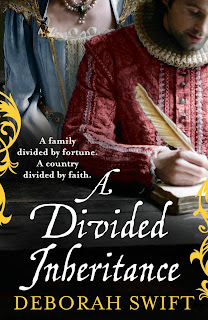
This period fascinated me, and I set my most recent novel at this time. The Leviston family are Catholic and must go to elaborate lengths to hide their faith. At the same time, in other European countries such as Spain, it was illegal not to be a Catholic. The young woman in my novel has to travel from England to Spain in search of her lost inheritance, a journey which changes her view of English life forever.


"A Divided Inheritance achieves what all stellar historical fiction must: through the voices of imagined characters, important lessons from the past linger and haunt long after the book is finished."  
Ann Weisgarber, winner of the Langum Prize for Historical Fiction

The book comes out on Thursday, published by Macmillan - Hooray! Find out more from my website.
Thanks for reading!
Sources: The Gunpowder Plot - Antonia Fraser
Religion and the Decline of Magic - Keith Thomas
You might also like http://englishhistoryauthors.blogspot.co.uk/2011/11/religious-upheaval-during-17th-century.html