by
Maria Grace
Life in early modern societies was rife with bodily threats often resulting in bodily deformities. Nutritional deficits, disease and accidents all resulted in sometimes horrific alterations to the human form. Skin conditions, tumors, both benign and cancerous, and conditions like gout marked individuals in all walks of life. Moneyed and poor alike were subject to the debilitating effects to daily life.
Improvements in medical science focused on the prevention and correction of disfigurements. Progress in infant health and nutrition helped prevent many conditions and assistive technologies such as wooden legs and rupture trusses improved the productivity and general quality of life for many of those injured.
Assistive technologies quickly crossed the line from improving function to merely improving aesthetics. Though some argued whether it was acceptable to attempt to improve upon God’s creation by artificial means, even the Puritans came to accept man-made means to improve upon nature’s imperfections.
Deformity
By the eighteenth century, with the developing culture of politeness, the ‘deformed’ or ‘defective’ body presented a quandary for polite society. While some emphasized the moral virtue that developed as a result of bearing with bodily disfigurement, others registered concern for the lack of social ease evident when those bearing obvious ‘defects’ were present. Etiquette required that polite individuals avoided anything which would draw attention to another’s ‘weakness’. However, it was also recognized that a crooked body prevented one’s acceptance in polite society, being more prison than palace for the individual. The imperfect body was often referred to as dismal and miserable and jarring the sensibilities and discomposing the cheerfulness of mind, stealing pleasure from an otherwise pleasant experience.
 |
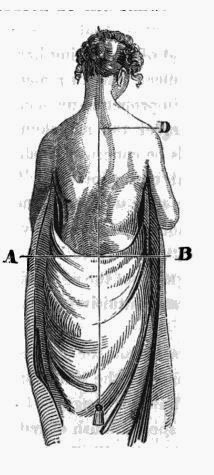
| Straightening a child's posture |
Nicolas Andry (1743) suggested that polite society should shun anything ‘shocking’ like visible impairments which might threaten virtuous interactions. Moreover, individuals who permitted, by their neglect, their bodies to become ‘ugly’ offended both society and God’s intentions. Thus, ‘orthopaedic’ intervention to restore the proper aesthetics to the body was an act of social and moral responsibility.
Causes and prevention of deformity
Experts concluded that preventing deformity was preferable (and easier) than curing it. Many suggested ignorant management in childhood was at the heart of many disfigurements and as such, more ‘scientific’ management might be applied to remedy them.
Towards the end of the Georgian era, malformations were classified by their causes including:
Those produced before birth
The result of tight lacing of long corsets, thought to impede the mother’s digestion, breathing, circulation and to even displace the womb itself. This practice was thought to impede the proper growth of a child resulting in dwarfism or other deformities of shape. Teaching mothers not to wear tight garments during pregnancy offered a simple remedy to this malady.
Those produced by ignorant nursing
In this case nursing referred to the care of the child in infancy. Infant bones were considered soft and unfinished, and the joints susceptible to injury by rough handling. Caregivers were directed to handle the infant as little as possible, allowing them to lie on mats and cushions without restrictions, and prevented from sitting and standing too soon.
Those produced by clothing in infancy
The practice of tight swaddling was still practiced in the Georgian era. However, toward the end of the period, the practice fell out of favor. The tight constriction of the infant was thought not only to be painful, but to restrict blood flow and to impede normal growth, forcing limbs and spine into unnatural shapes. Nurses were advised to adopt a looser mode of dress, but not so loose as to fail to support ‘feeble’ infant muscles, and to avoid dressing an infant too warmly and causing sweats in the night.
Those produced by dress in youth
Putting pressure on muscles was thought to weaken them. So the use of corsets, tight sleeves or garters was advised against; they might result in twisting the body out of natural position. Children’s clothing should be comfortable and allow the blood to flow freely and the body to move easily.
Those produced by position
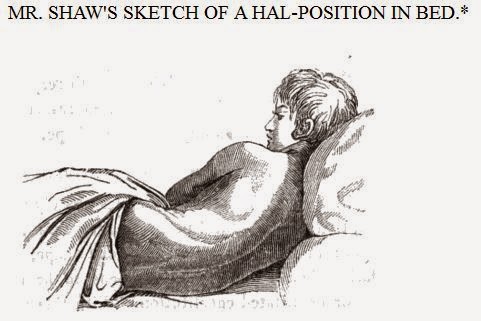
Sleeping on the same side of the bed every night, sitting on the same side of the window or fire every night or in any way that twists the body was to be scrupulously avoided. While reading, writing, sewing or practicing music, young ladies must maintain perfectly erect posture to avoid permanent deformation of the spine.
Correcting deformity
Once deformity occurred, Sheldrake argued that the amelioration of such irregularities was imperative as
"not only their appearance is disagreeable, but by impeding the function of viscera, they will in time destroy that balance of the constitution which is so necessary to health and longevity.”
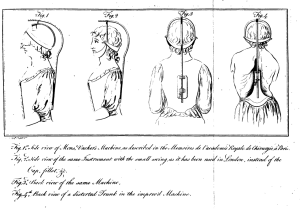
Stay makers and truss makers of the mid to late eighteenth century flooded the market with a cornucopia of devices to train young people’s bodies—particularly those of young women—as one trained young plants to grow strong and straight, often using braces and other contraptions made of newly available cast steel.
Braces and other devices
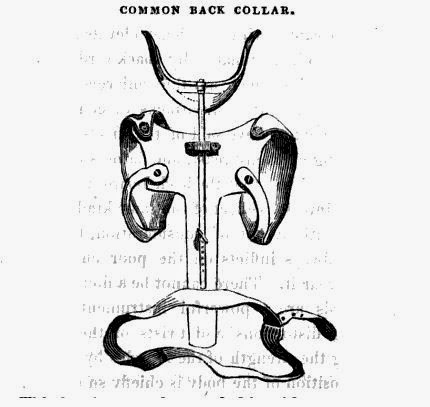
Devices to improve posture and keep and individual ‘straight’ were as varied as the manufacturers who made them. Large pieces of metal called backirons were hidden at the back of clothing and prevented slouching. Steel collars forced wearers to obey mothers’ and governesses’ injunctions to keep heads up, sometimes assisted by shoulder braces which pulled shoulders back. Neck swings stretched the spine by suspending the ‘patient’ in a block and tackle type device so that only their toes touched the ground.
Education chairs which forced the ‘patient’ to balance in a small hard seat without a support to lean against while windlass contraptions and stretching chairs performed similarly to neck swing. Despite the discomfort and pain these devices caused, they were widely sold throughout the eighteenth century.
As the century drew to a close and the nineteenth century dawned, a shift of perspective occurred leaning toward a more natural beauty, unencumbered by the rigorous management and training of the previous generations. The second part of this article will examine these changing conceptions of beauty and how to achieve it in the Regency era.
Bibliography
Andry, Nicolas.
Orthopaedia: Or, the Art of Correcting and Preventing Deformities in Children . Vol. 1. London, 1743.
Buc'hoz, Pierre-Joseph.
The Toilet of Flora Or, a Collection of the Most Simple and Approved Methods of Preparing Baths, Essences, Pomatums, Powders, Perfumes, Sweet-Scented Waters, and Opiates for Preserving and Whitening the Teeth, &c. &c. With Receipts for Cosmetics of Every Kind, That Can Smooth and Brighten the Skin, Give Force to Beauty, and Take off the Appearance of Old Age and Decay. For the Use of the Ladies. Improved from the French of M. Buchoz, M.D. London: Printed for J. Murray, Mo 12 Fleet-street and W. Nicoll, No. 51, in St. Paul's Church Yard, 1784.
Corbould, H.
The Art of Beauty, Or, The Best Methods of Improving and Preserving the Shape, Carriage, and Complexion ; Together with the Theory of Beauty. London: Printed for Knight and Lacey ... and Westley and Tyrrell, Dublin, 1825.
Duties of a Lady's Maid with Direction for Conduct and Numerous Receipts for the Toilette. London: James Bulock, 1825.
Jeamson, Thomas. 1665.
Artificiall embellishments. Or Arts best directions how to preserve beauty or procure it. Oxford: Printed by William Hall, amm. D.
Sanford, Victoria. "Public Reaction to Rising Waists During the Late 18th Century: Regency Fashion." Jane Austens World. June 2, 2010. Accessed January 9, 2015.
https://janeaustensworld.wordpress.com/2010/06/03/public-reaction-to-rising-waists-during-the-late-18th-century-regency-fashion/.
Sheldrake, Timothy.
An Essay on the Various Causes and Effects of the Distorted Spine ; on the Improper Methods Usually Practised to Remove That Distortion ; In Which That Recommended by Mr. Pott Is Considered, and the Bad Effects of Vacher's (commonly Called Jones's) Spinal Machine Are Pointed Out: With the Description of an Instrument That Is Better Calculated to Remove Those Distortions than Any Hitherto Made Use Of, and That Will Not Be Productive of the Pernicious Consequences That Have Been Caused by Most of the Other Machines. To Which Are Added, Some Observations on the Treatment of Ruptures ; Intended to Shew the Impracticability of Curing That Disorder by Any Other Means than the Use of Proper Truffes, and the Superior Utility of the Improved Elastic Truffes with Flexible Pads, Made by T. Sheldrake, Jun. London: Printed for C. Dilly, in the Poultry ;, 1783.
Snively, John H. A Treatise on the Manufacture of Perfumes and Kindred Toilet Articles. Nashville: C.W. Smith, 1877.
The Art of Preserving the Hair on Philosophical Principles. By the Author of The Art of Improving the Voice. London: Printed for Septimus Prowett, Old Bond Street, 1825.
The book of health & beauty, or the toilette of rank and fashion: embracing the economy of the economy of the beard eye-brovs gums nails breath eye-lashes hands skin complexion feet ips teeth eyes hair mouth tongue, 8::- 81c. With recipes, and directions for use, of safe and salutary cosmetics— perfumes—essences-simple ‘vaters—depilatories, etc. And a variety “ select recipes for the dressing room of both sexes. 2nd ed. London: Joseph Thomas, 1, Finch Lane, Cornhill, 1837.
The Hand-book of Bathing. London: W.S. Orr, 1841.
The Hand-book of the Toilette. 2nd ed. London: W.s. Orr and, 1841.
The New London Toilet: Or, a Compleat Collection of the Most Simple and Useful Receipts for Preserving and Improving Beauty, Either by Outward Application or Internal Use. With Many Other Valuable Secrets in Elegant and Ornamental Arts. Containing near Four Hundred Receipts under the following General Heads. Perfumes Fine Waters Baths Cosmetics Conserves Confectionary Snuffs Pastes Wash Balls Scented Powders Pomatums Fine Syrups Jellys Preserved Fruits, &c. With Every Species of Cosmetic That May Be Useful in Improving Beauty, or Concealing the Ravages of Time and Sickness. To Which Is Added a Treatise on the Art of Managing, Improving, and Dressing the Hair on the Most Improved Principles of That Art. London: Printed for Richardson and Urquhart, under the Royal-Exchange, 1778.
The Toilette of Health, Beauty, and Fashion: Embracing the Economy of the Beard, Breath, Complexion, Ears, Eyes, Eye-brows, Eye Lashes, Feet, Forehead, Gums, Hair, Head, Hands, Lips, Mouth, Mustachios, Nails of the Toes, Nails of the Fingers, Nose, Skin, Teeth, Tongue, Etc., Etc., : Including the Comforts of Dress and the Decorations of the Neck ... with Directions for the Use of Most Safe and Salutary Cosmetics ... and a Variety of Selected Recipes for the Dressing Room of Both Sexes. Boston: Allen and Ticknor, 1833.
Turner, David M.
Disability in Eighteenth-century England: Imagining Physical Impairment. New York: Routledge, 2012.
Turner, D. M. and Withey, A. (2014),
Technologies of the Body: Polite Consumption and the Correction of Deformity in Eighteenth‐Century England. History, 99: 775–796. doi:10.1111/1468-229X.12087
Withey, Alun. "(Dis)ability? Living with Impairment in Early Modern Britain." Dr Alun Withey. September 28, 2012. Accessed January 9, 2015.
https://dralun.wordpress.com/2012/09/28/disability-living-with-impairment-in-early-modern-britain/.
Withey, Alun. "Sit up Straight! Bad Posture and the 'Neck Swing' in the 18th Century." Dr Alun Withey. January 15, 2014. Accessed January 9, 2015.
https://dralun.wordpress.com/2014/01/15/sit-up-straight-bad-posture-and-the-neck-swing-in-the-18th-century/.
Withey, Alun. "Steel and the Body in the Enlightenment:." Dr Alun Withey. June 7, 2012. Accessed January 9, 2015.
https://dralun.wordpress.com/2012/06/07/steel-and-the-body-in-the-enlightenment/.
~~~~~~~~~~~~
Maria Grace is the author of
Darcy's Decision, The Future Mrs. Darcy, All the Appearance of Goodness, and Twelfth Night at Longbourn and Remember the Past, and A Jane Austen Christmas, .
Click here to find her books on Amazon. For more on her writing and other
Random Bits of Fascination, visit her
website. You can also like her on
Facebook, follow on Twitter or
email her.