Showing posts with label Dissolution of Monasteries. Show all posts

Wednesday, August 24, 2016

The Tombs of Henry VIII's Queens: Part One

by Linda Fetterly Root

Katharine[i] of Aragon (1485-1536):


On the morning of her death, Henry VIII’s discarded wife dictated two letters, one to her kinsman The Holy Roman Emperor, and the other, to the husband who had put her aside. It is not the scornful lament to which she was entitled and which the king deserved. In it, she wishes him well and requests Henry to extend benevolence toward their daughter and generosity to her servants. But it ends as the last letter written by a lover: 'Lastly, I make this vow. That mine eyes desire you above all things.’

When the king heard of her death, he donned clothes of celebratory yellow and frolicked the night away. He was not dancing with his wife, Queen Anne, for whom he had all but moved mountains to marry. He had already tired of her.

And thus, the daughter of the legendary lovers Ferdinand and Isabella was taken to the nearby Abbey of Peterborough and interred in the choir aisle to the north of the altar, with no more pomp than due a Dowager Princess of Wales, the title to which she had been demoted. She was put to rest as Arthur’s wife, not Henry’s. Katharine died on January 2, 1536, and was buried 22 days later. A mere three months after that, on May 2, Queen Anne Boleyn was arrested, and 17 days later, she was dead. Four months and a week after Katharine's death, Lady Jane Seymour was Queen of England.[ii]

In his excellent biography Catherine of Aragon, written in 1941, Garrett Mattingly remarked that few of the hopes the Queen still held when she died had been realized.[iii] However, her burial site at Peterborough may well have been an incidental beneficiary of her death. During the Dissolution of the Monasteries, achieved by a legislative scheme orchestrated by Henry VIII between 1536 and 1541, Peterborough Abbey Church was confiscated but spared. By royal edict, Henry granted Letters Patent to Peterborough making it a Cathedral and named the former abbot as its bishop.[iv] Thus, Peterborough was appropriately Anglicanized. Some historians think it was spared because it housed the remains of a royal who had once been considered Queen of England. It is just as likely that Henry saw it as a potential source of revenue for the Crown.


The site of Katherine’s burial did not fare well. It was desecrated in 1586 and the culprits caught. During the Civil War, Oliver Cromwell’s troops ravaged both the Cathedral and the town. Their onslaught is described in the Royalist newsbook Mercurius Aulicus as worse than what would have been expected of either the Goths or the Turks.[v]

In 1895, the dignity of Queen Katharine’s burial site was restored, when the wife of one of Peterborough’s canons, Catharine Clayton, solicited funds from women named Catherine, no matter where they lived or how they spelled the name. Then, Mary Teck, King George V’s consort, grandmother of Her Royal Highness Elizabeth II, joined in the cause, and Katharine's place of interment became clearly marked as the tomb of a Queen of England. Her successor did not fare as well.

Wikimedia Commons, Creative Commons.

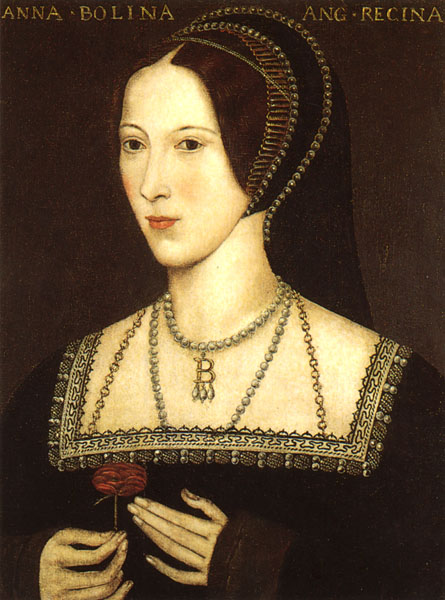
Anne Boleyn (c. 1501- May 19, 1536):


Wikimedia Commons, courtesy of Chris Nyborg
Many historians attribute Catherine of Aragon as having captured the hearts and minds of the English people. Albeit unjustly, not even her successor’s apologists extend the honor to her predecessor. There are as many accounts of Anne’s demise as there are screenwriters and historical novelists, and many versions propounded by historians are scarcely more than musings. One thing is certain: the queen was executed for treason within the grounds of the Tower of London on May 19, 1536. Her remains were disposed of according to the custom of the time. As an aristocrat, she was buried beneath the floor within the confines of the Royal Chapel of Saint Peter ad Vincula. Much haste accompanied her beheading, and no one had thought to order a coffin. Apparently, her remains were carried from the place of her beheading to her place of burial by her ladies and placed into a wooden box.

At the time, notes may have been made as to where the bodies of Royals executed during that bloodiest of weeks were buried, but none survive, and the accuracy of notations used to identify bones found under the floor during a renovation in the late 19th century are unauthenticated.

St. Peter ad Vincula, Wikimedia, Courtesy of Creative Commons
www.graveyards, Matt Hucke,

There are indeed bones of women scattered in at least two locations, but sources differ as to which if either set were Queen Anne's. A commission formed when the floor was torn up during Victoria’s reign, and a surgeon declared a set of female bones to be of the proper age and configuration. 21st-century historian Alison Weir disagrees and believes bones identified as Anne’s sister-in-law Lady Rochford were the Queen's.

While Dr. Weir does not have sufficient facts to declare the issue resolved, she certainly has enough to raise substantial doubt. It will be ironic if further studies show that Weir is correct since Lady Rochford and Anne Boleyn were reputed rivals for Anne’s brother George’s affections. And to add to the controversy, recent research implies that even that assertion may not be true. Jane Boleyn may not be Anne's jealous sister-in-law after all. She may just have been a scapegoat.

The fact that Anne’s burial site has not been resolved is further evidence of how little dignity her remains were afforded at the time of her death. As it stands, all that commemorates her final resting place is a plaque in the floor placed at the behest of Queen Victoria, marking the spot where a wooden box with copper screws in embedded in the concrete, and which may or may not contain the bones of Anne Boleyn. Alison Weir suspects they belong to Kathryn Howard, wife #5.

Jane Seymour (1509-October 24, 1537):


Perhaps it is time to look at Queen Jane Seymour in a different light than the one in which she has been cast. At least insofar as Henry VIII was concerned, of his six wives, Jane was special. His affections for her are usually explained by her ability to present him with a male heir, an achievement not to be downplayed. However, some recent research suggests there was more to Queen Jane Seymour than her label as ‘a little mouse' implies. At the very least she lasted a year without offending Henry as long as she kept her opinions to herself, a lesson learned when she approached him about pardoning the peasants who had taken part in the Pilgrimage of Grace.

The reign of Henry Tudor’s third wife was painfully brief. She triumphed over both of her predecessors by giving Henry the son he craved, but the birth cost Jane her life. Twelve days later, she was dead, either of a partially unexpelled placenta or puerperal fever. Henry's plans for her elaborate coronation became arrangements for a royal funeral. She was the only one of Henry’s wives to receive one. The funeral procession began at Hampton Court where she had died and thereafter, laid in state, and ended at Windsor Castle, where Henry planned to be interred. Because of the elaborate nature of his tomb, which remained very much a work-in-progress, she was placed in what was planned as a temporary crypt in the Quire of Saint George’s Chapel at Windsor Palace, while Henry sorted the details of the elegant tomb he had been planning for decades. He had hired a series of celebrated Italian sculptors to render elaborate designs, none of which pleased their patron.

Later representation of Henry VIII's family as
he defined it. (Wikimedia Commons, (PD)
Henry had begun planning his tomb during the happy early days of his marriage to Catherine of Aragon. Years later, after five more marriages, he chose to share it with Queen Jane. All he had to do was live long enough to see it finished. He died in 1547, leaving a partially completed set of ornaments for an unfinished tomb.

Sharing a crypt with the mighty Henry VIII should have assured Queen Jane's remains a resting place superior to all others, but such was not the case. Finances and what moderns call regime change intervened. In Henry's will and again, on his deathbed in 1547, he reaffirmed his desire to be buried at Windsor, with Jane alongside him. He anticipated his son and heir, Edward, Prince of Wales, and Edward's powerful Seymour uncles would see to the tomb’s completion, including life-size effigies of Henry and Jane, and a marble statue of himself upon a warhorse. He had not considered continental politics, religious strife in England, or the threat of Calvinism and the Scottish Reformation. Henry's death left Edward Seymour, then Earl of Hereford, and Protector of the Realm, with more pressing problems than a dead king's tomb. As he approached majority, studious and devoutly Protestant Edward VI had no time for such frivolities. During the Catholic restoration that occurred in Mary I’s reign, in spite of her deep affection for Queen Jane, she had no desire to deify the father who had rejected her. When Protestant, parsimonious Elizabeth Tudor succeeded her half-sister, she found other uses for her money. When Elizabeth I died in 1603, and the Tudor Dynasty made way for the House of Stuart, King James VI of Scotland and I of England, was preoccupied with rehabilitating the image of his mother, Marie Stuart, Queen of Scots, who had been beheaded in 1587 on a warrant signed by Elizabeth Tudor, and buried at Peterborough on the opposite side of the altar from Katharine of Aragon. It was she, who never set foot in England other than as a fugitive, and later, as a prisoner, who was reinterred in a glorious tomb in the Lady Chapel at Westminster. 

To finance the Civil War, Cromwell's Commonwealth parliament sold the effigy of Henry VIII and other substantially completed components of Henry VIII’s planned memorial. The author of the commentary at the Saint George’s Chapel page cited below remarks that ‘a less ambitious scheme achievable during his lifetime would have been a wiser choice’.

CONCLUSION OF PART I ~ Tombs of Henry VIII’s Queens

St.George's Chapel,Wikimedia, courtesy of Alan Thoma

The only marking above the royal vault at Windsor Castle where Henry VIII and his third wife, Queen Jane are buried dates to the 19th century and is as follows:[vi]

IN A VAULT BENEATH THIS MARBLE SLAB ARE DEPOSITED THE REMAINS OF
JANE SEYMOUR QUEEN OF KING HENRY VIII 1537
KING HENRY VIII 1547
KING CHARLES I 1648
AND AN INFANT CHILD OF QUEEN ANNE.
THIS MEMORIAL WAS PLACED HERE BY COMMAND OF KING WILLIAM IV. 1837

Join me in September for a look at the burial sites of Henry VIII's last three consorts, Anne of Cleves, Kathryn Howard, and Katharine Parr.


Notes:
[i] The author uses the spelling that appears at the site where the Queen is buried. Mattingly uses the popular spelling of the name. The queen herself signed as Katalina.

[ii] Garrett Mattingly, infra, states the King secretly married Jane Seymour the day after Anne’s execution, i.e., on May 20, 1936, not May 29.

[iii] Mattingly, Garrett, Catherine of Aragon, 1941, Book of the Month Club Edition, 1990, pages 429-430.

[iv] See the official Peterborough Cathedral website for an excellent recap of Katherine’s life, the present festival held in her honor, and a short biography. http://www.peterborough-cathedral.org.uk/newsarticle.aspx/41/katharine-festival-2016.

[v] The entire quote is found infra.

[vi] http://www.stgeorges-windsor.org/assets/files/LearningResources/BackgroundNotesHenryVIII.pdf

~~~~~~~~~~

Historical novelist Linda Root left a career as a major crimes prosecutor anticipating a retirement spent writing Historical Crime Fiction. She began compiling a Murder Book, aimed at convicting Marie Stuart, Queen of Scots of conspiracy in her husband Lord Darnley’s murder. Instead of the book she planned, her research inspired her to write a novel, The First Marie and the Queen of Scots, first published in 2011. It was followed in 2013 by The Last Knight and the Queen of Scots and four stand-alone books in the The Legacy of the Queen of Scots series, with a fifth in progress: They are: 1) Unknown Princess (formerly The Midwife's Secret; 2) The Last Knight’s Daughter, (formerly The Other Daughter); 3) 1603: The Queen’s Revenge;  and 4) In the Shadow of the Gallows. The Deliverance of the Lamb will be published this winter..She has also published an adult fantasy, The Green Woman, as J. D. Root.Visit her Amazon Author Page for a complete list:
http://www.amazon.com/Linda-Root/e/B0053DIGM8/ref=sr_tc_2_0?qid=1461277095&sr=1-2-ent

Wednesday, July 13, 2016

Finding the Ruins of Medieval Leiston Abbey, Suffolk

By Lizzy Drake

(Remains of Leiston Abbey. Photo credit Holly Stacey)

In the English county of Suffolk, not too far from Sizewell Nuclear Power Plants (both A and B), there is a stunning set of ruins marked out with the distinct English Heritage signage along the road, guiding visitors to a small car park. It's easily missed and upon arrival, one might feel a little out of place as children of various ages rush into the medieval barn which is off limits to the public and echoes out slightly off-key notes from violins, violas and the odd recorder. Clamber out of the car park and down the gravel path behind another building, however, and the views of crumbling masonry, delicate brickwork and flint in mortar will take your breath away as the shell-like remains of Leiston Abbey reveal themselves.

Currently managed by English Heritage, there are educational signs with interpretive and highly detailed artwork enabling the visitor to 'see' history on the site where the ruins now stand. This is no mere footwork of where monastery or abbey used to stand – there are still some staircases, second floors and high arched walls where roof-lines were once held.

(Looking out a doorway onto the canons' farmland)

Having a rich history before dissolution, the Abbey was founded by the White Canons of the Premonstratensian Order in 1182 by Ranulph de Glanville, who was also the founder of Butley priory (also in Suffolk). 'A History of the County of Suffolk: Part Two' states: ' By the foundation charter, this abbey, dedicated in honour of the Blessed Virgin, was endowed with the manor of Leiston, and with the advowsons of the churches of St. Margaret, Leiston, and St. Andrew, Aldringham. These churches, as stated in the charter, Glanville had first granted to the Austin canons of Butley, but they had been by them resigned. The founder stated that he made these gifts for the good estate of King Henry, and for his own soul's sake, and for that of his wife Bertha, and their ancestors and successors.'

(Leiston Abbey refectory)

However, although the founding and construction was successful, the site location, while inspirational to Ranulph de Glanville's eyes, didn't hold up well on such waterlogged, soggy ground and it wasn't until 1350 that the abbey was brought to a new locale.

The Ufford Connection

While the first abbey was founded and constructed in the 12th century, a new patron, Robert de Ufford, the then Earl of Suffolk, came to the abbey in the 14th century, building and 'refounding' the abbey in a more stable location as the first was in a notoriously swampy area by the sea (and having had many complaints from the high volume of mosquitoes and boggy marshland). This new location worked well for the abbey and it thrived.

(English Heritage info board - what the abbey may have looked like)

The History of the County of Suffolk quotes, 'In 1350 the advowson or patronage of this abbey, which had escheated to the crown by the death of Guy de Ferre without issue, was granted to Robert de Ufford, earl of Suffolk. A few years later the new patron became the munificent refounder of the abbey; for the first abbey church and the buildings, which were placed inconveniently near the sea, becoming too small, Robert earl of Suffolk, in 1363, erected new and larger buildings about a mile eastward, in a better and somewhat higher situation.'

The Abbey Ruins as we see them now

(Leiston Abbey ruins)

Although most people imagine abbeys filled with monks, the inhabitants of this abbey were of the Premonstratensian order, who had no monks, but canons regular, ordained priests who preferred places of isolation and solitude (this order is still alive and functioning today; for those who love their beer, Leffe Abbey is also Premonstratensian). While the followers of this order historically have a record of being healers and farmers (yes, and beer makers), past excavations at Leiston Abbey have shown evidence of a more industrious group, having evidence of metallurgy, tile working and, according to the DigVenture website updates, forgery (of coin).

As visitors walk along the remains of the abbey, they will come to the centre of monastic life, the cloister, or 'covered walkway' which led to the Cellarer's, a range of different small structures were used for storage and overseen (managed) by the 'Cellarer' who, during the abbey's active life, had the important role of overseeing all goods and distribution. It can easily be imagined that these areas were bustling with activity – grains being collected from harvest and put to storage, the retrieval of winter feed for the cattle and even the food stores for the cannons themselves. To the right of the cloister lay the remains of the refectory, where the canons ate their meals together as biblical passages were read during their meals. In these ruins, there are some remains of stairs and passages that may have been short cuts from the Cellarer's and possibly to chapel. Now mossy and grassed over, it has been claimed by nature, but still holds echoes of the past. To the front is the Chapter House, where everyday business of the running of an abbey took place, and finally, to the far left corner, some steps lead to the abbey church, now built over and used by the young musicians.

(remains of the chapter house)

The Abbey in Henry VIII's time

'This abbey came within the number of the smaller houses suppressed by the Act of 1536. The Suffolk commissioners came here on 21 August, 1536, and drew up a full inventory. The conventual church was fairly well supplied with ornaments and vestments. Details are given of the high altar, and those in the Lady chapel, St. Margaret's chapel, and the chapel of the Crucifix. The last three altars were supplied with alabaster tables, and there was another small alabaster sculpture on the south side of the quire door. The censers and candlesticks were of latten, but there were three pairs of chalices (that is chalices and pattens) of silver gilt. The vestments in the vestry were fairly numerous, but chiefly old and of small value. 'A lyttell pair of old organs' in the quire was valued at 10s. The furniture and utensils of the chambers, cloister, buttery, kitchen, were of an ordinary character, and of very little value. The only large items of the inventory were the cattle of the home-farm £22 3s. 4d., and the corn £10 8s. 8d. The total of the whole inventory only reached £42 16s. 3d (A History of the County of Suffolk).' All lands and possessions of the Abbey were eventually granted to Henry VIII's good friend Charles, Duke of Suffolk, in 1537.

Over time, much of the stone was reused as needed in the county and a Tudor farmhouse built over part of where the abbey church once lay. English Heritage run the ruins, and although there is currently no visitor centre, their information boards and interpretive artwork, bring the ruin to life. Just, don't forget to bring some waterproofs and a camera.


References:
-House of Premonstratensian canons: Abbey of Leiston, Pages 117-119
-A History of the County of Suffolk: Volume 2. Originally published by Victoria County History, London, 1975.
-English Heritage, Leiston Abbey
-http://digventures.com/leiston-abbey/timeline/diary/a-brief-history-of-leiston-abbey/
-http://www.abbey.ampleforth.org.uk/the-community/the-rule/reflections-on-the-rule/stewardship-the-cellarer-of-the-monastery

___________

 A Corpse in Cipher
Lizzy Drake has been studying Medieval and Tudor England for over 15 years and has an MA in Medieval Archaeology from the University of York, England. She has been writing for much longer but the Elspet Stafford Mysteries began her writing careen in the genre. The First Elspet Stafford book, A Corpse in Cipher - A Tudor Murder Mystery, is available now.

When not writing or researching, Lizzy can be found reading or gardening. She balances time between her two homes in Essex, UK and California.

You can follow her on Twitter (Lizzy Drake@wyvernwings)


Wednesday, May 18, 2016

Vagrants and Vagabonds in Tudor England

by Deborah Swift


Jacques Bellange (c. 1575–1616)
The Beggar Looking Through his Hat 
Hark! Hark! The dogs do bark!
The beggars are coming to town:
Some in rags, some in jags*
And one in a velvet gown 


Some gave them white bread,
And some gave them brown,
And some gave them a horse-whip,
And sent them out of town.


Tudor London attracted vagrants and beggars from all over England, who were in search of the rich pickings of the city. The Dissolution of the Monasteries in 1536 led to an increase in the number of vagrants, as the monasteries had been the chief source of charity, and had also provided employment for vast numbers of people who worked for them as agricultural labourers. The nursery rhyme above is attributed to this time. Because travel by horsepower was so slow, it was unusual for people to reside outside their birth town, and so all migrant travellers were treated with a degree of suspicion, especially if they were poor. This is why travelling actors had to procure a licence.

Sites of the Monasteries
There was of course, no police force, so crime was an enormous problem, tackled by extreme punishments designed to act as a deterrent. More than 70,000 people were executed during the reign of Henry VIII, many for what we would consider minor offences. Stealing was a hanging offence, and begging outside your home area was punishable by being tied to a cart and flogged, or locked in the stocks to be pelted by passers-by.

Village Stocks in Beetham Lancashire

There were so many beggars that a law was passed in 1547 which stated that anyone who was homeless could be made to be a slave for a period of two years. Should they run away from their master, they would then be branded with a 'V' and committed to slavery for life. This law was, unsurprisingly, extremely unpopular, and was revoked three years later in 1550. The 1563 Act reaffirmed the policy of whipping able-bodied beggars, but to prevent offenders from persistent begging a further Act stated that vagabonds should be burned through the right ear and, if they were arrested again, they could be imprisoned and executed. These policies of ear-boring and hanging remained the law until 1593.


With draconian punishment the order of the day, many turned to crime. A book published in 1552, 'A Manifest Detection of Diceplay' gives the first written evidence of the criminal underworld operating in Tudor London, and says that 'sleight and crafty deceit ... is common in every corner.' There were five prisons in London, to house the burgeoning number of petty criminals: The Clink, The Compter, The Marhalsea, The King's Bench and the White Lyon. The underworld looked to its own, however, and specific areas, such as Alsatia, and Southwark, became known as places where those on the run from the law could find refuge. And of course they were also the places where any rich man needed to guard his purse.

Beggar being whipped through town

The Poor Relief Act of 1576 was supposed to be the solution, but in fact it divided the poor into two categories:

The Deserving Poor This category was for those people who wanted to work but were unable to find suitable employment. The first category included the old, the sick, and widows, who were provided accommodation in almshouses and orphanages with a productive but sedentary activity such as spinning or weaving, by which they earned their Poor Relief, which was provided by each parish through taxation.
The Undeserving Poor Also called 'sturdy beggars', this category was for those who were physically able to work but chose not to. They gained no sympathy and were to be whipped through the town until they learnt the error of their ways. Many poor workers were harried from town to town as they sought work, and many feigned sickness in order to fall into the category where they would qualify for Poor Relief. The alternative for these people was the 'house of correction', where the able-bodied but persistently unemployed or in debt could be punished.

The first house of correction was Bridewell in London, and many other such institutions were called 'bridewells' after it. Bridewell was opened in 1533 in a former royal palace on the banks of the Fleet River and also housed homeless children. Because of this, it also became the first major charitable institution. The picture below shows it in Tudor times - after the Great Fire of London in 1666, it had to be rebuilt.
Bridewell 

However, the main purpose of a house of correction was to punish offenders, so they would correct their behaviour, and not just to be a depriver of liberty. Punishment was usually either hard labour, or whipping which could be observed as entertainment from the public gallery. The most common charges against prisoners were prostitution, petty theft, and something called 'loose, idle and disorderly conduct'. More than two-thirds of the prisoners were female, and many were recent migrants to London. These women, often widows trying to support their families, were also put to hard labour, and a common task for female offenders was beating hemp to make linen. 

The 1597 Act required each town to provide a prison, such as Bridewell, for vagrants and thieves, and paid for by local taxes. In the Tudor mind, there was barely a distinction between a beggar and a thief. Beggars caught offending were punished and then returned to their native parish.This system caused a great burden on parishes where harvests had failed, and whole populations were condemned to one area, unable to seek sustenance elsewhere. Surprisingly, most prisoners in houses of correction were released within a week of their imprisonment, so they could return home and to make room for others who needed this short, sharp shock of a punishment. 


Matters were made worse by a series of bad harvests in the 1590s, and the fact that during the reign of Elizabeth I, the population grew by a third - from three to four million people. By now, London was the biggest city in Europe with a population of somewhere between 130,000 and 150,000. To deal with this, The 1601 Poor Law consolidated all these various acts and laws to form one cohesive whole. It remained largely in place until the 18th-century workhouse movement began at the end of the 17th century. 

Giacomo Ceruti 1720  Little Beggar Girl and Woman Spinning
* Jags - Slashes or slits exposing material of a different colour, and popular during the Tudor period.

Sources:
The Elizabethan Underworld by Gamini Salgado
Everything You Wanted to Know about The Tudors, But Were Afraid to Ask by Terry Breverton
Life in Tudor England by Penry Williams 
BBC The Tudors
Pictures from Wikpedia, or my own unless otherwise linked.

Deborah Swift is an ex-costume designer for the BBC, and the author of four historical novels, and three more for young adults. She lives in the north of England in a 17th century village, with her husband and lucky black cat. Find out more on her website www.deborahswift.com , where she has a historical fiction blog or follow her on Twitter @swiftstory

You might also like Lowlifes of Elizabethan London, also on this blog.