by Judith Arnopp
The
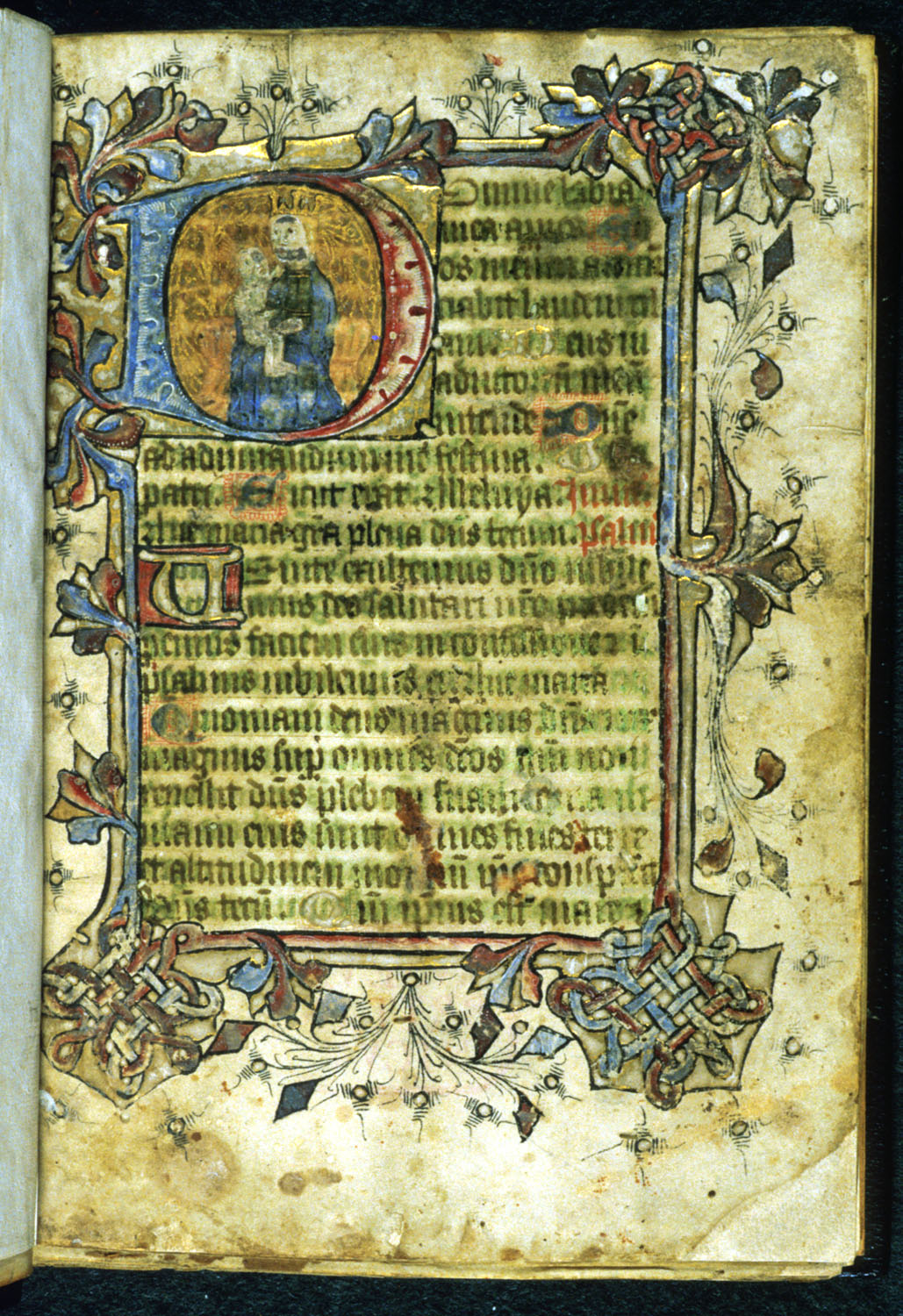
Luttrell Psalter, written and illuminated in the second quarter of the
fourteenth century, contains the psalms and canticles, a calendar of church
festivals and saint’s days, and a litany with collects and the office of the
dead. A single scribe was responsible for the Latin text which covers three
hundred and nine leaves of vellum but a variety of hands assisted with the
marginal decoration.
The text is of a distinctive square script possibly designed
to be read at a distance and the work is illuminated in a manner undetected in
other contemporary work. The resulting manuscript is testament to the grandeur
of the man who commissioned it and the work remains as strikingly symbolic of
his status today as it was during his lifetime.

The
portrait of Sir Geoffrey Luttrell together with its inscription ‘Dns Galfridus louterell me fieri fecit / The
Lord Geoffrey Luttrell caused me to be made’ ensures that his name and the
splendid Psalter will be forever connected, each gracing the other. The purpose
of the book was to glorify both the life of Christ and that of Sir Geoffrey
Luttrell.
It is not, however, the liturgical content that have made the
manuscript so uniquely famous but the scenes of domesticity and rural idyll
that decorate the borders.
Modern
history books, ranging from primary school histories to treatises on medieval
farming, are often illustrated with scenes from the psalter. It is generally
accepted that the work provides an honest account of fourteenth century life.
Janet Backhouse,
an authority on medieval manuscripts, comments that the Luttrell Psalter is permeated with a ‘general atmosphere of
satisfaction and rejoicing…[1]’ but
close examination shows that this is not necessarily so. The illustrations
of the labourers seem to me to be notable for their marked lack of satisfaction and joy. For all the colourful clothing and
depictions of leisure they still come across as repressed and resentful. In
fact, there is not the slightest suggestion of a smile in the entire manuscript.
The inhabitants
of the margins seem to be acting out an idyll, perhaps more for the sake of the
intended reader than for any attempt to represent reality. Their clothes are
inappropriate both to their station and lifestyle which would have been one of
toil, their role being to provide luxury for the Knight and his family. It is
as if the artist has been instructed to show scenes of idyll (possibly at the
behest of his employer) but has been unable or unwilling to disguise an
underlying dissent.
William
Langland in his poem Piers Plowman depicts similar scenes in his prelude to The Vision of Piers Plowman. He sees the
idyll of the scene before him but is aware of the discord beneath. His poem,
however, is of a vision or a dream, and the idealisation of rural life is more obvious
than in Geoffrey Luttrell’s vision of his country estate.
‘of alle manere men, the mene and the pore,
worschyng and wandryng as this world ascuth.
Somme otte hem to the plogh, playde ful selde,
In settynge and in sowynge swonken ful harde
And wone pat pis wastors with glotony destrueth.
And summe putte hem to pruyde and parayled hem per-aftir
In continence of clothing in many kyne gyse.
In preiers and penaunces potten hem mony,
Al for
love of oure Lord lyuenden swythe harde
In hope to haue a good ende and heuenriche blisse.’
The Luttrell
Psalter was produced at the end of one of the most tumultuous periods in
history; rebellion, civil conflict, failed harvests and famine resulted in a
social chaos that threatened the stability of every social strata, not least
that of the landed classes.
The resulting insecurity meant that the maintenance
of social position, was paramount and the nobility needed to be perceived as
secure in an uncertain world.
The comfort
of the lord of the manor took precedence over those of his tenants; the
freeholder tenants paid a monetary rent to the lord but the servile tenants
were required to pay their dues with labour. The Lord owned the mill (or maybe
more than one) and required every villager to use it and pay the customary fee
which usually took the form of a portion of the milled flour.
This monopoly
caused rancour and gave birth to the stereotypical untrustworthy miller of
contemporary literature. Other capitalist enterprises controlled by the
landowner were fishing, bird snaring, sheep and arable farming; and all of
these activities can be seen in the Luttrell Psalter.
Images of
farming dominate the margins; ploughing, sowing (f.170), weeding and harvesting
(f.172), but how far should we trust these images as being representational of
rural reality? The illustrations may provide evidence of types of tools that
were currently in use, but it remains unlikely that the workers were provided
with such costly attire.
The warm
hoods and protective gloves are more probably a part of Sir Geoffrey’s idlyll. In
medieval England dress was an indication of social status. Sumptuary laws
prohibited anyone below the rank of knight from wearing satin and some limitation
was placed upon the fur and colours he was allowed to wear.
As Michael Camille
confirms, ‘the peasants are being dressed
up to Sir Geoffrey’s level of taste and cosmeticized, much as they are in
Bruegel’s later paintings.[2]’ Other
aspects also suggest that we should be wary
of taking the images too literally, for example the reaping scene (f.172).
This
illustration depicts two women cutting the standing corn while a third eases
her aching back (f.172) and a man binds the cut corn into sheaths. Studies of
almost one hundred medieval images of reaping reveal only one other
illustration of women performing farming work.[3] This
strongly suggests that it was a task largely carried out by men. So, these
images are likely a projection of Sir Geoffrey Luttrell’s ideal world where he
is the centre of an ordered, prosperous society. However, the Psalter’s
illustrations suggest that, actually, the opposite was true.
The
reality is glorified in order to convince those around Geofrey Luttrell of his
unassailable power and virtue.
The idyllic representation magnifies his status
to that of a Christ figure. Nowhere is this more apparent than in the
comparison of the illustration of the Luttrell family at table (Fol. 208v) with
the representation of the Last Supper (Fol. 90v).
The design
and symmetry of the two illustrations are almost exact. Sir Geoffrey sits at
the centre of his family just as Christ sits at the centre of his disciples. He
is the focus of attention and there is even a servant standing to one side waiting
to serve him, just as Judas kneels before Christ.
One
notable difference is that at the table of the Last Supper Jesus is giving
Judas ‘the sop[4]’ whereas
Sir Geoffrey is preparing to drink himself from the cup which he holds in his
right hand.
Michael Camille notes that the cup Sir Geoffrey is holding
illustrates the verse from the accompanying psalm ‘Calicem salutaris accipiam et nomen domini invocabo’ (I will take the
chalice of salvation, and I will call upon the name of the Lord. Psalm 115.13).
Emmerson
and Goldberg state in their paper Lordship
and Labour in the Luttrell Psalter that in their view, ‘the visual allusion to the chalice of salvation and the possible
invocation of the Lord’s name further underscore the eucharistic allusions and
the entire scene’s association with the Last Supper. Such deliberate, and to
our minds, perhaps slightly shocking, juxtaposition of the secular lord with
the Lord is also found elsewhere in the psalter.[5]’
In fact the most lavish illustration in the manuscript is the
portrait of Geoffrey being armed by his wife and daughter in law. The prominent
use of heraldry, which can be observed on his surcoat, shoulders, helmet,
pennon and horse trappings, together with the inscription ‘Dominus Galfridus Louterell me fieri fecit’ all serve
to promote his importance. God created the world, David wrote the psalms and
Sir Geoffrey commissioned the Luttrell Psalter.
The
importance of Sir Geoffrey’s lordship is crucial to the understanding of the
Psalter itself. It is intended as a glorification of his status as the Lord of
his estates, he is depicted as a great knight (although he would have been long
past fighting age when the work was commissioned) and worthy of homage. The
peasants who inhabit his estate spend their lives working for his continued
prosperity and eminence in much the same way that Christians are expected to
live their lives for the greater glory of God. This self-canonisation does not
necessarily denote confidence or stability but rather suggests the opposite;
the impulse to self-aggrandise often springing from insecurity or anxiety.

Many
of the illustrations seem to involve representations of theft or the fear of
loss; for instance the crows that attempt to steal the grain (f.170 and f.171)
or the hawks preying upon the poultry (f.169). The image of the small boy
stealing cherries from the tree described by Janet Backhouse as ‘a lively scene[6]’ is
undoubtedly finely drawn and informative but while Backhouse notes the detail
of the tree bark and clothing she understates the threat of punishment that the
older man’s ‘club’ represents. The
child is stealing cherries that are intended for the Luttrell table and his
punishment may well be severe, another dark undertone to the colourful peasant lifestyle
presented by the artist.
Even the
miller, whose stereotypical untrustworthy nature has been recorded by Chaucer, ‘a theef he was for sothe of corn mele / and
that a sly, and usuant for to stele[7]’(3939)
seems afraid of becoming the victim of theft and has armed himself with a
fierce dog to protect his Lord’s property. These
images of plunder suggest insecurity and fear of loss. One explanation of the proliferation
of these images is that the deprivations of the great famine of 1315 -16 and
the civil war of 1321-22 would have still been fresh in the medieval mind.
The scenes
of farming and food preparation culminate in the feast at the Luttrell table,
the grain provides the flour for the bread, the poultry provides the meat, the
sheep provide the milk and the hens provide the eggs. The
labourers strive to put food, not into the mouths of their
families but into the mouths of the Luttrell family.
The entire ritual of
tilling the soil, sowing the grain, harvesting the crop, milling the flour and
cooking the meal is for the benefit of the Lord while those who labour receive
little or no benefit at all. The back breaking labour of the lower classes is
consumed by the upper; and, just as the seeds of their labour are consumed by
the crows, so are the end results of their toil consumed by the Luttrells.

The mouths
of the labourers in the margins are largely painted as down-turned grimaces
which lend discontent to their expressions. The rowers of the boat are among
those illustrations that depict the open mouth, whether this is meant to depict
horror, surprise or singing is unclear but what is clear is that they are not
representative of joy or contentment. The men in the boat retain their
impassive expressions and subjugated body language, which paired with their
peculiarly open mouths, lends a mask-like appearance to their faces. The open
mouth is extended to include biting and consuming activities elsewhere in the
margins and there is scarcely a page that fails to depict a human or beast
biting another life form or even in some cases biting itself.
Fol. 59v
shows an image of swine feeding on acorns thrown down to them by the swineherd,
Camille interprets this in conjunction with St Bernard’s Sermon which describes
the oak as barren ‘And if they bear fruit
it is not fit for human consumption but for pigs. Such are the children of this
world, living in carousing and drunkeness, in overdrinking and overeating, in
beds and shameless acts.[8]’
St
Apollonia (who stands nearby) wears her teeth on a rosary to illustrate how
they were extracted as part of her torture and martyrdom and her mouth is a
crimson gash across her face. The porcine illustration of gluttony and sexual
excess contrasts sharply with the toothless saint. Teeth, often associated with
hell and vice, are used by the pigs to indulge in that from which St Apollonia
abstains.
The gaping
mouth of hell is represented on fol. 157v and serves as a vivid reminder of the
consequence which waits to consume the ungodly sinner. The unfortunate man who
walks in naked trepidation to his fate looks suitably repentant and illustrates
the futility of earthy sin.
Interestingly,
at the foot of this page is a mysterious illustration that has baffled
historians for some time, Backhouse sees it as ‘an unidentified game of skill[9]’
while the less idealistic Camille views it as ‘water torture.[10]’
The illustration could represent an early drinking game wherein the victim is required to measure the quantity
of ale he can consume. This would fit nicely alongside other representations of
vice and gluttony and also compliment the accompanying representations of death
and descent into hell.
The combined images urge the reader to repent of the sin
of gluttony before it is too late and we must remember that peasants were not
usually in the position to commit that particular sin.
There are clearly more questions raised by
this manuscript than can be answered but what is quite clear is that it is not
representative of the social idyll that Geoffrey Luttrell desired.
Of course,
images of hybrids and grotesques are found elsewhere in medieval art and
architecture, usually in the margins of a civilised space like church or
monastic portals; and it is apparent that they represent some long lost meaning.
Their presence however does emphasise that there is more occurring in this
manuscript than we can as yet, understand and, if we
accept that the grotesques have cryptic connotations then it seems naïve to
accept that any part of the manuscript is truly representative of the
fourteenth century.

There are
many images in the margins that are distinctly separate from the
Luttrell family yet necessary to their continued prosperity. Labourers,
foreigners, grotesques and women are depicted in terms of excess and sin, the
clothes of the lower class women that fly about them denote their sinful state
and can be directly contrasted to the discreet dress of Agnes and Beatrice
Luttrell. Images of greed, lust and sin dominate the margins, juxtaposed with
the devotional doctrine of the Psalms. Monsters and sinners mingle with saints
and martyrs.
There are
many aspects of the Psalter that adhere to Sir Geoffrey’s (apparent) desire for
an idealised representation of life but his perfect world is undermined
by cosseted labourers with surly faces, women carrying out inappropriate tasks,
monks wielding weapons of war, the ever-present consuming mouth, the scenes of
theft. All of these turn Geoffrey Luttrell’s world into one of insecurity and even
dread

In the
words of Michael Camille, ‘Rather than
being a reflection of fourteenth century reality the Luttrell Psalter, like
most important works of art, restructures reality and shores up the conflicts
and discontinuities of late medieval England. It presents its noble owner as an
active knight at a time when not only were his chivalric values outdated but he
could no longer ride a horse. It presents him as the paterfamilias in his hall
and a supporter of his church during the very period when he was faced with
charges of incest and when the nobility was withdrawing into an ever-more
private world at home and in private oratories. It displays his peasants as
idealised labourers during the decades of agricultural crisis. The artists who
made this monument for their patron in the third decade of the fourteenth
century were creating an account of the contradictions of their age.[11]’
The
Psalter provides a cameo of a period when rural England was on the brink of
major agricultural reform; when discontent was present but the means of reform
not yet available, resulting in insecurity and hunger jostling for dominance
over subjugation.
Geoffrey
Luttrell desired to be commemorated and aggrandised in this manuscript but it
is obvious that the scribe had other ideas. The status of a scribe would have
been no higher than that of a ploughman so the artists may have been from the very peasant
class they were requested to depict. Perhaps it was impossible to resist
representing Geoffrey Luttrell’s 'perfect world' from the perspective of the
labouring class from which the illustrator sprung.
The
Luttrell Psalter can viewed online here
Photos property of the British library
BIBLIOGRAPHY
Backhouse, Janet The Luttrell
Psalter (Warwick: The Roundwood Press, 1989)
Camille, Michael. Mirror in Parchment
(Guildford: Reaktion Books Ltd., 1998)
Backhouse, Janet. Medieval Life in the
Luttrell Psalter (Hong Kong: South Sea International Press, 2000)
The Riverside Chaucer, ed. by
Larry D. Benson (Bath: Oxford University
Press, 1988)
The Problem of Labour in Fourteenth
Century England, ed., by J. Bothwell, P.J.P. Goldberg, W.M. Ormrod (Bury St Edmunds: York Medieval Press, 2000)
~~~~~~~~~~~~
Judith Arnopp writes historical fiction. You can find more information on her website: www.juditharnopp.com