Showing posts with label Roger Mortimer. Show all posts

Thursday, January 4, 2018

Bad Queens - Part II

by Danielle Marchant

On Sunday 7th September 1533, Elizabeth, daughter of Henry VIII and Anne Boleyn, was born at 3 o’clock in the afternoon at Greenwich Palace. This was supposed to be a happy occasion, but there was one detail that cast a shadow over this important event.

The baby was a girl.

Both her mother and father were disappointed that she was a girl. Up until now, all of the best astrologers and doctors had predicted a boy. Henry had spent time wondering whether to call his son Edward or Henry and was making plans for the celebratory tournament. Anne had even seen in advance the letter announcing the birth. In the letter, it gave thanks to God for sending her “good speed, in the deliverance and bringing forth of a prince”.

However, as soon as the baby girl was born, Henry decided to name her Elizabeth, after his mother Elizabeth of York, instead. The tournament was cancelled and the letter announcing the birth was slightly altered with an extra “s”, giving thanks to God for the birth of a “princes”.

Why was there so much disappointment over the baby being a girl? The reason for this was that at the time, there was a fear of having a female ruler. A history of what has been perceived as a series of “Bad Queens” had made it all the more important for the heir to the throne to be a boy, to keep the stability of the country. Henry had even divorced his first wife, Catherine of Aragon and had broken away from the Catholic Church because of Catherine’s failure in producing a healthy, male heir - despite the fact that they did have a healthy daughter, Mary.

Here is a part II of a list of Queens that helped to create the climate of fear of having another female ruler… (Read Part I HERE)

The Queens in the Wars of the Roses

Just over four decades before Princess Elizabeth’s birth in 1533, the country was torn apart by civil war between the House of York and the House of Lancaster, in the Wars of the Roses that lasted nearly thirty years. Around the time of Elizabeth’s birth, there may have still been many old enough to remember what they had seen, and this made it all the more important for the current generation to maintain peace. There were two main Queens in this civil war who became focus points for both Houses and helped to exasperate the situation even more. The series of events and the roles these two Queens played would definitely have helped to contribute to the climate of fear of not wanting another female ruler in the Tudor period:
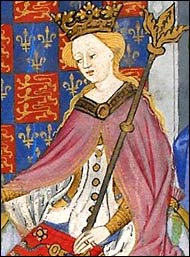

1. Margaret of Anjou

Like Queen Isabella a century before her, Margaret was another French princess, who married Henry VI in 1445. In Shakespeare’s Henry VI Part 3, she was famously named the “She-Wolf” of France, and that her “tiger’s heart wrapped in a woman’s hide”.

Margaret was niece by marriage to the French King, Charles VII. The marriage caused controversy because no dowry had been given to the English Crown for Margaret by the French. Alternatively, they agreed that Charles VII, who was at war with Henry V in The Hundred Years' War in France, would have the lands of Maine and Anjou returned to France. This caused friction in the King’s council.

A breakdown in law and order, corruption, the distribution of royal land to the king's court favourites, and the continuous loss of land in France meant Henry and Margaret’s reign was an unpopular one. Returning troops, who had often not been paid, contributed to the anarchy and triggered a rebellion led by Jack Cade. Henry lost Normandy in 1450 and later lost other French territories, leaving only Calais untouched.

It is believed that this loss of French territory contributed to Henry’s nervous breakdown, which modern Doctors would probably diagnose as Catatonic Schizophrenia. Margaret gave birth to their only son, Edward of Lancaster, in 1453. However, given Henry’s mental state, this fuelled rumours that the son was not his; he believed that he would have been incapable of fathering a child and that the baby was actually the result of an affair between Margaret and one of her favourites. Edmund Beaufort 1st Duke of Somerset, or James Butler Earl of Wiltshire were considered to be possible fathers. Nevertheless, Henry accepted the son as his own.

While Henry remained for some weeks in a catatonic stupor, Margaret had to rule in his place. The kingdom found difficulty in having to cope without a king, but Margaret was ruthless and called for a Great Council in May 1455. This council excluded Richard Duke of York, and this sparked the series of battles between the Houses of York and Lancaster. Margaret attempted to raise support for the Lancastrian cause and subsequently, Lancaster was victorious at the Battle of Wakefield and of St Albans.

However, they were defeated by York at the Battle of Towton, in 1461. Edward, son of Richard Duke of York (who had been beheaded at the Battle of Wakefield) overthrew King Henry VI and proclaimed himself Edward IV. Margaret then fled to Scotland with her son and remained there, plotting her return.
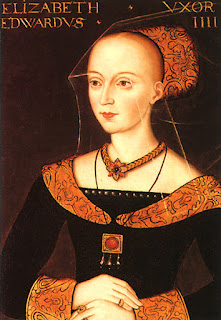
2. Elizabeth Woodville

Elizabeth was the eldest of twelve children and spent her early life in relative obscurity in Grafton Regis, Northamptonshire. Even though her mother was Jacquetta, Dowager Duchess of Bedford and her father was Sir Richard Woodville, she was considered to be a “commoner” by her contemporaries. Her first husband, Sir John Grey, was killed at the Battle of St Albans, leaving her a widow with two sons.

It is believed that around the summer of 1464, Elizabeth heard that Edward VI was hunting in Whittlewood Forest. She waited for him under a tree (which was later called the “Queen’s Oak”), holding her two sons tightly. The King then rode by and she allegedly threw herself at his feet, begging him for help with the Grey family inheritance. According to the story, Edward was so struck by her “mournful beauty” that he fell in love with her and assumed she would just agree to be his mistress. However, she refused to be his mistress, even when a dagger was put to her throat (according to some interpretations of the story, she produced the dagger herself and put it to her own throat).

Her refusal to give in to him, unless he married her, increased his passion for her even more. They married in secret on Mayday in 1464. Only her mother, a Priest, probably two others and “a young man who helped the Priest sing” were present. It is believed that Elizabeth and Edward continued to meet in secret with the help of Jacquetta (who even managed to hide the secret marriage from her husband) until September, when the Council met in Reading. Here, Edward was being coerced into a marriage with Bona of Savoy, sister-in-law to the French King. Edward then had to admit the truth about his relationship with Elizabeth.

The news was a bombshell. Richard Neville, Earl of Warwick – also known as “The Kingmaker” – who had helped Edward take the throne, responded angrily to the clandestine marriage. He had negotiated for the hand of Lady Bona, and her marriage to Edward would have helped to forge an alliance between the House of York and one of the greatest Houses of Europe, helping to replenish the dwindling treasury with a generous dowry. Warwick’s anger at not being consulted on such an important matter would have been understandable.

Elizabeth was crowned Queen in May 1465. However, refusing to accept the marriage, Warwick fell out with Edward. Warwick later formed an alliance with Margaret of Anjou. Together, they overthrew Edward and restored Henry VI to the throne. In addition, Warwick’s daughter, Anne Neville, was married to Margaret's son Edward in December 1470.

Their success was brief, as Margaret was taken prisoner by York after being defeated at the Battle of Tewkesbury, in May 1471, where her son Edward was killed. Soon afterwards in the same year, Warwick was killed in the Battle of Barnet by Edward VI’s forces.

Since her marriage to Edward, however, Elizabeth was plagued with rumours of being a “sorceress”, having bewitched Edward into marriage. When Edward died in 1483, his brother Richard seized the throne, accusing her of having bewitched his brother into a bigamous marriage. As a result, Elizabeth’s marriage was declared invalid, and her two sons were taken into the Tower of London by their uncle Richard, after which they mysteriously disappeared.

It is possible that she may have plotted against Henry VII, who married her daughter Elizabeth of York. It is believed that she may have conspired with rebels in the Simnel rebellion. Subsequently, she was sent to live in Bermondsey Abbey, where she died in June 1492. She was allowed only occasional visits to court, and all her lands were transferred to Elizabeth of York.

Therefore, it is understandable that this history of “Bad Queens” (or those perceived to be “Bad Queens”) would have made the news of Princess Elizabeth’s birth in 1533 most unwelcome news. However, as we know, Elizabeth grew up to become Queen Elizabeth I. Elizabeth was one of the most successful rulers in English history, and her reign was called “The Golden Age”. Not a “Bad Queen” at all and all fears of another female ruler had been unfounded.

Images:

Margaret of Anjou (British Library Royal)
Elizabeth Woodville, possibly a copy of a lost original (Master and Fellows of Queen's College, Cambridge)

Sources and further reading:

Elizabeth – David Starkey, 2001
Eleanor of Aquitaine – By the Wrath of God, Queen of England – Alison Weir, 2000
Blood Sisters – The Women Behind the Wars of the Roses – Sarah Gristwood, 2013
Anne Neville – Queen to Richard III – Michael Hicks, 2007
Elizabeth Woodville – Mother of the Princes in the Tower – David Baldwin, 2012.
She-Wolves: the Women Who Ruled England Before Elizabeth - Helen Castor, 2011
www.bbc.co.uk/history
www.historyextra.com
www.philippagregory.com

~~~~~~~~~~
Danielle Marchant is an Independent Author from London, UK. Parts 1, 2 and 3 of her series of historical novellas based on Jane Boleyn Lady Rochford’s life, The Lady Rochford Saga, are available now:

https://www.amazon.co.uk/gp/product/B077PRF6F9/ref=series_rw_dp_sw

Visit her pages at https://www.facebook.com/TheLadyRochfordSaga and at http://danielleliannem.wix.com/janeboleyn.


Wednesday, January 3, 2018

Bad Queens - Part I

By Danielle Marchant

On Sunday 7th September 1533, Elizabeth, daughter of Henry VIII and Anne Boleyn, was born at 3 o’clock in the afternoon at Greenwich Palace. This was supposed to be a happy occasion, but there was one detail that cast a shadow over this important event.

The baby was a girl.

Both her mother and father were disappointed that she was a girl. Up until now, all of the best astrologers and doctors had predicted a boy. Henry had spent time wondering whether to call his son Edward or Henry and was making plans for the celebratory tournament. Anne had even seen in advance the letter announcing the birth. In the letter, it gave thanks to God for sending her “good speed, in the deliverance and bringing forth of a prince”.

However, as soon as the baby girl was born, Henry decided to name her Elizabeth, after his mother Elizabeth of York, instead. The tournament was cancelled and the letter announcing the birth was slightly altered with an extra “s”, giving thanks to God for the birth of a “princes”.

Why was there so much disappointment over the baby being a girl? The reason for this was that at the time, there was a fear of having a female ruler. A history of what has been perceived as a series of “Bad Queens” had made it all the more important for the heir to the throne to be a boy, to keep the stability of the country. Henry had even divorced his first wife, Catherine of Aragon and had broken away from the Catholic Church because of Catherine’s failure in producing a healthy, male heir - despite the fact that they did have a healthy daughter, Mary.

Here is a part I of a list of Queens that helped to create the climate of fear of having another female ruler… (part II tomorrow)

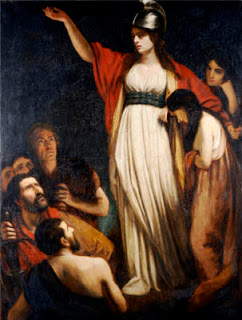
Queen Boudicca (died circa AD 60)

Boudicca was maybe not necessarily a “Bad Queen”, but her reign was definitely not a quiet and peaceful one. She ruled over the Iceni people of Eastern England and led a major uprising against occupying Roman forces. She was married to Prasutagus, ruler of the Iceni people of East Anglia.

When the Romans conquered southern England in AD 43, they allowed Prasutagus to continue to rule. However, when Prasutagus died, the Romans decided to rule the Iceni directly. They confiscated the property of the leading tribesmen. It is also believed that they stripped and thrashed Boudicca and raped her daughters. These actions helped to intensify widespread hatred at Roman rule.

In 60 or 61 AD, while the Roman governor, Gaius Suetonius Paullinus, was leading a campaign in North Wales, the Iceni rebelled with the help of members from other tribes.

Boudicca's warriors successfully defeated the Roman Ninth Legion and destroyed the capital of Roman Britain, which as the time was in Colchester. They went on to destroy London and Verulamium (St Albans). Thousands were killed. Finally, Boudicca was defeated by a Roman army led by Paulinus. Many Britons were killed, and Boudicca is thought to have poisoned herself to avoid capture. Where the battle had taken place and the site of Boudicca's death are unknown.

Empress Matilda

Once again, she was probably not exactly a “Bad Queen” (and Matilda was never crowned a Queen either), but it was down to the fact that she was a woman and the resulting dispute over her disregarded claim to the throne that led to years of civil war. Empress Matilda was the granddaughter of William the Conqueror and daughter of Henry I. She is known today as the Lady of the English, having never been crowned queen. She was married for a short time to the Holy Roman Emperor and was the rightful heir to the throne. If she had become Queen, she would have been the first reigning queen of England in 1135, being descended from Norman, Scottish, and English (Saxon) kings. However, on her father’s death in 1135 – and partly because she was a woman – her cousin Stephen of Blois seized the throne.

Like Matilda, Stephen was a grandchild of William the Conqueror. He had, on at least two occasions, promised Henry I to support Matilda as Queen of England, as had all other nobles in the realm. But after Henry died, Stephen claimed Henry made these promises under coercion and that Henry had named Stephen as his successor. In spite of this, the nobles and the Pope supported Stephen’s claim to the throne, and he became King of the English and Duke of Normandy, which was another title he had inherited from Henry I.

However, his reign was not a peaceful one, and this was the start of almost 20 years of civil war. Within four years of Stephen’s accession, Matilda had gathered a force to challenge him for the crown. She had a lot of political support, because along with other estranged nobles, she also had her husband, who was one of the most powerful nobles in France, Geoffrey, Count of Anjou.

In 1141, she was in London and was ready to be crowned. However, within a few months Stephen ruined her chances and forced Matilda out before the coronation occurred. In spite of this, Matilda’s supporters continued to fight for her claim by challenging Stephen. However, neither she, nor they could win and to make matters worse, her husband Geoffrey never sent a major force to England to assist them.

However, Geoffrey did eventually force out Stephen from Normandy and then, took over as its Duke. Geoffrey and Matilda had a son, Henry, who Geoffrey named Duke of Normandy in 1150. Henry inherited the titles and lands as Count of Anjou following his father’s death in 1151.

With the support of his mother, Henry claimed the English throne from Stephen. Eventually, Henry and King Stephen made an agreement that Henry would be the heir to the throne after Stephen died, even superseding the claims of Stephen’s son, Eustace. This ended the civil war. Within two years, both Eustace and Stephen’s wives were dead, and Stephen was forced to relinquish the crown to Henry. In 1154, Stephen died of natural causes and was succeeded by Matilda’s son, King Henry II.

Eleanor of Aquitaine

Eleanor was one of the most powerful and controversial women of the Middle Ages. She was beautiful, intelligent and headstrong. There were rumours about her in her lifetime, but definitely within reason and her contemporaries were shocked by her behaviour. Eleanor was the elder daughter of William, tenth Duke of Aquitaine. She was raised in one of Europe's most cultured courts and given an excellent education. She later became an important patron of poets and writers. It was also a relaxed and licentious place, where the arts of the troubadours thrived, and she even presided over the fabled Courts of Love.

In 1137, both her only brother and her father died, leaving her with a vast inheritance. At just the age of 15, she became the most eligible heiress in Europe. That same year, she married Louis, heir to Louis VI of France, who shortly afterwards became King Louis VII. The couple had two daughters.

In 1147, Eleanor accompanied her husband on the Second Crusade, travelling to Constantinople and Jerusalem. The Crusade was a failure. The relationship between Eleanor and her husband – which was already in a vulnerable state - worsened even more. Eleanor failed to produce a son, and this added to the tension. In 1152, they were divorced.

Two months later Eleanor married Henry of Anjou, who in 1154 became King of England. The couple had five sons and three daughters. For nearly twenty years, Eleanor played an active part in the running of Henry's empire, and she travelled back and forth between their territories in England and France.

In 1173, two of Eleanor's sons involved her in a plot against their father. Subsequently, Henry imprisoned her. After Henry's death in 1189, his eldest son, Richard I, ordered his mother's release. Despite her age (at this point, she would have been in her mid-sixties), Eleanor played a major part in government. In 1190, she acted as regent in England when Richard went to join the Third Crusade. She even played her part in negotiations for his release after he was taken prisoner in Germany on his way home.

Queen Isabella

Queen Isabella was the wife of Edward II. Isabella is definitely viewed as a “Bad Queen” because she helped to remove her husband from the throne, alongside her lover Roger Mortimer, one of Edward’s enemies. Edward was later imprisoned and murdered. In addition, Isabella’s reign alongside Mortimer was a failure.

Edward became King in July 1307. On his accession, he immediately recalled his favourite, Piers Gaveston from exile, whom his father, Edward I, had banished to France for having a bad influence on his son. Gaveston was given the earldom of Cornwall, which had previously been a title conferred on royalty.

This act sparked opposition to the king and his favourite. In 1311, the nobles issued the “Ordinances”. This was an attempt to restrict royal control of finance and appointments. Gaveston was twice exiled at the demand of the barons, but returned to England soon afterwards. In 1312, he was captured and executed by the barons.

In 1314, Edward invaded Scotland. He was defeated by Robert the Bruce at Bannockburn. Power was now in the hands of the barons led by Edward's cousin, Thomas of Lancaster, who by 1315 made himself the real ruler of England. Yet Lancaster did very little to pledge reform and as a result, some areas of the country collapsed into anarchy.

By 1318, Edward and Lancaster did resolve some issues between them, but the king had two new favourites - Hugh le Despenser and his son. When Edward supported the two Despensers' ambitions in Wales, a group of barons banished both father and son. This made Edward want to fight back. Edward defeated Lancaster - who had begged the Scots to help him - at Boroughbridge in March 1322. He executed him and recalled the Despensers, with whom he now ruled.

This is where Isabella comes in, because at this point, she emerged as a focus for Edward’s enemies. In 1325, she was sent on a diplomatic mission to France. There she met and became the mistress of Roger Mortimer, an exiled opponent of Edward. In September 1326, they invaded England. Fortunately for them, there was almost no resistance. The Despensers were captured and executed, and Edward was overthrown in favour of his and Isabella's son, who was crowned Edward III in January 1327. Edward II was imprisoned at Berkeley Castle and murdered there.

As Edward III was still a minor, the country was ruled by Queen Isabella and Roger Mortimer. However, their reign was as bad as Edward II’s. They had even gone so far as to recognize Robert the Bruce as the King of Scots, something even Edward wouldn’t do.

As soon as Edward reached the age of 18 in 1330, he decided to take matters into his own hands. He had Mortimer arrested, but instead of having him killed straight-away, Edward had Mortimer tried for treason in Parliament. Despite Queen Isabella’s protest, Mortimer was then hanged.

Isabella, however, escaped such a similar fate when Edward allowed her to retire from public life for the rest of her life. She died in 1358.

Tomorrow, Part II will explore the lives of the 'Bad Queens' of the Wars of the Roses...


Sources and further reading:
Elizabeth – David Starkey, 2001
Eleanor of Aquitaine – By the Wrath of God, Queen of England – Alison Weir, 2000
Blood Sisters – The Women Behind the Wars of the Roses – Sarah Gristwood, 2013
Anne Neville – Queen to Richard III – Michael Hicks, 2007
Elizabeth Woodville – Mother of the Princes in the Tower – David Baldwin, 2012.
She-Wolves: the Women Who Ruled England Before Elizabeth - Helen Castor, 2011
www.bbc.co.uk/history
www.historyextra.com
www.philippagregory.com

~~~~~~~~~~

Danielle Marchant is an Independent Author from London, UK. Parts 1, 2 and 3 of her series of historical novellas based on Jane Boleyn Lady Rochford’s life, The Lady Rochford Saga, are available now:
https://www.amazon.co.uk/gp/product/B077PRF6F9/ref=series_rw_dp_sw

Visit her pages at https://www.facebook.com/TheLadyRochfordSaga and at http://danielleliannem.wix.com/janeboleyn.

Friday, October 27, 2017

The debacle in Weardale - or how a young king learnt a valuable lesson

by Anna Belfrage

Bannockburn as depicted in Holkham Bible
In 1327, a very young Edward III rode out of York at the head of an army. His purpose was to find and destroy the Scots who were presently raiding northern England, leaving destruction in their wake. Edward was not having it, all of him quivering in anticipation at the thought of teaching these dratted Scots a lesson. After all, Bannockburn was still an open sore for the English, and our gallant young king wanted nothing so much as to show the Scots he too could hammer them. Just like his grandfather had done.

Not everyone was as enthused as Edward. Notably the king’s mother and her constant companion and co-regent, Roger Mortimer, had no desire to provoke a full out war with Scotland. First of all,  they were already in some sort of negotiation with Robert Bruce—they had been since 1326 when they promised Bruce a permanent treaty if he did not take advantage of the turbulent situation caused by their invasion of England and subsequent imprisonment and deposition of Edward II.  Secondly, England was as yet not fully pacified. Yes, by the summer of 1327 Mortimer had control of most of the kingdom, but there were several very strong barons who were severely disenchanted by the fact that England was now ruled by Isabella and Mortimer. Men like Henry of Lancaster, Edmund of Woodstock (earl of Kent) and several others felt they too should have a say in how the realm was governed during the king’s minority.

Robert Bruce
The reason Robert Bruce had agreed to hold off while Mortimer and Isabella did their invading thing was because he wanted a permanent peace. His country needed peace, and a treaty would not only give Scotland that but also confirm Robert Bruce as king, thereby strengthening the Bruce dynasty. At the time, Robert Bruce was all of fifty-three and fully aware of the fact that he would likely not live much longer. His heir was a boy of three and Robert knew his countrymen well enough to know a boy-king could quickly become a pawn—or even worse, ousted.

Edward III being crowned
Robert watched from afar as Mortimer and Isabella landed in September of 1326, sat on his hands throughout the following months as Isabella and Mortimer took control over the country. Come February of 1327, Edward II had abdicated, Edward III was crowned, and Bruce expected the treaty with Scotland to be the next item on the agenda. It wasn’t. Isabella and Mortimer had a kingdom to heal, an administration to put in order, muttering barons to be put in their place. On the other side of the border, Robert the Bruce grew impatient. When the negotiations were yet again put on hold—or broke down, depending on whose POV you applied—the Scottish king decided to do some serious prodding. He ordered his two captains, James Douglas and Thomas Randolph to invade northern England and create havoc.

Which is why, in July of 1327, Edward III did all that mustering. An impressive English army took the field, led by the Earl Marshal of the realm (Edward’s uncle, the earl of Norfolk), the earl of Kent (Edward’s other uncle) and the earl of Lancaster who was more than happy to ride against the Scots as a lot of the raiding was done on his land plus he suspected the king's campaign against the Scots had seriously twisted Mortimer’s nose out of joint. Whatever Mortimer’s private thoughts on this matter, he too rode with the king. While not given an official command, I think it’s a safe bet to assume Mortimer was very much on top of things—it sort of went with his nature.


Edward was of the firm opinion that Scotland was his kingdom. He had his forces ride under the cross of St George, bright red crosses flapping in the wind as the English army advanced. As an aside, Edward III had a serious thing about St George, whom he considered a far more appropriate saint for his bellicose ambitions than Edward the Confessor. This is why he founded a college dedicated to St George at Windsor (which then took over the chapel previously dedicated to St Edward) and why the red cross is part of the insignia for the Order of Bath. Right: not today’s topic.

James Douglas was as capable as any of the commanders on the English side. This hero of the Scottish people had stood by his king through thick and thin and would continue to do so as long as he had breath in his body. He had only one objective with his raiding: to force the English back to the negotiation table, there to recognise Scottish independence and Robert the Bruce as Scottish king. Made Edward almost choke just to think of doing so. His grandfather had fought long and hard to bring the Scots to bay, and our Edward was not about to give back what he considered his.

So off the English army went, eager to corner the Scots and force them to fight. Douglas was no fool.  He'd be outnumbered on the battlefield. Instead, he led his mounted men in a cat-and-mouse game. If Edward and his men rode one way, the Scots would ride the other and set whatever buildings they came across alight. If the English turned towards the destruction, chances were new fires would spring to life behind them. Very frustrating. I imagine Edward took every opportunity offered to call these elusive Scots craven and misbegotten creatures.

The Scots were neither craven or misbegotten. After some weeks of playing the scarlet pimpernel with the English (you know: they seek him here, they seek him there. Is he in heaven or is he in hell, that darned elusive pimpernel?) Douglas found a nice, strong position and set up camp. He also had one of his English captives released, ordering the man to find Edward and tell him the Scots were waiting to do him battle.

James Douglas among his peers
“Yes!” Edward exclaimed. “Finally!” His commanders were not quite as delighted. Mortimer especially had far too much respect for Douglas to believe Sir James had set himself up as an easy kill. He hadn’t. Douglas had chosen his position carefully. A hill, defended by the river Wear and steep slopes, with Douglas’ colours—three silver stars on a blue background—flapping lazily in the wind. Mortimer groaned inwardly, even more so when Edward started talking about what strategies to use to pulverise the Scots.

“You can’t fight them up that hill,” Mortimer told his young king.
“Of course, I can. But I’ll start by inviting him to come down and meet us on the flat ground, prove he is as brave as they say.”
“He’s brave, not a complete idiot,” Mortimer probably replied. “What commander worth his salt would give up that position?”

Mortimer was right. Sir James politely declined Edward’s invitation to come down from his hill, and Edward decided it was time to show the Scots just who had the upper hand. He ordered his archers to advance. The English (and Welsh) archers were the best in the world, and as soon as they came within range, they’d fill those dratted Scots with more arrows than a hedgehog has spines. Douglas was fully aware of how deadly the English archers were. He waited until they were wading the river, or making a hesitant approach up the slopes before attacking them. Dead archers everywhere, making it clear Edward had no hand at all—not in this game of war poker.

An exhausted and dispirited English army settled down for the night. Weeks of chasing the Scots, of more or less constant rain, of insufficient food, had left Edward’s men weak and grumpy. Their Scottish foes were made of sterner stuff: no sooner had the summer night begun to darken, but the Scots began an all-night party, blowing horns and clashing swords against shields. Impossible to sleep in, so to all their other woes, Edward’s men could now add sleep-deprivation.

Come morning, a host of pale and shivering Englishmen did their best to look intimidating and warlike, all of them probably hoping there wouldn’t be a battle this day. There wasn’t. James stuck to his hill and come nightfall the Scots repeated last night’s procedure. Blaring horns, steel against steel, and the English tossed and turned, further plagued by the drifting scents of roasted meat.

A couple of nights of this, and then suddenly, just before dawn, the Scots went quiet.
“Finally!” the English exclaimed, sinking into blissful oblivion. When they woke, it was to discover Douglas had snuck away, leading his men to a new, if possible even more impregnable, position.
Edward spent some time cursing the Scottish dogs to hell and back. Didn’t help much. He ordered the English army to follow Douglas and set up a new camp.

For a change, that August day was a nice day. No rain, and once the tents had been set up and the fires lit, the English had yet another pleasant surprise: the Scots were obviously too tired to repeat the hullabaloo of the preceding nights so the summer night was fragrant and wonderfully silent.
The king and his earls had supper with Mortimer. Plans were drawn up for the next day. Some wine, some good food and they took to their beds—as did the rest of the men. Which is when some of them registered the sound of many horses, approaching at a gallop.
Out of nowhere—or so it seemed—came the Scots. Armed with torches and spears, they charged through the English camp. Some wielded swords to cut the guy ropes, thereby causing the tents to collapse. Others set fire to the tents, or skewered the people trapped within on their spears.

Like witless hens, the English ran before the Scots. Some emerged with sword in hand and began to fight back. Others died. Quite a lot of others. The Scots thundered on, making for the tent flying the royal colours. Swish, and the guy lines were cut. Like a cut soufflé, the tent fell together, trapping the young king inside. The Scots were only moments away from abducting him, but Edward’s men rallied and the Scots backed away. A horn blew. Douglas, calling for help. The horn blew again, and the Scots rode to their lord’s defence. Some moments later, they were gone, leaving a trail of carnage behind them.

Next morning, Douglas and his men were gone, riding hard for Scotland. Standing in the shambles of his camp, the young Edward had learnt a valuable lesson: never underestimate your enemy.

A year or so later, a treaty with Scotland was concluded, sealed by the marriage of Edward’s little sister, Joan, to Robert the Bruce’s little son, David. Edward didn’t want the treaty. He wanted Scotland. But other than never to underestimate, he had also learnt another lesson: bide your time. So he did. For a while.

All pictures in public domain and/or licensed under Wikimedia Creative Commons

~~~~~~~~~~~

Had Anna Belfrage been allowed to choose, she’d have become a professional time-traveller. As such a profession does not exist, she became a financial professional with two absorbing interests, namely history and writing.

Presently, Anna is hard at work with The King’s Greatest Enemy, a series set in the 1320s featuring Adam de Guirande, his wife Kit, and their adventures and misfortunes in connection with Roger Mortimer’s rise to power. And yes, Edmund of Woodstock appears quite frequently. The first book, In The Shadow of the Storm was published in 2015, the second, Days of Sun and Glory, was published in July 2016, and the third, Under the Approaching Dark, was published in April 2017.

When Anna is not stuck in the 14th century, she's probably visiting in the 17th century, specifically with Alex(andra) and Matthew Graham, the protagonists of the acclaimed The Graham Saga. This is the story of two people who should never have met – not when she was born three centuries after him. The ninth book, There is Always a Tomorrow, will be released in November.

Friday, April 28, 2017

Behold the head of a traitor - of the sad fate of Edmund of Woodstock

by Anna Belfrage

In March of 1330, a parliament was held at Winchester. As always since 1327, the young king Edward III officially presided, but the real power lay with his regents: his mother, Queen Isabella, and her favourite & purported lover, Roger Mortimer, 1st Earl of March.

The men assembling in Winchester fell into two categories: those who supported the regents and those who didn’t. The king himself belonged among the latter, but as things stood, our seventeen-year-old king had no option but to smoulder and bear it—for now.

Among Mortimer’s more vociferous enemies were Henry of Lancaster, cousin to the king, and Edmund of Woodstock, Earl of Kent and the king’s uncle. When the Winchester parliament opened, Edmund was not among those present. He was under arrest—for treason.

Edmund's coat of arms
Let us take a few steps back: Edmund of Woodstock was born in 1301, the second son in Edward I’s second marriage. As can be deduced from his name, he was born at the palace of Woodstock, and we can assume there was quite some rejoicing at his birth—Edward I now had three sons to safeguard his bloodline.

When Edward I died in 1307, Edmund’s half-brother, Edward II, became king. The age-gap between the new king and his much younger brothers was such that we can assume their relationship was somewhat distant—Edward was busy governing his kingdom and enjoying the freedom his new role brought with it and likely had little time for Edmund and his brother Thomas of Brotherton.

Edward I had made plans for his two younger sons, but had not followed through on them prior to dying. His intention had been to settle an earldom each on his sons, but early on in his reign Edward II decided to invest his beloved favourite Piers Gaveston with the earldom of Cornwall, which was one of the titles earmarked for his brothers. Edmund’s mother seethed, Edward likely shrugged—but as his brothers grew older he invested Thomas as Earl of Norfolk and granted Edmund sufficient land to keep the lad in style.

Edward II dining in splendid isolation

Where Thomas of Brotherton rarely emerges from the shadows in what documents we have, Edmund has left a substantial impression. He quickly proved himself a capable servant of his king, especially during those tumultuous years when Roger Mortimer and Thomas of Lancaster led the baronial revolt against Edward II in 1321-22. Edmund was in the thick of things—all the way from the initial conflict at Leeds Castle to the signing of the execution order for the captured Thomas of Lancaster.

The baronial rebellion was quashed, Mortimer was thrown in the Tower, and Edward was very pleased with his young brother, who emerged from the fray as the Earl of Kent and holder of substantial lands in the Welsh Marches. Our Edmund had every reason to be grateful to his royal brother—except, of course, that where Edmund got some land, Edward’s new favourite, Hugh Despenser, got much, much more land. In fact, so generous was the king to Hugh that he had an annual income almost four times higher than Edmund’s. Not something that pleased Edmund—or anyone else, to be honest, seeing as the English barons were getting very tired of the grasping Despenser.

In the aftermath of the baronial rebellion, Edward II, together with his trusted advisors Bishop Stapledon and Hugh Despenser, implemented what is best described as a dictatorship. Anyone suspected of colluding with the rebels risked losing everything they had, including their lives. Their paranoia increased tenfold when Mortimer managed to escape from the Tower and flee to France. Suddenly, the baronial opposition had a leader again, and the more heavy-handed Edward II and Despenser became, the more attractive the option of joining Mortimer became.

Not only did Edward manage to aggravate his barons. He also alienated his wife when he deprived Queen Isabella of her dower lands. Isabella was closer in age to Edmund than to her husband, and seeing as she was drop-dead gorgeous and Edmund was just as mouth-wateringly handsome, I imagine these two shared a common admiration for each other. Besides, they were cousins, grandchildren to Philip III of France.

At the time, being French to any degree was not an advantage in England: yet again, England and France were at war, this time over Gascony. In 1324, Edmund was sent to France to attempt a diplomatic solution, and when that failed he was put in charge of defending Gascony, an almost impossible task seeing as Edmund lacked both men and means. But he did his best, holding out until late September of 1324 before he was forced to surrender and agree to a six-month truce.

Edmund chose to remain in France. Maybe he preferred not to face his brother’s wrath at having failed him in Gascony, or maybe he was sick and tired of dancing attendance of the royal chancellor, Hugh Despenser. Whatever the case, he was in France when Isabella arrived in March of 1325, charged by her husband with the delicate task of negotiating a permanent truce between him and his French counterpart, Charles IV.

How Isabella had managed to convince Edward to entrust her with this mission is unknown, but I suppose Isabella was smart enough to hide her anger and humiliation at being deprived of all her income while promising herself she would have revenge—some day. Whatever her feelings, she successfully negotiated a treaty with her brother Charles. All Edward II had to do was to come to France and do homage for his French lands and everything would be peachy-pie.

Edward of Windsor doing homage to Charles IV with his mama at his side
Except that Edward II didn’t want to come to France—or rather, Hugh Despenser didn’t want him to go, worried that the moment the king left the country, the baronage would rise in rebellion and kill poor Hugh. Probably a correct assessment of the sentiments of the time, and apparently Edward agreed. Instead of going himself, he sent his young son and heir, Edward of Windsor. Unwittingly, he had thereby handed Isabella the weapon with which to destroy him.

Young Edward came to France, young Edward did homage, young Edward did not go straight back home as instructed by his father. Instead, he stayed with his mother, who simply could not bear to let him go. Isabella had collected several disgruntled English noblemen as her admirers, including Edmund of Woodstock. I imagine there were already whispers of invasions, of doing something to oust that despicable Despenser. When Roger Mortimer rode in to present himself to Isabella, the invasion had found its leaders: the extremely capable and ruthless combo of Isabella and Mortimer.

Edmund would likely not have been entirely thrilled at seeing Mortimer rise so rapidly in Isabella’s favour. Mortimer would not have been delighted at coming face to face with the man who’d been rewarded with Mortimer land for his efforts in putting down the rebellion of 1321. For the moment, whatever differences they had were laid aside, and to reinforce this fragile truce Edmund married Margaret Wake, Mortimer’s first cousin. By doing so, he sent a clear signal to his half-brother that he’d changed his allegiance, and in March of 1326 Edward II retaliated by stripping Edmund of all his lands and titles. (As an aside, Edmund and Margaret were to have four children, one of whom is Joan of Kent, famous for her beauty and her somewhat complicated marital life)

Isabella leading the siege at Bristol

Mortimer’s and Isabella’s invasion of England was a resounding success. Soon enough, Hugh Despenser was dead and Edward II was locked up in Kenilworth, his son crowned as Edward III in his stead. Edmund expected to be part of the inner circle that guided his young nephew, but neither Isabella nor Mortimer were all that interested in sharing their power. This did not go down well with Edmund, who was also struggling with feelings of guilt related to his deposed brother. That guilt became a crushing burden when it was announced in 1327 that their former king, Edward of Caernarvon, had died while in captivity.

In 1328, Edmund joined Henry of Lancaster’s rebellion against the regents, demanding that Mortimer be set aside in favour of the true peers of the realm. Mortimer acted with speed and determination. Edmund, knowing just how efficient Mortimer could be, abandoned Lancaster’s cause and returned to the royal fold just before Lancaster’s final humiliation.

By now, Edmund had acquired the reputation of being a weather-vane: first he’d supported his royal brother, then he’d joined Mortimer and Isabella, then he’d thrown his lot in with Lancaster only to change his colours yet again when things got sticky. Not a man to count on, one could say, even if Edmund would probably have disagreed, protesting that he’d been driven into rebellion against his brother and king by the grasping and conniving Despenser.

Whatever his reputation, Edmund was concerned with other matters: there were rumours that his brother had not died but was still alive behind the thick walls of Corfe Castle. Disenchanted with Isabella’s and Mortimer’s continued rule, Edmund chose to investigate further. One little piece here, another there, and soon enough Edmund was convinced his brother was alive. If so, what better way to right the wrongs he’d done his brother than to spring him from his prison and help him retake his throne?

This was the plot Mortimer uncovered early in 1330, his agents presenting him with a letter Edmund’s wife had written on his behalf to the imprisoned king. (In itself interesting: does this mean Edmund did not know how to write or was it a matter of penmanship?) Being somewhat gullible, Edmund had handed the sealed missive to an intermediary who’d promised to smuggle it into Corfe and hand it to the unhappy erstwhile king. Instead, the rascal gave it to Mortimer, and so Edmund was arrested and brought before parliament where his confession was read out loud.

There was only one verdict: death.

Appalled, Edmund threw himself on his nephew’s mercy, begging piteously for his life. He’d do anything—anything!—to prove his loyalty. He’d even walk all the way to London with a noose round his neck to atone for his actions. But there was nothing Edward III could do. Mortimer had seen to that, making it impossible for Edward to pardon his uncle without implicitly admitting there could be some truth in Edmund’s assertions that the former king was alive.

Whether or not Edward II was alive is, as per some historians, an open question. The men named as co-conspirators included several barons and bishops, men who would be in a position to know—and surely they’d not risk Mortimer’s displeasure for a dead man? We will never know, of course. It does, however, seem probable that Mortimer very much on purpose fed Edmund the little bits and pieces that convinced him his brother was alive, thereby luring the earl into treason. Ultimately, Mortimer’s behaviour in this matter would lead to his own death: the king, disgusted at having been duped into signing away his uncle’s life did not forgive. Or forget.

On a cold March morning in 1330, Edmund of Woodstock was led out to meet his maker. The executioner had done a runner, refusing to soil his hands with the blood of a man condemned for trying to help his brother. None of the assembled men-at-arms volunteered in his stead, neither did their captains. Poor Edmund shivered in only his shirt as the hours passed and no one was found willing to strike off his head. At long last, a condemned man undertook the task in exchange for a reprieve. The earl knelt. The axe fell. The severed head was held aloft, accompanied by the traditional cry of “behold the death of a traitor.” Usually, the crowd would cheer. This time, no one did.

All pictures in public domain and/or licensed under Wikimedia Creative Commons

~~~~~~~~~~~

Had Anna Belfrage been allowed to choose, she’d have become a professional time-traveller. As such a profession does not exist, she became a financial professional with two absorbing interests, namely history and writing.

Presently, Anna is hard at work with The King’s Greatest Enemy, a series set in the 1320s featuring Adam de Guirande, his wife Kit, and their adventures and misfortunes in connection with Roger Mortimer’s rise to power. And yes, Edmund of Woodstock appears quite frequently. The first book, In The Shadow of the Storm was published in 2015, the second, Days of Sun and Glory, was published in July 2016, and the third, Under the Approaching Dark, was published in April 2017.

When Anna is not stuck in the 14th century, she's probably visiting in the 17th century, specifically with Alex(andra) and Matthew Graham, the protagonists of the acclaimed The Graham Saga. This is the story of two people who should never have met – not when she was born three centuries after him.

More about Anna on her website or on her blog!

Thursday, July 28, 2016

The rebellious aftermath of an unlawful execution

by Anna Belfrage

It is said that in the late 13th century, Edward I decided that he needed to up the death-penalty somewhat, make it even more of a deterrent. Specifically, Edward I wanted people considering treason to think again – which was why, on October of 1283, he had the last Prince of Wales, Dafydd ap Gruffydd, subjected to horrific torture before the poor man finally died. Dafydd thereby became the first recorded person to be executed by the gruesome means of being hanged, drawn and quartered.

Being drawn (Matthew Paris)
To be thus executed involved a lot of stages. First, you were tied to a horse (or in some cases several horses) and dragged through the town. Sometimes, you were strapped to a rough hurdle, at others, there was a large piece of leather beneath you. Sometimes, there was nothing protecting you from the ground beneath. Doesn’t sound too bad, you may think, but imagine being dragged over uneven cobbles, over gravel and stones, mud and slime, while the spectators lining the road pelt you with stuff – hard stuff, mostly. By the time the victim arrived at the gallows, he was a collection of bruises and gashes, his garments torn to shreds. Chances were, the man couldn’t stand, but stand he had to, and soon enough he was hoisted upwards, to the waiting noose.

The second stage involved the hanging as such. Now, in medieval times, hanging rarely resulted in a broken neck. The condemned man didn’t drop several feet. Instead, the victim was set to swing from his neck and slowly strangled to death. A painful and extended demise, with the further indignity that when a man dies, his bowels and bladder give. However, the unfortunate soul who’d been condemned to being hanged, drawn and quartered, never got to the bladder and bowels part. He was cut down before he died and placed before the executioner and his big, sharp knife. The horror was just about to begin.

In some cases, the executioner started by gelding the man. Loud cheers from the spectators – or not, depending on who was being executed. Once the condemned man had been rid of his manhood, he was cut open, and a skilful executioner would keep him alive all through the process, ensuring the dying man saw his organs being pulled from his body. And then, once he’d died, they chopped him up, sent off body parts to be displayed in various parts of the kingdom, and buried what little was left over.

Not, all in all, a nice way to die. Men condemned to die that way must have swallowed and swallowed, knowing full well that no one could bear such indignities and die well. Before he drew his last breath, he’d have cried and wept, suffered horrific pain, hoped for the release of unconsciousness, only to be brought back up to the surface so as to fully experience what they did next to him. A truly demeaning death – most definitely a deterrent! (And in case you're wondering why I only refer to male victims, it's because women were never hanged, drawn and quartered. It was considered too immodest a way to die, so instead treasonous ladies were burned alive at the stake.)

Edward I was rather fond of his new method of execution (although, to be honest, it is still a matter of dispute if it was Edward I who “invented” it – there seems to have been earlier cases, like when a man tried to assassinate Henry III). Other than the unfortunate Dafydd, Edward had several Scottish “rebels and traitors” – in itself a strange label to put on men fighting for the freedom of their country – hanged, drawn and quartered, notably among them William Wallace and some of Robert Bruce’s brothers.

Edward II 
Edward I’s son and heir, Edward II, was less blood-thirsty than his father, and there are very few recorded instances of men having been hanged, drawn and quartered during his reign. But among these unfortunates one man stands out: In 1318, Llywelyn Bren was executed without having been sentenced to die – a serious violation of existing law.

Llywelyn Bren was Welsh. His real name was Llywelyn ap Gryffudd ap Rhys, and his father had been one of those men loyal to Llywelyn ap Gryffudd, often referred to as the Last True Prince of Wales (He was Dafydd’s brother. Dafydd was something of a weathervane when it came to his loyalties – he had actually sworn allegiance to Edward I prior to his brother being killed, which was why Edward I was so incensed when Dafydd turned around and proclaimed himself Prince of Wales…) Bren is a Welsh honorific meaning something akin to “royal”, and our Llywelyn had earned the sobriquet, not only due to his lineage, but also because he acted like a king should – he defended “his” people.

The story starts in 1315. England was in something of a disarray after the Battle of Bannockburn, and this was especially true of the Welsh Marches, where the powerful Earl of Gloucester had died without a male heir. Young Gilbert de Clare did leave three sisters, but until the inheritance issues could be properly sorted, the huge de Clare lordship was administered by royal officers – with varying success. The period also coincided with famine. The second decade of the 14th century saw a sequence of failed harvests, and by 1315, the people were hungry and finding it increasingly difficult to pay the royal taxes.

The king, of course, insisted his taxes be paid, and his various sheriffs were charged with ensuring the subjects coughed up their pennies. In Wales – and especially in Glamorgan – the situation was very bad, and the newly elected sheriff, a certain de Turberville, did not make things any better when he started by dismissing all Welshmen holding office. One of the men so discourteously snubbed was Llywelyn Bren.

Bren had been a respected sub-lord under the Earl of Gloucester, held in high regard by Welsh and English alike. When de Turberville resorted to force – he sent out armed men to terrorise the Welsh into giving up what little they had, some of which he kept for himself – Llywelyn Bren protested. De Tuberville responded by accusing Bren of sedition, and Llywelyn was so outraged he penned a letter to the king, asking that he remove de Tuberville. Edward II answered by telling Llywelyn Bren to present himself before Parliament – and prepare to hang, should the court find him guilty of the charges made by de Turberville.

De Turberville continued with his persecution of the Welsh. Forced into a corner, Llywelyn Bren had no choice but to defend his people. In a well-planned action, he surrounded the detested sheriff and his closest men while they were holding court just outside Caerphilly castle. De Turberville tried to reach the safety of the castle, but the portcullis came down, the drawbridge was pulled up, and so a number of Englishmen – including de Turberville – were cut down in the outer bailey of the castle. The victorious Welsh then descended on Caerphilly town, looting and burning as they went.

Obviously, the king could not allow this to happen. He ordered the Earl of Hereford, Humphrey de Bohun, and the Lords Mortimer (Roger Mortimer and his uncle Roger Mortimer) to handle the issue, supported by further troops. Llywelyn quickly realised he was hopelessly outnumbered, and decided he had to do what a true leader had to do: set the safety of his men before that of himself. So he gave up, offered himself as a prisoner on terms that allowed his men to keep their lives. Llywelyn himself was to be taken to London, and I dare say he held little hope of ever seeing his homeland again.

Llywelyn’s bravery made a huge impression on both de Bohun and Roger Mortimer. Both of them pleaded with the king that he be lenient – Llywelyn had served the king loyally for many years. Besides, there was ample proof that de Turberville had exceeded his authorities. This time, the king listened, and Llywelyn Bren had the threat of being hanged, drawn and quartered commuted into imprisonment in the Tower. Phew, Llywelyn probably thought.

Time passed. Roger Mortimer was sent to Ireland to handle that Scottish would-be Irish king upstart Edward Bruce, and in England a certain Hugh Despenser nestled himself closer and closer to the royal bosom. Hugh was wed to Eleanor de Clare, one of the heiresses to the Earl of Gloucester, and as a consequence of his new position as the king’s favourite, in November of 1317 he (well, formally his wife) was awarded the plum pieces of the huge inheritance –  the lordship of Glamorgan, where Llywelyn Bren held his hereditary lands. Neither Roger Mortimer nor de Bohun were too thrilled by the news that Despenser had acquired the lordship of Glamorgan. In one fell swoop, the royal favourite had become a power to be reckoned with on the Welsh Marches, thereby threatening Mortimer’s traditional power base.

To celebrate his new lands, Despenser had Llywelyn Bren removed from the Tower. Despite the lack of a formal royal approval, the Welshman was handed over into the less than loving hands of Despenser and carried back to Wales sometime in early 1318. In Cardiff, the poor man was attached to two horses, dragged through the town to the waiting gallows where he was subsequently hanged before being cut down and resuscitated enough to see (and feel) his heart being cut out. Once dead, he was quartered and Hugh Despenser appropriated Llywelyn’s lands, imprisoned his widow and as many of his sons as he could lay his hands on.

The English nobility was appalled. More particularly, Roger Mortimer and Humphrey de Bohun were enraged. With what right had Despenser deprived Llywelyn Bren of his life? After all, Llywelyn Bren had been sentenced to imprisonment in London, not execution in Cardiff. Even worse, the man had died the death of a traitor, an awful extended death that a man like Llywelyn Bren did not deserve – this was a man both de Bohun and Mortimer held in high regard, an educated man with whom the Mortimers even shared (distant) kin. The king was expected to act, punish his favourite for this blatant disregard of the law. Except, of course, that Edward II didn’t, proving yet again to his disgruntled barons that he was not much of a king – or a man of his word. Or a defender of law and justice…

When Roger Mortimer and Humphrey de Bohun – together with the royal cousin Thomas of Lancaster – rose in rebellion in 1321, one of the reasons they put forward was the despicable treatment of Llywelyn Bren. The royal chancellor Hugh Despenser had violated the law and effectively murdered a loyal servant of the king, with not so much as a slap on the wrist as retribution. England, the rebel barons claimed, deserved to be ruled by better men, men who respected law and order.

And so, indirectly, the awful death of Llywelyn Bren set in motion events that would subsequently lead to the deposition of a king – and the equally harrowing death of Hugh Despenser, who died just like Llewlyn Bren did, in November of 1326. Maybe Llewlyn smiled down from the skies as he saw Hugh suffer. One who definitely smiled was Roger Mortimer, now permanently rid of that personal burr up his backside, the equally ambitious Hugh Despenser.

(all pictures in the public domain)

~~~~~~~~~~~

Had Anna been allowed to choose, she’d have become a professional time-traveller. As such a profession does not exist, she became a financial professional with two absorbing interests, namely history and writing. 

Presently, Anna is hard at work with The King’s Greatest Enemy, a series set in the 1320s featuring Adam de Guirande, his wife Kit, and their adventures and misfortunes in connection with Roger Mortimer’s rise to power. And yes, Hugh Despenser plays a central role.The first book, In The Shadow of the Storm was published in 2015, the second, Days of Sun and Glory, was published in July 2016.

When Anna is not stuck in the 14th century, she's probably visiting in the 17th century, specifically with Alex and Matthew Graham, the protagonists of the acclaimed The Graham Saga. This is the story of two people who should never have met – not when she was born three centuries after him.

More about Anna on her website or on her blog!

Monday, July 4, 2016

The Bishop and the Bread-knife

by Anna Belfrage

In a feudal society, the first-born son generally hit the jackpot. His was the future title, his were his father’s lands, and not very much was left for his younger brothers – unless, of course, the mother had her own lands and titles that could be settled on a younger son. Alternatively, the younger son entered holy orders. The church, you see, offered an interesting and lucrative career path to the ambitious younger son. Not that the younger son was always given a choice: your medieval ambitious daddy saw the benefits in having a son or two high up the ecclesiastic hierarchy.

Obviously, not all bishops in medieval England were younger sons of noblemen. Take, for example, today’s protagonist, Walter Stapledon, Bishop of Exeter and loyal servant of Edward II. Mind you, Walter was a younger brother. Big brother Richard was to inherit some minor landholdings from their father, and little Walter was therefore destined for the church. The Stapledon family was not without means, seeing as both Richard and Walter were educated at Oxford. Richard would go on to become a lawyer and local judge, on top of his day-to-day management of his lands. Walter, on the other hand, made his way to Exeter, where he became a cathedral canon in 1301. By then, Walter was in his mid-thirties, a well-educated man who in 1305 became a doctor of canon and civil law, which qualified him for royal employment.

In 1307, the bishop of Exeter died, and Walter was chosen as his replacement. Not a unanimous vote, and there was a lot of quibbling back and forth before Walter’s backside was firmly welded to the bishop’s chair. But once there, Walter had arrived: as a bishop, not only did he have access to substantial means, but he was also a member of Parliament. And somewhere along the line, Bishop Walter found favour with the king, Edward II.

During his first decade as bishop, Walter not only organised his diocese and founded Stapledon Hall in Oxford (present day Exeter College). He also served Edward as an envoy to Gascony on several occasions. Things weren’t all that good in Gascony, with the French encroaching regularly on English land. From a French perspective, the land was French. From an English perspective, Gascony was what remained of the magnificent Angevin empire that had been built by Henry II and his wife, Eleanor of Aquitaine, and which started crumbling the moment Henry II died – albeit that his son Richard held it together for some more years. Gascony therefore had immense emotional value for the English – and Edward II was not about to let this last toe-hold on the continent slip away.

Supposedly, Edward II

Edward had problems closer to home. Due to his blatant favouritism of the Despensers, father and son, he had alienated most of his powerful barons, who felt he was in breach of his coronation oaths, whereby he was supposed to take counsel from a larger group of barons, not only the Despensers. When Edward II repeatedly turned a blind eye on the Despensers’ rapacious (and at times illegal) appropriation of land belonging to others, the barons were further enraged. When Hugh Despenser the younger took it upon himself to hang, draw and quarter a man without a trial, the barons had had enough. In 1321, the barons, led by Roger Mortimer and Thomas of Lancaster, rebelled, and Walter Stapledon was one of ten bishops who had their work more than cut out for them as they hastened back and forth between the king and the barons in an attempt to broker a peace.

Ultimately, the king was given no choice: The Despensers were exiled and Edward retreated to lick his wounds and plan vengeance. Stapledon retired to his diocese, resigning from the role of Treasurer he’d been given by Edward a year or so earlier (this appointment was one of the issues of contention with the barons; such appointments should be discussed with the baronial council). Maybe Walter felt an element of relief at this development, hoping to expend his considerable energy on his diocese. Alternatively, he was disappointed, seeing as he’d earned the reputation of increasing his own wealth due to his position, not above applying extortion when so required.

In the event, Edward II rose like a phoenix from the ashes. Clearly, the risk of never seeing Hugh Despenser sufficed to have the king act swiftly and resolutely, and by 1322 the tables had been turned on the barons, with Mortimer languishing in the Tower and Lancaster very dead. The Despensers were recalled, Stapledon was reinstated, and things were, in Edward’s opinion, good. Well: except for Gascony, where things had taken a turn for the worse.

Stapledon had his work cut out for him as Treasurer. The hostilities in Gascony, the skirmishes with Scotland – it all cost money. And when Mortimer escaped the Tower in August of 1323, money had to be expended on increased security for the king and his favourites. Stapledon was an efficient administrator, but money was scarce – the king was not given to parsimony, neither was dear Hugh – and in 1324 the king seized Queen Isabella’s dower lands to supplement his income. Some say this was Stapledon’s idea, but whether it was or not, the bulk of Isabella’s holdings lay in his diocese, so Stapledon was put in charge of doing the actual seizing. This did not go down well with Isabella, who was reduced to a meagre allowance and blamed Stapledon for her humiliation.

The political situation in England became increasingly volatile. Spurred on by Hugh Despenser, Edward turned England upside down in his search for potential allies to his rebellious barons – first and foremost Mortimer. Suspects were hauled before the assizes, in some cases deprived of their lands, in others imprisoned or executed. Tensions rode high, putting it mildly. In Gascony, the French under Charles de Valois routed the English. If Edward wanted to retain his Gascon lands, he had to act – which he did, by sending his queen to negotiate with her brother, the French king Charles IV. Isabella was successful, Charles IV was willing to be magnanimous, and all that remained was the thorny issue of homage.

Paris - back then 
Charles IV wanted Edward II to do homage – in Paris – for Gascony. This would mean leaving England in Hugh Despenser’s hands, and while Edward himself had no problem with this, Despenser most certainly did, convinced that the moment the king was gone, he’d be attacked and murdered by the disgruntled barons. Probably a legitimate fear, and so in September of 1325 Edward II despatched his son, Edward of Windsor, to do homage in his stead. The young prince was accompanied by Walter Stapledon who was charged with one further task: bring Queen Isabella home.

By then, Isabella had been in France for six months or so, and she showed no inclination whatsoever to return to her husband. Seeing as Roger Mortimer was at large on the continent, this made Edward decidedly uncomfortable – he was intelligent enough to realise that his disaffected and humiliated wife might entertain the notion of supporting the traitorous (as per Edward) baron. He had repeatedly ordered Isabella to return, and at her non-compliance had cut off her funds, hoping this would bring his wife to heel. The only thing that happened was that Isabella moved in with her brother, still stubbornly refusing to return to England.

The future Edward III, doing homage
Stapledon oversaw the homage ceremony, tried to corner Isabella into having a private conversation, and when that didn’t work he chose to stand up before the entire French court and tell her she had no option but to return home immediately, her husband would not tolerate any more excuses from his disobedient wife. Isabella stood and told Stapledon she would not go home – not as long as Hugh Despenser the younger was the third wheel in her marriage. Stapledon turned to the French king – a man-to-man demand that the king send his sister back to her husband. Charles, unsurprisingly, refused. Stapledon had no choice but to retire, utterly humiliated. Some days later, he chose to flee the court in disguise, convinced there was a plot afoot to assassinate him. Left behind in France was Prince Edward, now firmly under his mother’s control. The rebellion against Edward II had just acquired its figurehead – the heir to the throne.

Stapledon returned to an England in turmoil. Over the coming months, it became apparent that Isabella and Roger had joined forces – more than that, they’d embarked on a passionate relationship, openly cuckolding Edward II. In England, all those suffering under the double yoke of Despenser and Edward II organised themselves, while the king and his advisors concentrated on defence strategies. Stapledon was made responsible for defending his part of the country, and as the winter of 1325 became the spring of 1326, people waited. And waited. And waited.

In September of 1326, Isabella and her son, accompanied by Roger, landed in England. In a series of rousing speeches, Isabella declared that they were here only to safeguard England from the tyranny of the Despensers and the other evil counsellors of the king (I am sure she included Stapledon in this little club), and to ensure the rule of law was restored within the land. At every opportunity, she presented her handsome fourteen-year-old son, ensuring everyone got an eyeful of the heir – the future king.

Despenser urged the king to flee. Edward II did not lack personal courage, and with the funds in his treasury he could easily have fielded an army substantially larger than that of Isabella and Roger. But in view of Hugh’s abject terror, he did as his favourite asked him to and rode west, making for the relative safety of Ireland. London was left in control of Stapledon – a dangerous task, seeing as the Londoners were major Mortimer and Isabella fans.

On October 15, 1326, London exploded. Angry citizens decided to take justice in their own hands and the mayor (who, incidentally, was one of the men who condemned Roger Mortimer to death in 1321) was forced to sign the death sentences of two men: one was a purported Despenser spy, the other was none other than the hated Treasurer, Walter Stapledon. Now Walter was a bishop, and as such could only be tried by an ecclesiastic court, but the mob had gone beyond trials – they wanted blood, and they wanted it now. The Despenser spy was hunted down and dragged to Cheapside where he was beheaded. And then they went in search of the bishop.

Stapledon was not at home when the mob burnt down his doors, ransacked his house and carried off his precious belongings. But upon hearing that his house was being looted, the bishop donned armour and rode into the city, ignoring the advice to stay away. By the time he’d realised his error, it was too late, the mob baying for his blood as they chased Stapledon and his squires through the London streets. Desperately, Stapledon made for St Paul’s, hoping to claim sanctuary. At the north door, the crowd caught up with him, and he was pulled off his horse, screaming in fear as he was hauled towards Cheapside. There he was forced to his knees and his head was sawed off with a bread-knife. I can only imagine just how much time that took…

Depiction of Richard Stapledon's Monument (S A Hart)
The ecstatic Londoners sent Stapledon’s head as a gift to Isabella. It is to her credit that she was horrified – mostly because one should not saw off the head of bishops. On Isabella’s orders, the body (and head, one assumes) of Walter Stapledon were returned to Exeter, where he was buried before the high altar. His brother, Richard, is also buried in the Exeter Cathedral. Whether or not they meet up at night to chat about the distant past, I have no idea.

(All pictures in the public domain)

~~~~~~~~~~~~

Had Anna Belfrage been allowed to choose, she’d have become a professional time-traveller. As such a profession does not exist, she became a financial professional with two absorbing interests, namely history and writing.


Presently, Anna is hard at work with The King’s Greatest Enemy, a series set in the 1320s featuring Adam de Guirande, his wife Kit, and their adventures and misfortunes in connection with Roger Mortimer’s rise to power. And yes, Walter Stapledon and his poor head features in Days of Sun and Glory, published in July of 2016. The first book, In The Shadow of the Storm was published in 2015.

When Anna is not stuck in the 14th century, she's probably visiting in the 17th century, specifically with Alex and Matthew Graham, the protagonists of the acclaimed The Graham Saga. This is the story of two people who should never have met – not when she was born three centuries after him.