Showing posts with label 11th Century England. Show all posts

Tuesday, March 19, 2019

Alfgar, The Recalcitrant Earl


by Paula Lofting

The king with his witan
Hexateuch

It was March 1055, and as every year, all the nobles in the land that could, would make their way to the witanegemot, and in this year the council were set to elect the next earl of Northumbria. There were two men in the running: Ælfgar, son of Leofric, Earl of Mercia, and Tostig Godwinson, as his name implied, of the number one clan in the country.

Ælfgar had been elevated to earl of East Anglia in 1051 when Harold Godwinson was forced into exile with other members of his family. In 1052, the Godwinsons made a successful comeback and all their lands and properties were once more restored to them, which meant that Ælfgar had to hand back the earldom to Harold, leaving him with nothing to run. That must have gone down like a treat. However, in the wake of Godwin's death, it was restored to Alfgar after Harold's appointment to Wessex. Tostig had been waiting in the wings for his first appointment since his brothers, Harold and Swegn (the latter now deceased) had both been invested in earldoms 10 years ago. With Harold in Wessex, and Alfgar sorted in East Anglia, Tostig obviously thought that he was up for the Northumbrian post.

Photo c/o Christopher Doyle
and members of Regia Anglorum
And so, at that gathering that year, the proverbial gossips must have had a field day, and anyone with a leaning to intrigue might have found themselves weaving in and out of each contestant's supporters to stir up trouble faction had they a mischievous mind.

This was very much a north and south thing, and even as far back as then, the divide between the two still existed. The last native ruler who'd been in charge of Northumbria had been Uhtred the Bold from the House of Bebbanburgh. In 1016 he was assassinated by Thurbrand the Hold probably on the orders of Cnut whom he was on his way to see. Eadwulf, Uhtred's son succeeded him in Bernicia and Cnut later made the Norwegian, Erik Hlathir, the earl in the south of Yorkshire. The killing of Uhtred was to spark the blood feud in the north that would last more than two generations.

The date when Siward, the Dane took over as earl is sketchy, but it seems to have been around 1030. Siward had a good run, and he must have been a tough old pair of boots to step in to. He had reigned for at least twenty-five years or so. What with managing the wild northerners with their violent bloodfeuds, which the north was notorious for, plus supporting Malcolm Canmore to get his throne back in Scotland, Siward was most likely to have been the most warlike of the earls in England at the time of Edward's reign. 

Battles were fought with the Welsh on the borderlands
In 1054, Siward invaded Scotland by land and sea to overthrow King MacBeth, helping the murdered Duncan's son to resume the throne that Malcolm obviously thought was his. Edward sent many of his own huscarles north to support him, and many of them were slaughtered.The hard fought battle saw Siward losing his son and nephew. MacBeth was defeated, but still alive and pushed north-west to recoup. Malcolm was able to take over the rest of the territories gained from the defeat of his rival. Many lives were lost on both sides in the terrible battle of Dunsinane and the loss of his son and nephew might have hastened Siward's death which eventually came a year later in 1055. Although he had not been a northerner himself, he was a Dane, and many of the men of Yorkshire were of Danish descent, he knew how they thought, how they fought, and they respected him.

Photo c/o Christopher Doyle
and Regia Anglorum
 So who were these men, Tostig and Alfgar, who thought they could step into Siward's rather big boots? Tostig was probably born in Suth Seaxa (Sussex) and as a boy grew up in the Godwin family home of Bosham. The winters were milder and the land not as harsh as in the north. From an early age he most likely spent a lot of time at court under his sister's tutelage, well educated and groomed for an administration job which would have eventually have flowered into an office of high standing. He was also schooled in military matters as most noble sons would have been, and brought up to be ambitious as all of the Godwinson men seem to have been. He also had a lot to prove. His older brother, Harold, was on the rise, and fast becoming the king's number one man, and as Tostig's later actions in the coming years would show, he was, I suspect, envious of his brother, the latter day Golden Balls. Tostig had the blood of the Vikings running through his veins with his mother being daughter of Thorgil Sprakalägg, so called because he was fast on his legs, perhaps because he was purported to have been the son of a bear. (Yes, I know!) Tostig's father's lineage is just as mysterious. (though no bears in the tree) and Wulfnoth, father of Godwin, according to Frank Barlow, apparently could trace his family tree back to King Egbert making him a son of the House of Wessex. Despite the possibility of a royal pedigree and Viking blood, Tostig was a 'soft' southerner, brought up in southern ways and unpalatable to the rough, wild men of the north.

Photo c/o
Christopher Doyle and Regia Anglorum
Alfgar was not so much of an alien perhaps, having been born less south than Tostig. He was the son of Leofric of Hwicce, now absorbed into Mercia. Leofric became Earl of Mercia around 1017, after Cnut had taken the crown following the death of Ironside. Alfgar's mother was Godgifu, who appears to have come from good noble stock herself, considering that she held quite a lot of land in her own right. This might have something to do with the fact that she was a widow when she married Alfgar's father. Alfgar was most likely to have had some military experience seeing as there had been quite a lot of conflict with the Welsh, but nothing is recorded for definite, just how experienced he was or whether he'd had the benefit of a court upbringing like Tostig most likely had. It's quite likely he may well have, it seems to have been traditional for the sons of nobles to be educated at court, though he was probably not of an age that he would have been in Queen Edith's school. However, he did have some experience already, having run East Anglia for a year before Harold's return and for a couple of years after Harold had stepped back out of it and into Wessex. With this in mind, Alfgar, might have thought he was better qualified than his opponent, Tostig.

Photo C/o Christopher Doyle
& Regia Anglorum
Court must have been interesting, with Alfgar and Tostig posturing amongst their supporters. The Mercians vs West Saxons. And when it was announced at the council meeting that Tostig was to be invested with the earldom of Northumbria, there must have been some threatening glares across the feasting boards that evening at supper. What happened after the council met gives us some idea that Alfgar was not happy at what had occurred at the council meeting.

The Anglo Saxon Chronicle is sympathetic to Alfgar. Chronicle C  reports that he was 'outlawed without any fault.' And then the E Chronicle says, 'And the king gave Tostig, son of Earl Godwin, the Earldom which Earl Siward owned before.' The D script tells it the other way round, that Tostig was given the earldom and then later Alfgar was exiled, without 'well-nigh any fault'. Chronicle E tells us that his outlawing took place on the 19th March ( 7 days before mid-lent) and the reason being 'that it was thrown at him that he was a traitor to the king and all the people of the land. And he admitted to this,' but the words evidently left his mouth before he had time to think about what he was saying. This latter version seems to explain things a little clearer, though none of the scribes writing the chronicles seem to have been of a mind to tell us what it was that came out of his mouth. One can imagine there was a lot of expletives about a puppet king whose strings were being pulled by a certain family!
Alfgar's Mercenaries
Photo c/o Richard Price & Regia Anglorum

The usual punishment for treason seems to have been exile, however hanging was also an option. But though exile seems a lenient punishment for such a crime, it was not as simple as you think. You were usually given a limited amount of time to get out of the country, which could be anything from 3 days to a week. In that time you would have to make whatever arrangements you could to gather your wealth if you had any and make arrangements for transport. If you lived nowhere near the coast, the further you were, the more time you would have needed, and if you didn't get out within the time allotted you could be killed on the spot by anyone. But at least you were had a chance, and if you made it like the Godwinsons had done in 1051, you were free to gather forces and whatever mercenary help you could get and force your way back to power.
Alfgar was said to have gone straight to Ireland where he stayed some months recruiting men and ships from amongst the Hiberno-Norse. When he had 18 ships fully crewed, he made his way to King Gruffudd in Gwynnedd to recruit him to his cause. Gruffudd also took advantage of the Englishman's pleas by promising to help him invade England, if he helped him to defeat the king of South Wales, thus realising his dream of a becoming king of a united country. Alfgar was obviously obliging, and supported Gruffudd successfully. Shortly afterwards, the two armies, Alfgar's mercenaries and Gruffudd's Welshfighters, joined together to invade England, and razed Hereford to the ground, causing the deaths of five hundred English mounted warriors.

The lesson to be learned here for the English king, was that execution was more effective punishment than exile. You would think, wouldn't you? Unfortunately, the lesson was not learned and the same thing was to happen again three years later.
~~~~~~~~~~
Paula Lofting is an author and a member of the re-enactment society Regia Anglorum, where she regularly takes part in the Battle of Hastings. Her first novel, Sons of the Wolf, is set in eleventh-century England and tells the story of Wulfhere, a man torn between family and duty. The sequel, The Wolf Banner is available now. Paula is currently working on the third book in the series, Wolf's Bane.

Connect with Paula on her Blog and on her Amazon Author Page


Wednesday, April 12, 2017

Eustache the Monk - Medieval Outlaw or Hero?

by Lana Williams


As with many tales of old, whether the protagonist is an outlaw or hero depends on the view of the one telling the story. Such is the case with Eustache the Monk, a manuscript written in Old French between 1223 and 1284. While the author’s identity remains in question, the story is known to be based on a real person, Eustache Busquet, who was born in Northern France in 1170 and died in 1217.

Eustache lived an extraordinary life. He trained as a knight, then as a seaman, and traveled to Spain to study black magic, though no evidence technically supports this. The story embellishes his deeds, telling readers how Eustache and his companions got into a fight in a tavern and cast a magic spell and made the tavern keeper and her customers strip naked, straddle wine casts, and get a bit crazy. Or maybe that should be a lot crazy. Eustache continues his journey and casts another spell on a man driving a cart and makes the cart and horse appear to go backwards.

Soon after, he joined a Benedictine abbey at the age of 20 and wreaked havoc there by casting more spells. The monks eat when they should be fasting, go barefoot when they should wear shoes, and swear when they’re supposed to be silent. He also casts a spell on a side of bacon, changing it into an old ugly woman which frightens the cook. Eustache remained at the monastery until his father was murdered by a man named Hainfrois de Heresinghen.

As with any good son, Eustache left the monastery to demand justice from his father’s overlord, the Count of Boulogne, for his father’s murder. A judicial duel was arranged, but alas, Eustache’s champion lost. Apparently the count was impressed with Eustache, for he appointed him seneschal for an expedition with King Philip of France to win back territories in Normandy which King John of England held. Unfortunately, Eustache’s enemy, de Heresinghen, returned to the picture and accused Eustache of mismanaging the finances of the expedition, convincing the count as well.

Eustache suspected treachery and fled into the forests near Boulogne. The count, displeased with Eustache, seized his properties and burned his fields. That is when the story grows even more interesting. Eustache began to methodically harass the count, his allies, and his soldiers. The story tells of Eustache leading a band of up to 30 men, as well as operating alone, often in disguise. As the story progresses, Eustache moves from casting spells to using trickery and deception instead. While this period of outlawry was brief as it lasted only a year, it takes up the majority of the story. Not so different from the action movies at the theaters these days!

Leaving his homeland, Eustache wandered the English Channel where he acted as a pirate, eventually offering his services as a mariner to King John. As a reward, Eustache is given lands in Swaffham, Norfolk. Soon after, while he still served King John, he acted as English ambassador to the Count of Boulogne. That did not go well though, for as soon as King Philip learned of his return to France, he outlawed him.

In London in 1212, the Count of Boulogne was able to negotiate a charter of allegiance with King John. Again fearing treachery, Eustache fled, this time back to France where he joined King Philip. Nothing like changing allegiances as circumstances dictate. In 1214, King John was faced with a rebellion of his English barons, and Eustache was said to have supplied them with arms. Needless to say, King John was less than pleased and seized the lands he’d previously given Eustache in Norfolk.

Over the next few years, Eustache continued to control the English Channel and to support the English barons. He provided transport to Prince Louis of France to the Isle of Thanet during the Baron’s War. Alas, his ship was later attacked by four English ships. They captured him and beheaded him immediately in August of 1217.

Despite his time as an outlaw, Eustache was supported by his family and friends, suggesting he was worthy of loyalty, a heroic quality for certain. The story written about him tells of the code by which he lived. Following such rules is also a quality we can admire and suggests chivalric behavior. He rewarded those who were truthful and loyal to him. If someone betrayed him, they were killed but he did release some adversaries unharmed. If someone lied to him about the amount of money they had on their person, they were robbed. However, if a person told the truth about the amount of money they had, they were allowed to keep it.

There are similarities in Eustache the Monk’s story to Robin Hood and other ‘good outlaw’ legends. Eustache was of noble birth, he set out to avenge his father’s murder, and he lived by his own version of chivalry. However, the story also contains rather shocking cruelties which put the term ‘hero’ in question. He forces a young man to twist his own rope from which to hang. When several of his men have their eyes gouged out, he retaliates by chopping off the feet of four of the culprit’s men. He tortures another person in a mud pit. There’s also a passage in the story of Eustache disguising himself as a prostitute, humiliating the count’s man, and taunting him for trying to sodomize a monk. None of those acts seem heroic.

As with all great heroes and villains/outlaws, there are shades of gray in both characters and real people, some darker than others. Often it is how we authors tell the story as to what the reader decides.

For additional information on Eustache the Monk, I recommend: Ohlgren, Thomas H., Medieval Outlaws, Sutton Publishing, United Kingdom, 1998 and http://d.lib.rochester.edu/teams/text/eustache-the-monk-introduction


This post is an Editors' Choice post and was first published on 12th Sep 2013


~~~~~~~~~~~~~


Lana Williams is the author of medieval romances intertwined with mystery and a pinch of paranormal, including A Vow To Keep, Trust In Me, and Believe In Me, all part of The Vengeance Trilogy. More information about her books is on her website.
Amazon US
Amazon UK


Saturday, July 30, 2016

The Beautiful Village of Shere

by Lauren Gilbert

One’s first visit to a new place is always special. On my first visit to England, we were taken to a teashop in Shere. I was entranced. I had never been anywhere like it. So many stone and timbered buildings... It was truly the England I had always dreamed of visiting. Shere is considered to be one of the most beautiful villages in England, and I can certainly attest to that. (It was used as a setting for the movie “The Holiday.”) It is also quite old. It is in the Guildford district, between Guildford and Dorking.

A view of Shere, taken by the author, 1996

Shere appears in Domesday Book of 1086 as Essira and Essire. It was held by William the Conqueror. In 1086, when Gomshall, a village about 8 miles away, was royal demesne, the villagers of Shere were exempt from the sheriff's jurisdiction. There were four manors in the immediate vicinity of Shere: Shere Vachery, Shere Eboracum, Gomshall Netley and Towerhil.

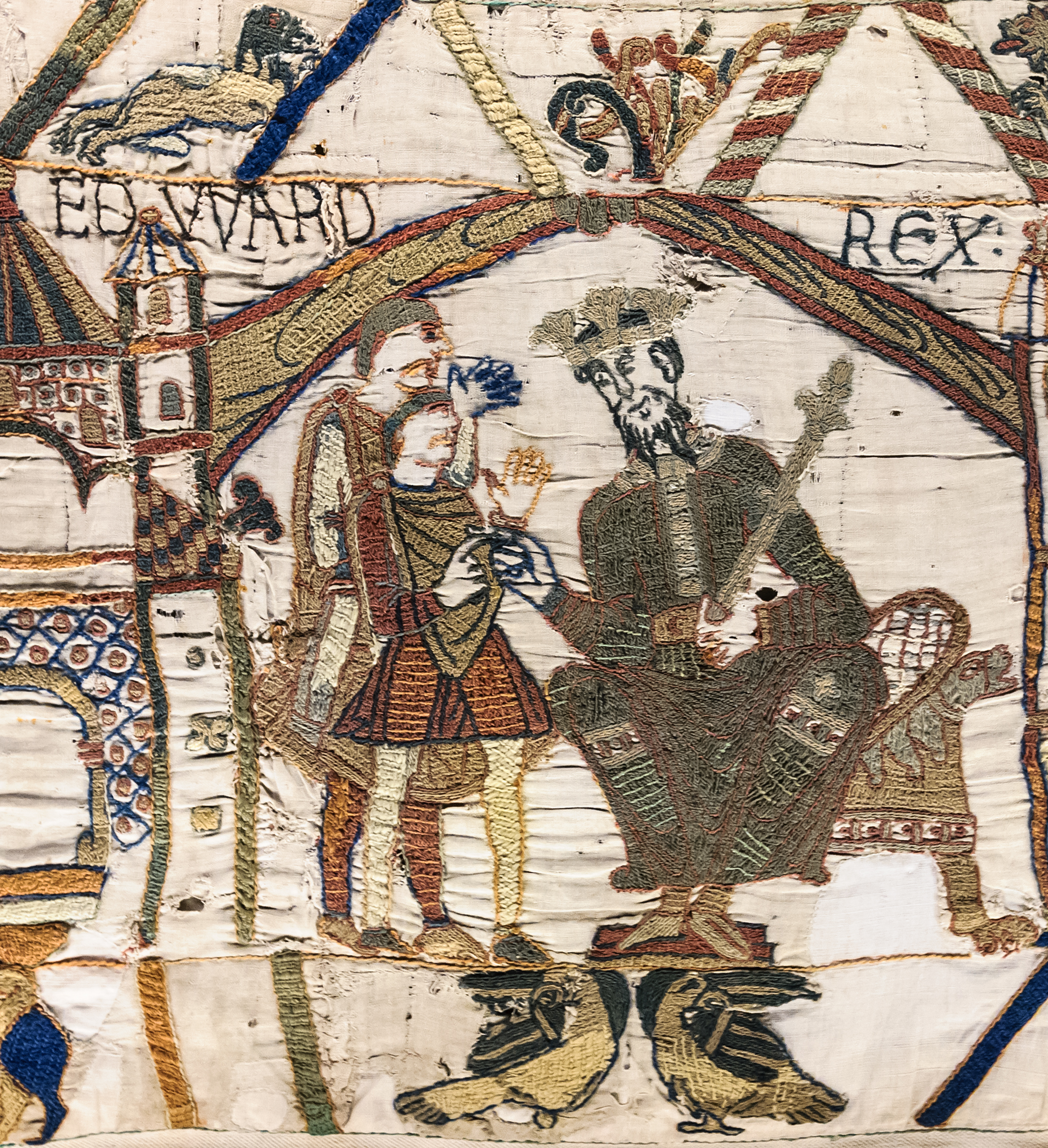
Edward the Confessor, Bayeux Tapestry

Under Edward the Confessor, his queen Edith held Shere Vachery and Shere Eboracum until her death, when they were absorbed by William the Conqueror. It became the chief English seat of the Irish Earls of Ormond. Eleanor, Countess of Ormond (wife of James Butler, the first Earl of Ormond), who owned Shere Vachery manor, had a “view of frankpledge” (a compulsive sharing of responsibility, because of kinship or an oath of fealty, to produce anyone accused of a crime) in Gomshall Towerhill.

In 1281 William Braose was granted a privilege: he was allowed to kill certain kinds of game normally off limits there (free warren). Shere Vachery was forfeited to the king when James Butler, the fifth Earl of Ormond and Earl of Wiltshire, was beheaded in 1461. (It was restored to John, Lord Audley, James’ brother in 1467. The earldom of Ormond was also restored.) Henry VII granted this manor to Sir Reginald Bray in 1486, but Lord Audley remained in possession and paid rent. Because of Audley’s activities in the Cornish Revolt in 1497, the manor was again forfeit to the crown, but was soon returned to Sir Reginald Bray, and has remained in the Bray family.

Shere Eboracum was held by William Donn de Burgh, the third Earl of Ulster. It also changed hands several times. At one point it was held by Richard, 3rd Duke of York and subsequently his widow, Cecily Neville, who held it until her death.

Because Henry VIII used it as a dower property for his first five wives, it was also known as Queen’s Hold. (Apparently, it was not a dower property for Katherine Parr.) Subsequently, for a short time, it was held by Sir Edward Bray who also owned Shere Vachery. He bequeathed it to his wife, Mary, who subsequently married Edmund Tylney, Master of the Revels to Elizabeth I. It changed hands again several times, ending up in the possession of the Bray family several times. Ultimately, the Bray family holds it today.

Gomshall Netley and Gomshall Towerhil resulted from the division of the manor of Gomshall, which was royal demesne, and had been held by King Harold. After William the Conqueror defeated Harold, it was held by William (although his brother Odo did encroach somewhat). It appears that the division of the property occurred under Henry II, who awarded part to Robert de Wendenale and part to William de Clere. Gomshall Netley was awarded to Sir Edward Bray by Henry VIII, after the suppression of Netley Abbey. It remains in the Bray family still.

Gomshall Towerhil also changed hands multiple times. In 1205 it was in the hands of William de Braose who held it until driven out by King John who awarded it to to Peter de Mauley. After the Civil War, in which Williams son the Bishop of Hereford, John, was forced to restore Towerhil to the de Braose heirs.

Rowland de Bloet held it for a time, but in 1218 Reginald de Braose (younger brother of the Bishop) had it. His widow claimed dower rights in 1230. In 1332, Edward III granted it to John Pulteney, Lord Mayor of London; after Pulteney’s death, Edward III granted Towerhil to Eleanor, Countess of Ormond for her lifetime. After her death, it changed hands a couple of times again. In 1539, it was in the hands of Sir Edward Walsingham, who conveyed it to Sir Edward Bray in 1550 (the Brays again!). Gomshall Netley and Gomshall Towerhill manors held court baron, to resolve disputes and enforce the lord’s will.


Church of St James, taken by the author, 1996

The Church of St. James is a Norman church, with the oldest part dating from possibly the late 11th century but mostly being 12th, 13th and 14th century, of various materials probably taken from Roman buildings on Farley Heath, with buttresses, which has been carefully restored. By the north chancel wall, there is a 14th-century Anchorite Cell, supposedly used by the Anchoress of Shere, Christine Carpenter, who had promised in 1329 to devote her life to God and live in a holy place. It had a quatrefoil window through which she received communion, and a “squint” (a window through which she could see the altar) belonging to Anchorite Cell. There is 14th-century glass in the east window and the chancel fittings were renewed.

Quatrefoil and Squint
This area was one of the most lawless in Surrey, with smugglers, poachers and sheep and horse-thieves hiding in the hills surrounding the village. Most of the stolen livestock ended up in London. Sheep stealing was particularly troublesome 1830-1840. Some of the cottages had (and some still have) very large cellars, considered to have been constructed to hide smuggled goods until they could be removed to London.

Iron was worked from the stone and into implements in centuries before the 18th century in Shere. Relying on the River Tillingbourne for power, gunpowder was also manufactured near Shere at Chilworth.

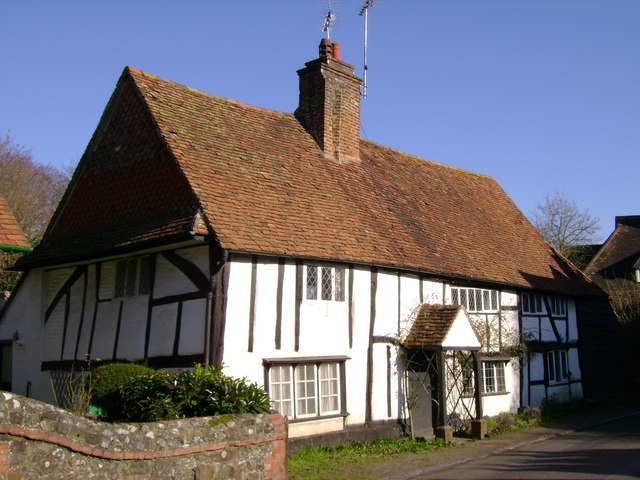
Tudor Cottage

Shere holds many old cottages and houses dating from the 15th to the 19th century. It is also home to the White Horse pub, which was originally a farmhouse built in the 15th century. After traditional beer was replaced by hopped ales in the late 18th century, the farmhouse was converted to an alehouse and brewery. It is still in operation today, and a scene from “The Holiday” with Cameron Diaz and Jude Law was shot on the premises. I had a fantastic cream tea at a beautiful tea shop there as well.

The White Horse

This is an Editor's Choice. The original article was published on November 20, 2013.

Sources:

Archive.org. Some West Surrey Villages, by E. A. Judges. 1901: Guildford (publisher’s name unclear).

Chef & Brewer. “History of the White Horse and Shere.

BritishHistory Online. Victoria County History, H. E. Malden, ed. A History of the County of Surrey, Vol. III. “Parishes: Shere.” Published 1911.

Exploring Surrey’s Past. “Shere.”

Sheredelight.com “The History of Shere.”

Wikipedia: Shere  

Edward the Confessor image from Wikimedia Commons:

Quatrefoil and Squint image from Wikimedia Commons:

Tudor Cottage image from Wikimedia Commons:

The White Horse image from Wikimedia Commons:

~~~~~~~~
Lauren Gilbert is the author of HEYERWOOD: A Novel, in 2011, and is a contributor to CASTLES, CUSTOMS, AND KINGS: True Tales by English Historical Fiction Authors. Her second novel, A RATIONAL ATTACHMENT, is in process. She lives in Florida with her husband. Visit her website at http://www.lauren-gilbert.com.

Tuesday, February 9, 2016

Eadric Streona: An Eleventh Century Villain

by Kelly Evans

In 2005, Eadric Streona (Streona is not his real last name, rather a nickname assigned to him meaning ‘grasper’ or ‘acquisitor’), a little known man to most, was voted the worst Briton of the 11th century in a poll conducted by BBC History Magazine. And, to those who know of him, for good reason. The chronicler William of Malmsbury (1095-1143) had this to say about Eadric:
“This fellow was the refuse of mankind, the reproach of the English; an abandoned glutton, a cunning miscreant; who had become opulent, not by nobility, but by specious language and impudence. This artful dissembler, capable of feigning anything, was accustomed, by pretended fidelity, to scent out the king’s designs, that he might treacherously divulge them.”
Who Was Eadric?
Eadric was one of eight or more children, born to a father who worked at the court of King Aethelred Unraed. There is no evidence that Eadric’s father, Ethelric, held any titles or contributed to the court in any significant way. Eadric and many of his brothers followed in their father’s footsteps; their names are included as witnesses of many charters from Aethelred’s reign.
320px-Ethelred_the_Unready
Aethelred Unraed (Source: Wikipedia)
The first appearance of Eadric’s name on a charter is in 1002, where he stood as witness along with his father and brother. History suggests that Eadric was retained by Aethelred to perform the more distasteful tasks of rule, one of which was the murder in 1006 of a nobleman, Ealdorman Aelfhelm. (Aelfhelm was father to Aelfgifu of Northampton, who would later go on to marry Aethelred’s enemy Canute). Aelfhelm’s sons were blinded on Aethelred’s orders and although there is no evidence that Eadric performed this task it is likely, given his role in their father’s death, that he was at least present.
A Rising Star
The following year Eadric was made Ealdorman of Mercia and it was around this time that he also married the king’s daughter, Eadgyth. Obviously Aethelred valued Eadric’s contribution to his reign.
It was a dangerous time for Aethelred and England: the country’s borders were weakly protected and England was a tempting prize for Danish invaders. After an invasion of the Danes in 1009, Aethelred was prepared to retaliate with force but was persuaded by Eadric to take a different course. Over the next two years the Danes ravished England and were only stopped by the payment of nearly 50,000 pounds of gold, an unpopular move negotiated and delivered by Eadric Streona.
Early in 1013 Sweyn Forkbeard attacked England and this time no amount of gold would be enough: Forkbeard wanted the crown. By the end of the year Aethelred, his wife Emma, their children, and Eadric had all fled to Emma’s home in Normandy. Sweyn died early the following year however and while Sweyn’s supporters declared his son Canute king, the royal counsel in the south of England asked Aethelred back.
Sweyn_Forkbeard
Sweyn Forkbeard (Source: Wikipedia)
Eadric followed Aethelred and his family back from Normandy and once again set himself up as the king’s enforcer. One of his first acts was to punish two of the leading thegns from the Danelaw for their possible support of the invaders. Sigeforth and Morcar were tricked into attending a meeting where Eadric murdered them.
Canute arrived back in England a year later, having restocked supplies, ships, and men. By this time Aethelred was ill and his son by his first wife Edmund Ironside took control of the English army. Eadric had his own army and ships and for reasons unknown to history, betrayed his king and country to side with the invading Canute.
Betrayal
In April of 1016 Aethelred died and Edmund was nominated king by the London noblemen, despite more widespread support for Canute. The fighting continued, with Canute’s and Eadric’s armies stretching Edmund’s resources to breaking points. At the battle of Otford, John of Worcester writes that Edmund had the upper hand but Eadric, still fighting with Canute, cut the head off of a soldier who looked like Edmund, held it in the air and told the English that their leader was dead, an act which further sealed his reputation as worst Briton of the time. Eadric isn’t done however.
Edmund_Ironside_-_MS_Royal_14_B_VI
Edmund Ironside (Source: Wikipedia)
Late that same summer Eadric switched sides once again, swearing loyalty to Edmund. The Anglo-Saxon Chronicle’s comment on this act is revealing: “No greater folly was ever agreed to than this one.”
In October the final battle occurred and with it another of Eadric’s treacheries. Edmund should have won the Battle of Assandun; his forces were superior to the Danes and he had enlisted fresh fighters, compared to the Danish forces who were fewer in number and battle-weary. The fighting continued for hours, the sound of shield walls thundering could be heard in the next village. But at a pivotal moment, Eadric fled the battlefield, his many supporters along with him. The sides were now numbered in favour of the Danes and the English suffered a crushing defeat.
The Anglo-Saxon Chronicle’s record for the day of the battle: “Then Ealdorman Eadric did as he so often did before, first started the fight…and betrayed his royal lord and the whole nation.”
After the battle Edmund and Canute met and divided the country between them, with Canute ruling in the north and Edmund in the south. They agreed that if either died without issue then the other would take the entire country. Fortunately for Canute, Edmund died of battle injuries not long afterwards; Canute now ruled all of England.
cnut
Canute (Source: Wikipedia)
Demise
Eadric ingratiated himself enough with the new king to remain Ealdorman of Mercia but by the following Christmas, 1017, the mood had changed: Canute either suspected Eadric of treason or had already accused him of such.
In the Encomium Emmae, Emma of Normandy’s account of events, Eadric’s death is noted:
“…One of these was Eadric, who had fled the war, and to whom, when he asked for a reward for this (ie aiding Canute at Assandun) from the king, pretending to have done it to ensure his victory, the king said sadly ‘shall you who have deceived your lord with guile, be capable of being true to me? I will return to you a worthy reward, but I do so to the end that deception may not subsequently be your pleasure’. And summoning Erik, his commander, he said ‘Pay this man what we owe him, that is to say, kill him lest he play us false.’ (Erik) indeed raised his axe without delay and cut of his head with a mighty blow…”
Other versions of his death have Eadric being strangled and his body thrown out of a window, decapitation with his head thrown out of a window and decapitation with his head posted on a pole to serve as a warning to other would-be traitors.
Conclusion
So does Eadric Streona deserve the title of worst 11th century Briton? It would seem so, for even the chroniclers of the time were horrified by his actions. As well as the earlier quote by William of Malmsbury, John of Worcester (died 1140) has this to say: “He was a man, indeed, of low origin but his smooth tongue gained him wealth and high rank, and, gifted with a subtle genius and persuasive eloquence, he surpassed all his contemporaries in malice and perfidy as well as in pride and cruelty.”
Worst Briton indeed!
References
Campbell, Alistair, ed. Encomium Emmae Regina. Cambridge: Cambridge University Press, 1998
Fjalldal, Magnus. Anglo-Saxon England in Icelandic Medieval Texts. Toronto: University of Toronto Press, 2005.
Stenton, Frank. Anglo-Saxon England. Oxford: Oxford University Press, 2001.
Swanton, Michael, ed. The Anglo-Saxon Chronicles. Great Britain: Pheonix Press, 2000.
BBC News: http://news.bbc.co.uk/2/hi/uk/4560716.stmkellyaevans.com Book Link  (Amazon)
Book Link (Amazon UK)
Universal Amazon Author Link

Tuesday, January 19, 2016

The Inhabitants of the Medieval Monastery

by E.M. Powell

In around 530 A.D, the Roman Christian, Benedict of Nursia, sickened by the sinfulness of Rome, decided to live apart from the world as a hermit. And he wasn’t just apart: one of his early holy dwellings was a cave half-way up a cliff face. Although a community grew up around him and he established a group of monasteries, it’s doubtful that he could have envisaged just how popular his vision for monastic life was to become.


By the medieval period, those who inhabited monasteries made up a substantial section of the population. It has been estimated that by 1348, some thirty thousand people lived a full-time religious life in England, with two percent of adult males being clergymen. Most houses were male, but around two thousand women lived in one hundred and fifty nunneries.


Much in monastic life had evolved over the centuries, including how it was ordered by, and for, those who lived it. According to the Rule of Saint Benedict, the abbot was to be seen as the father of his monastic family and had ultimate authority in the running of his holy house. He was to be obeyed in all matters. The abbot was indeed the head of the medieval monastic community. And by medieval times, he also got the best food.

Many monasteries owned huge amounts of land and running it profitably became the abbot’s responsibility. The chronicles of monastic houses recorded ‘bad’ abbots whose mismanagement caused debt or loss of land. Those who had been successful in running the estate were deemed to have been virtuous.


Such an undertaking was complex and demanding, so a number of monks were appointed to hold offices or ‘obediences’ to assist the abbot and were known as ‘obedientiaries.’  Deputy to the abbot was usually the prior. (In a priory, the prior is the superior.) As the abbot would have to travel, often for weeks or even months at a time, so the role of day-to-day running of the monastery fell increasingly to the prior.


Another obedientiary was the cellarer, responsible for seeing that sufficient food and drink was available. This meant extensive dealings with outside tradesmen and those on the monastic estate who produced food. The food rent attached to Ramsey Abbey in Nottinghamshire in around 1000 A.D. consisted of 80 bushels of malt (for brewing), 40 bushels of oatmeal, 80 bushels of flour (for bread), eight sides of bacon, sixteen cheeses and two fat cows. Eight salmon were required in Lent. Yet this was only enough to feed the monks and servants of a large monastery for a week or two. In Wales, food rents consisted of loaves of bread, oats, cattle, sheep, pigs, butter, ale and honey. The cellarer also had the headache of feeding the large numbers of visitors who would pass through the monastery.


The sacrist had charge of the vestments and sacred vessels (including the corporals), while the precentor directed the church services. The corporals are pieces of linen on which the bread and wine are placed and consecrated in the Eucharist. The sacrist would launder these and there is an account of the sacrist at the London Charterhouse hanging the corporals on the lavender bushes to freshen them.


Timekeeping also fell to the sacrist. He would ring a bell or strike a board to wake his fellow monks in the (very early) morning, to assemble for prayer or to gather for a meeting. Without a mechanical clock (which did not make an appearance until the late thirteenth century), the sacrist might use a candle clock, a water clock, a sundial or rely on the position of the stars. Norwich Cathedral Priory acquired one of the earliest mechanical clocks in the 1270s but they were hugely costly.

The infirmarer cared for the sick but maintained the health of the well, too.  Bloodletting was performed on healthy members of religious communities at regular intervals throughout the year. It is described in monastic customaries and mentioned in visitation records and account rolls. It took place in groups and was quite a social occasion with the added advantage of plenty of good food and the chance to sleep in the infirmary after.


The infirmary was a place of warmth and comfort. Music might be played and prayer was considered an essential part of recovery. Injuries such broken bones, scalds and burns had to be treated in the infirmary as well as disease. When mental ill health occurred, it was often considered to be demonic possession. Behaviours such as uncontrolled raving or blaspheming called for Satan to be banished or expelled from the individual. Again, it was believed that such occurrences could be countered with prayer. But very little could counter the sickness that came calling to almost every monastery in England in 1348. The plague killed almost two-thirds of their inhabitants, the close proximity in which people lived helping the spread of the deadly disease.


The almoner was the monk who carried out charitable acts on behalf of the holy house and looked after the poor of the neighbourhood. His duty was to distribute alms for those deemed fit to receive them.

The majority of the monastic community consisted of choir monks or nuns whose days and nights were centred on the liturgy. Anyone wishing to become a monk had to first undergo a probationary period known as the novitiate. The novitiate could last up to a year but many novices completed only a few weeks before their acceptance.


The novice master had charge of the novices, a responsibility with challenges all of its own. One can hear the frustration of 14th century novice master Henry of Kirkstead: ‘novices acquire years sooner than understanding.’


Once they completed their novitiate, the novices were professed as monks and made full members of the community. The ceremony to receive them into the brotherhood took place in front of the entire community. Each of them made a will. Then the sacrist had another duty to perform: the new monk was given a tonsure.

The tonsure is of course the part of a monk's or priest's head left bare on top by shaving off the hair. The familiar image of the medieval monk bears the tonsure of Saint Peter: either a circular patch on the crown, or the whole upper part of the head so as to leave only a fringe or circle of hair. There are other types. In the Eastern Church the whole head is shaven (the tonsure of St Paul). In the ancient Celtic Church, the head was shaved in the front of a line drawn from ear to ear, which is the tonsure of St John.


Many of the new monks went on to take Holy Orders and become priests. Lay brothers, however, did not. Lay brethren took vows of obedience and were required to observe various liturgical Offices but unlike the monks, their day was centred on manual labour. They farmed the land, reared livestock and did building and repair work. They wore work clothes rather than habits and did not receive the tonsure. Their work was supported by other non-religious servants.

Monks were often known by where they came from, such as Hugh of Durham. Others were numbered. Thorney Abbey had a Jocelin I, a Jocelin II and a Jocelin III.


One would not perhaps expect to find a child in a monastery. But children sometimes were gifted to the community and were known as oblates. A younger son of a nobleman who would not inherit his father’s land and/or title might have met such a fate. Oblates received an education until the age of seventeen, then took their vows. The practice flourished in the eleventh century but was phased out during the twelfth and prohibited at the Fourth Lateran Council of 1215.


The last group to find shelter within a monastery’s walls were its visitors. They included patrons. The monasteries were closely bound in to the secular elites, who patronised a monastery as a matter of family prestige, to ensure that they would be remembered in the monks’ prayers and buried in an honoured place in the church. Relatives of the brethren, as well as visiting monks and other travellers would also seek accommodation. And, of course, pilgrims. Making a gift or a donation to a monastery would allow the pilgrim to be let off a penance. By the thirteenth century, one could acquire, for the right sum, indulgences for souls in purgatory.

One can only wonder what Saint Benedict, living in his isolated cave, would have thought.
~~~~~~~~~~~~
References:
All images are in the Public Domain and are part of the British Library's Catalogue of Illuminated Manuscripts. 
Dyer, Christopher: Making a Living in the Middle Ages, Yale University Press (2002)
Jones, Terry & Eriera, Alan: Medieval Lives, London, BBC Books (2004)
Kerr, Julie: Life in the Medieval Cloister, London, Continuum Publishing (2009)
Knowles, Elizabeth, ed.: The Oxford Dictionary of Phrase and Fable (2 ed.) Oxford University Press (2005, Current Online Version: 2014)
Livingstone, E.A.,ed.:The Concise Oxford Dictionary of the Christian Church (2 rev.ed.), Oxford University Press (2006, Current Online Version: 2013)
Mortimer, Ian. The Time Traveller's Guide to Medieval England. London: The Bodley Head. (2008)

E.M. Powell is the author of medieval thrillers The Fifth Knight & The Blood of the Fifth Knight which have both been #1 Historical Thrillers on Amazon's US and UK sites. The Fifth Knight was published in Germany on January 12 2016 as Der fünfte Ritter. It is currently the #1 Historical thriller there.

Sir Benedict Palmer and his wife Theodosia are back in book #3 in the series, The Lord of Ireland. It's 1185 and Henry II sends his youngest son, John (the future despised King of England), to bring peace to his new lands in Ireland. But John has other ideas and only Palmer and Theodosia can stop him. The Lord of Ireland is published by Thomas & Mercer in April 2016.

E.M. Powell was born and raised in the Republic of Ireland into the family of Michael Collins (the legendary revolutionary and founder of the Irish Free State) she now lives in the north west of England with her husband and daughter and a Facebook-friendly dog. Find out more by visiting www.empowell.com

Amazon.com
Amazon.co.uk
Amazon.de
Barnes & Noble
Walmart
Waterstones


Saturday, October 3, 2015

Queen Emma - One of the Neglected Figures in English History

by Helen Hollick

This is part of an essay I wrote in 1997 for a history degree course at Birkbeck College, University of London. Unfortunately I never found the time to complete the degree!
The full, original essay is here:

The first chapters of the Norman conquest of England began in the spring of 1002, with the marriage of Emma of Normandy to Æthelred, King of the English. She was a daughter of Richard of Normandy, great grandfather of William I of England. Although of Scandinavian (Viking) descent, these "Northmen" were, by the early eleventh century, mostly Christian, and an alliance would prevent Vikings from using Norman ports from which to harass England. Henceforth, the Counts of Normandy would have a considerable interest in the English crown, with the ambition being that a son of Emma's would succeed to the throne. Two, Harthacnut and Edward, did rule, but both were childless, thus eliminating the prospect of Norman rule by direct succession. Considering that the alliance was to bring security from Viking raiders, it is ironic that when Æthelred died in 1016, Emma then married one of the most prominent Vikings of this period, Cnut, who conquered England and became King.

Emma became a queen who carved for herself a significant position within the political estate of England. Her first son, Edward, was born circa 1005 with a second son, Alfred, a year or so later. The succession to the throne however, was disrupted in 1013 by an invasion by Svein Forkbeard of Denmark and his son, Cnut. In the autumn, Emma and her sons, at her initiative, fled to Normandy soon followed by Æthelred himself.

In the spring of 1014 Æthelred dispatched ambassadors to England, with his young son Edward accompanying them, to negotiate a return to the English throne. Shortly after Æthelred's reinstatement, his son by a first (common-law) wife, Edmund Ironside, began to act independently of his father. Emma, it seems, was also dissatisfied with her husband’s failures, for she apparently transferred her support to Edmund. In the Encomium Emma Reginae (her biography written during her lifetime) Æthelred is not merely omitted as her husband, but his existence is significantly suppressed. Emma was a strong and determined women who knew her own mind, what she wanted, and was ruthless in her ambition to obtain it. It is doubtful that she would have chosen to ‘forget’ her first husband because of infidelity; more likely she was dissatisfied with his failures and weakness as a king.

A Hollow Crown cover
depicting the frontispiece of the Encomium
showing Emma, Harthacnut and  Edward
(fourth person unknown, possibly the Encomum's author)
Æthelred died in 1016. Edmund Ironside occupied the throne and withstood Cnut, with the boy Edward, who was possibly no older than thirteen, at his side. That Emma had deliberately sent her eldest son to be with his half-brother is typical of her character. Edward would have been too young to stand against Cnut on his own; her only chance of recovering her position, wealth, and estates would have rested on Edmund's success - with Edward as his successor. Unfortunately for Emma, Edmund died in 1016, and Cnut became King of England.

Cnut turned to securing his position and took Emma as his second wife in July 1017. He had a reputation of paganism and needed to establish his Christianity. The degree of involvement that Emma herself had in the betrothal negotiations is unknown, but she was certainly shrewd and politically wise. As Queen, Emma had acquired expertise in English politics, and marriage to her diverted support away from the two royal English sons, neutralizing them as potential opponents. The master plan of the sixth or seventh century usurper had three stages: murder the king, get the gold, marry the widow. Since the widow usually sat on the gold, the two went together.

Emma achieved a position of prominence under Cnut that she had not enjoyed under Æthelred. She benefitted from her second husband's control of three kingdoms, and by Cnut she had a third son, Harthacnut, reducing Æthelred's sons who were again in exile in Normandy to little more than pawns. When Cnut died in 1035, Harthacnut was ruling in Denmark, and Emma pressed for his succession, not Edward's. Harthacnut would retain for her, as King of England and Denmark, her wealth and status and would be more likely to receive support from the Angle-Danish aristocracy who had risen to power under Cnut. Her main ally proved to be Earl Godwine of Wessex. When Edward and Alfred arrived in England in 1036 to make a claim for the throne, there was virtually no support for either brother, including none from Emma herself.

Emma was a woman of considerable wealth and because of that, she held great political power. She held three types of property which would provide her with revenue. The possession of the royal treasury was crucial. It would contain essential royal documents, such as tribute lists, gold, silver, precious stones and weapons. Possibly also, the royal insignia. By having control of the treasury, Emma was able to attract - and hold - support. Harthacnut, however, remained in Denmark and when Godwine, the crux of Emma's success, unexpectedly switched sides to support Cnut’s illegitimate eldest son, Harold Harefoot, Emma fell swiftly from power and went, once again, into exile.

Harefoot died in 1039 which gave Harthacnut opportunity to renew his claim on England. It may have been during her exile that Emma commissioned the Encomium Emmae Regina to be written; a work of praise for herself and a demonstration that Harthacnut was the right choice as King of England. It shows that Emma was literate and of distinguished learning.

Harthacnut's reign was brief; he died in 1042. After all her struggles Emma must have been devastated; the crown passed to Edward, but it was of little comfort to her. For most of his life Edward had lived in exile in Normandy. His mother had abandoned him, and there was no love between son and mother. Soon after his consecration in 1043, Edward rode to Winchester to accuse Emma of treason and to dispossess her of lands and movables, although he stopped short at exile. According to the Anglo Saxon Chronicle, "They came unexpectedly upon the lady and deprived her of all the treasures …because she had been very hard to the king, her son...”

Whether by her own strength of character or her son's remorse, she was soon reinstated into favour, although at a lower scale. He took Earl Godwine’s daughter, Edith, as wife – although the marriage produced no children, and Emma retired to Winchester, an indication that her influence had decreased. She died on 6th March 1052 and was buried in the Old Minster, Winchester near Cnut and Harthacnut.

Post 1066 queens of England are discussed at length, appreciated or condemned, depending on their worth, while those of pre-Norman history are considerably neglected - even ignored. Emma was the only woman in British history to have been Queen twice, the wife of different ruling kings. This makes her unique. She was an intriguing woman, on a par with the later Eleanor of Aquitaine, and she has a significant place in English history.

Sources:
Pauline Stafford
Queens, concubines and Dowagers: The king's wife in the early middle ages
Henrietta Leyser
Medieval Women: A social history of women in England 450- 1500
Christine Fell
Women in Anglo-Saxon England
Frank Barlow
Edward the Confessor
Translator, Anne Savage:
 The Anglo Saxon Chronicles

~~~~~~~~~~

Helen Hollick is the author of A Hollow Crown (UK edition)/The Forever Queen (US edition). 
The Forever Queen was a USA Today bestseller.
Emma's story continues in Harold the King (UK title) / I Am The Chosen King (US title)

For more information  about Queen Emma : click here 

Buy the book in paperback or on Kindle: Amazon


Tuesday, July 23, 2013

Uncovering Lady Godiva

by Octavia Randolph


The first of a two part article.  This month we look at the “real” Lady Godiva.

NO other early Englishwoman has been remembered as long, or as provocatively, as Lady Godiva. The name instantly conjures an image of a woman on horseback, clad only in her hair. Whether depicted in a 15th century print or gracing a modern chocolate box, Godiva lives – and rides – on in our imaginations.


Lady Godiva (1867) by P Pargetter for Minton Pottery.
 
Godiva is the latinised form of the Old English name Godgyfu or Godgifu (literally, "God's gift" or "good gift"). Godgyfu was an 11th century Anglo-Saxon aristocrat whose life spanned one of the most tumultuous periods in early English history. Despite her illustrious husband, renowned piety, and religious benefactions, without the tantalising legend of her ride through the Midlands town of Coventry she would likely be completely forgotten.

What is known of Godgyfu is found in the chronicles of various religious foundations, mentions of her or her husband in charters, and the post-Conquest compilation known as the Domesday Book. The first positive record of her is in 1035, when she was already married to Leofric, Earl of Mercia. Her birth date is unknown. Similarly, the date of her ride through Coventry cannot be known, possibly it was linked to the dedication of the Priory she and Leofric built there in 1043.

Here I must also acknowledge that despite records dating to the late 12th century concerning her ride, there are some modern scholars who doubt that it ever took place. I am persuaded that it did.

To return to fact: Like other Anglo-Saxon women of her class, Godgyfu owned property in her own right, both given to her by her parents and acquired through other means - gifts from her husband, inheritance from relatives, and purchases and exchanges from individuals and religious foundations. The modest farming village of Coventry was one of them. The Domesday Book lists it, twenty years after her death, as having sixty-nine families.

It is not known why Godgyfu and Leofric turned their attention to Coventry, which after all, was a small and seemingly unremarkable farming community. As early as 1024 Bishop Æthelnoth (later to be Archbishop of Canterbury) gave to Leofric a priceless relic, the arm of St.Augustine of Hippo, which had been purchased by the bishop in Rome and which he apparently indicated was intended – we do not know why – for Coventry.

The response of Leofric and Godgyfu was to create a suitable sanctuary to house this exceptional relic. The lavishly decorated Benedictine Priory of St.Mary, St.Osburgh, and All Saints was dedicated by Archbishop of Canterbury Eadsige in 1043, on property owned by Godgyfu. Within was a shrine to St. Osburgh (a local holy woman who had earlier founded a nunnery in Coventry) which held her head encased in copper and gold. St.Augustine's arm took its place in a special shrine, and Godgyfu and Leofric also presented to the new Priory many ornaments of gold, silver and precious stones, so that it was famed for its richness. Leofric further endowed the Priory with estates in Warwickshire, Gloucestershire, Leicestershire, Northamptonshire, and Worcestershire.

Their religious endowments were many, restoring, enriching, or founding houses in Much Wenlock, Worcester, Evesham, Chester, Leominster, and Stow in Lincolnshire. This last, the Priory Church of St. Mary's Stow-in-Lindsey, is of particular interest as a significant portion of the beautiful and impressive extant church there issued from their hands. The earliest stonework in the church dates from 955; Godgyfu and Leofric greatly endowed and enriched it from 1053-55. The lofty crossing features four soaring rounded Saxon arches (which now enclose later pointed Norman arches built within the original Saxon arches). A 10th or 11th century graffito of an oared ship is scratched into the base of one of the Saxon arches, possibly a memento from a Danish raider who sailed up the nearby Trent.

The north transept houses a narrow, deep Saxon doorway of honey-coloured stone, which would originally have been lime-washed and over-painted with decorative designs. It likely led to a chapel in Godgyfu's day, and surely she passed through this very arch. To experience St. Mary's Stow, built just ten years after the dedication of the Coventry church, is to begin to imagine what the Priory Church of St. Mary, St Osburgh, and All Saints may have been like.


St. Mary's Stow-in-Lindsey, a 10th c church endowed by Godgyfu and Leofric in the mid-11th c. Note the three windows in the transept, shown below from the interior.


St. Mary's Stow-in-Lindsey.
Three windows, three ages.
The circular window is Saxon;
the very narrow round-headed
one beneath it is Norman; the larger
pointed one later Medieval.


St. Mary's Stow-in-Lindsey.
The crossing. The later, pointed Norman
arches were actually built within
the larger rounded Saxon ones.

St. Mary's Stow-in-Lindsey.
North transept. Narrow Saxon doorway
with your author inserted for scale.
St. Mary's Stow-in-Lindsey.
Ancient stone steps to tower.
Photos by Jonathan Gilman.


Leofric was a man of considerable talent and statesmanship; no man could survive forty years as Earl without these qualities. Elevated to Earl (a title and position new to the English, replacing and expanding the Anglo-Saxon ealdorman) in 1017 by the Dane Cnut, he survived and thrived through Cnut's reign. Then followed that of Harold Harefoot (1035-1040), in whose selection as successor to Cnut Leofric was instrumental. Hardacnut, Cnut's other son, reigned next (1040-1042), and then began Edward the Confessor's rule (1042-1066).

Unsurprisingly for his age, Leofric could alternate between great rapacity and great piety, his depredations and subsequent generous benefactions upon the town of Worcester being a case in point. In 1041, when Hardacnut was king, two of his tax collectors were murdered by an angry and over-taxed group of Worcester citizens.

 An act of this nature, upon the direct representatives of the king, was seen as almost an assault upon the king’s body itself. In reprisal Hardacnut ordered Leofric to lay waste to Worcester, which Leofric did with complete and horrifying efficiency, made perhaps even more reprehensible as Worcester was the cathedral city of his own people. Afterwards (and seemingly as personal reparation) Leofric bestowed many gifts of treasure and lands upon the religious foundation there, enough to ensure that his memory would be revered and not reviled.

He seems to have been successful in this. Near the end of his life Leofric experienced four religious visions which were carefully recorded by the monks at Worcester and published after his death in 1057. The Anglo-Saxon Chronicle entry for 1057 noted, "...In this same year, on 30 October, Earl Leofric passed away. He was very wise in all matters, both religious and secular, that benefited all this nation. He was buried at Coventry, and his son Ælfgar succeeded to his authority..." (G.N. Garmonsway translation).

Following his death, Godgyfu made additional gifts to the religious foundation at Worcester to aid in the repose of Leofric's soul and for the benefit of her own. These gifts included altar frontals, wall hangings, bench covers, candlesticks, and a Bible, and joined a long list of items and estates the two had granted to Worcester in the years prior to Leofric's death.

Leofric and Godgyfu had one known child, the above-mentioned Ælfgar, who died in 1062. His daughter Ealdgyth was wed briefly first to a Welsh king and following his death, to Harold Godwineson, killed by William of Normandy's men on the field at Hastings. Thus for nine months Godgyfu was grandmother to the queen of England.

Godgyfu died in 1067, the year following Hastings. At her death she was one of the four or five richest women in England with estates valued at £160 of silver. Her lands were then forfeit to new king William.

Godgyfu was buried next to her husband in the Priory church in Coventry they had created. According to chronicler William of Malmesbury, her dying act was characteristically pious: as a final gift to the Priory, she ordered hung about the neck of a statue of the Virgin Mary her personal rosary of precious stones. (The church was alas, destroyed like so many others during the Reformation, the treasures looted and dispersed.)

Now that we have taken a look at the historical record concerning Godiva, next month we’ll examine the literary legend of her famous ride.

~~~~~~~~~~~~

My short story about Lady Godiva, Ride, was published in Narrative Magazine, and has just been translated and published in Russia in The Translator. Ride is my attempt to re-frame her act in light of the realities of 11th century Anglo-Saxon law and social and religious custom. It is also my tribute to the efforts of women everywhere who seek peace over their own personal comfort.

Octavia Randolph is also author of The Circle of Ceridwen Trilogy, and Book One is available free all day July 24th and 25th. Please claim your copy! Click here for Amazon USA and click here for Amazon UK.