Sunday, March 11, 2018

Editors Weekly Round-up, March 11, 2018


by the EHFA Editors

Visit English Historical Fiction Authors every week for posts on various aspects of British history. Enjoy this week's round-up!


by Tim Walker


by Cryssa Bazos


Friday, March 9, 2018

Ralph Josselin: A 17th Century Vicar

by Cryssa Bazos

Every diarist leaves a little of themselves behind for the next generation. Samuel Pepys gave us insight into his city diversions and business in the shipyards, John Evelyn a political perspective, and Lady Fanshawe, her love for her husband. All three were political insiders, with a privileged front row seat to the royal entanglements and comings and goings. But from Ralph Josselin’s diary, we see a different aspect of 17th century Stuart society: the life of a middle class country vicar and family man.

Life and Times

Ralph Josselin - unknown artist
Ralph Josselin was born at Roxwell in Essex on January 26, 1617. About his beginnings, he wrote:
"I was the eldest son in our whole Family and yet possessed not a foot of land in which yet I praise god I have not felt inward discontent and grudging, god has given me himself, and he is [all] and will make up all other things to me."
Though his grandfather was a wealthy yeoman who left an estate valued at £1,000, Josselin’s father did a poor job of farming and whittled his inheritance away. But the elder Josselin did leave his son something more valuable—an education.

Ralph Josselin entered Cambridge in 1633 and earned his Bachelor of Arts in 1637 and his Masters three years later. It took him longer than most to complete his education as he had to juggle shortages in funds and take on various posts, including a stint as a schoolmaster. During this time, he discovered an aptitude for sermons which spoke to his keen spirituality. After graduating, he became a curate in Olney.

Now that Josselin had a living and was set for his life’s work, he looked to starting a family. A local Olney girl, Jane Constable, attracted his attention and on October 28, 1640, the young couple married. They eventually settled in Earls Colne where Josselin served as vicar for the rest of his life. Over the next twenty-three years, Ralph and Jane welcomed ten children into their family, six girls and four boys. Two of their children were infants when they died, and their oldest, Mary, died at the age of 8. Only five of their children survived him.

Earls Colne Church
Josselin sided with Parliament during the English Civil War and in 1645 he joined as a chaplain. He was a moderate in his politics and looked upon the more revolutionary factions, like the Levellers and the Quakers, with concern. When Charles II was restored to throne in 1660, he obtained the King’s pardon, which allowed him to continue living in peace.

Historical Anthropologist, Alan MacFarlane, conducted a thorough analysis of Josselin’s diary by recording quantifiable details about his sources of income and his wealth during the years of the diary and even more intriguing, qualitative information about his attitudes toward his life, society and his children. The study is fascinating and invaluable.

Marriage

It was the norm during Stuart England for middle class couples to marry on average between the ages of twenty-three and twenty-five, far later than their aristocratic counterparts. Most men would not even consider getting married until they had their career firmly established.

Contrary to modern assumptions, marriage was not expected to be a loveless transaction. It was expected, even hoped, that couples would find a good match in personality and temperament. Ralph and Jane shared a loving marriage, though not without their ups and downs.
“You can consider, here I was won’t to see my dear Wife; here to enjoy her delightsome imbraces [sic]; her counsel, spiritual Discourses, furtherance, encouragement in the waves of God, I was won’t to fine her an help to ease me of the burthen and trouble of household-affaires, whose countenance welcomed me home with joy.”
Nor was theirs a one-sided marriage with Ralph making all the decisions and Jane merely obeying. The couple consulted over important decisions, such when they needed to consider suitors for their daughters. There was one situation where one young man came calling, and while Ralph favoured him, Jane didn’t agree. In the end, the suitor was turned away and their daughter ended up marrying someone else.

Children

Josselin was a Puritan and that alone conjures up images of a stern and authoritarian father, however his relationship with his children, even his daughters, was warm and caring, not to mention involved. Josselin worried over their welfare and their health, grieving as much as his wife over their premature deaths. Even after they married, he did not stop worrying about their welfare.

Curiously, Josselin did not limit his observations to his children after they were born. He diligently recorded the progress of his wife’s pregnancy, when she weaned their children and most of her miscarriages. Breastfeeding ranged between twelve and nineteen months and often weaning perfectly coincided with the onset of the next pregnancy.

Apprenticeship and Education

Education was not limited to the boys. Josselin was at one time the schoolmaster at Earls Colne school and ensured all his children received a good education. The Josselin children were taught there between the ages of 4 to 10, and their education included numbers and reading, though writing appeared to be a skill taught later in their education. For instance, Josselin received his daughter’s first letter when she was fourteen.

It was a common practice to send away children to be educated (including apprenticeship) around the time of adolescence, girls included. Most of them were sent to London either as apprentices or in the case of the daughters, to serve in a household, and rarely to relatives. These arrangements can be seen as an extension of their education and not as a way to shift the financial obligation to his children’s care to someone else. For Josselin reciprocated this arrangement and took in apprentices from other families, providing them food and shelter. He approached his duties very seriously accepting the boys as part of his extended family. This was a highly efficient and affective way to expand social reach and alliances to beyond one’s family.

Income

Not only did Josselin serve as a vicar, he was also a yeoman farmer and kept very detailed records of his income, expenditures and sources of wealth. The weather was the greatest source of worry and concern, and his diary also addresses the growing season, the weather conditions and the crop yields. February and September were the two months where he commented the most about the weather. The worst years for his crops were between 1646 to 1648 due to excessive rain. Interestingly, this happened between the first and second civil war, following years of food shortages due to free quarter by both Royalist and Parliamentarian armies.

Jocelyn’s source of income was varied. Income earned as a vicar provided a steady living, but he was able to supplement this through the rents he received on leased land (which he had either purchased over the years or had inherited), his farming, and for a brief time, his position as schoolmaster. Based on his diary notes, over the course of his working lifetime, approximately half of his income was derived from his ecclesiastical duties and just over a third from land (leases and farming).

Ralf Josselin’s diary gives us a much-needed insight into the personal life of a middle class family in the 17th century, and through his observations, the life of the women in his family.  I’ve only scratched a thin surface of what we can glean from his writings. If you’re interested in learning more, I would recommend the historical anthropological study, The Family Life of Ralph Josselin: A Seventeenth-Century Clergyman, by Alan MacFarlane.

Media:

East Colne Church: 'Plate 108: Church Towers', in An Inventory of the Historical Monuments in Essex, Volume 3, North East (London, 1922), p. 108. British History Online.

~~~~~~~~~~

Cryssa Bazos is historical fiction author and 17th century enthusiast with a particular interest in the English Civil War. She is a member of the Historical Novel Society, the Romantic Novelist Association and is a co-editor and contributor of the English Historical Fiction Authors blog. Her award winning debut novel, Traitor's Knot, is published by Endeavour Media.

Connect with Cryssa through her blog cryssabazos.com, Facebook, Twitter (@CryssaBazos), and Instagram (@cryssabazos). Traitor's Knot is available through Amazon.

Tuesday, March 6, 2018

In Search of King Arthur

by Tim Walker

The search for a tangible King Arthur remains as inconclusive as ever due to lack of compelling, physical evidence, although some continue to try and convince us otherwise. There are many places in Britain that lay claim to have connections to a ‘real’ Arthur – Tintagel where he was said to have been conceived; Camalat (South Cadbury in Somerset), an impressive iron age citadel; Glastonbury Abbey where monks in 1190 claimed to have found his grave; Camelford – a village in Cornwall that claims to be the site of the Battle of Camlann, where Arthur was mortally wounded around the year 515 AD (a date arrived at through research by historian John Morris). Avalon, or The Island of Apples, where Arthur’s body was taken, is thought to be near Glastonbury – its proximity to Camelford lending support to the claims of this patch of the West country. There are other ‘Arthurian’ sites at various locations in Wales, at Birdoswald on Hadrian’s Wall, and north of the wall at Caledonian Wood.

At the visitor centre near Camelford at the aptly-named Slaughterbridge, I followed a path to a low cliff above the River Camel and look across to the meadow on which Arthur is said to have fought his last battle. On the muddy riverbank below lies The Arthur Stone – a granite tombstone dated to 540 AD engraved with Celtic runes that have been interpreted as stating ‘here lies the son of Arthur’, throwing up the intriguing possibility that it was not Arthur but his heir who fought and died on this spot some years after his illustrious father (or that both father and son fought battles there, as the keepers of the visitor centre would like us to believe). Legend has it that the victorious Saxons desecrated his burial site and rolled the tombstone down to the riverbank where it remains to this day. Hold on a minute, did King Arthur have a son? In Geoffrey of Monmouth’s account, Arthur is succeeded by his cousin, Constantine of Cornwall.

In the absence of something more substantial from historians and archaeologists, these remain theories in the realm of legend. One theory is that Arthur may not have been a king at all, but a ‘leader of battles’ a ‘Dux Bellorum’ or a hired sword, working for a group of tribal leaders, in the immediate post-Roman era. Bernard Cornwell’s excellent novel, The Winter King, adopts this point of view.

Another perspective is offered by historical fiction author Chris Flynn (The Bear, The Dragon and The Wolf) who argues the case for a Northern Arthur who is a cavalry commander, possibly drawing on the influence of Sarmatian cavalry units once garrisoned at Hadrian’s Wall, who organises resistance to the spread of Anglo-Saxons in the north-east (www. botrbooks.com/blog). Also in this corner is Alistair Moffat, who puts forward the case for Arthur being a warlord based in the Scottish borderlands north of Hadrian’s Wall in the years after Roman evacuation, in his book, Arthur and the Lost Kingdoms. His book builds a case based on literary sources, historical documents and interpretations of place names to build a compelling and intriguing case for a Scottish Arthur. Add this to the Welsh chroniclers’ Arthur, and you have a folk hero claimed by three home nations.

Clearly, it was a troubled time for the Britons, left exposed by the removal of Roman protection. However, there is no physical or archaeological evidence for who the leaders were, where battles took place and when. It has been suggested that the legend of King Arthur is a composite of the feats of a number of Briton leaders over a broad period stretching from the mid-fifth to the mid-sixth centuries, embellished by bards over the years until written down in 1136 AD by Geoffrey of Monmouth in his book, The History of the Kings of Britain.

Victories in as many as seventeen battles on British soil have been attributed to Arthur, plus his overseas adventures, giving credence to the notion that this was not the work of one leader but of several – collapsed together for the purposes of engaging storytelling by bards to make one great heroic figure who battled to preserve a Romano-Briton way of life.

Contemporary historian, Miles Russell (writing in History Revealed magazine), has re-examined Geoffrey’s claim that the inspiration for his work was based on an ancient book ‘in the British tongue’ and found that it may have some credence (despite the source text never having been found or mentioned by any other). To support his theory he uses as an example Geoffrey’s telling of the coming of Julius Caesar in 55 and 54 BC - an account that has similarities to the ‘official’ Roman version but differs in some details and is told from a British point of view. Geoffrey certainly did his homework, poring over source material as diverse as folklore, chronicles, church manuscripts, king-lists, dynastic tables, oral tales and bardic praise poems.

In Geoffrey of Monmouth’s ‘history’ we get a compelling story of a time of desperate struggle following the end of Roman Britain. He gives us a linage of Fifth Century kings – Constantine, Vortigern, Ambrosius Aurelianus, Uther Pendragon and then King Arthur.

Arthur becomes king at the age of fifteen and marries Ganhumara (‘Guinevere’) who is from a noble Romano-Briton family. Arthur forms an alliance with his nephew, King Hoel of Brittany, and they inflict defeats on the Saxons at Lincoln and Bath before crushing a combined force of Picts (Scots) and Hibernian (Irish) tribes at Loch Lomond. They then attack Ireland, the Orkneys, Iceland, Norway, Sweden and parts of Gaul (France), forcing the people to pay them homage. He lays waste to fields, slaughters the population of these places and burns down their towns – the exact opposite of a chivalric king. Geoffrey’s Arthur is an arrogant, aggressive and brutal warlord who kills and takes what he wants.

But Geoffrey’s story does not end there – Arthur is summoned by the Roman Emperor to face charges of war crimes and responds by raising a large army, sailing to Gaul, and meeting the Roman army in battle, defeating and killing the emperor. Arthur’s mind is set on capturing Rome, but he is forced to return home at news that his nephew Mordred has taken his queen, Ganhumara, and seized the kingdom. In a bloody civil war in which thousands die, both Mordred and Arthur fall in battle – Arthur’s body is taken to the Isle of Avalon and he is succeeded by his cousin, Constantine of Cornwall.

This is a summary of Geoffrey’s account in his Historia, and it is an intriguing thought that he MAY have taken it from a lost manuscript. Later generations lightened the blood-soaked narrative, adding more sorcery, the romance of Camelot, chivalric heroes (the knights of the round table), the quest for the Holy Grail, an evil foe in Morgana, and a doomed love triangle involving Arthur, Guinevere and Lancelot.


Despite the fanciful tale of Arthur taking on the might of the Roman Empire, there is still the possibility that Geoffrey’s account was largely based on genuine source material that offers a glimpse of native Briton resistance to foreign invaders in the fifth and sixth centuries. Geoffrey’s King Arthur could not possibly have done all those things – he is most certainly a composite of several characters, including Ambrosius Aurelianus, who perhaps has better credentials as a noble leader who led the Britons to early victories over the Saxons.

Clearly, there was organised resistance to invaders, and tales of bravery told by chroniclers and bards from the Briton resistance point of view – and perhaps missing texts. Arthur is the embodiment of this oral tradition from the fifth and sixth centuries, offering us intangible glimpses of deeds in a period wedged between the gloating records of Roman and Anglo-Saxon conquerors.

*****

Tim Walker is an independent author based in Windsor, UK. Tim’s background is in marketing, journalism, editing and publications management. He began writing an historical series, A Light in the Dark Ages (set in the Fifth Century), in 2015, starting with a novella set at the time the Romans left Britain – Abandoned. This was followed in 2017 with a novel – Ambrosius: Last of the Romans, and the third installment, Uther’s Destiny, has just been released in March 2018.

His creative writing journey began in July 2015 with the publication of a book of short stories, Thames Valley Tales. In 2016 his first novel, a futuristic/dystopian thriller, Devil Gate Dawn was exposed on the Amazon Scout programme prior to publication. Both titles were re-launched with revised content, new covers and in print-on-demand paperback format in December 2016.
In January 2017 his first children’s book, The Adventures of Charly Holmes, co-written with his 12-year-old daughter, Cathy, was published. In September 2017 he published a second collection of short stories – Postcards from London.

Author Website: http://timwalkerwrites.co.uk
Newsletter sign-up: http://eepurl.com/diqexz
Amazon Author Page: http://Author.to/timwalkerwrites
Facebook Page: http://facebook.com/timwalkerwrites
Twitter: http://twitter.com/timwalker1666


In my historical book series, A Light in the Dark Ages, I have attempted my own alt-history of the period starting with the departure of the Romans and building to the coming of King Arthur, putting flesh on the mythical bones of early kings Vortigern, Ambrosius Aurelianus and Uther Pendragon.

Book one – Abandoned! – http://myBook.to/Abandoned
Book two – Ambrosius: Last of the Romans – http://myBook.to/Ambrosius
Book three – Uther’s Destiny – http://myBook.to/Uther


Sunday, March 4, 2018

Editors Weekly Round-up, March 4, 2018

by the EHFA Editors

Visit English Historical Fiction Authors every week for posts on various aspects of British history. Enjoy this week's round-up!

by Charlene Newcomb
(Editor's Choice from the Archives)

Thursday, March 1, 2018

The Mediums and the Messages

By Linda Stratmann

Victorian séances were almost always performed in darkness, which provided the perfect conditions in which unscrupulous mediums could produce convincing illusions.


There was one significant exception to this, and it was the brainchild of American Henry Slade. Born in 1836 he was already an established medium when around 1860 he devised the slate-writing séance, which he probably based on an established conjuring trick. In its simplest form, and there were numerous variations, it required only a schoolroom slate, slate pencils or chalks, and a talent for legerdemain.

Henry Slade

Slade and his client would be seated at a table. The medium would put a small piece of slate pencil on the surface of a slate, and hold it under the table. As far as could be seen the slate was pressed flat against the underside of the table, and it was impossible for any human agency to write on it. After a while there would be the sound of the pencil moving, and when the slate was withdrawn a message from the spirits would be found.

Henry Slade Seance

Before long other mediums were taking up slate-writing. Some used double hinged slates with the scrap of pencil enclosed between the two sections which were then locked, while others had trick slates specially made, with false surfaces that could be moved to reveal writing beneath. Crucially however, the actual writing was never done when the sitter thought it was happening. The noise was produced by the medium scratching at a convenient surface. Either the writing was prepared in advance and the slates switched, or it was done surreptitiously during the séance.

Slade was highly successful and made substantial sums of money. He was at the height of his popularity when he came to London in 1876, and aroused the suspicions of Professor Edwin Ray Lankester of the British Association for the Advancement of Science and his surgeon friend Dr Horatio Donkin. Lankester and Donkin attended a séance and both noticed Slade’s arm moving as if writing on the slate which was lying on his lap before being slid under the table, while trying to muffle the noise of the pencil by talking or clearing his throat.  Before the slate could be hidden, Lankester quickly snatched it away, and revealed the writing. Unappeased by Slade’s explanations, Lankester and Donkin wrote to The Times denouncing the medium as a fraud. Slade and his assistant were arrested and charged with conspiracy to defraud and obtaining money by false pretences.

Ray Lankester

There was a small sensation at Bow Street magistrates’ court when the conjurer John Maskelyne was called as a witness for the prosecution.  Slate-writing, he told the court was a very old trick, and proceeded to demonstrate. He placed a thimble on his finger with a pencil point attached, and used it to write a message on a slate under a table while the slate was held in place by the thumb of the same hand. He then showed how a message could be obliterated and revived by a sponge dipped in a chemical fluid. Warming to his theme, and ignoring the repeated protests of the defendants’ representatives, he then described how a medium with his hands secured could write a message with a pencil held in his mouth.

Evidence was also produced to show that the table used by Slade and made specially for him, was of an unusual construction, with moveable bars and ledges underneath, which it was believed would facilitate the deception. On 31 October Slade was found guilty under the 1824 Vagrancy Act of being a ‘rogue and a vagabond’ using a ‘subtle craft, means or device.’ He was sentenced to three months in prison with hard labour. Slade appealed, and due to a fault in the wording of the conviction it was quashed. A fresh summons was prepared, but before Slade could be re-arrested he had fled the country.

William Eglington

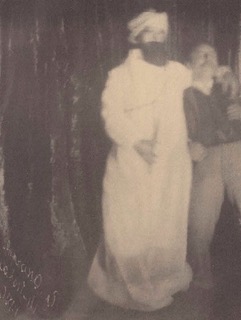
The best-known British slate-writer was William Eglinton. (Born Eglington) He first achieved fame as a medium in 1875, aged seventeen. Initially, he conducted dark séances involving levitation and the materialisation of his spirit control, Abdullah. Spiritualist Archdeacon Thomas Colley was present at such an event in 1876 and cut off a portion of the robe and beard of the ghostly figure. These were later found to match materials found in Eglinton’s portmanteau. This was not, however as one might imagine, a career-ending revelation. Colley, not wanting to bring disgrace to the spiritualist movement, decided not to act on his discovery and gave the medium the benefit of the doubt.

William Eglington with Abdulah
In 1882 Eglinton was accused of conspiring with theosophist Madame Blavatsky to commit a fraud. He had claimed that while on board the S.S. Vega from Ceylon he had written letters that were transported to a spiritualist circle in Calcutta by psychic means. It may have been as a reaction to this controversy that Eglinton, looking for some less detectable means of mediumship, turned to slate-writing, in which he enjoyed considerable success. In 1886 however the subject of slate-writing was examined in some detail by the Society for Psychical Research.

A young clerk, Samuel John Davey, had attended a number of séances with Eglinton, when he began to suspect that there was trickery involved. Rather than try to expose Eglinton directly, Davey decided to teach himself conjuring in order to show that all the manifestations of the slate-writer could be produced without any intervention by spirits. He then conducted a number of séances, which his sitters found wholly convincing and afterwards informed them that his results were achieved by conjuring. Davey’s experiments also highlighted how little the observation and memory of the sitters could be relied upon. His work, reported in the Journal of the Society for Psychical Research in 1887 sparked a furious debate. With letters to the Journal denouncing Eglinton as a fraud, spiritualists turned on Davey, accusing him of secretly being a medium. Several members of the SPR resigned in protest. Eglinton had been abroad, but on his return must have realised that even the world of slate-writing was too warm for him. He abandoned his career as a medium and took up journalism, in which he achieved notable success. He died in 1933, and his obituary in The Times makes no mention of his mediumship.

Davey, whose insight, enterprise and diligence had illuminated the dark surfaces of the slates, never completed his work. He died from typhoid in 1890 at the age of 27.

After a spell on the continent, which was not entirely free from controversy, Henry Slade returned to the United States, and was practising as a medium in New York, when he attracted the attention of the Seybert Commission for Investigating Modern Spiritualism. A Mr Henry Seybert, who had been a profound believer in spiritualism, had shortly before his death, gifted money to the University of Pennsylvania on condition that it appointed a commission, which, as one of its purposes was the investigation of spiritualism. Having no success with a Philadelphia medium, the commission sent for Henry Slade, and the results were such as could not have been anticipated by either Slade or the late Mr Seybert. 

The observers stated bluntly that whatever Slade might have done previously the manifestations they observed were ‘fraudulent throughout.’ It had not even been necessary to use any ‘elaborate method of investigation; close observation was all that was required.’ It was noticeable that general communications written by the spirits covered most of the slate and were well-written. On the other hand, where the spirit was answering a question put during the séance the message was brief and clumsily written. The conclusion was that Slade had prepared the long messages before the séance, substituting the written slate for a clean one. He had written the others while holding the slate under the table, concealing what he was doing with convulsive spasms of his body.

The Seybert report was published in 1887, and effectively destroyed Slade’s career. Unlike Eglinton he had no other means of making a living. He died in poverty in 1905.

The slate-writers were a curious diversion in the world of mediumship, but ultimately none of them was ever shown to be anything more than a clever and convincing conjuror.

Sources:

The Case For and Against Psychical Belief, Carl Murchison, (ed), (Humphrey Milford, Oxford University Press, 1927) pp. 242-3
(Preliminary Report of the Commission Appointed by the University of Pennsylvania to Investigate Modern Spiritualism, (Philadelphia, J. B. Lippincott Company 1887, p. 7)
Vagrancy Act, 1824 Chapter 83, 5 Geo 4
The Bottom Facts Concerning the Science of Spiritualism, Truesdell, John W, (G W Carleton and Co, New York, 1883)
The Possibilities of Mal-Observation, &c., from a Practical Point of View, Davey, S J, Journal of the SPR, January 1877 pp 8-44
Mr Eglinton, Journal of the SPR, June 1886 pp 282-3
Mr W. Eglington, The Times, 11 March 1933, p. 12.

~~~~~~~~~~

Linda Stratmann is the author of thirteen non-fiction books and eleven novels, including the popular Frances Doughty series set in 1880s Bayswater. www.lindastratmann.com

An Unquiet Ghost: Mina Scarletti Mysteries book 3
In 1871 Brighton, a betrothed couple want to solve a family murder by finding a medium who can contact the dead man. They go to Mr Castlehouse, a slate-writer, who claims to receive messages from the spirits. Will they find the answer they seek? 


Tuesday, February 27, 2018

Hannah Lightfoot, “The Fair Quakeress”- Historical Hoax?

by Lauren Gilbert

Portrait of A Lady-Attributed to Sir Joshua Reynolds,
this may be a portrait of Hannah Lightfoot.


Historical hoaxes crop up from time to time. Examples ranging from the Piltdown Man in England (here) to Francis Drake’s Plate (here) in the US and others abound. Some are found to be pranks, some deliberate hoaxes. Then there are stories about people and personal relationships. They start with whispers, then printed hints and finally, hey presto! We now have full blown “history”. Gossip? Undoubtedly. True? No one really knows. Sometimes there simply aren’t enough known facts to determine the answer. A case in point is the story of Hannah Lightfoot and the very young Prince of Wales who became George III.

THE LEGEND

Young George, Prince of Wales, saw Hannah Lightfoot’s beautiful, unblemished face through a window (or maybe at a masquerade) and fell immediately in love with her sometime in 1753, and she with him. At some point, they began a passionate affair. She married Isaac Axford in December of 1753, and was snatched from the doors of the church (or maybe 6 weeks later) by the prince (or by the prince’s mother’s orders), who took her to live in one of the royal residences or another residence connected with the royal family. One particularly lurid account has the prince and Hannah in a coach pursued up the turnpike by Mr. Axford. George cleared the tolls by shouting “Royal Family”(1) at the tollkeepers, while poor Mr. Axford had to stop and pay each toll, ultimately losing the couple.

There is also an account that George was married to Hannah in the spring of 1759 by James Wilmot. They had at least one child (some accounts list 3, and the story has grown to a point where there seems to have been many children). When King George II died in October of 1760, Prince George’s mother and Lord Bute convinced him of the need to make a marriage of state to a royal princess, and he bigamously married Princess Charlotte of Mecklenburg-Strelitz. Hannah and her child(ren) left. Some accounts place her in South Africa, others in America. Some sources indicate that Charlotte found out about this previous marriage; she insisted on being married again to George III in 1765 (again by James Wilmot), supposedly after the death of Hannah in 1764.

THE FACTS

GEORGE
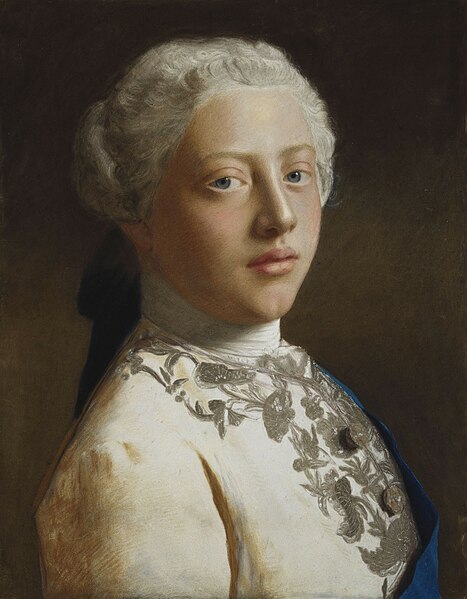
George III as Prince of Wales by Jean-Etienne Liotard, painted 1754

George was born June 4, 1738, the second child and oldest son of Frederick, Prince of Wales, and his wife Augusta, Princess of Saxe-Gotha. He was the grandson of King George II and Queen Caroline. He was born two months prematurely and tended carefully so that he became a healthy child. Prince Frederick was interested in the arts, sciences, writing and sports, and was quite involved with his children’s education. George and his younger brother Edward studied with Rev. Ayscough, learning to read and write both English and German well. It is likely that, thanks to Prince Frederick’s interests, they had exposure to literature, including Jonathon Swift and Alexander Pope, music, including the work of Bononcini and Handel, and fine art, thanks to Frederick’s personal collection, which included works by Van Dyck, Rubens and Breughel. Frederick also played with his children when he was available.

When he was age 11, a new tutor, George Lewis Scott, was assigned to George. He and his brother also were appointed a governor, Lord North. Their schedule expanded to include Latin and Greek, with a work day that started at 8:00 in the morning and continued until bedtime (between 9:00 and 10:00 at night), 6 days per week. On Sundays, they attended church multiple times and studied religion with Dr. Ayscough in the time available. (This schedule is outlined in Christopher Hibbert’s biography of George III.) This schedule was maintained, wherever they were in residence, until Prince Frederick died suddenly on March 31, 1751. George became the heir apparent at age 12.

Because of the antipathy George II had felt for Frederick, changes were made in the children’s household to get rid of those appointed by Frederick. Lord Harcourt replaced Lord North and Dr. Thomas Haytor. George’s studies continued, including Latin, mathematics, trigonometry, algebra, history, sciences, etc. He had a music master, drawing master, dancing master, fencing master, riding master, and went to outside lectures as well. He was shy, reserved and somewhat melancholy. Still living with his mother Princess Augusta, George came under the influence of Lord Bute, who had many political enemies. When George turned 18 in 1756, George II offered George his own household, but George refused, choosing to stay with his mother. His education continued, with interests expanding into agriculture, architecture and international trade. He received input from conflicting sources regarding current affairs and politics, but placed a lot of trust in Lord Bute.

Prince George turned 21 in June of 1759, at which point (according to Stella Tilyard in Aristocrats), he was still a virgin(2). In November 1759, Prince George took his seat in the House of Lords. Also in November of 1759, Sarah Lennox (one of the famous Lennox sisters) arrived at Holland House in London. She was almost 15 years old. She was presented at court in late November and met Prince George again. Sarah was known to the King and the royal family. She had participated in Protestant Irish society, so was more socially sophisticated than the Prince. Prince George apparently fell in love with Sarah immediately. Sarah was much admired at court. In addition to coping with his passion for Sarah, Prince George was also trying to convince his grandfather George II to give him something more to do politically. Somewhere around this time, he confessed to Lord Bute that he was interested in girls, Sarah in particular. Since Prince George was expected to marry for state reasons, his interest in Sarah was not encouraged.

Although Prince George yearned for Sarah, and it appears he asked her to marry him at least once, nothing came of this romance. On October 25, 1760, King George II died, making George king. Meetings with Lord Bute, William Pitt, Cabinet ministers and government business dominated the new king’s time. George III ultimately married Princess Charlotte of Mecklenburg-Strelitz on September 8, 1761. They were crowned king and queen together on September 22, 1761. In spite of his passion for Sarah Lennox, George III was devoted to his wife almost from the beginning, and to their family (they had 15 children.)

HANNAH


Hannah Lightfoot was the daughter of Matthew Lightfoot, a shoemaker by some accounts, and Mary Wheeler his wife, and was born in approximately 1730. Matthew died in 1732 or 1733. The Lightfoots and Wheelers were members of the Society of Friends. Mary’s brother Henry Wheeler, a linendraper, took Hannah and her mother into his home at some point. Accounts indicate he had a shop in St. James’s Market that was apparently not far from the Opera House and Pall Mall. Most accounts indicate Hannah was expected to work for or with her uncle in the family business. On December 11, 1753, Hannah married Isaac Axford, a grocer, in Dr. Keith’s marriage chapel in Mayfair. Isaac’s parents were Baptists (although other family members may have been members of the Society of Friends). The records of the Westminster Society of Friends indicate Hannah was expelled from the society in 1756 for being married by a priest to a non-member. Data indicates she had left and could not be contacted.

In 1757, a man named Robert Pearne of Isleworth left a will leaving Hannah (Mrs. Hannah Axford, formerly Miss Hannah Lightfoot) an annuity of 40 pounds per year. Mr. Pearne was reportedly a wealthy, single man with property in England and Antigua.  He may, or may not, have been known to Hannah's family.  No one really knows why he left her the annuity.  (I saw nothing to indicate anyone has discovered if it were claimed.)  Isaac Axford, claiming to be a widower, remarried in December of 1759. Hannah’s mother, Mary Wheeler Lightfoot, made a will in January of 1760 leaving her property to Hannah, stating she had not heard from her daughter in 2 years and did not know if she were alive or dead. Mary died in May of 1760. By all accounts that I have read indicate Hannah disappeared shortly after her marriage in December of 1753. To date, there is no indication that a date, place or cause of death has been established for her.

CONCLUSION

In 1753, George, Prince of Wales, was 15 years old and engaged with studies 6 days a week under the supervision of a governor, tutors and multiple masters, as well as his mother and Lord Bute, with Sundays equally occupied with multiple church attendances and religious studies. In 1753, Hannah would have been somewhere between approximately 23 years old, a member of a conservative and devout religious sect, and probably working in her uncle’s shop. There is no indication of any contemporary gossip of the prince being involved with any girl at this time in his life. Frankly, I don’t know when he would have had the time or the opportunity. It also does not seem likely that a young woman working for her keep in her uncle’s shop would have had much spare time to carry on a flirtation with passing royalty.

There is no contemporary record indicating a meeting between George and Hannah or of Hannah’s presence in any of the royal residences or of any gossip concerning the prince’s romance with Hannah. (One would think that someone would have noticed, given the intense supervision to which the prince was subjected.) I think that a mad flight up the turnpike would have been noted somewhere. The idea that a 15-year old Prince of Wales could organize such an event without getting caught by one or more of his many minders also seems wildly improbable.

We do know that by the end of 1759, George was madly in love with and wanted to marry Sarah Lennox. This seems completely out of character if he were in fact happily ensconced in a family relationship with Hannah and a child or children. After his grandfather’s death October 25, 1760, he was occupied with matters of state and forming a government as king, working closely with Lord Bute and his mother. He was married to Charlotte September 22, 1761. A letter was written by Lady Sophia Egerton to her uncle William Bentinck (who became the Duke of Portland) in December of 1759 that indicated that George had kept a beautiful Quaker, had a child by her, and she was dead. The Quaker in question was not named. There is nothing to indicate where she got the story, and there is no indication of similar stories in other sources. The timing is certainly odd, given the then-Prince’s known feelings for Sarah Lennox. I have not been able to find the full text of this letter, and I’ve seen no discussion regarding the existence and the validity or otherwise of this letter.

Subsequently, no rumors concerning a romance between Hannah and the Prince of Wales surfaced until the 1770’s, when an account was published that the prince had had this relationship, after which they popped up occasionally. By this time, George had been king and a contented family man for at several years. While it has been noted that George III was aware of and respected the Society of Friends, no evidence indicates this viewpoint on a personal relationship with an affair with a young woman. From 1779 until 1820, the story did not appear to be in circulation. In 1817, a woman named Olive Wilmot Serres contacted the Prince of Wales, claiming to be the daughter of the Duke of Cumberland.  After the death of George III, she revised her story to say she was the legitimate daughter of the Duke of Cumberland.  Such documentation of the relationship between George and Hannah that has been located include marriage certificates indicating that a marriage was performed between George and Hannah by James Wilmot in Curzon Street Chapel in either April or May of 1759 (apparently there are 2 certificates, each with a different date) and a will signed in 1762 by Hannah Regina appeared in a case filed by the illegitimate daughter of Olive Serres in a last attempt to establish that her mother was Princess Olive, daughter of the Duke of Cumberland and petitioned King George III for a pension. (For Princess Olive’s story go HERE and HERE  and in THE GREAT PRETENDERS shown in Sources below). The royal family contested Olive's allegations and, after Olive's death, her daughter Lavinia took the case to court in 1866. The documents (including those related to Hannah Lightfoot and George III) were finally pronounced at best suspicious, probably forgeries. (There are indications that George III’s oldest son, George IV, spread the story, using it to tease Queen Charlotte about the legitimacy of her marriage to his father.(3))  It is worth noting that the chapel where the wedding of George and Hannah allegedly occurred in 1759 was closed in 1754.(4)   The story grew throughout the Victorian era. There is also no evidence linking the portrait shown, attributed to  Joshua Reynolds, to Hannah Lightfoot Axford.  It is a portrait of a woman in an elegant gown, not in Quaker attire.  (There is a similar portrait, painted in 1756 by Joshua Reynolds, hanging at Knole, titled "Miss Axford, "The Fair Quakeress", also in fashionable garb.)  Either or both portraits could be portraits of Miss Ann Axford, who was not a Quaker but a member of a well-to-do family of grocers in Ludgate Hill. 

While Hannah Lightfoot Axford did exist, and did disappear sometime after her marriage to Isaac Axford on December 11, 1753, there is nothing linking her disappearance to the then-Prince of Wales. The inheritance of an annuity in 1757 from Robert Pearne would indicate other possibilities. Is it completely impossible that, at some point, she may have met George? No. I do however, feel a relationship of any kind between the two would not have gone unnoticed and undocumented, and a passionate romance that included living together and producing a child (or several) without any contemporary record does seem impossible to me.

Footnotes

(1) Bondeson, Jan. THE GREAT PRETENDERS The True Stories behind Famous Historical Mysteries. P. 175.

(2) Tilyard, Stella. ARISTOCRATS. P. 112

(3) Hampden, John Jr. THE ARISTOCRACY OF ENGLAND A History for the People. P. 204.

(4) Bondeson, Jan.  Op. Cit. P. 181

SOURCES INCLUDE

Bondeson, Jan. THE GREAT PRETENDERS The True Stories behind Famous Historical Mysteries. 2004: W. W. Norton & Co., New York.

Hibbert, Christopher. GEORGE III A Personal History. 1998: Viking of Penguin Books. Reprinted by Basic Books, a Member of the Perseus Books Group, New York.

Pendered, Mary Lucy. THE FAIR QUAKER Hannah Lightfoot and Her Relations with George III. 1911: D. Appleton and Co., New York. Kessenger Legacy Reprint.  (historical book reprint including imperfections) in my possession.

Tilyard, Stella. ARISTOCRATS. 1994: Farrar, Straus and Giroux, New York.

Archive.org. Doran, Dr. LIVES OF THE QUEENS OF ENGLAND. Second Edition in Two Volumes. Vol. II. . 1855: Richard Bentley, London. HERE

Chest of Books. “True Love Stories of Famous People-29. King George III and Hannah Lightfoot” from EveryWoman’s Encyclopaedia, 1910-1912.  HERE

GoogleBooks. Ashdown-Hill, John. ROYAL MARRIAGE SECRETS: Consorts & Concubines, Bigamists and Bastards. 2013: History Press. (Preview)  HERE

GoogleBooks. Hampden, John Junior (annotated William Howiitt). THE ARISTOCRACY OF ENGLAND A History for the People. 1856: Chapman Brothers, London.   HERE
Wikipedia.  "Olive Serres"(last edited 30 June 2017). No author or date provided. HERE
Illustrations:
Joshua Reynolds' Portrait of Hannah: HERE
Liotard's portrait of George: HERE
Imaginary portrait of Hannah is the frontispiece from Mary Lucy Pendered's THE FAIR QUAKER Hannah Lightfoot, and Her Relations with George III (1911) as reprinted by Kessinger Legacy Reprints, p. vii. in my possession.  (THE MYSTERIES OF THE COURT OF LONDON by G. W. M. Reynolds, from which she obtained this portrait, was a "penny dreadful" published in 1849 by J. Dicks.)


~~~~~~~~~~

Lauren Gilbert lives in Florida and is a long-time member of the Jane Austen Society of North America. An obsessive reader, she has been writing since childhood, and achieved her dream of publishing a book with HEYERWOOD: A Novel in 2011. She is working on her second novel A RATIONAL ATTACHMENT. Visit her website HERE for more information.


Sunday, February 25, 2018

Editors Weekly Round-up, February 25, 2018

by the EHFA Editors

Join us on the blog every week for wonderful posts on various aspects of British history. Enjoy our weekly round-up:

by Kim Rendfeld


Wednesday, February 21, 2018

Queen Ælfflæd: A Bride Worth Killing Over

By Kim Rendfeld


Today we know little about Ælfflæd, except that kings wanted to her to marry their sons.

She was the daughter of deposed Mercian King Ceolwulf, who claimed to descend from the legendary Penda’s brother. Apparently, that pedigree made her a desirable bride.

Ælfflæd’s birth and death dates are unknown. Not a surprise consider the dearth of information about 9th century Mercia. She lived in turbulent times. In a span of 54 years, there were 10 kings. The realm faced danger from Viking raids and power struggles within.

Her uncle Cenwulf succeeded Offa’s son, Ecgfrith, who died in December 796, maybe not of natural causes. Offa had a reputation for ruthlessness, but Cenwulf was no Mr. Nice Guy. Early in his reign, he suppressed a rebellion in Kent and had its leader blinded and his hands chopped off. He released his crippled rival to Winchcombe, an abbey and center of power. His daughter, Cwenthryth, was abbess of Winchcombe and Minster in Thanet in Kent. (Rumors of Cwenthryth ordering the murder of her brother, later revered as a martyr, are likely apocryphal.)

Cenwulf died without male heirs in 821, passing the throne to Ælfflæd’s father, Ceolwulf. If she was at court as a child, it was not for long. Although anointed in 822, Ceolwulf was deposed only a year later, and we don’t know why.

Coins from Ceolwulf's reign (The Portable
Antiquities Scheme/The Trustees of
the British Museum, CC BY-SA 2.0,
via Wikimedia Commons}


His successors fared no better. Beornwulf, perhaps a descendant of rival family to Offa, died in 826, at the hands of East Angles. Then Ludeca died the next year, also in battle against the East Angles.

Wiglaf ascended to the throne in 827. He was deposed by Wessex King Ecgberht in 829 but resumed his reign in 830. After that scare, Wiglaf might have realized he needed some help if he didn’t want to wind up like the last two rulers. Beornwulf, Ludeca, and Wiglaf might have been regional rulers—they could seize the throne but couldn’t secure the support of all Mercian factions. Wiglaf needed an alliance, and marriage between noble families was one way to forge that. His son Wigmund was the eligible bachelor and the father looked to Ælfflæd.

Why Ælfflæd, the daughter of a deposed king? For one thing, she might have been wealthy and controlled a lot of land. She was the sole heiress for her father and, after Cwenthryth passed, her uncle. Perhaps, Mercians still held a high regard for her ancestors, and she had friends through the kingdom.

History is silent on whether Ælfflæd immediately supported the union and her family’s return of power or required persuasion. It’s not too much of a stretch to think she welcomed the offer. Medieval women were expected to manage assets and wield influence in Church and secular politics. I suspect Ælfflæd, much like another woman with the same name, was quite capable.

We don’t know how well Wigmund and Ælfflæd got along. They had a son, Wigstan. Whether they had another son, Ceolwulf, is uncertain. If there was a second child named after his maternal grandfather, that says a lot about Ælfflæd and her importance.

You might have noticed part of the father’s name often appears in the names of his children, both sons and daughters. Ælfflæd seems to be an exception. There’s no way to know for certain, but it is possible she had been named for Saint Ælfflæd, an influential abbess of Whitby who had died in the previous century. Ceolwulf’s parents might have wanted to remind the people of another king, either Ælfflæd’s father or an 8th century saint who was king of Northumbria.

Wiglaf ruled for another 10 years, a long time in this period. Exactly who succeed him and when is in dispute, but here’s what I suspect. The crown passed to Wigmund, who ruled another nine years until his death.

Crypt at Repton (public domain, via Wikimedia Commons)


According to legend, Wigmund’s son Wigstan preferred the religious life to ruling the kingdom and appointed his mother regent. If Ceolwulf was his brother, why didn’t the crown pass to him? Was Ceolwulf too young?

Wigstan’s kinsman Beorhtfrith wanted to wed the widowed Ælfflæd. Politically, this would have made sense. The marriage would reconcile two noble families who had been at odds. (Given the similarity of names Beorhtwulf and Beornwulf, it is likely the two were related.) It’s not too much of a stretch to imagine Ælfflæd still young enough to bear children.

But Wigstan forbid the marriage—or persuaded his mom to refuse the offer—because of consanguinity. Beorhtfrith and a servant murdered Wigstan on June 1, 849. Interred with his father at Repton, Wigstan would later be canonized as a martyr.

We know Beornwulf, Beorhtfrith’s father, was the next king. What happened to Ælfflæd is unclear. She might have retired to Winchcombe and become its abbess. History is silent on Ælfflæd’s grief. Nor does it tell us if she prayed for Beorhtwulf’s downfall.

Beorhtwulf’s reign lasted only three years. Burgred succeeded him after a Mercian defeat at the hands of the Vikings. Then Burgred himself was ousted by Vikings in late 873 or early 874.

Ceolwulf II succeeded him. Perhaps an older man when he became king, he’s been called a puppet of Vikings, but because of his royal descent, he was acceptable to Mercians. The Vikings and the people of Wessex accepted him as the ruler of Mercia. We don’t know if Ælfflæd was alive to witness this. But if she were around, and if this Ceolwulf was his son, perhaps she felt some triumph to see royal power back in her family’s hands.

Sources
Oxford Dictionary of National Biography, including:
“Cenwulf” by M.K. Lawson
“Cwenthryth” by S.E. Kelly
"Beornwulf" by S.E. Kelly
"Wiglaf" by S.E. Kelly
"Wigstan [St Wigstan]" by David Rollason
"Berhtwulf [Beorhtwulf]" by S.E. Kelly
"Burgred [Burhred]" by S.E. Kelly

A Biographical Dictionary of Dark Ages Britain: England, Scotland, and Wales, C. 500-c. 1050 by Ann Williams, Alfred P. Smyth, D.P. Kirby

The Mammoth Book of British Kings and Queens by Mike Ashley
~~~~~~~~~~

Kim Rendfeld has written two novels set in 8th century Europe. In The Cross and the Dragon, a Frankish noblewoman must contend with a jilted suitor and the fear of losing her husband (available on Amazon). In The Ashes of Heaven's Pillar, a Saxon peasant will fight for her children after losing everything else (available on Amazon). Her short story “Betrothed to the Red Dragon,” about Guinevere’s decision to marry Arthur, is set in early medieval Britain and available on Amazon.

Connect with Kim at on her website kimrendfeld.com, her blog, Outtakes of a Historical Novelist at kimrendfeld.wordpress.com, on Facebook at facebook.com/authorkimrendfeld, or follow her on Twitter at @kimrendfeld.


Sunday, February 18, 2018

Editors Weekly Round-up, February 18, 2018

by the EHFA Editors

Never miss a post - British history across the centuries, with our round up for the week ending February 17 featuring:


Friday, February 16, 2018

In Search of Bannockburn

By Annie Whitehead

On a recent trip to Scotland I had, as is my wont, attempted to see as many historical sites as possible, and, looking at the map as we left Doune Castle (filming location for Outlander, and Monty Python and the Holy Grail) it seemed to me that a short drive would take us to Bannockburn, and since the place was marked clearly on the map, we'd be there in a matter of minutes.

I'll say no more about that, except that the words lost, minor roads, and divorce were uttered.

But, a roadside sign showed how close we were, for we had inadvertently found ourselves at the very edge of the battle site.


We had arrived on the eastern slope of Gillies Hill, where the servants, cooks, smiths - essentially the non-combatants - of Robert Bruce's army were placed for safety before the battle. It is assumed that at some point they went down the hill, nearer the fighting, but perhaps only to loot, sensing that the battle was all but won.


Bannockburn was a major engagement between the forces of King Edward II of England and Robert Bruce, thenceforth Robert I of Scotland. A short distance from Gillies Hill we could see the monument to Bruce, and we set off. Eventually we found the Visitors' Centre, down in the valley but not, necessarily, on the site of the battle.


For, although it is known that the battle commenced on 23rd and continued into 24th June, 1314, it has never been established exactly where the main fighting took place.

On 22nd June, Bruce had moved his men to the New Park, two miles south of Stirling Castle. There were trees beside the road to the castle which would make it hard for Edward II's cavalry to be deployed, while to the southwest, a place named Halbert's Bog, and rolling hills, would be protection from attack.

Stirling Castle, seen from Bannockburn
On the morning of 23rd, Edward's troops marched from Falkirk towards Stirling (a matter of some fourteen miles). Edward received word that Robert had blocked the road through the Park. Edward commanded his army to stop for a break, but, either through disobedience or confusion, the vanguard pressed on, only to be pushed back by the Scots.

Later in the day, two of Edward's knights attempted to take 300 cavalry to higher ground, but they were met by a schiltron*, which pushed them back.


Mindful of a possible night-time attack by the Scots, that night Edward decided to cross the Bannock Burn and set up camp on the far side, on the 'Carse', an area of lower ground.

This was no easy feat. They needed to erect makeshift bridges to get the horses across the water. It took a long time, with some having to wait until nearly dawn to cross.

Meanwhile, at dawn, Robert Bruce ordered an advance, as close to Edward's line as possible. First to engage were the archers, but it was the Scots who were forced to pull back first. The English cavalry lined up, as best they could in the unfavourable terrain.

The English cavalry could not get past the schiltron, led by the Earl of Moray. Unable to present more than a limited front, they could not take advantage of their superior numbers, and were further hindered by those who began to retreat, pushing them back. Sir Robert Keith successfully led the Scottish cavalry against the English archers, depriving Edward of his deadliest resources.

Hand-to-hand combat ensued, with many English soldiers being pushed back to drown in the Bannock Burn.


After the battle, Edward fled to Dunbar, and thence to Berwick. The fighting did not end there, with Scots harrying into England and Robert Bruce facing opposition still from the Balliols, in the form of John Balliol's son, Edward, but a plot against Robert in 1320 failed.

Edward II meanwhile, refused to accept Robert as king of Scotland, but in 1320 the Declaration of Arbroath , a letter (sealed by the nobles of Scotland) to Pope John XXII, asserted Robert's right to rule Scotland.


So, that's a potted history of the battle itself. But while the Visitors' Centre has a wealth of information about it, it cannot provide the answer to the question: where was the battle?

There is hardly any archaeological evidence for the battle. No human remains, no pieces of military or personal equipment, and no mass graves have been found. The fighting took place over a huge area, and this was subject to wholesale looting. The sources refer vaguely to 'the wood', the 'kirk', 'the great ditch' and even a 'dry field', hard to identify now without specific place-names.

It seems to have been agreed that the first day's fighting occurred round New Park, which roughly equates to the site of the Visitors' Centre, but argument continues about the second day, with many topographical features, such as the 'great ditch' still unidentified. Up to eight potential sites have been identified from written sources. These sources include: 
The Lancercost Chronicle, The Chronicle of Andrew of Wynton, Liber Pluscardensis, Chronica gentis Scotorum, Vita Edwardi Secundi, The Brut, or Chronicle of England, and The Anonimalle Chronicle. 
This is not even a complete list, yet still the site cannot be pinpointed with precision. One theory contends that the battlefield was specifically on the Carse, between the Pelstream Burn and the Bannock Burn. Another potential site is under a school and a modern housing estate. The Visitors' Centre was set up to preserve the general area, rather than commemorate a specific site, and there is a magnificent monument to Robert Bruce there.


In 2012 and 2013 an archaeological survey of the Carse was undertaken, yielding some medieval pottery which was of roughly the date of the battle, which suggests human settlement and thus reduces the weight of one argument which contends that the area was too boggy to be a battle site.

The best hope for identification lies in a technique known as LiDAR, a system of recording the landscape using lasers to create a computer model of the landscape, and then studying the possible routes taken by Edward's army.

Ironic, then, that we had initially been unable to find Bannockburn, for it transpires that there is nothing really to find.

As an Anglo-Saxonist, I am used to relying on written and archaeological evidence. Rarely am I able to visit a known battle site, or see a building which dates from the period. So it still surprises me that such a major battle as Bannockburn, one which marks, to all intents and purposes, Scottish independence from the Plantagenet kings, should have left so little trace of itself. A huge impact on history, yes, and a wealth of written material, too. But for the visitor to Bannockburn, all that awaits is - an admittedly impressive - 3D visual 'experience', a chance to view the monument, but no insight at all into where the fighting actually took place.

*Schiltron - a formation of tightly-packed spearmen (around 500-1000)

[all illustrations are photographs taken by and copyright of the author, except the Declaration of Arbroath, which is a Public Domain image via Wikipdedia]

~~~~~~~~~~

Annie Whitehead is an author and historian, and a member of the Royal Historical Society. Her first two novels are set in tenth-century Mercia, chronicling the lives of Æthelflæd, Lady of the Mercians, who ruled a country in all but name, and Earl Alvar who served King Edgar and his son Æthelred the Unready who were both embroiled in murderous scandals. Her third novel, also set in Mercia, tells the story of seventh-century King Penda and his feud with the Northumbrian kings. She is currently working on a history of Mercia for Amberley Publishing, to be released in 2018.