Showing posts with label 9th century. Show all posts

Monday, July 13, 2020

The Triads of Ireland: Medieval Irish Wisdom.

By E.M. Powell

Anyone who loves history will tell you that one of the most enjoyable things to do is to visit actual historical sites. An added bonus of writing historical fiction is that one can do quite a lot of this in the name of research. One of my more recent trips was to the wonderful Dunmore Cave in Co. Kilkenny in Ireland.

Dunmore Cave, Co. Kilkenny
© E.M. Powell

Dunmore Cave has been used for refuge and storage for hundreds of years. A Viking massacre here is recorded in the Annals of the Four Masters, a 17th century compilation of earlier Irish chronicles. In 928 Godfrey and the Vikings of Dublin reputedly slaughtered more than 1,000 people here. Archaeological investigations have found the remains of hundreds of people, with many being those of women and children.  10th century coins, beads, and pins have also been found.

I was particularly pleased to see an information board announcing it as ‘One of the Three Darkest Places in Ireland’. No, this wasn’t just a cheap marketing ploy by the Irish Office of Public Works. It's a reference to the mention of Dunmore Cave in the Irish Triads. Triads, the arrangement of ideas or sayings in groups of three, are common in ancient Irish and Welsh writing. They are a type of wisdom literature, serving to instruct, enlighten and at times entertain the reader/listener with truths about life.

St. Luke- 9th C Irish MS
Public Domain

Trecheng Breth Féne or The Triads of Ireland is a collection composed about the ninth century AD by an anonymous author who was most likely a cleric. One might think that the Irish Triad wisdom of over 1,100 years ago would be remote and/or inaccessible. It’s quite the opposite. So much of what this unknown writer has left us could have the ink still wet on the paper. I thought I’d share my personal favourites.

Some of the triads are simply a geographical reference, such as to Dunmore Cave above. We have ‘The three mountain-passes of Ireland: Baltinglass, the Pass of Limerick, the Pass of Dublin’ and ‘The three uneven places of Ireland: Breffny, the Burren, Beare.’ Anyone who has visited the Burren and had a walking boot wedged in a limestone crack would never disagree with this assessment.

Early Medieval Grave Slab, Durrow, Co. Offaly
© E.M. Powell

Moving on from geography, the writer relates some moral musings:
‘Three rejoicings followed by sorrow: a wooer's, a thief's, a tale-bearer's.’
‘Three things which justice demands: judgment, measure, conscience.’
‘Three things which judgment demands: wisdom, penetration, knowledge.’
Wise indeed, yet quite theoretical. Happily, he gets more specific:
‘Three laughing-stocks of the world: an angry man, a jealous man, a niggard.’ 
Yes, indeed, but closely followed by:
‘Three ruins of a tribe: a lying chief, a false judge, a lustful priest.’ 
‘Three ranks that ruin tribes in their falsehood: the falsehood of a king, of a historian, of a judge.’

Early Medieval Grave Slab, Durrow, Co. Offaly
© E.M. Powell

One has to wonder at this point if the scribe has somehow found a wormhole where he is viewing the 21st century. Leaving his very pertinent observations on human nature, we come to the cleric’s Triads that relate to the natural world. These for me have great lyrical beauty.
‘Three slender things that best support the world: the slender stream of milk from the cow's dug into the pail, the slender blade of green corn upon the ground, the slender thread over the hand of a skilled woman.’
‘Three live ones that put away dead things: a deer shedding its horn, a wood shedding its leaves, cattle shedding their coat.’
‘Three cold things that seethe: a well, the sea, new ale.’
‘Three sounds of increase: the lowing of a cow in milk, the din of a smithy, the swish of a plough.’
‘Three dead things that give evidence on live things: a pair of scales, a bushel, a measuring-rod.’
‘Three renovators of the world: the womb of woman, a cow's udder, a smith's moulding-block.’
Beautiful, of course, but this unknown writer didn’t simply excel at pastoral imagery. He also has a number of observations of human nature that are on the nail and often hilarious.
‘Three rude ones of the world: a youngster mocking an old man, a healthy person mocking an invalid, a wise man mocking a fool.’
‘Three ungentlemanly things: interrupting stories, a mischievous game, jesting so as to raise a blush.’
‘Three ungentlemanly boasts: I am on your track, I have trampled on you, I have wet you with my dress.’ (Note: on this one, I have no idea. I included it because I love it.)
‘Three deaths that are better than life: the death of a salmon, the death of a fat pig, the death of a robber.’
‘Three silences that are better than speech: silence during instruction, silence during music, silence during preaching.’
‘Three speeches that are better than silence: inciting a king to battle, spreading knowledge, praise after reward.’
‘Three things that constitute a buffoon: blowing out his cheek, blowing out his satchel, blowing out his belly.’
‘Three wealths in barren places: a well in a mountain, fire out of a stone, wealth in the possession of a hard man.’
‘Three oaths that do not require fulfilment: the oath of a woman in birth-pangs, the oath of a dead man, the oath of a landless man.’
‘Three worst smiles: the smile of a wave, the smile of a lewd woman, the grin of a dog ready to leap.’

Initial- 9th C Irish MS
Public Domain

The last of the Triads I have included have a particular appeal. They reflect the contemporary world that the writer lived in, such as this one about Irish appearance.
‘Three lawful handbreadths: a handbreadth between shoes and hose, a handbreadth between ear and hair, a handbreadth between the fringe of the tunic and the knee.’
The world of work is here, too.
‘Three things that constitute a comb-maker: racing a hound in contending for a bone; straightening a ram's horn by his breath, without fire; chanting upon a dunghill so that all antlers and bones and horns that are below come to the top.’
‘Three things that constitute a carpenter: joining together without calculating, without warping; agility with the compass; a well-measured stroke.’
‘Three things that constitute a physician: a complete cure, leaving no blemish behind, a painless examination.’
‘Three things that constitute a harper: a tune to make you cry, a tune to make you laugh, a tune to put you to sleep.’ 

Durrow High Cross, Co. Offaly c850 A.D.
© E.M. Powell

And as it’s Ireland, we have views on hospitality. First, things the writer isn’t happy with:
‘Three unfortunate things for a man: a scant drink of water, thirst in an ale-house, a narrow seat upon a field.’
‘The three worst welcomes: a handicraft in the same house with the inmates, scalding water upon the feet, salt food without a drink.’
‘Three preparations of a bad man's house: strife before you, complaining to you, his hound taking hold of you.’
‘Three sorrowful ones of an alehouse: the man who gives the feast, the man to whom it is given, the man who drinks without being satiated.’
Counterbalanced with what he approves of:
‘Three preparations of a good man's house: ale, a bath, a large fire.’
‘Three entertainers of a gathering: a jester, a juggler, a lap-dog.’
‘Three accomplishments of Ireland: a witty stave, a tune on the harp, shaving a face.’
‘Three fewnesses that are better than plenty: a fewness of fine words, a fewness of cows in grass, a fewness of friends around good ale.’

John- 9th C Irish MS
Public Domain

But I think he must be back at that wormhole, looking over my shoulder. For, lastly, we have:
‘Three glories of speech: steadiness, wisdom, brevity.’
I’ll accept that 1,100 year old advice: brevity it is. Slán!

~~~~~~~~~~~
References:
Images are either © E.M. Powell or are in the Public Domain and are part of the British Library's Catalogue of Illuminated Manuscripts. 

Kelly, Prof. Fergus, SIR JOHN RHYS MEMORIAL LECTURE: Thinking in threes: the triad in early Irish literature: (2003) http://www.britac.ac.uk/events/2003/autumn/031009.cfm
Lindahl, C., McNamara, J & Lindow, J. (eds.): Medieval Folklore, Oxford University Press (2002)
Meyer, Kuno, The Triads of Ireland, Royal Irish Academy, Dublin, Hodges Figgis & Co. Ltd.: (1906.) http://www.gutenberg.org/files/31672/31672-h/31672-h.htm
Yocum, Christopher: Wisdom Literature in Early Ireland. STUDIA CELTICA, XLVI (2012), 39–58 https://www.academia.edu/419294/Wisdom_Literature_in_Early_Ireland

This is an Editor's Choice from the archives, originally published March 29, 2016.

~~~~~~~~~~~

E.M. Powell's historical thriller and medieval mystery FIFTH KNIGHT and STANDON & BARLING novels have been #1 Amazon and Bild bestsellers. The third Stanton & Barling mystery, THE CANTERBURY MURDERS, will be released in October 2020. Born and raised in the Republic of Ireland into the family of Michael Collins (the legendary revolutionary and founder of the Irish Free State), she lives in northwest England with her husband, daughter and a Facebook-friendly dog. Find out more by visiting her website www.empowell.com or follow her on Twitter @empowellauthor.

Amazon
Barnes & Noble
Waterstones


Wednesday, May 16, 2018

Queen Eadburh: Maligned but Not Murderous

By Kim Rendfeld

A woman who was once a murderous queen of the West Saxons winds up begging in the streets of Lombardy. Lovely poetic justice, if only it were true.

Eadburh, daughter of Mercian King Offa and Queen Cynethryth, was a real person. She did marry a king and was widowed. And she might have ended her days in Lombardy, but not begging and for much more mundane reasons than those in a story written by an author currying favor with a political enemy.

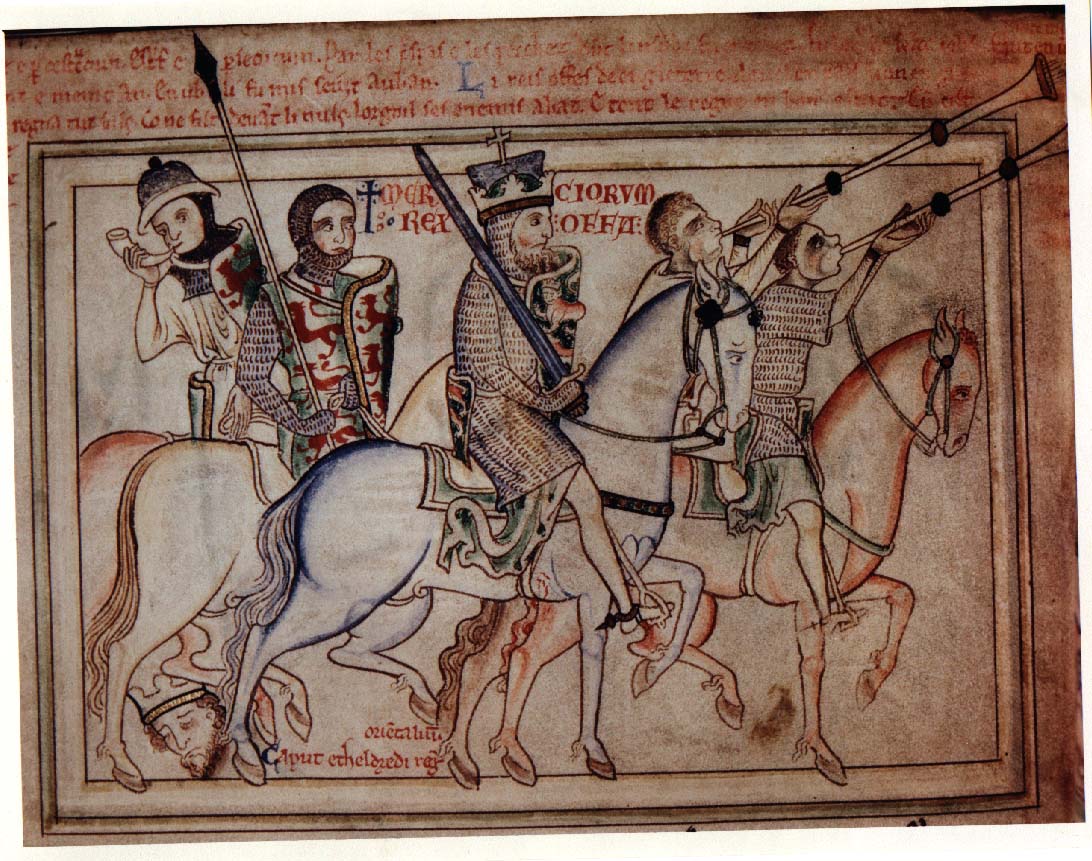
Offa (d. 796) was known for his ruthlessness and for the dike bearing his name. Like most aristocrats, he and his wife arranged for their children to marry for political advantage. In 789, Eadburh wed Beorhtric, king of Wessex.

Offa of Mercia from Matthew Paris's tract on St. Alban,
 13th century (Public domain, via Wikimedia Commons)
The alliance had a mutual benefit. Beorhtric might have come to power as an outsider taking advantage of a power vacuum when his predecessor died. Marriage to the daughter of a powerful Mercian king solidified his claim. In his part of the bargain, Beorhtric teamed up with Offa to drive rival Ecgberht out of England. Beorhtric also had the dubious honor of having Vikings land on his shore and kill his reeve.

Apparently, Eadburh did wield power and influence. She gave away land in her own name and witnessed charters with her husband and her brother. Even though her marriage to Beorhtric lasted several years, they didn’t have children. Men in this age sometimes tried to repudiate wives who didn’t produce a healthy son. Beorhtric seems to have been a steadfast husband. Or maybe he feared upsetting Eadburh’s parents more than dying without an heir.

After Offa died, his son, Ecgfrith, succeeded him, and Beorhtric and Eadburh supported him. But Ecgfrith’s reign didn’t last even a year. He died, likely not of natural causes.

Eadburh and Beorhtric’s marriage lasted until his death in 802. He didn’t die of old age, either.

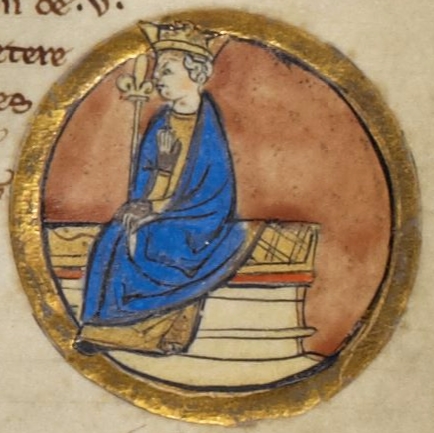
13th century image of Beorhtric
(Public domain, via Wikimedia Commons)

And now we get to the fiction, an account by Asser, who wrote Life of Alfred in 893. The title character was Ecgberht’s grandson. Asser supposedly includes Eadburh’s story to explain why the wives of the Wessex kings weren’t crowned queen like Eadburh was and not take her seat beside him on the throne. More likely this is an attempt to discredit the rival family.

If we are to believe Asser—and I don’t—Eadburh was tyrannical like her father and dominated the relationship (not good in medieval eyes). If her husband liked anyone she didn’t, she would poison the friendship, and if that didn’t work, the poisoning took a literal turn. Poison, the weapon of women and cowards, fits nicely into the narrative.

Eadburh planned to kill a young man she thought was getting too close to her husband. The victim took the poison. So did Beorhtric. Oops.

In reality, Ecgberht is the more probable culprit. He might have invaded Wessex with his followers, and Beorhtric fell in battle. Ecgberht subsequently seized the throne.

According to Asser, Eadburh took treasures and fled. That much is believable. What’s next is a stretch, and that’s being charitable.

Eadburh went to Charlemagne’s court. The emperor, whose fifth wife had died, asked Eadburh if she wanted himself or his son Charles. Eadburh said she preferred the younger man. Charlemagne told her had she chosen the father, she would have gotten the son, but now she could have neither.

This doesn’t pass the laugh test. By medieval standards, Eadburh was not a desirable bride, especially for a royal marriage. Her father and brother were dead, leaving her without the family connections needed to form alliances. Instead, Charlemagne appointed her as an abbess.

Charlemagne by Albrecht Dürer
(public domain,
via Wikimedia Commons)
Using another time-honored technique to discredit women, Asser says that Eadburh was caught fornicating with one of her countrymen and expelled from the convent on Charlemagne’s order. Somehow she made her way to Pavia with a slave and ended her days in shame and misery as a beggar.

She might have spent the rest of her days in Lombardy but not as a punishment or in poverty. A confraternity book written between 825 and 850 shows an “Eadburg” as an abbess of a large Lombard convent. If this Eadburg is the former queen of Wessex, she would be in her 50s to her 70s.

It was common for a widowed queen to retire to a convent, and if the emperor thought her a reliable ally, he might appoint her as the abbess. An abbess was a leader, controlling land and the convent’s other assets, and she usually did not live an ascetic lifestyle.

The real Charlemagne very much believed in the power of prayer, and that extended to winning wars. If he trusted Eadburh to lead her sisters in prayer, it is possible he or his successor, Louis the Pious, might have bestowed the abbey upon her.

Sources

"Eadburh" by Janet L. Nelson, Oxford Dictionary of National Biography

“Beorhtric” by Heather Edwards, Oxford Dictionary of National Biography

Asser’s Life of Alfred

Asser's Life of King Alfred, together with the Annals of Saint Neots erroneously ascribed to Asser
by John Asser, d. 909, edited by William Henry Stevenson

“A handsome, but wretched head.” by Lisa Graves, The History Witch

“Eadburh, Queen of the West Saxons” by Susan Abernethy, The Freelance History Writer

~~~~~~~~~~

Kim Rendfeld has written two novels set in 8th century Europe, and her third novel, Queen of the Darkest Hour, will be published August 7. The ebook about how Queen Fastrada must stop a conspiracy before it destroys the kingdom is available for preorder on Amazon, iBooks, Barnes & Noble, and Kobo.

In The Cross and the Dragon, a Frankish noblewoman must contend with a jilted suitor and the fear of losing her husband (available on Amazon). In The Ashes of Heaven's Pillar, a Saxon peasant will fight for her children after losing everything else (available on Amazon). Her short story “Betrothed to the Red Dragon,” about Guinevere’s decision to marry Arthur, is set in early medieval Britain and available on Amazon.

Connect with Kim at on her website kimrendfeld.com, her blog, Outtakes of a Historical Novelist at kimrendfeld.wordpress.com, on Facebook at facebook.com/authorkimrendfeld, or follow her on Twitter at @kimrendfeld.


Wednesday, March 21, 2018

Cwenthryth: A Maligned Royal Abbess

By Kim Rendfeld

The story of Cynehelm and Cwenthryth has envy, sibling rivalry, lust for power, murder, and divine justice. Too bad it’s just not true.

According to an 11th-century passio (account of martyrdom), Mercian King Cenwulf died in 819, and his realm passed to his 7-year-old son, Cynehelm (also spelled Kenelm). Lusting for power, Cwenthryth persuaded Cynehelm’s tutor to decapitate the child while the young king was hunting. Cwenthryth got the crown, but a dove miraculously delivered a parchment to the pope, telling him where Cynehelm was buried. The pope sent a delegation, led by Wulfred, archbishop of Canterbury, to recover the body and have it enshrined at Winchcombe. Apparently, Cwenthryth was not satisfied with her brother’s death; she wanted to curse him. So she read the psalter backward as the procession passed by her window. Her eyes, literally, dropped to the page, and she soon died in disgrace.

Any resemblance between this tale and actual history is purely coincidental.

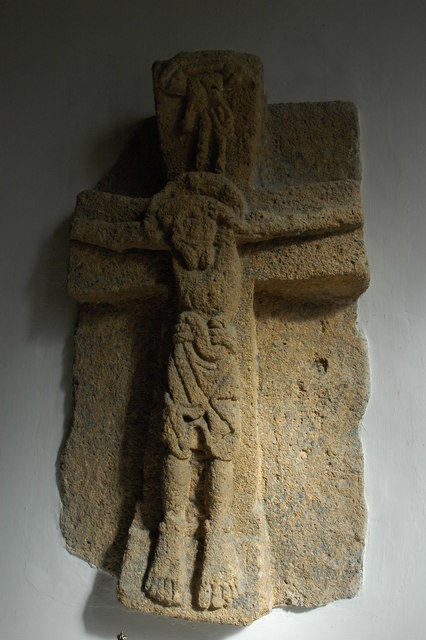
Sculpture of St. Kenelm (photo by
Sjukmidlands,  CC BY-SA 4.0, via
Wikimedia Commons)


The real Cwenthryth was the daughter of King Cenwulf, who reigned from 796 to 821. She did witness a charter as the king’s daughter in 811, the same year Wulfred dedicated a church at Winchcombe.

Cenwulf, who claimed descent from Penda’s brother, had succeeded Offa’s son Ecgfrith, whose death might not have been from natural causes. Offa had a reputation for ruthlessness (Alcuin said Ecgfrith paid for his father’s sins). But Cenwulf had his moments. Early in his reign, he suppressed a rebellion in Kent and had its leader blinded and his hands chopped off. He released his crippled rival to Winchcombe, an abbey Cenwulf had founded in 798 and a center of power.

If Cynehelm was Cenwulf’s son—it is possible with such similar names—Cynehelm preceded his father in death. When Cenwulf died in 821 (two years after the legend says he did), the king did not have a male heir, and his brother Coelwulf ascended to the throne.

Coins with Cenwulf's image (drawing by DrKay,
public domain, via Wikimedia Commons)


If she had a living brother, Cwenthryth likely would have wanted him remain alive and influence him. What happened to Cwenthryth raises a more nuanced question: Why did she become an abbess? As a late king’s daughter and current king’s niece, and one with ties to a dynasty, she would have been a desirable bride. Marriage was a way for noble families to forge alliances. Yet kings sometimes gave daughters to the Church as a thanksgiving for a victory in battle. Did Cwenthryth herself feel pulled to the religious life? Or did she simply not want a husband ordering her around?

As the abbess of Winchcombe, as well as Reculver and Minster-in-Thanet in Kent, she led communities and controlled land. And she was determined to keep control of those properties.

When her father died, Cwenthyth inherited a years-long dispute between Cenwulf and Wulfred (who happens to be one of the good guys in the legend). At the center was who controlled the Kentish churches. Wulfred had reached an agreement with Cenwulf shortly before the monarch died and expected those properties.

Wulfred was a powerful churchman, having anointed Cwenthryth’s uncle Coelwulf as king, but Cwenthryth did not give in to the archbishop’s demand for rent or her obedience.

Unfortunately for Cwenthryth, Coelwulf had a short reign. He was deposed in 823. Perhaps Wulfred saw an opportunity in the new king, Beornwulf. But he underestimated Cwenthyth.

Finally, Wulfred filed a lawsuit against her in 825, demanding those two church properties in Kent and submission from Cwenthryth. Beornwulf was less sympathetic to Cwenthryth and ruled against her, but before she surrendered the Kentish lands, she managed to drag out the process until 827, a year after Beornwulf was killed by East Angles.

Cwenthryth disappears from the historical record after 827. She likely remained abbess at Winchcombe for the rest of her life, and the abbey might have passed to her cousin Ælfflæd, daughter of Coelwulf.

Photo by Philip Halling, CC BY-SA 2.0,
via Wikimedia Commons


So why defame Cwenthryth? Her defiance to a male authority did not make her an ideal woman in medieval eyes, but she wasn’t a murderer.

Like some historical fiction such as The Song of Roland, the passio might have been more about the times it was written in. The 11th century story might reflect the culture of England right before the Norman Conquest. It is similar to Edward the Martyr—a young king killed by treachery of female relative.

Winchcombe, where Cynehelm is interred, might have become a center for pilgrims who wished to pray before a martyr’s relics. Its cathedral was rededicated twice between 970 and 1070. The first was for an Anglo-Saxon revival; the second, to introduce the Norman church.

A religious story like a hagiography or a passio is meant to be a tale of faith rather than a literal historical record. In this case, it might be the message of divine punishment and spiritual blindness manifesting as a physical one.

Sources

Oxford Dictionary of National Biography, including
“Cenwulf” by M.K. Lawson
“Cwenthryth” by S.E. Kelly
“Beornwulf” by S.E. Kelly
“Cynehelm [St Cynehelm, Kenelm]” by David Rollason

“Wicked Queens and Martyred Kings – the 819 Murder of S. Kenelm of Mercia,” The Postgrad Chronicles
~~~~~~~~~~

Kim Rendfeld has written two novels set in 8th century Europe, and a third, Queen of the Darkest Hour, will be published this summer. In The Cross and the Dragon, a Frankish noblewoman must contend with a jilted suitor and the fear of losing her husband (available on Amazon). In The Ashes of Heaven's Pillar, a Saxon peasant will fight for her children after losing everything else (available on Amazon). Her short story “Betrothed to the Red Dragon,” about Guinevere’s decision to marry Arthur, is set in early medieval Britain and available on Amazon.

Connect with Kim at on her website kimrendfeld.com, her blog, Outtakes of a Historical Novelist at kimrendfeld.wordpress.com, on Facebook at facebook.com/authorkimrendfeld, or follow her on Twitter at @kimrendfeld.


Wednesday, February 21, 2018

Queen Ælfflæd: A Bride Worth Killing Over

By Kim Rendfeld


Today we know little about Ælfflæd, except that kings wanted to her to marry their sons.

She was the daughter of deposed Mercian King Ceolwulf, who claimed to descend from the legendary Penda’s brother. Apparently, that pedigree made her a desirable bride.

Ælfflæd’s birth and death dates are unknown. Not a surprise consider the dearth of information about 9th century Mercia. She lived in turbulent times. In a span of 54 years, there were 10 kings. The realm faced danger from Viking raids and power struggles within.

Her uncle Cenwulf succeeded Offa’s son, Ecgfrith, who died in December 796, maybe not of natural causes. Offa had a reputation for ruthlessness, but Cenwulf was no Mr. Nice Guy. Early in his reign, he suppressed a rebellion in Kent and had its leader blinded and his hands chopped off. He released his crippled rival to Winchcombe, an abbey and center of power. His daughter, Cwenthryth, was abbess of Winchcombe and Minster in Thanet in Kent. (Rumors of Cwenthryth ordering the murder of her brother, later revered as a martyr, are likely apocryphal.)

Cenwulf died without male heirs in 821, passing the throne to Ælfflæd’s father, Ceolwulf. If she was at court as a child, it was not for long. Although anointed in 822, Ceolwulf was deposed only a year later, and we don’t know why.

Coins from Ceolwulf's reign (The Portable
Antiquities Scheme/The Trustees of
the British Museum, CC BY-SA 2.0,
via Wikimedia Commons}


His successors fared no better. Beornwulf, perhaps a descendant of rival family to Offa, died in 826, at the hands of East Angles. Then Ludeca died the next year, also in battle against the East Angles.

Wiglaf ascended to the throne in 827. He was deposed by Wessex King Ecgberht in 829 but resumed his reign in 830. After that scare, Wiglaf might have realized he needed some help if he didn’t want to wind up like the last two rulers. Beornwulf, Ludeca, and Wiglaf might have been regional rulers—they could seize the throne but couldn’t secure the support of all Mercian factions. Wiglaf needed an alliance, and marriage between noble families was one way to forge that. His son Wigmund was the eligible bachelor and the father looked to Ælfflæd.

Why Ælfflæd, the daughter of a deposed king? For one thing, she might have been wealthy and controlled a lot of land. She was the sole heiress for her father and, after Cwenthryth passed, her uncle. Perhaps, Mercians still held a high regard for her ancestors, and she had friends through the kingdom.

History is silent on whether Ælfflæd immediately supported the union and her family’s return of power or required persuasion. It’s not too much of a stretch to think she welcomed the offer. Medieval women were expected to manage assets and wield influence in Church and secular politics. I suspect Ælfflæd, much like another woman with the same name, was quite capable.

We don’t know how well Wigmund and Ælfflæd got along. They had a son, Wigstan. Whether they had another son, Ceolwulf, is uncertain. If there was a second child named after his maternal grandfather, that says a lot about Ælfflæd and her importance.

You might have noticed part of the father’s name often appears in the names of his children, both sons and daughters. Ælfflæd seems to be an exception. There’s no way to know for certain, but it is possible she had been named for Saint Ælfflæd, an influential abbess of Whitby who had died in the previous century. Ceolwulf’s parents might have wanted to remind the people of another king, either Ælfflæd’s father or an 8th century saint who was king of Northumbria.

Wiglaf ruled for another 10 years, a long time in this period. Exactly who succeed him and when is in dispute, but here’s what I suspect. The crown passed to Wigmund, who ruled another nine years until his death.

Crypt at Repton (public domain, via Wikimedia Commons)


According to legend, Wigmund’s son Wigstan preferred the religious life to ruling the kingdom and appointed his mother regent. If Ceolwulf was his brother, why didn’t the crown pass to him? Was Ceolwulf too young?

Wigstan’s kinsman Beorhtfrith wanted to wed the widowed Ælfflæd. Politically, this would have made sense. The marriage would reconcile two noble families who had been at odds. (Given the similarity of names Beorhtwulf and Beornwulf, it is likely the two were related.) It’s not too much of a stretch to imagine Ælfflæd still young enough to bear children.

But Wigstan forbid the marriage—or persuaded his mom to refuse the offer—because of consanguinity. Beorhtfrith and a servant murdered Wigstan on June 1, 849. Interred with his father at Repton, Wigstan would later be canonized as a martyr.

We know Beornwulf, Beorhtfrith’s father, was the next king. What happened to Ælfflæd is unclear. She might have retired to Winchcombe and become its abbess. History is silent on Ælfflæd’s grief. Nor does it tell us if she prayed for Beorhtwulf’s downfall.

Beorhtwulf’s reign lasted only three years. Burgred succeeded him after a Mercian defeat at the hands of the Vikings. Then Burgred himself was ousted by Vikings in late 873 or early 874.

Ceolwulf II succeeded him. Perhaps an older man when he became king, he’s been called a puppet of Vikings, but because of his royal descent, he was acceptable to Mercians. The Vikings and the people of Wessex accepted him as the ruler of Mercia. We don’t know if Ælfflæd was alive to witness this. But if she were around, and if this Ceolwulf was his son, perhaps she felt some triumph to see royal power back in her family’s hands.

Sources
Oxford Dictionary of National Biography, including:
“Cenwulf” by M.K. Lawson
“Cwenthryth” by S.E. Kelly
"Beornwulf" by S.E. Kelly
"Wiglaf" by S.E. Kelly
"Wigstan [St Wigstan]" by David Rollason
"Berhtwulf [Beorhtwulf]" by S.E. Kelly
"Burgred [Burhred]" by S.E. Kelly

A Biographical Dictionary of Dark Ages Britain: England, Scotland, and Wales, C. 500-c. 1050 by Ann Williams, Alfred P. Smyth, D.P. Kirby

The Mammoth Book of British Kings and Queens by Mike Ashley
~~~~~~~~~~

Kim Rendfeld has written two novels set in 8th century Europe. In The Cross and the Dragon, a Frankish noblewoman must contend with a jilted suitor and the fear of losing her husband (available on Amazon). In The Ashes of Heaven's Pillar, a Saxon peasant will fight for her children after losing everything else (available on Amazon). Her short story “Betrothed to the Red Dragon,” about Guinevere’s decision to marry Arthur, is set in early medieval Britain and available on Amazon.

Connect with Kim at on her website kimrendfeld.com, her blog, Outtakes of a Historical Novelist at kimrendfeld.wordpress.com, on Facebook at facebook.com/authorkimrendfeld, or follow her on Twitter at @kimrendfeld.


Wednesday, October 28, 2015

Of Talking Wolves and Severed Heads

by Anna Belfrage

The other day I drove by a place called Hoxne in Suffolk. As many English place-names, Hoxne is not pronounced as it is spelled, no this is ”Hoxenn” – although one must admit the alternative would have been difficult to enunciate.

Anyway: Hoxne swished by in 20 seconds. The name gnawed at me, somehow, and when my friend said “this is where some king or other died”, I knew I had heard the name. Problem was, I couldn’t quite remember…

Those among you who know your Anglo-Saxon kings are of course leaping up and down by now. Me, I had to mull it over before it came to me: Edmund. Or, if we’re going to be quite correct, St Edmund.

All old European kingdoms have a martyred royal or two. In Sweden it’s St Erik – whom I seriously doubt ever existed – in Norway it is St Olof (who definitely existed), Scotland has St Margaret, and England has St Edward. And St Edmund. Two royal saints – one of whom was martyred by the ancestors of St Erik and St Olof.

So who was this Edmund, and what did he ever do to deserve the honorific of saint? Well, obviously he died – rather painfully – but many people throughout history have done that without being rewarded with a sainthood.

Very little is known about Edmund. In fact, what comes down through the ages is a story of a beleaguered hero, a symbol necessary to keep the fire burning in the hearts of his people, cowering under the weight of the Viking yoke. Because it was a yoke, the Nordic raiders returning year after year. At times, attempts were made to buy them off, but in the latter half of the ninth century, Ingvar Benlös (Ivar the Boneless), as per the sagas one of Ragnar Lodbroke’s sons, headed a huge Viking army – adequately nick-named the Great Heathen Army  - and landed on English soil. This time, they did not want plunder. This time, the Vikings wanted land.

Due to all that Viking raiding and pillaging, most East Anglian written records of the time have been lost. Vikings didn’t read books – they burnt them. We do know there existed an Edmund – coins with his name testify to this. Those same coins indicate he succeeded a gentleman named Aethelweard as king of East Anglia. It is thought he was related to Aethelstan, king of Kent, and whatever the case, the general supposition is that he was of a “noble and ancient race”, i.e. of royal Saxon blood.

Edmund became king at the tender age of fifteen – or so the Anglo Saxon Chronicle tells us, which means we need to take things with a pinch of salt, as the Chronicle showed little interest in the events unfolding in East Anglia until twenty years after Edmund’s supposed death. But let us assume the Chronicle had it right – if nothing else because it makes for a better story. A young, gallant prince takes up the ermine (well…no ermine at the time) and proceeds to lead his people. By all accounts, he did a good job of this, showing plenty of promise.

He was also a good Christian – a pious young man who in everything was the perfect role model for all those future young men who aspired to be brave and heroic. Here we had a king who refused to compromise when it came to his faith – no matter what it might cost him.

In the 860s, the Viking army landed in England with the intention of staying – for good. This did not go down well with those already there, but the Vikings were ever a somewhat brusque race, and what people didn’t give them, they took. They marched north and conquered York and Northumberland, entered Mercia and forced the Mercians into accepting a treaty, before turning southeast to formally conquer East Anglia.

Edmund defended his kingdom as well as he could. But however competent Edmund may have been, he wasn’t much of a match for the battle-hardened Vikings, and his men were pathetically inadequate in facing up to the roaring Northern horde. To be fair, all of the Saxon kingdoms except Wessex were to succumb before the Viking warlords.

In November of 869, Edmund and his men ended up surrounded by the Vikings. The various versions of the story are somewhat different, but I prefer the one where Edmund yielded to save the lives of his men. There’s another variant whereby Edmund hid himself under a bridge in Hoxne – hoping no doubt to live and fight another day – but his spurs caught the sunlight and a young girl gave him up. However it came about, our Edmund was now in the less than tender care of the Danes.

Vikings were practical people. Why kill someone you could milk until they were dry? They therefore suggested that Edmund buy his life by giving them half his treasure. But, they added, he would have to embrace their faith as well. Anathema to Edmund. He might consider parting with what little treasure he had left, but his faith was not up for discussion. Edmund squared his shoulders, prepared to meet his fate. A young man still, not yet thirty, about to be cut down in his prime.

The Vikings found this rather hilarious – or intriguing. In general, Vikings couldn’t quite understand how anyone could worship such a weakling as the White Christ – the silly man got himself nailed to a cross, and as far as the Vikings could make out, he hadn’t even tried to fight himself free. Very strange, as per the Norsemen. It therefore amazed them that so many men were willing to die for this – in their opinion – useless god.

Edmund was tied to a tree. He was whipped with chains until he was bleeding from all over. He still refused to disavow his god. If Christ could die for all humanity, then Edmund could die for Christ. Very well, said Ubba the Viking, and ordered the half-dead man to be peppered with arrows. Still he didn’t die, but by now his tormentors had tired of their game, so they chopped off his head and threw it into the surrounding woods, leaving the decapitated corpse tied to the tree.

No sooner had the Vikings ridden off, but Edmund’s men cut him down, weeping (I suppose) at this futile death. They searched everywhere for the head, but it was dark and cold, and no matter how they looked they couldn’t find it. But Edmund had friends among the wild creatures that lived in the woods, and so it was that a wolf found the head, and called out a series of “hic, hic, hic” until Edmund’s men cottoned on and came charging through the underbrush, marvelling at the miracle of a talking wolf (in Latin, no less).

Edmund was buried in a nearby church and there he remained for twenty-odd years. By then, the myth and legend of Edmund, the brave and handsome young king who died for Christ, had found its ways to the Church, and it was decided that the saintly king needed a more suitable shrine – which is how Edmund ended up in Bury St Edmunds.

By then, the Viking raiders had settled firmly into their new land. The Danelaw covered most of England, but interestingly enough those savage heathen warriors developed a softer side when living in peace. Many of them became Christians, and thirty years or so after Edmund’s death, the mints of East Anglia produced pennies with the legend SCE EADMUND REX (St Edmund King). Those ferocious Vikings and their descendants were proud of their brave saint, somehow conveniently choosing to forget he wouldn’t have been a saint had the Vikings not killed him.

The cult of St Edmund grew so rapidly that some years on it required a separate community devoted to this English saint. The abbey of Bury St Edmunds grew fat and happy thanks to their resident saint. Until the Reformation, the cult of the saint remained strong, and when the shrine was defaced and destroyed in the 16th century, it is said gold and silver to the value of 5 000 marks were carried away. Interestingly enough, at the time the shrine was probably empty, as it is said the French invaders who fought King John in the early 13th century stole away the body. As per this story, St Edmunds remains ended up in Toulouse and were venerated by the French for centuries.

In the early 20th century, some of the remains in the French shrine were returned to England. It has never been determined if they belong to Edmund, which is why these sad little fragments remain in Arundel, under the care of the Duke of Norfolk rather than being buried under the high altar of Westminster Cathedral as originally intended.

And as to Hoxne, not everyone agrees that this is where it all happened. But Hoxne clings to this claim to fame, and after seeing this minute little village I am thinking it could have been there – just at it could have been elsewhere. Thing is, it doesn’t really matter, does it?

Well over 1100 years ago, a young king was tortured to death by barbaric invaders. To this day, his name is remembered, even if the man behind the saint remains forever enigmatic. Me, I hope he did other things in his life but die. I hope there was love, and comradeship, and moments of silent awe at the beauty of being alive.

~~~~~~~~~~~~~

Anna Belfrage is the successful author of eight published books, all of them part of The Graham Saga. Set in 17th century Scotland, Virginia and Maryland, this is the story of Matthew Graham and his wife, Alex Lind - two people who should never have met, not when she was born three centuries after him.

Presently, Anna is hard at work with The King’s Greatest Enemy, a series set in the 1320s featuring Adam de Guirande, his wife Kit, and their adventures and misfortunes in connection with Roger Mortimer’s rise to power. The first instalment, In the Shadow of the Storm, will be published in November 2015.

For more information about Anna and her books, please visit her website. If not on her website, Anna can mostly be found on her blog.

Monday, June 29, 2015

Truth or Myth? Of Hairy-breeched and Boneless Vikings

by Anna Belfrage

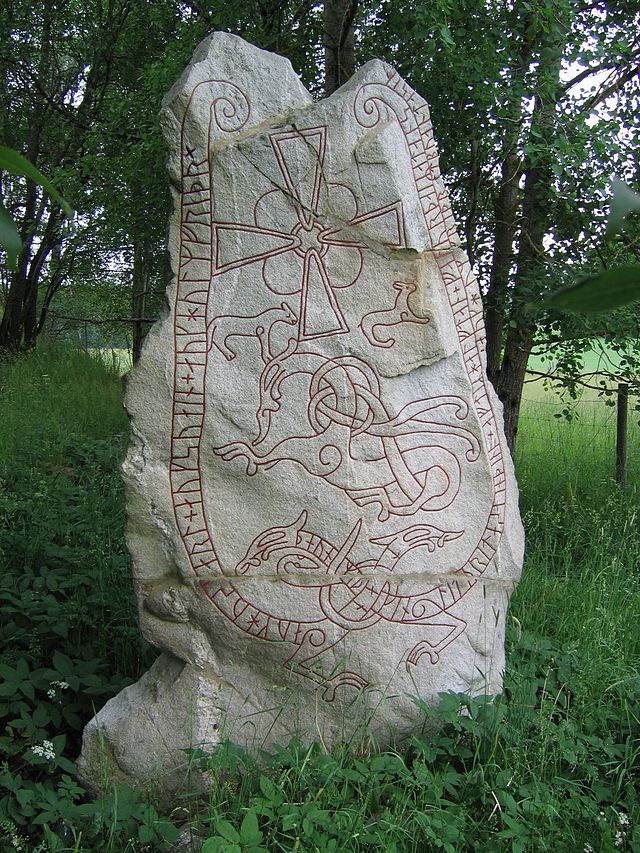
Just in case anyone is thinking Vikings is a correct portrayal of dear old Ragnar Lodbrok, I thought it time to set the facts straight. (Not that I care, not with Travis Fimmel to rest my eyes on.) First of all, I thought it might interest you to know that Ragnar Lodbrok in essence means Ragnar Hairy Breeches. Secondly, let us keep in mind that Ragnar, like all ambitious little Viking boys, early on dreamed of becoming rich – very rich even – by stealing from others, a.k.a. raiding. If he was successful enough, he’d be able to buy a farm and retire with a comely wife. Plus, if he was really successful, someone might even raise a runestone over him.

Runestone: I,Berig
CreativeCommons Licence
None of the above ever came true for Ragnar. The runestone thing mainly because Ragnar did not exist outside the sagas (although some say otherwise). The retirement thing because fate had other plans for Ragnar. You see, the Norse sagas are rarely very keen on the Happily Ever After. Such notions are for wimps, not for die-hard warriors like our Scandinavian forebears. No, the sagas are harsh and gritty stories of man pitted against his destiny, with not as much as a whiff of romanticism. Hang on: the sagas DO actually romanticise one thing – the concept of honour, of men who will die rather than betray their own integrity.

These days, things have gone downhill when it comes to honour and integrity – at least here in Sweden, where neutrality rather than integrity has been evoked as a guiding principle in (relatively) recent major conflicts.

Neither here nor there – let’s get back to Ragnar. We have here a young man eager for adventure – and riches. So when he heard of poor Tora Borgarhjort, a pretty maiden whose bower was encircled by a fierce and deadly serpent, he decided to do the right thing and save her, to a large extent motivated by Tora’s father’s promise that whoever killed the monster would wed his daughter and inherit his titles and riches.

We’re talking a huge serpent here, a vile creature that considered Tora its property and defended her from any potential suitor through a combination of fangs and poison. So potent was its poison that it burned holes through garments and human skin, and as a consequence, there was a pile of young dead men at the door of Tora’s bower.

Ragnar was a bright young man. Approaching the serpent obviously required protective gear, which is why he fashioned himself a pair of breeches out of untreated goatskins (ergo the hairy breeches). These he then dipped in pitch and rolled in sand, so that they became more or less impregnable. In these pants and with a spear in hand, he snuck up on the serpent and managed to slay it, thereby gaining Tora’s hand and a jarldom.

I can hear some of you say, "What? Tora? Who's this Tora, and where is Lagertha?" Sorry to tell you that the sagas are not always consistent, so in some Ragnar does wed Lagertha for a short while (after first having killed her tame bear and hound - beasts set upon him as a test by Lagertha) but divorces her to marry Tora, a much better catch seeing as she's a jarl's daughter and Danish - just like Ragnar.

By all accounts, Tora and Ragnar were very happy. Too happy as per the Norns, those rather cold-hearted crones that spin the threads of fate. Which is why they decided to cut Tora’s thread, and Ragnar was left a devastated widower. As any grieving Viking would do, Ragnar set off on a raiding expedition, hoping to dull the constant ache in his heart through violent action and plunder.

Kraka
Ragnar and his men were in a Norwegian fjord, and Ragnar sent some of his men off the ship to do some baking (and I rather like the resulting picture of self-sufficient Viking warriors with bulging biceps kneading dough). As they were doing their bread thing, the men were distracted by the sudden appearance of a young girl called Kraka. So beautiful was she that the bakers forgot their task, mouths agape as they stared at this female apparition. As a result, the bread was badly burnt, and Ragnar was less than pleased when his men returned to the ship.

"It was Kraka’s fault," the men said, going on to describe this gorgeous creature. Ragnar was intrigued not only by the description, but also by the amusing fact that someone so beautiful should be named Kraka, which means crow. Whatever the case, Ragnar decided it was best if he did some inspecting of his own, but before doing so, he tried to do some research.

In an age devoid of internet, finding out more about Kraka proved difficult for Ragnar. Fortunately for you, dear readers, I do have internet (and books) so I can tell you in confidence that Kraka was really named Aslög, and she was the daughter of Brunhilde and Sigurd Fafnesbane of Wagnerian fame. Now that story of love, betrayal, blood and death is so complicated it would take an entire post to explain it all, so let’s just summarise by saying little Aslög is left an orphan when her parents die, and she is smuggled to safety in a harp (?) by a gentleman named Heimer. When Heimer asks for lodging with a poor couple in Norway, the wife urges her husband to kill their guest as she can see that he is rich, and among his belongings they discover the girl whom they rename Kraka and set to hard work.

Sigurd defeating the dragon
Ragnar got as far as the Sigurd Fafnesbane bit and was very impressed – especially as Sigurd had died like two centuries prior to Ragnar seeing the light of the day, so either Kraka was very old, or there was magic at work. When in doubt, go with magic, and Ragnar found this additional ingredient quite alluring. So he decided to set the young woman a test and invited her to visit him on his ship “neither dressed nor naked, neither hungry nor full, neither alone nor accompanied”. Clearly, my ancestors enjoyed speaking in riddles…

Kraka/Aslög rose to the challenge and appeared swathed in fishnets having eaten a clove of garlic and with a dog at her heels. This, apparently, sufficed to sweep Ragnar off his feet, and he carried Aslög with him back to Denmark where he promptly married her and had many, many children with her.

Together, Aslög and Ragnar had four sons: Ivar Benlös (boneless), Björn Järnsida (ironside), Sigurd Ormöga (serpent's eye) and Vitsärk (white shirt). Ivar Benlös was supposedly afflicted with some sort of disease (in some cases attributed to his parents having had sex before marriage, but I believe this is a later addition, intended to curb the rather relaxed attitude to sex Scandinavian have had since time immemorial), but it doesn’t seem to have hampered his style much, as he and his brothers grew up to be as fierce as their father. So successful were the brothers in their raiding expeditions that people began to mutter that the sons were better warriors than their father. This Ragnar did not like. At all.

In an effort to set things straight, Ragnar launched his own little raiding party – and he was going west, to ransack the lands of King Aella of Northumbria. To really show the world just what a fearsome warrior he was, Ragnar decided to go with only two ships, sufficient, in his opinion, to defeat that milksop of an English king. Aslög begged him not to go, plagued by foresight. When he insisted on going, she gave him a magic shirt, a garment which could not be penetrated by iron. But she was weeping as he left, knowing deep inside she’d never see him again.

Ragnar arrived in England only to crash straight into Aella’s army. Thanks to his shirt, Ragnar survived while one by one his men died, and so he was captured alive and hauled before a smug Aella who demanded to know his name. Ragnar refused to tell him, and so Aella had him thrown into a pit with vipers, there to die a slow, painful and – most distressing for a Viking – ignominious death.

“The piglets will squeal when they hear how the old boar suffered,” Ragnar supposedly said before dying, smiling at the thought of the revenge his sons would wreak on Aella.

The piglets most certainly squealed. As per the saga, the brothers were in their hall when the messenger carrying the tidings of their father’s death reached them. Vitsärk was playing draughts, and squeezed so hard round the piece in his hand that blood began to well. Sigurd was paring his nails and cut himself to the bone. Björn was honing his spear, and tightened his hold on the shaft until it splintered. Ivar calmly asked the messenger to tell them everything. Everything, mind.

The three younger roared and gnashed their teeth together, wanting to set off immediately to kill Aella. Ivar urged caution and stealth.

“Revenge is a dish best eaten cold,” he said, but was overruled. So off the brothers went, with Ivar choosing to distance his ships and men from his revenge-maddened brothers.

Aella was no fool. Upon realising who had died in his snake pit, he knew it was just a matter of time before the sons came, so he’d amassed a sizeable army, big enough to beat back the brothers who turned tail and ran back to their ships. All except Ivar, who decided to visit with Aella and expressed himself willing to accept weregild for his father’s death. Aella was more than happy to oblige, and settled sizeable land on Ivar, who seemingly was content to live in proximity with his father’s murderer. Not...

Over the coming years, Ivar fostered unrest and resentment among Aella’s vassals, and once the kingdom had been sufficiently destabilised, he sent for his brothers. This time, there was no army to defend Aella. This time, he was captured and dragged alive before Ragnar’s four sons. Not for Aella the snake pit, no, Aella was undressed, thrown to the ground with his back bared to the sky, and ever so slowly Ragnar’s sons “carved a blood eagle” on him. This entailed slicing through his back, breaking the ribs and pulling them wide apart to resemble wings, and then pulling the lungs out through the resulting hole. Nice.

The sons returned to Aslög, and she was satisfied that her husband had been adequately avenged. Björn and Sigurd went on to become kings of Sweden and Denmark respectively. As to Ivar, he stayed on in England – as per the saga as king of all England, as per what little facts there are, as the leader of the Viking army that despoiled most of Mercia and East Anglia in the late 9th century.

There is an interesting little add-on to Ragnar’s saga, which refers to Ivar’s final resting place. It is said Ivar ordered his burial mound to be built just at the edge of the sea, prophesising that as long as his bones lay untouched, no one would be able to invade England from the sea. According to this little codicil, “the bastard William” found the mound and had it opened. Upon finding Ivar’s body un-decayed, William ordered a pyre to be built, and only once Ivar’s bones had been reduced to ashes did he proceed with his invasion plans. I’m thinking Ivar would have applauded William – after all, they both had Viking blood, a gift for violence and pillage.

Beware of the Norns!
So, did Ragnar exist in any form? We don’t know, sources from the 9th century being understandably scarce. Some people seem to think there was a historic Ragnar, a Danish Viking of great renown. But for him to be married to a woman whose father slayed a dragon, well, that does seem difficult to believe, doesn’t it? Whether real or not, the story of Ragnar and Aslög is a story of two equals, two people who meet and know immediately they belong together. Maybe it was Aslög seeing the hole of grief in Ragnar's heart. Or maybe it was Ragnar seeing in poor Kraka a woman with the spirit of a lion. Or maybe it was those pesky Norns, thinking it would be fun to twine these two threads together and see what happened. A lot, as it turns out. Enough to build an entire TV series on.

~~~~~~~~~~~~~

Anna Belfrage is the successful author of eight published books, all of them part of The Graham Saga. Set in 17th century Scotland, Virginia and Maryland, this is the story of Matthew Graham and his wife, Alex Lind - two people who should never have met, not when she was born three centuries after him.

Anna's books have won several awards and are available on Amazon, or wherever else good books are sold.
For more information about Anna and her books, please visit her website. If not on her website, Anna can mostly be found on her blog.