Thursday, October 24, 2013

The Other Bayeux Tapestry

by Octavia Randolph

ONE of the treasures of the attractive Museum of Reading, Berkshire is a full-length replica of the Bayeux Tapestry. Dubbed by the museum "Britain's Bayeux Tapestry", it was created in 1885 by a group of industrious English needlewomen. Few know that this copy exists; the sophistication of the modern gallery viewer, general lack of interest in history, and a sort of bemused embarrassment concerning the value of replicas make the validity if not the existence of such an item rather problematical both for the owning institution and the visiting public. But the student of Anglo-Saxon studies and anyone interested in either needlework or the neo-medievalism of the Victorian era will relish the experience of seeing it.

The Story of the Bayeux Tapestry

Housed in the Musée de la Tapisserie de Bayeux at the Centre Guillaume-le-Conquérant in Bayeux, Normandy, is the Bayeux Tapestry, not a woven tapestry at all but instead a 230'-9" (nearly 70m) strip of linen averaging 18 to 20" (46-51cm) in width. A version of the momentous events of 1066 is embroidered in woollen threads upon its surface. The tale of the death of Edward the Confessor, the visit of his heir Harold to France, his subsequent accession as the last Saxon King of England, and the battle of 14 October 1066 are all told in exuberant and colourful detail. The narrative ends abruptly on the field of battle; originally the final scene must have been that of William's jubilant coronation. But the loss of this closing episode in no way mars the remainder. A tumult of activity, personalities, and scene changes spill across its length, and draw the viewer in with the verve and immediacy of the draughtsmanship and the boldness of colouration of the figures as they journey to an inexorable end. It depicts 623 people, 202 horses and mules, 55 dogs, over 500 other beasts both real and mythological, 37 buildings, 41 ships, all crowned by a running commentary in Latin describing the scenes as they unfold.

No records remain to tell us who commissioned this remarkable feat of needlework, who created it and when, or where it first hung, but modern scholarship is in agreement that the commissioner was probably William's own brother, Bishop Odo of Bayeux. This warlike and womanizing cleric figures prominently throughout the piece. Jan Messent in her incisive book The Bayeux Tapestry Embroiderers' Story argues persuasively that the intended setting for the embroidery was the newly enlarged royal residence at Winchester, and that the embroiderers were the inmates of six or seven Wessex nunneries: Winchester (long famed for its needlework), Wherwell, Romsey, Wilton, Amesbury, Shaftesbury, and possibly Barking in Essex. The work must have been carried out shortly after the victory when the episodes and personalities were still fresh in memory. Cloistered nuns, most of notable if not noble lineage, and all skilled with the needle, would have worked to a design approved by Odo.

The fine quality of English needlework was already renowned throughout France, and it would have made sense for Odo to utilize the most talented workers he could procure to execute such an important and costly project. Indeed, the memorializing of heroic lives and fierce battles in just such a manner was an English tradition. Byrhtnoth's widow Æthelflaed gave to Ely Cathedral a hanging depicting the life of her husband, cut down at the battle of Maldon in 991, although sadly no remnant remains of the work.

Such was nearly the fate of the Bayeux Tapestry as it dipped in and out of obscurity. Numbered amongst the treasures of the Cathedral of Bayeux in an accounting of 1476, it was nearly cut up for use as munitions waggon coverings in the 18th century. It was rolled up on a wooden roller for some time before finding a more suitable home in the splendid Musée de la Tapisserie de Bayeux, where it is now visited by many thousands each year.


You probably know that the Bayeux Tapestry ends abruptly.  The final panel(s) have been lost for hundreds of years.  These photographs represent the completing panels as imagined by artist, scholar, and expert needle woman Jan Messent.
Photos used by permission.


Few people have viewed these magnificent, imagined reconstructions of how the Bayeux Tapestry may have ended.  I am grateful to Jan Messent for permission to share these beautiful images with you.


The Reading Replica

The year is 1885 and the place London. A prosperous couple is being shown around the galleries of the South Kensington Museum (later to become the V&A) by its director, Sir Philip Cunliffe-Owen. Knowing of the couple's interest in textiles, and particularly the lady's in embroidery, he escorts them to a private office where he reveals a sheaf of crisp photographs showing the Bayeux Tapestry in its entirety. Accompanying these are coloured drawings keying in the vivid hues of thickly laid wool upon the linen surface.

The woman is at first stunned, then inspired. "England should have a copy of its own," is her response. The couple were Elizabeth and Thomas Wardle, who had travelled down from their home in Leek, Staffordshire, to take in the glories of the capital. Cousins bearing the same surname, the two had wed in 1857 and their affectionate marriage had yielded fourteen children. The family business was fabric dyeing; Thomas's father Joshua had been a successful silk dyer in Leek, and Thomas carried on the work in his Hencroft Dye Works. Thomas travelled extensively throughout India to procure silks and perfect its dyeing, and produced highly popular needlework kits on silk that were snapped up by Victorian women eager to create "art needlework" to adorn parlour and boudoir. What distinguished Thomas from any other entrepreneurial businessman was his interest in craft. The new coal-tar and benzene based aniline dyes introduced from the 1850's had so revolutionized dyeing that within a generation the craft of using naturally derived plant materials had nearly vanished. The great designer William Morris, champion of artisanry and the dignity of handwork, approached Thomas in 1875 to help recover some of the lost techniques of herbal dyeing. Thomas's brother George was a manager at Morris & Co, Morris's firm in London which designed and produced wall coverings, carpets, fabrics, and stained glass windows amongst other items, and likely brought the two together. In response to Morris's proposal that the two attempt to relearn the art of natural dyeing, Thomas dedicated one of his two dyeing sheds at Hencroft for two years of experiments and production. Morris himself was often in residence in Leek, working over the dye vats. During the two years of their closest association Morris may have actually stayed with the Wardles; certainly his philosophies and values would have been attractive to Elizabeth.

The time was right for any artistic expression of medievalism, whether in buildings, furnishings, literature, or paintings. Growing interest in medieval or indeed any post-Classical studies made movements such as the Gothic Revival possible. Rampant nationalism during the height of Great Britain's imperial powers made looking back on a lost era of heroic endeavour attractive, especially at a time when the Empire was showing signs of strain. Morris himself wrote reams of poetry on medieval topics, including a translation of Beowulf and reworkings of Icelandic sagas. With such a social backdrop it is no surprise that Elizabeth Wardle conceived the bold plan to copy the iconic textile of the defeated but proud Anglo-Saxons.

Elizabeth was a needleworker of acknowledged skill and taste; what is more she was a tireless organizer and able to instill enthusiasm in others. She was already highly experienced in large scale embroidery projects worked with other women, having completed a number of alter frontals and other ecclesiastical hangings. By 1879 she was at the centre of a group known as the Leek Embroidery Society (sometimes School) which created finished embroideries for individuals and churches and later produced kits using her husband's silk fabrics and threads.

So both Thomas and Elizabeth were well suited to Elizabeth's ambitious plan. Thomas would take charge of dyeing the 100 pounds of wool required, using such natural dyestuffs as madder, a source for reds, woad for blues, walnut roots for browns, and weld for yellows. The wool was dyed in eight shades to match those of the original embroidery in Bayeux: red, blue-green, sage, buff, grey-blue, dark blue, dark green, and yellow.

Elizabeth marshalled the 39 women who would participate in the re-creation. One of these, Miss Lizzie Allen, performed the onerous task of tracing on linen from the photographs provided by Cunliffe-Owen, and another was responsible for stitching the individual panels together. Two other women pressed the panels prior to their being joined and in other ways contributed to the effort. Thirty-five women took part in the actual embroidery, completing sections ranging from six inches to nearly twenty feet in length. Like the original, the work is effectively done in only two stitches, one a simple stem stitch used to outline areas, and the other laid work, in which wool thread is run back and forth over the front of the linen in dense areas and then pinned down with short stabbing stitches that fasten the wool firmly to the surface.

Most of the women were from Leek, and nearly all must have worked with almost superhuman effort, for the replica panels were finished, sewn together, and placed on display in the Nicholson Institute, Leek, by 14 June 1886. That a 230-foot embroidery could have been created in approximately a year from start to finish is a testament to the Society's determination. It also offers a fascinating insight into how long the original may have taken to complete. If as Jan Messent suggests the Bayeux Tapestry was the work of six or seven English convents, most within ten or fifteen miles of the next, the conditions under which it was created were not dissimilar from those shared by Elizabeth Wardle's dedicated band of local women.

Although great care was taken by Elizabeth to make her replica as close as possible to the original, there are two important distinctions. The first is that the women of the Leek Embroidery Society were determined to escape the anonymity that befell the needlewomen of the eleventh century. To this end they attached a handsome blue linen border to the top and the bottom of their replica. The top portion of this narrow border is blank, but the bottom portion, roughly 2 1/2" (6cm) in width, contains each embroiderer's signature. The very first panel, over 8 feet long, was fittingly executed by Elizabeth Wardle herself, and under it reads in coloured thread "Elizabeth Wardle's work" (then a long graceful line of scrolling needlework) "ends here". This opening panel was the first of two Elizabeth worked. Each woman adopted a distinctive way of signing her piece, with her own style of floral or scrolling designs running the length of the lower blue border. Some women preferred to work together; one densely-packed four-foot section was stitched by three women. One Anne Smith Endon was particularly energetic, creating nearly twenty feet of the embroidery in two panels. Like the original, the varying skills and perhaps even temperaments of the Leek stitchers can be discerned. Not all pieces are of equal quality, and even for a group of women accustomed to large projects it may have seemed overwhelming at times. Perhaps this is why "E. Eaton" could only complete six inches of embroidery, but her name is rightly emblazoned upon the blue border beneath those painstaking six inches.

The second way in which the Reading Replica differs from Bayeux Tapestry is both regrettable and wholly understandable. A certain amount of graphic editing was deemed necessary by the Leek ladies; whether the decision was made by Elizabeth Wardle, by the tracer of the photographs Miss Allen, or by common consensus will never be known. In every instance in which human male genitalia is depicted in the original, it was omitted in the replica. The same fate was even suffered by many of the horses the Leek ladies stitched, so notably stallions in the original were neutered by Victorian sensibility in the later effort. It is clear that many of the Leek ladies were quite young women at the time they worked on the replica; they signed their names with their birth names and are later noted in Leek Embroidery Society records as becoming "Mrs So and So." Yet a sense of delicacy so great that piquant elements serving as actual commentary on the main themes of the story were omitted (not to mention the absurdity of the debased stallions) seems pointless when the horrific violence of the battle scenes and Harold's death is so graphically and accurately copied. The Leek ladies had sadly forgotten their Anglo-Saxon fore-sisters -- very likely nuns and some of them invariably virgins too -- who with a healthier view of sexuality, both human and animal, had no such compunctions.

This is why one wishes to cheer upon closely examining the work of a Miss Margaret J. Ritchie. She was entrusted with embroidering the important panel bearing the legend "Where Æfgyva and a certain cleric" depicting a now obscure sexual scandal between a young woman being lured from a nunnery by a tonsured priest. The cleric was likely Odo himself. Beneath this panel (or associated with it) as part of the small border tableaux of the original are three naked male figures in a state of arousal. In the Leek version, these men are blandly nude. But if one looks closely at the crouching male in a full frontal pose just beneath the Æfgyva scene, one can see Miss Ritchie's dilemma, and her integrity. The tracer of the design has drawn in a pair of shorts on the offending figure. Miss Ritchie had to have been aware of the dishonesty of this amendment, for she refused to colour in the shorts with laid work or even to outline them in stem stitch. Miss Allen's three pencil lines at waist and thighs remain, mute testimony to Miss Ritchie, a needlewoman who if she could not bring herself to follow the original at least would not implicate herself in a modern debasement. (I will note that new scholarship suggests that the Leek ladies may have been handed "tidied" up photographs to copy. If this is so, they are to be doubly excused.)

Subsequent History

The replica was received with general acclaim, and the Leek Embroidery Society set about attempting to recoup their financial investment by sending it around the country to be enjoyed by paying viewers. It even travelled abroad to America and then Germany. But no permanent home could be found for it, and the admission fees could in no way serve as adequate recompense for the labour invested by members of the Society. It came to Reading to be temporarily exhibited in June 1895, and during that time a former mayor and current alderman of Reading, Arthur Hill, offered to buy the replica and present it as a gift to the Borough. Elizabeth had her misgivings about allowing the piece to be sold away from Leek, but put to a vote the Society accepted £300 for the replica, its viewing supports and a quantity of printed guides. After expenses were paid, each needleworker received £2 5 /6d per share, a share being one yard of embroidery worked. The piece was then put on display at the Reading Town Hall, often in less than ideal viewing conditions.

In 1993, after careful cleaning and modern conservation, the replica was placed in a most attractive purpose-built gallery in the new wing of the Museum of Reading. Care has been taken to educate the viewer as to the subject of the tapestry, and ancillary information, visual guides and artifacts contribute to an atmosphere that enriches the viewing experience. Medieval carpenter's axes hang by the scenes of the building of William's fleet, and Anglo-Saxon swords by the battle scenes. As one travels around the gallery sound effects greet the ears -- monks chanting, frightened horses neighing, the clangs of metal upon metal, men screaming as they fall in battle. Modern photos of Halley's Comet, depicted in the panel of the tapestry showing Harold's crowning, serve to link that distant era with our own.

Conclusion

One hundred and twenty-seven years have endowed the Leek effort with a patina of its own. There is some differential fading and warping which I believe adds rather than detracts to the embroidery's appearance. Taken as an emblem of Victorian interest in their Anglo-Saxon forebears it is of signal importance. The fact that a sizable group of women worked in close collaboration to create and exhibit it and that thousands of viewers paid to see it is testament to how seriously it was taken. The piece demonstrates the pride the Leek Embroidery Society took in the long heritage of quality English needlework and their desire to contribute meaningfully to that tradition. Even their censoring adds historic value to the piece, as it serves to anchor the replica firmly in its own era while harkening back to one of the great turning points in the nation's history.

If you go: The Museum of Reading is located in the Reading Town Hall, less than a five minute's walk from the train station, well served by Thames Trains. Admission is free.

Related Websites: http://www.hs-augsburg.de/~harsch/Chronologia/Lspost11/Bayeux/bay_tama.html shows the entire Bayeux Tapestry.
www.bayeuxtapestry.org.uk is part of the Museum of Reading's Website, which shows a frame by frame view of the replica.
Suggested reading: Jan Messent The Bayeux Tapestry Embroiderers' Story Madeira Threads, 1999 Selected bibliography: David M Wilson The Bayeux Tapestry Thames & Hudson
Christine Poulson, editor, William Morris on Art and Design Sheffield Academic Press 1996
Michael J Lewis The Gothic Revival Thames & Hudson 2002

The author wishes to thank Jan Messent who generously made available materials concerning the history of the Leek Embroidery Society.

~~~~~~~~~~~~

Octavia Randolph is the author of The Circle of Ceridwen, set in 9th century England, available on Amazon.com and Amazon.co.uk. Enjoy!

Wednesday, October 23, 2013

In the name of God - Implementing Religious Tolerance

by Anna Belfrage

In 1963, my parents decided to brave the unknown. They said farewell to family and friends, waved goodbye to Sweden, and set off for exotic South America. In the sixties, this was a relatively drastic thing to do – but compared to the emigrants of the previous centuries, my parents had something of a walk in the park, with the added benefit of knowing that, should they want to, they could always go back home and it wouldn’t take them more than a couple of days by plane.

In the 17th century, airplanes were not even on the drawing board. The ships that crossed the Atlantic were small and fragile, and the probability of dying in a shipwreck was relatively high. Add to this the risk of being attacked by pirates, or being blown off course, and one wonders that anyone actually dared to set off for new lands. Maybe they were braver than I am –or maybe they didn’t feel they had a choice.

Many of the early settlers in the American Colonies emigrated due to religious issues. Interestingly enough, while the English government had little tolerance for Puritans, Quakers, Catholics, Presbyterians and what have you back home, they seemed not to have minded overmuch when these people settled in the faraway colonies – still English dominions, but at a sufficient distance to allow the heart to grow (somewhat) fonder. Maybe this tolerance rather reflected the government’s interest in increasing their fiscal income. Or maybe it was as simple as “out of sight, out of mind”, because seriously, who in Bristol or York would be all that bothered by what happened on the other side of the world?

The young colonies were no more tolerant than England – but with different religious preferences. Virginia quickly became an Anglican stronghold, further reinforced during Sir William Berkley’s long tenure as governor. Massachusetts was firmly in Puritan hands – strong, capable and somewhat sombre hands – and then there was Maryland, where for the first time in history an Act of Toleration was implemented in 1649. (The fledging Rhode Island passed a series of laws in the 1630’s that protected religious freedoms, but nothing as explicit as Maryland’s Act)

Let us take a step back, and consider just how turbulent the 17th century was from a religious perspective. The Reformation movements of the 16th century spilled over into the new century, and with the Protestant view that man was fully capable of reading the Bible and understanding it all on his own, the door was opened wide on multiple interpretations, resulting in a plethora of Protestant orientations, all of them with their own distinctive set of beliefs. At one end of the spectrum was Calvin and the Presbyterian school of thought, at the other the far more moderate (lax in the eyes of the more rabid reformers) Church of England.

Gustavus Adolphus victorious during the Thirty Years' War
Ultimately, the unrest of the 17th century was never about faith as such; it was about power. The Thirty Years’ War was clad in the guise of defending the faith, but was about expanding the power base and wealth of certain states (such as Sweden and France) while curtailing that of others, notably the Hapsburg Empire. How else to explain the interesting fact that Catholic France bankrolled a substantial part of Protestant Sweden’s war efforts?

Inconsistency was rife: on one hand, France allied itself with Sweden, on the other it viciously oppressed the Huguenots, this culminating in the Huguenot revolts and the Anglo-French War. England had to retreat from the war due to Charles I’s increasing problems at home (he had his own vociferous religious protesters), leaving France’s Protestants to their fate.

In England, the Church of England – and the government – was distrustful of all religious faiths outside the Anglican Church. Catholics were hounded, would continue to be hounded for decades. Puritans were seen as dangerous dissenters and were forced to flee in large numbers, first to the welcoming Dutch States, eventually to Massachusetts. When the situation for Catholics (or ‘recusants’) became intolerable, many of them opted to go overseas as well, and fortunately for these papists there was a small colony in America that welcomed them with open arms, namely Maryland.

Cecilius Calvert
Maryland at the time was a private possession. It was owned by Cecilius Calvert, a Catholic peer, and as such it welcomed Catholic immigrants with open arms. Actually, the colony welcomed immigrants of any Christian denomination with open arms, and as a consequence the colony’s population very quickly came to be dominated by Puritans.

Calvert was set on creating some sort of safe haven for his co-religionists, and he quickly concluded that persecution of non-Catholics was not the right way to go about it – after all, Maryland was the colony of a Protestant country. Besides, Calvert seems to have been a wise man, who urged all his colonists to set their religious rivalries aside and concentrate on building a prosperous new country – which of course benefited Calvert financially.

Maybe those early colonists were tired of strife. Perhaps Calvert’s urgings had them rubbing along equably. Already in 1639, the colony passed an ordinance that had a generally worded comment as to the rights of man, but when the English Civil War broke out, the underlying religious differences surged to the surface, and for a couple of years Maryland was under Protestant dominion before the Calvert family regained  control. Worried by the violence that had erupted in his colony, Lord Calvert drafted an Act of Toleration, not only to protect the minority Catholics, but also to assure the recent Puritan colonists in Providence (Annapolis) that they would have freedom of worship.


The Act of Toleration is in many ways a precursor to the First Amendment in the American Constitution. In a world full of religious strife, it was an innovative attempt to heal rather than breach. In many ways it was imperfect, granting freedom of worship only to Trinitarian Christians. To deny the divinity of Jesus Christ could lead to execution, thereby closing the gate in the face of Unitarians and Jews. The colony’s Puritans chafed under some of the wordings, made uncomfortable by accepting a law drafted by a Catholic. (To them, swearing fealty to Calvert was to indirectly swear fealty to the Pope, who according to Puritan tenets was anti-Christ. Interestingly enough, those early Puritans found a way of accommodating this conundrum within their conscience)

What is of particular interest in Calvert’s Act is that it contains the first attempts to curtail hate speech. As per the Act of Toleration, the word “heretic” and religious insults in general were forbidden. Well before the rest of the world woke up to the need to reinstate civility in religious discourse, Calvert attempted to draw up a framework of rules that would force people of different convictions to treat each other with respect.

In 1654, the Act of Toleration was repealed. Two years earlier, Calvert’s government had been overthrown, the colony seized by Protestant forces loyal to the new Parliamentarian Government in England and led by William Claiborne. The Puritans went on a spree once the Act was repealed. Catholic churches were burnt, Catholics were persecuted and forbidden to practise their religion. All in all, not at all a godly behaviour...

Fortunately, Calvert regained control, and in 1658 the Act was once again passed by the colonial assembly. This time, it would survive until 1692, when the Maryland Puritan Protestants overthrew Calvert’s rule yet again. And this time, the Act was permanently abolished, Catholicism was banned and the Church of England became the colony’s official church in 1702 – something that can’t have pleased the Maryland Puritans all that much.

Not until the American Revolution would freedom of worship be reinstated in Maryland, but when the Founding Fathers of the United States drew up their documents, they clearly found some inspiration Maryland’s Toleration Act. I think Lord Calvert would have been pleased.

Anna Belfrage is the author of three published books, A Rip in the Veil , Like Chaff in the Wind and The Prodigal Son. The fourth book in The Graham Saga, A Newfound Land, will be published in November of 2013. Set in seventeenth century Scotland and Virginia/Maryland, the books tell the story of Matthew and Alex, two people who should never have met – not when she was born three hundred years after him. For more information about Anna and her books, please visit her website, www.annabelfrage.com

Tuesday, October 22, 2013

The Horrors of War: The Black Prince and the "Massacre" at Limoges

by Rosanne E. Lortz


The year was 1370. The Hundred Years’ War was in full swing. The Battles of Crecy and Poitiers had already been fought. Edward, Black Prince of Wales, had already earned a reputation as the most famous knight in all Christendom.

The place was Aquitaine—the duchy that the spirited Eleanor had transferred to English control in the twelfth century, the duchy that the French king Philip VI had tried to confiscate in 1337, and the duchy that the Black Prince had already fought so hard to reclaim.

The French forces were buzzing like hornets around the city of Limoges, but the Black Prince was not worried. Limoges had a strong English garrison, and its governor—the bishop—was a close friend and the godfather to the prince’s eldest son.

But the prince’s confidence, as it turned out, was misplaced. The bishop of Limoges, after receiving an envoy from the French, decided to transfer his allegiance and surrender the city. The historian Richard Barber notes that “one late chronicle even says that he spread rumours of the prince’s death in order to persuade the citizens.”

And that is the backstory to what many consider one of the great military atrocities of the medieval period—the siege of Limoges, and the massacre thereafter which was perpetrated by the Black Prince.

Edward III bestows the rule of Aquitaine upon the Black Prince


Froissart’s Chronicles gives a chilling description of what happened at that unfortunate city in the year 1370.
When intelligence was brought to the prince that the city of Limoges had become French…he was in a violent passion…. He swore by the soul of his father, which he had never perjured, that he would have it back again, that he would not attend to anything before he had done this, and that he would make the inhabitants pay dearly for their treachery…. 
…The prince, the duke of Lancaster, the earls of Cambridge and of Pembroke, Sir Guiscard d'Angle and the others, with their men, rushed into the town. You would then have seen pillagers, active to do mischief, running through the town, slaying men, women, and children, according to their orders. It was a most melancholy business; for all ranks, ages and sexes cast themselves on their knees before the prince, begging for mercy; but he was so inflamed with passion and revenge that he listened to none, but all were put to the sword, wherever they could be found, even those who were not guilty: for I know not why the poor were not spared, who could not have had any part in this treason; but they suffered for it, and indeed more than those who had been the leaders of the treachery. 
There was not that day in the city of Limoges any heart so hardened, or that had any sense of religion, who did not deeply bewail the unfortunate events passing before their eyes; for upwards of three thousand men, women and children were put to death that day. God have mercy on their souls! for they were veritable martyrs.
The picture Froissart paints is a gruesome one, and one that I had to grapple with when writing I Serve: A Novel of the Black Prince. Although the story in my novel ends ten years before the Siege of Limoges, I believed that the events at Limoges must inform how I thought of the Black Prince’s character in his earlier years. It was a little difficult to reconcile the romantic hero with the man who could give the command to slaughter more than three thousand defenseless men, women, and children.

Is it possible to portray the Black Prince as anything other than a mass murderer?

Perhaps.

There are a couple considerations that made me take a more nuanced approach to the prince’s character.

In his book The Medieval Siege, Jim Bradbury says, “it needs to be emphasized that Limoges was not an exceptional atrocity.” In the Middle Ages, a city that surrendered could, for the most part, expect to be treated with restraint whereas a city that defied a besieging army could not. Wholesale sack and slaughter in cities that “held out” against a prolonged siege was considered a just punishment for the city’s obstinacy and a deterrent to other enemy cities that might otherwise do the same—thus causing far greater expenditure of effort and loss of life on the side of the besieging army.

Bradbury gives the example of James I of Aragon (who on most occasions granted quarter) refusing to make terms in one particular instance and hanging and beheading all the inhabitants of a captured city. He also cites the examples of the Crusaders’ capture of Jerusalem where the streets ran red with blood and of Richard the Lionheart’s actions at Acre where hundreds of Moslem prisoners were slaughtered.

If Edward, the Black Prince, must lodge with the mass murderers, he has a good deal of company including many of the other military leaders in medieval Europe.

Another historian, Richard Barber, acknowledges that post-siege massacres occur in many of the medieval chronicles. Interestingly, however, he sees these accounts as more a conventional literary trope than a precise description of what actually happened. (Much like how film makers insist on including a car exploding in flames in every car chase scene, despite the infrequency of that occurring in the real world.)

Barber writes that:
Froissart’s vivid picture probably arises from two sources: he is portraying in conventional terms the taking of a city by storm, and his information may have come from a source strongly hostile to the prince. Under the accepted laws of war at the time, a city taken by assault was entirely at the mercy of its conquerors. However, it was extremely rare for a place of the importance of Limoges to be taken in this way, and Froissart is merely depicting what would have been expected to happen under such circumstances. None of the sources which might be expected to make capital, for propaganda purposes, out of such a massacre, even mention it: the references in the papal and French records are purely factual, referring to some destruction of property.
Barber sees Froissart’s gruesome account as more rhetorical hype than historical substance.

So what did happen then at Limoges? According to Barber,
Much more reliable sources put the number of dead at about 300, or one in ten of the population. In fact, the number of dead may well have been less than the number of those carrying arms in defence of the city, estimated at about 500. 
The Black Prince, in Order of the Garter regalia

With these two considerations in mind—Bradbury’s explanation that if the massacre did happen the prince was far from unusual, and Barber’s contention that the massacre didn’t happen and that Froissart is all wet—reconciling the accounts of the Black Prince as the flower of chivalry and the Black Prince as a genocidal maniac became a little easier.

As I mentioned above, my novel I Serve ends ten years prior to Limoges, but my understanding of the events of that siege still helped me construct the character of the prince in his younger days. Thus, in my novel, when the prince observes his own father Edward III threatening to massacre the citizens of Calais, he does not react with shocked modern sensibilities but acknowledges that the king would have the right to do so—for the siege had been a year in length and cost him much time and many men. But at the same time, he also throws in his plea with the remonstrations of the nobles and the implorations of his mother for the king to grant the citizens of Calais clemency.

And, if Barber is right, then despite all the rape, pillage, and slaughter we see splashed about the pages of the medieval chronicles, maybe clemency was the case more often than not. Maybe sieges were a bloodier affair on paper than in person. Maybe the Black Prince was not the butcher of Limoges. One can always hope….

_________________


Rosanne E. Lortz is the author of two books: I Serve: A Novel of the Black Prince, a historical adventure/romance set during the Hundred Years' War, and Road from the West: Book I of the Chronicles of Tancred, the beginning of a trilogy which takes place during the First Crusade.

You can learn more about Rosanne's books at her Official Author Website where she also blogs about writing, mothering, and things historical.
_________________


BIBLIOGRAPHY

Barber, Richard. Edward, Prince of Wales and Aquitaine: A Biography of the Black Prince. Woodbridge, Suffolk: The Boydell Press, 1978.

Bradbury, Jim. The Medieval Siege. Woodbridge, Suffolk: The Boydell Press, 1992.

“The Prince of Wales’ Revenge on Limoges.” Edited by Steve Muhlberger. Tales from Froissart. http://usna.edu/Users/history/abels/hh381/froissart_limoges.htm.

Monday, October 21, 2013

A Recusant's Life in the 17th Century

by Deborah Swift


In 1571  a law was passed making it treasonable to be under the authority of the Pope, including being Jesuit, being Roman Catholic or harbouring a Catholic priest. The standard penalty for all those convicted of treason at the time was execution by being hanged, drawn and quartered. Nevertheless, many Catholics would not give up their faith as a matter of principle, claiming that Henry had stolen their Church, the rightful Church of England, from them.

Official records show that 5000 people were fined between 1593 and 1600, but these numbers are probably the tip of the iceberg. Many more would have escaped being fined and continued to practice their faith in secret. Women in particular, deemed to be 'the weaker vessel', with no property rights, and whose husband controlled all their wealth, were particularly difficult to fine - unless of course their husbands agreed to pay the penalty.

At the beginning of the realm of James I, many Catholics were outraged that Mary Queen of Scots's son did nothing to ease the legal persecution that they had endured since the reign of Henry VIII.But James knew that to win the allegiance of the English,who saw themselves as a Protestant nation, he must accede to the demands of  the powerful evangelical committee of the Church of England.

So a new King meant further persecution for the remaining Catholic families, who could be fined or jailed for attending Mass. Catholic Priests were concealed in 'priest holes' and led their lives in hiding, often in fear for their lives. Some people went so far as to build their houses to plans which would include multiple hiding places - Eliza Vaux arranged for Harrowden Hall to have many - something that alllowed her a virtual Jesuit college right in the heart of England.

Priest Hole at Harvington Hall


There are many tales of Priests who did not escape their pursuers - forty of the Priests who lost their lives in this period were canonised as late as 1970 by Pope Paul VI.

In the 17th Century the penalty for an ordinary person not attending the Church of England was £20 a month - an enormous sum considering that a yeoman farmer might earn £2 a year. No wonder Guy Fawkes and his Catholic friends wanted to blow up the Houses of Parliament. An anonymous letter eventually warned Parliament of the Gunpowder Plot - a letter that is still in our National Archives and causes fierce debate because nobody really knows who it was that betrayed the conspirators.

Image of The Monteagle Letter

Of course Guy Fawkes and his gang were executed in the traditional way, but their plotting made life considerably worse for Catholics, as recusants were subsequently banned from practising Law, serving in the Army or Navy, and from voting in elections.

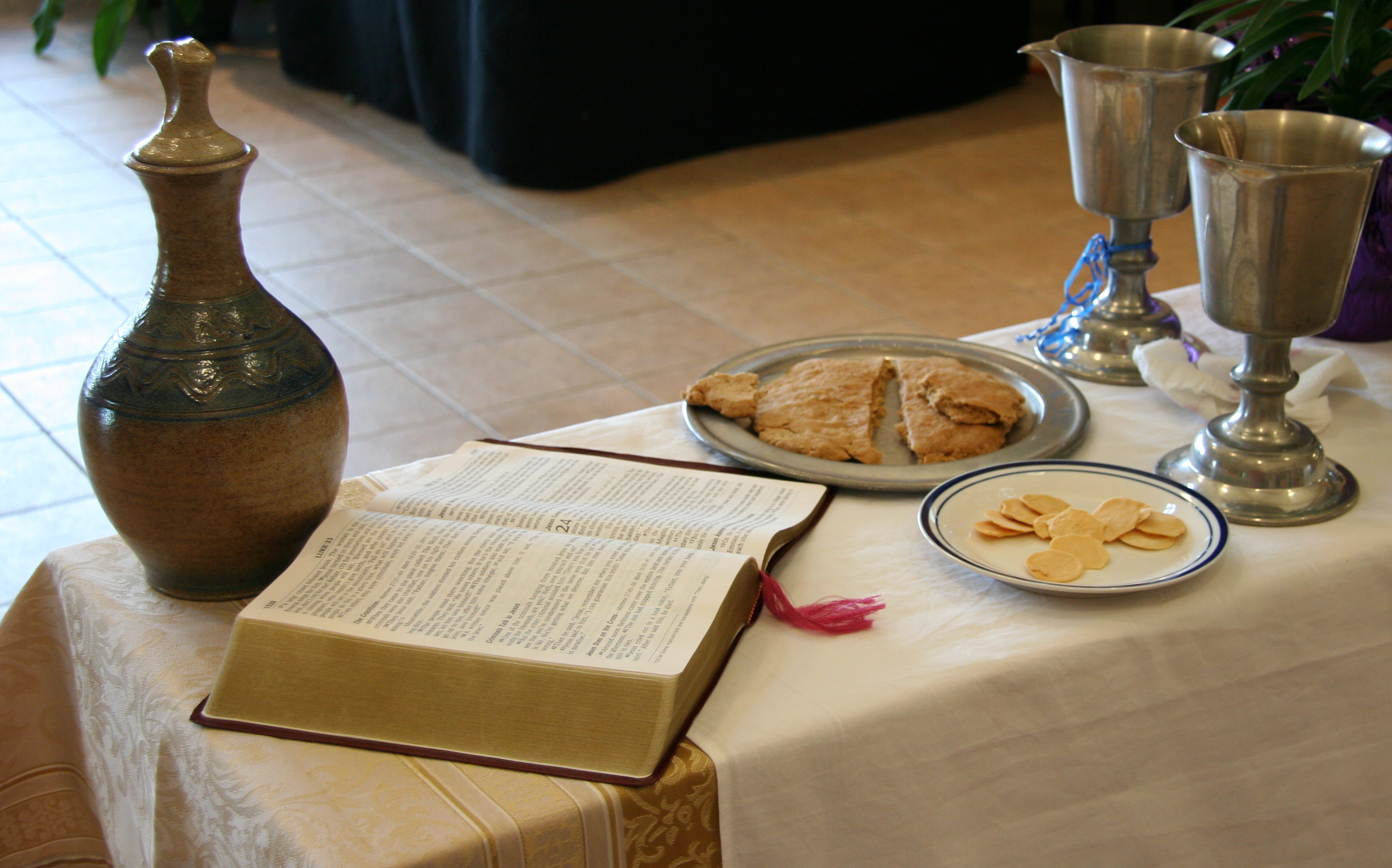
For a recusant, the objects of your faith - chalice, Bible, statuary had to be hidden in cellars or in attics. In this picture - again of Harvington Hall, the floorboards to the left of the altar can be lifted to hide away the candleabra and altar furniture.


Some Catholics had elaborate chests made that opened out to reveal an altar or shrine. This article about Mapledurham House shows a picture of a secretaire adapted for that purpose, and tells us that some priest holes were so well-hidden that they are only now being discovered.

Picturez

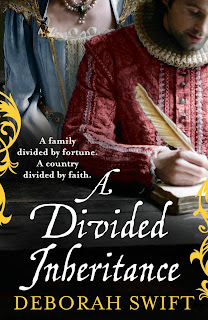
This period fascinated me, and I set my most recent novel at this time. The Leviston family are Catholic and must go to elaborate lengths to hide their faith. At the same time, in other European countries such as Spain, it was illegal not to be a Catholic. The young woman in my novel has to travel from England to Spain in search of her lost inheritance, a journey which changes her view of English life forever.


"A Divided Inheritance achieves what all stellar historical fiction must: through the voices of imagined characters, important lessons from the past linger and haunt long after the book is finished."  
Ann Weisgarber, winner of the Langum Prize for Historical Fiction

The book comes out on Thursday, published by Macmillan - Hooray! Find out more from my website.
Thanks for reading!
Sources: The Gunpowder Plot - Antonia Fraser
Religion and the Decline of Magic - Keith Thomas
You might also like http://englishhistoryauthors.blogspot.co.uk/2011/11/religious-upheaval-during-17th-century.html

Sunday, October 20, 2013

GIVEAWAY: The First Marie and the Queen of Scots by Linda Root

Linda Root is giving away a copy of her 2011 debut novel The First Marie and the Queen of Scots.  This giveaway ends at Midnight Sunday October 27. To see some information about the book, please click HERE.  Comment  here to enter the drawing and be sure to leave your contact information and whether you want the Kindle version or the paperback. The paperback is only available in the US and Canada.

Isabella: She Wolf or Cream Puff?

by Colin Falconer

Some have called her the She Wolf; playwrights, film makers and novelists have all shone light on her from different directions but all we ever see is a silhouette. Isabella of France continues to polarise opinion.

Was she a femme fatale and arch bitch; or just a misunderstood cream puff?

Those who take Isabella’s side paint her husband, Edward II, as a cruel and despotic monarch. They view her as a tragic figure, a bewitched princess trapped in a loveless marriage to a negligent husband, a passionate and intelligent woman driven to extreme measures by her situation.

Edward II
Photograph: Siebrand
But was Edward cruel and despotic? He was certainly incompetent. But not all kings are born to rule; some are ill suited for their destiny. But to paint him as the villain is surely too simplistic. A TV news style of historical reporting where there has to be a good guy and a bad guy does not give us the true picture.

Edward battled private demons. Although regal and handsome, his inner life was tormented; he had endured a strained relationship with his authoritarian father, ‘Longshanks,’ and had looked for affection elsewhere, usually in passionate attachments to certain 'favourites'.

His relationship with squires like Piers Gaveston led to violent quarrels between father and son, and eventually banishment for Piers.

But when Longshanks died, Edward could do as he pleased - and he did. He recalled Gaveston and made him Earl of Cornwall, a title previously reserved for the nobility, much to the outrage of his barons.


His marriage to Isabella was a political alliance, as all royal marriages were then. Isabella was just 12 years old. Edward was outrageously handsome, and she would grow up to be exceptionally beautiful. They were a Hollywood couple. Today they would have been the new Brangelina.

Perhaps we would have called them Edabella.

She was certainly no she-wolf then, just a bewildered and frightened girl in a foreign court. But she had been trained for her regal duties by one of Europe’s most adept and ruthless kings, and she had a natural talent for politics combined with a passionate heart. It put her and Edward on a collision course.

Historians have prevaricated over his sexuality. But today being gay is not really so shocking - and certainly not unusual. Plenty of gay men marry and have children, because they have to, not because they want to. You don’t have to be a king to find yourself in that situation. But his weakness was in his decision-making not in sexual orientation.

It is possible that Isabella was obedient and long suffering at first. But people change. A proud heart such as hers can take only so much submission.

If she had had a milder nature, perhaps she would have endured in silence all her life, content to remain in the background.

This she did for a while and earned sympathy from her contemporaries for her husband’s behaviour. But a different Isabella appeared later. Her behaviour during her exile in Paris was scandalous and forced even her own brother to distance himself from her.

She finally overthrew her husband with the help of her lover; but did she also collude in her husband’s death? We cannot know the extent of her involvement in the regicide. At the least she looked the other way.

The queen who invaded England was not the same obedient mouse who came to England in 1207 as Edward’s 12 year old bride.

Powder puff or she-wolf? The best way to decide is perhaps to think what we ourselves might have done in her situation.

Would you have been content to stay in the background and embroider with the ladies?

Or would you have had the guts - and the ruthlessness - to have wanted more?

For Isabella, daughter of one of France’s most ruthless kings, cream puff was never an option.

~~~~~~~~~~~~~

ISABELLA, Braveheart of France, available now from Amazon US and Amazon UK

And also available as POD from Cool Gus publishing.

Colin Falconer’s blog page

Colin Falconer on Twitter


Saturday, October 19, 2013

A Short History of the Sedan Chair

by Grace Elliot


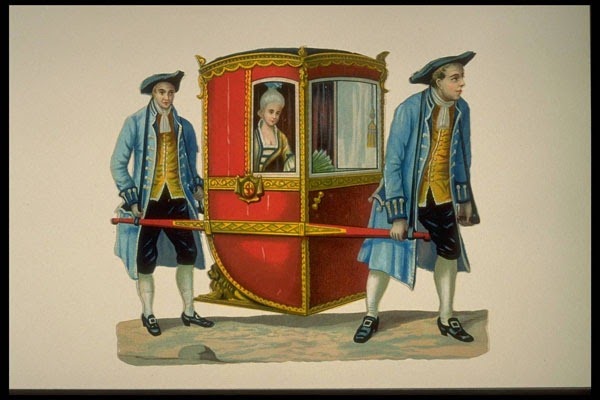
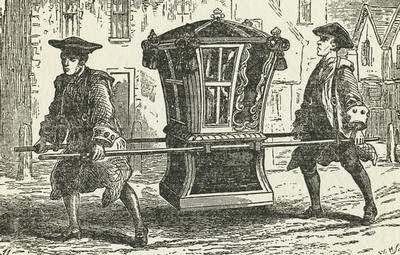
The name ‘sedan’ chair came from town of Sedan in France where they were first used. They consisted of a cabin containing a seat mounted on horizontal poles and carried by two burly men, one at the front, the other at the rear. It was an open secret that chairmen preferred female passengers as they were generally lighter to carry. Indeed the use of sedan chairs in the early 1600's by the Duke  of Buckingham lead to public disapproval, and he was villified for using people to do the work of animals.

Sedan chairs were re-introduced to England in 1634 by Sir Saunders Duncombe, who took out a 14 year license to provide chairs to the public as vehicles for hire. They quickly became popular in London because they were cheaper than a hackney cab and provided cover to the extravagant wigs and gowns that were currently in fashion. The use of sedan chairs spread to spa towns such as Bath since the spas attracted many people of limited mobility who particularly welcomed sedan travel as being a practical way of being transported from chamber to spa and back again.

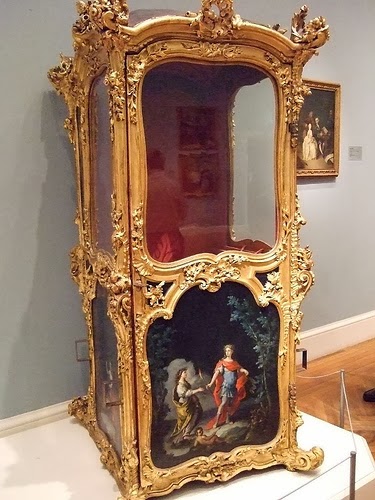
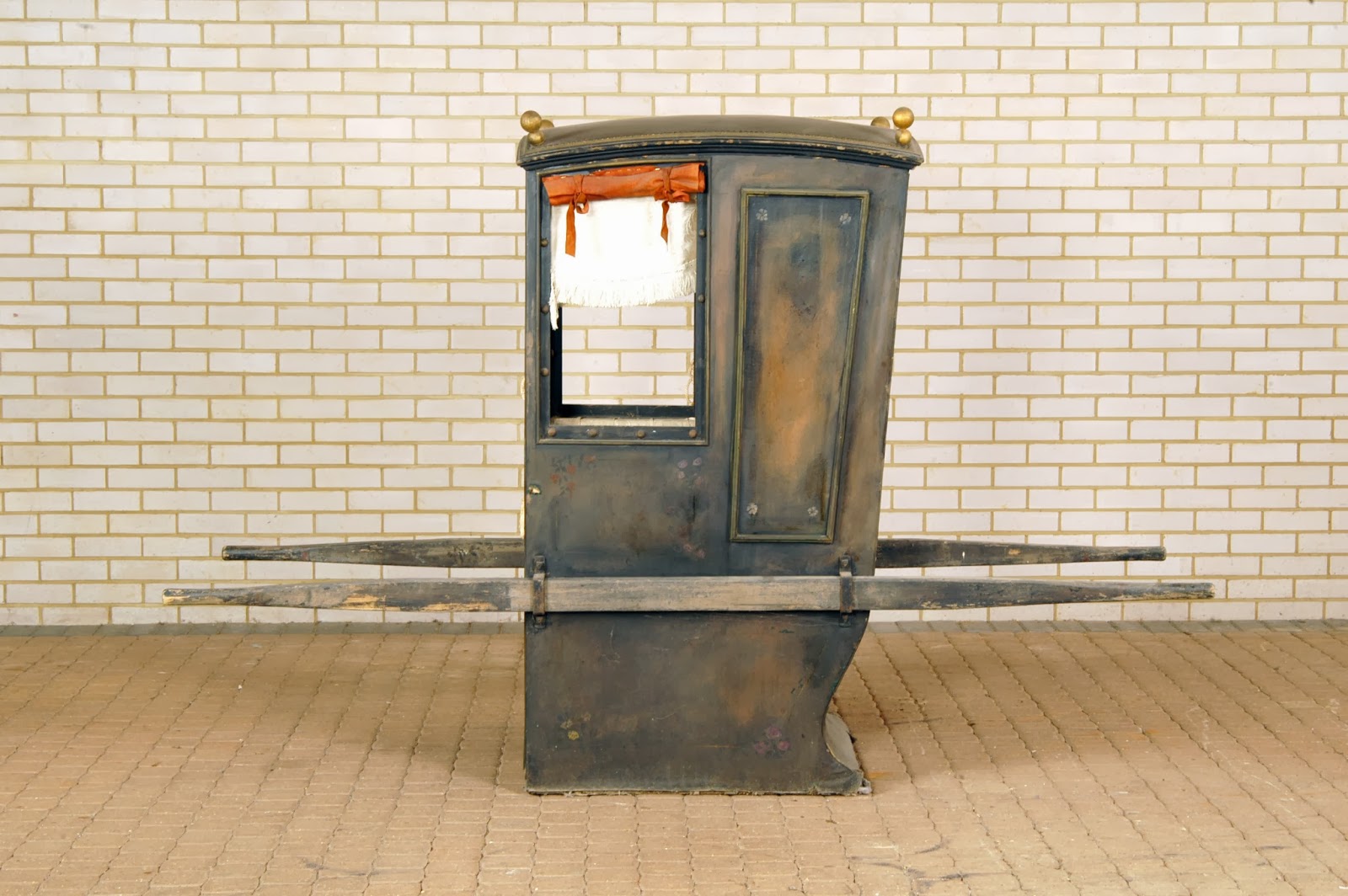
A fine example of a private sedan chair,
decorated to match internal decor.

The very wealthy kept their own chair (minus poles) in the hall of their town house and had it painted and decorated to match the interior décor. Others had their footman summon a chair by standing in the street and shouting ‘Chair! Chair!’ – whereupon a race of competing chairmen hastened forth.

Sedan chairs were popular  in London for a number of reasons. London streets were notoriously dirty and smelly, and so traveling in your own capsule was very appealing to the wealthy.

'After the fire of London, in 1666, the streets were impassable
and so people of quality went on their business or pleasure in sedan chairs.'
                                                                                                       New York Times, 1884

You could make good time in a sedan chair since they were legally allowed to use the pavement – and therefore bypass traffic jams on the road. Since the chair could enter a house, the privacy of the traveller was assured – be it a journey made for a secret tryst or for some illegal reason!

'However, it does not appear that the Sedan chair was always
a safe refuge against arrest for debt, as in one of Hogarth's prints
the tipstaves are seen to be laying hold of on they were in search of, just
as he was about to descend from his supposed place of security.'

 
A scene from Hogarth's 'The Rakes Progress.'

Much like modern taxi drivers, chairmen were licensed and had to display a number to prove it. In the 1700’s there were 300 sedan chairs licensed. A trip within the city cost sixpence, and hire for a whole day, four shillings. Trips taken after midnight cost twice as much.

Sedan chair stations were established, where a passenger could go to be sure of finding a lift. One such was in St James’ Park and much disapproved of by aristocrats who thought it lowered the tone of the park. They were probably right, as the chairmen were notoriously foul mouthed and the bearers were regularly fined for cursing loudly in public. Not only that but chair rank was open to the air and when it rained the vehicles became unpleasantly soggy inside.


The chairmen had to be strong, since carrying a man in even a light sedan chair meant bearing a load of about 100 lbs per man. The trade quickly became dominated by Irishmen who had travelled to England in search of labouring jobs. It seems they had quite a reputation for speed and agility.

‘the bearers [go] so fast that you have some difficulty
in keeping up with them on foot. I do not believe that in all Europe
better or more dexterous bearers are to be found.’
                                       Cesar de Saussure writing in 1725.


This is generous of Cesar since he was knocked over not once but four times by sedan chairman whilst visiting London. Pedestrians were supposed to give way to sedan chairs but didn't always  get out of the way in time even when the chairmen shouted a warning of 'Have a care!' or 'By your leave, sir!'

 However, with the capital’s rapid expansion the days of the sedan bearer were numbered because the size of the city made a journey by sedan unsustainable, as elucidated by Horace Walpole in 1791.

‘The breed of chairs is almost lost, for Hercules and Atlas could
not carry anybody from one end of this enormous capital to the other.’


If you have enjoyed this post, why not visit Grace's blog? 

Grace leads a double life as a veterinarian by day and author of historical romance by night.  


New edition! Click for link.

Friday, October 18, 2013

Eels, Fish and Animals from Early Bestiaries on The Bayeux Tapestry

by Carol McGrath


Since this week sees the anniversary of the Battle of Hastings (14th October 1066) I have returned to The Bayeux Tapestry which is one of the most important sources for any writer concerned with the period of the Norman Conquest. The Bayeux Tapestry is the dramatic story of the Norman Conquest set out in threads, stitched by contemporaries and displayed in Bayeux in the heart of victorious Normandy. It is seventy metres in length and barely a metre wide. Interestingly, it is in the margins that we see the tapestry's subtext and these margins are consequently of particular interest to the historian and the writer of historical fiction of this period because they often give clues to character.

The Treacherous Sands of the River Couesnon
Depictions in the border scenes on the Tapestry consist of paired animals and representations of fables. Only in the lower borders do you see extended diagonals separating out stories and scenes below the main narrative. One might think these echo the narrative above in parody but they actually often contain extraneous pieces that are unrelated to the main panel above. At other times, they are part of it.

Creatures seem deliberately chosen and arranged using moralised traits and values assigned by bestiary tradition. This is an exciting interpretation as bestiaries tend to belong to the first quarter of the 12th century and the tapestry dates back to the 1070s. Moralised animal literature was available in earlier sources which include the second century text Physiologus which is a later model for animal imagery and St Ambrose's Hexameron from the 4th century which offers a commentary on Creation as it is written in Genesis. The Canterbury designers certainly had access to such texts as 11th century English manuscripts from Canterbury suggest. Later bestiaries drew on these early sources.

One border line of embroidery of particular interest falls below the main narrative scene where Harold Godwinson is depicted pulling two men out of the quick sand by the River Coueson near Dol in Brittany. He is on a Breton Campaign with Duke William whilst a 'guest' at William's Norman court  He carries a man on his back and tugs the other with his wrist and he is holding a shield. Beneath his feet in the border the embroiderers place six eels. These swim from right to left chased by a man who is reaching for the tail of one of the eels with his left hand. He has a weapon in his right hand. An animal gnaws at his feet. This is attacked by another quadruped. A centaur is holding the second creature by the tail. Two fish appear to the left of the eels and they are connected to each other by a cord from their mouths. A dog tooth effect is created throughout the scene by opposed diagonal lines.

Could this scene comment on Harold's character? Now, such a comment could be interpreted as pro or against and it may be a character comment reflecting circumstance. Harold seems courageous , virtuous and noble but could he be slippery as an eel? Is it a witty scene and does the arrangement of figures imply that the scene can be read as a whole? 

To take the bestiary tradition maybe it is possible to shed light on Harold's character as perceived by the Tapestry's designers and emboiderers bearing in mind that this could be subjective. They could be poking fun at the Norman conquerors or they could be saying something important about Harold's traits or both. He was a war lord determined to be a survivor and may have needed wiles to hold a kingdom against his enemies. Moralised animal tradition suggests that here eels are not just eels but contain the potential for duplicity. Added to double headed serpents decorating the upper border when Harold and William set out for Mont-St-Michel and the two reliquaries that Harold touches later to double the strength of his oath to recognise William as a future king one wonders about the pairings in the borders.

The Oath, paired caskets!

Bestiary Interpretations of eels and fish and strange beasts

Fish

They are mouth to mouth and associated with early spring. The Breton campaign took place in March. Small fish are the object of greed of the stronger fish. The weaker the fish the more open it is to predation. Some fish consume each other. Violence is increased spontaneously in fish as in us, arising not from nature but from greed. So the fish is made into a sign, Pisces, so that we can see them in the sins of our ways and we should avoid their example lest someone stronger might be offered as a living example of the violence of one who is more powerful. Was Harold foolish to prey on William? Could this be one interpretation using the bestiary's 'insight' or perhaps William is preying on England's representative. Could that be the other way to read fish below the border in this scene?

Eeels

The snakes' origin is in the mud. We discover that from the bestiary tradition, when it is seized it is so smooth that the moment you tighten your grip on it the quicker it slips away! So what is being commented on here?

The Recumbent Man

He is English. We can see his beard and his moustache. The eels face away from him. They fly from his knife. He is amongst the creatures and linked by touch to all of them. It could of course have a dual interpretation. Harold tried valiantly to chase William from England's shores.

The First Quadruped

It is probably a wolf. Moralised, the wolf is the devil who circles the sheepfold of the church's faithful to afflict and destroy their souls. We can see Harold as an oath breaker or we can also acknowledge the determination of the reforming church to bring England's church into line with reformed continental Europe. This motivation for Rome's support for William's invasion cannot be ignored.

The Bird

An eagle is associated with royalty. It could even suggest Harold's right to the throne or was it William's right, or both?

The Second Quadruped

It touches the tail of the wolf, not holding on to it. It watches the man seize the wolf's foot in its mouth. It has associations with lion motifs on the borders by virtue of its colour. It has a tail and stripes on its back that do not appear on lions elsewhere. It could be another wolf. Its attempt to restrain the man, possibly Harold, is fruitless. He will break his oath to William and set in motion the events leading to Conquest and forthcoming devastation.

The Centaur

It is half man, half donkey , not the usual horse-man with a bow. Its two part nature according to Physiologus suggests derangement, double tongue, treacherous, deformed and half-wild. The ass is slow and obstinate for no reason. Is this another slight to Harold's character? However there is also the duality of the rational and the bestial. The reversal from left to right appears only in one other border scene and sometimes in the main panels, just like a theatre set. This movement creates a pause so that a viewer can absorb the impact of the scene before going on. It also has a thematic element because an interpretation of the border depictions may imply that Harold goes against orders King Edward might have given him when he travelled to Normandy in 1064/5. It was unwise. It could suggest he may also have gone against God's will.

In conclusion, the Tapestry's borders often provide a comment on Harold's actions as well as the main scenes which depict the events leading to The Norman Conquest and the Invasion itself. They are very clever and often ambiguous suggesting dual interpretation depending on what the viewer is looking for. As Andrew Bridgeford points out in his marvellous book listed below there is a hidden history lurking in the Bayeux Tapestry if only we know how to look at it.

nuns stitching The Tapestry

Bibliography

The Bayeux Tapestry, New Approaches, Oxbow Books, Oxford, 2011.
1066, The Hidden History of the Bayeux Tapestry by Andrew Bridgeford, Harper Perennial, 2004.

~~~~~~~~~~~


Carol McGrath is the author of The Handfasted Wife, first novel in a trilogy about the noble women of Hastings, published by Accent Press and available from Amazon UK and USA and all bookshops by order.