Showing posts with label Martyrs. Show all posts

Tuesday, September 15, 2015

Saint Kilian: Too Close to Power?


Saint Kilian baptizing Gozbert
Baptism of the Duke Gozbert by St. Kilian, 1905 glass painting
by Matthew Schiestl (1869-1939), in the
parish church of Our Lady of the Rosary in Gerolzhofen
(by Wolfgang Keller, public domain via Wikimedia Commons)

by Kim Rendfeld

Saint Kilian played by the rules.

When the seventh-century traveling bishop decided he and his followers should evangelize the Thuringians, he sought approval from the pope. Then he focused his efforts on converting Duke Gozbert, the pagan ruler in Würzburg. A shrewd choice. The Irish-born missionary would have stood out with his accent (assuming he learned the local language), his clothes, and his tonsure. He needed protection to preach and teach.

And he was playing by the rules when he told Gozbert to set aside his wife, Geilana, who was also the widow of the duke’s brother. By Church law, Gozbert and Geilana were spiritual brother and sister; therefore, the marriage was invalid.

But Killian waited two years before telling Gozbert. One legend says Kilian tarried to make sure Gozbert’s faith was strong enough for an arduous test. The duke called Kilian’s request the most difficult sacrifice the missionary had asked of him.

Was concern for Gozbert’s soul—and those of other Thuringians who married against Church rules—Kilian’s only motive? Or was there something more?

The answer might lie with Geilana, whom we know only through legend. An early medieval duchess could have tremendous influence on her husband and on affairs of the duchy. Aristocratic wives did more than bear children. They managed the household and controlled the treasury and access to their husbands. If Geilana remained a pagan, she could hinder Kilian’s missionary work by persuading her husband not to donate land or money to the Church or not let people see him.

A common tactic to remove a female political adversary was to call her an adulteress. (Double standard here: a Christian man’s infidelity was a matter between him and his confessor.) Had Kilian made such an accusation, he risked Geilana being able to disprove it through a trial by ordeal, in which the defendant or her champion is hurt and if the wound heals, she’s innocent.

He also risked Gozbert’s wrath. The duke apparently was satisfied with his marriage. If he weren’t, he would have tried to end it, even after accepting Christianity. Gozbert’s reluctance could have several causes. He might have loved his wife, but the primary reason for medieval marriages, especially among aristocrats, was politics. To divorce Geilana would offend her family. Gozbert might have even married her to preserve the alliance he had with his in-laws. And he might have come to depend on her as a partner.

Rather than question Geilana’s virtue, Kilian relied on another common tactic, one she could not dismiss: consanguinity by blood or by marriage.

Kilian probably knew there would be consequences if Gozbert ended his marriage but thought he was doing the right thing. Early medieval Christians believed they would be the only ones to see paradise. For a missionary, there was a personal stake: God would judge him for every soul he failed to lead to the True Faith. The fate of many souls outweighed politics.

Gozbert conceded to Kilian’s wishes but would do so only after he returned from war. Perhaps, he did not wish to fight more than one battle at a time.

Saint Kilian relics
Relic of Saint Kilian, Kolonat, and Totnan,
2012 temporary in St. Burkard church in Würzburg
(by Steffen 962 (CC0), dedicated the public domain,
via Wikimedia Commons)
Geilana was not going to stand for it. Perhaps, she wanted to avoid a feud, or she was desperate to hold onto her status and power as a duchess. Regardless of her reason, she used another common tactic to get rid of an enemy: assassination. On July 8, 689, she ordered Kilian and his companions slain and the bodies and their possessions buried. When Gozbert returned, she claimed the missionaries had left town.

The legends vary, but they all have Geilana and her accomplices going insane and dying miserably. I will leave it to the reader to decide whether Geilana faced divine retribution, but the story would have been true to its medieval audience. In it was a warning: Respect and obey God’s servants.

Sources

The Roman Breviary: Reformed by Order of the Holy Oecumenical Council of Trent

Papers of the Manchester Literary Club

Foxe's Book of Martyrs

"St. Kilian" by Friedrich Lauchert, The Catholic Encyclopedia, Vol. 8

Kim Rendfeld explores religion, warfare, justice, and love in her novels set in eighth century Francia. The Cross and the Dragon (2012, Fireship Press) is a story of a noblewoman contending with a jilted suitor and the premonition she will lose her husband in battle. The Ashes of Heaven’s Pillar (2014, Fireship Press) is a tale of a mother who will go to great lengths to protect her children after she has lost everything else.

To read the first chapters of  Kim's published novels or learn more about her, visit kimrendfeld.com or her blog Outtakes of a Historical Novelist at kimrendfeld.wordpress.com. You can also like her on Facebook at facebook.com/authorkimrendfeld, follow her on Twitter at @kimrendfeld, or contact her at kim [at] kimrendfeld [dot] com.

Kim's book are available at Amazon, Barnes & Noble, and other retailers.

Tuesday, January 20, 2015

Did the Pagans Kill the Saints to Save Their Community?

by Kim Rendfeld


How could two Northumbrian priests be considered such a threat that a pagan mob would murder them?

The seventh century martyrdom of Saints Ewald the Fair and Ewald the Black in Saxony leaves a lot of unanswered questions, but their story could have been in Charlemagne’s mind as he started a series of wars against pagan Saxon tribes almost 80 years later, and those wars would result in the obliteration of the Continental Saxons’ religion.

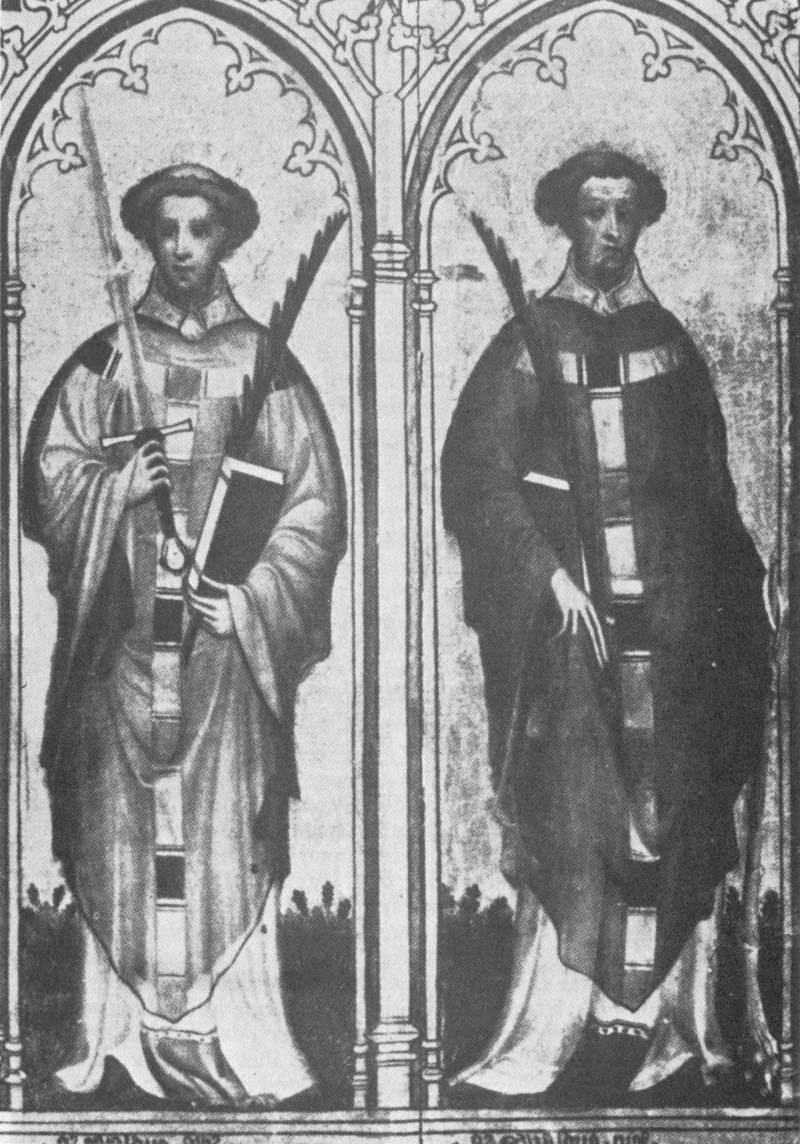
An image of the Ewalds from 1400
What information we do have about the Ewalds is far from an objective account. They were educated at Irish schools, and Ewald the Black was the more learned of the two. There, they likely met St. Willibrord. He in turn might have been influence by Ecgbert, who wanted to evangelize the Continental Saxons but was prevented from doing so.

Whether or not they accompanied Willibrord to the Continent, the Ewalds began their mission about the same time, around 690. About five years later, their journey took them to the house of a steward of a Saxon nobleman in Westphalia. The priests said they had an important message to give the aristocrat, and the steward promised to take them to him.

For some reason, the priests had to wait several days and were the steward’s guests. With their tonsures and robes, they would have already stood out, and they held Masses, prayed often, and did whatever else their faith required.

Did the practice of their religion also include preaching, with a call to destroy sites sacred to the pagan villagers? On the North Sea island of Fositeland (Heligoland), the Ewalds’ contemporary Willibrord insulted the pagans by baptizing people at a fountain holy to them and having sacred cattle slaughtered for meat.

In Germanic religions, the stakes were higher than hurt feelings. The gods held power over every aspect of their lives, from the farm fields to the battlefield. Angry gods could cause famine or defeat in battle.

The story goes that Saxon villagers believed the priests were trying to convert their chieftain and destroy their temples, and if we are to read between the lines, they thought the aristocrat could be swayed. In those days, religion was not merely a personal matter. The reason priests tried to convert a lord is that his followers might also renounce their gods and embrace Christianity.

Perhaps the people who attacked the priests feared disaster. They killed Ewald the Fair with a sword and tortured and dismembered Ewald the Black, who was the spokesman. The two bodies were thrown into a river.

When the nobleman found out about the deaths, he was furious. He ordered the murderers to be killed and the village to be burned. Was the nobleman outraged that guests in his house, and therefore under his protection, had been slain (never mind his obligation to protect the village)? Or is this element included to give the audience a sense of justice, important to Germanic societies? I leave that up to the readers. As I do the stories of the miracles that followed.

A spring of water gushed from the site where the priests had been martyred. The bodies were carried for 40 miles upriver to where the priests’ companions were, and a bright pillar of light shone above the martyrs. One of the Ewalds appeared to a monk and told him how to find the bodies.

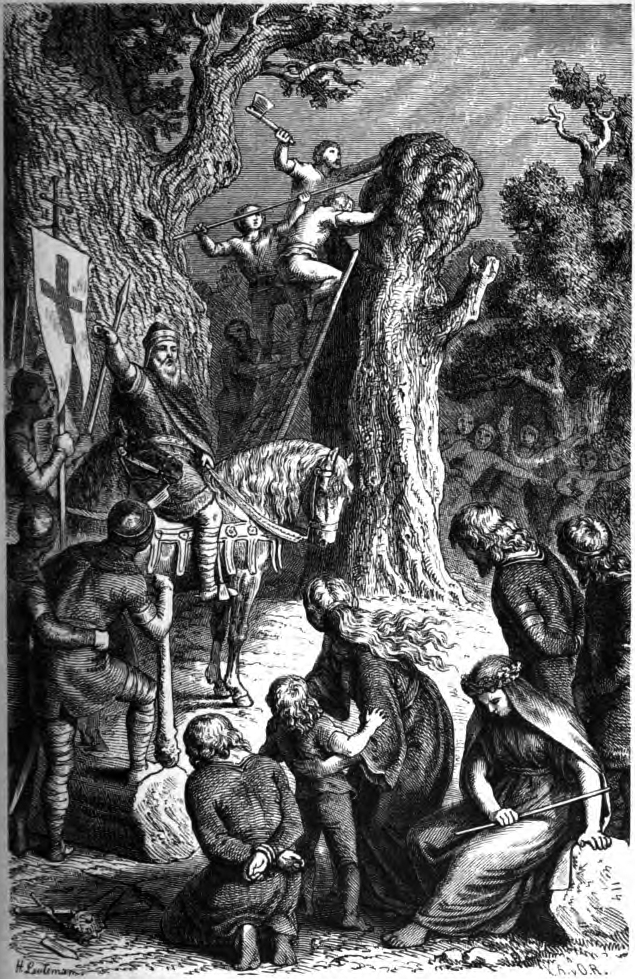
A 19th century illustration of the
destruction of the Irminsul
The story made its way to Christian Francia. Hearing of the miracles, Pepin of Herstal had the saints’ relics translated to a church in Cologne. It is possible that one of his great-grandsons, Charlemagne, heard about the saints decades after the martyrdom. How it influenced his perception of the Saxons and their religion is a mystery. Perhaps it underscored his belief that they worshipped devils.

In 772, he led an army that destroyed the Irminsul, a pillar sacred to the Saxon peoples. It was the start of decades of bitter warfare, with brutality on both sides. But in the end, the thing the murderous Saxon mob feared came to pass: their religion was lost.

Public domain images via Wikimedia Commons.

Sources

"Sts. Ewald" by Columba Edmonds, The Catholic Encyclopedia

Alcuin’s The Life of Saint Willibrord

Carolingian Chronicles, which includes the Royal Frankish Annals and Nithard’s Histories, translated by Bernard Walter Scholz with Barbara Rogers

Teutonic Mythology, Volume 1, Jacob Grimm

Kim Rendfeld’s latest release, The Ashes of Heaven’s Pillar (2014, Fireship Press), starts in 772 with Charlemagne’s first war in Saxony and is told from the perspective of a Saxon peasant who will go to great lengths to protect her children.

To read the first chapters of Ashes or Kim’s debut, The Cross and the Dragon (2012, Fireship Press), or learn more about her, visit kimrendfeld.com or her blog Outtakes of a Historical Novelist at kimrendfeld.wordpress.com. You can also like her on Facebook at facebook.com/authorkimrendfeld, follow her on Twitter at @kimrendfeld, or contact her at kim [at] kimrendfeld [dot] com.

Kim's book are available at Amazon, Barnes & Noble, and other retailers.

Monday, October 21, 2013

A Recusant's Life in the 17th Century

by Deborah Swift


In 1571  a law was passed making it treasonable to be under the authority of the Pope, including being Jesuit, being Roman Catholic or harbouring a Catholic priest. The standard penalty for all those convicted of treason at the time was execution by being hanged, drawn and quartered. Nevertheless, many Catholics would not give up their faith as a matter of principle, claiming that Henry had stolen their Church, the rightful Church of England, from them.

Official records show that 5000 people were fined between 1593 and 1600, but these numbers are probably the tip of the iceberg. Many more would have escaped being fined and continued to practice their faith in secret. Women in particular, deemed to be 'the weaker vessel', with no property rights, and whose husband controlled all their wealth, were particularly difficult to fine - unless of course their husbands agreed to pay the penalty.

At the beginning of the realm of James I, many Catholics were outraged that Mary Queen of Scots's son did nothing to ease the legal persecution that they had endured since the reign of Henry VIII.But James knew that to win the allegiance of the English,who saw themselves as a Protestant nation, he must accede to the demands of  the powerful evangelical committee of the Church of England.

So a new King meant further persecution for the remaining Catholic families, who could be fined or jailed for attending Mass. Catholic Priests were concealed in 'priest holes' and led their lives in hiding, often in fear for their lives. Some people went so far as to build their houses to plans which would include multiple hiding places - Eliza Vaux arranged for Harrowden Hall to have many - something that alllowed her a virtual Jesuit college right in the heart of England.

Priest Hole at Harvington Hall


There are many tales of Priests who did not escape their pursuers - forty of the Priests who lost their lives in this period were canonised as late as 1970 by Pope Paul VI.

In the 17th Century the penalty for an ordinary person not attending the Church of England was £20 a month - an enormous sum considering that a yeoman farmer might earn £2 a year. No wonder Guy Fawkes and his Catholic friends wanted to blow up the Houses of Parliament. An anonymous letter eventually warned Parliament of the Gunpowder Plot - a letter that is still in our National Archives and causes fierce debate because nobody really knows who it was that betrayed the conspirators.

Image of The Monteagle Letter

Of course Guy Fawkes and his gang were executed in the traditional way, but their plotting made life considerably worse for Catholics, as recusants were subsequently banned from practising Law, serving in the Army or Navy, and from voting in elections.

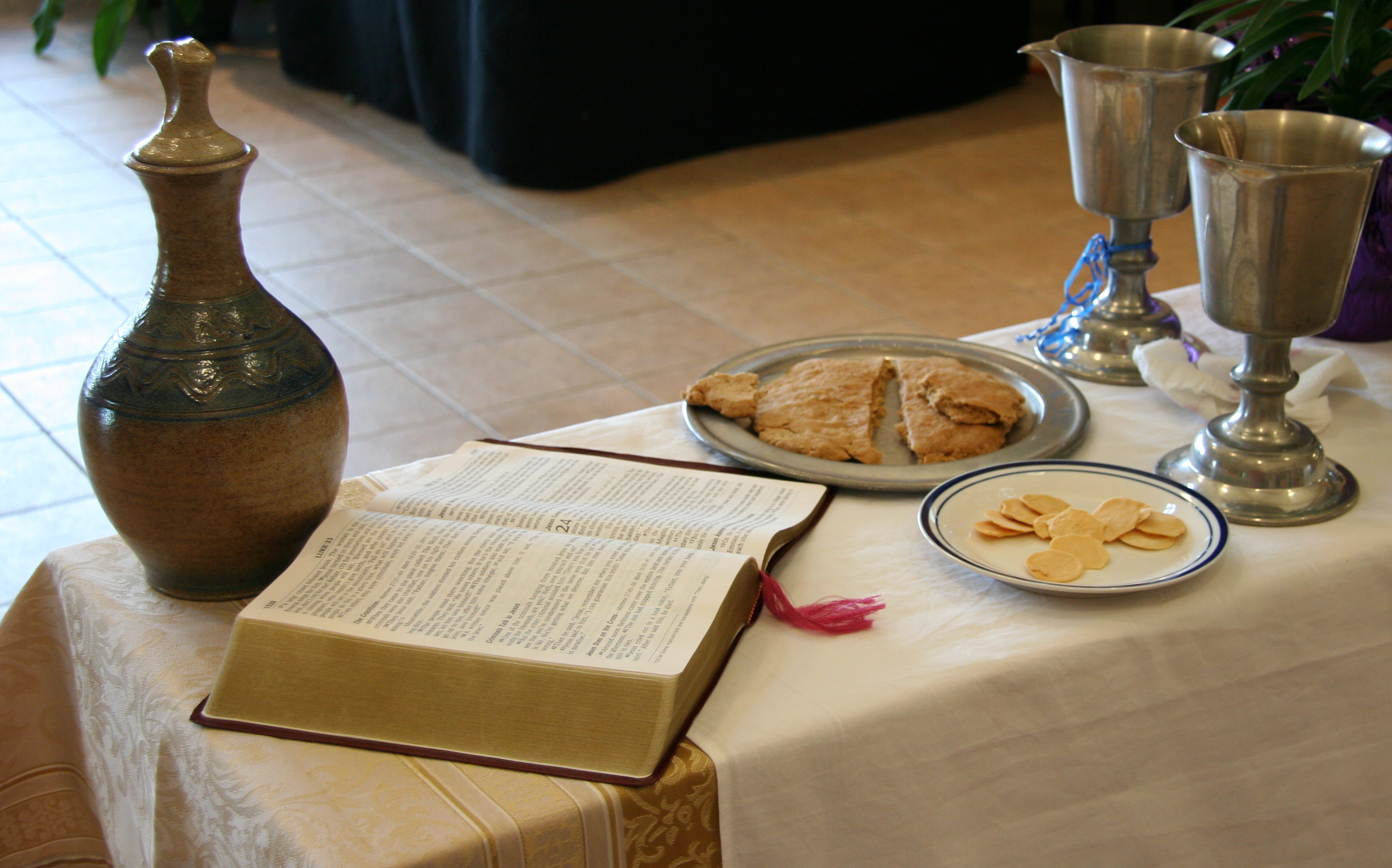
For a recusant, the objects of your faith - chalice, Bible, statuary had to be hidden in cellars or in attics. In this picture - again of Harvington Hall, the floorboards to the left of the altar can be lifted to hide away the candleabra and altar furniture.


Some Catholics had elaborate chests made that opened out to reveal an altar or shrine. This article about Mapledurham House shows a picture of a secretaire adapted for that purpose, and tells us that some priest holes were so well-hidden that they are only now being discovered.

Picturez

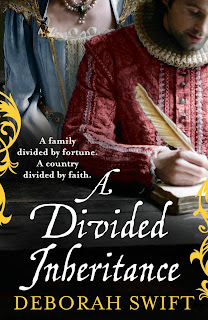
This period fascinated me, and I set my most recent novel at this time. The Leviston family are Catholic and must go to elaborate lengths to hide their faith. At the same time, in other European countries such as Spain, it was illegal not to be a Catholic. The young woman in my novel has to travel from England to Spain in search of her lost inheritance, a journey which changes her view of English life forever.


"A Divided Inheritance achieves what all stellar historical fiction must: through the voices of imagined characters, important lessons from the past linger and haunt long after the book is finished."  
Ann Weisgarber, winner of the Langum Prize for Historical Fiction

The book comes out on Thursday, published by Macmillan - Hooray! Find out more from my website.
Thanks for reading!
Sources: The Gunpowder Plot - Antonia Fraser
Religion and the Decline of Magic - Keith Thomas
You might also like http://englishhistoryauthors.blogspot.co.uk/2011/11/religious-upheaval-during-17th-century.html