Showing posts with label Guy Fawkes. Show all posts

Wednesday, March 25, 2020

The Pearl of York, Treason and Plot – Political Intrigue in Tudor York

By Tony Morgan

Margaret Clitherow was the wife of John Clitherow, a successful businessman and butcher. Her arrest and subsequent trial for harbouring Jesuit priests in March 1586, was chronicled by Father John Mush.

As Father Mush was a Catholic priest himself, he couldn’t risk attending the court in person. Someone else had to be his eyes and ears on the streets of York and at the Lent Assizes. Could this really have been Margaret’s near neighbour, a youthful Guy Fawkes?

Margaret Clitherow was born around 1553 into a prosperous family. Her father, Thomas Middleton, was a wax-chandler, at a time when everyone needed candles, and an alderman of the city. His wife Jane busied herself looking after the family, supporting the business and running the household.


With the family firmly part of York’s merchant class, Margaret was raised a Protestant. Their conformity and position in society was confirmed in 1564, when Thomas Middleton was elected for a one-year tenure as Sheriff of York. When he died three years later, he left behind a legacy for his family, and a small amount of money for the city’s poor, with a request they’d pray for his soul.

His widow Jane quickly remarried. Her new husband, Henry Maye, was a younger man and from a lower social class, which would have been a surprise to many. He quickly transformed their home, however, into a successful inn and pursued various business interests. Over time, Henry, and his new family, prospered. His place at the heart of York’s governing class was eventually accepted, and he became an alderman, himself.

Margaret is said to have had a good relationship with her stepfather. The family would have been pleased in 1571, when she married the well-to-do widower John Clitherow, and moved to his household in The Shambles, a narrow street dominated by the city’s meat traders.

The Shambles, York

In the years which followed, Margaret raised a family and controversially converted to Catholicism. Most Catholics stayed true to their faith unobtrusively. They attended Protestant church services every Sunday, as the law demanded, before sneaking off to secretly attend an illegal Catholic Mass.

But Margaret Clitherow was no ordinary Catholic. She refused to hide her new religion. Instead, she joined York’s recusants - dissenters who shunned the official church services and objected to swearing allegiance to the queen. Over the next ten years, she was imprisoned and fined multiple times for her crimes. Once, she was even released on licence for a few weeks to have a baby.
John Clitherow remained a Protestant. For a time, he was even a church warden, responsible for naming people who didn’t attend church. But he paid Margaret’s fines, and welcomed her home whenever she returned from prison.

At the time, there was a major power struggle underway behind the scenes in York. In one corner was the Council of the North. the Queen’s official representatives in this part of England. Based in the King’s Manor in York, near the city walls, the Council was responsible for preventing and putting down religious or other uprisings in this unruly place, two hundred miles north of the Queen’s power base in London.

In another corner was York Corporation. This was effectively York city council, run by the merchant classes, rather than councillors from political parties or independents. The Corporation set local taxes and laws in the city, controlled the powerful guilds, ran correction facilities and at times gave alms to the poor. Based in the building known as the Common Hall, above the banks of the River Ouse, the Corporation was led each year by the Lord Mayor and a senior Sheriff.

There was also a third powerful body to consider, the Church of England. Headed locally by the Archbishop of York, the Church operated the city’s churches, had its own prison and an Ecclesiastical Court, which had employed Guy Fawkes’s father and grandfather in days gone by. The major locations of the Church in York included York Minster and the Bishop’s Palace, located just outside the city.

York Minster

In some ways, all three vied for the Queen’s favour, and what better way of getting this than by persecuting Catholics? Methods includes fining and imprisoning recusants and capturing and executing any Catholic priests found in the city. In addition, a new law had been introduced. Anyone found guilty of allowing Catholic Mass to be said in their house or aiding a Catholic priest in any way could be executed, as local layman Marmaduke Bowes discovered to his cost in the year 1585.
In the same year, Margaret’s mother Jane died. Following the family tradition, her stepfather Henry remarried quickly to a much younger spouse. Margaret’s stepfather’s star was on the rise. In February 1586, he was elected, with great fanfare, as the new Lord Mayor of York.

There was only one problem, Margaret’s recusancy. What sort of example did this set to the city? The representatives of the Council of the North must have been rubbing their hands together. This was something they could exploit to their own benefit. Equally, Henry Maye would have been cursing Margaret and wondering how he could wash his hands of this blot on his reputation.

Both parties then, as well as the Church, had motive enough to investigate Margaret further. When whispers went around that she might be hiding priests and allowing Mass to be said in her house, which body would have acted first? Or for once, did they act in co-ordination?

For only one month after Henry Maye’s inauguration, John Clitherow was summoned to the King’s Manor to speak to the Council of the North. As soon as he was away from his house, the Corporation acted. The Sheriff of York raided the premises. Margaret was arrested, and although no priests were found, she was sent to trial at York Lent Assizes.


What happened next had even more political intrigue, as the Council and Corporation attempted to influence events in favour of their own agenda. Father Mush watched on from the side-lines. What role did he and the Catholic Church have to play in Margaret’s downfall?

~~~~~~~~~~

Tony Morgan is an author and university academic. He lives in North Yorkshire, near to the birthplace of Guy Fawkes and Margaret Clitherow. In addition to writing historical novels, Tony gives history talks covering the events of the Gunpowder Plot and the life and death of Margaret Clitherow.
To date, all profits from his novels and talks have been donated to good causes. In 2020, Tony is supporting St Leonard’s Hospice in York.
For more details, visit Tony’s website - https://tonymorganauthor.wordpress.com/ or follow Tony on Twitter @MorgantheBook

If you want to find out more about Margaret, and Father Mush's role in proceedings, The Pearl of York, Treason and Plot is available from March 2020 on Amazon in Kindle and paperback formats. It can also be purchased locally in Yorkshire, for example at one of Tony’s history talks.


Saturday, May 6, 2017

Who was Robert Catesby? A look at the real Man Behind the Mask

by Linda Root

Why May and not November?

One would expect a post about the mastermind behind the Gunpowder Treason to appear on November 5 rather than in May, but like so much else about the plot, it had not been planned for November. The original plot was to be sprung in February and designed to reach fruition by the end of spring.

Had the conspiracy gone forward as originally projected, by the end of May  James I would be dead, the crown would be tottering on the head of his nine-year-old daughter Elizabeth, the Earl of Northumberland or some other peer sympathetic to the Catholic cause would be Protector of the Realm, and the man who is widely blamed for it all--Guy Fawkes-- would have been in the Spanish Netherlands explaining the necessity for the regicide to the Archdukes Albert and Isabella.

Then the king went and ruined it all by delaying the opening of parliament until autumn because he feared the lingering plague, unaware of greater dangers lurking.

In the months between the Spring of 1605 and infamous November 5, the original plan was refined and in a sense, improved, but it was also weakened as the circle of conspirators expanded. Then, on October 26, 1605, William Parker, Lord Monteagle, received an anonymous letter warning him not to attend the opening of Parliament. According to traditional histories, he passed the letter on to Robert Cecil, then known as Salisbury,  and consequently saved the day.

National Archives -{{US-Public domain - expired copyright.}}
Or did he?
There is an alternative history that propounds a different theory --one in which Cecil had been watching Guido (aka Guy) Fawkes for months based on warnings from English spies in the Netherlands who had documented his visits there. Fawkes had been placed on Cecil's watch list, and thus, Cecil had been aware of the plot all along. He simply had not acted  until he had  conceived of a way to net all of the culprits and designed a way to implicate the Jesuits in the evil deed.

According to that version, the Monteagle letter was a hoax concocted by Cecil and Lord Monteagle, taking advantage of one of the plotters who was Monteagle's relative, a cousin who had spilled the beans to Parker. The authorship of the letter was pinned on him and he mysteriously died of poison while languishing in the Tower, a very convenient act of damage control if Cecil actually was behind the ruse.

Lord Monteagle benefited from grants of interests in England's overseas enterprises at the cost of the life of a mere cousin. In the aftermath, Cecil got his vengeance against England's leading Jesuits, Catholics were again persecuted by a less tolerant King James than the one who had arrived from Holyrood two years earlier, and the false hero Monteagle got to keep the change.

So, how did Guy Fawkes figure in all of this?

The statement that Guy Fawkes almost blew up Parliament is about as accurate as when those of us who are Americans call George Washington the father of our country or claim that Abraham Lincoln fought the Civil War to free the slaves. There is much more to the Gun Powder Treason than a conspiracy to bring down the government, and it involves issues that plague us today. To put the caper at the feet of Guy Fawkes is about as complete an analysis as blaming 9/11 on Abdulaziz-a-Omari. How many readers recognize the name well enough to identify what part Omari played in it? Likewise, Fawkes was not the instigator of the Gunpowder Plot--he was the bloke who got caught.

Public Domain -Anonymous, from work already in the public domain.

Fawkes had two specific roles to play, both of them suited to his talents. His experience as a soldier made him the ideal choice when it came to spreading the explosives and lighting the fuse. But he also was a veteran of the wars waged against the rebellious Dutch, and in the Spanish Netherlands he was regarded as a loyal Catholic soldier whose interests aligned with those of Spain.

His projected duties went well beyond the event planned at Westminster. In modern terms, he was the conspirators' public relations man. His role was to plant the seed before the explosion and after the deed was done, market it to the crowned heads of Europe in the least offensive terms imaginable.

He was suited to the task because during the time he had spent in Flanders he had established many friendships among the Catholic English exiles and had performed well in services of the Spanish in their war against the Dutch. He had comported himself with honor and bravery exceptional in a mercenary,  and thus would be a persuasive apologist  in defense of what would otherwise appear a heartless regicide.

His was an important mission, designed to combat two features of the Gunpowder Plot that made it particularly odious.

 First, it threatened the concept of Divine Right of Monarchy, a fact certain to offend Philip III and Henry IV as well as the Archdukes Albert and Isabella Clara Eugenia, co-rulers of the Spanish Netherlands. Killing kings was the job of other kings and to be done with honor, not by knaves hunkering in dark basements stockpiled with explosives.

The other troublesome feature of the Gunpowder Treason is what we call collateral damage, and collateral damage of the worst kind, because among the intended victims would be women and children and many souls sympathetic to the conspirators. It was the aspect of the plot that even the most radical among the group found difficult to accept and for which they sought counsel from representatives of the Pope.  It was Fawkes' assigned duty to minimize the stigma by spreading the doctrine that had evolved as the plot progressed--the concept of necessary evil.

In spreading the propaganda, Fawkes was not the orchestrator but the messenger. Blaming him is like blaming a guy named Bernard Barker for Watergate.

Exclusive image: ID 16858073 © Steve Allen | Dreamstime.com 

Who was Robert Catesby?

Fawkes was a principal in the commission of the crime, but he was not the mastermind. That dishonor falls on the head of a man named Robert Catesby. He doesn't have a day named for him. No one goes running about on November 5 in a Robert Catesby Mask. No one stages public protests in his name, and to my knowledge, no one burns him in effigy. He was never tried of convicted or racked or disemboweled. He was fortunate to get himself killed while trying to escape arrest.

He was the ringleader, a member of the landed gentry, as were most of the others. And while he was firm in his Catholic faith, there was nothing that pointed him out as a man who would kill a king. He was known to be one of many recusants but he was not considered instrumental in any current Papist plot.

Catesby was an Oxford man who left before graduation, apparently to avoid having to take the Oath of Supremacy that would have forced him to betray his faith. He had taken part in the Essex Rebellion of 1601, and escaped Elizabeth's wrath by paying a substantial fine  that caused him to divest himself of his estate. By the time of Elizabeth Tudor's death, he had become radicalized. When hopes that James would lift restrictions on the mass when he ascended to the English throne in 1603 were dashed, Catesby decided it was time to act.

Ashby-Saint -Ledgers, home of Anne Catesby - Wikimedia Commons, P.D.

Parts of his early planning occurred at the family estate at Ashby-Saint Ledgers, Catesby's mother's home. It was centrally located to the residences of  the others he had drawn into the plot.

Among his earliest recruits were men he knew from the Essex Rebellion. Clearly it was Catesby and never Fawkes who was the principal in the evolving plot. And as other men were brought into it, it was Catesby who had the final word as to their suitability to join. Fawkes was accepted into the group  by virtue of his devout Catholicism, his contacts in Europe and his military expertise. When the Parliament set for February 1605 was cancelled due to the king's fear of plague in London, the plot had expanded from the original five--Catesby, Thomas Wintour, John Wright, Thomas Percy and Guy Fawkes-- into one involving a group of thirteen men, many of whom were aristocrats.

The thirteen Gunpowder Plot conspirators- Wikimedia Commons-P.D.

The plan called for most of the participants to be far away in the Midlands when the Houses of Parliament exploded,which of course resulted in Fawkes being caught with the power keg. Part of the gang was posing as a hunting party near the manor house where the Princess Elisabeth resided. Their objective was to take possession of the princess and make her titular queen, possibly under a regency with the Earl of Northumberland as Protector.

News of Fawkes' arrest sent them into flight. When news of Fawkes's capture and the discovery of the explosives reached Catesby, he lied about it to his followers and those he hoped to recruit to his cause, declaring that the king was dead. When that deception failed, he changed his tactics and sought to build his own revolt. When he declared that his rebel group stood for God and Country, a resident of the village he tried to bring into his ranks replied, "We stand for King, God and Country." That indeed was the prevalent sentiment.

 It was not the first time that radical Catholic dissidents misjudged the sentiments of England's moderate Catholics. From the time when Catholic dissidents colluded with the King of Spain to place imprisoned Marie Stuart on the English throne, the loyalty of most English to their sovereign was underestimated.

Sadly, it was not the first time that moderates became the scapegoat of the royal wrath. After all, many English peers, protestant and Catholic, some with their wives and families in attendance,  were scheduled to attend the opening day of Parliament, including not just the king, but Queen Anne, the formidable and much admired Prince of Wales Henry Frederick and possibly the frail five year old Charles, Duke of York, who at last had learned to walk.  It is the strike against their own coreligionists and the entire royal household that so inflamed not just James but the common English.

In judging the heat of their passion, one recalls that the concept of a royal family was a new thing in the life experience of English men and women of the time. Elizabeth had been an independent childless woman. Her closest relatives were cousins, nephews and nieces. The Stuarts were still a romantic phenomena to the average English man and woman.  The plotters had attacked a popular new institution - that of the Royal Family.

While James opened the following year's Parliament with conciliatory words and assured the Catholic kings of Europe that he bore no ill will to his common Catholics, his policy of looking through his fingers at the activities of recusants ended. Thus, the plotters were defeated  in principal as well as in design.

One died and another was blinded in an accidental fire when gunpowder moved from other locations to Holbeche House in Staffordshire caught fire. Others, including Catesby, died the following day when the Sheriff of Worchester arrived with 200 armed men with no intention of extending leniency. Many depictions show Catesby being injured in close combat, but most historians report that he was shot.

Public Doman Art ((US)) -
Anonymous drawing of the death of Robert Catesby,
Wikimedea Commons 
Some say he died clutching a small statue of the virgin or at a larger statute of the virgin's feet. The men who died at Holbeche House were luckier than the survivors who suffered the indignities and horrors of a traitor's death. 

Fawkes did not give up his comrades until he was tortured by increasingly gruesome means. Others who were only peripheral to the plot also suffered. The mighty Earl of Northumberland was imprisoned in the Latham Tower for his association with his cousin Thomas Percy, one of the original five, with whom he had lunched on November 4th. Thomas Percy had died along with Catesby, some say from the same bullet, leaving no one to condemn or exonerate the earl, who eventually was released upon levy of a substantial fine but who never  regained his former prominence.

A second version shows Caesby in close combat over the death of his comrade Percy. Public Domain from Wikimedia Commons {{US-Art}}Add caption

The Death of Guy Fawkes:

King James personally participated at the initial interrogations of Fawkes,who was arrested under an alias he commonly used--John Johnston. James approved the use of what was called 'the gentle tortures' at first, and eventually allowed the more severe. Fawkes held out until he had been racked repeatedly, and when he did confess, his former proud signature was barely legible.

He met his death as he had lived his life, in the manner of a soldier. When Guy Fawkes and the others who suffered with him were taken to their place of execution at a site within view of the Houses of Parliament, unlike the others, Fawkes died from a broken back during his hanging and was dead before they cut him down. Thus the man whose likeness is a symbol of anti-establishment protest met his end.

Just as it so often happens today,  as it happened then, few remember the man who had set the conspiracy in motion,. It is Fawkes who is burned in effigy. Even the art of the day, as shown below, misrepresents the truth. When Fawkes met his death, there is no way he would have been able to climb the ladder on his own.


 John Cruikshank,Wikimedea Public Domain Art

Was Robert Catesby a Terrorist?
Much has been written about the relationship of the Gunpowder conspirators to modern terrorists. Certainly the act meets most definitions, all but one. It has been said in different words and in different contexts that the goal of terrorism is terror, and that terrorist acts target civilian non-combatants.

That was not the objective of Robert Catesby and the others involved in the Gunpowder Treason. In modern terms, what they sought was regime change.Their ultimate goal was to affect a revival of Catholicism. Their target was the king. The result of their failed conspiracy was to make his personal agenda as a Peacemaker difficult to implement.

To that extent, I disagree with Antonia Fraser and others who have called the Gunpowder plotters terrorists. Perhaps fanatics is the better term.  Nevertheless, even this thumbnail analysis begs the question of whether they deserve to be remembered by some as patriots who dared to strike out against a despotic regime. New information about the goals of James VI and I counter most arguments as to  the proprietary  of their cause.

AUTHOR'S NOTE

Faith and Treason ~the Story of the Gunpowder Plot, by Antonia Fraser, is a remarkable work that should be in the library of any scholar of English history and anyone who loves historical mystery. It is written with the same vitality and style as her seminal biography of the Queen of Scots, and is often lauded as a well crafted detective story. It is the foundation of this thumbnail sketch and the basis of research in my current work in progress In the Shadow of the Gallows, the fourth installment in my series The Legacy of the Queen of Scots.

This Editor's Choice was originally published May 23, 2014

~~~~~~~~~
Linda Fetterly Root is a retired major crimes prosecutor and a historical novelist writing of events in 16th and 17th century Scotland, France and England. She lives in the Morongo Basin area of the California desert with two wooly malamutes, a flock of chickens and assorted wild things. Her books are on Amazon.

Wednesday, April 13, 2016

Bonfire Night - Guy Fawkes and the Gunpowder Plot of 1605

by Maggi Andersen

This post is an EHFA Editor's choice. It was first published on 15th June, 2012


The same year that the first Plays Act was passed, Guy Fawkes was discovered trying to blow up the King and the Houses of Parliament in the ill-fated Gunpowder Plot.

A contemporary engraving of eight of the thirteen conspirators, by Crispijn van de Passe. Fawkes is third from the right.

Guy Fawkes (13 April 1570 – 31 January 1606), also known as Guido Fawkes – the name he adopted while fighting for the Spanish in the Low Countries – belonged to a group of provincial English Catholics who planned the failed Gunpowder Plot of 1605.

Fawkes was baptised at the church of St. Michael le Belfrey

Fawkes was born and educated in York. His father died when Fawkes was eight years old, after which his mother married a recusant Catholic. Fawkes later converted to Catholicism and left for the continent, where he fought in the Eighty Years' War on the side of Catholic Spain against Protestant Dutch reformers. He travelled to Spain to seek support for a Catholic rebellion in England but was unsuccessful. He later met Thomas Wintour, with whom he returned to England.

Wintour introduced Fawkes to Robert Catesby, who planned to assassinate King James I and restore a Catholic monarch to the throne. The plotters secured the lease to an undercroft beneath the House of Lords, and Fawkes was placed in charge of the gunpowder they stockpiled there.

Discovery of the Gunpowder Plot (c. 1823), Henry Perronet Brigg

Prompted by the receipt of an anonymous letter, the authorities searched Westminster Palace during the early hours of 5 November, and found Fawkes guarding the explosives.

Fawkes being interrogated

Over the next few days, he was questioned and tortured, and eventually he broke. His signature of "Guido" made soon after his torture, is a barely evident scrawl.


Immediately before his execution on 31 January, Fawkes jumped from the scaffold where he was to be hanged and broke his neck, thus avoiding the agony of the mutilation that followed.

A 1606 etching by Claes (Nicolaes) Jansz Visscher, depicting Fawkes's execution

As a result the Observance of 5th November Act was passed, which required the people of England to celebrate ‘with unfeigned thankfulness … this joyful day of deliverance’ as a ‘perpetual remembrance … for all ages to come’. This meant that you were supposed to go to church where prayers of thanksgiving were to be said, ‘and there to abide orderly and soberly at the time of the said prayers, preaching or other service of God’.

This law made it compulsory to celebrate the arrest of Guy Fawkes and stayed in force in England until 1859.


However, there is one law concerning bonfire night still in force which says it is only permissible for children to go door to door collecting ‘a penny for the guy’ with the written permission of the local chief constable of police – no mention of ‘trick or treat’ on Halloween without his consent.

Though long dead, there is still debate as to whether Guy Fawkes was a hero or villain. His adversary was King James I of England, and he planned to kill the queen, and elder son, Henry too. Before ascending the English throne (following the death of the Virgin Queen Elizabeth), James became the King of Scotland at the tender age of 13 years. The boy king was under constant threat. People around him were always looking to seize power.

James I was a man of integrity and new ideas. One of his greatest achievements was the translation of the scriptures.

The Monteagle letter

He ruled during a time when the Church and State were same and brought about various changes. There were two factions within the church: the Bishops, who had supreme power, used the Bishop’s Bible which was the sole religious text for the British. The Puritans had faith in the Scriptures and used the Geneva Bible. King James I felt that the Bishop’s Bible was a lazy work while the Geneva Bible had footnotes with political inclinations. He made the decision to give the English a new Bible. He formed a committee that worked for seven years to come up with King James Bible. England thrived under King James I’s leadership. But the old Roman Catholic followers were not happy with the radical thoughts of their king.

The plot led to renewed penal legislation against Catholics in 1606, and increased Protestant fears of popish conspiracies.

~~~~~~~~~~~~~

Maggi Andersen writes historical romances set in the Georgian, Regency and Victorian periods.
Find her novels at Amazon.
Author website: maggiandersenauthor.com
Facebook: Maggi Andersen Author
Twitter: @maggiandersen

Research: 
The Strange Laws of Old England, Nigel Cawthorne. Piatkus.
The Cambridge Historical Encyclopedia of Great Britain and Ireland. Guild Publishing, London.
Wikipedia

Illustrations: All are in the Public Domain with additional attributions req: 
Church of St Michael le Belfrey: Source=http://www.flickr.com/photo_zoom.gne?id=156011512&context=set-72057594119141960&size=o |Date=28 May 2006 |Author=Andrew Dyer |Permission={{cc-by-sa-2.0}

Monday, October 21, 2013

A Recusant's Life in the 17th Century

by Deborah Swift


In 1571  a law was passed making it treasonable to be under the authority of the Pope, including being Jesuit, being Roman Catholic or harbouring a Catholic priest. The standard penalty for all those convicted of treason at the time was execution by being hanged, drawn and quartered. Nevertheless, many Catholics would not give up their faith as a matter of principle, claiming that Henry had stolen their Church, the rightful Church of England, from them.

Official records show that 5000 people were fined between 1593 and 1600, but these numbers are probably the tip of the iceberg. Many more would have escaped being fined and continued to practice their faith in secret. Women in particular, deemed to be 'the weaker vessel', with no property rights, and whose husband controlled all their wealth, were particularly difficult to fine - unless of course their husbands agreed to pay the penalty.

At the beginning of the realm of James I, many Catholics were outraged that Mary Queen of Scots's son did nothing to ease the legal persecution that they had endured since the reign of Henry VIII.But James knew that to win the allegiance of the English,who saw themselves as a Protestant nation, he must accede to the demands of  the powerful evangelical committee of the Church of England.

So a new King meant further persecution for the remaining Catholic families, who could be fined or jailed for attending Mass. Catholic Priests were concealed in 'priest holes' and led their lives in hiding, often in fear for their lives. Some people went so far as to build their houses to plans which would include multiple hiding places - Eliza Vaux arranged for Harrowden Hall to have many - something that alllowed her a virtual Jesuit college right in the heart of England.

Priest Hole at Harvington Hall


There are many tales of Priests who did not escape their pursuers - forty of the Priests who lost their lives in this period were canonised as late as 1970 by Pope Paul VI.

In the 17th Century the penalty for an ordinary person not attending the Church of England was £20 a month - an enormous sum considering that a yeoman farmer might earn £2 a year. No wonder Guy Fawkes and his Catholic friends wanted to blow up the Houses of Parliament. An anonymous letter eventually warned Parliament of the Gunpowder Plot - a letter that is still in our National Archives and causes fierce debate because nobody really knows who it was that betrayed the conspirators.

Image of The Monteagle Letter

Of course Guy Fawkes and his gang were executed in the traditional way, but their plotting made life considerably worse for Catholics, as recusants were subsequently banned from practising Law, serving in the Army or Navy, and from voting in elections.

For a recusant, the objects of your faith - chalice, Bible, statuary had to be hidden in cellars or in attics. In this picture - again of Harvington Hall, the floorboards to the left of the altar can be lifted to hide away the candleabra and altar furniture.


Some Catholics had elaborate chests made that opened out to reveal an altar or shrine. This article about Mapledurham House shows a picture of a secretaire adapted for that purpose, and tells us that some priest holes were so well-hidden that they are only now being discovered.

Picturez

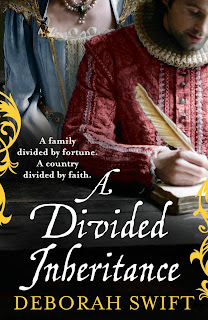
This period fascinated me, and I set my most recent novel at this time. The Leviston family are Catholic and must go to elaborate lengths to hide their faith. At the same time, in other European countries such as Spain, it was illegal not to be a Catholic. The young woman in my novel has to travel from England to Spain in search of her lost inheritance, a journey which changes her view of English life forever.


"A Divided Inheritance achieves what all stellar historical fiction must: through the voices of imagined characters, important lessons from the past linger and haunt long after the book is finished."  
Ann Weisgarber, winner of the Langum Prize for Historical Fiction

The book comes out on Thursday, published by Macmillan - Hooray! Find out more from my website.
Thanks for reading!
Sources: The Gunpowder Plot - Antonia Fraser
Religion and the Decline of Magic - Keith Thomas
You might also like http://englishhistoryauthors.blogspot.co.uk/2011/11/religious-upheaval-during-17th-century.html