Showing posts with label medieval women. Show all posts

Saturday, March 31, 2018

The Abducted Nun or What Happened when the Abbess became an Heiress

by Anna Belfrage

In medieval times, women of high birth essentially only had two “career” options: marry or become a nun. Not that the choice was theirs—in medieval times the future fate of a child was decided by his/her father—but a young woman who openly expressed a vocation to serve God could often sway her father. Becoming a nun was a way of avoiding the uncertainties of childbirth, plus, of course, it allowed the lady in question to theoretically lead a somewhat more tranquil life.

In some cases, women who had every desire to marry and have babies still ended up as nuns, usually because their father felt this was a good idea. Take, for example, the case of the three de Geneville sisters in the late 13th century, where it was decided the family would best benefit by concentrating the sizeable dower on the eldest girl, thereby making Joan de Geneville a most attractive bride (snatched up by Roger Mortimer, no less). The two younger girls were sent off to a nunnery to take the veil. What they might have thought of all this we don’t know.

There were also cases when girls were forcibly veiled by others than their family so as to get rid of them. Such was the fate of Llewellyn the Last’s daughter Gwenllian of Wales, whom Edward I had locked away with the nuns at Sempringham Priory. Such was the fate of Hugh Despenser’s three young daughters, who in 1327 were sent off to three different convents and there veiled, thereby removing them for ever from the marital market.

Sometimes, however, a nun ended up being a marital pawn no matter what vows she had taken. At times, it may have been the nun herself who regretted her choices and absconded (but to do so was to risk everlasting hellfires). More often, the nun in question ended up being the sole heiress to lands and wealth, thereby attracting ambitious suitors who were willing to risk the opprobrium of the church to feather their nests.

King Stephen
One such nun was Marie of Blois. She was also one of those girls who’d had little say in how her life was ordered, seeing as she was destined for the cloisters already as a young child. Her parents, King Stephen of England and Matilda of Boulogne, were devout and what better gift to God than their own precious daughter?

Marie was very young when she was placed in a convent. Whether she was delighted at the idea or not, she seems to have adapted, and by the time her father died in 1154, she was about twenty years old and the Abbess of Romsey. Had things gone according to plan, likely Marie would have remained there for the rest of her life, capably managing her little universe.

Marie lived in uncertain times. Prior to her father’s death, England had for decades been submerged in a bloody civil war between King Stephen (who effectively usurped the crown) and Stephen’s cousin, Empress Matilda. Initially, Matilda fought to claim the crown for herself. Over time, her son, the future Henry II, took over her claims and managed to force through a treaty with Stephen whereby Henry would inherit upon Stephen’s death. I imagine this did not please Marie—after all, she had a surviving brother who also had a claim on the crown. However, William of Blois was no fool. He swallowed his pride, submitted to Henry and was rewarded with a nice heiress and the earldom of Warenne.

None of the above would have had much of an impact on Marie’s life. But in 1160, William died—childless. In one fell swoop, Abbess Marie became a major landowner, inheriting the substantial Boulogne lands that came from her mother. Having said lands under the control of a woman sat somewhat uncomfortably with Henry II, who preferred his lords to be adequately beholden to him for their fiefs and grants: besides, what was a woman—and a nun to boot—to do with all that wealth, all that power?

Henry wasn’t the only one thinking along those lines. One of those considering the possibilities offered by William’s demise was Matthew of Alsace, younger son to the Count of Flanders. Being a man of action Matthew decided to make a grab for the prize in the literal sense. Marie, Abbess of Romsey, was therefore forcibly abducted in 1160 and carried off by Matthew who was determined to make her his wife.

According to most contemporary sources, Marie was anything but delighted by this turn of events. No matter her reluctance, soon enough she was hauled before an altar and wed. I suppose by then her virtue had been compromised, as demonstrated by the birth of a daughter, Ida, in 1160/61. I’m thinking Marie derived some pleasure from presenting her husband with a girl and not a boy, but truth be told I have no idea what her feelings were for Matthew. She seems to have actively disliked Henry II, thereby indicating he may have given Matthew a discreet go-ahead, this despite the fact that abducting an abbess was a serious breach of canon law. So serious, in fact, that Matthew was placed under interdict.

I suppose a marriage that began with an abduction was not destined to be successful. Or maybe it was – after all, Marie stayed with Matthew. This may have been because she had nowhere else to go, but it could also indicate some level of affection. Whatever her thoughts, the Church was not about to let this go: a nun had promised herself to Christ, and unless she received a papal dispensation, those vows were binding unto death.

There was no papal dispensation—or at least we can’t find any records of one. Besides, would the Church have kept up the pressure had there been one? But keep up the pressure they did, and by 1170, Matthew’s father was beginning to have serious fears for his son’s eternal soul. So much so, in fact, that the ailing Count of Flanders urged Matthew to accept the Church’s demands that the marriage be annulled.

Suddenly, Marie was neither married nor a nun. The man who had once imperilled his own soul—and hers—no longer wanted her enough to risk the Church’s wrath. Poor Marie was in limbo, but the Church offered to welcome her back, and whether this was what she wanted (she had just been delivered of a little girl, so one would have thought she might have wanted to stay with her baby) this was what she did. Obviously, her forays into the outside world had left her religious reputation torn to shreds, which meant Marie returned to her cloistered life as a plain nun. Not for her the lofty station of abbess, not anymore.

As to Matthew, he continued to rule Boulogne on behalf of his eldest daughter, Ida. I’m betting there’d been some horse-trading behind the scenes, along the lines of “yes, I can send my wife back to the convent, but my daughters must be declared legitimate”. After all, this was what Matthew had always wanted: to pass Boulogne down to his heirs. Yes, he’d have preferred male heirs, but any heirs were better than no heirs.

Matthew died in 1173. Marie remained in her convent, and her daughters were raised by their paternal uncle, the new Count of Flanders. In 1182, Marie died, no doubt relieved to know her eldest daughter was already safely married. Not for her Ida an existence as tumultuous as her own, Marie probably thought, sending off a prayer or two of gratitude to God for having arranged it thus. Turns out all that gratitude was premature, as Ida of Boulogne’s private life would eclipse her mother’s, featuring various husbands and one well-orchestrated abduction. But that, I think, is a subject for another post.

All pictures in public domain and/or licensed under Wikimedia Creative Commons

~~~~~~~~~~~

Had Anna Belfrage been allowed to choose, she’d have become a professional time-traveller. As such a profession does not exist, she became a financial professional with two absorbing interests, namely history and writing.

Presently, Anna is hard at work with The King’s Greatest Enemy, a series set in the 1320s featuring Adam de Guirande, his wife Kit, and their adventures and misfortunes in connection with Roger Mortimer’s rise to power. And yes, Edmund of Woodstock appears quite frequently. The first book, In The Shadow of the Storm was published in 2015, the second, Days of Sun and Glory, was published in July 2016, and the third, Under the Approaching Dark, was published in April 2017. The fourth instalment, The Cold Light of Dawn, was published in February 2018.


When Anna is not stuck in the 14th century, she's probably visiting in the 17th century, specifically with Alex(andra) and Matthew Graham, the protagonists of the acclaimed The Graham Saga. This is the story of two people who should never have met – not when she was born three centuries after him. The ninth book, There is Always a Tomorrow, was published in November 2017.


Thursday, October 15, 2015

Richard the Lionheart and the Women of Jerusalem

by Helena P. Schrader

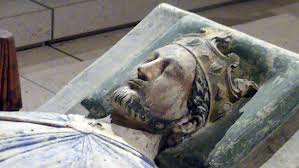
Richard's Tomb at Fontevrault

There has been a lot of speculation about Richard the Lionheart’s sexuality over the years, but whatever his personal proclivities, he cannot be accused of misogyny. He was raised by one of the most powerful women of the age, and he not only relied upon his mother for advice, he also entrusted her with delicate affairs of state. His relationship with his sister Joanna was also characterized by mutual respect. When she flatly refused to be a pawn in his negotiations with Saladin, for example, Richard meekly accepted her decision and made no attempt to coerce her. That might all have been Eleanor’s influence, or were his attitudes and reactions also colored by his family’s strong ties to the Kingdom of Jerusalem and his own sojourn there?

The crusader states set themselves apart from contemporary societies by the prominent role played by women.  This high status probably evolved out of the repeated failure of the ruling dynasty to produce male heirs and the high mortality rate among adult males generally.  A look at the succession in the Kingdom of Jerusalem illustrates this well. When Baldwin II died in 1131, he was succeeded by his daughter, Melisende, who ruled jointly with her husband Fulk of Anjou (grandfather by his first marriage of Henry II of England and great-grandfather of Richard). When Fulk died in 1143, Melisende remained Queen of Jerusalem, and ruled jointly with her eldest son, Baldwin III, (half-brother of Geoffrey d'Anjou, and hence Henry II's paternal uncle). Although her son eventually side-lined her, it was only after a struggle in which several powerful barons and most of the clergy sided with the Queen.

Medieval Illustration of a King and Queen

At Baldwin III’s death in 1163, his heir was his brother Amalric I, but Amalric’s heir was the ill-fated Baldwin IV, the Leper King, who had no children, making his sisters (and through them, their children and/or husbands) his heirs. As fate would have it, in the century between the death of Baldwin II and the ascension of Friedrich II as consort of a Queen of Jerusalem in 1225, the crown of Jerusalem passed through the female line no less than ten times!

The situation in the other crusader states and baronies thereof was similar. Due to the almost continuous fighting and the many exotic diseases for which the Westerners had no immunity, mortality rates among knights and barons in the crusader kingdoms were exceptionally high. While many men died without any heir, even more died without a male heir. The small size of the Latin elite combined with the natural desire of families to retain their lands led to the early recognition of female inheritance. By 1131, laws guaranteed the right of daughters to inherit, and primogeniture of the eldest daughter in the absence of a son was recognized.  As a result, the title to baronies repeatedly passed through heiress rather than heirs. This fact alone would have raised the importance of women, but it is significant that these queens (princesses, countesses and ladies) were not passive vessels.


Melisende was Queen in her own right and commanded loyalty and support among her vassals to such a degree that both her husband and later her son had to take her political wishes into account.  Sibylla (Richard’s 1st cousin) forced upon the kingdom a man patently unsuitable for the kingship and soon detested by her brother, the reigning King, and the majority of the barons.  When her son Baldwin V died, Sibylla – not her husband Guy de Lusignan – was crowned by the patriarch;  she then placed the crown on Guy’s head as her consort.  Furthermore, many of Guy’s vassals viewed their oaths to him absolved the moment Sibylla died – despite Richard’s determined support for Guy.

In the end, even the Lionheart gave up and recognized that without Sibylla, Guy could not be King of Jerusalem. The crown passed to Sibylla’s sister, Isabella (another of his cousins). Isabella conferred the crown on two men in succession, Henri de Champagne (Richard’s nephew) and later Aimery de Lusignan. Notably, Henri de Champagne, a nephew of both Philip II of France and Richard I of England (his mother was a daughter of Eleanor of Aquitaine by Louis VII), never even called himself King of Jerusalem; he remained Count of Champagne, while Isabella was Queen of Jerusalem.

Medieval Illustration of Isabella 
and possibly Henry of Champagne --
note her crown is more elaborate than the man's

The dynastic importance of women was both cause and effect of a uniquely high status for women in the crusader kingdoms that took many other forms. Not only did women act as regents and receive homage from vassals, they enjoyed a freedom of movement and opinion that scandalized the Muslim – and sometimes the Christian – world.  While the sexual antics of the some royal women may indeed have deserved censure, the higher status of women generally meant that widows in the crusader kingdoms exercised far more control over their property and their lives.

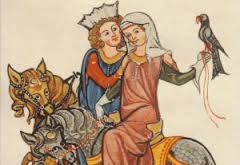
The higher status of women also impacted their daily lives. Upper class women were literate as they could not otherwise conduct their affairs, and they owned books. Some accounts stress that they rode astride for greater safety in an always precarious environment, something that gave them greater mobility. They did not have to go veiled in public, although women almost certainly covered their faces from the ravaging effects of the Palestinian summer sun when out of doors.  But perhaps most important, they were entitled to their opinions, free to voice them and often heeded by their male contemporaries. William of Tyre records multiple instances when Queen Melisende's opinion or that of her sisters was sought out. Likewise, the Count of Flanders sought the advice of Dowager Queen Maria in a dispute with Baldwin IV and the High Court. The Lady of Tiberius and of Oultrejourdain are other examples of non-royal women with documented influence.

A medieval illustration
of a woman riding astride
while engaging in the sport of hawking.

Compared to their faceless and voiceless sisters in the Muslim world, the fact that women in the crusader states were viewed as intelligent human beings with opinions worth hearing was undoubtedly the greatest privilege of all.

~~~~~~~~~~~~~

Helena P. Schrader is the author of three books set in the crusader kingdoms. St. Louis’ Knight is set in the Latin Kingdom of Cyprus in the mid-13th century and Knight of Jerusalem and Defender of Jerusalem are the first two books in a three biographical novel of Balian d’Ibelin, who defended Jerusalem against Saladin in 1187 and later played an important role during the Third Crusade. St. Louis Knight was winner of the 2014 Chaucer Award for Historical Fiction set in the High Middle Ages.

Amazon

Monday, September 14, 2015

Of Dowries, Dowers and Dowagers

by Helena P. Schrader


Arguably, nothing is more indicative or determinative of women’s status in a society than their ability to hold and control property.  In ancient Athens, women could not control property worth more than a bushel of wheat — and from the moment of birth they were denied the same food as their brothers, denied physical exercise, denied access to light and fresh air (by being imprisoned in the dark, back rooms of their houses), denied education, and then married at 12 or 13 to men three to four times their age, so they could die before the age of thirty from bearing on average 6 children, most of whom their husband discarded (particularly if they were female) because he couldn’t be bothered paying the cost of rearing them. In Sparta, in contrast, women controlled the estates of their husbands—and they were fed the same food as their brothers from birth onwards, engaged in physical exercise, received a public education, were married in the late teens to men roughly their same age, and generally lived long healthy lives. Today in the developing world, legal changes designed to guarantee women the right to own land has repeatedly proven one of the most effective ways to improve the status and economic condition of women.

For readers and writers of English historical fiction it is therefore advisable to understand two related but very different types of property associated with women in English common law: the dowry and the dower.


First, however, allow me to digress for a moment to discuss the position of heiresses. Please note that in England here were heiress (feminine), i.e. it was possible for women to inherit property and titles. This is not the case everywhere in the world even today. Second, heiresses were not dispossessed at marriage. Their husbands were expected to share in the control of their estates and the heiresses no longer controlled them exclusively, but they did not legally lose control or ownership. Women might, of course, “bow to their husbands' wishes” for the sake of domestic harmony or be otherwise coerced or cajoled into granting their husbandsr more control than was legally required, but stronger women knew how to keep their husbands in their place. Geoffrey d’Anjou never titled himself “King of England.” Eleanor of Aquitaine took the Aquitaine back when she divorced Louis VII.  Joan, Countess of Kent, did not bestow the honor of Kent on any of her three husbands; she retained it and passed it to her sons. Heiresses, furthermore, were not found only in the aristocracy; peasant and merchant daughters also had the right to inherit their estates, provided they had no brothers. Indignation over the fact that boys inherited first should not blind us to the more important fact that because girls could inherit, some girls held very powerful positions indeed.

A dowry was not an inheritance. It was, however, property that a maiden took with her into her marriage.  Anyone who has read Jane Austin’s books knows that young ladies generally had a greater or lesser “dowry” settled upon them and the size of that dowry greatly affected their value on the marriage market. A dowry, however, was never a girl’s property. It was property that her father/brother/guardian owned but agreed to transfer to a girl’s husband at her marriage. In the Middle Ages, dowries were usually land. Royal brides brought entire lordships into their marriage (e.g. the Vexin), but the lesser lords might bestow a manor or two on their daughters and the daughters of gentry might bring a mill or the like to their husbands. Even peasant girls might call a pasture or orchard their dowery. With time dowries were increasingly monetary, either a lump sum paid at the time of the marriage to the bridegroom or a fixed annual income paid by the bride’s guardian (or his estate) to the husband. The key thing to remember about dowries, however, is that they were not the property of the bride. They passed from her guardian to her husband.


Dowers on the other hand were women’s property. In the early Middle Ages, dowers were inalienable land bestowed on a wife at the time of her marriage. A woman owned and controlled her dower property, and she retained complete control of this property not only after her husband’s death, but even if her husband were to fall foul of the king, be attained for treason, and forfeit his own land and titles.

In the early Middle Ages, dowers were usually negotiated in advance of a marriage. Generally the father of the bride and the father of the groom would negotiate both the size and nature of the dowry and the dower at the same time. In short, the father of the bride would agree to transfer certain properties or a combination of properties and money to the groom at the marriage, and in exchange the father of the groom would designate properties as the new bride’s dower. These could, obviously, be identical. I.e. the father of the bride might agree to transfer certain properties to the bridegroom on the condition that they were designated his daughter’s dower, i.e. they were effectively transferred not to the control of the groom but to the bride after her marriage. Formally, however, the groom bestowed the “dower” on his wife at the church door immediately after marriage, and its size was variable.


In the absence of a formal agreement, however, English law came to recognize the right of every widow to one third of her late husband’s property. In this case, it fell to the husband’s lord (for barons, the crown) to determine exactly which pieces of property made up the dower portion after her husband’s death. Theoretically, the husband’s overlord was supposed to make this determination within forty days, but reality sometimes looked different. English judicial history is full of cases where tenacious widows litigated for decades to get their rights, an indication that justice was not always served rapidly, but also that women felt sufficiently protected by the law to take their case to court. The exception here was in the case of the widows of executed traitors. Whereas the older custom of designating the dower at the church door protected the widows of traitors, the idea that the dower was simply one third of a man’s estate at death meant that it was de-facto forfeited to the crown with the rest of a traitor’s lands, and his widow was left empty-handed.


This change in the nature of dowers may explain the increasing popularity of “jointures.” Jointures were not strictly women’s property as they were (as the name suggests) bestowed jointly on a couple at marriage. Nevertheless, the effect of jointures was to protect women financially. Property that was part of a jointure was controlled jointly so long as both partners lived, but became the sole property of the surviving partner at the death of the other. For men, that was nothing new, but for women it meant that in addition to the third of her husband’s estate that made up her dower portion, she had control of all her “jointure” lands. Furthermore, land held via “jointures” could not seized by the crown if either partner were convicted of treason; it remained the property of the survivor (usually the widow).

It was not uncommon in the High Middle Ages for women to successively marry two, three or even four husbands. After each marriage, the widow retained her dower and any jointures settled on her at the time of the marriage. Women who were politically well-connected, already wealthy and/or knew how to negotiate could therefore accumulate vast estates. “Dowagers” controlling these estates were not only wealthy and independent, they were influential and powerful -- at least within their family circles. They often controlled the income, marriages and dowries of their off-spring. One can imagine, they were not always popular but undoubtedly formidable!

~~~~~~~~~~~~~

Helena P. Schrader is the author of numerous works of history and historical fiction.  She holds a PhD in History from the University of Hamburg.  The three-part biographical novel of Balian d’Ibelin, who defended Jerusalem against Saladin in 1187, is now on sale. Knight of Jerusalem was awarded a B.R.A.G. medallion and was a finalist for the 2014 Chaucer Awards for Historical Fiction.  St. Louis' Knight was the winner of the 2014 Chaucer Award for Historical Fiction set in the High Middle Ages. Defender of Jerusalem is newly released.  Read more at: http://defenderofjerusalem.com
http://helenapschrader.com or follow Helena’s blogs: Schrader’s Historical Fiction and Defending the Crusader Kingdoms.

Monday, June 15, 2015

Medieval Women & Magna Carta

by Lauren Johnson

On 15 June 1215, Magna Carta was sealed at Runnymede. Bad King John – slayer of teenage nephews, executer of hostages and military embarrassment – was forced to recognize that even a king was beneath the law. Of course, he only recognized that fact temporarily, and within ten weeks the treaty of peace (or ‘charter of liberties’ as we now remember it) was metaphorically torn up and civil war broke out between John and his barons.

One of the two Magna Cartas in the British Library:
Cotton MS Augustus ii.106
We all know this story. Eight hundred years of myth-making and, latterly, myth-busting have examined the document and what it meant. Most recently, a brilliant exhibition at the British Libraryin London explored the making, breaking and transformation of this totemic text. The exhibition is almost exhaustively rich, but my abiding feeling on leaving was ‘what about all the women?'

Because frequently forgotten in our narrative of Magna Carta is the half of the population who were not at Runnymede. We don’t know of any queens, abbesses, female barons or labourers being in attendance – there were certainly no female serfs pleading their cause, since the men and women bonded to their master were explicitly excluded from Magna Carta. But in 1215, in an England of roughly 3.5 million subjects, at least 1.75 million of them were female.[1] And many of them had equivalent influence and authority – were treated with similar respect – to their male counterparts.

This absence of women from our narrative of Magna Carta is particularly surprising since women appear right near the top of the charter – in a 63-clause document, the rights of widows are mentioned seventh and eighth on the list.
(7) At her husband's death, a widow may have her marriage portion and inheritance at once and without trouble. She shall pay nothing for [them]... She may remain in her husband's house for forty days after his death...
(8) No widow shall be compelled to marry, so long as she wishes to remain without a husband...

Widows were the most powerful female figures in contemporary life, pursuing their inheritances through law courts and administering their estates independently. They were also among those who had suffered most as a result of the extortion of John’s family, with some being repeatedly forced into unwelcome marriages or paying enormous sums of money to escape them. John’s father Henry II had a list compiled of all the wards and widows in the king’s gift, recording royal rights over land – and conveniently calculating which widows might make the richest gifts to royal friends. Despite earlier promises that widows would be free to marry as they wanted (as long as they didn’t choose to marry the king’s enemies), throughout the twelfth century wealthy widows were forced into unwanted unions. John’s brother King Richard the Lionheart (the famed flower of chivalry) forcibly remarried the widow Hawise of Aumale (d.1213/4) twice. When she refused the first match he made for her, he seized her chattels and threatened to sell them until she gave in. The only way out of this system was for a widow to pay a fine to remain single. In 1212, Hawise did exactly that, paying a staggering 5,000 marks for the privilege of the single state. She was one of 149 widows who paid to remain single or marry whom they chose in John’s reign alone.

John's mother, Eleanor of Aquitaine, with the tombs 
of her son Richard and daughter-in-law Berengaria. 
Casts of the originals, at London's V&A Museum.
The inclusion of these clauses protecting widows’ rights in Magna Carta suggest that this simply cannot have been a document created without any female influence. Men – even medieval men – were still sons, fathers, brothers and husbands. Even if their interests were self-serving, they would still be concerned about the king’s treatment of their female kin.

It has been claimed that Robert Fitzwalter, self-appointed ‘Marshall of the Army of God’ and leader of the rebels, was finally roused to action against the king because of an attempted – and unwanted – seduction of Fitzwalter’s daughter Maud. One version of events has John locking Maud in the Tower of London and killing her with a poisoned egg. Fitzwalter’s wrath at John certainly seems to have exceeded that of his baronial allies. In 1212, he was implicated in a plot to have the king assassinated.

The Tower of London

In fact, when John learnt of the assassination plot against him, it was a woman who warned him: John’s illegitimate daughter Joan sent him a message at Nottingham Castle. In her capacity as wife of the great Prince Llewelyn ap Iorweth, Joan also acted as mediator between John and the rebellious Welsh lords – an intercessory role that was consistently expected of high-ranking women, but is frequently overlooked in reports of medieval warfare and politics.

Robert Fitzwalter’s ally among the rebels – and widower of the possibly-poisoned Maud – was Geoffrey de Mandeville, who in 1214 had had a similar fate imposed on him as Hawise of Aumale. He was forced into marriage. His bride was Isabella of Gloucester
, not only an heiress to extensive estates in her own right but also John’s ex-wife. For the privilege of marrying Isabella, Geoffrey was forced to hand over an eye-watering 20,000 marks – in modern terms, millions – in a maliciously short period of time. When he briefly failed to keep up payments, John seized Isabella’s lands until the account was balanced. Hardly surprising that Isabella joined Geoffrey in rebellion against her royal ex.

But not all of John’s female subjects had poor relations with him. Nicola de la Haye
, castellan of Lincoln Castle, remained loyal to John through thick and thin. When John rebelled against his brother King Richard in 1191, Nicola held Lincoln Castle for him against royal forces – she endured forty days of siege. In the civil wars that followed John’s renunciation of Magna Carta, she again proved her worth and despite being in her fifties or sixties once more defended her castle from the enemies of John’s cause (by then, his nine-year-old son had inherited the throne). As a reward for her consistent loyalty, John named Nicola Sheriff of Lincoln.

When writing The Arrow of Sherwood
, I was influenced by these real-life medieval women with authority and influence. In fact, the links between real-life Plantagenet figures and characters in the Robin Hood myth have often been asserted: the unfortunate Maud Fitzwalter has sometimes been cited as the original Maid Marion (with a minor name change); Nicola de la Haye’s co-sheriff in Lincoln was the once-Sheriff of Nottingham and despised royal tax-collector, Philip Mark.

My own Sheriff and Marian are inventions connected with the local Peverill family, but in giving Marian a front-row seat at the Siege of Nottingham in 1194, and in creating the powerful Abbess of Newstead – as much a political player as any of her local lords – I was following contemporary example.

The frustrations and necessary subterfuges of Marian and the Abbess were also influenced by the real medieval world. Because even wealthy, influential women did not benefit as much from Magna Carta as we might hope. The most famous clauses of the charter, which are still on the statute book in the UK today, concern the right of every ‘free man’ to justice:

(39) No free man shall be seized or imprisoned, or stripped of his rights or possessions, or outlawed or exiled, or deprived of his standing in any other way… except by the lawful judgement of his equals or by the law of the land.

The lawful judgement of equals did not mean much for women, since they had almost no permitted role in contemporary lawmaking. They were not part of the frankpledge system of self-government, they did not act on juries of any sort and they could not be royal justices. Even the ability of women to appeal to law as plaintiffs was limited by Magna Carta – according to clause 54, no one could now be ‘arrested or imprisoned through the appeal (accusation) of a woman for the death of anyone other than her husband’.

So what did Magna Carta mean for women? Perhaps exactly what it meant for most people in the country. The unfree got nothing, the free but poor had their rights limited, and some of the wealthy benefited. But we should not let this document overshadow the reality of the medieval women that we know did
have agency and authority, nor assume that it means that women were completely absent from the thoughts of those who wrote the charter in the first place.

~~~~~~~~~~~~~

Lauren Johnson
Lauren Johnson is the author of The Arrow of Sherwood (Pen & Sword Fiction). An origin story of Robin Hood, it roots the myth in the brutal, complex reality of the twelfth century. She is currently writing a history of the year 1509 (when Henry VIII came to the throne), to be published by Head of Zeus in 2016.
Lauren will be discussing the Magna Carta as part of the Devizes Arts Festival on 17 June 2015.


[The text of Magna Carta I have used is the recent translation by David Carpenter in Magna Carta: with a new commentary (Penguin Classics, 2015).

Images are either my own, or from The British Library Collection and have been made available for the public domain.]


[1] Figures based on David Carpenter, Magna Carta: with a new commentary (Penguin Classics, 2015).

Thursday, April 16, 2015

Everyday Medieval Women

By E.M. Powell

So much of the fascination of history is accounts of kings and queens, mighty battles and events that helped shape the modern world. Medieval history is no exception. The murder of Thomas Becket, The Wars of the Roses, Magna Carta, Richard the Lionheart, the Crusades: all indeed showstoppers. But what of the everyday day life that millions of people had to lead? I confess to finding that equally, and at times, even more absorbing. When visiting re-enactments or museums, I’m less taken with sword A or helmet B, but more likely to watch as a woman makes a dish of pottage using twelfth century implements and ingredients.

Medieval Cooking Pot
© York Museums Trust used with permission.


The fascination for me is that it’s so relatable. Everyone has to make their way in the world and we (most of us, anyway) don’t do it from the battlements of a castle. Yet even in the history of the ordinary man, it tends to be just that. Men. Whatever sparse records exist tend to disappear almost entirely when it comes to women, as so many records are linked to land. We do know some of what life was like for a woman who was not at the top of the social tree: challenging is a word that springs to mind.

Amazon.co.uk

Everyday women were excluded from holding any kind of office. A woman’s legal rights were defined primarily by men throughout her life. Men defined her description. When she was a maiden, her father was in charge. As a wife, her husband. A medieval legal definition of married women from 1180 tells us that “every married woman is a sort of infant.” A wife has to agree to her husband’s sexual demands, cannot borrow money without his permission and is not able to make a will. A widow’s standing is based on her late husband’s status. This might suggest some level of independence.

Amazon.co.uk

But the widow of a villein (a tenant entirely subject to a lord) had, in reality, to remarry. She had a brief few months to make her own choice. If she did not, then the lord’s bailiff or reeve would select her next spouse for her. Refusal brought a fine, or imprisonment. Giving birth to an illegitimate child carried a fine called childwyte. This seems particularly punitive when one considers the law on rape. It was believed that conception could only occur when a woman experienced orgasm. And if she did so, then she had enjoyed the encounter with the man. And so it wasn’t rape. Blinding logic. For medieval men, that is.

Amazon.co.uk 

Childbirth was a terribly risky endeavour for medieval women, no matter what their status in society. It is estimated that for every pregnancy, a woman had a one in fifty chance of dying in childbirth. Women from the lower classes were often employed as wet-nurses for the wealthy.

The wives of peasants and villeins shared much of the agricultural labour with their husbands. They could earn money as labourers but were paid about half than men for the same work. Seasonal work paid better than service. Women’s tasks included sheep shearing, milking cows and looking after livestock and chickens, planting, winnowing and weeding. This was on top of all the domestic tasks: keeping a fire, cooking, washing.

Amazon.co.uk

The dark hours were put to good use also. Cheese making and brewing could yield a woman some extra income. Many women brewed ale. The demand for ale was high as drinking water was frequently dirty and unsafe. While the brewers were women, the tasters were male and women could be fined for sour beer. With the introduction of hops to brewing (which makes beer, rather than ale and preserves the drink for a lot longer), it became a male-dominated practice, through women continued to sell it.

With the expansion of towns and cities in the medieval period, women found other opportunities to earn an income. Many unmarried young women opted for service as it gave a yearly wage and moved from the countryside to secure a place. Women also worked as huxters. They would buy produce such as bread, eggs, vegetables or other foods and sell from baskets, either door-to-door or on foot in the increasingly busy marketplaces. The female ale sellers went by some rather wonderful names: gannockers, tapsters or tranters. The money earned in these ways was pitifully small.

Amazon.co.uk

Medieval towns also saw the rise of the apprentice, where a young person could be trained to learn a craft over many years. But there were no female guilds, and female apprenticeships do not occur in large numbers in the records. The skilled weavers, for instance, were men. The preparatory work for weaving, such as combing, carding and spinning of the wool tended to be done by women who would be paid little for this work. Silk weaving developed as an all-female craft in London, yet the silk-women only formed a collective, not a guild.

Laundry was an all-female preserve. Women did their own washing at home, often using unpleasant substances such as lye and urine as cleaning agents. They also worked as laundresses, travelling to the houses of the rich to carry out their duties. Naturally, the work in the laundry is dismissed by some chroniclers as a hot-bed of gossiping. It must in reality have been back-breaking.

Amazon.co.uk

Moving to towns and cities made women vulnerable to exploitation. Prostitution was rife. Female prostitutes were tolerated in fourteenth century London so long as they wore a yellow hood that marked them out. This was to save confusion on behalf of men who might mistake a respectable woman for a prostitute.

I like chain-mailed heroes as much as the next medieval history fan. But for me, these forgotten women were pretty darned heroic too. Speaking as an everyday woman, I'm so privileged I have my life and not theirs.

References:
Included in the post above with Amazon links: there is so much more to discover in them about ordinary life in medieval times.

~~~~~~~~~~~~~


E.M. Powell’s medieval thrillers The Fifth Knight and The Blood of the Fifth Knight have been #1 Amazon bestsellers. Born and raised in the Republic of Ireland into the family of Michael Collins (the legendary revolutionary and founder of the Irish Free State), she lives in northwest England with her husband, daughter and a Facebook-friendly dog. She blogs for English Historical Fiction Authors, reviews for the Historical Novel Society and contributes to The Big Thrill. Find out more at www.empowell.com.

Amazon.com
Amazon.co.uk
Barnes & Noble
Walmart