Showing posts with label King John. Show all posts

Monday, May 18, 2020

William Longchamp – Richard the Lionheart’s Chancellor

by Charlene Newcomb

Richard I
Whilst preparing to depart on crusade in 1189, King Richard, the Lionheart, invested the authority to act in his name in the Bishop of Ely, William Longchamp. A cleric likely trained at Bologna, Longchamp had been a trusted advisor to Richard and had served him as chancellor of Aquitaine. Longchamp’s family was Norman and not of high birth, but his father had risen in power during the reign of Henry II and held lands in Normandy and in England.

To serve as co-justiciar with Longchamp, Richard named the Bishop of Durham, Hugh of Le Puiset; and three others, William Marshal, Hugh Bardolf, and William Briwerre, were named associate justiciars. Richard is not known as being a capable administrator and he failed to delineate the specific authority of these men, which led to major upheaval in 1190-91.

For the sum of £3000, Richard named Longchamp chancellor and asked the Pope to make him papal legate to England. To his contemporaries, William Longchamp became “a man with three titles and three heads,” exercising power as justiciar, chancellor, and papal legate. His critics claim he was greedy, ambitious, and unscrupulous and he eyed co-justiciar Le Puiset’s authority with envy. Longchamp did not know the language, did not adapt to English customs, and “openly professed his contempt for the English.” The author of a biography of the gentle Bishop Hugh of Lincoln writes that Richard “left behind a little lame, black foreigner, Longchamp…who had been adviser, schemer, general brain box and jackal to Lion-heart.” Perhaps Richard did not know Longchamp as well as he thought.

Contemporary sources note that Longchamp was short, had a limp, and “possessed the face of a dog.” It did not take the chancellor long to alienate his co-justiciars or the English barons after Richard left England behind. The chronicler Roger de Hoveden writes “the said bishop of Ely, legate of the Apostolic See, chancellor of our lord the king, and justiciary of England, oppressed the clergy and the people, confounding right and wrong; nor was there a person in the kingdom who dared to offer resistance to his authority, even in word.” The chancellor deposed Le Puiset, had him arrested and forcibly taken to London. He appointed numerous relatives to high positions, removed sheriffs and castellans, and suspended clergy.

Lincoln Castle
As Longchamp attempted to consolidate his own power, many barons turned to Richard’s brother John. John, who eyed Richard’s crown and expected to be named his heir, garnered the support of these men. When Longchamp removed Gerard de Camville as Sheriff of Lincolnshire, de Camville joined forces with John to take over Nottingham and Tickhill Castles, whilst his wife, Nichola de la Haye, held Lincoln Castle against Longchamp’s forces in a 40 day siege in 1191. Compromise was reached due to the efforts of Walter de Coutances, archbishop of Rouen, whom Richard had sent back to England from Sicily after hearing of the many complaints against Longchamp.

For a very brief period it appeared that Longchamp and John might come to a peaceful coexistence after John secured word that the chancellor would support him as heir should Richard not return from the crusade. But Longchamp made a fatal error, taking action against Richard’s half-brother Geoffrey, the archbishop of York, when he landed at Dover.

Dover Castle
Longchamp denied ordering the rough treatment against the archbishop, but his supporters physically dragged Geoffrey from the sanctuary of a church (recalling Beckett’s murder 20 years earlier). John and the justiciars called Longchamp to appear to explain his action, but he fled and barricaded himself in the Tower of London for three days before surrendering. The bishops excommunicated him and the justiciars removed him from office and ordered him to relinquish custody of his castles.

Longchamp attempted to flee and, according to one of his enemies, Bishop Hugh of Nonant, he was caught trying to board a boat in Dover dressed as a woman. De Hoveden writes that “He chose to hasten on foot from the heights of the castle down to the sea-shore, clothed in in a woman’s green gown of enormous length instead of the priest’s gown of azure colour… a hood on his head instead of mitre… [he] became so effeminate in mind… Having seated himself on the shore upon a rock, a fisherman, who immediately took him for a common woman, came up to him; and having come nearly naked up from the sea, perhaps wishing to be made warm, he ran up to the wretch, and embracing his neck … began pulling him about, upon which he discovered that he was a man.”

Incarcerated for several days, Longchamp was released and sailed to Flanders at the end of October 1191. Armed with a message from the Pope, he landed at Dover the following year and attempted to be reinstated to his former position, but was ordered by Queen Eleanor and the justiciars to leave the country.

When word of Richard’s imprisonment became public knowledge in 1193, Longchamp ended up at the king’s side in Germany, negotiating for terms with the Holy Roman Emperor Henry VI. He delivered information to the justiciars in England about the ransom agreed to by the king, bringing Richard’s instructions about collection and delivery of the money. Richard sent him to negotiate with King Philip and later with John. Longchamp was with the king when he released from captivity in Mainz in February 1194, and returned to England with him.

Longchamp continued to serve Richard on numerous diplomatic missions to Germany and France. His last task for the king was to go to Rome and ask the Pope to lift an interdict the Archbishop of Rouen had placed on Richard. Longchamp fell ill on the journey and died in January 1197.

Images

Richard being anointed during his coronation. by Unknown. - A 13th-century chronicle. Public Domain, https://commons.wikimedia.org/w/index.php?curid=15543148

Gate at Lincoln Castle. by Rodhullandemu - Own work, CC BY-SA 3.0, https://commons.wikimedia.org/w/index.php?curid=5143923

Dover Castle. by Misterzee - Own work, CC BY 3.0, https://commons.wikimedia.org/w/index.php?curid=4999617

Sources

Appleby, J.T. (1965). England Without Richard. Ithaca : Cornell University Press.

Lloyd, A. (1973). King John. Newton Abbot Eng.: David & Charles.

Marson, Charles L. (1901). Hugh, Bishop of Lincoln: a short story of one of the makers of Medieval England. London : Edward Arnold.

Norgate, K. (1902). John Lackland. London : Macmillan.

Turner, R.V. (2009). King John: England’s Evil King? Stroud, Gloucestershire : The History Press.

Turner, R.V. “Longchamp, William de (d. 1197)”, Oxford Dictionary of National Biography, Oxford University Press, 2004; online edn, May 2007 [http://www.oxforddnb.com/view/article/16980, accessed 24 April 2016]

This is an Editor's Choice from the #EHFA archives, originally published June 4, 2016.

~~~~~~~~~~

Charlene Newcomb is the author of the Battle Scars series, 12th century historical fiction filled with war, political intrigue, and a knightly romance of forbidden love set during the reign of Richard the Lionheart. She is currently working on a new medieval tale set during King John’s reign; and in summer 2020 will publish Echoes of the Storm, a sci fi/space opera filled with rebels and traitors and battles and romance in a galaxy far, far away (no, not Star Wars). Sign up for Char’s Newsletter for exclusives, including a free short story, and other special offers. Find her books on Amazon & connect with Char on Facebook, Twitter, or Instagram.


Wednesday, March 13, 2019

England and France: Sibling Rivalry

By Erica Lainé

Robert and Isabelle Tombs wrote a book* - which begins in the 1600s, charting the relationship between England and France - called That Sweet Enemy, a quote from a 1591 sonnet by Sir Philip Sidney: ‘That sweet enemy, France.’ But there were quarrels, bitter and sweet, long before this.

The First Hundred Years War

The 100 Years War, lasting from 1337 to 1453, has been the subject of much in-depth research and critical analysis. Some French historians refer to an earlier period from 1154 to 1259 as the First 100 Years War. When Eleanor of Aquitaine, newly divorced from the French heir Prince Louis, married Henry of Anjou in 1152, this marriage set in train a relationship between England and France that was almost that of siblings. Henry became King of England in 1154 and ruled over that vast land mass from the borders with Scotland to the Pyrenees, with Aquitaine sitting like a very rich plum in the middle of the pie.


This did not make for an easy relaxed partnership between the two crowns.  Instead it was a relationship full of petty squabbles, some periods of savage fighting and frequent competition. The English and the French shared a feudal Christian heritage during the Middle Ages and had overlapping areas of influence, especially as the English kings, the Anglo-Angevins, tried to hold onto their lands in continental France. So a common heritage, but where they differed was in the size of the domains held and wealth and power. Their main interactions were based on trade and war.


In France the Capets held the île de France and relied on surrounding counties, Champagne, Burgundy, Blois and Flanders for support. France was not unified by allegiances to the centre or indeed by language and culture. Power was shared out among many feudal lords and some of these had very divided loyalties. From time to time each monarch tried to enlist the support of his rival’s men; local risings were stirred up against both the English and French kings. 

Further problems were caused by English nobles who held lands in France and swore loyalty to the French king but were called upon by their English overlord to fight against him. There was no unified state in the modern sense. Power was fragmented amongst this melange of feudal lords. Monarchs could not command direct authority over them; local dukes and counts or major towns owed the king, as their overlord, a duty of obedience but within their own territories they could act as independent rulers. When a king managed to get most of the big players on his side, they would support him; if not they could and frequently did rebel. Especially when they felt he or his officials were encroaching too much on their independence. 

And the problem of loyalty existed for the king himself. As English monarchs also had titles and lands within France, these possessions made them vassals to the kings of France. They had to swear fidelity to the French king as a duke of those lands, not as the King of England but as, for example the Duke of Normandy. Normandy was a huge sticking point and in May 1200, King John and Philippe Augustus signed a treaty at Le Goulet in an attempt to end the war over the duchy and to draw up new borders. Philippe now had a legal right over the English king’s lands but not over Aquitaine, which was still held by John as heir to Eleanor of Aquitaine.  

By 1202 the two kings were at loggerheads as Philippe had summoned John to answer charges brought against him by the Lusignans and John had refused to attend the court. He argued that as a king he did not need to answer such commands. Philippe replied that he summoned him as vassal duke of France and deposed him of his fiefs and went to war for Normandy. He was successful and Normandy was lost in 1204.

South West France: A Rebellious Region 

South West France from just below the Loire to the Pyrenees was not a heavily populated region. Aquitaine was a confusing collection of a dozen or so counties. Few towns of any significant size existed before 1200. But there was a growing sense of power and independence and many castles and fortified churches (which can be seen to this day) were built by forceful local lords and bishops.

Siorac de Riberac 

Who owned the Poitou? It was complicated. John seems to have agreed that it belonged to his mother and that it was hers to have and to hold forever. In May 1199 after he inherited the English crown, she ceded it to him as ‘her right heir’ and received his homage for it.  She made over to him the rights to govern and the fealty of its vassals. But one month later she also met Philippe and he had allowed her make homage to him for the Poitou, and this act formally recognised her as its lawful countess. Eleanor was determined to be the person legally responsible for the Poitou as far as the king of France was concerned. Perhaps she knew that the region would not be as loyal to her son as it was to her. The Poitevins had been described by William Marshal as ‘scheming traitors.’

Poitiers was Eleanor’s stronghold, a well-fortified town and always dominant. Further south control moved from Périgeuex to Angoulême and Thouars. Among the powerful local lords were the Lords of Lusignan and this map shows how their influence grew. 

 
Draft map - John and Erica Lainé

Their story is almost archetypical for the region. Swerving loyalties, savage raids on towns that stood out against them, grasping at charters and taxes and tolls, brutal ambushes, lies and treachery. In 1220 Hugh Lusignan married the widow of King John, Isabella of Angoulême thus binding himself to Henry III as his step-father. Except he was only loyal when it suited him. They were both happy to turn away to the French king when it didn’t and as the French could offer far more in the way of cash, betrothals and promises of more land the swerving allegiance paid well.

The Poitou was eyed by the Capets as a region they wanted under their control and King Louis VIII (who as Prince Louis had been invited, in 1215, to take the English throne at the time of the Barons’ War) decided in 1224 to ride down from Bourges and take it. Louis mopped up every Poitevin town with ease and besieged La Rochelle, which looked in vain to England for support. 

When Henry III decided to campaign in 1230 to take back the Poitou he was helped and encouraged by the Duke of Brittany, and other rebellious French lords who were intent on unseating Blanche of Castile, a formidable mother to a young King Louis IX. Henry’s campaign meandered down the Poitou to Bordeaux and back again and achieved nothing except expense and loss of life to disease, most likely malaria as the Vendée was marshy and the army marched through here in the height of the summer.  

Battle of Taillebourg:  Delacroix 1834: public domain

In 1242 Henry tried again to retake the Poitou and safeguard Gascony, his mother and step father had called on him for help as their independence was severely threatened by the Capets. They had invested King Louis’s brother Alphonse, as Count of Poitou and called for all kinds of allegiances to be sworn and homages made. This was another disastrous campaign ending in the Battle of Taillebourg, which Henry lost.  

The Poitou was now firmly part of the newly expanded France. Henry retreated to Bordeaux and was determined to hold onto Gascony and the lucrative wine trade.
 
The relationship between England and France continued to be uneasy until the Treaty of Paris in 1259. Henry III held Gascony and pockets of the Poitou and it was as Duke of Gascony and King of England that he negotiated. His resources seemed to be eternally limited though and at one stage he pawned the crown jewels to fund an expedition to put down strife in Gascony.  


Two Kingdoms: One Problem, Two Solutions 

For both the kings of France and England there was a similar difficult situation. However much they might desire to wage a major war, a king’s private income could not finance a costly war. 

The English kings’ problem was maintaining an army across the sea in France and having access to safe ports. The ports in Normandy were lost after John’s defeat. La Rochelle remained a safe haven until Louis took it, thus depriving Henry III of a landing place for easy excursions into the Poitou. Unless the Duke of Brittany was paid great sums of money, St Malo would be a place of unwelcome piracy and raids. It was a long and difficult voyage to sail down the Bay of Biscay to Royan or the mouth of the Gironde. Knights, soldiers, provisions and horses had to be carried by ship. Mercenaries had to be paid.  All of this was very expensive. 

When Henry III inherited an almost bankrupt kingdom he struggled to find money to regain those lost French lands.  A king who was now relying on contributions from the magnates and the church and who had to persuade, but not coerce them, or face rebellion.  Raising money for warfare by imposing a new tax meant asking a nascent parliament for agreement.  Often the council was reluctant to do so, unless they were convinced that the war was of benefit to them, and held out for concessions. Gradually this became how the king and his circle, the king and the magnates conducted policy. It had all the ingredients to make for a belligerent and acrimonious relationship. This tussle led to the beginnings of a political system where the centres of power, nobles, the Church, the king and his advisers would determine their differences in the context of parliament. 

In France the problem was in reverse. The campaigns were fought on its soil and the towns and villages and people suffered. It became easier for French kings to justify taxes to raise armies and maintain them, even if lords and knights would only give their 40 days of service before returning home. The king asked for aid and it was very rarely refused. Louis IX had a healthy annual revenue of between £200,000 and £250,000 parisi. During his reign the monetary system in France consolidated and stabilised. His father and grandfather had been prudent and managed to have sons who did not quarrel within the family or turn against them. 

Taxes were collected year after year without there necessarily being a war to justify the imposition and without the necessity for an assenting vote. The church and the French kings also tended to be in agreement most of the time, which kept the balance of power firmly with the king. 

The several wars that made up the First 100 years War and The 100 Years War paved the way for the French kings to build a very central and absolute monarchy. 

Two Kings, Two Systems

In each situation these years of war, helped to shift both England and France onto a new path. In France, instead of various magnates controlling large, almost princedoms within the borders, there was now a sense of greater unity. The king did not rule only because of their support and consent. His power extended throughout the realm, and this began in the late 1220s. The concept of a sovereign king rather than a suzerain or feudal overlord was born and France was becoming a nation–state. But always with the king and his officials firmly holding centre stage. 

The concept of an English nationality became more apparent now that the English were expelled from France. Borders were more defined; possessions on the continent were no more. Loyalty was more straightforward. And so strong central government came about in England too, but here it was a partnership between king and parliament. In 1236 the term parliament was recorded for the first time. A new term for something that was often fractious and inconsistent. But it described the assemblies and councils held by the Anglo-Saxons and which had existed for many centuries. Now it evolved again. 

This article began with a quote from the 16th century and it ends with one from the 15th. Sir John Fortescue, a Chief Justice of the King's Bench, reflected that the king of France could rule his people by such laws as he made himself and set taxes without their assent. The king of England by contrast could not rule his people 'by laws other than those the people had assented to'. 

[*Tombs, Robert and Tombs, Isabelle, That Sweet Enemy: Britain and France: The History of a Love-Hate Relationship, Vintage 2008]

~~~~~~~~~~

Erica Lainé has been an actress, a beauty consultant, a box office manager for an arts festival, a domiciliary librarian, a reader liaison officer, a speech and drama teacher, a writer of TEFL textbooks for Chinese primary schools, and an educational project manager for the British Council in Hong Kong. She was awarded an MBE for her work there. 

After Hong Kong she came to south west France with her architect husband to live in the house he had designed, a conversion from a cottage and barn. She is president of An Aquitaine Historical Society and through this came to know about Isabella Taillefer, the subject of her trilogy. Isabella of Angoulême: The Tangled Queen.


Wednesday, December 20, 2017

Conisbrough - The Ups and Downs of a Medieval Castle

By F.G. Dannatt

Conisbrough Castle, the Grade 1 listed building, is an unbelievably beautiful place to visit, sitting on a prominent, steep hilltop that overlooks the picturesque village of Conisbrough in South Yorkshire; a village that itself has a long history and like a lot of the villages in South Yorkshire can be dated back to Doomsday Book. But, it’s the castle itself that really catches the eye and the imagination from people around the world - from being the inspiration to one of the greatest novels, Ivanhoe, to the legend of a ghostly lady wondering the keep, this Medieval Castle has it all and is one of Britain’s treasures.

photo by Rob Bendall via CC Licence

Dating back to the 11th century, the land and surrounding area was originally called ‘Cyningsburh’ which was the Anglo-Saxon word for ‘The King’s Borough’ and was first owned by a Saxon nobleman named Elheim. It was granted to him by Wulfric Spott who was a minister to Edward the Confessor. It then went on to be owned by King Harold II and Harold Godwinson, Earl of Wessex, after King Harold fell at the Battle of Hastings. The area was granted to William the Conqueror’s greatest supporter, William de Warenne – who was to become the 1st Earl of Surrey - along with estates in Sussex and Norfolk

By all accounts William didn’t really do that much with Conisbrough, seeming to prefer his property at Castle Acre in Norfolk and so all that was achieved with Conisbrough was little more than a very basic castle, a wooden motte and bailey which would have been surrounded by palisades made of wood and earthen-works. The castle did stay pretty much untouched for the next three generations, as it passed from father to son and so on, and it wasn’t really until Isabelle de Warenne inherited the castle that changes really started to happen, and after that it stayed within the de Warenne family right up until the 14th century where the last Earl of Surrey, John de Warenne, died without heirs and all de Warenne land, including Conisbrough Castle reverted back to the crown.

During the civil war between King Stephen and his cousin Empress Matilda over who controlled England, the Countess of Conisborough Castle was Lady Isabelle de Warenne, the daughter of the 3rd Earl of Surrey - who had died during his foray into the Crusades.

De Warenne Coat of Arms - image supplied by author
via English Heritage

Isabelle was by far one of the most sought-after women in England at the time; she was ridiculously wealthy with a title that dated back to William the Conqueror with some of the most sought-after properties in the country. Every man in England would have wanted her, but it was King Stephen that managed to align his house with the de Warenne estates. Stephen married Isabelle off to his son William, who most likely thought he had an advantageous arrangement – that is until his father made a deal with Empress Matilda that on Stephen’s death the crown would go to Matilda’s son, Henry of Anjou. William and Isabel seemed to accept what would happen and when Henry succeeded Stephen, William served King Henry II loyally until his own death.

On the death of her husband, and without a child to pass on the title to, Isabelle was once again the powerful and much sought-after heiress and yet again regarded by England and the nobility as a great prize. King Henry II, by all accounts, was desperate to unite his house with the Countess and in 1162 Henry’s youngest brother William was seeking a marriage with her, but his request was refused by the Archbishop of Canterbury, Thomas Becket, and William died shortly after – legend has it that he died of a broken heart after losing Isabelle.

King Henry though was not put off by this and he was determined to get the de Warenne estates into royal hands, so he pushed for a marriage between Isabelle and his illegitimate half-brother Hamelin Plantagenet, and in 1164 they were married. It was through Hamelin that Conisbrough Castle became the magnificent castle that it is today.

Hamelin, I think, was a man who was decades ahead of his time - on his marriage to Isabelle he took the very unusual decision to take her name of de Warenne. Even though he would have been the Earl of Surrey on their marriage, he took on her family name as well. For me that speaks a lot about his character, it appears that he could have had a genuine fondness for his wife and in taking her name he was showing her the ultimate respect by honoring her family.

Not just him honoring her family but the marriage by all accounts seems to have been a success, as they went on to have four surviving children: only son and heir William and three daughters Ela, Isabel and Matilda – even though it was rumored that Matilda was Hamelin’s daughter from a previous relationship and one of their daughters – it is believed to be Isabel - was reported to have birthed the illegitimate son, Richard Fitzroy, of her cousin and future King, John. Both Hamelin and Isabelle were very loyal to his brother Henry II.

photo by Rob Bendall via CC Licence

As well as his political work at court, Hamelin was busy having the castle renovated and brought right up to date. During the 1170s/1180s Hamelin had the mighty hexagonal stone keep built which is 28 metres (92 feet) high, the stairs to the keep used to be accessed across a drawbridge. The curtain wall (as it has been called) and the out buildings that lined the wall, which included the great hall and a chamber block which could have been reserved for servants – these were either built along the same time as the keep or added by William after his father’s death - and in 1189 Hamelin and Isabelle founded a chapel lain to be established at the castle. Once Hamelin’s nephew John became king, it is widely known that King John liked to stay at Conisbrough Castle for long periods of time, and cementing it as the de Warennes’ most principal seat.

Over the next few generations life at Conisbrough Castle went along peacefully enough, passing from father to son, that is until the 8th and last Earl of Surrey, John de Warenne - who by all accounts was a bit of a character and John’s exploits changed Conisbrough’s future forever. John married Joan of Bar who was Edward I’s granddaughter, their marriage wasn’t happy – or even amicable. John tried and failed to be granted a divorce, and after this failure Joan decided to leave Conisbrough to live in London under the protection of Edward II, leaving John at Conisbrough to carry on living with his mistress. It was after Joan had left, that Conisbrough was center stage of political rivalry, sieges and a legendary kidnapping. At one point the castle was besieged by Thomas, Earl of Lancaster and taken from John, only for Thomas to rebel against the King and who was defeated and executed.

Conisbrough Castle was then again returned to John in 1326. Unfortunately, John died 20 years later without any heirs and all of the de Warenne lands and estates were reverted to the crown. But in a way the castle was still connected to the de Warenne family, as Edward II handed his fourth son Edmund Langley - who was the godson of John de Warenne - the castle.

When Edmund Langley died in 1402, the castle and the Dukedom were inherited by his elder son, Edward. His second son, Richard of Conisbrough, Earl of Cambridge, was left with nothing as his paternity was constantly in doubt, so with nothing to his name Richard had no choice but to lease a portion of the land from his brother. It was said that he was by far the poorest Earl in the country at the time. It was while living there that Richard was caught in a conspiracy plot to assassinate Henry V, for which he was tried and executed. Only three months later, Edward died at the Battle of Agincourt, and as Edward died without an heir, the castle and all estates were inherited by Richard’s son from his first marriage - Richard, the third Duke of York. After Cambridge’s death his widow and 2nd wife, Maud Clifford, decided to take up permanent residence at Conisbrough up until her death.

Sometime in the 15th century Conisbrough Castle seems to have been abandoned; even with its lofty aristocratic and royal connections it was left to ruin. In 1538 when Henry VIII had his various surveys of castles done around the country, it was noted that Conisbrough had lost its roof, floors and gatehouse and a good potion of the south curtain had collapsed into a ditch (that part of the castle can still be seen today.)

In 1559 the castle was gifted to Elizabeth I, who didn’t seem to want to be burdened with it and passed it to her cousin Henry Carey, Lord Hunsdon.

During the next couple of hundred years the castle passed from one family to another, no one seeming to want to bring it back to its former glory and all the while the castle was getting more and more ruined and dilapidated.

Aerial View - see here for attribution

It wasn’t really until the early 19th century that Conisbrough Castle got the attention that is so deserved. After a trip to Doncaster Sir Walter Scott visited the ruins and he used the location in his best-selling novel Ivanhoe. In the book it called ‘Coningsburgh Castle’. Obviously, this got a lot of people’s attention and people were visiting the castle as a tourist attraction.

In 1950 the castle was taken into state guardianship and in the 1960s The Ministry of Works began extensive repairs on the castle and during 1967-69 the castle underwent important excavations and later in the 1970s brand new stairs were built into the keep.

It wasn’t until the 1990’s that The Ivanhoe Trust took over management of the castle and they re-roofed and re-floored the keep and finally in 2007 this historic building was under direct management by English Heritage.

~~~~~~~~~~

F.G. Dannatt owns a blog site called Walking in History, which can be found at https://walkinginhistoryblog.wordpress.com/


Thursday, October 5, 2017

The Truth Behind the Fiction: Two Brothers, Two Kings

by N.B. Dixon

When I began working on my Robin Hood series, I had to research the real characters in the story as well as the fictional. The two Kings most closely associated with the Robin Hood legend are King Richard I, also known as the Lionheart for his fearlessness in battle, and his brother John. Usually, Richard is portrayed as the chivalrous knight, a man of honour and decency, while John is the dastardly villain, a man greedy for wealth and power. But were things really as cut and dried as that?

It’s true that in many ways, Richard and John seemed to have been opposites. Richard was a warrior, a born soldier. He was never happier than when he was on a battlefield. During his ten year reign, he spent only four months on English soil.

John, being the youngest son, was never expected to amount to much. He seems to have favoured strategy and manipulation as his weapons of choice. When he did take to the battlefield, it was often disastrous. His brief spell in Ireland when he was in his late teens, is a study in mistakes. Far from bringing the Irish lords to accept English rule, he succeeded in alienating every one of them.


However, the two brothers do have more in common than is evident at a first glance. Firstly, neither of them was born to be King. They were the sons of Henry Plantagenet, later to become King Henry II, and his wife, Eleanor of Aquitaine. Richard was the elder of the two, but he was the third son born to Henry and Elinor. His eldest brother William died in infancy. The next brother, Henry, did survive into adulthood. However, his life was a short, tempestuous one, mainly spent in rebelling against his father. His father outlived him. Between Richard and John, there was another brother, Geoffrey, as well as some sisters. Richard was, however, destined to rule from birth. His mother always intended him to take over the Duchy of Aquitaine at her death.

The ambition that Richard and John shared, was that of triumphing against their father. Richard joined his elder brother’s rebellion against King Henry. The rebellion did not succeed, and for a time, John’s star was in the ascendant as his father’s favourite son. However, when it became evident that the King was dying, John switched his allegiance to Richard. He was quick to renege on that almost as soon as Richard became King.


Richard was crowned King of England in September 1189. Almost immediately he set out preparing to go on crusade to the holy land. It was an oath he and several kings and princes had taken, to recapture Jerusalem from the Muslims and return it to Christian rule. Richard’s friend and ally, Philip of France, had also sworn to go on crusade. Richard fully expected Philip would keep his oath.

Richard was delayed in reaching his goal. First he was held up at Sicily, where he liberated his sister, the former Queen, who, on her husband’s death, had been taken prisoner by his bastard cousin, Tancred. Tancred had seized power, and Richard was held up as he attempted to bring peace to the region. This he eventually succeeded in doing, by suggesting that his brother Geoffrey’s young son Arthur could be betrothed to Tancred’s daughter, thus uniting their two families. Richard’s brother Geoffrey had died before his son was even born, and it is doubtful whether Richard ever intended to honour this agreement. Arthur was, at that time, his only heir Besides John.

In Cyprus, Richard wed his queen, Berengaria. He was a reluctant bridegroom, and spent as little time with his wife as possible.

By the time they reached Aker, the crusade was already well underway. Attempts had been made to breach the city, but they had been unsuccessful. Philip of France was ill. The climate was not agreeing with him. When Richard arrived and succeeded in doing what he had been trying and failing to do, Philip had had enough. He chose to return to France. Richard accused him of going back on his oath, and their friendship was broken.

It’s at this time that Richard did something that even the Robin Hood legends have been unable to gloss over. After the fall of acre in 1191, many of its citizens became prisoners of war. Richard agreed to return them to the enemy side in exchange for a large sum of gold. When Saladin refused to pay, Richard had nearly 3000 men, women and children beheaded. Saladin retaliated in kind. Despite this, there does seem to have been some respect between the two men. When Saladin heard that Richard was ill, he sent him a present of fruit.

Richard was never able to reclaim Jerusalem. Finally in 1192, a peace treaty was agreed. Jerusalem remained in Muslim hands, but Christians would be permitted to visit and worship at the holy sepulchre. Richard was ready to return home, but he’d made many enemies during his time in the holy land, and not all of them were those he’d come to fight.


In December 1192, Richard was captured in Vienna by Leopold of Austria and later handed over to Henry of Germany. There is a charming legend that his minstrel, Blondel, travelled from castle to castle, singing a song that both he and Richard knew well. When Richard heard him and answered, that was how Blondel was able to discover his location. In reality, Richard’s location was never a secret. The ransom demanded was a hundred thousand marks.

So what was John doing all this time? When Richard left for the Crusades, he left his mother Queen Elinor as regent. John, however, lost no time in capitalising on his brother’s absence. He said that he would be an English king for the people. Richard is rumoured not to have spoken a word of English. John had stayed in England all this time, not deserting his people the moment the Crown was on his head. There were some who rallied to his support. His greatest enemy, the Chancellor Longchamp, was eventually forced to flee the country.

John entered into negotiations with Philip of France, who was still smarting from his humiliation at Richard’s hands. It is rumoured that they wrote a letter to Henry of Germany, stating that they would pay twice the amount of money specified for Richard’s release, if he died in his prison cell and never came home at all. But John had reckoned without his mother. Somehow, despite the fact that England was already suffering owing to the amount of money Richard had demanded to fund his crusade, part of the ransom was raised. Promises were given that the rest would be paid, and Richard was released. He returned to England in 1194, but it was to find a divided country. Some declared for John.

Nottingham Castle refused to surrender to Richard, and a bloody battle ensued. The castle Gatehouse was burned down, and Richard hanged several rebels. Those left alive surrendered, and John’s hopes of seizing his brother’s throne came to nothing. He was loyal throughout the rest of Richard’s reign, but he didn’t have long to wait. Richard lived only five years after his release. Much of that time he spent in France, and he was killed in action.


John became king in 1199. However, he did face a threat to his own rule in the form of his nephew, Arthur of Brittany. There were many who felt that Arthur’s claim was just a strong as John’s. Arthur laid siege to the Castle of Mirabeau in France, where Queen Elinor was staying. John was forced to go to her rescue, and Arthur was captured. In 1203, he disappeared. Later a body was found washed up on the banks of the River Seine, but it was never positively identified as that of Arthur of Britany. It was widely believed that John had had the boy murdered. Philip of France had turned against John by this time, and he lost no time in vilifying him.

Like Richard, John made many enemies in his reign. Many of John’s barons turned against him, which eventually led to the signing of Magna Carta, a charter giving power to the barons, and restricting the King’s ability to pass laws without consulting them.

John ruled from 1199 to 1216. He was a lecher, and also cruel and vindictive. However, he did often give money to beggars if he came across them in the street, not something the Robin Hood legend would report.

Richard’s reign was short and eventful. He was generous to his friends, but murdered three thousand innocent people. To think of Richard as the good King and John as the evil one is perhaps to make things two black and white, but as the saying goes, there is no smoke without fire.

~~~~~~~~~~

N.B. Dixon is an author of historical fiction. Her love for the Robin Hood legend began in a neglected corner of the school library and has continued ever since. She is a self-confessed bookworm and also a musician.

She began work on the Outlaws Legacy Series in 2013, and was accepted by Beaten Track Publishing in 2016. Outlaws Legacy is a historical series based around the Robin Hood legend. The author describes it as Exciting Historical Adventure with GLBT romance. Knight of Sherwood is available now.

Friday, June 16, 2017

King John’s Castle – Medieval Stronghold

by Antoine Vanner

The term “medieval castle” brings immediately to mind images of high castellated walls, massive gatehouses and vast keeps, and many such fortresses did indeed exist. The vast majority of castles were however much smaller structures – “strongholds” – built for local defence, even if on occasion they did serve as royal residences. One such is King John’s Castle, near Odiham, Hampshire. Though it is little more than a ruined shell today it has a most spectacular history and provides insights into what many more like it looked like.

The remains of King John's Castle today

The castle consisted of a single massive octagonal keep of three stories and was surrounded by one or possibly more deep moats, which survive today only as dry, overgrown ditches. The walls, with cores of flint boulders held together by mortar, were externally clad with stone. This has however been stripped away over the centuries since here, as elsewhere in Britain, neighbouring communities exploited it as a quarry after it had been abandoned.

Now only the cores remain and indeed two sides of the octagon are gone completely. The site is preserved by Hampshire County Council as well as is possible given the castle’s ruined condition. A number of very informative notices are provided, each featuring delightful illustrations in the medieval style by the artist Andy Bardell. Some are shown here.

The structure was built in the 1207-1214 period on the orders of King John, a monarch who has had a deservedly bad reputation, as compared with his older brother Richard, who had an undeservedly good one. John’s entire reign consisted of conflicts with the Church, with the French and with his own barons. The castle at Odiham is associated with the single most important event of John’s reign, as it was from here in 1215 that he rode to Runnymede, under pressure from his rebellious barons, to sign the Magna Carta, and thereby to lay the foundation for the liberties of the English-speaking world in centuries to come.

King John rides out to Runneymede

A year later invading French troops besieged the castle for two weeks. The defenders were allowed to surrender with honour and were found, to the amazement of the French, to consist of fourteen men only. This is a commentary on just how invulnerable such structures were in the days before gunpowder and when hunger and thirst were the most effective weapons against determined defenders.


King John’s young son, Henry III, ordered repairs to the castle in 1225, the refurbished roof being of lead and weighing some 22 tons. It was supported by the outer walls and by a central column that no longer exists. On each of the two floors above ground level, beams extended from this central beam, like spokes of a wheel, to joist holes in the outer walls.

Eleven years later Henry III gave the castle to his younger sister, Eleanor, who was married to the powerful French nobleman, Simon de Montfort. He in due course became Earl of Leicester and was a key figure in the “Barons’ War” against his royal brother-in-law. While a residence in this period, the castle’s interior was likely to have been richly furnished. It can only however have been very cramped by modern standards and one assumes that most of the retainers and servants were lodged in smaller dwellings, of which no trace now remains, in the area between the castle walls and the moat.

Eleanor and Simon prepare for a banquet (note Eleanor's household roll)

This period ended when Simon de Montfort was killed in 1265 at the Battle of Evesham, in which he was fighting the future King Edward I, son of Henry III. Family ties notwithstanding, Eleanor was exiled to France, where she spent the rest of her days, taking with her the household rolls, which give an insight to life at the castle and which can be seen in Andy Bardell’s illustration. 

Edward succeeded his father in due course and spent Christmas 1302 there. His own son, Edward II, proved to be one of the most disastrous kings in English history and his reign was not only marred by civil war but by his ultimate overthrow by his wife, Isabella, abetted by her lover. Odiham Castle was once more besieged in 1322, but again survived.


Edward III, unlike his father, proved to be perhaps the most powerful English king of the medieval period and he not only initiated the Hundred Years War against France but scored notable victories over the Scots, Scotland at that time still being an independent kingdom, and almost invariable an ally of France. Edward granted Odiham Castle to his queen, Phillippa of Hainault, and it appears that she may have had a garden planted around it, an indication that its role was no longer primarily military.

Edward III and Phillippa prepare for bed

The castle was to play its last significant role in history in this period. In 1346 Edward’s army smashed an invading Scots force at Neville’s Cross (today a suburb of Durham) and in the process captured the Scottish king, David II. Held captive until an enormous ransom of 100,000 marks was paid, Davis was held for part of the time at the Tower of London, and for three years at Odiham. Here, in the agreeable rural surroundings of East Hampshire, he was provided with a well-furnished room and with good food, wine and other luxuries. The nature of his detention was unlikely to have been rigorous since honour would forbid escape prior to payment of ransom and one can well imagine David hunting in the surrounding area.


With David’s release Odiham Castle, now relegated to the status of a hunting lodge, started to fade from history. By 1600 it seems to have been in ruins and the process of quarrying it for stone seems to have started. Its day had however been a long one and despite its small size it was witness to some of the most dramatic events of England’s Middle Ages.

Odiham Castle today

A particularly attractive way to reach the castle today is by barge from the nearby modern village of Odiham, and the photograph  below shows a lucky group en route to King John's Castle in August 2013.


In preparing this article I am indebted to the splendid notices posted by Hampshire County Council at the site and which are so beautifully enhanced by Andy Bardell’s illustrations.
~~~~~~~~~~~~
An Editor's Choice, originally published on September 9, 2013
~~~~~~~~~~~~
Antoine Vanner had had an adventurous and rewarding life, living and working long-term in eight countries and doing short-term assignments in many more. He is fascinated by history, especially of the nineteenth century, and this provides the foundation for his Dawlish Chronicles novels, the first of which, Britannia's Wolf was published early in 2013. Volume 5, Britannia's Amazon, was published in November 2016. He maintains a very extensive website: www.dawlishchronicles.com.

Wednesday, April 12, 2017

Eustache the Monk - Medieval Outlaw or Hero?

by Lana Williams


As with many tales of old, whether the protagonist is an outlaw or hero depends on the view of the one telling the story. Such is the case with Eustache the Monk, a manuscript written in Old French between 1223 and 1284. While the author’s identity remains in question, the story is known to be based on a real person, Eustache Busquet, who was born in Northern France in 1170 and died in 1217.

Eustache lived an extraordinary life. He trained as a knight, then as a seaman, and traveled to Spain to study black magic, though no evidence technically supports this. The story embellishes his deeds, telling readers how Eustache and his companions got into a fight in a tavern and cast a magic spell and made the tavern keeper and her customers strip naked, straddle wine casts, and get a bit crazy. Or maybe that should be a lot crazy. Eustache continues his journey and casts another spell on a man driving a cart and makes the cart and horse appear to go backwards.

Soon after, he joined a Benedictine abbey at the age of 20 and wreaked havoc there by casting more spells. The monks eat when they should be fasting, go barefoot when they should wear shoes, and swear when they’re supposed to be silent. He also casts a spell on a side of bacon, changing it into an old ugly woman which frightens the cook. Eustache remained at the monastery until his father was murdered by a man named Hainfrois de Heresinghen.

As with any good son, Eustache left the monastery to demand justice from his father’s overlord, the Count of Boulogne, for his father’s murder. A judicial duel was arranged, but alas, Eustache’s champion lost. Apparently the count was impressed with Eustache, for he appointed him seneschal for an expedition with King Philip of France to win back territories in Normandy which King John of England held. Unfortunately, Eustache’s enemy, de Heresinghen, returned to the picture and accused Eustache of mismanaging the finances of the expedition, convincing the count as well.

Eustache suspected treachery and fled into the forests near Boulogne. The count, displeased with Eustache, seized his properties and burned his fields. That is when the story grows even more interesting. Eustache began to methodically harass the count, his allies, and his soldiers. The story tells of Eustache leading a band of up to 30 men, as well as operating alone, often in disguise. As the story progresses, Eustache moves from casting spells to using trickery and deception instead. While this period of outlawry was brief as it lasted only a year, it takes up the majority of the story. Not so different from the action movies at the theaters these days!

Leaving his homeland, Eustache wandered the English Channel where he acted as a pirate, eventually offering his services as a mariner to King John. As a reward, Eustache is given lands in Swaffham, Norfolk. Soon after, while he still served King John, he acted as English ambassador to the Count of Boulogne. That did not go well though, for as soon as King Philip learned of his return to France, he outlawed him.

In London in 1212, the Count of Boulogne was able to negotiate a charter of allegiance with King John. Again fearing treachery, Eustache fled, this time back to France where he joined King Philip. Nothing like changing allegiances as circumstances dictate. In 1214, King John was faced with a rebellion of his English barons, and Eustache was said to have supplied them with arms. Needless to say, King John was less than pleased and seized the lands he’d previously given Eustache in Norfolk.

Over the next few years, Eustache continued to control the English Channel and to support the English barons. He provided transport to Prince Louis of France to the Isle of Thanet during the Baron’s War. Alas, his ship was later attacked by four English ships. They captured him and beheaded him immediately in August of 1217.

Despite his time as an outlaw, Eustache was supported by his family and friends, suggesting he was worthy of loyalty, a heroic quality for certain. The story written about him tells of the code by which he lived. Following such rules is also a quality we can admire and suggests chivalric behavior. He rewarded those who were truthful and loyal to him. If someone betrayed him, they were killed but he did release some adversaries unharmed. If someone lied to him about the amount of money they had on their person, they were robbed. However, if a person told the truth about the amount of money they had, they were allowed to keep it.

There are similarities in Eustache the Monk’s story to Robin Hood and other ‘good outlaw’ legends. Eustache was of noble birth, he set out to avenge his father’s murder, and he lived by his own version of chivalry. However, the story also contains rather shocking cruelties which put the term ‘hero’ in question. He forces a young man to twist his own rope from which to hang. When several of his men have their eyes gouged out, he retaliates by chopping off the feet of four of the culprit’s men. He tortures another person in a mud pit. There’s also a passage in the story of Eustache disguising himself as a prostitute, humiliating the count’s man, and taunting him for trying to sodomize a monk. None of those acts seem heroic.

As with all great heroes and villains/outlaws, there are shades of gray in both characters and real people, some darker than others. Often it is how we authors tell the story as to what the reader decides.

For additional information on Eustache the Monk, I recommend: Ohlgren, Thomas H., Medieval Outlaws, Sutton Publishing, United Kingdom, 1998 and http://d.lib.rochester.edu/teams/text/eustache-the-monk-introduction


This post is an Editors' Choice post and was first published on 12th Sep 2013


~~~~~~~~~~~~~


Lana Williams is the author of medieval romances intertwined with mystery and a pinch of paranormal, including A Vow To Keep, Trust In Me, and Believe In Me, all part of The Vengeance Trilogy. More information about her books is on her website.
Amazon US
Amazon UK


Thursday, October 13, 2016

Worcester Cathedral

by Cryssa Bazos

Severn River © Cryssa Bazos

On the banks of the Severn River stands a magnificent cathedral. Framed against a river of gliding swans, Worcester Cathedral's history has spanned centuries, serving as the final resting place for royalty and providing a backdrop for major conflicts.

Worcester Cathedral © Cryssa Bazos

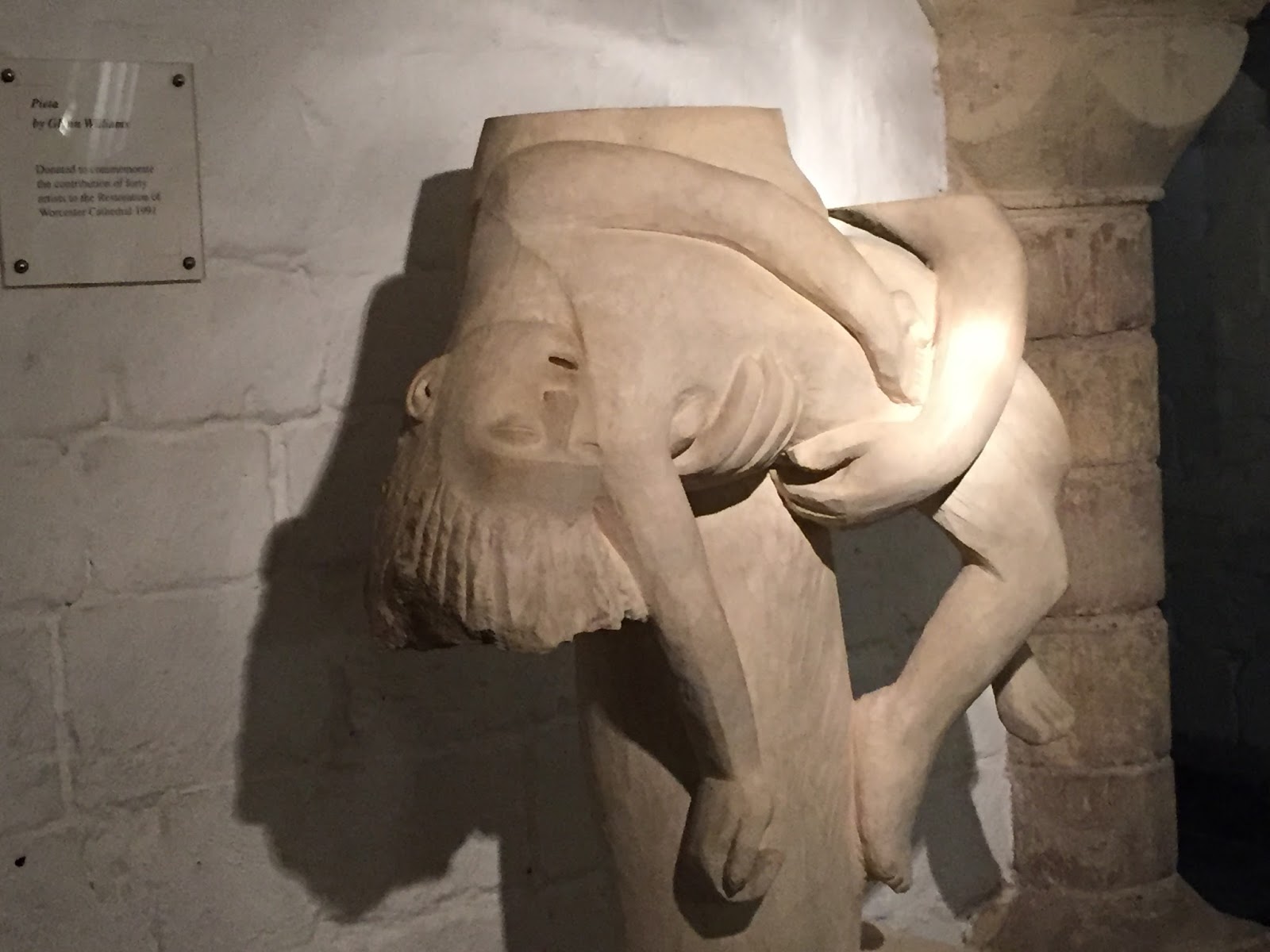
Even before the present day cathedral, the site was consecrated by a priory founded in the 7th century. Nothing now remains of this original priory, but in the 10th century, a new church was built by Saint Oswald, the Bishop of Worcester. The subterranean crypt is the only part of that earlier structure still remaining. It's a hauntingly quiet niche still used for worship.

The Crypt © Cryssa Bazos

The Crypt © Cryssa Bazos

Statue in the Crypt © Cryssa Bazos

Another saint associated with Worcester was an Anglo Saxon bishop, Saint Wulfstan who held this see before and during the Norman Conquest. Despite his allegiance to Harold Godwinson (of the Battle of Hastings fame), Wulfstan held his post under William the Conqueror.

This stained glass panel commemorates both saints.

Stained glass saints © Cryssa Bazos

Work on the present day cathedral started in 1084 and was finished by 1504. It is a work of art as one can see by the magnificent vaulted quire ceiling, which is decorated with the images of saints and angels.

And now to visit the cathedral's famous residents. King John, also known as John Lackland, Prince John, and signer of the Magna Carta, is buried in Worcester Cathedral. His sarcophagus is decorated with his likeness, carved in Portland stone. At one time, the stone would have been painted, but now has darkened to the colour of agate.

King John was a poor monarch and his reign was punctuated by periods of revolt . Though he did sign the Magna Carta, he did so under duress, forced to do so by his barons who had had enough of his abuse. He died shortly after trying to launch a fresh attack on the rebel barons.

What is interesting about his effigy is that the two Worcester saints, Oswald and Wulfstan, have been included, sitting on each shoulder of the king. Proof that John Lackland needed all the help he could get for the afterlife.

Detail of King John's tomb © Cryssa Bazos

King John's tomb © Cryssa Bazos

Royal crest on King John's tomb © Cryssa Bazos

A better mourned royal in Worcester Cathedral is Prince Arthur, the older brother of Henry VIII. Prince Arthur died suddenly at the age of 15, only five months after his marriage to Catharine of Aragon. His death was a crushing blow to his father, Henry VII.

After lying in state at Ludlow castle, Prince Arthur's body was brought to Worcester Cathedral by boat. The Prince had a connection to the city since he had been baptized by the Bishop of Worcester, and as a child, he had spent time in the city. During his funeral, dirges were sung for him. His tomb lies in the chantry chapel and is decorated by the white and red roses of York and Lancaster. 

Prince Arthur's tomb © Cryssa Bazos

Heraldic motif Prince Arthur's tomb
© Cryssa Bazos

Imagine what might have happened had he lived. Henry VIII would not have been king, would not have married Arthur's widow, Catherine, and subsequently broken from the Catholic church for the sake of Anne Boleyn. The country may have gone down a different path, one perhaps not driven by religious conflicts.

The final grave I'd like to visit belongs to the Duke of Hamilton, killed during the final battle of the English Civil War.

The first battle of the civil war was fought in 1642 just south of Worcester Cathedral at Powick Bridge. The last battle of the civil war was fought at Worcester on September 2, 1651. During the week leading up to the final battle, King Charles II occupied Worcester with 12,000 - 14,000 Scottish soldiers. William Hamilton, the 2nd Duke of Hamilton, was a close friend of the king and led a regiment on his behalf.

During the early stages of the battle, King Charles observed the fighting to the south from the strategic vantage of the cathedral's tower, with its sweeping views of the area. When he gauged the time right, King Charles led an assault against Cromwell's forces at Red Hill (to the east of the city) while the Duke of Hamilton led an assault against Perry Wood.

The Duke was shot during the engagement, and his men brought him back to his lodgings in the Commandery (just outside Worcester's Sidbury Gate) which was now overrun by the victorious Parliamentary soldiers.

At the Commandery, a Royalist surgeon examined him and found a musket shot had shattered in the leg and the only way to save him would be to amputate. Cromwell's physician examined him as well, but disagreed with the prognosis and told him that he didn't need to lose the leg. Hamilton worsened and subsequently died of his injuries. Another version of this story was that Hamilton declined Cromwell's offer of his surgeon, determined not to be treated by a traitor.

On his deathbed, the Duke had barely enough energy to write a heart-wrenching farewell letter to his wife. The letter was found in his pocket after he passed away.

Dear Heart,
YOV know I have been long labouring, though in great weakness, to be prepared against this expected Change, and I thank my God I find Comfort in it, in this my day of Tryal; for my Body is not more weakned by my Wounds, then I find my Spirit Comforted and Supported by the infinite Mercies and great Love of my Blessed Redeemer, who will be with me to the end and in the end.
I am not able to say much more to you, the Lord preserve you under your Tryals, and sanctifie the use of them to the Comfort of your Soul.
I will not so much as in a Letter divide my dear Neeces and you; the Lord grant you may be constant Comforts to one another in this Life, and send you all Eternal Happiness with your Saviour in the Life to come: to both of your Cares I recommend my poor Children, let your great Work be to make them early accquainted with God, and their Duties to him; and though they may suffer many wants here before their Removal from hence, yet they will find an inexhaustible Treasure in the Love of Christ. May the Comforts of the Blessed Spirit be ever near you in all your Straits and Difficulties, and suffer not the least repining to enter into any of your Hearts for his Dispensations to|wards me, for his Mercies have been infinitely above his Iustice in the whole Pilgrimage of,
Dear Heart, Your Own, HAMILTON.
Worcester, Sept. 8. 1651.

Against his wishes for his body to be returned to Scotland, the Duke was buried in Worcester Cathedral. His servants repeatedly petitioned Cromwell to approve the transfer of the Duke's body to his wife but the request was denied. A single plaque marks where he was buried.

Duke of Hamilton plaque © Cryssa Bazos

Worcester Cathedral has a long, rich history to explore. The next time you are visiting Worcester, I encourage you to take a detour and visit the past.

Worcester Cathedral interior © Cryssa Bazos

~~~~~~~~~~
Cryssa Bazos is a historical fiction writer and 17th Century enthusiast with a particular interest in the English Civil War (ECW). For more stories about the English Civil War and the 17th Century, visit her blog.