Showing posts with label Duchess of St Albans. Show all posts

Thursday, December 3, 2015

The Trouble with Duchesses in Queen Anne's Court

by Margaret Porter

'Perhaps . . . in the reign of Queen Anne ’tis a sign the power of women will increase.' Sarah Cowper, April 1702


Queen Anne by Godfrey Kneller
The average follower of English history, when confronted with the equation Queen Anne + Duchess + Trouble, would assume the resulting total to be Sarah Churchill, Duchess of Marlborough. Of all the non-royal females of her era, she is surely the most famous--or infamous. Sarah published various editions of her memoirs (a form of self-justification and self-defence), she's the subject of scholarly biographies and entertaining novels, she was the heroine of the television series The First Churchills, she and Anne are currently the main characters in a play on the London stage, and a film about their relationship is reportedly on the horizon.


But Anne's childhood friend, confidante, and eventual enemy was not the only duchess frequenting her court. Although the others did not leave so indelible a mark on the historic record, they are worthy of interest and scrutiny.

Elizabeth, Duchess of Somerset


Duchess of Somerset by Kneller
Young Elizabeth Percy seemed destined to challenge Sarah for Most Interesting Courtier. At age twelve she became Countess of Ogle, and was widowed the following year. The year after that the immensely wealthy Thomas Thynne lured her into a secret marriage. Not long afterwards he was murdered at the instigation of Count von Konigsmark, a Swede who was infatuated with Elizabeth. Within five months the double widow married again. Her third husband was Charles Seymour, Duke of Somerset, 'The Proud Duke'--a dynastic marriage rather than a love match. After that her marital history was far from scandalous, and probably not the happiest.

During Princess Anne's quarrels with her sister Mary II and brother-in-law William III, when they demanded she dismiss Sarah from her household, the Somersets were her firmest allies. Forced to relinquish her Whitehall lodgings, Anne accepted her friends' offer to take sanctuary with them at Syon House, where she suffered through one of her many stillbirths. She remained forever grateful for their support.

On Anne's accession in 1702, Elizabeth joined the royal household as a Lady of the Bedchamber. She was a witness to the protracted and nasty breakdown in Anne's relationship with Sarah Churchill, and was ultimately a beneficiary. In 1710/11 she succeeded Sarah as Mistress of the Robes and Groom of the Stole. Her prominence stirred up old scandals--her unusual and colourful past had for many years provoked rumour and innuendo. Because of her red hair, she was sometimes lampooned as 'Carrots.' The cruelest accusation--that she might do harm to the Queen--was penned by Jonathan Swift in The Windsor Prophecy:


Beware of Carrots from Northumberlond.
Carrots sown Thynne a deep root may get,
If so be they are in Somer set:
Their Conyngs mark thou; for I have been told,
They assassine when younge, and poison when old.

Although the Duke incurred the Queen's displeasure and was removed from office, Elizabeth retained the royal favour, vying with Abigail Masham as chief confidante. Wisely she refrained from employing Sarah's bullying tactics. According to one observer, 'She never pressed the Queen hard; nothing makes the Queen more uneasy than that.' A daughter of the ancient aristocracy, she maintained a graciousness and dignity that the Queen must have appreciated greatly after the strife Sarah stirred up.

She retained her positions of authority until Anne's death in 1714, and was present as the Queen lay dying. A witness described the 'soft, courteous way of the Duchess's speaking to the Queen, and her majesty's look and motion of her face in receiving it, though so ill.' Elizabeth was designated chief mourner for the funeral but was herself indisposed and unable to participate.

Mary, Duchess of Ormonde


Duchess of Ormonde by Michael Dahl
Following the death of his first wife, whom he mourned deeply, the 2nd Duke of Ormonde married Lady Mary Somerset, the Duke of Beaufort's daughter, in 1685. Like the Duchess of Somerset, she was named a Lady of the Bedchamber at the outset of Anne's reign and held that position till its end.  


She allegedly lined her pockets by brokering places in the royal household. When selecting her maids of honour, the young unmarried women who attended the Queen, Anne wanted girls who 'had good education and beauty.' The stipend and the visibility to prospective husbands was tempting, and parents were very eager to place their daughters at court. Christian Temple's entire marriage portion was £2000, and apparently £1200 of it was paid to Mary as a bribe to obtain her place. The duchess then paid the all-powerful Sarah £500 for acquiescing to the appointment!

Mary was in waiting at Kensington when the Queen suffered the convulsions and stroke that resulted in death. It was she who replaced the ailing Duchess of Somerset as chief mourner at Anne's funeral. Her life changed drastically the following year when her husband was impeached for high treason, as a supporter of the Jacobite rebellion of 1715. He fled to France rather than stand trial in Parliament. Subsequently he was attainted, and his estate was forfeited.


Catherine, Duchess of Buckingham


Duchess of Buckingham
Catherine Darnley was the illegitimate daughter of James II by his mistress Catherine Sedley, and she was therefore Queen Anne's half-sister. She first married the Earl of Anglesey, and the union did not prosper--in 1701 she petitioned the House of Lords for a separation, on the grounds of cruelty. The next year he died. Her second husband was John Sheffield, 1st Duke of Buckingham and Normanby, and she was his third wife. At one time he had courted Anne, resulting in his dismissal from court. Anne was fond of her former suitor Buckingham, who had proved himself a fast friend of her father's prior to his exile. He also shared her strongly Tory sympathies. She merely tolerated Catherine.

Though born on the wrong side of the blanket, Catherine was ever at pains to remind everyone of her royal blood, 'exhibiting a love of display, a violent temper,' and frequently travelling to France to kneel at the tomb of her father, 'shedding tears over the threadbare pall which covered his remains.' Because of her husband's position as Lord Privy Seal (prior to 1703) and later Lord President of Council, Catherine frequented the court. At the Queen's birthday celebration in January 1711, 'The Duchess of Buckingham and Lady Paulet were scarce able to move under the load of jewels they had on.'

After Anne's death, Catherine's drawing room was a magnet for Tories and Jacobites, as she was in regular contact with her legitimate half-brother James, the Old Pretender, and would doubtless have preferred him as King to George I. She was buried with other Stuarts at Westminster Abbey, where her splendid funeral effigy can be found in the museum.


Adelhida, Duchess of Shrewsbury


Duchess of Shrewsbury
This lady's father was Marquis Andrea Paleotti and her mother was Maria Cristina Dudley, daughter of the titular Duke of Northumberland--an Englishman who was also a Tuscan nobleman. She grew up in Italy and was apparently an engaging and accomplished young woman, but also a scandalous one. She might or might not have been married to Count Brachiano, and she might or might not have been the Duke of Shrewsbury's mistress before their 1705 marriage in Rome. (Lady Cowper spitefully recorded that her brother forced the nobleman to wed her 'after an intrigue together.')

Shrewsbury, a one-eyed aristocrat known as the 'Duke of Hearts' for his good looks, brought his duchess to England, where she caused a stir in society. She won the favour of the newly widowed Queen Anne by expressing her sympathy: 'Oh, my poor Queen, I see how much you do miss your dear husband.' This was in contrast to Sarah, who was very unfeeling towards her grieving mistress.

In 1712 Shrewsbury served as Ambassador to Paris, where his duchess was appreciated for her hospitality and conversation, though she was also regarded as an eccentric. This did not prevent her becoming a Lady of the Bedchamber to Caroline, Princess of Wales, after the accession of George I, a post she held until her death in 1726.


Diana, Duchess of St Albans


Duchess of St Albans by Kneller
The eldest daughter of Aubrey de Vere, 20th and last Earl of Oxford, Diana was very much a child of the court. During her infancy, her father and Charles II supposedly discussed a possible marriage between Diana and Charles Beauclerk, Duke of St Albans, the King's illegitimate son by Nell Gwyn. Diana grew up to be an ornament of Queen Mary II's court. At the same time, the young duke won the favour and patronage of of William III. Neither fact would have endeared them to Anne, who was estranged from her sister and loathed her brother-in-law. But the de Veres were courtiers for centuries. And the Duke was a Whig, the party in power at the outset of Anne's reign, so he held various appointments.
 

In the course of researching my latest novel, I stumbled upon an intriguing mystery. On 26 March, 1702, Luttrell the diarist reports, 'The dutchesses [sic] of Ormonde and St Albans are made ladies of the bedchamber to the Queen.' Yet Diana's name never appears again, and cannot be found in the official or unofficial lists of Anne's attendants. If Anne reconsidered, it could have been for any of four reasons, or a combination. Diana and her husband supported William and Mary in their quarrels with Anne, doubtless provoking her resentment. As well, Anne never much cared for her uncle's bastard offspring and that attitude might have extended to their wives. Alternatively, Sarah 's enmity towards one or both Beauclerks (she famously feuded with their son and heir) was such that she persuaded Anne to revoke the appointment. Or else Diana declined the position after rumours about it circulated--which is the unlikeliest explanation, as it was a prestigious and salaried post, ensuring access to the monarch.

With a change from Whig to Tory government in the last years of Anne's reign, the duke lost his court position. At the accession of George I, the Beauclerks were restored to high favour. Diana was chosen by Caroline, Princess of Wales, as First Lady of the Bedchamber and Groom of the Stole, and her husband was a Gentleman of the Bedchamber and captain of the King's personal guard.

Conclusion

When the meddlesome, overbearing, battle-tested, impulsive Sarah toppled from her perch, the Duke of Beaufort told Anne, 'Now is your Majesty Queen indeed!' None of the other duchesses who served in her household or who appeared at court attempted to rival or rule the ruler as Sarah had done for so long. Consequently, they are far less familiar--the price they paid for their discretion, submissiveness, and loyalty turned out to be their obscurity!

Sarah, Duchess of Marlborough by Kneller

~~~~~~~~~~~~

Image credits: Petworth House, The National Trust; Wikipedia/Wikimedia Commons; www.thepeerage.com; Private Collection
 ~~~~~~~~~~~~

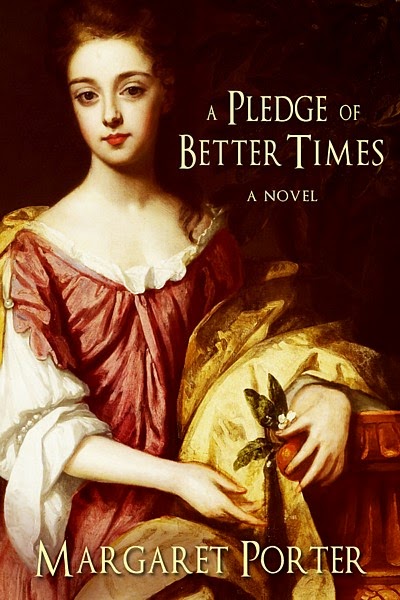
Margaret Porter is the award-winning and bestselling author of twelve period novels, nonfiction and poetry. Lady Diana de Vere's association with Queen Mary's court, and Queen Anne, is featured in A Pledge of Better Times, her highly acclaimed novel of 17th century courtiers the 1st Duke and Duchess of St. Albans (available in trade paperback and ebook). Margaret studied British history in the UK and the US. As historian, her areas of speciality are social, theatrical, and garden history of the 17th and 18th centuries, royal courts, and portraiture. A former actress, she gave up the stage and screen to devote herself to fiction writing, travel, and her rose gardens.


Thursday, May 7, 2015

The First Duke of St Albans: His Early Years

by Margaret Porter

On this date, the eighth of May, in 1670 actress Nell Gwyn bore a son and named him Charles—for his father, whose identity was no secret. As one letter-writer reported, "Elianor Quin, one that belongs to the King’s play hous, was brought to bed of a boy in her house in Lyncoln’s Inns fields . . . the King’s bastard.” Unlike the other illegitimate offspring, the infant had no surname and no title. Within months the royal mistress returned to the stage, for she received no income from the royal purse. Before long her protector provided a grand new residence close to St. James’s Palace and its gardens, which he eventually deeded to her.

When the court painter Peter Lely portrayed her on canvas as Venus, her little son was included in the portrait as Cupid, kneeling at her side. The next time she posed as the goddess of love, she was attended by a pair of cherubs—she had borne a second son.

The boys wore the costliest of children’s garments and had a pet donkey in the garden which provided milk for His Majesty's bastards. In his sixth year, young Charles received at last from his father a surname—Beauclerk—and a pair of titles, Baron Heddington and Earl of Burford. At age 10 he became an only child again after his little brother died at school in France. Despite this tragedy, Charles was also sent there for his education, academic and social. On his birthday in 1683 he was presented to King Louis XIV—his cousin—and was at that time described as “le duc de Saint-Alban, fils du roi d’Angleterre et de Mademoiselle Gouin, comédienne.” His father had bestowed the dukedom earlier that year. He divided his time between England and France, for in March of the following year John Evelyn observed him at the Royal Chapel, and his mother wrote from Burford House, her mansion in Windsor, “The Duke brought me down with him my crochet of diamonds, and I love it the better because he brought it.”

In February 1685 the fates of Charles and his mother altered drastically. The young man received a ring from his dying father, and was still in London six weeks later, when the Gazette reported, “Lost in the King’s Garden near St. James's Park, a black and white Spaniel Bitch, near a year old, her Legs white, with some mottled black Spots, most white about her Neck, with a little white up her Face, and the top of her Tail white. Whoever brings her to the Duke of St. Albans in the Pall-Mall, shall have a Guinea reward.” Perhaps the runaway spaniel was another legacy from the King, who was remarkably devoted to his dogs.

By November Charles had resumed his studies at L’Académie du Sieur Coulon near Versailles, where in 1686 he contracted smallpox and promptly recovered.His education was intended to prepare him for a career in the military—his elder half-brothers had served with distinction in the army. But he was also attending balls in his spare time, for early in 1687, Princess Anne wrote to her sister Princess Mary in Holland to report her fondness for a dance “called the Rigadoon which the D[uke] of St Albans brought out of France . . . mightily liked and indeed it was a very pretty one I thought.” But soon thereafter she reported with regret, "I have no reason to like it now, for I believe it was the dance that made me miscarry, for there is a great deal of jumping in it.”

His mother had been suffering from ill health for some time, and after a period of prolonged illness during 1687, she died in November. Unaware of the extent of her debts, everyone assumed that Charles inherited a vast fortune. At the end of the month his uncle, King James II, wrote to his daughter Mary, “she hath not left the Duke of St. Albans so much as was believed.” James had settled the mortgage on Bestwood Park, the Nottinghamshire hunting lodge King Charles had granted Nell, but her income had never adequately supported her spendthrift ways and lavish lifestyle. Unlike the other royal mistresses, she had made no financial demands of the King. His widow, Dowager Queen Catherine, was fond enough of Charles Beauclerk to provide him with an allowance of £2000 per year to augment his other stipends from the Privy Purse.

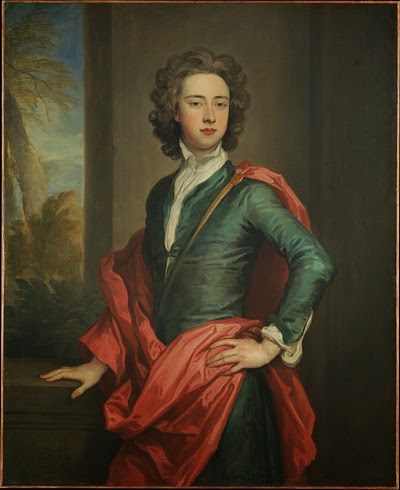
Charles Beauclerk, Duke of St Albans
As the product of an irregular liaison between a monarch and a play actress, a proud young man, and a firm Protestant, Charles would not have felt comfortable at a newly Roman Catholic court. He’d firmly resisted King James’s unrelenting efforts to bring about his conversion. Apparently the prospect of becoming a soldier was more to his liking, and he not only received his uncle’s permission to return to the Continent for that purpose, he received a recommendation. Shortly before Charles’s eighteenth birthday, King James wrote in French to the Duke of Lorraine declaring his nephew’s interest in supporting the war against the Turks, who had recently been driven from Vienna but now occupied Hungary.

And there the Duke of St. Albans would seize the opportunity to escape the shadow of scandal cast by his parents and begin to establish his own identity and reputation.
~~~~~~~~~~~~~
Images: National Portrait Gallery, Wikimedia Commons

Sources: Manuscript Letters in the British Library; The London Gazette; Oxford Dictionary of English Biography; Nell Gwyn: Mistress to a King by Charles Beauclerk; Right Royal Bastards: The Fruits of Passion by Peter Beauclerk-Dewar and Roger Powell; The House of Nell Gwyn by Peter Beauclerk-Dewar; Journal de Philippe de Courcillon de Dangeau.

~~~~~~~~~~~~~


Margaret Porter is the award-winning and bestselling author of several historical fiction genres, and is also published in nonfiction and poetry. A Pledge of Better Times, her highly acclaimed novel of courtiers Lady Diana de Vere and Charles Beauclerk, 1st Duke of St. Albans, was recently released in trade paperback and ebook. Margaret studied British history in the UK and the US. As historian, her areas of speciality are social, theatrical, and garden history of the 17th and 18th centuries, royal courts, and portraiture. A former actress, she gave up the stage and screen to devote herself to fiction writing, travel, and her rose gardens.
Amazon

Sunday, January 25, 2015

The De Vere Family in the 17th Century

by Margaret Porter

The blood of the English de Veres, which still flows through the veins of Britain’s noble families—and some members of the present royal family—can be traced backwards in time to a Frenchman, Alberic de Vere. He accompanied William the Conqueror to England and in 1066 fought at the Battle of Hastings. Not long afterwards he was granted lands in Essex, the county most closely associated with his descendants. His grandson Aubrey, Count of Guines, was further ennobled as First Earl of Oxford by Empress Matilda when she was Queen of England. And down the centuries, through every reign, the de Veres were prominent as royal chamberlains, courtiers, and favourites.

Edward de Vere, 17th Earl of Oxford
The passage of five hundred years brings us to the 17th century and the waning days of the Seventeenth Earl—by far the most famous and illustrious member of his family. Edward de Vere was a shimmering star in Queen Elizabeth’s court, who referred to himself in his signature variously as "Oxford" or "Oxenford". For those who doubt that the genuine author of Shakespeare’s plays and poetry was a common glover’s son from Stratford, de Vere is most frequently proposed as their probable creator. He was a warrior-poet, in addition to being well-travelled, a gifted dancer, and a court officer. And, in the opinion of his wife Anne Cecil and her powerful father Lord Burghley, a terrible husband! It was his second wife, Elizabeth Trentham, who in 1593 provided an heir to his earldom.

Ten years later, at the death of his beloved Queen, Lord Oxford wrote to his brother-in-law of his grief, saying, “In this common shipwreck, mine is above all the rest.” On the accession of King James I, he asserted his hereditary claim as Lord Great Chamberlain and received from the King’s Wardrobe “forty yards of crimson velvet for the Earl’s own robes” to wear at the coronation on 25 July, 1603. Among his many duties on that date: delivering the uncrowned monarch's shirt, stockings, and underclothing to his bedchamber and dressing him for the coronation. As a perquisite, the Earl received “the bed on which the King had slept the night before the coronation and all his bedding, the coverlet, curtains, pillows, and hangings of the whole room, with the King’s nightgown.” During the coronation banquet, he presented the King's food. Oxford had but a year to enjoy his new possessions, for he died on 24 June, 1604.

Henry de Vere, 18th Earl of Oxford
His son and successor Henry was only eleven years old, the inheritor of a wasted estate. The boy's mother struggled to reclaim Hedingham, the de Veres’ ancestral castle in Essex, and other property in East Anglia. On attaining his majority he departed on a grand tour and spent five years in the Low Countries, France, and Italy. He later became Vice-Admiral of the Fleet, perhaps in order to keep him away from Parliament, where he was reportedly “one of the free-est speakers . . . .” He didn’t last long as a naval commander: disputes with the all-powerful Duke of Buckingham landed him in the Tower more than once. Like his father, he married a Cecil, but she bore him no children. He died at The Hague from a battle wound in 1625, two months after King James I, and was buried in Westminster Abbey.

Robert de Vere, 19th Earl of Oxford
As preparations began for Charles I’s coronation, Henry’s cousin Robert’s right of succession was disputed by another lord, preventing the presumptive Nineteenth Earl from taking part in the ceremony. Nearly a year later the House of Lords affirmed Robert’s status, and he took his seat in April 1626. In February of the following year his countess, Beatrice van Hemmema of Friesland, delivered their son Aubrey.

History repeated—like Edward and Henry de Vere before him, Aubrey became an earl when very young after his father fell at the Siege of Maastricht. Inheriting his title at the age of five, the Twentieth Earl of Oxford spent his childhood and early adolescence in Friesland with his mother’s family.

Aubrey de Vere, 20th Earl of Oxford
By the time Aubrey returned to England at age fourteen with his mother and sister, the de Vere properties were nearly all lost. He attended university at Oxford and began his long and rather distinguished career as a soldier—he loved a good fight on and off the battlefield and was a notorious duelist. In 1647 he took as his bride the ten-year-old heiress Anne Bayning, who brought him much-needed funds and a life interest in her Essex estates. A bright and promising future was dimmed by the execution of Charles I. Aubrey, a devoted royalist, fled to the Netherlands to join the court in exile. His estate was sequestered in 1651. Three years later he returned to England and landed in the Tower after being accused of plotting against Cromwell. This did not deter him--after his release, under the code name "Mr Waller" he participated in further royalist conspiracies and in 1659 was again imprisoned. His wife voluntarily joined him in the Tower, sickened, and died there. He was released a fortnight afterwards.

With the fall of the Commonwealth, the widower Aubrey, premiere earl of the realm, was among the six peers who invited Charles II to return to England. His good friend, the king he’d supported in exile, made him a Knight of the Garter, Lord Lieutenant of Essex, and gave him command of the regiment that was known as the “Oxford Blues.” He became a Privy Councillor and a Gentleman of the Bedchamber.

Aubrey, “the first of his Dignity in the Realm tho’ low in fortune,” was a gallant and courtly man, a gambler, and as lusty as Charles II’s other cronies—in other words, a very typical nobleman of the Restoration court. He arranged a false marriage to an actress who stirred his lust, employing one of His Majesty’s trumpeters to serve as “priest”. Despite the deception, the lady remained with him and in 1664 bore him a son. The mother referred to the boy Lord Bolbec, the courtesy title granted to an Earl of Oxford’s heir apparent, although he was the product of an unlawful marriage. Not surprisingly, the liaison didn’t last.

Aubrey proved himself a friend of the theatre in another way, by loaning out his coronation robes for a production of Shakespeare's Henry IV!

Diana Kirke by Peter Lely
His next mistress of note was the beautiful and immoral Diana Kirke, daughter of Whitehall Palace’s keeper and granddaughter of Aurelian Townsend, who composed court masques for King Charles I and Queen Henrietta Maria. When Di fell pregnant, the King offered the couple an annual pension of £2000 if they married. And so they did, in April 1673. Their first child, Charlotte, arrived not many months later.  She and her brother Charles, the true Lord Bolbec, died very young. Of the Oxfords' three surviving daughters, only one had an unblemished reputation—Lady Diana, the future First Duchess of St. Albans, who married Charles II’s son by Nell Gwyn. Lady Mary and Lady Henrietta, who were very possibly sired by Di's paramours, were as scandalous as their mother but did not succeed in marrying any of their lovers.

At James II’s accession in 1685, Aubrey was appointed Privy Councillor. At the coronation on 23 April his responsibilities were the same as when Charles II was crowned, and his wife took precedence over the other countesses. The Lord Chamberlain's instructions for the coronation clearly outline their positions: In procession of Countesses, four abreast, excepting Diana Countess of Oxford, alone….In procession of His Majesties regalia: The Sword of State in the Scabbard, born by Aubrey de Vere Earl of Oxford, Premier Earl of England, in his Robes of Estate, and Collar of the Order. 

Aubrey and James eventually fell out—the Earl refused to submit to the new King’s pro-Catholic policies and his stubborn intention to abolish the Test Act. Aubrey and his regiment supported the Protestant cause embodied in Prince William of Orange, and he welcomed the Dutch invader to England. After the accession of William and Mary, Aubrey participated in their coronation (his daughter Diana was one of the Queen’s train-bearers), and his former offices and honours were restored to him. He and the Oxford Blues fought against James II’s forces in Ireland, most notably at the Battle of the Boyne. In 1700 and and the following year he was commissioned as Speaker of the House of Lords, serving until William III revoked his privilege in September 1701.

Queen Anne was the last of the many monarchs Aubrey helped to crown. He succumbed to a serious illness in the winter of 1703 and died at his house in Downing Street, aged seventy-six. He was buried with his first wife Anne and many of his ancestors in Westminster Abbey's Chapel of St. John the Evangelist. The historic earldom of Oxford (first creation) died with him, as he had no legitimate son.

His daughter Diana, Duchess of St Albans, was a renowned beauty. Not long after her father's death, a member of the Kit-Kat club (a Whig drinking and discussion society) paid tribute to her and the de Veres' martial exploits by engraving these verses on a toasting glass:

1st Duchess of St Albans, 1694
Author's Collection
The line of Vere, so long renown’d in arms,
Concludes with luster in St. Albans’s charms;
Her conquering eyes have made their race complete,
It rose in valor, and in beauty set. 

Through Diana, the de Vere bloodline extended through her numerous offspring (eight of her nine sons survived) to the present day. Although the Beauclerks are more often described as direct descendants of King Charles II, they are equally connected to Aubrey the great 17th century courtier and his forbears. Murray de Vere Beauclerk, the current and Fourteenth Duke of St Albans, bears the name that Alberic brought to England in the 11th century, as does his eldest son, an author--and biographer of their ancestress Nell Gwyn.

Members of the royal family who carry de Vere DNA are William, Duke of Cambridge (through his mother Diana, Princess of Wales) and his son Prince George.

Sources:

The de Veres of Castle Hedingham, Verily Anderson
Manuscript letters written by Aubrey de Vere, 20th Earl of Oxford, held by the British Library
Beauclerk family papers held by the London Metropolitan Archive
A Genealogical History of the Dormant, Abeyant, Forfeited, and Extinct Peerages of the British Empire, Sir Bernard Burke
The Diary of Samuel Pepys
The Fighting Veres, Sir Clements Robert Markham
Monstrous Adversary: The Life of Edward de Vere, 17th Earl of Oxford, Alan H. Nelson
Dictionary of National Biography

~~~~~~~~~~~~~

Margaret Porter, who can claim a few tiny drops of de Vere blood, is the award-winning and bestselling author of several historical fiction genres, and is also published in nonfiction and poetry. A Pledge of Better Times, the story of courtiers Lady Diana de Vere and Charles Beauclerk, 1st Duke of St. Albans, and of Diana's father Aubrey de Vere, will be available in April 2015. Margaret studied British history in the UK and the US. As historian, her areas of speciality are social, theatrical, and garden history of the 17th and 18th centuries, royal courts, and portraiture. A former actress, she gave up the stage and screen to devote herself to fiction writing, travel, and her rose gardens.