Showing posts with label Vikings. Show all posts

Thursday, April 6, 2017

The (Almost) Forgotten Battle

by Chris Bishop

If you asked most people to name the most important battles ever fought on British soil the chances are that the Battle of Hastings would rank high on their list.  The battle most likely to be omitted altogether is the one which had an equally significant impact on all our lives and which few people have even heard of – the Battle at Ethandune in 878.

Progress of the Great Heathen Army
Image by Hel-hama - Own work, CC BY-SA 3.0

The relevance of this conflict reaches deep into English culture for had King Alfred not triumphed there, virtually the whole of England would have been under Viking rule and Alfred himself either executed or slain.  Had that occurred, many of the hugely important events which followed would simply not have happened – including quite possibly the Battle of Hastings itself given that the Vikings had such close ties with the Normans.  More importantly, we would have been denied many of Alfred’s very significant achievements - this includes the beginnings of the unification of England and cultural changes such as having important books translated and rewritten in English so they could be more readily understood (even though few people could read at that time).  He also set about creating a stronghold of fortified Burghs and establishing the beginnings of a navy as a way of securing a period of relative and much needed peace.  That is not to say that England as a whole was suddenly free from the threat of invasion or further Viking raids, but he used the respite his victory gave him to instigate administrative and legal reforms which meant a much fairer system for all, many of which are still relevant today.

So, what do we know about this important battle?  The answer is not very much.  We’re not even sure exactly where it took place except that it was probably close to a place called Edington and is therefore sometimes called ‘The Battle of Edington.’  My own interpretation of events is as follows:-
The background to the story is that having been defeated in a surprise attack on his Vill at Chippenham soon after Christmas, Alfred retreated with the remnants of his army to hide out in the desolate marshes at Athelney.  It is from this miserable and wretched period that many of the stories about Alfred emanate -  such as the burning of the cakes and the contention that he disguised himself as a wandering minstrel and actually returned to Chippenham to learn what he could of the Vikings plans – (surely an unlikely proposition given that he would have been so well known to his enemies?).  What we do know is that by Easter Alfred had managed to rally his men in sufficient numbers to strike back and win a decisive Victory at the battle of Ethandune which then secured his realm of Wessex.
England in 878 - Image Hel-Hama

Some records suggest that the Vikings, led by Lord Guthrum, held the ridge at Ethandune thereby forcing the Saxons to charge uphill.  If so, Alfred still won the day amidst terrible slaughter on both sides. I have to say I think there is an element of propaganda in this contention as, in my view, Alfred is likely to have arrived at Edington first and would therefore have had the opportunity to choose his ground.  As a skilled and experienced commander, he would surely have positioned himself on the high ground and thus held the advantage of the field.  Remember that Guthrum was safely ensconced in Chippenham (in Alfred’s own Vill) and would not have expected Alfred to have the ability to raise anything like an army after such a devastating defeat only a few months earlier. Guthrum would have therefore felt no need to rush into the battle, hoping Alfred’s men would disperse to tend their farmsteads after a long hard winter. Perhaps the suggestion that the Saxons fought uphill was a way emphasising what a great victory they achieved and what a great leader they’d found in Alfred?

To my mind, the greatest mystery of all was how Alfred, having been virtually annihilated at Chippenham, managed to raise anything resembling an army so quickly.  It would have helped that the battle was fought at Easter as this would have done much to rouse the deeply religious Saxons given that Alfred, having gone into hiding, was believed by many to have been slain or fled abroad.  Thus his reappearance at such a crucial time must have been seen as some sort of resurrection in itself, something which would have helped to stir many loyal Saxons into action even though, by then, most people probably craved peace above all else.  Also, the Saxons had their backs to the wall and so some may have felt they had nothing to lose – after all, they were fighting not just for themselves but for their freedom, their religion and for their whole way of life.  It is also said that Alfred claimed to have the support of St Cuthbert who was a much revered and well-loved saint.  A visitation by St Cuthbert may well have seemed believable to many given that his body had been disinterred and moved to keep his remains safe from Viking hands.  If no longer at rest, it would have been easy and heartening for them to think of the goodly saint supporting the Saxon cause.

Perhaps the most difficult aspect to grasp is how Alfred managed to defeat the dreaded Vikings.

Typical battle tactics would have involved a shield wall and desperate hand to hand combat – but on foot, not horseback, for at that time most warriors didn’t ride into battle.  Ironically, a charge on horseback was used against the Saxons at the Battle of Hastings to devastating effect – but that’s another story!

So who were these fearsome Vikings?  Well it would be wrong to think of a race of people who had nothing better to do than raid, rape and pillage.  For a start, the ‘Vikings’ who attacked our shores were probably second sons with no land to inherit, outcasts, men banished for crimes and – quite likely – a good number of adventurers.  Indeed the word Viking is actually a verb which means to go ‘a Viking’ rather than the name of a group of people.

Although sea farers by inclination, it took skill and courage to cross the North Sea in an open boat, so what was it that lured them to risk these dangers and sail to our shores?  Plunder is an obvious answer but, more likely, they also wanted land – hence Alfred’s plan whereby having secured victory, he ceded areas to them so long as they didn’t trouble him again.  None of this should diminish the image of battle hardened warriors who carried out some brutal attacks, choosing the fat monasteries as readily as the homes of ordinary people, usually with much bloodshed.  But these were brutal times – war was conducted very much up close and personal, with hand to hand combat being the norm.  It was also a very dangerous occupation because even minor wounds received whilst fighting might well become infected and therefore cause an agonising death sometime later.


Favourite weapons for the Saxons would have been a spear and/or a bow, items readily available to them for use when hunting.  Only the very wealthy men would have possessed a sword but quite a few would have carried a seaxe – a short singled edged sword ideal for use at such close quarters that there was little room to wield anything larger.  Logically, those in the second rank of the shield wall might have used longer handled spears to keep the Vikings at bay, though once the enemy got between these the spears would have been all but useless. A great many projectiles would have been used by both sides – arrows, javelins, throwing axes etc - but, for the Vikings particularly, the favourite weapon was probably various types of axe as these could be used to haul aside a shield and inflict terrible injuries, cutting through mail, flesh and bone.  In reality, there was probably nothing which could be described as ‘standard kit’ on either site – everyone just carrying whatever weapons they had.

Given the ferocity of the weaponry, mail vests and helmets might seem a good idea to us but they would not have been available to everyone, regardless of which side they were on.  That said they would doubtless have protected themselves as best they could with padded jackets, leather caps, gloves and such like.

So, all in all, a pretty vicious affair with a high body count and some dreadful wounds. Which brings me to the question of how they dealt with the wounded.  It might seem an anathema to us, but I suggest that warriors would have put their own badly wounded comrades to the knife rather than let them suffer a slow and lingering death - leaving their enemies to die in agony.  I confess I have no firm evidence to support this, though in my view it does make sense at a time when life was cheap, short and often pretty wretched.  That is not to say that they lacked any ability to tend their wounds for we know of many cures, not all of them entirely effective but nonetheless capable of bringing an element of relief.  Some we would find quite strange – for example, where an amputation was required, some accounts suggest that the Vikings would force the hapless victim to drink a strong broth made of leeks and herbs and the next day they would sniff the wound and, if they could smell the leeks emanating from it, the man was deemed to have little chance of survival.  What they would do then would depend on who he was or who is friends were as much as anything else.  One thing is for certain, whilst on a raid there would be little scope for carrying a wounded man without a very good reason for doing so.

Memorial to the Battle of Ethandune - Image Trish Steel

The last question is why, if battles were so brutal and so dangerous, would anyone in their right mind want to get involved in one?  The incentive for the Vikings has already been mentioned but as for the Saxons, many were sworn to support their Ealdorman and so had little choice.  They would have been trained by the Fyrd in at least the rudiments of combat though were probably no match for a fully fledged or experienced warrior.  They would have donned what war gear they had (probably passed down to them or scavenged from a previous battle), picked up whatever weapon came to hand and followed their Lord into battle.  That was the way of things then and most people had little option but to do as they were ordered.

The Battle of Ethandune itself was said to have lasted most of the day – pretty exhausting stuff when you think of wielding a heavy weapon whilst fighting at such close quarters.  Alfred’s forces eventually prevailed and the Vikings retreated to Chippenham where they were besieged for 10 days before surrendering.  Alfred must have had enough men to then surround the settlement which shows just how large the force was that he managed to muster.  This in itself is surprising given how little time he had to summon his army, particularly given that the battle took place in the Spring when many men would have been needed to tend the land so not everyone would have been available to fight.  Either way, Guthrum had not prepared himself for a siege otherwise he might have held out long enough for Alfred’s men, already laden with the booty stripped from the dead and dying Vikings, to have dispersed and returned to their long-neglected lands.

So, when Guthrum at last surrendered, the ‘almost’ forgotten battle ended – a major triumph for Alfred which led eventually to the Treaty of Wedmore and an extremely important outcome for the English.  No wonder Alfred is the only English King (indeed one of the few men in history) to be afforded the title ‘Great’, an epithet he well deserved.

~~~~~~~~~~

Chris Bishop is the author of Blood and Destiny, a novel based on the events leading up to the Battle of Ethandune.  It is his first book and forms part of a series entitled The Shadow of the Raven.


Sunday, March 6, 2016

The Jomsvikings: Legendary Viking Mercenaries

by Kelly Evans

Thorkell the Tall (also referred to as Thorkell the High in the Anglo Saxon Chronicle due to his great height), was truly a great Dane. He fought alongside Canute the Great, the Danish invader who became King of England, Denmark and Norway and achieved much success in life, becoming a lord in his own right. But what of his early years, and how did he learn the skills that made him such a successful warrior?

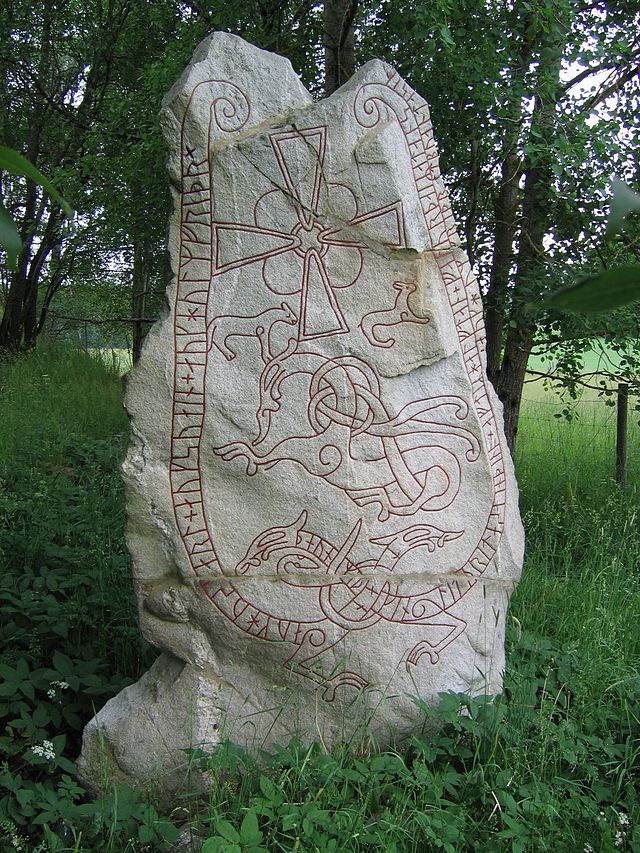
Rune Stone mentioning Thorkell the Tall (source: Wikipedia) 

Little is known of Thorkell’s early life, but what we do know is mainly through his association with the legendary Viking mercenaries, the Jomsvikings.

We know about the Jomsvikings from the Icelandic sagas, particularly The Jomsvikinga Saga and King Olaf Tryggvasson’s Saga. They were staunchly pagan, worshipping Odin and Thor, but would fight for Christian rulers if the price was right. Hiring themselves out to the highest bidder, they nonetheless followed a very strict set of rules and regulations.
1,000 year old Mjolnir pendant, 
similar to those possibly worn by the Jomsvikings
for protection (source: National Museum of Denmark
Their stronghold, Jomsborg, is said to have been located on the southern shore of the Baltic Sea. The exact location has never been found and is still the cause of great debate amongst scholars and amateurs alike as there are no primary sources that mention the place. There are, however, three contemporary rune stones that mention their battles and hint at a central location.

Thorkell the Tall would have had to follow the code by which the Jomsvikings ruled themselves. They were extremely selective when deciding whom to admit to their group, with membership being restricted to men aged 18 to 50 who had proven their bravery. This usually took the form of a display of strength, with a ritual duel, or holmgang, with an existing Jomsviking. (Normally these duels would be to the death, but in the case of proving yourself to the Jomsviking, besting your opponent was enough).

Once admitted to the group, a Jomsviking would continue to follow the strict code used to maintain order and instill military discipline.
- a Jomsviking was bound to defend his brothers and avenge their deaths.
- quarrelling or speaking ill of fellow Jomsvikings was forbidden
- blood feuds, if they arose, would be adjudicated by senior Jomsvikings
- a Jomsviking was forbidden to show fear in the face of the enemy, or run from battle (orderly retreat when against an enemy of superior strength, however, was permitted)
- spoils from a battle were shared equally amongst the entire order
- no Jomsviking could be absent from Jomsborg for more than 3 days without permission from the order
- no women or children were permitted within the Jomsborg fortress walls
- no women or children were to be taken captive

Non-adherence to any of these rules resulted in the offender being expelled from the group.

A few sources state that Harald Bluetooth, who ruled Denmark from 958 to c985, and from whom we get the Bluetooth symbol used in today’s technology (the Norse runes for ‘H’ and ‘B’ are combined to create the Bluetooth symbol), was the founder of the Jomsvikings. Another source claims the Jomsvikings were given their land by mythological ruler of Denmark. But no one really knows for certain where or why the group was started.

Curmsun Disc – 
Commemorating the death of Harald Bluetooth
at Jomsborg (Source: Wikipedia)

There is also very little known about what happened to the Jomsvikings. One story tells us that Magnus I, King of Norway (from 1035) and Denmark (from 1042) until his death in 1047 may have destroyed Jomsborg and the Jomsvikings as a show of control the year after he conquered Denmark. But without primary sources and with the lack of archaeological evidence, this legendary group of warriors will remain just that: legendary.

~~~~~~~~~~~~~

Kelly Evans was born in Canada of Scottish extraction but spent much of her life in London, England. She obtained degrees in History and English in Canada and continued her studies in London, focusing on Medieval Europe, landscape archaeology, and the Icelandic Sagas.

Kelly moved back to Canada eight years ago, shortly after which her first short stories were published. The Northern Queen is her first novel. Her work can be found on kellyaevans.com or via Nordland Publishing
Twitter: @chaucerbabe
Facebook

Tuesday, December 1, 2015

Ye Olde Christmas Traditions

by Steven A. McKay


Christmas isn't a new invention – it's been around for quite a while, in one form or another, as you're probably aware! Many of our favourite traditions are relatively recent additions though, such as the red-suited, white-bearded Santa with his elves, Rudolph the red-nosed reindeer and Slade with their annoying yet brilliantly catchy song.

Of course, winter has always been a time for people to celebrate, as the old year gives way to the new and we look forward to what the future will bring us. Medieval folk shared many of our customs and they had some interesting ones of their own that didn't carry over to the present day.

With the passing of summer, things become bleak and drab so, at Christmas we decorate our houses to chase away the gloom. In the middle-ages they used evergreens like holly, ivy and mistletoe to brighten the place, a tradition stemming from the Roman festival of Saturnalia.

Icy holly by Liz West

Holly was thought to deter witches while men wore it to attract female admirers. Ivy also kept evil forces away but it was kept outside the home, while mistletoe – a plant venerated by the pagan Druids – was really frowned on by the Church but that didn't stop suitors kissing beneath it as they do to this day.

Of course, the main evergreen we use to see in Christmas nowadays is the fir tree, with its fairy lights and shiny baubles. Medieval people didn't have a tree in their house but a candlelit fir was displayed in London in the fifteenth century and, in general, it was seen as a Christian symbol, possibly to combat the pagan oak.

Many of those traditions originated in even earlier times, with the Vikings, who celebrated the winter solstice, their Yuletide, around the same time as we enjoy Christmas.

Our lovely, chocolatey Yule Log, for example, which is a cake nowadays but in pre-Christian days it  was an actual log or even a small tree, carved with protective runes and brought inside with great ceremony to be used as fuel for the household's fire during December.

That should last a while!

Santa Claus takes many elements from the Viking legends. They believed Odin, or Old Man Winter, a white-bearded old man in a hooded robe who flew around the world on an eight-legged horse, gave out gifts to the good and punishments to the bad. He would even be invited into people's homes with food and drink.

Yuletide was often referred to as “drinking yule”, which suggests drinking a lot of alcohol played a big part in the Viking celebrations, with feasting, games and songs. Which of course carried on into medieval times and nowadays...well, I'd imagine more booze is sold in December than any other time of the year. We certainly carried on that custom!

Getting back to medieval times, the people had various saints' days which were celebrated throughout the winter, with some of them even carrying over after Christmas Day (which is still the case for those of Catholic faith).

December the 26th was St Stephen's day and it saw sword dances and mumming plays which sound pleasant enough, but the animals were also bled (in those days, of course, bleeding was seen as healthy!) and in Wales, female servants would have their arms and legs beaten bloody by young men with holly branches! Ouch. Thankfully that tradition died out…

Odin/Father Winter

There was also Holy Innocents' Day on the 28th, and Epiphany on January 6th, but most interesting to me was St Lucy's Day, which was on the 13th of December and was a celebration of light. This is another feast day that has links to earlier, pagan times, with candles and processions. Of course, Lucifer, before he became synonymous with Satan, was known as the light-bringer, so it seems clear to me that St Lucy's Day was actually a celebration of Lucifer (bear in mind, the Latin word lucifer was once even applied to Jesus)...

Which brings me rather neatly to my own little take on medieval festivities.

Friar Tuck and the Christmas Devil is my brand new novella and December 1323 is the backdrop for much superstition and fear. I greatly enjoyed writing and researching it and, who knows, maybe reading it each December will become as much a modern tradition as Scrooge and Noddy Holder/Mariah Carey!

I am doing a giveaway of the book this week. Click HERE to find out more, and leave a comment below to enter!


Steven A. McKay is the bestselling author of the Forest Lord series of books, Wolf's Head, The Wolf and the Raven, and Rise of the Wolf. All his books are available on Kindle, paperback and from Audible.

To buy Friar Tuck and the Christmas Devil click HERE

To find all of Steven's books on Amazon, click HERE 

Sign up HERE to Steven's email list and get a FREE short story, "The Escape", starring Little John in a tight spot...

Steven's WEBSITE

References:
Jackson, Sophie - The Medieval Christmas (The History Press, 2005)
http://skandland.com/vikxmas.htm
http://www.whychristmas.com/customs/yulelog.shtml
http://freya.theladyofthelabyrinth.com/?page_id=397
http://www.timetravel-britain.com/articles/christmas/santa.shtml
http://www.mrshea.com/germusa/customs/lucia.htm


Friday, November 27, 2015

Mrs Gaskell's Tower Part I - Historical Trails & Serendipity

By Annie Whitehead

I'm fortunate to live in a part of the world which gives me easy access to many areas of outstanding natural beauty. And I tend to veer away from the obvious spots in the English Lake District to see what else is on my doorstep.

On the northern edge of Morecambe Bay lies a little place called Silverdale, and it was here, at Lindeth Tower, that Elizabeth Gaskell, novelist and biographer of Charlotte Bronte, used to come for her holidays.


As an historian and an author, I love to go wandering along a trail, be it metaphorical or geographical. Mrs Gaskell's Tower had given me a starting point, but she is a literary, rather than historical figure. Little did I know that what started as a 'Victorian' day, would become a day when I got tantalisingly close to the Anglo-Saxons ... 

A pleasant walk down a lane strewn with autumn colours took me down to Jenny Brown's point, where a chimney stands as a reminder of this area's industrial past:


Walking back from the point, I found an old lime kiln which has been reconstructed, fenced off, and given a little placard explaining the history and uses of lime-burning. I also discovered that there was a shipwreck in the area in 1894, when a pleasure yacht, The Matchless, foundered off Jenny Brown's point with the loss of 25 souls.

The English poet Gordon Bottomley (1874-1948) lived in the village and was visited often by his friend, the artist Paul Nash.
Silverdale is noted for its wells, which used to serve the village, and Woodwell is situated, as one might guess, in an area of peaceful woodland.
photo by Zephyrine Barbarachild

It was a wonderful walk, despite the typical northern weather that day, but I left feeling that I hadn't uncovered everything that Silverdale knew ...

And then I remembered that a while ago I'd read in the local paper about the Silverdale Hoard. Now, I'm an Anglo-Saxon-ist, rather than a Viking-ist, so the Silverdale Hoard didn't initially get my pulse racing in the way that the Staffordshire Hoard is apt to do. And yet, and yet ... something drew me to investigate.

2oo pieces of Viking silver were found by a detectorist in 2011 and have been dated to around the year 900. Of the 27 coins, some are coins of Alfred the Great and some of the Danish king of Northumbria. As with the Staffordshire Hoard, it is assumed that whoever buried this stash was unable, due to the turbulent nature of the times and probably due to loss of limb, or life, or both, to come back and retrieve their retirement fund.


It's no thing of beauty compared with the ornate goldwork of the other afore-mentioned hoard, but this cache contained a silver bracelet with an unusual combination of Irish, Anglo-Saxon and Carolingian style decoration. Other pieces of jewellery were found as fragments, having been cut up to be used as 'hacksilver', an alternative form of coinage.

One coin in particular was considered note-worthy, inscribed as it was with the name AIRDECONUT, which has been translated as Harthacnut. Since the coin also bears the inscriptions DNS and REX, it has been suggested that this might identify a hitherto unnamed Danish king of Northumbria. The historian in me was interested.

Another coin, a silver penny, was inscribed  ALVVADVS, translated as Aethelwold. The author in me was excited ...

Aethelwold was the son of Alfred the Great's elder brother, King Aethelred. When Alfred died in 899 Aethelwold made a bid for the throne, taking a nun hostage (why? Don't ask me) and holing up in Wimborne, Dorset, where his father was buried, as if to establish that he, and not Alfred's son Edward, had the stronger link to the West-Saxon line of kings. From Wimborne he went to ally himself with the Northumbrian Danes, who acknowledged his claim to the kingship of Wessex. Confident of eventual victory, he must have proceeded to order coins minted in his name. He eventually met his cousin Edward in a remote part of of East-Anglia in 902, at the Battle of the Holme. The rarity of the coin bearing Aethelwold's name perhaps tells you what you need to know about the outcome.

So, from a tower favoured by a Victorian writer, via industry and shipwreck, and an interesting but not initially fascinating buried treasure, I had come, unplanned and unconsciously, to a person whom I feel I 'know' rather well. For you see, a year before this hoard was discovered, I had written a story. It's called To Be a Queen, and it features Alfred the Great, his daughter, her brother, Edward, and their cousin, one Aethelwold, or as I call him, Thelwold.

Those among you who write, and have a penchant for digging, either literally or figuratively, will understand how satisfying it was for me to find out about that tiny little silver penny.


And as for Mrs Gaskell? Well, she got me thinking, too, and Part II of my Silverdale 'wanderings' will be live on this blog on December 27th.


Annie Whitehead is an historian and author of To Be a Queen, which tells the story of Aethelflaed, Lady of the Mercians, daughter of Alfred the Great. She writes regularly for magazines and will be releasing her second novel, also set in 'Dark Ages' Mercia, in the New Year.

Find her book at AMAZON and BOOK DEPOSITORY
and find Annie on her BLOG and FACEBOOK PAGE

Wednesday, October 28, 2015

Of Talking Wolves and Severed Heads

by Anna Belfrage

The other day I drove by a place called Hoxne in Suffolk. As many English place-names, Hoxne is not pronounced as it is spelled, no this is ”Hoxenn” – although one must admit the alternative would have been difficult to enunciate.

Anyway: Hoxne swished by in 20 seconds. The name gnawed at me, somehow, and when my friend said “this is where some king or other died”, I knew I had heard the name. Problem was, I couldn’t quite remember…

Those among you who know your Anglo-Saxon kings are of course leaping up and down by now. Me, I had to mull it over before it came to me: Edmund. Or, if we’re going to be quite correct, St Edmund.

All old European kingdoms have a martyred royal or two. In Sweden it’s St Erik – whom I seriously doubt ever existed – in Norway it is St Olof (who definitely existed), Scotland has St Margaret, and England has St Edward. And St Edmund. Two royal saints – one of whom was martyred by the ancestors of St Erik and St Olof.

So who was this Edmund, and what did he ever do to deserve the honorific of saint? Well, obviously he died – rather painfully – but many people throughout history have done that without being rewarded with a sainthood.

Very little is known about Edmund. In fact, what comes down through the ages is a story of a beleaguered hero, a symbol necessary to keep the fire burning in the hearts of his people, cowering under the weight of the Viking yoke. Because it was a yoke, the Nordic raiders returning year after year. At times, attempts were made to buy them off, but in the latter half of the ninth century, Ingvar Benlös (Ivar the Boneless), as per the sagas one of Ragnar Lodbroke’s sons, headed a huge Viking army – adequately nick-named the Great Heathen Army  - and landed on English soil. This time, they did not want plunder. This time, the Vikings wanted land.

Due to all that Viking raiding and pillaging, most East Anglian written records of the time have been lost. Vikings didn’t read books – they burnt them. We do know there existed an Edmund – coins with his name testify to this. Those same coins indicate he succeeded a gentleman named Aethelweard as king of East Anglia. It is thought he was related to Aethelstan, king of Kent, and whatever the case, the general supposition is that he was of a “noble and ancient race”, i.e. of royal Saxon blood.

Edmund became king at the tender age of fifteen – or so the Anglo Saxon Chronicle tells us, which means we need to take things with a pinch of salt, as the Chronicle showed little interest in the events unfolding in East Anglia until twenty years after Edmund’s supposed death. But let us assume the Chronicle had it right – if nothing else because it makes for a better story. A young, gallant prince takes up the ermine (well…no ermine at the time) and proceeds to lead his people. By all accounts, he did a good job of this, showing plenty of promise.

He was also a good Christian – a pious young man who in everything was the perfect role model for all those future young men who aspired to be brave and heroic. Here we had a king who refused to compromise when it came to his faith – no matter what it might cost him.

In the 860s, the Viking army landed in England with the intention of staying – for good. This did not go down well with those already there, but the Vikings were ever a somewhat brusque race, and what people didn’t give them, they took. They marched north and conquered York and Northumberland, entered Mercia and forced the Mercians into accepting a treaty, before turning southeast to formally conquer East Anglia.

Edmund defended his kingdom as well as he could. But however competent Edmund may have been, he wasn’t much of a match for the battle-hardened Vikings, and his men were pathetically inadequate in facing up to the roaring Northern horde. To be fair, all of the Saxon kingdoms except Wessex were to succumb before the Viking warlords.

In November of 869, Edmund and his men ended up surrounded by the Vikings. The various versions of the story are somewhat different, but I prefer the one where Edmund yielded to save the lives of his men. There’s another variant whereby Edmund hid himself under a bridge in Hoxne – hoping no doubt to live and fight another day – but his spurs caught the sunlight and a young girl gave him up. However it came about, our Edmund was now in the less than tender care of the Danes.

Vikings were practical people. Why kill someone you could milk until they were dry? They therefore suggested that Edmund buy his life by giving them half his treasure. But, they added, he would have to embrace their faith as well. Anathema to Edmund. He might consider parting with what little treasure he had left, but his faith was not up for discussion. Edmund squared his shoulders, prepared to meet his fate. A young man still, not yet thirty, about to be cut down in his prime.

The Vikings found this rather hilarious – or intriguing. In general, Vikings couldn’t quite understand how anyone could worship such a weakling as the White Christ – the silly man got himself nailed to a cross, and as far as the Vikings could make out, he hadn’t even tried to fight himself free. Very strange, as per the Norsemen. It therefore amazed them that so many men were willing to die for this – in their opinion – useless god.

Edmund was tied to a tree. He was whipped with chains until he was bleeding from all over. He still refused to disavow his god. If Christ could die for all humanity, then Edmund could die for Christ. Very well, said Ubba the Viking, and ordered the half-dead man to be peppered with arrows. Still he didn’t die, but by now his tormentors had tired of their game, so they chopped off his head and threw it into the surrounding woods, leaving the decapitated corpse tied to the tree.

No sooner had the Vikings ridden off, but Edmund’s men cut him down, weeping (I suppose) at this futile death. They searched everywhere for the head, but it was dark and cold, and no matter how they looked they couldn’t find it. But Edmund had friends among the wild creatures that lived in the woods, and so it was that a wolf found the head, and called out a series of “hic, hic, hic” until Edmund’s men cottoned on and came charging through the underbrush, marvelling at the miracle of a talking wolf (in Latin, no less).

Edmund was buried in a nearby church and there he remained for twenty-odd years. By then, the myth and legend of Edmund, the brave and handsome young king who died for Christ, had found its ways to the Church, and it was decided that the saintly king needed a more suitable shrine – which is how Edmund ended up in Bury St Edmunds.

By then, the Viking raiders had settled firmly into their new land. The Danelaw covered most of England, but interestingly enough those savage heathen warriors developed a softer side when living in peace. Many of them became Christians, and thirty years or so after Edmund’s death, the mints of East Anglia produced pennies with the legend SCE EADMUND REX (St Edmund King). Those ferocious Vikings and their descendants were proud of their brave saint, somehow conveniently choosing to forget he wouldn’t have been a saint had the Vikings not killed him.

The cult of St Edmund grew so rapidly that some years on it required a separate community devoted to this English saint. The abbey of Bury St Edmunds grew fat and happy thanks to their resident saint. Until the Reformation, the cult of the saint remained strong, and when the shrine was defaced and destroyed in the 16th century, it is said gold and silver to the value of 5 000 marks were carried away. Interestingly enough, at the time the shrine was probably empty, as it is said the French invaders who fought King John in the early 13th century stole away the body. As per this story, St Edmunds remains ended up in Toulouse and were venerated by the French for centuries.

In the early 20th century, some of the remains in the French shrine were returned to England. It has never been determined if they belong to Edmund, which is why these sad little fragments remain in Arundel, under the care of the Duke of Norfolk rather than being buried under the high altar of Westminster Cathedral as originally intended.

And as to Hoxne, not everyone agrees that this is where it all happened. But Hoxne clings to this claim to fame, and after seeing this minute little village I am thinking it could have been there – just at it could have been elsewhere. Thing is, it doesn’t really matter, does it?

Well over 1100 years ago, a young king was tortured to death by barbaric invaders. To this day, his name is remembered, even if the man behind the saint remains forever enigmatic. Me, I hope he did other things in his life but die. I hope there was love, and comradeship, and moments of silent awe at the beauty of being alive.

~~~~~~~~~~~~~

Anna Belfrage is the successful author of eight published books, all of them part of The Graham Saga. Set in 17th century Scotland, Virginia and Maryland, this is the story of Matthew Graham and his wife, Alex Lind - two people who should never have met, not when she was born three centuries after him.

Presently, Anna is hard at work with The King’s Greatest Enemy, a series set in the 1320s featuring Adam de Guirande, his wife Kit, and their adventures and misfortunes in connection with Roger Mortimer’s rise to power. The first instalment, In the Shadow of the Storm, will be published in November 2015.

For more information about Anna and her books, please visit her website. If not on her website, Anna can mostly be found on her blog.

Monday, June 29, 2015

Truth or Myth? Of Hairy-breeched and Boneless Vikings

by Anna Belfrage

Just in case anyone is thinking Vikings is a correct portrayal of dear old Ragnar Lodbrok, I thought it time to set the facts straight. (Not that I care, not with Travis Fimmel to rest my eyes on.) First of all, I thought it might interest you to know that Ragnar Lodbrok in essence means Ragnar Hairy Breeches. Secondly, let us keep in mind that Ragnar, like all ambitious little Viking boys, early on dreamed of becoming rich – very rich even – by stealing from others, a.k.a. raiding. If he was successful enough, he’d be able to buy a farm and retire with a comely wife. Plus, if he was really successful, someone might even raise a runestone over him.

Runestone: I,Berig
CreativeCommons Licence
None of the above ever came true for Ragnar. The runestone thing mainly because Ragnar did not exist outside the sagas (although some say otherwise). The retirement thing because fate had other plans for Ragnar. You see, the Norse sagas are rarely very keen on the Happily Ever After. Such notions are for wimps, not for die-hard warriors like our Scandinavian forebears. No, the sagas are harsh and gritty stories of man pitted against his destiny, with not as much as a whiff of romanticism. Hang on: the sagas DO actually romanticise one thing – the concept of honour, of men who will die rather than betray their own integrity.

These days, things have gone downhill when it comes to honour and integrity – at least here in Sweden, where neutrality rather than integrity has been evoked as a guiding principle in (relatively) recent major conflicts.

Neither here nor there – let’s get back to Ragnar. We have here a young man eager for adventure – and riches. So when he heard of poor Tora Borgarhjort, a pretty maiden whose bower was encircled by a fierce and deadly serpent, he decided to do the right thing and save her, to a large extent motivated by Tora’s father’s promise that whoever killed the monster would wed his daughter and inherit his titles and riches.

We’re talking a huge serpent here, a vile creature that considered Tora its property and defended her from any potential suitor through a combination of fangs and poison. So potent was its poison that it burned holes through garments and human skin, and as a consequence, there was a pile of young dead men at the door of Tora’s bower.

Ragnar was a bright young man. Approaching the serpent obviously required protective gear, which is why he fashioned himself a pair of breeches out of untreated goatskins (ergo the hairy breeches). These he then dipped in pitch and rolled in sand, so that they became more or less impregnable. In these pants and with a spear in hand, he snuck up on the serpent and managed to slay it, thereby gaining Tora’s hand and a jarldom.

I can hear some of you say, "What? Tora? Who's this Tora, and where is Lagertha?" Sorry to tell you that the sagas are not always consistent, so in some Ragnar does wed Lagertha for a short while (after first having killed her tame bear and hound - beasts set upon him as a test by Lagertha) but divorces her to marry Tora, a much better catch seeing as she's a jarl's daughter and Danish - just like Ragnar.

By all accounts, Tora and Ragnar were very happy. Too happy as per the Norns, those rather cold-hearted crones that spin the threads of fate. Which is why they decided to cut Tora’s thread, and Ragnar was left a devastated widower. As any grieving Viking would do, Ragnar set off on a raiding expedition, hoping to dull the constant ache in his heart through violent action and plunder.

Kraka
Ragnar and his men were in a Norwegian fjord, and Ragnar sent some of his men off the ship to do some baking (and I rather like the resulting picture of self-sufficient Viking warriors with bulging biceps kneading dough). As they were doing their bread thing, the men were distracted by the sudden appearance of a young girl called Kraka. So beautiful was she that the bakers forgot their task, mouths agape as they stared at this female apparition. As a result, the bread was badly burnt, and Ragnar was less than pleased when his men returned to the ship.

"It was Kraka’s fault," the men said, going on to describe this gorgeous creature. Ragnar was intrigued not only by the description, but also by the amusing fact that someone so beautiful should be named Kraka, which means crow. Whatever the case, Ragnar decided it was best if he did some inspecting of his own, but before doing so, he tried to do some research.

In an age devoid of internet, finding out more about Kraka proved difficult for Ragnar. Fortunately for you, dear readers, I do have internet (and books) so I can tell you in confidence that Kraka was really named Aslög, and she was the daughter of Brunhilde and Sigurd Fafnesbane of Wagnerian fame. Now that story of love, betrayal, blood and death is so complicated it would take an entire post to explain it all, so let’s just summarise by saying little Aslög is left an orphan when her parents die, and she is smuggled to safety in a harp (?) by a gentleman named Heimer. When Heimer asks for lodging with a poor couple in Norway, the wife urges her husband to kill their guest as she can see that he is rich, and among his belongings they discover the girl whom they rename Kraka and set to hard work.

Sigurd defeating the dragon
Ragnar got as far as the Sigurd Fafnesbane bit and was very impressed – especially as Sigurd had died like two centuries prior to Ragnar seeing the light of the day, so either Kraka was very old, or there was magic at work. When in doubt, go with magic, and Ragnar found this additional ingredient quite alluring. So he decided to set the young woman a test and invited her to visit him on his ship “neither dressed nor naked, neither hungry nor full, neither alone nor accompanied”. Clearly, my ancestors enjoyed speaking in riddles…

Kraka/Aslög rose to the challenge and appeared swathed in fishnets having eaten a clove of garlic and with a dog at her heels. This, apparently, sufficed to sweep Ragnar off his feet, and he carried Aslög with him back to Denmark where he promptly married her and had many, many children with her.

Together, Aslög and Ragnar had four sons: Ivar Benlös (boneless), Björn Järnsida (ironside), Sigurd Ormöga (serpent's eye) and Vitsärk (white shirt). Ivar Benlös was supposedly afflicted with some sort of disease (in some cases attributed to his parents having had sex before marriage, but I believe this is a later addition, intended to curb the rather relaxed attitude to sex Scandinavian have had since time immemorial), but it doesn’t seem to have hampered his style much, as he and his brothers grew up to be as fierce as their father. So successful were the brothers in their raiding expeditions that people began to mutter that the sons were better warriors than their father. This Ragnar did not like. At all.

In an effort to set things straight, Ragnar launched his own little raiding party – and he was going west, to ransack the lands of King Aella of Northumbria. To really show the world just what a fearsome warrior he was, Ragnar decided to go with only two ships, sufficient, in his opinion, to defeat that milksop of an English king. Aslög begged him not to go, plagued by foresight. When he insisted on going, she gave him a magic shirt, a garment which could not be penetrated by iron. But she was weeping as he left, knowing deep inside she’d never see him again.

Ragnar arrived in England only to crash straight into Aella’s army. Thanks to his shirt, Ragnar survived while one by one his men died, and so he was captured alive and hauled before a smug Aella who demanded to know his name. Ragnar refused to tell him, and so Aella had him thrown into a pit with vipers, there to die a slow, painful and – most distressing for a Viking – ignominious death.

“The piglets will squeal when they hear how the old boar suffered,” Ragnar supposedly said before dying, smiling at the thought of the revenge his sons would wreak on Aella.

The piglets most certainly squealed. As per the saga, the brothers were in their hall when the messenger carrying the tidings of their father’s death reached them. Vitsärk was playing draughts, and squeezed so hard round the piece in his hand that blood began to well. Sigurd was paring his nails and cut himself to the bone. Björn was honing his spear, and tightened his hold on the shaft until it splintered. Ivar calmly asked the messenger to tell them everything. Everything, mind.

The three younger roared and gnashed their teeth together, wanting to set off immediately to kill Aella. Ivar urged caution and stealth.

“Revenge is a dish best eaten cold,” he said, but was overruled. So off the brothers went, with Ivar choosing to distance his ships and men from his revenge-maddened brothers.

Aella was no fool. Upon realising who had died in his snake pit, he knew it was just a matter of time before the sons came, so he’d amassed a sizeable army, big enough to beat back the brothers who turned tail and ran back to their ships. All except Ivar, who decided to visit with Aella and expressed himself willing to accept weregild for his father’s death. Aella was more than happy to oblige, and settled sizeable land on Ivar, who seemingly was content to live in proximity with his father’s murderer. Not...

Over the coming years, Ivar fostered unrest and resentment among Aella’s vassals, and once the kingdom had been sufficiently destabilised, he sent for his brothers. This time, there was no army to defend Aella. This time, he was captured and dragged alive before Ragnar’s four sons. Not for Aella the snake pit, no, Aella was undressed, thrown to the ground with his back bared to the sky, and ever so slowly Ragnar’s sons “carved a blood eagle” on him. This entailed slicing through his back, breaking the ribs and pulling them wide apart to resemble wings, and then pulling the lungs out through the resulting hole. Nice.

The sons returned to Aslög, and she was satisfied that her husband had been adequately avenged. Björn and Sigurd went on to become kings of Sweden and Denmark respectively. As to Ivar, he stayed on in England – as per the saga as king of all England, as per what little facts there are, as the leader of the Viking army that despoiled most of Mercia and East Anglia in the late 9th century.

There is an interesting little add-on to Ragnar’s saga, which refers to Ivar’s final resting place. It is said Ivar ordered his burial mound to be built just at the edge of the sea, prophesising that as long as his bones lay untouched, no one would be able to invade England from the sea. According to this little codicil, “the bastard William” found the mound and had it opened. Upon finding Ivar’s body un-decayed, William ordered a pyre to be built, and only once Ivar’s bones had been reduced to ashes did he proceed with his invasion plans. I’m thinking Ivar would have applauded William – after all, they both had Viking blood, a gift for violence and pillage.

Beware of the Norns!
So, did Ragnar exist in any form? We don’t know, sources from the 9th century being understandably scarce. Some people seem to think there was a historic Ragnar, a Danish Viking of great renown. But for him to be married to a woman whose father slayed a dragon, well, that does seem difficult to believe, doesn’t it? Whether real or not, the story of Ragnar and Aslög is a story of two equals, two people who meet and know immediately they belong together. Maybe it was Aslög seeing the hole of grief in Ragnar's heart. Or maybe it was Ragnar seeing in poor Kraka a woman with the spirit of a lion. Or maybe it was those pesky Norns, thinking it would be fun to twine these two threads together and see what happened. A lot, as it turns out. Enough to build an entire TV series on.

~~~~~~~~~~~~~

Anna Belfrage is the successful author of eight published books, all of them part of The Graham Saga. Set in 17th century Scotland, Virginia and Maryland, this is the story of Matthew Graham and his wife, Alex Lind - two people who should never have met, not when she was born three centuries after him.

Anna's books have won several awards and are available on Amazon, or wherever else good books are sold.
For more information about Anna and her books, please visit her website. If not on her website, Anna can mostly be found on her blog.