Showing posts with label Alfred the Great. Show all posts

Friday, June 12, 2020

Æthelflæd: Lady, or Queen?

By Annie Whitehead

On 12 June, 918, Æthelflæd, Lady of the Mercians, died at Tamworth. Her body was taken for burial at Gloucester, to be laid alongside her husband who had died seven years earlier.

Her profile has been raised in recent years with, among other things, her fictional portrayal in the Bernard Cornwell novels/television series and, in 2018, conferences, festivals and re-enactment events to celebrate the 1100th anniversary of her death. A new statue was erected at Tamworth.

The New Statue - Image by Annatoone via Wiki Commons - Link here

We know the basic facts of her life which are that she was the eldest daughter of Alfred the Great, and was married to the lord of Mercia around the time that the Mercians aided Alfred when he freed occupied London from the Danish invaders. This would suggest that Æthelflæd’s marriage took place in around 886, when she was probably sixteen or seventeen. Since he is named as fighting alongside Alfred, and was clearly a warrior deemed capable of leading Mercia during such turbulent times, it is likely that her husband was a good deal older than her.

His name was Æthelred and in all the extant charters his title is given as lord of the Mercians, not king. The last two kings of Mercia, Burgred and Ceolwulf II, came from rival branches of the royal family. Burgred, who was married to Alfred’s sister, fled overseas when the ‘Vikings’ invaded Repton in Mercia. Ceolwulf II, whom the Anglo-Saxon Chronicle dismissed as a ‘foolish king’s thegn’ was, in fact, considered a legitimate king who minted coins jointly with Alfred and issued charters in his own name. His date and place of death are not known for certain, nor is it clear where Æthelred came from and nothing is known of his lineage.

Æthelred was clearly considered a worthy husband for the daughter of the king of Wessex and he proved himself an invaluable ally, fighting alongside not only Alfred but also Alfred’s son, Edward.

In 902 though, his name disappeared from the records. His death was recorded as having occurred in 911, and most historians agree that he was incapacitated in some way for nearly a decade.

Very few even near-contemporary chroniclers mention Æthelflæd by name, most often referring to her - if at all - as Edward’s sister. We do, however, have a portion of an annal incorporated into the Anglo-Saxon Chronicle and referred to as the Mercian Register. It isn’t very long, but it chronicles the years 902-918 and it focuses on the programme of burh-building, where fortified towns were built in the campaign to push the invaders back and as part of the strategy of retaking areas overrun by the ‘Vikings’. This building campaign was not random, either, but saw Æthelflæd and her brother working strategically to aid one another and provide mutual support and back up.
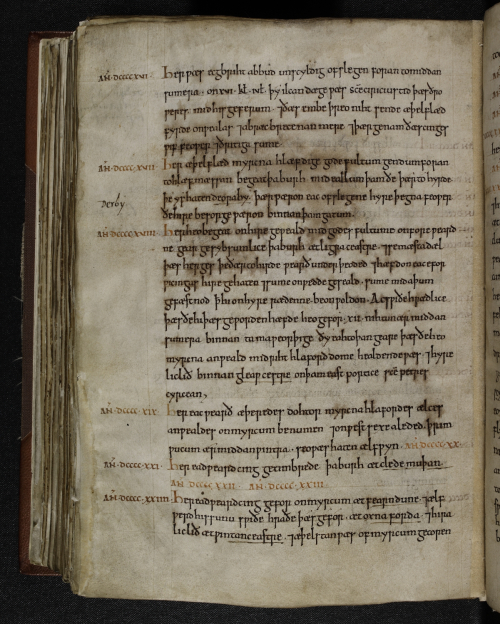
The Mercian Register. British Library - Link here

The Mercian Register mentions three specific incidents which are not related to the burh-building, however, although not until near the end of her life. The first is that Æthelflæd sent an army into Wales to avenge the death of an abbot, the second is the taking by her forces of Derby, in which she lost four men who were ‘dear to her’ and the third is that when she died, her daughter was considered the rightful heir to Mercia but was ‘deprived of all authority’ by Edward of Wessex.

So it seems that Æthelflæd did far more than oversee building projects and she was accepted as a leader of an erstwhile kingdom as was, briefly, her daughter [1]  but even so, while it begins in the critical year of 902, the Mercian Register gives no hint that Æthelflæd was in charge of Mercia during her husband’s illness, most of the activity seemingly occurring after his death.

Fortunately, we have another source which, although not considered hugely reliable, does fill in some gaps for us. It is an Irish annal, known as the Three Fragments, and it explains how, when the ‘Vikings’ overran Chester, a message was sent to Æthelred, whom it refers to as the king, and who was in disease and at the point of death. He, apparently, gave instruction to his wife who then successfully restored Chester, driving out the enemy.

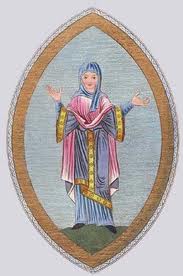
Image from the Abingdon Cartulary

It may not be true, but it does seem to corroborate the idea that Æthelred was ill, but still able to command. And it does put some flesh on the bones of the stark statement in the Anglo-Saxon Chronicle that in 907 ‘Chester was restored.’ And, a point to consider is that at other times the Anglo-Saxon Chronicle is happy to name Æthelred when he was involved in various campaigns and battles, but it doesn’t give a name here. Perhaps we can safely assume then, that Æthelflæd was indeed acting in her husband’s stead.

After her husband’s death, Edward took Oxford and London under the direct control of Wessex but left the rest of Mercia under his sister’s command. I’ve discussed elsewhere [2] his possible motives for this and for his annexation of Mercia following his sister’s death but, whilst there are political implications, it’s hard not to conclude that he saw personal strengths in his sister.

14th century depiction of Edward

Leaving aside the later Anglo-Norman chroniclers’ depictions of her as a warrior queen who could be compared to Caesar, what we have are very ‘bare bones’ accounts of her life and deeds but it’s more than enough. We know that she cared deeply about Mercia, ruled in her husband’s stead while he was ill, and worked in tandem with her brother after Æthelred’s death, building fortresses and pushing back the invaders.

What we cannot settle is the debate over her title. She was Lady, not Queen. And yet that word implies so much more than nobility, especially if her daughter was then deprived of ‘all authority’. Indeed, Æthelflæd's own mother, wife of Alfred the Great, was remembered as 'Lady of all the English', so the title carried some implication of nobility of the highest order. Many might argue that Æthelflæd's status, and that of her husband, was downplayed by the main, Wessex-based, chroniclers but it seems unlikely to me that Æthelred was considered a king, even by the Mercians and he was never styled so in the charters he issued. It has been suggested that he was in fact the son of King Burgred, who married Alfred’s sister, but if so why was he not called king, as his father had been? Barbara Yorke [3] has suggested that he was descended from the ealdorman Æthelmund of the Hwicce (a sub-kingdom of Mercia) who was named in the Anglo-Saxon Chronicle as being killed in 802 fighting at Kempsford.

So whether by bias or reality, Æthelflæd was a Lady. But she certainly acted like a queen and if we once again turn to sources not English, then we see how other nations viewed her. The Three Fragments referred to her as queen of the Saxons and the Annales Cambriae, the Welsh annals, erroneously give the date of her death as 917 but the entry is succinct: 'Queen Aethelflaed died.'

Today, in Tamworth and elsewhere, she will be remembered, not for her title, but for her deeds.

Tamworth Statue erected in 1913. Author's photo


Notes:

[1] England would have to wait for more than another 600 years before a woman succeeded a woman to the throne.

[2] In my nonfiction books, Mercia: The Rise and Fall of a Kingdom and Women of Power in Anglo-Saxon England

[3] Æthelflæd 1100 Conference Tamworth, June 2018

~~~~~~~~~~

Annie Whitehead studied History under the eminent Medievalist Ann Williams. She is a member of the Royal Historical Society and an editor for EHFA.  She has written three award-winning novels set in Anglo-Saxon England, one of which was long-listed for the Historical Novel Society (HNS) Indie Book of the year 2016, and a full-length nonfiction book, Mercia: The Rise and Fall of a Kingdom. She has contributed to fiction and nonfiction anthologies and written for various magazines, including winning the New Writer Magazine Prose Competition. She was the winner of the inaugural Historical Writers’ Association/Dorothy Dunnett Prize 2017. She has recently been a judge for that same competition, and for the HNS Short Story Competition. Annie’s new book, Women of Power in Anglo-Saxon England, is published by Pen & Sword Books.

For more information, visit Annie's Website or her Author Page. Also connect with Annie through her Blog and Twitter (@AnnieWHistory) 

Friday, November 3, 2017

History Revealed: The Welsh Highland Railway

by Annie Whitehead

A trip on the Welsh Highland Railway reveals more than just its own history; it allows the traveller to learn about centuries of Welsh history.

My historical research often takes me into the pages of the Welsh annals. It's true that the Mercians of the English Midlands often fought the Welsh, but it's also true that they allied themselves frequently to the Welsh princes to unite against a common enemy.

In the seventh century, Penda, (a pagan) and Cadwallon of Gwynedd (a Christian) banded together to wage war on Northumbria.

In the ninth century, Anarawd of Gwynedd gave fealty to Alfred the Great and Welsh troops allied with Alfred's son-in-law,  Æthelred of Mercia, (husband of  Æthelflæd, Lady of the Mercians) helping the English to defeat the Danes at Buttington in 893.

Ælfhere of Mercia, (whom I called Alvar) was also an ally of the Welsh. As earl of Mercia, his job was to defend the marches from incursions by the Welsh, but the chronicles often noted him aiding the Welsh in their internecine struggles. He aided Hywel ap Ieuaf against his uncle in 974 and again in 978.

It's not just my research that takes me into Wales, but my travels, too. And once in Wales, it's impossible to encounter only one period of history. The story of the land is everywhere, and you can see much of it from the railway.

Public Domain Image

The Ffestiniog Railway had already proved its worth in the nineteenth century in carrying people and goods through the mountain region of Snowdonia. In 1872 Charles Spooner proposed a new line linking the main railway at Dinas with Rhyd Ddu at the foot of Snowdon. It was only partially completed when it opened in 1881, and was only fully laid southwards through Beddgelert and the Aberglasyn Pass to Porthmadog in 1923. But, as I said, a trip on the railway reveals more than just the industrial past of Wales.

Embarking at Caernarfon, one cannot help but be awed, as the station stands in the looming shadow of the castle, built by Edward I (known as Longshanks) in 1283, and designed as a symbol of oppression, echoing the walls of Constantinople and reminding the Welsh that their princes were no more, and that Edward was now their lord and master.

Caernarfon Castle, photographed by my late father

But not far away we can see occupation of Caernarfon from an earlier time, at the Roman fort of Segontium. The Romans arrived in North Wales in 60AD, over a century after Caesar's first invasion. Their main objective was Ynys Mon (Anglesey) where they set about subduing the druids there. (See my earlier post.) In around 77AD Suetonius Paulinus established a fort at Caernarfon. It was named Segontium, and housed around 800 men. It was a base well-located for keeping control of both Ynys Mon and the Llyn Peninsular.

Roman soldiers murdering druids and burning their groves
on Anglesey, as described by Tacitus

The train journey takes you through the valley of the Afon Gwyrfai and through the village of Waunfawr. As it crosses the bridge over the Afon Gwyrfai it passes the old church at Betws Garmon.

Saint Garmon was a Gallican bishop who arrived in Britain in the latter half of the fifth century. He was best known for establishing schools and it it thought that Betws was one of these. Clearly the church is more modern, and has been rebuilt many times. In 1634 a small four-leafed clover was inscribed on the font in the rebuilt church, but no one knows for sure when the previous church had been built. Saint Garmon was also known as Germanus, and his mission was to combat the influence of Pelagius, who has been the study of a recent EHFA blog post by Kim Rendfeld.

The railway arrives at the foot of Snowdon and begins to climb. Somewhere around this area, JMW Turner must have sat for a while as he drew a pencil watercolour entitled Llyn Cwellyn.


Full citation for image at bottom of this LINK

Offering views back down the valley towards Llyn Cwellin and Mynydd Mawr (Great Mountain), the line curves sharply as the train heads towards Rhyd Ddu (Black Ford). Rhyd Ddu is believed at one time to have formed the pasture lands of Llewlyn Fawr (of whom more in a moment.) It remained a farming community until the middle of the nineteenth century when the slate quarries and copper mines caused the population to double in size. The village became home to a blacksmith and a postmaster, as well as a coal merchant, a dressmaker and a publican. This Welsh-speaking settlement also boasted three shops, a school, and a woollen mill. The downturn came in the latter part of the century, and these days there are no shops, although there is still a pub, and with the loss of the industry, the community makes its living from farming.

From the stop at Rhyd Ddu, the view is a choice between the looking up to the summit of Snowdon, or towards Beddgelert.

Mount Snowdon, or Yr Wyddfa, is the highest peak in Wales. Its name means 'burial place' and there is a legend attached to it. A cairn at the top of the mountain is said to mark the grave of Rhita Fawr, a giant who wore a cloak fashioned from the beards of all the kings he had killed.

The mountain village of Beddgelert provides more insight into medieval Welsh history. The parish church of St Mary's was built on an earlier, sixth-century site, which eventually became the nucleus of an Augustinian priory in the thirteenth century. The priory was endowed by Llewelyn ap Iorwerth, also known as Llewelyn Fawr (Llewelyn the Great). He married the natural daughter of King John, and his grandson came to be known as Llewelyn the Last, fighting, and ultimately losing to, Longshanks. The priory prospered, and became an important centre. The building was destroyed by fire around 1283/4 and restored by Edward I. It is said that his munificent act was prompted by the fact that it was the carelessness of his own soldiers which had caused the fire in the first place. The later history of the priory is a familiar one, seeing it damaged again by fire in the early sixteenth century and then being allowed to fall into ruin on the orders of Henry VIII. Only the chapel was left standing.

St Mary's, Beddgelert - image attribution

Beddgelert is reputed to have been named after Gelert, the faithful hound of Llewelyn Fawr, who had a hunting lodge in the area, and it's possible to visit Gelert's 'grave'. The story goes that the faithful hound was left to guard the prince's baby, only to be discovered with bloodied mouth and the baby missing. Llewelyn drew his sword and killed the dog, whose yelp caused the baby to cry out. Seemingly, the dog had in fact protected the baby from a wolf. Full of remorse, Llewelyn buried the dog with great ceremony.

Gelert by Charles Burton Barber - Public Domain Image

Travelling on from Beddgelert the train crosses the Afon Glaslyn and along the Aberglasyn Pass. It then goes through the Aberglasyn tunnels. Between these tunnels, at Plas-y-Nant, the story of Wales is brought nearer to modern times, with the location of circular gun mounting blocks, built for World War II 'Blacker' Bombards, 20lb anti-tank mortars. There is also a pill box dating from around 1940.

Since I first travelled on the railway, the line has been opened up further and a team of enthusiasts works hard to keep the engines running.

Wherever I go in North Wales, I encounter history spanning the centuries. Here on the little mountain railway, the same is true. With monuments, sites and buildings stretching from Roman times to WWII, it really is the tale of centuries, incorporating a wonderful mix of fact and legend.

~~~~~~~~~~

Annie Whitehead is an author and historian, and a member of the Royal Historical Society. Her first two novels are set in tenth-century Mercia, chronicling the lives of Æthelflæd, Lady of the Mercians, who ruled a country in all but name, and Earl Alvar who served King Edgar and his son Æthelred the Unready who were both embroiled in murderous scandals. Her third novel, also set in Mercia, tells the story of seventh-century King Penda and his feud with the Northumbrian kings. She is currently working on a history of Mercia for Amberley Publishing, to be released in 2018.
Amazon Page
Website
Blog


Thursday, April 6, 2017

The (Almost) Forgotten Battle

by Chris Bishop

If you asked most people to name the most important battles ever fought on British soil the chances are that the Battle of Hastings would rank high on their list.  The battle most likely to be omitted altogether is the one which had an equally significant impact on all our lives and which few people have even heard of – the Battle at Ethandune in 878.

Progress of the Great Heathen Army
Image by Hel-hama - Own work, CC BY-SA 3.0

The relevance of this conflict reaches deep into English culture for had King Alfred not triumphed there, virtually the whole of England would have been under Viking rule and Alfred himself either executed or slain.  Had that occurred, many of the hugely important events which followed would simply not have happened – including quite possibly the Battle of Hastings itself given that the Vikings had such close ties with the Normans.  More importantly, we would have been denied many of Alfred’s very significant achievements - this includes the beginnings of the unification of England and cultural changes such as having important books translated and rewritten in English so they could be more readily understood (even though few people could read at that time).  He also set about creating a stronghold of fortified Burghs and establishing the beginnings of a navy as a way of securing a period of relative and much needed peace.  That is not to say that England as a whole was suddenly free from the threat of invasion or further Viking raids, but he used the respite his victory gave him to instigate administrative and legal reforms which meant a much fairer system for all, many of which are still relevant today.

So, what do we know about this important battle?  The answer is not very much.  We’re not even sure exactly where it took place except that it was probably close to a place called Edington and is therefore sometimes called ‘The Battle of Edington.’  My own interpretation of events is as follows:-
The background to the story is that having been defeated in a surprise attack on his Vill at Chippenham soon after Christmas, Alfred retreated with the remnants of his army to hide out in the desolate marshes at Athelney.  It is from this miserable and wretched period that many of the stories about Alfred emanate -  such as the burning of the cakes and the contention that he disguised himself as a wandering minstrel and actually returned to Chippenham to learn what he could of the Vikings plans – (surely an unlikely proposition given that he would have been so well known to his enemies?).  What we do know is that by Easter Alfred had managed to rally his men in sufficient numbers to strike back and win a decisive Victory at the battle of Ethandune which then secured his realm of Wessex.
England in 878 - Image Hel-Hama

Some records suggest that the Vikings, led by Lord Guthrum, held the ridge at Ethandune thereby forcing the Saxons to charge uphill.  If so, Alfred still won the day amidst terrible slaughter on both sides. I have to say I think there is an element of propaganda in this contention as, in my view, Alfred is likely to have arrived at Edington first and would therefore have had the opportunity to choose his ground.  As a skilled and experienced commander, he would surely have positioned himself on the high ground and thus held the advantage of the field.  Remember that Guthrum was safely ensconced in Chippenham (in Alfred’s own Vill) and would not have expected Alfred to have the ability to raise anything like an army after such a devastating defeat only a few months earlier. Guthrum would have therefore felt no need to rush into the battle, hoping Alfred’s men would disperse to tend their farmsteads after a long hard winter. Perhaps the suggestion that the Saxons fought uphill was a way emphasising what a great victory they achieved and what a great leader they’d found in Alfred?

To my mind, the greatest mystery of all was how Alfred, having been virtually annihilated at Chippenham, managed to raise anything resembling an army so quickly.  It would have helped that the battle was fought at Easter as this would have done much to rouse the deeply religious Saxons given that Alfred, having gone into hiding, was believed by many to have been slain or fled abroad.  Thus his reappearance at such a crucial time must have been seen as some sort of resurrection in itself, something which would have helped to stir many loyal Saxons into action even though, by then, most people probably craved peace above all else.  Also, the Saxons had their backs to the wall and so some may have felt they had nothing to lose – after all, they were fighting not just for themselves but for their freedom, their religion and for their whole way of life.  It is also said that Alfred claimed to have the support of St Cuthbert who was a much revered and well-loved saint.  A visitation by St Cuthbert may well have seemed believable to many given that his body had been disinterred and moved to keep his remains safe from Viking hands.  If no longer at rest, it would have been easy and heartening for them to think of the goodly saint supporting the Saxon cause.

Perhaps the most difficult aspect to grasp is how Alfred managed to defeat the dreaded Vikings.

Typical battle tactics would have involved a shield wall and desperate hand to hand combat – but on foot, not horseback, for at that time most warriors didn’t ride into battle.  Ironically, a charge on horseback was used against the Saxons at the Battle of Hastings to devastating effect – but that’s another story!

So who were these fearsome Vikings?  Well it would be wrong to think of a race of people who had nothing better to do than raid, rape and pillage.  For a start, the ‘Vikings’ who attacked our shores were probably second sons with no land to inherit, outcasts, men banished for crimes and – quite likely – a good number of adventurers.  Indeed the word Viking is actually a verb which means to go ‘a Viking’ rather than the name of a group of people.

Although sea farers by inclination, it took skill and courage to cross the North Sea in an open boat, so what was it that lured them to risk these dangers and sail to our shores?  Plunder is an obvious answer but, more likely, they also wanted land – hence Alfred’s plan whereby having secured victory, he ceded areas to them so long as they didn’t trouble him again.  None of this should diminish the image of battle hardened warriors who carried out some brutal attacks, choosing the fat monasteries as readily as the homes of ordinary people, usually with much bloodshed.  But these were brutal times – war was conducted very much up close and personal, with hand to hand combat being the norm.  It was also a very dangerous occupation because even minor wounds received whilst fighting might well become infected and therefore cause an agonising death sometime later.


Favourite weapons for the Saxons would have been a spear and/or a bow, items readily available to them for use when hunting.  Only the very wealthy men would have possessed a sword but quite a few would have carried a seaxe – a short singled edged sword ideal for use at such close quarters that there was little room to wield anything larger.  Logically, those in the second rank of the shield wall might have used longer handled spears to keep the Vikings at bay, though once the enemy got between these the spears would have been all but useless. A great many projectiles would have been used by both sides – arrows, javelins, throwing axes etc - but, for the Vikings particularly, the favourite weapon was probably various types of axe as these could be used to haul aside a shield and inflict terrible injuries, cutting through mail, flesh and bone.  In reality, there was probably nothing which could be described as ‘standard kit’ on either site – everyone just carrying whatever weapons they had.

Given the ferocity of the weaponry, mail vests and helmets might seem a good idea to us but they would not have been available to everyone, regardless of which side they were on.  That said they would doubtless have protected themselves as best they could with padded jackets, leather caps, gloves and such like.

So, all in all, a pretty vicious affair with a high body count and some dreadful wounds. Which brings me to the question of how they dealt with the wounded.  It might seem an anathema to us, but I suggest that warriors would have put their own badly wounded comrades to the knife rather than let them suffer a slow and lingering death - leaving their enemies to die in agony.  I confess I have no firm evidence to support this, though in my view it does make sense at a time when life was cheap, short and often pretty wretched.  That is not to say that they lacked any ability to tend their wounds for we know of many cures, not all of them entirely effective but nonetheless capable of bringing an element of relief.  Some we would find quite strange – for example, where an amputation was required, some accounts suggest that the Vikings would force the hapless victim to drink a strong broth made of leeks and herbs and the next day they would sniff the wound and, if they could smell the leeks emanating from it, the man was deemed to have little chance of survival.  What they would do then would depend on who he was or who is friends were as much as anything else.  One thing is for certain, whilst on a raid there would be little scope for carrying a wounded man without a very good reason for doing so.

Memorial to the Battle of Ethandune - Image Trish Steel

The last question is why, if battles were so brutal and so dangerous, would anyone in their right mind want to get involved in one?  The incentive for the Vikings has already been mentioned but as for the Saxons, many were sworn to support their Ealdorman and so had little choice.  They would have been trained by the Fyrd in at least the rudiments of combat though were probably no match for a fully fledged or experienced warrior.  They would have donned what war gear they had (probably passed down to them or scavenged from a previous battle), picked up whatever weapon came to hand and followed their Lord into battle.  That was the way of things then and most people had little option but to do as they were ordered.

The Battle of Ethandune itself was said to have lasted most of the day – pretty exhausting stuff when you think of wielding a heavy weapon whilst fighting at such close quarters.  Alfred’s forces eventually prevailed and the Vikings retreated to Chippenham where they were besieged for 10 days before surrendering.  Alfred must have had enough men to then surround the settlement which shows just how large the force was that he managed to muster.  This in itself is surprising given how little time he had to summon his army, particularly given that the battle took place in the Spring when many men would have been needed to tend the land so not everyone would have been available to fight.  Either way, Guthrum had not prepared himself for a siege otherwise he might have held out long enough for Alfred’s men, already laden with the booty stripped from the dead and dying Vikings, to have dispersed and returned to their long-neglected lands.

So, when Guthrum at last surrendered, the ‘almost’ forgotten battle ended – a major triumph for Alfred which led eventually to the Treaty of Wedmore and an extremely important outcome for the English.  No wonder Alfred is the only English King (indeed one of the few men in history) to be afforded the title ‘Great’, an epithet he well deserved.

~~~~~~~~~~

Chris Bishop is the author of Blood and Destiny, a novel based on the events leading up to the Battle of Ethandune.  It is his first book and forms part of a series entitled The Shadow of the Raven.


Saturday, June 18, 2016

The Attack on Llangorse 19th June AD916

By Annie Whitehead


It is not often that the early medieval chroniclers provide us with specific dates. And of a period about which the Anglo-Saxon Chronicle is almost silent - Aethelflaed's 'reign’ - we are incredibly lucky to have not one date, but two, while the second date enables us to identify a third. The Chronicle tells us that she died on June 12th, 918. But the third, implied, date is the one that interests me today: June 19th, two years before her death, and exactly 1100 years tomorrow.

The 'C' Chronicle of the Anglo-Saxon Chronicle, incorporating the annals known as The Mercian Register, tells us:

"In this year before midsummer, on 16th June, the day of the festival of St Quiricus the Martyr, abbot Ecgberht, who had done nothing to deserve it, was slain together with his companions. Three days later Aethelflaed sent an army into Wales and stormed Brecenanmere [at Llangorse lake near Brecon] and there captured the wife of the king and thirty-three other persons."

We cannot know much about the unfortunate abbot, (a search of the Prosopography of Anglo-Saxon England [PASE] reveals only that single mention of him) save that he was sufficiently dear to Aethelflaed that she was prepared to avenge his life in such a forceful manner.

So what can we discover about Brecenanmere, and the unnamed king, whose wife was captured?


In his book, The Making of Mercia, Ian Walker says that the Mercian Register "... records the destruction of the royal crannog of Tewdr, king of Brycheiniog, on Llangorse lake in Brecon and the capture of his queen."

PASE lists two kings named Tewdwr. One of them is the father of Elise and both of these men are mentioned in Asser's Life of Alfred [1] as having submitted to Alfred. Alfred died in 899 so either of these men could, in theory, have still been alive and militarily active in 916.

The other Tewdwr is listed as Tewdwr ap Griffi ab Elise, who, as Teowdor, Subregulus, witnessed a charter of King Athelstan in 934. [2] The Welsh system of patronymics suggests that he must have been the grandson of Elise, although Kari Maund names him as Tewdwr ab Elise, suggesting a closer consanguineal relationship [3]

We cannot know why this abbot was killed, or why a king who had submitted to Alfred the Great chose to anger Alfred’s daughter in this way. Perhaps he fancied his chances against a weak female ruler. At this time, the king of Wessex was Alfred’s son, Aethelflaed’s brother, Edward the Elder. He and his sister were engaged in an active campaign of building fortified towns, such as the fortress at Chirbury (on the Welsh/English border, in 915) and perhaps there were hostilities between the English and the Welsh which have gone unrecorded.


In 916 Edward is recorded as being engaged in Essex, building a fortress at Maldon. Is it possible that this King Tewdwr thought that Aethelflaed, a mere woman, would do little in retribution while her brother was busy elsewhere? We cannot know, because as previously mentioned, we have few specific dates and only know that Edward was in Essex in ‘the summer.’ Tempting as it is to join these two facts together, we cannot be certain.

There can be no doubt, though, that Edward was busy, and that he trusted his sister with power and authority. Her husband, Ethelred of Mercia, had died in 911 but had, for some years before that, been incapacitated in some form. Edward, whilst minting Mercian coins in his name, had allowed Aethelflaed to lead Mercia during her husband’s prolonged illness and in 911, although Edward took control of London and Oxford, previously handed to Mercia by Alfred, he left his sister as nominal head of Mercia.


Brother and sister worked as a team in 917: while Edward built fortresses at Towcester and Wigingamere (unidentified), and received the submission of ‘Viking’ armies of Northampton, East Anglia, and Cambridge, Aethelflaed took the borough of Derby, one of the prized ‘five boroughs’ which Edward had vowed to prise back out of the invaders’ hands. [4] In 907, Chester had been ‘restored’ [5] although no mention is made of the person who led the army which starved the occupying Vikings out. Professor Simon Keynes confirmed my suspicion that it is safe to assume that Ethelred was, by this point, unwell, and that in all likelihood it was Aetheflaed who took the fight to the walls of Chester.

We have therefore, enough evidence, however scant in detail, from 907 and 917, to be comfortable with the notion that she led an army into Wales. What would she have found there?

The ‘crannog’ mentioned above probably looked something like this:

Credit - Garnet Davies (Llangorselake.co.uk - Lakeside Bar/Caravan Park)

It seems likely that this was the only crannog in Wales and the museumwales website [6] has this to say:

“The crannog was carefully constructed of brushwood and sandstone boulders, reinforced and surrounded by several lines of oak plank palisade. Tree-ring dating of the well-preserved timbers has established that they were felled between AD889 and AD893. The site seems to have been influenced by Irish building techniques, and was possibly constructed with the assistance of an Irish master craftsman.

The kings of Brycheiniog claimed to be descended from a part-Irish dynasty, and their use of such an unusual and impressive construction may have enhanced their political standing and strengthened their claims to Irish ancestry.”

Of Aethelflaed’s attack, the site says: “This record of an attack probably refers to the crannog, and the capture of the wife of king Tewdwr ap Elisedd. During excavation, a charred, burnt layer was uncovered - probably representing this attack.”

If this was indeed the structure which Aethelflaed attacked, and where she took a queen prisoner, then this place was being used at a royal ‘llys’, a high status secular site. Tewdwr himself obviously survived this battle, but of course we cannot be sure if he was even in residence on the day in question. The only information we have is that his wife and thirty three other persons were captured. Conjecture is the preserve of the novelist, and I had a lot of fun filling in the gaps of this particular incident, but the historian cannot afford such luxuries.

Map of medieval Wales showing Brycheiniog

What we can infer, though, is that retribution was swift but relatively merciful. The Chronicle mentions the killing of the abbot, but no revenge killings of any high-status Welsh. Aethelflaed had no further trouble from beyond the border. As we have seen, she went on to retake Derby (although the chronicle laments the loss of “four of her thanes, who were dear to her.”)

Early in 918, she obtained control of Leicester (another of the five boroughs and, later in the year, the second battle of Corbridge, involving Ragnall against the Scots with the English Northumbrians, seems to have brought the people of York, wishing for a strong southern ally against Ragnall and his Norse Vikings, to Aethelflaed’s court, seeking her assistance.

What at first glance seems an unlikely entry in an 1100-year old chronicle, that a woman marched into another country to avenge a death of a friend, seems more plausible when we piece together all we know of Aetheflaed’s life. However few those facts are, they add up to one - that she was indeed, a remarkable woman.

[1] Asser Vit.Alfredi 80
[2] Charter S425 King Athelstan to Ælfwald, minister; grant of 12 hides (cassatae) at Derantune. (probably Durrington, Sussex)
[3] The Welsh Kings - Kari Maund (Tempus)
[4] the five boroughs: Derby, Leicester, Lincoln, Nottingham and Stamford.
[5] Anglo-Saxon Chronicle
[6] http://www.museumwales.ac.uk/
(all images in the public domain, unless credited)


Annie Whitehead is a history graduate and prize-winning author. Her first novel, To Be A Queen, is the story of Aethelflaed, daughter of Alfred the Great, who came to be known as the Lady of the Mercians. It was long-listed for the Historical Novel Society’s Indie Book of the Year 2016. It has recently also been awarded an indieBRAG medallion. Her new release, Alvar the Kingmaker, which tells the story of Aelfhere of Mercia, a nobleman in the time of King Edgar, is available now, and is the story of one man’s battle to keep the monarchy strong and the country at peace, when successive kings die young. 
Find her on her author page HERE
Buy Alvar the Kingmaker
Buy To Be A Queen

All this week I have been running a giveaway of a signed copy of To Be A Queen. There is still time to add your name - go to the link HERE

Friday, November 27, 2015

Mrs Gaskell's Tower Part I - Historical Trails & Serendipity

By Annie Whitehead

I'm fortunate to live in a part of the world which gives me easy access to many areas of outstanding natural beauty. And I tend to veer away from the obvious spots in the English Lake District to see what else is on my doorstep.

On the northern edge of Morecambe Bay lies a little place called Silverdale, and it was here, at Lindeth Tower, that Elizabeth Gaskell, novelist and biographer of Charlotte Bronte, used to come for her holidays.


As an historian and an author, I love to go wandering along a trail, be it metaphorical or geographical. Mrs Gaskell's Tower had given me a starting point, but she is a literary, rather than historical figure. Little did I know that what started as a 'Victorian' day, would become a day when I got tantalisingly close to the Anglo-Saxons ... 

A pleasant walk down a lane strewn with autumn colours took me down to Jenny Brown's point, where a chimney stands as a reminder of this area's industrial past:


Walking back from the point, I found an old lime kiln which has been reconstructed, fenced off, and given a little placard explaining the history and uses of lime-burning. I also discovered that there was a shipwreck in the area in 1894, when a pleasure yacht, The Matchless, foundered off Jenny Brown's point with the loss of 25 souls.

The English poet Gordon Bottomley (1874-1948) lived in the village and was visited often by his friend, the artist Paul Nash.
Silverdale is noted for its wells, which used to serve the village, and Woodwell is situated, as one might guess, in an area of peaceful woodland.
photo by Zephyrine Barbarachild

It was a wonderful walk, despite the typical northern weather that day, but I left feeling that I hadn't uncovered everything that Silverdale knew ...

And then I remembered that a while ago I'd read in the local paper about the Silverdale Hoard. Now, I'm an Anglo-Saxon-ist, rather than a Viking-ist, so the Silverdale Hoard didn't initially get my pulse racing in the way that the Staffordshire Hoard is apt to do. And yet, and yet ... something drew me to investigate.

2oo pieces of Viking silver were found by a detectorist in 2011 and have been dated to around the year 900. Of the 27 coins, some are coins of Alfred the Great and some of the Danish king of Northumbria. As with the Staffordshire Hoard, it is assumed that whoever buried this stash was unable, due to the turbulent nature of the times and probably due to loss of limb, or life, or both, to come back and retrieve their retirement fund.


It's no thing of beauty compared with the ornate goldwork of the other afore-mentioned hoard, but this cache contained a silver bracelet with an unusual combination of Irish, Anglo-Saxon and Carolingian style decoration. Other pieces of jewellery were found as fragments, having been cut up to be used as 'hacksilver', an alternative form of coinage.

One coin in particular was considered note-worthy, inscribed as it was with the name AIRDECONUT, which has been translated as Harthacnut. Since the coin also bears the inscriptions DNS and REX, it has been suggested that this might identify a hitherto unnamed Danish king of Northumbria. The historian in me was interested.

Another coin, a silver penny, was inscribed  ALVVADVS, translated as Aethelwold. The author in me was excited ...

Aethelwold was the son of Alfred the Great's elder brother, King Aethelred. When Alfred died in 899 Aethelwold made a bid for the throne, taking a nun hostage (why? Don't ask me) and holing up in Wimborne, Dorset, where his father was buried, as if to establish that he, and not Alfred's son Edward, had the stronger link to the West-Saxon line of kings. From Wimborne he went to ally himself with the Northumbrian Danes, who acknowledged his claim to the kingship of Wessex. Confident of eventual victory, he must have proceeded to order coins minted in his name. He eventually met his cousin Edward in a remote part of of East-Anglia in 902, at the Battle of the Holme. The rarity of the coin bearing Aethelwold's name perhaps tells you what you need to know about the outcome.

So, from a tower favoured by a Victorian writer, via industry and shipwreck, and an interesting but not initially fascinating buried treasure, I had come, unplanned and unconsciously, to a person whom I feel I 'know' rather well. For you see, a year before this hoard was discovered, I had written a story. It's called To Be a Queen, and it features Alfred the Great, his daughter, her brother, Edward, and their cousin, one Aethelwold, or as I call him, Thelwold.

Those among you who write, and have a penchant for digging, either literally or figuratively, will understand how satisfying it was for me to find out about that tiny little silver penny.


And as for Mrs Gaskell? Well, she got me thinking, too, and Part II of my Silverdale 'wanderings' will be live on this blog on December 27th.


Annie Whitehead is an historian and author of To Be a Queen, which tells the story of Aethelflaed, Lady of the Mercians, daughter of Alfred the Great. She writes regularly for magazines and will be releasing her second novel, also set in 'Dark Ages' Mercia, in the New Year.

Find her book at AMAZON and BOOK DEPOSITORY
and find Annie on her BLOG and FACEBOOK PAGE

Thursday, June 5, 2014

England and Flanders: A Love Story

By Rosanne E. Lortz

In Flanders fields the poppies blow
Between the crosses, row on row,
That mark our place; and in the sky
The larks, still bravely singing, fly
Scarce heard amid the guns below....

Nowadays, the place name “Flanders” typically evokes the World War I poem by John McCrae and the sadness and loss that war brings. But in the Middle Ages, Flanders evoked a far different image—a bustling county renowned for its clothiers and its commercial ties with England.

Medieval Flanders, when juxtaposed with a modern map, overlaps the top right corner of France and a portion of Belgium and the Netherlands. The territory was part of the Carolingian domain under Charlemagne, but interestingly enough, its foundation as a County in its own right came about because of an English princess—or rather, a Carolingian princess who had been sent to England and then returned to her homeland.

When Alfred the Great was seven years old, his father Æthelwulf formed an alliance with the French king Charles the Bald by marrying his daughter Judith, a girl of no more than fourteen years old. In his History of Flanders, Charles Vanderhaegen describes Judith's unfortunate situation:
...Judith…was married off to the Anglo-Saxon king Ethelwolf, who was over 50 years old. 18 months later she became a widow and was married off again, this time to Ethelbald, a son to Ethelwolf from a previous marriage. He also died a few years later and Judith was promptly accused of incestuous relations to her stepson and expelled from England. Just like all kings from that time, Karel de Kale [Charles the Bald] sacrificed everything, including his daughter, for his political plans. So he locked her up in the castle only to free her for a future beneficial marriage.
At this point, while still imprisoned in a castle, Judith attracted the attention of a visiting nobleman named Baldwin. Although she had already had two husbands, Judith was not more than twenty years old and was reputed to be a beauty. Baldwin and Judith fell in love. Vanderhaegen writes:
Boudewijn [Baldwin] did not really count on getting Karel De Kale's [Charles the Bald’s] approval to marry his daughter as he was a mere subordinate. He therefore decided to free Judith from her prison by abducting her. He was aided by her younger brother prince Lodewijk, later to become Louis II of France, nicknamed the Stutterer. For some unknown reason he favoured a marriage between his sister with Boudewijn. Louis informed Judith of Boudewijn's marriage plans and in a specific night, sometime in 860, Judith disguised herself and escaped her guards. She left the castle and met Boudewijn outside the gates. Together they returned to Boudewijn's home.
But the star-cross’d lovers were not to have their happily ever after quite so easily. Charles the Bald was enraged by his daughter’s disobedience, and they were forced to flee to the neighboring kingdom of Lorraine.

Judith’s father demanded that the king of Lorraine (a cousin from the Carolingian line) return his daughter and her “husband”. To apply pressure on the couple, Charles confiscated all of Baldwin’s property and convinced the Carolingian clergy to excommunicate him.

But according to Vanderhaegen, Baldwin was not so easily intimidated: “He communicated to Karel [Charles] that if he was not reinstated and if Karel did not acknowledge his marriage, he would make a treaty with the Norsemen who had invaded the Frankish empire around 800 and who pillaged northwards and took power over that area.”

Although Charles chose to ignore this threat, the local clergy did not. The Archbishop of Reims alerted the pope about this very serious matter. The lovers went to Rome to present their case and won the pope over to their side.

However much it might have galled him, Charles was not powerful enough to go against the pope. A settlement was reached. Charles acknowledged the marriage and even presented Baldwin with a dowry of land.

Institution of Baldwin I, the first count of Flanders by Charles the Bald, the Frankish king.


Baldwin proved himself to be, if not the son-in-law that Charles wanted, then at least the son-in-law that Charles needed. Instead of going over to the “dark side” as he had threatened, he earned the nickname Ferreus (“Iron Arm”) by protecting the Carolingian kingdom against Viking incursions. Through Charles' begrudging generosity and his own prowess, he became the first Count of Flanders, ruling a County that would last for hundreds of years and become an important power on the continent.

Not much is known about the couple in the succeeding years, but Judith, who had been childless in her previous two marriages, gave birth to at least three sons and one daughter. And as if Judith’s connections with the royal line in England had not been tangled enough, her son Baldwin II ended up marrying Ælfthryth, the daughter of Alfred the Great (who had been Judith’s stepson/brother-in-law).

A century and a half later, there came another English connection. William soon-to-be-the-Conqueror married Matilda of Flanders (although one story of their courtship—of William dragging Matilda by the hair after she refused to marry him—is not quite as romantic as the story of Baldwin and Judith…).

As the centuries went by, the County of Flanders became an increasingly important player in French affairs. In the latter part of the twelfth century, the Flemish Count held as much territory as the French king held directly, and Flanders enjoyed a period of great prosperity.

The bulk of this prosperity was due to the thriving commerce between Flanders and England. And the bulk of the commerce was due to English sheep and Flemish looms. Historian Elizabeth Hallam writes that beginning in the eleventh century, “wool accounted for half the wealth in England.” Some of this wool was exported to Italian weavers, but most of it went to Flanders. Hallam says:
The stimulus for the wool trade came from Flanders, whose powerful counts had in the 11th century imposed a long period of peace on the region. With peace came prosperity and a rise in population: food shortages resulted and many Flemings emigrated. Others moved to the burgeoning Flemish cities, where they worked in the region’s rising industry, cloth manufacture…. English wool production expanded to meet [this demand]. As early as 1194 England grazed around six million sheep, and produced up to 50,000 sacks of wool a year. 
This mutually beneficial relationship between Flanders and England lasted for several hundred years—until the English Edwards killed the goose that laid the golden eggs by putting too high a tariff on wool export.

As the English began to make their own cloth (and as the Black Death spread across Europe), the County of Flanders went into a decline. In 1369, the Duke of Burgundy took possession of Flanders as part of his wife’s dowry, and from that point onward the County of Flanders was no longer independent.

In terms of size, the County of Flanders was not a large piece of medieval Europe, but the part it played in England’s economy was a pivotal one. And while the symbiotic relationship that English shepherds and Flemish weavers shared across four centuries is not quite as dramatic a love story as that of Judith and Baldwin, it is still a romance worth reading about—a romance that contributed to the success of a country that had half of its money wrapped up in wool.

____________

Rosanne E. Lortz is the author of two books: I Serve: A Novel of the Black Prince, a historical adventure/romance set during the Hundred Years' War, and Road from the West: Book I of the Chronicles of Tancred, the beginning of a trilogy which takes place during the First Crusade.

You can learn more about Rosanne's books at her Official Author Website where she also blogs about writing, mothering, and things historical.

____________
BIBLIOGRAPHY

Hallam, Elizabeth, ed. Chronicles of the Age of Chivalry. London: Salamander Books, Ltd., 2002.

Vanderhaegen, Charles. The History of Flanders. Trans. Herman Boel. http://www.hermanboel.eu/en-dossiers-hist03.htm (Accessed June 4, 2014).

Wednesday, January 8, 2014

Alfred and the Battle of Ashdown

By Rosanne E. Lortz

Before the gods that made the gods 

Had seen their sunrise pass,
The White Horse of the White Horse Vale 
Was cut out of the grass. 
Before the gods that made the gods 
Had drunk at dawn their fill, 
The White Horse of the White Horse Vale 
Was hoary on the hill. 
Age beyond age on British land, 
Aeons on aeons gone, 
Was peace and war in western hills, 
And the White Horse looked on….

Thus begins G.K. Chesterton’s epic poem The Ballad of the White Horse, the tale of King Alfred’s struggle against the Danish invaders. The poem begins in the middle of things, with the Danes having nearly conquered all of England and Alfred in hiding on the island of Athelney. The bulk of the poem deals with the Battle of Ethandun (more commonly known now as the Battle of Edington), where Alfred defeated the Danish king Guthrum and swore the Vikings to a treaty that would keep them out of the land of Wessex.

The victory at the Battle of Edington is probably the most famous moment of Alfred’s career, the story most retold in the histories of ninth century England. But seven years before Edington there was another battle, the Battle of Ashdown, that also resulted in a victory. It was the battle where Alfred won his spurs, so to speak. It was the battle where an untried leader, the youngest of five brothers, gave glimpses of the greatness that was to come. And coincidentally, it took place on January 8, one thousand one hundred forty-three years ago today.

The backstory to the Battle of Ashdown begins as any incident involving the Vikings must. Bishop Asser records that:
In the year of our Lord's incarnation 871, which was the twenty-third of king Alfred's life [i.e. he was twenty-two], the pagan army, of hateful memory, left the East-Angles, and entering the kingdom of the West- Saxons…scoured the country for plunder….
The Danes, or “pagan army” as Bishop Asser terms them, surprised and captured the town of Reading. From there, they began to send out raiding parties to loot the surrounding farms. The locals did an admirable job fending off the Danes until their king, Æthelred, arrived four days later, accompanied by his younger brother Alfred and the hastily gathered military of Wessex.

In his book The White Horse King, Benjamin Merkle notes that:
This would be the first actual combat that either Æthelred or Alfred had ever faced. The closest the two brothers had come to real fighting had been during the siege of Nottingham—a siege that had been resolved with the payment of the danegeld rather than with the sword point. Now Æthelred, twenty-five, and Alfred, twenty-two, arranged the might of Wessex for an assault on the Viking defenses, a daunting task. 
What followed was a disaster—as assaults on well-fortified towns held by skilled opponents often are. After much blood had been spilled, and after Æthelred, Alfred, and the men of Wessex had failed to breach the Danish defenses, their enemies poured through the gate and the attackers fled in a panicked retreat.

It was an inauspicious introduction to the world of warfare. But rather than giving up all hope, Æthelred, and Alfred managed to regroup the army for another attempt. The Danes sallied forth out of Reading to find more cities to pillage, and a few days later the army of Wessex “encountered the pagan army at a place called Ashdune, which,” as Bishop Asser tells us, “means the ‘Hill of the Ash.’” The exact location of the Battle of Ashdown is debated by historians, but popular tradition places it at Whitehorse Hill—where the famous stylized horse is carved into the grassy hillside, the white chalk horse that G. K. Chesterton refers to in his epic poem.


But whether or not it was on the slopes of Whitehorse Hill, it is certain that the Danes held the higher ground at Ashdown, looking down from the hill onto the West Saxons ranged below. Bishop Asser wrote:
The pagans had divided themselves into two bodies, and began to prepare defences, for they had two kings and many earls, so they gave the middle part of the army to the two kings, and the other part to all their earls. Which the Christians perceiving, divided their army also into two troops, and also began to construct defences.
Æthelred, being the king, was to engage the Danish kings. Alfred would engage the part of the Danish army led by the earls. Merkle notes that with Alfred’s lack of military experience and with the disaster at Reading fresh on everyone’s minds, “he had little to commend himself to the men of Wessex who were now expected to follow him up the soon-to-be-bloodied slope of Ashdown.”

The Danish warriors started to yell their usual taunts from the top of the hill, insulting the West Saxons’ parentage and manhood to the best of their abilities. Merkle writes:
But far more dismaying to Alfred than the taunting force on the hillside ahead was the absence on either flank of his brother and the second half of the Wessex army. The plan had been for both Alfred and Æthelred to immediately muster their forces and march to face the Danes. But Æthelred was nowhere in sight.
Where was Æthelred? Bishop Asser tells us that he was in his tent praying and hearing mass. And despite the fact that the battle was ready to be joined, he refused to put on his armor until the priest was done. His actions—or rather, his inaction—can either be seen as very pious or very cowardly. It certainly placed Alfred in a difficult position.

Returning to Bishop Asser, we read that “Alfred, though possessing a subordinate authority, could no longer support the troops of the enemy, unless he retreated or charged upon them without waiting for his brother.” Inexperienced as he was, Alfred discerned that he needed to act now, before the Danes swept down the hill like a tidal wave uprooting everything in their path. And so, despite the absence of his brother the king and despite the lack of a full half of the Saxon army, Alfred did what he had to. He charged up the hill—where the Vikings possessed both better ground and superior numbers.

The results were markedly better than the assault on Reading that the Saxons had made four days ago.
And when both armies had fought long and bravely, at last the pagans, by the divine judgment, were no longer able to bear the attacks of the Christians, and having lost a great part of their army, took to a disgraceful flight. One of their two kings, and five earls were there slain, together with many thousand pagans, who fell on all sides, covering with their bodies the whole plain of Ashdune.
In the above description of the battle, Bishop Asser does not mention the turning point of the battle which sent the “pagans” into “disgraceful flight.” When Alfred’s men charged up the hill, the Danes supposed that they were facing the whole of the Wessex army. They formed a shield wall and concentrated all their forces on Alfred.

When Æthelred finally finished his prayers and led the second half of the army against the enemy flank, the Danes were taken completely by surprise. In stark contrast to the battle at Reading, it was now the invaders’ turn to panic. Their shield wall crumbled and they fled pursued all day and all night till they reached the cover of the defenses they had erected at Reading.

In terms of significance, the Battle of Ashdown was not a great turning point militarily. The men of Wessex had lost a great deal of their number, just as the Danes had, and the weakened Wessex army was still unable to drive the Danes out of their stronghold. The Saxons suffered two more crushing defeats in the succeeding months, and Æthelred , receiving a serious wound, died not long afterward from infection.

The significance of the Battle of Ashdown lies in this—that it was a great turning point in the life of Alfred and in the confidence of the Saxons. Up until this point, Alfred had never led an army to victory. And up until this point, the Saxons had never defeated this large a company of Danes in pitched battle.

The Battle of Ashdown, on January 8, 871, showed the people of West Sussex that there was hope—that their enemies were not as invincible as they had feared, and that their soon-to-be king Alfred had the intelligence and the courage to overcome them.
___________________

Rosanne E. Lortz is the author of two books: I Serve: A Novel of the Black Prince, a historical adventure/romance set during the Hundred Years' War, and Road from the West: Book I of the Chronicles of Tancred, the beginning of a trilogy which takes place during the First Crusade.

You can learn more about Rosanne's books at her Official Author Website where she also blogs about writing, mothering, and things historical.

___________________

BIBLIOGRAPHY

Asser. The Life of King Alfred. Trans. J.A. Giles. http://omacl.org/KingAlfred/ (accessed January 6, 2014).

Chesterton, G. K. The Ballad of the White Horse.  http://www.archive.org/stream/theballadofthewh01719gut/botwh10.txt (accessed January 6, 2014)

Merkle, Benjamin. The White Horse King: The Life of Alfred the Great. Nashville, TN: Thomas Nelson, 2009.

Friday, May 24, 2013

Women’s Rights in Anglo-Saxon England ~ Why They Were Much Greater than You Think

by Octavia Randolph

Two Saxon LadiesHere in the 21st century it is easy, and even natural, to believe in an ever-improving continuum of human rights. We look back to the banning of slavery in Britain in 1834, the signing of the 13th Amendment to the Constitution of the United States in 1865, the granting of the vote to women in the US in 1920 and in Britain in 1928, the passing of Civil Rights laws in the 1960’s, recent legal recognition of same sex marriage in many nations, and feel: “This is the natural progression of things. People gain more rights as time goes on.”

But you might be surprised to learn that if you are of English descent, your maternal ancestors of 1000 years ago enjoyed more legal rights than did your great grandmother. Shocking, but true.

Women’s legal rights under, say King Ælfred the Great (King of Wessex 844-899 CE) were far greater than under Queen Victoria (reigned 1837-1901). (Indeed, the Victorian era was the nadir of women’s rights in Britain, as women were reduced to the state of near-complete legal dependence on fathers and husbands, and divorce required an act of Parliament until 1857. The most powerful woman in the world repeatedly claimed her own sex unfit to win suffrage. But that is another essay…)

The fact is that women enjoyed legal rights under Anglo-Saxon law that they were to lose after the Battle of Hastings (1066) and for many hundreds of years afterwards. So let us return to the more congenial 9th century, and learn more.

Ælfred’s 9th century law code has survived, and provides us with valuable insight into women’s legal status. His laws were predicated upon those of earlier kings, particularly Ine, King of the West Saxons (688-726). In his preface, Ælfred explains that he examined many existing law codes from the Old Testament to those of previous Anglo-Saxon kings in neighbouring kingdoms:
Then I, King Ælfred, gathered them together and ordered to be written many of the ones that our forefathers observed - those that pleased me; and many of the ones that did not please me I rejected with the advice of my councillors, and commanded them to be observed in a different way. For I dared not presume to set down in writing at all many of my own, since it was unknown to me what would please those who should come after us. But those which I found either in the days of Ine, my kinsman, or of Offa, king of the Mercians, or of Ælthelberht (who first among the English people received baptism), and which seemed to me most just, I collected herein, and omitted the others.
Crimes are categorised along class lines. Here are penalties owed by men for adultery:
If anyone lies with the wife of a twelve-hundred man, he is to pay 120 shillings compensation to the husband; to a six-hundred man, he is to pay 100 shillings compensation; to a ceorl, he is to pay forty shillings compensation.
A "twelve-hundred man" refers to the individual's wergild (man-gold), or valuation. Twelve hundred shillings would signify a nobleman, or at least a thegn (the forerunner of the later knight). The ceorl ("churl") was a common free man, usually an agricultural worker, but possibly a skilled craftsman as well. The ceorl's wergild was set at 200 shillings. We do not know the exact figure of Ælfred's own wergild, but it is thought to have been 6,000 shillings.

Wergild was an important legal concept, for without it all feuds were settled "eye for an eye": If you killed my kinsman, I killed your kinsman. If you raped my daughter, I raped yours. Wergild, the notion of a cash valuation for each person's life, allowed the ruling noble to command that grievances be redressed not by violence but by silver or gold payments, thus limiting the escalation of vendetta.

All persons (except slaves) had a wergild, and Ælfred's laws spell out reparations for the loss of bodily parts as well, even unto the loss of the little fingernail (one shilling fine).

Anglo-Saxon Nun
Don't kidnap this nun...
Ælfred's laws cover penalties owed for kidnapping (or luring) a woman from a nunnery; for assault, sexual and otherwise, of a woman; rape of a slave woman; rape of underage girls; and for the death of a pregnant woman. While it is true that the financial penalties exacted from the wrongdoer typically went to the women’s father or husband, it is also true that crimes against women were treated with as much seriousness as crimes against men. And no woman of any age could be forced into marriage:
No woman or maiden shall ever be forced to marry one whom she dislikes, nor be sold for money.
Other rights that Anglo-Saxon women enjoyed were the right to own land in her own name, and to sell such land or give it away without her father's or husband's consent; the right to defend herself in court; and the right to act as compurgator in law suits; that is, to testify to another's truthfulness. She could also freely manumit her slaves. Her morgen-gifu, or morning-gift, that gift of land, jewellry, livestock or such that a bride received from her new husband the morning after their wedding, was hers to keep for life. (Compare these rights to those of your great grandmother in London, the chattel of her father until marriage and then the legal “property” of her husband afterward.)

Weaver
I'm taking this loom with me when I go
One of the greatest indicators of women’s rights is the women’s ability to end an abusive or otherwise unsatisfactory marriage. Divorce was extremely common amongst upper-class Anglo-Saxons; indeed (and to the chagrin of the Church), both men and women practised serial “marrying up” as a form of social climbing. (More humble folk simply separated without ado, to take up with another or remain single as they wished.)

Early divorce laws granted the wife half the household goods, including any goods she had brought into the union, and full custody of the children. As only women’s wills from the era mention the disposition of things such as linens, furniture, plate, and so on, there is reason to assume that the majority of household furnishings by default followed the woman in case of divorce. Instead of impoverishing women, divorce laws ensured an equitable sharing of goods and property.

All of this was to come to a crushing end after the catastrophe of October 1066. The Normans (“northmen”) carried across the Channel with them the vestiges of their earlier Viking mores towards property and women. A legal “golden age” for English women had come to an end.

In the 9th century daughters inherited goods or land from either parent, or both, and these bequests were theirs without challenge or question. One exception was that of heathens: in the opening of The Circle of Ceridwen the eponymous character is denied her inheritance from her uncle because as a heathen she had no standing in the eyes of the law. Her rightful lands were given to a nearby priory for its maintenance, and she became their ward.

~~~~~~~~~~~~

Octavia Randolph is the author of The Circle of Ceridwen Trilogy.  Young women with courage. Swords with names. Vikings with tattoos. Warfare. Passion. Survival. Sheep. And Other Good Things...

For more about Anglo-Saxon law and society, I highly recommend The Beginnings of English Society by Dorothy Whitelock, Penguin Books 1974; and Alfred the Great: Asser's Life of King Alfred and Other Contemporary Sources, translated by Simon Keynes and Michael Lapidge, Penguin Books 1983, from which I excerpted portions of Ælfred's law code.