Showing posts with label Medieval. Show all posts

Wednesday, February 15, 2023

Sir John Crosby and Crosby Place, Bishopsgate, London

by Toni Mount

In 1466, wealthy city grocer Sir John Crosby took a 99 year lease on a buildings adjacent to the Priory Church of St Helen in Bishopsgate, London, paying the prioress, Dame Alice Ashfield [or Ashfed] £11 6s 8d per year in rent. However, he demolished the old buildings and began to build his beautiful new house. Contemporaries noted that it took years before the place was finished and habitable and the unfortunate Sir John had little time to enjoy its luxuries before he died. Indeed from around 1475 Crosby Place became the London town house of Richard, Duke of Gloucester’s (later King Richard III). In my new Sebastian Foxley medieval murder mystery novel, The Colour of Bone, much is going on at Crosby Place. This grand mansion – scene of feasting, entertainment and dark deeds in my novel, was centuries later, moved stone by stone across London to Chelsea.

The Great Hall of white stone is the only remaining part of Sir John’s Crosby Place [the rest is 20th century]  

The church of St Helen's Bishopsgate still stands in what is now the heart of the financial centre of the modern day city of London. Inside St Helen’s Church, there is a superb monument tomb of Sir John Crosby and his first wife, Agnes. He is in armour with a Yorkist Suns-and-Roses collar and she wears a fashionable late fifteenth-century headdress with her lap-dogs at her feet. Agnes predeceased Sir John in 1460 and he designed their joint tomb.

Sir John was knighted by Edward IV in 1471 for taking a leading role in the defence of London against Thomas Neville, known as the Bastard of Fauconburg, who attempted to take the city on behalf of the Lancastrians while Edward was away fighting in the South-West of England. Sir John openly supported the Yorkist cause during the Wars of the Roses yet he wasn’t primarily a soldier but a wealthy merchant and member of the Grocers’ Company. He died in January or February 1476, leaving his second wife, Anne, a widow and owner of their luxurious mansion, Crosby Place, but it was far too large for her and she rented it out to the Duke of Gloucester as his town house. Most noblemen, archbishops and bishops had their own private residences in London but Gloucester didn’t, perhaps because he spent little time in the city before he became king. Once he was king, he had the Tower of London and Westminster Palace to live in but it’s thought he continued to rent Crosby Place, maybe using it as first class guest accommodation.

The tomb of Sir John and Agnes Crosby in St Helen’s Church [GRM 2022]

Sir John also bequeathed 500 marks to St Helen’s Church, money which was used to redesign the interior of the nave. A row of arches and a screen shielded the nuns from the common folk but Sir John’s bequest was used to build taller, more elegant arches and a new screen in 1480. [This rebuild is the first crime scene in The Colour of Bone.]

Sir John’s four new arches viewed from the Nuns’ Choir [GRM 2022]

Meanwhile, Crosby Place was at the centre of the action when the Duke of Gloucester became King Richard III in 1483. In his play on the subject, Shakespeare has the mansion as the setting where Gloucester is offered the crown, although this more probably occurred at Baynards Castle, the Duchess of York’s London property down on the riverside. Shakespeare certainly knew Crosby Place as he lived in St Helen’s parish for some time, appearing on a list of rate-payers. Some sources suggest that Gloucester had bought the property outright, rather than leasing it, but this seems unlikely because after his defeat at Bosworth in 1485, Henry Tudor seized all his possessions but not Crosby Place. Such a desirable residence wouldn’t have been overlooked, so it must have reverted to Crosby’s relatives after King Richard was killed.

The mansion again became the focus for royalty in 1501 when Katherine of Aragon arrived in London in November to marry her first bridegroom, Prince Arthur. Crosby Place was then the home of a wealthy goldsmith, Alderman Bartholomew Rede, who would serve as London’s Lord Mayor the following year. Katherine spent two nights in the luxurious mansion before the wedding in St Paul’s Cathedral on Sunday 14th November.
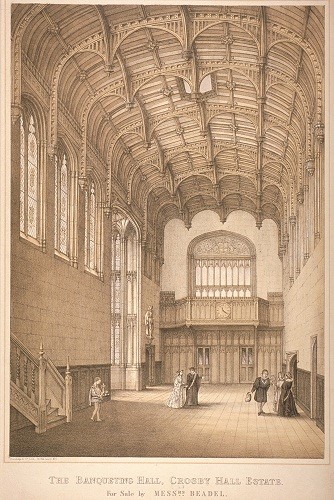
The Great Hall of Crosby Place much as Katherine of Aragon and Sir Thomas More would have seen it.[i]

A later famous occupant was Sir Thomas More although documentary evidence suggests he held the lease for a few months only and it’s uncertain whether or not he ever actually lived there. John Stow described Crosby Place in 1598, in his Survey of London as ‘of stone and timber, very large and beautiful and the highest in London’, so it was still impressive more than a century later.

If you want to know what’s going on at Crosby Place, in the Duke of Gloucester’s household in 1480, you can follow Sebastian Foxley’s new adventures in the my medieval murder mystery, The Colour of Bone. 

[Some parts of this article and photographs first appeared in Tudor Life magazine]

Toni Mount earned her Master’s Degree by completing original research into a unique 15th-century medical manuscript at the Wellcome Library in London. She is the author of several successful non-fiction books including the number one bestseller, Everyday Life in Medieval England, which reflects her detailed knowledge in the lives of ordinary people in the Middle Ages. Toni’s enthusiastic understanding of the period allows her to create accurate, atmospheric settings and realistic characters for her Sebastian Foxley medieval murder mysteries. Toni’s first career was as a scientist and this brings an extra dimension to her novels. It also led to her new biography of Sir Isaac Newton. She writes regularly for The Richard III Society Bulletin and other magazines and is a major contributor of online courses to MedievalCourses.com. 


[i] Crosby Place is known today as Crosby Moran Hall and stands on Chelsea Embankment, by coincidence just a stone’s throw from More’s Garden, once the site of Sir Thomas More’s fine house in Chelsea. The medieval hall was all that remained of Crosby Place when, in 1910, it was moved, stone by stone, from Bishopsgate in the city of London to its new site on the north bank of the River Thames. It has been sympathetically restored and greatly extended since 1988. It’s in private ownership.


Sunday, January 9, 2022

Unwanted Pregnancies in the Middle Ages

by Jeri Westerson

We’ve read about some pretty bold women in the Middle Ages; Eleanor of Aquitaine, Queen Elizabeth, Kathrine Swynford. They made their destinies, though they might have had trouble achieving it in early life…or as in the case of Eleanor was consigned to what amounted to house arrest in the latter part of her life.

But for the average medieval woman, when one could be married off to secure alliances, gain property for the family, or to be sent to nunneries—there was surprisingly little impediment when it came to some control of their lives. For them, it was whether to remain pregnant or not. Granted, for some women, giving birth to an important man’s child meant a place at court or court adjacent at the very least, as well as funds to raise that bastard child, but other women who got into a family way through country matters needed a way out.

It’s a modern idea to consider an embryo a person, something that didn’t worry the medieval mind in so far as the Church was concerned. Much of the physician’s art in the Middle Ages favored Greek philosophers and ancient physicians, who had nothing to go on but their own feelings on the matter, and a certain tradition among them. Certainly nothing scientific.
Many of these men—and they were most often men—were of the opinion that an embryo was plantlike until birthed and took its first breath. Indeed, this was the medieval Hebrew philosophy as well, citing Adam: mere clay until God breathed life into him to become a human being.

Hippocrates, on the other hand, forbade ending pregnancies. In his oath he mentions, “I will not give to a woman an abortive remedy”, but then again, he also stated that the fetus was only viable from the moment its various organs – their structures – were already formed, which puts the kibosh on only later abortions, just not earlier ones. This was also what the famous ancient physician, surgeon, and philosopher Galen (c. 129 CE) expressed.

Aristotle viewed abortion as population control for a well-ordered society, but only before the embryo achieved animal life, or was recognizably human. “The line between lawful and unlawful abortion will be marked by the fact of having sensation and being alive,” he stated. Before that, Aristotle did not regard abortion as the killing of something human. (It should be understood that the “unlawful” aspect leaned heavily as to whether the husbands wanted to end this pregnancy). Unmarried women would find less opposition. Including (or perhaps even especially) prostitutes.

In Greece and ancient Rome, various instruments—curettes, hooks, other scraping tools—might be used to extract a fetus, but early physicians were worried that these instruments—and rightly so—could perforate the organ. A woman’s life over the unborn was
always utmost in cases of these operations.

By the time we reached the Middle Ages, such procedures, though still practiced, were not preferred. Herbalists/apothecaries were easier and no doubt more inexpensive to consult. Female apothecaries were often nuns in monasteries with access to the herbs grown on convent grounds. Midwives, too, were experts on such herbs for contraceptives and all stages of pregnancies, both wanted and unwanted.

An amazing array of proscribed methods such as bloodletting, fasting, diuretics, emmenagogues (herbs that stimulate menstruation), and enemas, were used. Jumping up and down. Carrying heavy objects. Heavy horseback riding. A painful massaging of the abdomen, and similarly binding the abdomen tightly.

Did any of these approaches work? Was there a scientific method involved? Not so much. These were from those same unscientific ancient physicians, folk remedies, “old wives’ tales”, and any number of shamanistic methods that came down to medieval woman from very old sources indeed (the first recorded evidence of induced abortion is from an Egyptian papyrus recorded in 1550 BCE.)

Perhaps these methods worked coincidentally. Or the embryo wasn’t viable to begin with. Or poor nutrition contributed to a spontaneous abortion. Or the woman wasn’t pregnant in the first place. Whatever the situation, women, herbalists, apothecaries, and physicians of the day believed in it, and proscribed them again and again.

An apothecary administering 
pennyroyal to a patient. 
Public domain

The variety of concoctions of herbs used was breathtaking; pepper, myrrh, thyme, rue, catnip, dittany, savory, sage, watercress seed, parsley, soapwort, hyssop, marjoram, tansy, juniper, hellebore, and pennyroyal (the last two of which contain some properties that actually can be used as an abortifacient. But beware. Too much pennyroyal or hellebore can cause death. Consult your apothecary).

These herbs and essential oils used in conjunction with one another could be drunk with hot water in a kind of tea with honey. Mostly, they were to induce menstruation to begin again, which would expel the embryo.

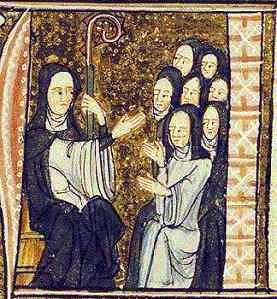
Hildegard von Bingen
Public domain

Even Hildegard von Bingen, the saint and mother superior of her convent in the twelfth century who wrote sacred music, works of theological philosophy, and scientific works on botanicals and their medicinal properties, got into the act and described a particular treatment (tansy) to restore menstruation in her treatise De Simplicis Medicinae. 

Were there medieval laws against a woman obtaining an abortion? In a word, no. The Church seemed to prefer not to meddle into what amounted to “women’s complaints”. So women consulted other women to help them with these life-changing difficulties. It was a natural for nuns to work as apothecaries to help in the physicians’ art and to administer to other women, including their own nuns in the convent who might also get into a family way. After all, it wasn’t all prayer and meditation. Not everyone could be a St. Hildegarde.

~~~~~

Jeri Westerson


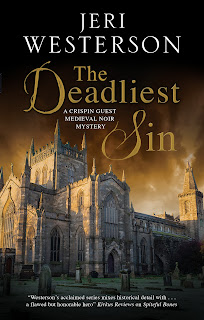
  • Jeri Westerson is the author of fifteen novels in the Crispin Guest Medieval Noir mysteries that just concluded the series with The Deadliest Sin that deals with nuns administering abortifacients; the Enchanter Chronicles, a gaslamp fantasy-steampunk trilogy; Booke of the Hidden, an urban fantasy series, and several standalone historical novels. Be looking for her newest mystery Courting Dragons, the first in her King's Fool Mysteries with Henry VIII's real court jester Will Somers as the amateur sleuth. See all her books at jeriwesterson.com.


Sunday, November 15, 2020

Masters of Stone: the Medieval Stonemasons

 By E.M. Powell

In our twenty-first century urbanised world, buildings of enormous height and size are all around us and are so familiar a sight that we rarely pay them much attention. We are accustomed to living, working and shopping in them. When a new one is built, we see huge cranes and other heavy machinery employed, with elevators and lifts taking contractors up to where they need to be. 

Canterbury Cathedral
© E.M. Powell

Anybody time-travelling from the medieval world to now would be understandably astonished by what we can achieve. Yet the reverse is also true. We cannot of course travel back to medieval times. But we can stand next to a vast cathedral such as Canterbury and wonder how on earth it could be constructed by people who had only the most basic of tools.  

There has been a cathedral in Canterbury for more than 1,400 years. Saint Augustine consecrated the first cathedral there not long after his arrival in the year 597. There is no trace of the original building, as a fire in 1067 destroyed it and it had to be completely rebuilt. Archbishop Lanfranc oversaw much of the construction, but it was his successor, Archbishop – and later Saint – Anselm, who built the ‘glorious quire’ –of which more later––and the enormous crypt. 

The credit might be Anselm’s but his hands were not the ones that wielded axes, hammers and chisels, and mixed mortar that is still holding up the walls after almost a thousand years. Those people, with their remarkable skill and ingenuity, were the medieval stonemasons. 

Building- Canterbury or Anglo-Catalan Psalter 12th Century
Public Domain- British Library

The stonemasons’ guild, the Worshipful Company of Masons, is one of the ancient Livery Companies of the City of London. It was formed for the purpose of regulating the craft of stonemasonry and ensuring that standards could be properly maintained and rewarded. The earliest available records of regulation from the Court of Aldermen are from 1356.

The preceding two centuries had already seen massive growth in stone construction–royal, ecclesiastical and municipal–and alongside that came major developments in the skill of stone masonry. Stonemasons were by no means a homogenous group. Their skills ranged from the most basic to outstanding artistry, though categories of worker were fluid. Rates of pay varied from job to job too.

Before stone could be used as building material, it first had to be dug from the earth and that was the task of the quarrymen. The records use the term ‘quarrymen’ to refer to those who owned the quarries as well as those who worked in them. While the quarry owners were frequently men of means and high social standing, those who actually worked within the quarries were not. The work was back breaking, digging and breaking stone in poor conditions that led to health problems like silicosis, a lung disease induced by inhaling flinty or siliceous particles. The quarriers also partially or completely worked the stone before it was transported to its destination, as this saved on cost. In addition to providing the supply of stone, the quarries often served as schools where stoneworkers could learn the basics of the craft, before moving on to more skilled employment and better rates of pay. 

Canterbury Cathedral interior stonework
© E.M. Powell

Roughmasons and layers prepared wall stone with scappling hammers and might also hew stone with an axe into the approximate shape required. Fine carving was done with a mallet and chisel and this was the work of the freestone mason. The freestone mason did not simply step in and apply the last artistic flourishes. He would also have had to be an expert stone hewer and layer to ensure that intricate work fitted perfectly and robustly together. Building work was not solely the preserve of men either. The records show women working as masons’ servants and plasterers. 

Overseeing any project was the master mason, frequently assisted by an undermaster or a second master mason. Master masons were not just the most skilled stone workers: they were architects, designers and visionaries as well as capable administrators. They had shared responsibility with the abbey or nobleman who had embarked on the construction project for the financial accounts. These covered every aspect of expenditure: wages, materials and transport. The master masons were involved in the hiring and dismissing of their workers. 

Mason and carpenter, Bruges, 15th Century
Public Domain- British Library

In general, masons were a highly mobile group. They travelled to where the biggest and best-paying jobs were, including from country to country. Quarrymen tended to live locally to their work. 

In order for the best work to be produced, the most suitable materials had to be sourced. Huge quantities of wood went into building a structure like Canterbury Cathedral. But wood is much easier to source and transport than stone. And it could not be just any stone: it had to be soft and easy to carve. Canterbury’s cream limestone came from Caen in Normandy as it could be delivered by ship, rather than trying to move stone along medieval roads. 

Canterbury Cathedral Choir
© E.M. Powell

Such transport was not without risk. An account exists from the days of William I of a flotilla of fifteen ships that were sailing from Caen with cargoes of stone. Fourteen carried stone for the king’s new palace at Westminster and one was full of stone for Saint Augustine’s abbey in Canterbury. The ships foundered in a terrible storm and fourteen were lost. The one with the Canterbury stone was about to suffer the same fate. The master and crew prayed to Saint Augustine himself, bailed furiously and made it as far as the Sussex port of Bramber, where the ship split open and all the stone ended up on the sands. The master got hold of another ship, reloaded his cargo and delivered the stone to the abbey. A delighted abbot paid the master ‘a bonus of some shillings’. A relieved master offered half the money to God and Saint Augustine in thanks for his miraculous escape. 

Speaking of saints and miracles, Canterbury Cathedral’s most famous archbishop is another saint: Thomas Becket, who was murdered there on 29 December 1170. He was slain by four knights acting on one of King Henry II’s legendary outburst of temper. The knights’ original intention may have been to arrest Becket, who had been engaged in a monumental power struggle with the King for several years. But the situation quickly deteriorated, and Becket was hacked to death on one of the altars. The Martyrdom is still maintained in the cathedral and one can stand at the very spot. 

Sculpture of the sword's point at the Martyrdom
- site of Becket's murder in the cathedral.
© E.M. Powell

The miracles quickly began. Word quickly spread and the devotion to Becket the Martyr began, with his tomb becoming a major site for pilgrimage. 

It was a huge stroke of good fortune that the monks had chosen to place Becket’s body in a stone tomb in the crypt while they set about constructing a shrine. For on 5 September 1174, fire broke out in three cottages near the cathedral. Unknown to everybody before it was too late, the blaze spread to the roof of the cathedral. A monk, Gervase of Canterbury, wrote a vivid account of the fire, with its black smoke and scorching flames. Consumed by flames, the roof collapsed into the choir and its wooden seats. The flames rose up ‘a full fifteen cubits, scorching and burning the walls’ and causing terrible damage to the stone pillars. Anselm’s choir was destroyed. Gervase describes the reaction of those who witnessed it. He talks of people overcome with ‘grief and perplexity’ blaspheming at such an event and unable to comprehend that it had happened. 

Notre Dame Fire
Baidax, CC BY-SA 4.0 

A modern reader might dismiss this as an overreaction. But on April 15 2019, fire broke out in the roof of Notre Dame Cathedral in Paris and millions worldwide witnessed a medial cathedral burn in real time.  People’s reactions on social media and on news reports were almost identical to those reported by Gervase eight centuries ago.  

Back in twelfth century Canterbury, the monks were faced with the daunting task of reconstructing their fire-ravaged choir. They commissioned master mason William of Sens, known for his brilliance and technical expertise. Unfortunately for him and for future generations, William fell from faulty scaffolding in the choir in 1178. He was badly injured and never recovered. He was replaced and the work was finished by another mason, William the Englishman. 

Stone conservation work, Canterbury Cathedral
© E.M. Powell

The stonemasons of Canterbury Cathedral continue their work to this day, with a team of over two dozen. Their job is to conserve and to preserve the building. And they work with tools on blocks of stone brought in from a quarry near Caen- just as the masons of a millennium ago did. 

Anselm's Crypt in Canterbury Cathedral, original site of Becket's tomb.
The figure is Transport by sculptor Antony Gormley.
The work is made from nails from the repaired roof of the cathedral.
© E.M. Powell
References:

Foyle, Jonathan, Architecture of Canterbury Cathedral (London: Scala Publishers Ltd., 2013).
Gimpel, Jean, The Cathedral Builders (New York: Harper Colophon Press, 1983).
Guy, John Thomas Becket (London: Viking, 2012).
Keates, Jonathan and Hornak, Angelo, Canterbury Cathedral (London: Scala Publications Ltd., 1980).
Knoop, Douglas and Jones, G.P., The Mediaeval Mason: An Economic History of English Stone Building in the Later Middle Ages and Early Modern Times (Manchester: Manchester University Press, 1933).
Urry, William, The Normans in Canterbury: Occasional Papers No.2 (Canterbury Archaeological Society, 1959)
Urry, William, Canterbury Under the Angevin Kings (University of London, The Athlone Press, 1967).
Woodman, Francis, The Architectural History of Canterbury Cathedral (London, Boston and Henley: Routledge & Kegan Paul, 1981).
Websites:

~~~~~~~~~~~~~~

© E.M. Powell

E.M. Powell’s historical thriller and medieval mystery Fifth Knight and Stanton & Barling novels have been #1 Amazon and Bild bestsellers. The third Stanton & Barling mystery, THE CANTERBURY MURDERS, was released in November 2020. Born and raised in the Republic of Ireland into the family of Michael Collins (the legendary revolutionary and founder of the Irish Free State), she lives in northwest England with her husband, daughter and a Facebook-friendly dog. She’s represented by Josh Getzler at HG Literary. Find out more by visiting her website www.empowell.com or follow her on Twitter @empowellauthor


Thursday, August 6, 2020

My Kingdom for a Horse: The Cost of the Equestrian Lifestyle in the Middle Ages

By Rosanne E. Lortz

It is the prince of palfreys. His neigh is like the bidding of a monarch, and his countenance enforces homage…. I once writ a sonnet in his praise and began thus: “Wonder of nature—”
--Shakespeare's Henry V  
A horse, a horse! My kingdom for a horse!
--Shakespeare's Richard III

Very few people (unless they happen to find themselves in the same sticky situation as Richard III did) would consider trading the kingdom of England for something as inconsequential as a horse. And yet, when the medieval horse is compared to something other than the inestimable value of a kingdom, it was in fact quite a costly item, and an item that added a great deal of consequence to its owner.

A thirteenth century treatise on horses states:
No animal is more noble than the horse, since it is by horses that princes, magnates and knights are separated from lesser people, and because a lord cannot fittingly be seen among private citizens except through the mediation of a horse. 
The owning of horses, and especially warhorses, was an essential part of being a medieval nobleman precisely because it was something far out of the reach of a simple peasant.

Steven Muhlberger, in his book Jousts and Tournaments, helps us understand the value of warhorses during the thirteenth and fourteenth centuries by looking at the records of the king’s compensation to men-at-arms for horses lost during a campaign. He says that, “the lowest value assigned to a warhorse was £5 and the highest £100.”

To put this in perspective, “a well-off English peasant family at the beginning of the century might earn just a little over £3 annually.” In order to qualify to become a knight, Muhlberger says that a landowner would need to make £40 a year. They were “an elite class that included at the very most 1500 men.

With warhorses being valued all the way up to £100, some of the noblest of the beasts would be worth more than a lower-level knight’s yearly income. The loss of a horse, therefore, would be a devastating blow to all but the wealthiest of men (meaning that a man would think twice about taking his horse into battle…unless the king was willing to compensate him if his horse was lost).

Detail of a horse from a medieval bestiary

Besides war, tournaments were another place where horses might be lost…or won. In many cases, the loser of the joust had to forfeit his horse to the winner.

Geffroi de Charny, one of the premier French knights of the fourteenth century, wrote a series of questions and answers dealing with the etiquette of the joust. Unfortunately, the answers (if they were ever written down) have been lost to posterity, but the content of the questions is still revealing.
2. If it happened that…one knight knocked another to the ground with a stroke of the lance, his saddle being between his legs and the whole thing off the horse, will he who knocked the other down win the horse? What do you say in this case, will it not be judged by the laws of arms?  
3. Knights are jousting without any formal announcement, and one knight knocks another down and out of the saddle with a stroke of the lance. Will he who knocked the other down win the horse? What do you say? 
5. In the emprise it is said that anyone who kills a horse with a stroke of a lance will pay for it. So it happens that in jousting one strikes the other’s horse with his lance well advanced; but their horses collide so hard that both of them fall to the ground. Will he who struck the horse with the lance pay for it or not? What do you say? 
8. A banneret sends out from his entourage some knights to go out with him in the fields to joust with those who have set the emprise; …If there are two or three of them whose horses are dead and injured in the joust from blows or falls, will the banneret be obliged to compensate them? What do you say?
From reading just a short sampling of these questions, a common theme emerges—the theme of who deserves to win a horse and who is required to compensate for a horse’s loss. In fact, out of the twenty questions centered around jousting, nineteen of them deal with these equestrian issues. Charny’s questions, designed to standardize judicial rulings in the “law of arms” at tournaments, reinforce the idea of just how consequential the possession—and loss—of a horse could be.

A medieval warhorse might not have been worth an entire kingdom, but he was still worth a tidy chunk of change. And since the consequence of owning a horse was not something the nobler classes would willingly do without, it was essential for kings to recompense knights when horses were lost and for tournament law to clearly explain when a horse would be forfeit.

The horse was the ultimate status symbol in the later Middle Ages. Shakespeare's scene in Henry V describing "the prince of palfreys" was clearly written to poke fun at the French prince...and yet, knowing how valuable horse of this period actually were, one can almost understand why the Dauphin once “writ a sonnet” in praise of his horse, whose “neigh is like the bidding of a monarch” and whose “countenance enforces homage.”

BIBLIOGRAPHY

Muhlberger, Steven. Jousts and Tournaments: Charny and the Rules for Chivalric Sport in Fourteenth Century France. Union City, CA: Chivalry Bookshelf, 2002.

~~~~~~~~~~~~~

Rosanne E. Lortz (“Rose”) is a writer, editor, teacher, history-lover, and mom to four boys. Her first book, I Serve: A Novel of the Black Prince, released in 2009. This book explores the tumultuous landscape surrounding the Hundred Years’ War and the Black Death and is a tale of arms, of death, of love, and of honor. In 2015, Rose began her Pevensey mysteries, novels of romantic suspense set during the British Regency (with inspiration from medieval characters and events). The first three titles are: To Wed an Heiress, The Duke’s Last Hunt, and A Duel for Christmas. Rose has served on the board of the Historical Novel Society North America and works to promote interest in historical novels. Find Rose on website, and her books on Amazon.


Wednesday, October 3, 2018

Crime and Punishment Under Henry II

By E.M. Powell

King Henry II of England is best known in the popular imagination for the murder of Archbishop Thomas Becket, a murder for which the King was blamed. Four knights broke into Canterbury Cathedral on 29 December 1170 and slew Becket in the most brutal manner.

The Murder of Thomas Becket c 1480 Public Domain- British Library

Whatever one’s view of the volatile Henry, there is one achievement from his thirty-five-year reign that stands above all others: his reform of the English legal system, which laid the foundations of the English Common Law. When he came to the throne in 1154 at the age of just twenty-one, his realm was in deep disarray following civil war. He urgently needed to re-establish royal authority and impose order and set about doing so with his customary relentless drive. The judicial system was the subject of much of his attention and he was aided in this by the talented Becket, who was his chancellor at the time.

Henry II enthroned, arguing with Thomas Becket c. 1307 - c. 1327 Public Domain- British Library

Henry addressed reform of both land law and criminal law. With land law, cases relating to an individual being dispossessed or those in which inheritance was in dispute were now settled in a trial by jury. The jury system was far quicker and more efficient than the system it replaced. Given that said system was one of trial by combat, one can see why it was not just the efficiency of the new system that made it so popular.

His reform of criminal law was even more impressive. He issued new legislation at Clarendon in 1166 and Northampton in 1176. It was at Clarendon where the procedures of criminal justice were first established, addressing how serious felonies such as murder, robbery and theft would be dealt with. Juries of presentment were established, consisting of twelve lawful men in each hundred (a subdivision of a county) and four in each vill (village). These juries were not there to decide on guilt or innocence, but to support an accusation of a serious crime.

Anyone who was accused of such crimes would be put in prison to await trial. Those trials could only be heard by the King’s justices, who travelled the country to do so. Henry first introduced his system of itinerant justices at Clarendon but refined the system at Northampton. England was divided into six circuits, with three justices, the justices of the general eyre, allocated to each.  Twelfth century chronicler Roger of Howden lists the eighteen justices itinerant and their circuits for 1176.

Detail of an historiated initial 'I'(udex) of a judge c. 1360- c. 1375 Public Domain - British Library

One of the justices listed was Ranulf de Glanville. De Glanville was one of Henry’s staunchest allies, securing key victories for the King in the rebellion of 1173-74 and rising to the position of Justiciar of England. The ‘Treatise on the Laws and Customs of the Kingdom of England’, produced in the late twelfth century, is the earliest treatise on English law and is commonly referred to as ‘Glanvill’, though it is unlikely that de Glanville was its author.

The justices provided a system of criminal investigation for the whole country. The impact of the arrival of the travelling court should not be underestimated. It could consist of several hundred people, all of whom were tasked with supporting the royal justices in administering the law in the name of the lord King. As well as being administratively impressive, it would have been a spectacle that reinforced Henry’s power over all his subjects. It would also have instilled awe and fear in all those who witnessed it, especially those who were accused of a serious crime.

The accused were brought before the justices. Proof of their guilt or innocence could be established in a number of ways, such as witness testimony, documents or the swearing of oaths. Unlike criminal trials today, the jury acted as witnesses and not an impartial panel. They would give the account of what had happened.

Five judges and three plaintiffs c. 1360- c. 1375 Public Domain - British Library

In cases that were not clear cut or in those of secret homicide where there were no witnesses, the justices used the ordeal. Ordeal could be by cold water or by hot iron. The blessing of the water and the iron served to bring the notion of God’s judgement, judicium Dei, into the proceedings.

There was great ceremony and a long build-up attached to the ordeal, which would have added to the pressure on the accused to confess. The accused would be taken to church four days before the day on which the ordeal was due to take place. They had to wear the clothes of the penitent, fast and hear several masses. If they still did not confess, the ordeal would take place.

Two judges addressing a prisoner held by a court officer c. 1360-c. 1375 Public Domain - British Library

The most innocent of hearts must have quailed. Stripped to only a loin cloth, the accused would be led to the pit, which was twenty feet wide and twelve feet deep and full of water. A priest would then bless the water. God would now be the judge: His blessed water would receive the accused if innocent, reject him if he was guilty. The accused would be bound, thumbs to toes, and lowered in from a platform.

With ordeal by hot iron, the accused had to undergo the same preparation of fasting and penitence. A length of iron would be blessed and heated in a fire until it was red hot. The accused would have to take it in one hand and carry it for three paces. The injured hand would be bandaged and then examined three days after the ordeal. If it had healed, then innocence was proclaimed. If it had not, then the accused was guilty.

Both forms of ordeal were terrifying and horrific in themselves, and the lengthy preparations would have only added to the pressure to make a confession. Once the accused made a confession, it could not be retracted. In 1215, the Church forbade priests to take part in the ordeal, bringing an end to its use.

A man hanging from gallows c. 1360-c. 1375 Public Domain - British Library

For those found guilty, the King’s punishment awaited. Hanging was reserved for the worst crimes. Thieves and robbers could lose a foot and, from 1176, their right hand. The law also had a final judgement it could impose, even if the accused was acquitted by undergoing the ordeal. If it was judged that the accused had a particularly bad reputation, as sworn to by the jury, then the accused was to leave the King’s lands as an outlaw and had to swear under oath that they would never return.

And lest anyone think that they could take the law into their own hands and administer punishments themselves, the King’s justices had a clear system of heavy fines for those who would dare to do so. Order would prevail. Henry, the consummate administrator, had thought of everything.


References:
All images are in the Public Domain and are part of the British Library's Catalogue of Illuminated Manuscripts. 
Bartlett, Robert, Trial by Fire and Water: The Medieval Judicial Ordeal (Oxford, 1986)
Bartlett, Robert, The New Oxford History of England: England under the Norman and Angevin Kings 1075–1225 (Oxford, 2003)
Hudson, John, The Formation of the English Common Law (London, 1996)
Pollock, Frederick, and Maitland, Frederic William, The History of English Law Before the Time of Edward I (Cambridge, 1898)
Warren, W. L., Henry II (Yale, 2000)

~~~~~~~~~~


E.M. Powell’s historical thriller Fifth Knight novels have been #1 Amazon and Bild bestsellers. Her new Stanton & Barling medieval murder mystery series starts with THE KING’S JUSTICE, followed by THE MONASTERY MURDERS.

As well as blogging for EHFA, she is a contributing editor to International Thriller Writers The Big Thrill magazine and is the social media manager for the Historical Novel Society.

Born and raised in the Republic of Ireland into the family of Michael Collins (the legendary revolutionary and founder of the Irish Free State), she now lives in northwest England with her husband, daughter and a Facebook-friendly dog. Find out more by visiting www.empowell.com.


Monday, September 24, 2018

Giveaway: THE KING'S JUSTICE by E.M. Powell

A paperback copy of THE KING'S JUSTICE, the first in E.M. Powell's bestselling new medieval mystery Stanton & Barling series, is being offered.

A murder that defies logic—and a killer on the loose.

England, 1176. Aelred Barling, esteemed clerk to the justices of King Henry II, is dispatched from the royal court with his young assistant, Hugo Stanton, to investigate a brutal murder in a village outside York.

The case appears straightforward. A suspect is under lock and key in the local prison, and the angry villagers are demanding swift justice. But when more bodies are discovered, certainty turns to doubt—and amid the chaos it becomes clear that nobody is above suspicion.

Facing growing unrest in the village and the fury of the lord of the manor, Stanton and Barling find themselves drawn into a mystery that defies logic, pursuing a killer who evades capture at every turn.

Can they solve the riddle of who is preying upon the villagers? And can they do it without becoming prey themselves?

“Cleverly plotted, the action is fast paced and full of twists and turns, surprises, and suspense.” —Historical Novel Society

For a chance to win a copy, please leave a comment below. Don't forget to leave your contact details.

This giveaway will remain open until 11.59 pm on Sunday September 30 (Pacific Daylight Time)

Good luck!

Tuesday, April 3, 2018

Robert Hood of Wakefield

by Chris Thorndycroft


Much has been written on the possible historical basis of the Robin Hood legends and the search is problematic to say the least. Even if we accept the idea that England’s famous forest-dwelling outlaw was a real person and not a literary character or a mythological archetype, the name Robin/Robert Hood was hardly an uncommon one in medieval England. To even be in the same ballpark we need to look for specific Robin Hoods whose lives bear at least a passing resemblance to the figure of the legends. And the search has turned up some interesting candidates.

First of all we need to reacquaint ourselves with the Robin Hood of the medieval ballads in which he makes his first appearance. Forget Prince John trying to usurp the throne while his brother King Richard the Lionheart is a prisoner on his way home from the crusades. The only king mentioned in the early ballads is an unspecified King Edward. There were three Edwards who ruled in succession in the Middle Ages which indicates a timeframe of 1272 to 1377; a good hundred years after the Lionheart’s reign. Sherwood Forest also has to go. The stomping ground of Robin Hood in the ballads is Barnsdale which once took up a sizable portion of West Yorkshire.

With the aforementioned facts in mind, a possible candidate has been put forward in the form of Robert Hood of Wakefield who lived during the reign of Edward II. Aside from his name and era, there is one other thing about him that makes him a possibility; his hometown.

Wakefield was a manor ruled by Earl John de Warenne until around 1317 when Earl Thomas of Lancaster took it from him as a result of a bitter feud. The previous spring Lancaster’s wife, Alice de Lacy, was purportedly abducted by de Warenne’s men (although rumour had it that she and de Warenne were lovers). Immensely powerful and more or less ruler of the north, Lancaster also had a falling out with his cousin, King Edward II. Lancaster drew support from the Marcher Lords who resented the king and his relationship with the hated royal favourites; the Desepnsers. What began as an attack on the Despensers’ lands soon turned into open rebellion and ended with the Battle of Boroughbridge in 1322 and the subsequent execution of Lancaster for treason.


It is interesting to find a Robert Hood living in Wakefield at this time because the forest of Barnsdale encroached upon that very manor and was a natural hiding place for any outlaw on the run. The antiquarian Joseph Hunter was the first to put Robert Hood forward as the real Robin Hood and his findings were largely culled from the Wakefield Court Rolls(1). Subsequent historians like J. W. Walker(2) and J. C. Holt(3) found additional entries and bolstered his brief biography. What follows is a basic outline of Robert Hood’s life according to Hunter, Holt and Walker.
  • On Jan 25th, 1316 Robertus Hood, son of Adam Hood (who hailed from nearby Stanley and was a forester for Earl de Warenne) and his wife Matilda gave 2 shillings for leave to take one piece of the lord's waste on Bichill (the market place in Wakefield) between the houses of Phillip Damyson and Thomas Alayn.
  • In 1316, Robert Hood's handmaid was fined for taking wood from Old Park. In the same year, Hood himself was fined 3d for not obeying Earl de Warenne’s summons to join the forces of Edward II's Scottish invasion.
  • After the Battle of Boroughbridge and Lancaster’s execution in 1322, his followers were outlawed and their properties seized. One property seized in 1322 was a ‘building of five rooms of a new construction on Bichill, Wakefield’.
Hunter’s hypothesis is that Robert Hood was outlawed after taking part in Lancaster’s rebellion against the king and fled to nearby Barnsdale to begin his life of crime. But that’s not all. Hunter also found a ‘Robyn Hode’ serving in the chamber of King Edward II not long after. That these two people could be one and the same sounds highly unlikely were it not for the events in the earliest ballad; A Gest of Robyn Hode. In this story, King Edward travels to Nottingham and, furious at the poaching of the deer in his royal parks, tracks Robin and his companions down. Impressed by his honour and skill, the king takes Robin into his service where he remains at court for ‘twelve months and three’. Then, longing for the greenwood, Robin returns to Barnsdale and lives there for a further twenty-two years until his death at the hands of the treacherous Prioress of Kirklees.

King Edward II did indeed tour the north of England after the defeat of Lancaster’s rebellion and was particularly interested in the state of his forests such as Pickering and Knaresborough which had seen many trespasses during the war. He stayed at Nottingham in November, 1323 and Hunter remarks that from April, 1324, several payments were made to a porter of the chamber named Robyn Hode. On the 22nd November, 1324 – a year after the king visited Nottingham – Hode is given five shillings as a gift because he is ‘no longer able to work’ and nothing further is heard of him.

Later research by J. C. Holt shows that Robyn Hode was already in the king's service from June 27th, 1323, a good five months before the king arrived in Nottingham. This has weakened Hunter’s hypothesis in the eyes of many but it is interesting to note that on June 27th the itinerary of King Edward II places him at Chapel Haddlesey; a village roughly ten miles east of Barnsdale.

Hunter calculated the year of Hood’s death as 1347; twenty-two years after he left the service of the king. Interestingly there is a grave at Kirklees Priory (in the Wakefield manor) inscribed with Hood’s name and the date of 1247; exactly a century earlier than Hunter’s prediction. The grave is a relatively recent replacement for a previous monument and its inscription makes it clear that Robin Hood of legend is meant. That the date is a century earlier than Robert Hood of Wakefield’s death (according to Hunter) either means that the Robin Hood buried at Kirklees is not Robert Hood of Wakefield or, it is and a scribal error was made on the part of the engraver.

It’s tempting to consider Robert Hood of Wakefield (and possibly Robyn Hode of the king’s chamber) as the real life Robin Hood. After all, he has the right name and lived in the right place at the right time. However, not only is it pure conjecture that Robert Hood of Wakefeld and Robyn Hode of the king’s chamber are the same man but there is also no evidence that either were ever outlawed. Nevertheless, of all the possible candidates for the historical Robin Hood, Robert Hood of Wakefield provides both name, location and a tantalising correspondence to the Gest ballad in the appearance of a similarly named man in the chamber records of King Edward II who is also known to have been in the area at the right time. Coincidences maybe, but intriguing ones at that.

In my recent novel Lords of the Greenwood, Robert Hood of Wakefield, or more correctly, his son (also called Robert), is the Robin Hood of legend. Robert Hood the Elder (the one who was married to a Matilda in the Wakefield court rolls) was killed by the Scots at the Battle of Myton as a result of Lancaster’s treachery. His son, Robert the Younger, finds himself outlawed for murder and has only his bitter enemy Will Shacklock for company in the woods of Barnsdale (the Wakefield court rolls show a Schackelock family living at nearby Crigglestone at this time(4) and the name bears a similarity to the variants of Will Scarlet’s original surname in the ballads). Robert and Will learn to put aside their differences and begin recruiting a band of outlaws fleeing the chaos of Lancaster’s rebellion. Their actions eventually draw the attention of the king himself who comes to them with a proposition…
Sources
  1. Joseph Hunter. The Great Hero of the Ancient Minstrelsy of England, “Robin Hood”: His Period, Real Character, Etc. Investigated, and Perhaps Ascertained. 1883
  2. J. W. Walker. Robin Hood Identified in The Yorkshire archaeological journal vol. 36 (1944)
  3. J. C. Holt. Robin Hood. 1982
  4. P. Valentine Harris. The truth about Robin Hood : a refutation of the mythologists’ theories, with new evidence of the hero’s actual existence. 1952
~~~~~~~~~~

Chris Thorndycroft is a British writer of historical fiction, horror and fantasy. His early short stories appeared in magazines and anthologies such as Dark Moon Digest and American Nightmare. His first novel under his own name was A Brother’s Oath; the first book in the Hengest and Horsa Trilogy. He also writes under the pseudonym P. J. Thorndyke.

His recent novel, Lords of the Greenwood, blends history with medieval ballads. This is the entwined saga of two men, separated by a generation and united by legend, who inspired the tales of England’s famous hooded outlaw. Lords of the Greenwood is available through Amazon.

For more information, please visit Chris Thorndycroft’s website. You can also find him on Twitter and Goodreads.

Wednesday, February 1, 2017

Medieval Morals

 by Barbara Gaskell Denvil

The church was a great power throughout the medieval age, and on through the Tudor and Stuart periods. But the Puritan standards of the early to mid-17th century stand out as quite distinct from earlier eras. The medieval age was not puritan in its beliefs, and certainly not puritan in behaviour.

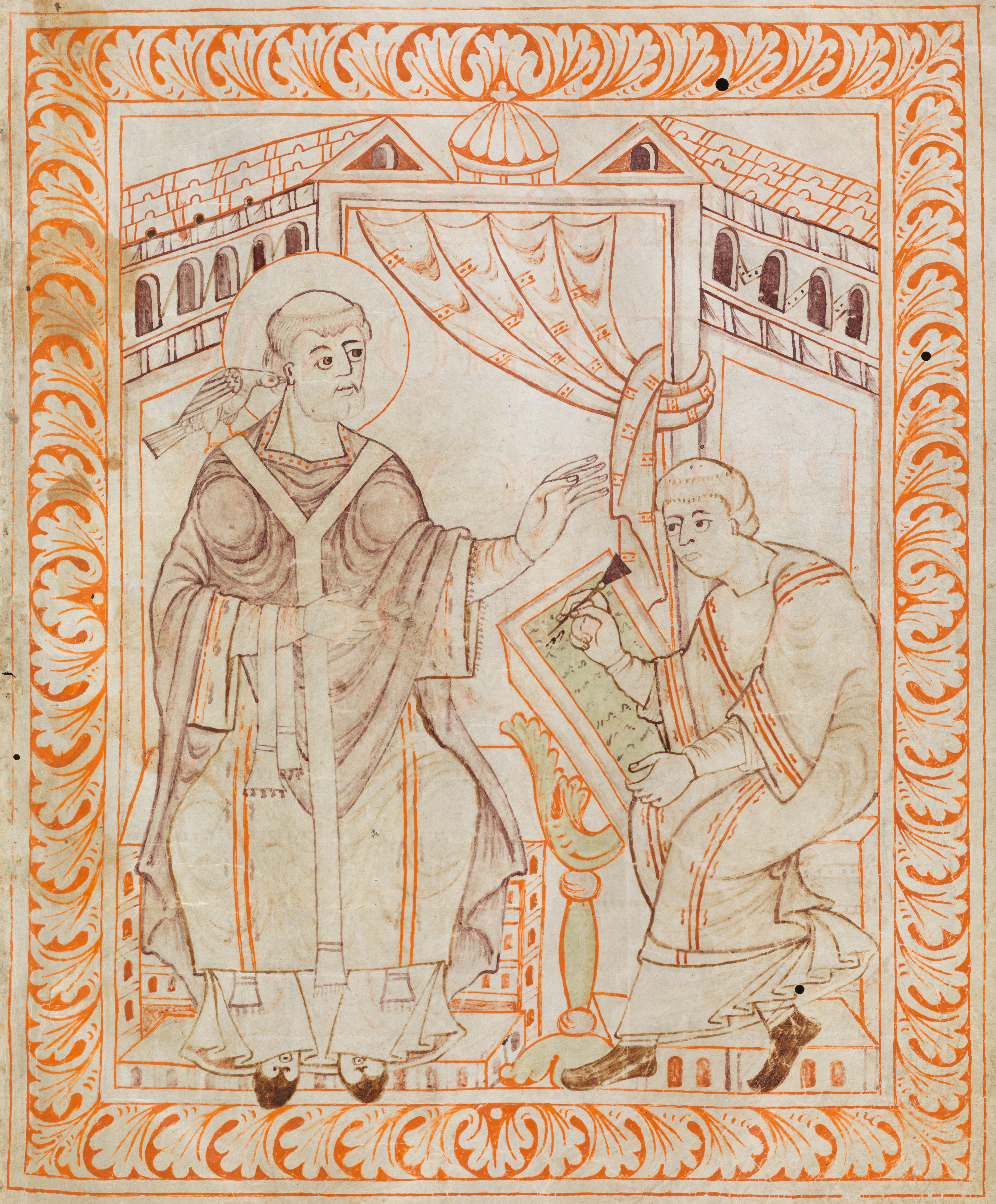
Pope Gregory dictating to a secretary
Much contemporary documentation which still survives today was written by priests. Those who liked to keep records often had little else to do during the long quiet hours in monastery life, and who wished to lay down the standards by which they believed the people should live. Now we can read these past diatribes, and we naturally come to believe that the people of the time were forced to live up to such high moral standards, and that the power of the church demanded exactly that.

Yet although it is true that many people felt obliged to attend church far more regularly than is expected now, and it is also true that daily Mass was not an unusual habit for many, I believe it would be quite wrong to accept that the entire population of any country (I write principally of England ) lived continuously in a state of obedience to the church doctrines. Folk were as independent then as they are now, and few people find it easy to obey strict rules during their day to day lives.

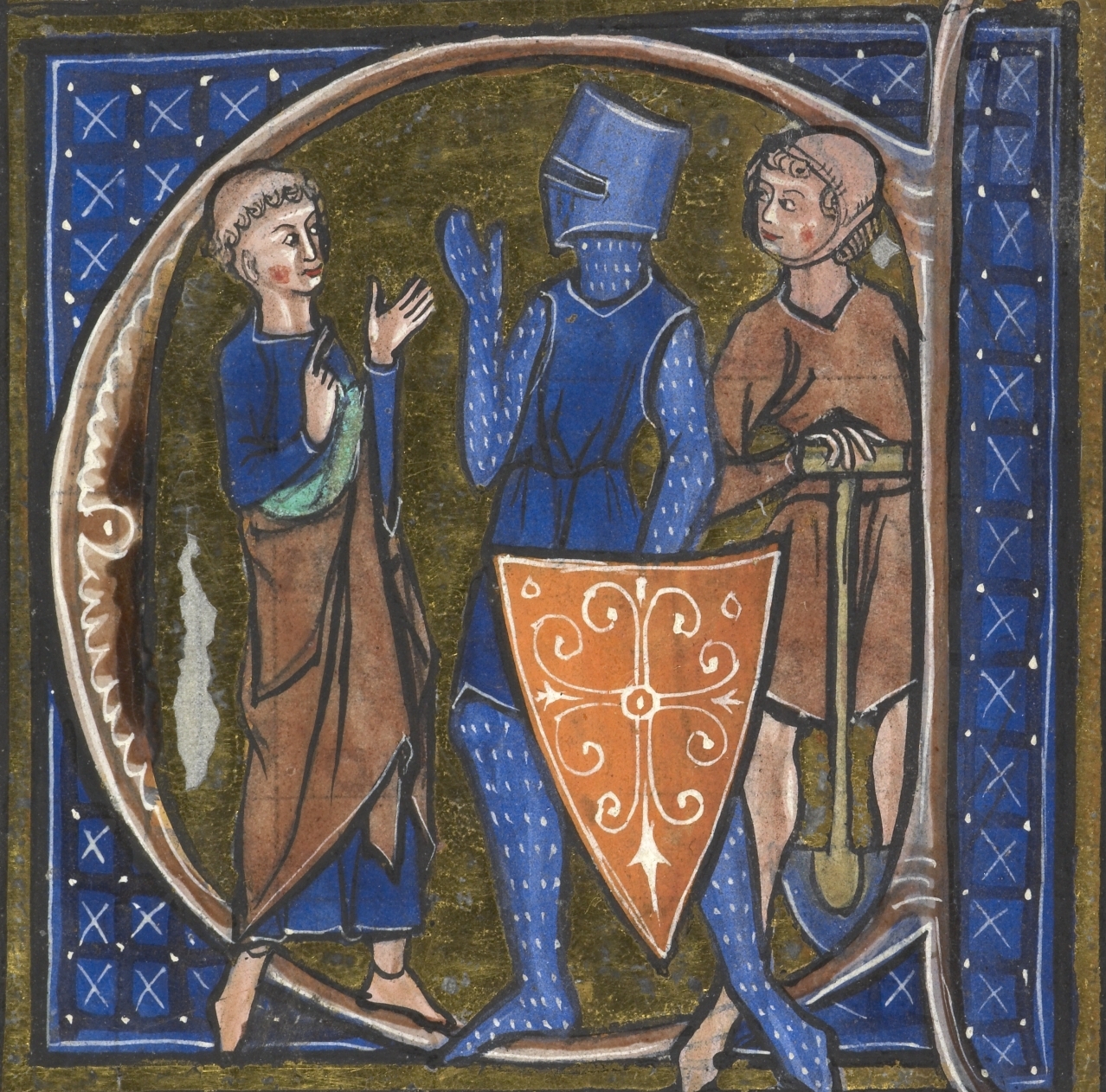
The three medieval classes: those who prayed, those who fought and those who worked
Adultery was a sin, but most kings had openly kept mistresses, had illegitimate children which they cheerfully acknowledged, and made no secret of their adultery. What is more, there is significant documentation showing that the brothels of the time were much used by priests and higher clergy. Many brothels were legally licenced, and on the southern shore of the River Thames across from London, the area of Southwark was awash with prostitutes, taverns, and criminal activity.

There exists a hilarious surviving sermon of the time, scribed by the monks, which lists a series of amazingly lurid sexual acts, describing them all as dreadful sins and utterly forbidden. But it is equally clear that quite a number of people had confessed these behaviours, knowing such acts sinful but acting out their desires anyway. Indeed, it was accepted practice of the time to sin as wished, then to confess those sins, pay the price and take the simple punishment, and thus be forgiven. Earlier generations might commit the most serious of crimes and be absolved by riding off to fight for Christianity during the Crusades, and so earn absolute salvation. But that method was long gone during the late medieval period, yet general behaviour most certainly did not improve.

 Medieval illustration of a battle during the Second Crusade
A depiction of a battle of the Second Crusade
In any case, morality of the time came with certain limitations. Toilets (privies) were not common in most houses and even the great castles might have only one or two for the use of the lords. A few public toilets were built in the city, and were much used. However, none of these were enclosed by a door, and were simply open alcoves where seats were erected over holes emptying directly into the moat, the river, or the cess pit. No flush-toilets in those days – and no privacy either. Of course, when no toilet of any kind was available, then folk used a chamber pot – and these were frequently emptied out of the window each morning – to decorate the gutters of the town.

Privacy was very hard to find in other ways too. Most small houses both in town and countryside, had just one room upstairs which served as bedchamber for the entire family. The children would curl up to sleep on the straw pallets or share a truckle bed, listening to the familiar sounds of their parents making love just a few inches away. Even the nobility had little dignity for such matters. True, they could pull the curtains around their four poster beds, but within the same room the pages and other servants would be listening. And at this time, everyone went to bed naked. The films which show medieval sleepers in glorious long nightdresses are not accurate at all. Naked in bed – and in the coffin!

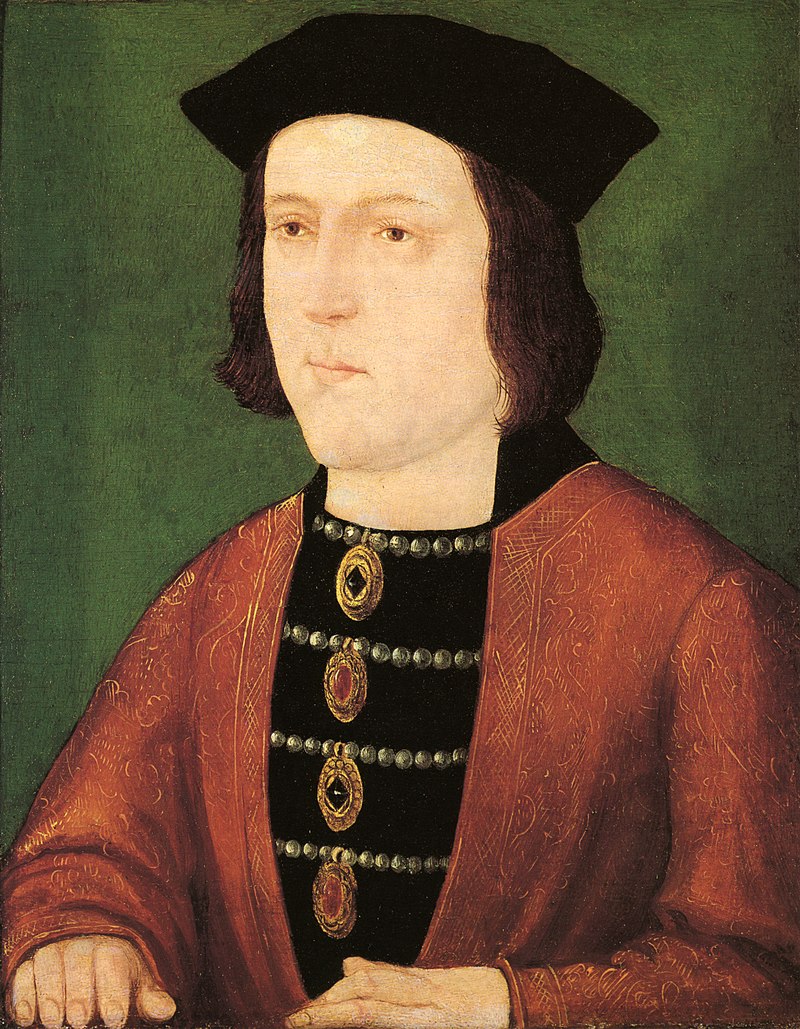
The church was strictly disapproving of common marriage practices, and insisted that only church porch wedding ceremonies were valid in the eyes of God – with God’s law on Earth being the church itself. But this was largely ignored. Most folk committed themselves to a marital union by “hand-fasting” which was a private agreement, needing no clergy and not even witnesses. Even kings – notably King Edward IV – got away with this most improper behaviour. It was perfectly legal after all, however disapproving the church was of such secretive practices.

King Edward IV.jpg
King Edward IV
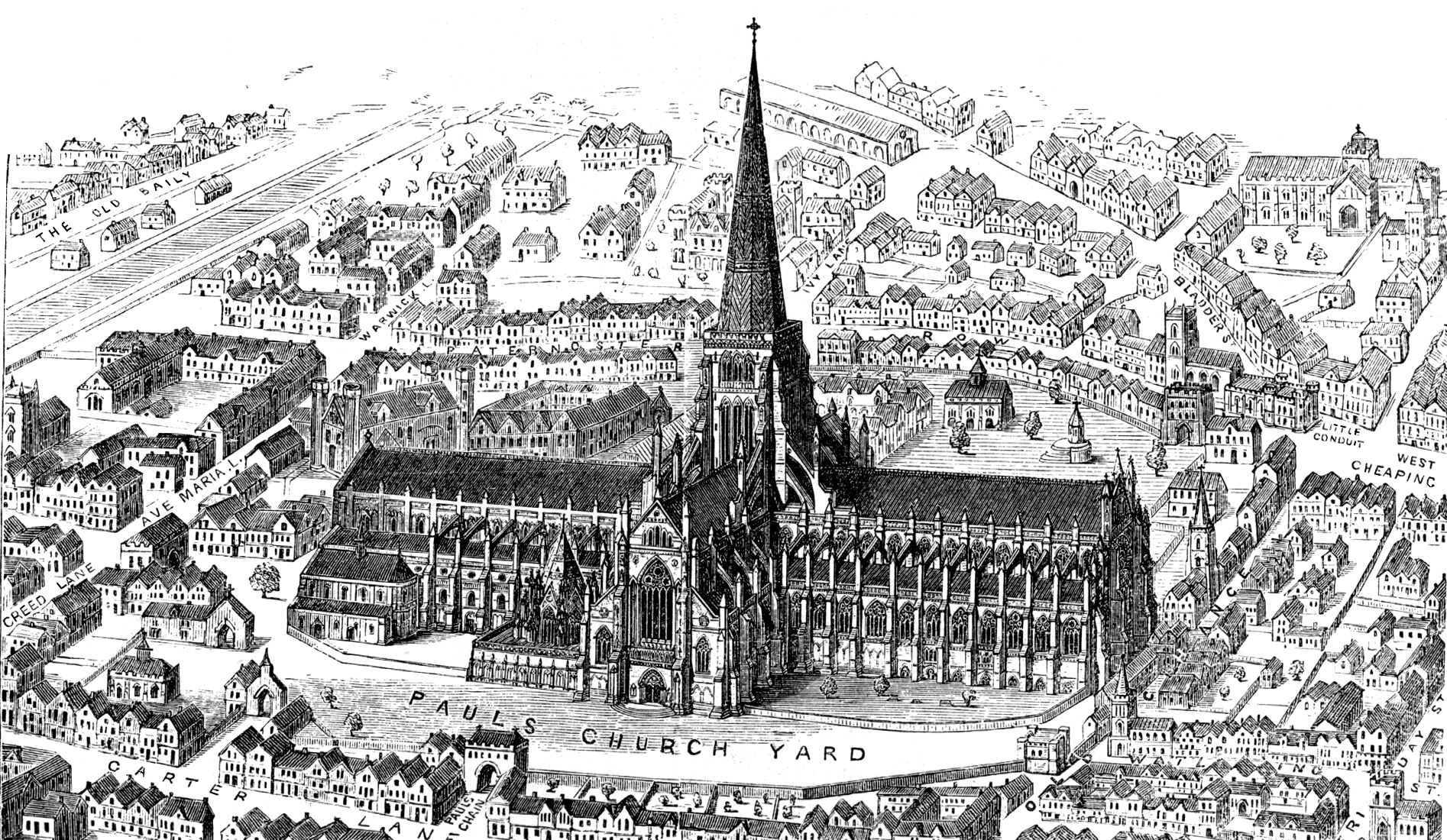
There also exists evidence showing many folk of the time attended church, but without the respect of pious behaviour. St. Paul’s Cathedral, for instance, also allowed wandering beggars and traders, trays of goods hung around their necks, who continued to do their business in the aisles. People evidently carried on their own conversations during the priest’s sermon, had arguments, wandered off to see what was for sale, and left when bored.

St Paul's - before 1561
However, life was not without attempts to make it comfortable and safe, with severe punishment for treason, murder and theft. There was no common police force of course, but there was the Constable and his assistants, and the Sheriff who oversaw the peace.

But it was when death threatened that folk took their religion most seriously, and with the risk of hellfire and endless wandering in Purgatory, their last confession was considered of absolute importance. The presence of a priest was essential for absolution before death, and no one would lie during that final important confession, believing that they must soon answer to God.

Purgatory -  Très Riches Heures du Duc de Berry 1412-16

~~~~~~~~~~

Barbara Gaskell Denvil was born in Gloucestershire, England but, has now moved to rural Australia.
She has published five  historical novels - Satin Cinnabar which is a crime adventure actually commencing on the Bosworth battlefield, Sumerford's Autumn which is an adventure mystery with strong romantic overtones, set in the early years of the Tudor reign, Blessop's Wife (published in Australia as The King's Shadow) which is a crime/romance set in England during 1482-3 in those turbulent years around the death of King Edward IV, The Flame Eater, a romantic crime novel also set in 1482/3, and a time-slip novel Fair Weather, a highly adventurous mystery  which is set earlier during the reign of King John.
Her new novel The Deception of Consequences is a Tudor mystery - adventure and will be published late February 2017.
Barbara is also an author of fantasy fiction.

Thursday, December 29, 2016

The Murder of Thomas Becket

By E.M. Powell

Midwinter in England can indeed be bleak. Iron-hard frosts, smothering snow, torrential rain and gales: all can sweep down on these short days where daylight is gone by mid-afternoon. But at day's close on the twenty-ninth of December 1170, an event occurred that stunned medieval England and all of Christendom. Archbishop Thomas Becket was brutally murdered by four knights in his own cathedral at Canterbury. The knights came to Canterbury following an outburst by Henry II, king of England and much of France. It was a tragedy that had been set in motion many years before.

Canterbury Cathedral
© Shane Broderick Photography 

The son of a London merchant, Becket cut an imposing figure. He was over six feet tall (well above average for the period), with an aquiline nose, a "large brow", and "long and handsome face". He had a quick mind and a particular capacity to absorb and retain huge amounts of information. One chronicler states that he could even detect and react to distant smells and scents! Though he had stammered in his youth, he largely overcame this and was a fluent orator.

Appointed as Henry's Chancellor in 1155, Becket did not disappoint the King. He performed brilliantly in the role and the two men, Henry thirteen years younger than Becket, became extremely close. William Fitzstephen records "Never in Christian times were there two greater friends, more of one mind."


Henry makes Becket Archbishop of Canterbury
Liturgical comb c. 1200
© 2014 E.M. Powell 

One mind, perhaps, but of course Henry was king. And he was a king who was engaged in power struggles with Rome. On the death of Archbishop Theobald in 1161, Henry appointed Becket as Archbishop of Canterbury, believing Becket would simply do his bidding and act at all times on his behalf. Henry could not have been more wrong. Becket stood firm against Henry in matters of ecclesiastical law and power. Their disputes dragged on until in 1170 Henry had his son anointed as king by the Archbishop of York, a ceremony that was witnessed by ten other bishops. Becket's response? He excommunicated the bishops from the pulpit at Canterbury Cathedral on Christmas Day. When news reached Henry, he went into one of his legendary rages.

And his rages were indeed legendary. Henry could really let rip when roused. According to John of Salisbury, Henry once became so enraged during a debate about the King of Scotland that he flung off many of his clothes and started "chewing on pieces of straw." John also has Henry describing himself as "a child of anger." One of Henry's charters states that if anyone "should attempt to quash...this grant, he will incur the disfavour, anger and indignation of Almighty God and me."

Canterbury Cathedral
© Shane Broderick Photography 

So it was when Henry was informed of the news of Becket's latest actions. He "struck his hands together and exclaimed against it vehemently", his face "white with fury." His tirade against Becket was about the man's ungratefulness, too: he had raised Becket to a high position, and the only response was treachery. He worked himself up to a frightening pitch, ending with the words: "He has...shamed my realm; the grief goes to my heart, and no-one has avenged me!" Unfortunately, a group of barons who were listening took him at his word. They set off for Canterbury to avenge their king.

And who were these knights? It is unlikely they were part of Henry's intimate circle and acted to increase their favour with the king. William of Canterbury gives us their names and their descriptions. First was Reginald Fitzurse. "Urse" means "bear", and William claims the name indicated the man's savagery. Hugh de Morville's surname translates as "a village of death." William de Tracy is acknowledged as a brave fighter, but had a "sinful way of life." Richard le Bret became the Brute "on account of the depravity of his life." It was these who headed for the cathedral in which the holy man they sought was to be found.

Canterbury Cathedral
© Shane Broderick Photography 
The accounts of events from eight hundred and forty four years ago can often be sketchy. In the case of Becket's murder, we have detail upon appalling detail, as five monks were eye-witnesses to it and wrote their version.

When the knights arrived at Canterbury Cathedral, daylight was fading. They first took off their armour and went to confront Becket who was in the Episcopal Palace. They most likely had come to arrest him but Becket simply refused to comply. That did not help the situation. The knights went back out and started to put on their armour once more. The monks and clerks who were with their Archbishop were extremely concerned by now for Becket's safety. Even if no-one expected murder, they were aware that Becket could be hideously maimed or wounded in such a tense situation. No doubt Becket himself was also aware that this was now a very real possibility. The monks hustled him through to the Cathedral, though he protested throughout.

Carrying on with the rhythm of the day, the Office of Vespers was being sung, the monks voices echoing into the cathedral's high roof with the only light from candles or lamps. Such illumination would hardly have  pierced the chill darkness and cast instead deep shadows. Once the monks saw Becket, they halted their prayers, rejoicing that he was safe. It was only a temporary reprieve. As he walked to the altar, the knights burst in, armed with hatchets and an axe, Fitzurse yelling "Where is the archbishop, the traitor of the King?"

The Murder of Thomas Becket
Public Domain

Becket kept his composure, replying: "Here I am, not a traitor of the King, but a priest. Why do you seek me?" The knights were not so calm. They surrounded Becket, in a shouting, clamouring group, their lethal weapons ready and raised. Grabbing hold of Becket, they tried to manhandle him away but he grabbed for one of the stone pillars and refused to move. Then the Archbishop delivered an insult to Fitzurse, calling him a panderer or a pimp and challenged Fitzurse to kill him. This seemed to tip Fitzurse over into murderous rage, and he roared at de Tracy to strike. Becket bent his head in submission. He knew he was going to die.

Chasse showing the Martyrdom of Saint Thomas Becket c1190
© 2014 E.M. Powell 

De Tracy's first strike took off the top of Becket's skull and glanced off, injuring Brother Edward Grim. The watching appalled monks fled in panic, as Becket took another blow to the head but still remained standing. He must have been in unspeakable agony and shock, yet managed to speak for the last time: "For the name of Jesus and the good of the Church, I am ready to embrace death." De Bret thrust his sword through Becket's head with such force that the sword shattered on the altar stone. A cleric who had accompanied the knights scattered the Archbishop's brains, declaring, "He won't get up again." It was over. The knights left the cathedral and went to the Episcopal Palace, where they ransacked Becket's possessions.

Becket's body lay cooling on the altar as the traumatized monks made their way back in. Over the next few hours, people converged on the cathedral in horrified disbelief. Those who came dipped their fingers in the blood of their martyred Archbishop, daubed their clothes with it, and collected as much as they could. Terror still filled the air, with rumours flying around that the murderers were coming back to take the body, or to slay others. It was feared that the knights would defame Becket's corpse, and pull it across the city behind a horse, or display it on a gibbet. This could not be countenanced. The monks decided to bury Becket in the crypt as quickly as possible.

Canterbury Cathedral
© Shane Broderick Photography 

The miracles began that very night. A man who dipped part of his shirt into Becket's blood went home to his paralysed wife. As he wept in his telling of the murder, she asked to be washed in water containing some of the blood. She was cured immediately. A shrine was erected to Becket in the cathedral. An astonishing 100,000 people came to pray and visit Canterbury Cathedral in 1171 alone. The attributed miracles mounted up and in ten years, there were a total of 703 recorded. Becket’s intercession was in healing, casting out demons. He was prayed to by women in childbirth. When Queen Eleanor, the wife of King Henry III was expecting her fourth child, 1,000 candles were lit around Becket’s shrine.

Reliquary casket with scenes of the martyrdom c1173-80
© 2014 E.M. Powell 

And what of Henry, the king whose supposed utterance of "who will rid me of this meddlesome priest?" set the murder in motion? Henry had to give in on the matter of church courts. He also performed a number of acts of penance for the man who had once been his dear friend. The most extreme was on the streets of Canterbury on 12 July 1174, where he was scourged by eighty monks before spending the night praying at Becket’s tomb. In death, Becket had been victorious.

Canterbury Cathedral
© Shane Broderick Photography 

Saint Thomas Becket was a venerated saint for the next four hundred years. Until the arrival of another King Henry, Henry VIII. This Henry was going to take on the church. And win. When he achieved his aim of total control of the church, Henry VIII denounced Becket as a traitor. Becket’s shrine was destroyed, his bones were burned and the mention of his name was outlawed.

Canterbury Cathedral
© Shane Broderick Photography 

But Henry didn’t manage to erase the memory of Becket. People continued in their devotion to him as a saint. Today, Canterbury Cathedral still marks the place of Becket’s martyrdom and thousands continue to visit every year. Think of him today, at day’s close.

References:
Abbott, Edwin A.: St. Thomas of Canterbury: His Death and Miracles, A & C Black (1898)
Cathedral: Murder at Canterbury, BBC TV (2005)
Gervase of Canterbury: Thomas Becket's Death, from History of the Archbishops of Canterbury, Internet Medieval Sourcebook, Fordham University
Grim, Edward: The Murder of Thomas Becket, Internet Medieval Sourcebook, Fordham University
Guy, John: Thomas Becket, Penguin Books (2012)
Jones, Dan: The Plantagenets: The Kings Who Made England, William Collins, (2013)
Staunton, Michael (ed.): The Lives of Thomas Becket, Manchester University Press (2001)
Warren, W.L., Henry II, Yale University Press (2000)
Weir, Alison: Eleanor of Aquitaine: By the Wrath of God, Queen of England, Vintage Books (2007)

Editor's Choice from the archives. Originally published December 28, 2014.
~~~~~~~~~~~~~~~~~


E.M. Powell’s medieval thrillers THE FIFTH KNIGHT and THE BLOOD OF THE FIFTH KNIGHT have been #1 Amazon bestsellers and a Bild bestseller in Germany. Book #3 in the series, THE LORD OF IRELAND, about John’s failed campaign in Ireland was published by Thomas & Mercer on April 5 2016. 

Born and raised in the Republic of Ireland into the family of Michael Collins (the legendary revolutionary and founder of the Irish Free State), she now lives in northwest England with her husband, daughter and a Facebook-friendly dog. 

As well as blogging for EHFA, she is a contributing editor to International Thriller Writers The Big Thrill magazine, reviews fiction & non-fiction for the Historical Novel Society and is part of the HNS Social Media Team. Find out more by visiting www.empowell.com.

Amazon
Barnes & Noble
Waterstones

Photographer Shane Broderick specializes in studies of castles, churches and places of pilgrimage. To view more and to see his other work, please visit his Facebook Page at Shane Broderick Photography. You can also view his video here for more on Canterbury Cathedral. His photographs on this post have been used with his generous permission.