Showing posts with label dark ages. Show all posts

Tuesday, December 20, 2022

Artúr mac Áedáin of Dál Riata and his time

by Marco Mazzi

When we speak of "Dark Ages", we refer to those centuries (5th - 9th) of which we have scarce and often unreliable historical sources. But the lack of information doesn't necessarily mean they were uncivilized times or that important events didn't take place. On the contrary, recent archeological and historiographic research tells us that those were times "of dynamic development, cultural creativity, and long-distance networking", as Professor Peter S. Wells points out.
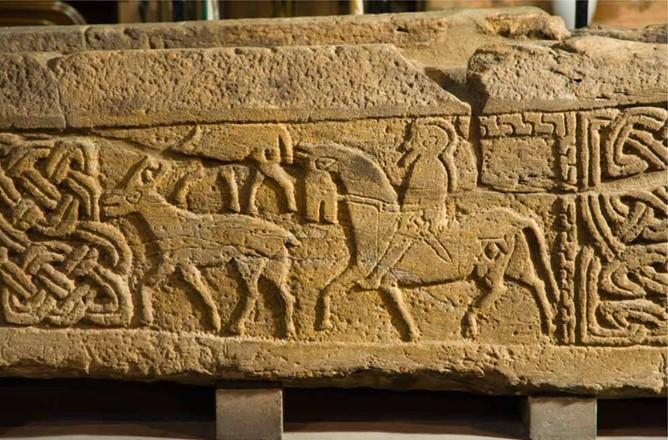

https://scarf.scot/wp-content/uploads/sites/15/2022/04/Detail-from-the-sarcophagus-at-Govan-Old-Parish-Church-perhaps-representing-St-Constantine-c-CSG-CIC-Glasgow-Museums-and-Libraries-Collections.jpg

Detail from the Sarcophagus, Govan Old Parish Church. Public domain


The land we today call Scotland experienced in the 6th century a most unique period in its history: the events of the following three hundred years would have unfolded from what happened in the 6th century.


At that time, southern Scotland was inhabited by the Celtic Britons, while in northern Scotland lived the mysterious ancient Picts. On the southeastern shores, the Angles, one of the Germanic peoples coming from the European continent, were slowly settling into those which for them were relatively new lands. On the northwestern coastal region lived the so-called Scots (but that is not what they used to call themselves) whose kingdom, Dál Riata, had linguistic and social connections to the Irish Gaels of Ireland, while it is still debated whether or not the Dalradians (or Scots) had Irish origin.


All of these very different peoples lived in a semi-tribal society, where many clans joined to form petty kingdoms led by a high chieftain or king. The relations between neighboring populations (Britons, Dalradians/Scots, Picts, even Angles) ranged from war, to competition, to mixed marriages in order to forge political alliances. Some of these petty kingdoms, in particular Dál Riata, held commercial relations not only in the region, but also with distant countries on the European continent, through seafaring networking. Recent discoveries have shown that Dál Riata was a kingdom based on the trade of luxury goods, including gold and silver, worked by the Dalradian smiths.


In this scenario, during the 6th century Christianity appeared as a major game changer. Celtic Britons in the south of Scotland had previously known the Christian religion, but the definitive withdrawal of the Roman legions from Britain, in the 5th century, had caused the abandonment of Christian beliefs and a revival of the ancestral religion and society of the druids. Now, in the 6th century, Christian missionaries from Ireland brought back Christianity to Scotland, this time for good. A main actor in this missionary work was Saint Columba, whose abbey on the island of Iona, in Dál Riata, became a hub of evangelization for all of northern Britain.
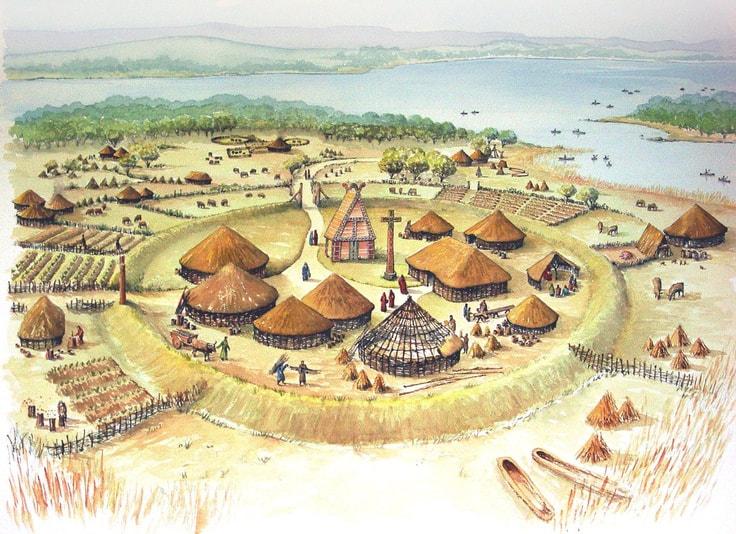

A representation of what the Spike Island monastery may have included. 
 The Wooden Church, Devenish, Co Fermanagh.  An example of a waterside 6th century Irish monastery.  Stone buildings and churches were very rare in 7th century Ireland.

An example of a 6th century Gaelic monastery, as it may have been the Abbey of Iona in its early years.

Artistic drawing by Philip Armstrong


In the last quarter of the 6th century, the most powerful ruler in this region was King Áedán mac Gabráin of Dál Riata.


None of the sources for his life are contemporary: the earliest, Life of Columba (Vita Columbae) was written at the end of the 7th century by an abbot of Iona, Adomnán, who, according to some scholars such as James E. Fraser, draw extensively from an existing body of accounts, all subsequent King Áedán's death by some decades, anyways. All the other sources were written centuries later.


Furthermore, none of these sources are historically reliable. Some of them are hagiographies, some are poems and literary tales, or inconsistent lists of kings compiled hundreds of years later, based mostly on oral accounts. Modern historians had to compare all the different sources and select the more credible information, discarding the implausible details.

Needless to say, the paucity of the historical record makes treating the biographies of Áedán mac Gabráin and his contemporaries extremely difficult.


Nonetheless, historians can identify some facts amongst the many gaps in the records.


Proceeding with selective research, for example, we came to know the existence of a very peculiar character who lived in Scotland in the second half of the 6th century. His name was Artúr mac Áedáin, son of the above-mentioned King Áedán of Dál Riata.


Artúr of Dál Riata is mentioned in three sources: the already mentioned Life of Columba (7th century); the genealogical section of The History of the Men of Scotland (Senchus fer n-Alban), which is believed to have been originally compiled between the 7th and the 10th century; and the Annals of Tigernach (Annála Tiarnaigh), chronicles dating between the 11th and the 12th centuries.


In the Senchus fer n-Alban his name is actually recorded apparently as Áedán's grandson (but as already mentioned, the list shows some inconsistencies). In the Life of Columba, anyways, which dates only a few decades after Áedán's death, Artúr is part of a story which clearly describes him as Áedán's oldest son, and how he predeceased his father.


The bardic poem Y Gododdin, believed to have been transmitted from oral poetry dating from the 7th century (but the oldest manuscript is dated from the 13th century, most probably copied from earlier versions), honoured the memory of a great and famous warrior named Artúr, though there isn't any evidence which links that name to Artúr mac Áedáin, besides the fact that the events celebrated in Y Gododdin are set in the same region where Artúr lived and only a few years after his death: the poem consists of a series of elegies to the men of the Brittonic Kingdom of Gododdin and its allies who, according to the conventional interpretation, died fighting the Angles at a place named Catraeth around the year 600.


Cross checking the references found in all the different sources, we can draw a possible picture of the historical Artúr of Dál Riata. And it turns out that through the mist of the "Dark Ages", we can glimpse a very unique character.


As is often the case when it comes to the sources on the "Dark Ages", we don't have any date related to Artúr of Dál Riata. We can infer the range of his lifetime indirectly, from references contained in some sources. So, presumably he was born around the 550s and died in battle around the 580s or 590s.


His name is Brittonic, even if he was born into a Gaelic clan of Dál Riata. The reason for that is that his mother, Áedán's first wife, is indirectly recorded as a Briton woman. In the hagiography Acta Sancti Laisriani, written in Latin centuries later, it's mentioned as Áedán's daughter, Gemma or Maithgemma (also a Brittonic name), niece of a Briton king: meaning that Áedán's wife was sister to that Briton king. It's not possible to be sure if this hagiography contains some seeds of historical truth, but Maithgemma and Artur are both Brittonic names. Additionally, several Welsh works in the following centuries claim a Brittonic pedigree for Áedán. His own mother is recorded as a Briton high-ranking woman, daughter of Dumnagual Hen ("Dyfnwal the Old"), a 6th century king of the neighbouring Brittonic Kingdom of Alt Clut (later known as Strathclyde, in the area of the modern Glasgow). Though these pedigrees are inconsistent and likely dubious, they are notable in highlighting Áedán's close association with the Britons.


Thus, it appears that Artúr was probably three-quarters Briton, closely related by blood to the Briton rulers of the neighbouring Kingdom of Alt Clut, which stretched in the territory between Hadrian's Wall and the Antonine Wall, in southern Scotland. The Briton king mentioned in the Acta Sancti Laisriani could have been the famous Riderch Hael ("Rhydderch the Generous") of Alt Clut, contemporary of Áedán and Artúr, who reigned between the last quarter of the 6th century and the beginning of the 7th century. Riderch Hael joined an alliance with another important Briton king, Urbgen of Rheged, whose figure later merged into the Welsh legends as Urien Pendragon.


The meaning of the word "king" when referring to that society is somewhat different than what we would usually expect. It indicates a figure who ruled a confederation of clans as their high chieftain. The Brittonic word was guletic, which means "land-holder". The kingdoms ruled by those petty kings were not organised states, but rather territories under their influence, without defined borders. When a so-called-king became powerful enough, he usually tried to submit the neighbouring territories to his influence, and that led to bloody wars which often led to a shift in the powers of the region. One more aspect to take into consideration is that the armies were much smaller than what they would become many centuries later. Usually they consisted of just a few dozen men, so the correct term would be "warbands", rather than "armies". Only in rare circumstances, a confederation of different warbands from allied kingdoms would reach maybe a (very) few hundred men.


Artúr of Dál Riata was in his teenage years when the battle of Arfderydd was fought in southern Scotland (almost 200 miles away to the south from Dál Riata), which supposedly happened in the year 573 according to the 10th century chronicles Annales Cambriae; an alliance of Christian Briton leaders defeated a pagan Briton ruler, Gwenddoleu, and his retinue. It was possibly a defeat of the ancient druids' supporters, which set off the definitive predominance of Christianity in the region, at least in the Brittonic territories. Some sources, though not all of them, report that Artúr's uncle (if we want to consider believable the kinship reference in the Acta Sancti Laisriani) Rhydderch Hael was among the leaders fighting on the winning side. According to Old Welsh sources (hundreds of years subsequent to the event), Gwenddoleu's bard, named Lailoken, escaped from the battle and went insane wandering in the forests of the territories of Alt Clut. These semi-unhistorical sources tell how Lailoken became a madman with prophetic abilities and became known as Myrddin Wyllt ("Myrddin the Wild"), eventually getting in contact with Rhydderch Hael, to whom he predicted the future. The figure of Myrddin Wyllt will develop much later, through several versions, into the character of Merlin the wizard belonging to the Arthurian legends.


One year after the battle of Arfderydd, Artúr's father was ordained as King of Dál Riata by the hands of Saint Columba himself. It's the first known example in all Britain and Ireland of a king anointed by a Christian priest, and that is another sign of the spread of Christianity not only among the Britons, but among the Scots too.


As the oldest son of the Dalradian king, and at the same time as a nephew of the ruler of one of the most important Celtic Brittonic kingdoms, Artúr of Dál Riata was in a position of power from a young age.

Historian Michael D. Wood and others take into consideration some references in semi-historical sources, whose reliability cannot be confirmed: according to those sources, at some point Áedán mac Gabráin, more and more involved in the Christian transformation of his kingdom under the influence of Columba of Iona, provisionally retreated to a religious life and gave his son Artúr the supreme command of the Dalradian forces, making him the de facto leader of Dál Riata.


It would be Artúr, then, who led the Scots in several battles mainly against the Picts. Under this hypothesis, in his position as leader and considering that he was three-quarters Briton, Artúr would have probably had to deal with the Briton rulers active at that time at the southern borders of Dál Riata, especially with his uncle Rhydderch Hael and his allies, including Urien Pendragon. That epithet, Pendragon, with the meaning of "Highest Commander", was traditionally linked to Urien of Rheged probably because around the year 590 he was at the head of a Brittonic coalition in their first recorded war against the Angles of Bernicia, as is recounted in the Historia Brittonum, a semi-historical account dated from the 10th century. In that war Urien died, betrayed by a conspiracy of a Briton leader jealous of his power, and his figure was consigned to legend.


Artúr was not involved in that coalition, mainly because he was a leader of a Gaelic kingdom, adversary of the Brittonic kingdoms, but also because in the same period he was busy with his own battles at the Pictish borders.


According to some pedigrees, Áedán of Dál Riata claimed as his own territory an area between the Brittonic Kingdom of Gododdin (centered maybe around the modern city of Edinburgh) and the region called Manau, in the southern Pictish territories. His claims derived from matrilineal line, since his mother was a daughter of a Briton king of Alt Clut (Strathclyde). That's the reason why his son Artúr was active as military leader in that region.


The Miathi, as they are mentioned in Vita Columbae, were a population living in that area. Probably they are to be identified with the Southern Picts, but their identity might be traced back from the ancient Maeatae, a confederation of tribes that rebelled against the occupying Roman legions in the 3rd century.


It was against the Miathi that Artúr fought his last battle. It's not clear when, but around the 580s or the 590s. According to Vita Columbae, in that terrible battle two of Áedán's sons, Artúr and Eochaid Find, lost their lives, though at the end the Dalradian forces defeated the Miathi.


After the tragic "battle of the Miathi", Áedán mac Gabráin came back to the throne of Dál Riata, even though he was already in his fifties or even in his sixties, and he led the Scots maybe until around the time of his death in 609. Or he may have been deposed or have abdicated following his defeat around the year 603 at the battle of Degsastan, recorded also by Bede in his Historia ecclesiastica gentis Anglorum. The victor of that battle was the Angle king Æthelfrith of Bernicia, the first unifier of the territories which will come to form the Anglo-Saxon Kingdom of Northumbria.


As for Artúr, we don't know if he was buried after the battle of the Miathi or what was his body's fate. But most probably his fame as a great warrior and leader outlived him. We have cited already the Old/Middle Welsh poem Y Gododdin and in particular the stanza in which is mentioned a warrior named Artur in passing, as a paragon of incomparable bravery. There's no evidence about who it could be that mentioned Artur, but considering that the stanza might date back to a few decades after the battle and that the poem is set in the same region as the battle of the Miathi, it could plausibly be a reference to Artúr mac Áedáin of Dál Riata.


It is a common view among historians that the earliest bardic poetry in the Old Welsh language of which we are in possession originated in the Brittonic lands of southern Scotland in the 6th and the 7th centuries and recounts the deeds of heroes belonging to that region's folklore.


If that is so, could it be possible that some of the feats of the commander Artúr became part of the Welsh legends? It is very possible, even if most of it was lost and what survives to our days was just a part of it. Actually, some of Artúr's contemporaries are an important part of those legends: figures such as Urien Pendragon and Myrddin/Merlin are legendary characters whose identities are rooted in real people who lived in the 6th century.


It's not the purpose of this article to prove anything, just to suggest with how much interest our popular imagination plunges into historical events that have been embellished and dramatically changed in the legendary accounts.


Sources include:


- Clarkson, Tim. THE MEN OF THE NORTH. The Britons of Southern Scotland. 2010, Birlinn Ltd.


- Wells, Peter S. BARBARIAN TO ANGELS. The Dark Ages Reconsidered. 2008, W. W. Norton.


- Wood, Michael D. IN SEARCH OF MYTHS AND HEROES. 2007, University of California Press.


- Adomnán of Iona. THE LIFE OF SAINT COLUMBA. As Told by Saint Adomnán (edited with an introduction by Phillip Campbell). 2021, Cruachan Hill Press.


- Bede. AN ECCLESIASTICAL HISTORY OF THE ENGLISH PEOPLE (edited by B. Colgrave and R. A. B. Mynors). 1992, Oxford: Clarendon Press.


~~~~~

An avid reader, Marco Mazzi has cultivated his passion for writing articles on different subjects for years, from history to modern society to sport. Marco has a Bachelor of Arts degree in Mass Communication, besides a Musical Arts degree in Viola, which led him to the profession of classical musician. He has always been a history buff, and he has written several historical articles. He currently lives in South Africa, and he is a Lecturer at UKZN University. CHRONICLES OF ALBION is available HERE.

Wednesday, April 10, 2019

A Church Called Saint Discord

By Kim Rendfeld


When the churchman Virgil arrived at Mayor of the Palace Pippin’s residence in Quierzy-sur-Oise in late 743 or early 744, did he foresee his role in a dispute between a ruler of Francia and his brother-in-law, the duke of Bavaria?

Virgil apparently had been abbot of Aghaboe in Ireland before deciding to embark on a pilgrimage to the Holy Land. There is some dispute over his nationality. He might have been an Irishman, from a high-ranking family, perhaps a descendant of the legendary King Niall. Or he could have been a Frank or Bavarian who had studied in Ireland. For my work in progress, I’m leaning toward high-ranking Irishman. If he was from the nobility, he would have been familiar with the role of politics in his homeland and understood the need to make the right allies.

Saint Virgil, photo by Karin Rager
(CC BY-SA 3.0, via Wikimedia Commons)

The summer before Virgil arrived at Quierzy, Pippin and his elder brother, Karlomann, mayor of the palace for a different region of Francia, had been at war with Bavarian Duke Odilo. The brothers were probably still steamed that their sister, Chiltrude, had run off to marry Odilo, the father of her unborn child, two years earlier. After the most recent war, Pippin and Karloman claimed victory, but in reality, the fighting had dealt heavy losses to both sides.

Nevertheless, Odilo remained in power, without ceding territory or paying tribute. A few months after the war, the episcopal chancery of Freising gave Odilo the title “gloriossisimus,” also used for Frankish kings and mayors of the palace. At that time, Francia had a king, Childeric III, who gave the brother moral authority, but he owed his position to the mayors of the palace, who had found him in a monastery and installed him on the throne.

It’s not too much of stretch to think that residents of Quierzy were still talking about the recent war, grousing about how Odilo sent a papal legate to Pippin on the eve of battle to tell him to back off. Perhaps they were furious when they learned Odilo had the title of “gloriossisimus.” That spring, Virgil likely knew about Pippin’s reaction to Karlomann making a separate peace with Odilo, perhaps with Bishop Boniface as a mediator.

We don’t know exactly what Virgil and Pippin talked about or how often they interacted. Apparently, Pippin was impressed with how learned Virgil was. Another thing might have impressed Pippin even more: he could count on Virgil as an ally.

Pippin needed allies in Bavaria. The bishops, three of whom were appointed by Boniface in 739, were loyal to Odilo. If Boniface did broker Karlomann and Odilo’s peace agreement, Pippin probably thought he couldn’t trust the Anglo-Saxon bishop, either.

At Niederaltaich abbey church, the founder, Bishop Pirmin,
plants a new oak with Odilo (photo by Wolfgang Sauber,
CC BY-SA 3.0, via Wikimedia Commons)
After a few months or two years at Quierzy, Virgil went to Salzburg, the see held by Bishop Johannes. In the mid-740s, there might have been speculation about Johannes’ health. Johannes died in June 745 or 747. Close to that time, 746, Virgil and another cleric complained to the pope that Boniface had enjoined them from administering baptisms. Boniface and Virgil’s disagreement centered on a priest who had botched the Latin. Instead of the Father, Son, and Holy Spirit, the priest had baptized the child in the name of the fatherland, daughter, and Holy Spirit. Boniface said the baptism was invalid, while Virgil argued it was. Perhaps realizing that bad Latin was common, the pope sided with Virgil.

Boniface and Virgil still clashed. Probably in 747, Boniface complained to the pope that Virgil was sowing discord between Boniface and Odilo, and he accused Virgil of teaching doctrine contrary to Scripture.

In 747, Virgil became abbot of Saint Peter monastery in Salzburg. A fellow Irishman, Dobdagrecus, served as bishop, apparently at Virgil’s direction. The Irish had a different hierarchy than the Continent. There, bishops were under the authority of abbots. Soon after he became abbot, Virgil picked a fight with Odilo and asserted his abbey rights over the site of a small monastery in Bischofshofen.

Photo by Wolfgang Sauber, CC BY-SA 3.0, via Wikimedia Commons


The site of a miracle, monastery dedicated to Saint Maximillian had been founded before 716 by Salzburg Bishop Rupert, Duke Thedo, and two brothers from the noble Albini clan, Tonanzo and Urso. Although the land in question officially belonged to the Church, the Bavarian donor family expected to maintain control of it, a common practice. The Albini brothers’ nephews or sons trained as clerics at Salzburg. They asked for and received at least half the property from Rupert. The monastery was later destroyed by Slavs and abandoned.

After Odilo returned from exile in 741, he entrusted the property to his archchaplain, Urso, who was either one of the founders or a relative. Urso had accompanied Odilo to exile in Charles Martel’s court, and the duke might granted Urso’s request as a reward for loyalty.

Odilo also needed someone he could trust at Bischofshofen. It was strategically placed on the upper Salzach River, across the Lueg Pass south of Salzburg, near an old Roman road traversing the High Tauern Alps. Odilo would have been loath to let someone loyal to an adversary have it. At first, Odilo offered Virgil property somewhere else, but Virgil turned it down. After a while, Odilo gave Virgil half the property at Bischofshofen.

Virgil built a church on his side, still demanding the rest of the property, and Urso, with Odilo’s support, constructed a church on his portion. Urso went so far as to have a bishop without a see consecrate the church. Virgil retaliated by banning priests from practicing rites there, calling Urso’s church “Saint Discord.”

Odilo died on January 18, 748, and his six-year-old son, Tassilo, succeeded him. Likely serving as regent, the widowed Chiltrude might have sought support for her son when she and Tassilo made a generous gift to Salzburg in Odilo’s memory.

After another war in 748-49 over who would rule Bavaria, ending with Pippin restoring Tassilo to his duchy, Virgil became that bishop of Salzburg. He and Tassilo had an alliance that would last until Virgil’s death in 784. Yet “Saint Discord” remained under ban all that time.

Sources

From Ducatus to Regnum: Ruling Bavaria under the Merovingians and Early Carolingians by Carl I. Hammer

Unjust Seizure: Conflict, Interest, and Authority in an Early Medieval Society by Warren Brown

Land and Landscape: The Transition from Agilolfing to Carolingian Bavaria, 700-900 by Leanne Marie Good

Conflicting Loyalties in Early Medieval Bavaria: A View of Socio-Political Interaction, 680-900 by Kathy Lynne Roper Pearson

"History and Memory in Early Medieval Bavaria," History and Memory in the Carolingian World by Rosamond McKitterick

"St. Vergilius of Salzburg" by William Turner, The Catholic Encyclopedia

St. Virgilius,” EWN


~~~~~~~~~~

In Kim Rendfeld's Queen of the Darkest Hour, Queen Fastrada must stop a conspiracy before it destroys everyone and everything she loves. The book is available on Amazon, iBooks, Barnes & NobleKobo, and Smashwords.

Kim has written two other books set in 8th century Francia. In The Cross and the Dragon, a Frankish noblewoman must contend with a jilted suitor and the fear of losing her husband (available on Amazon). In The Ashes of Heaven's Pillar, a Saxon peasant will fight for her children after losing everything else (available on Amazon). Kim's short story “Betrothed to the Red Dragon,” about Guinevere’s decision to marry Arthur, is set in early medieval Britain and available on Amazon.

Connect with Kim at on her website kimrendfeld.com, her blog, Outtakes of a Historical Novelist at kimrendfeld.wordpress.com, on Facebook at facebook.com/authorkimrendfeld, or follow her on Twitter at @kimrendfeld.


Friday, December 14, 2018

Heroes of the Dark Ages - Who's yours?

by Matthew Harffy

If I were to ask a group of people to name a hero from the Early Medieval period, the era more commonly known as the Dark Ages, who do you think they might mention? Alfred the Great perhaps? After all, he is the only king to be known as “Great” that Britain has ever produced.

King Alfred the Great

Some might go with that famous warrior king from the end of the period, Harold Godwinson. He will forever be known to all British schoolchildren as the man who rather clumsily got an arrow in his eye at the Battle of Hastings on that most famous of dates, 1066.

Harold has something in his eye on the Bayeux Tapestry

Some people, unsure of what is fact and what is fiction, might even give King Arthur a plug. Now, we don’t even know whether Arthur really existed, and we certainly don’t have any facts about his life or who he was even if we believe he is not purely fictional. And yet, his name is synonymous with Britishness and the distant mist-veiled days of the Dark Ages. He is “the once and future king” who will return to rid us of an invading army when the land most needs him.

A watery tart lobs a sword at Arthur

People who are more knowledgeable of the period’s history, and who are more inclined to turn to learning rather than battle-glory as a sign of greatness, might well mention The Venerable Bede, the Northumbrian monk and scholar who wrote much of what is known of the history of Britain up to his death in the 8th century.

Bede - the grandfather of British history

If they are really into their seventh century history, people might say their hero is King Penda of Mercia, or King Oswald (later Saint Oswald) of Northumbria, but I think those people would be few and far between.

What I can guarantee is that nobody would say that their hero of the Early Medieval period is King Sigebehrt of East Anglia. Well, perhaps I can’t guarantee it, but if someone voted for him, you can be sure they would belong to an extremely niche crowd!

However, to his people, Sigebehrt was every bit the hero.

St. Felix and King Sigebehrt

King Sigebehrt of East Anglia (known later also as Saint Sigebehrt, following his ***SPOILER ALERT*** martyrdom ***SPOILER ALERT***), had been the epitome of the warrior kings of the Anglo-Saxons.

You may well be thinking that it’s no wonder you haven’t heard of some ancient king of a small area of modern-day England. But back in the 7th century, East Anglia was a big deal. It was one of the most powerful kingdoms of Britain, perhaps the most powerful for a time. Indeed, it was powerful enough for its king, Rædwald, to be called by Bede ‘Rex Anglorum’ (King of the Angles, which makes him sound like he was great at trigonometry, but remember that the Angles were the Germanic tribe who gave their name to what would eventually become England). Rædwald was not only able to rule over all the Angles, but also to put those he favoured on the thrones of other kingdoms, as he did with King Edwin of Northumbria.

Replica of the Sutton Hoo helmet

Rædwald is probably the noble buried in the ship beneath the famous mound at Sutton Hoo, and it is likely that Sigebehrt was either his stepson or his nephew. Whatever his relationship to the great king, Sigebehrt was part of the dynasty of the Wuffingas, the ruling family of East Anglia for many decades.

Little is known about Sigebehrt’s early life, save that he was exiled from East Anglia to France. Exile was common at the time for nobles with a claim to the throne. It certainly beats death! In France he became a Christian and was in fact the first English monarch to be baptised before his succession to the throne.

Upon the assassination of Rædwald’s son, Eorpwald, Sigebehrt returned to take the throne of East Anglia. Nothing is known about how he did this, but given the violence prevalent at the time and the fact his prowess in battle was later chronicled, it seems likely he had to fight his way to the top. That he was a Christian wouldn’t have hurt his prospects either, what with Edwin of Northumbria and Eadbald of Kent both having converted to Christianity and having ties to the Frankish rulers, who may well have aided Sigeberht to take the crown.

However he managed it, he was the king by 629 and he promptly went about setting things in motion that would cement Christianity’s place in the kingdom. During his stay in France, Sigeberht had been impressed by the learning found in the religious schools on the Continent. So, after setting up a Burgundian missionary, Felix (yet another Saint!), as Bishop of Dommoc (possibly Dunwich), Sigeberht then secured the future of the Church by establishing a school, based on the model that he had witnessed in France, where boys could be taught reading and writing in Latin.

Saint Fursey (not sure which one he is!)

Furthering the Church’s influence in his kingdom, he then granted the Irish hermit Fursey (yes, another Saint!), a monastery site called Cnobheresburg, most commonly identified as Burgh Castle, near Great Yarmouth.

If it sounds as though Sigebehrt was obsessed with learning and the Church, you wouldn’t be wrong. He was clearly much more interested in the Church than in governing and being a warlord king of the people of East Anglia. We know this, because a few years after attaining the throne, he abdicates power to Ecgric, another of the Wuffingas dynasty, whereby he promptly retires to his monastery at Beodricesworth (Bury St Edmunds).

Now this is where the story gets really interesting, and what drew me to the character in the first place.

In 636 or thereabouts, that most successful of pagan warlords of the age, Penda of Mercia, attacked East Anglia. For some reason the people didn’t think Ecgric was up to the task of defending them, so they went to Beodricesworth and dragged their erstwhile king, Sigebehrt, out from his monastery, that he might save them from the invading Mercians.

Well, the peaceful, Christian Sigebehrt refused to fight, but his ex-subjects were having none of it and he was forced onto the battlefield unarmed and unarmoured to lead his people. I won’t give you details of what happened, but let’s just say that a robe and a cross are not great protection against spears and swords! And you already know he becomes Saint Sigebehrt, after his ***SPOILER ALERT*** martyrdom ***SPOILER ALERT***, so join the dots!

Battles are never pretty

Sigebehrt, might not be the most famous of kings of the Early Medieval period, but he was certainly influential in securing the Church in East Anglia, and his life was definitely interesting enough to spark inspiration in me to write a novel featuring him and his unfortunate end. And if being brave enough to step into the chaos and havoc of a Medieval battlefield without weapons or armour doesn’t make you heroic, I don’t know what does!

Who is your Dark Ages hero or heroine? Leave a comment below. I’d love to read your thoughts.

~~~~~~~~~~

Matthew Harffy is the author of the Bernicia Chronicles, a series of novels set in seventh century Britain. KILLER OF KINGS, which features Sigebehrt, Ecgric and the battle with Penda is now available in hardback, e-book and audio.

The other books in the series, The Serpent Sword, The Cross and the Curse, Blood and Blade and Warrior of Woden are available on Amazon, Kobo, Google Play, and all good bookstores.

Website: www.matthewharffy.com
Twitter: @MatthewHarffy
Facebook: MatthewHarffyAuthor

Images:
King Alfred: Odejea [GFDL (http://www.gnu.org/copyleft/fdl.html) or CC BY-SA 3.0 (https://creativecommons.org/licenses/by-sa/3.0)]
King Arthur: Newell Convers Wyeth [Public domain]
Death of Harold: Myrabella [Public domain or CC0], from Wikimedia Commons
The Venerable Bede: The original uploader was Timsj at English Wikipedia. [Public domain], via Wikimedia Commons
Stained glass, Old Felixstowe Church: Copyright Andrew Hill
Sutton Hoo helmet: British Museum [CC BY-SA 2.5 (https://creativecommons.org/licenses/by-sa/2.5) or Public domain]
Saint Fursey: Public Domain
La victoire de Tullus Hostilius sur les forces de Veies et de Fidena ---- Giuseppe Cesari [Public domain], via Wikimedia Commons

Wednesday, October 24, 2018

Ecgberht: The Refugee Returns to Claim the Throne

By Kim Rendfeld

In 789, Ecgberht was a refugee in the Frankish court, driven from his home in Kent. His exile was another chapter in the long struggle between his kinsmen and Mercian King Offa.

Twenty-seven years earlier, Kent suffered a succession crisis, with the death of Æthelberht II. Over the next few years, five men claimed to rule the kingdom or at least eastern or western half of it. One of them was King Ecgberht II, who at the time claimed the western half. This Ecgberht is not our hero but was perhaps a relative. Medieval aristocrats were fond of reusing names, especially to remind subjects, allies, and enemies of prior rulers.

The chaos about who exactly was in charge of Kent was an opportunity for Offa. He might have felt entitled to the kingdom next door because Kent had acknowledged his predecessor, Æthelbald, as overlord by 731. Whether that relationship lasted until Æthelbald’s murder in 757 is unknown.

By 765, Offa imposed himself as overlord of Kent, and apparently held on to the kingdom for several years.

14th century image of Offa
(public domain via Wikimedia Commons)


The Kentish people apparently weren’t happy with Mercian rule. In 776, Ecgberht II led soldiers to drive Offa out. They fought at Otford, and Kent likely won its independence, if we are to believe circumstantial evidence like coins with Ecgberht II’s name and charters with his name but not Offa’s. This time Ecgberht II ruled all of Kent.

We know Ecgberht II flourished between 765 and 779, but don’t know how his reign ended. King Ealhmund, our hero’s father, might have succeeded him. Evidence is scant. One piece is that his name appears on charters. Ealhmund’s relationship between Ecgberht II, assuming there is one, is unknown. Ealhmund did name his son after the warrior who triumphed over a foreign invader.

But Offa was not one to sit quietly. By 785, he reimposed his authority on Kent, issuing charters in his name without a reference to a Kentish king. Ealhmund’s fate is a mystery. Was he killed? Driven out?

Ecgberht, Ealhmund’s son, was still around. Considering that he lived until 839, 50 years after he went into exile, he might have been an adolescent when his father lost Kent. Offa likely saw Ecgberht as a threat, as he likely perceived anyone with a claim to the throne.

In 789, Offa enlisted the aid of his new son-in-law, Beorhtric, to help solve his problem—perhaps it was one of the reasons the Mercian king and his wife arranged of his daughter Eadburh to the king of Wessex. Until this time, Beorhtric probably had no quarrel with Ecgberht and no concern about Kent. But he did have this new alliance and might have felt obligated to fulfill it.

Driven from home, Ecgberht found refuge in Charlemagne’s court or in Francia. Either way, he would have had the permission of the Frankish king to be there, much to Offa’s aggravation. Ecgberht might have met fellow exiles during his time in Francia, including Eadberht Præn. Sharing the name of prior Kentish kings, Eadberht likely had been tonsured against his will—a common way to deny rivals their inheritance to the crown.

Seven years later, Mercian rule in Kent was again challenged. Offa died in July 796, and his son, Ecgfrith, succeeded him. Although Ecgfrith had be crowned co-ruler, he didn’t seem as strong as his father. Some aristocrats in Kent might have seen opportunity.

That same year, Eadberht Præn decided to leave the priesthood and seize power. He reigned for two years, having coins minted in his name and getting rid of a troublesome archbishop. In the meantime, Ecgfrith died, and his successor, Cenwulf, was able to stabilize Mercia then try to regain Kent.

Eadberht Præn was captured in 798 and taken in chains to Mercia. Things turned out horribly for him. Because he had been ordained, he could not be killed, but he suffered what some might see as a worse fate. Be warned: it is gruesome. His captors blinded him, chopped off his hands, and sent him to Winchcombe, an abbey Cenwulf had recently founded. Thus crippled, Eadberht Præn would never be able to rule again.

13th century image of Ecgberht
(public domain via Wikimedia Commons)


In 802, Ecgberht decided to claim power, but he didn’t go for Kent. Instead he invaded Wessex. It’s uncertain why he decided on Wessex. Perhaps it was the easier target, and Ecgberht had not forgotten how Beorhtric had helped Offa steal what was rightfully his. The two likely met on the battlefield at Wiltshire. Beorhtric died, and Ecgberht seized the crown.

He didn’t stop at Wessex. During his 37-year reign, Ecgberht would extend his rule to include Surrey, Essex, Sussex, and Kent.

Sources
Oxford Dictionary of National Biography, including
“Offa” by S.E. Kelly
“Eadberht Præn” by S.E. Kelly
“Ecgberht” by Heather Edwards
“Æthelberht II” by S.E. Kelly

~~~~~~~~~~

In Kim Rendfeld's Queen of the Darkest Hour, Queen Fastrada must stop a conspiracy before it destroys everyone and everything she loves. The book is available on Amazon, iBooks, Barnes & NobleKobo, and Smashwords.

Kim has written two other books set in 8th century Francia. In The Cross and the Dragon, a Frankish noblewoman must contend with a jilted suitor and the fear of losing her husband (available on Amazon). In The Ashes of Heaven's Pillar, a Saxon peasant will fight for her children after losing everything else (available on Amazon). Kim's short story “Betrothed to the Red Dragon,” about Guinevere’s decision to marry Arthur, is set in early medieval Britain and available on Amazon.

Connect with Kim at on her website kimrendfeld.com, her blog, Outtakes of a Historical Novelist at kimrendfeld.wordpress.com, on Facebook at facebook.com/authorkimrendfeld, or follow her on Twitter at @kimrendfeld.


Wednesday, September 26, 2018

Charlemagne and Offa, Their Kids’ Failed Betrothals, and Trade

By Kim Rendfeld

About 790, Frankish King Charles (Charlemagne) had a proposition for Mercian King Offa: one of Offa’s daughters marry one of Charles’s sons.

Charles likely saw this as a way to secure an alliance between a powerful kingdom in England and his vast realm—stretching from the Atlantic to east of the Rhine, from the North Sea to the Pyrenees and part of Italy. If Charles did not sire any other sons, the bridegroom, his son Charles (whom I call Karl in my books), stood to inherit all but Aquitaine and northern Italy.

Gervold, abbot of St. Wandrille, served as Charles’s envoy to work out the details. The two kings likely brought their wives into the discussions. Frankish Queen Fastrada and Mercian Queen Cynethryth were both strong-willed women. Although Karl might have also favored the marriage, but we don’t know the sentiments of the young woman involved.

In some modern eyes, princesses and other young noblewomen appear to be pawns. In medieval parents’ minds, daughters had an important role in forming the alliances and swaying their husbands to uphold her family’s interests. A husband would think his wife should convince his in-laws to side with him.

Matthew Paris's 13th century tract on St. Alban
(public domain, via Wikimedia Commons)


Offa, who had seized power in 757 during a civil war after the murder of his cousin, was no exception. Although one daughter, Æthelburh, was an abbess—an influential position—another daughter, Eadburh, wed Beorhtric, king of Wessex. The marriage solidified Beorhtric’s claim to his throne, and the father- and son-in-law drove out Ecgberht, son of Kentish King Ealhmund and a rival for the West Saxon crown.

Offa had another daughter, Ælfflæd, who remained unattached in 790. Offa might have wanted her to wed a ruler in a neighboring kingdom rather than go to the continent. (She would marry Northumbrian King Æthelred I two years later.)

Offa made his own offer to Charles. He would only agree to the Frankish king’s proposition if Charles’s daughter Bertha married his son, Ecgfrith. Crowned co-ruler with his father in 787, Ecgfrith was quite the bachelor, assured of succession. Offa had, ahem, reduced the number of claimants to the throne.

But why Bertha, too young to marry at only age 11, and not her older sister, Hruodtrude, who was the marriageable age of 15? Hruodtrude had been betrothed to Byzantine Emperor Constantine, whom she never met, but that agreement fell apart a few years before.

Apparently Offa was willing to wait a couple of years as he expanded his rule into Kent. Perhaps, he thought the marriage of Charles’s second daughter to his son would remind the Kentish folk of a successful royal couple from long ago: a Merovingian princess named Bertha and Æthelberht, the most powerful Anglo-Saxon king in the late sixth century.

14th century work by Jacob van Maerlant
(Public domain, via Wikimedia Commons)


Charles was not having it. Not at all. While he was willing for Offa’s daughter to come to Francia, learn the ways of the Frankish court, and benefit from the scholars there, he might not have wanted his own child to live in Mercia. He might have heard firsthand accounts of Offa’s ruthlessness and did not wish to subject Bertha to it.

Charles became angry, and that led to Mercia and Francia closing their ports to each other’s merchants.

This isn’t the first time a failed betrothal in Charles’s family had international consequences. According to the Revised Royal Frankish Annals, Constantine, furious at being refused Hruodtrude’s hand in marriage, ordered the Sicilians to attack Benevento, a duchy recently allied with Charles. (Exactly who dashed Constantine’s hopes is unclear. Both Charles and Empress Mother Irene take credit for the breakup.)

Yet I wonder if the cause of Charles’s ire was something in addition to a failed betrothal. Perhaps, Offa brought up another issue. Charles was sheltering Ecgberht, among other exiles, and that must have irked Offa, who still saw Ecgberht as a threat. Might Offa have demanded Charles surrender his guest as a condition for their children’s marriage? If that was the case, I can imagine Charles feeling indignant.

By 796, the two monarchs reconciled, and trade resumed. In an April letter from that letter, Charles calls Offa “dearest brother.”

Still, it turns out that Bertha was better off staying at home. Offa died in 796, and his son succeeded him, but Ecgfrith’s reign didn’t last even a year. He died, likely not of natural causes.

796 was a bad year for Ælfflæd, too. Her husband, Æthelred, had been a ruthless ruler, and two ealdormen took matters into their own hands and murdered him. Ælfflæd might have joined her sister Æthelburh in the cloister, a common refuge for a widowed queen. Karl himself never married. The reason remains a mystery.

Had politics not interfered with Karl and Ælfflæd’s betrothal, what kind of a couple would they have been? We’ll never know.

Sources

Charlemagne: Empire and Society, edited by Joanna Story

Charlemagne: The Formation of a European Identity by Rosamond McKitterick

"Carolingian Contacts" by Janet L. Nelson, from Mercia: An Anglo-Saxon Kingdom in Europe, edited by Michelle P. Brown, Carol A. Farr

“Offa” by S.E. Kelly, Oxford Dictionary of National Biography

Carolingian Connections: Anglo-Saxon England and Carolingian Francia, c. 750–870, by Joanna Story

Charlemagne: Translated Sources, P.D. King


~~~~~~~~~~

This story appears in Kim Rendfeld's third novel Queen of the Darkest Hour. In Kim's version of events, Queen Fastrada must stop a conspiracy before it destroys everyone and everything she loves. The book is available on Amazon, iBooks, Barnes & NobleKobo, and Smashwords.

Kim has written two other books set in 8th century Francia. In The Cross and the Dragon, a Frankish noblewoman must contend with a jilted suitor and the fear of losing her husband (available on Amazon). In The Ashes of Heaven's Pillar, a Saxon peasant will fight for her children after losing everything else (available on Amazon). Kim's short story “Betrothed to the Red Dragon,” about Guinevere’s decision to marry Arthur, is set in early medieval Britain and available on Amazon.

Connect with Kim at on her website kimrendfeld.com, her blog, Outtakes of a Historical Novelist at kimrendfeld.wordpress.com, on Facebook at facebook.com/authorkimrendfeld, or follow her on Twitter at @kimrendfeld.


Wednesday, July 25, 2018

Why Alcuin Joined Charlemagne’s Court

By Kim Rendfeld

In 781, Alcuin had a choice. Should he accept an offer from Frankish King Charles (Charlemagne) to teach in the brand new Palace School or should he continue serving as master of the Cathedral School of York as he had for 15 years?

At the time, the Northumbrian was about 46. (His exact birthdate is unknown; the estimate is 735, which is good enough for me.) He had been with the York school since he was a child, placed there by his noble parents. York was a prestigious place, second only to Canterbury. York’s archbishop, Ecgberht, was King Eadberht’s brother.

Alcuin proved to be an apt pupil and said the school taught him “with tenderness of a mother’s love” and “a fatherly chastisement.” He attracted the attention of Ælbert, the master of the school, and Ecgberht.

In the morning, Ecgberht taught Latin literature, Greek, Roman law, astronomy, music, and theology such as the New Testament. Ælbert’s subjects were rhetoric, grammar, jurisprudence, poetry, astronomy, and the Old Testament. The students attended Mass at midday, followed by dinner and recreation, which included discussions and debates of the morning’s lesson. At vespers, students knelt for blessing.

Alcuin also might have grown up hearing about missionaries such as Willibrord and Wigbert, who tried to convert pagan peoples on the Continent. He likely knew about Boniface and the nuns and priests who followed him across the channel to strengthen Christianity. Alcuin would have been 19 when Boniface was martyred.

All this must have instilled a deep faith and devotion to scholarship in him. Later he would write, “My master Ecgberht used to tell me that the arts were discovered by the wisest of men, and it would be a deep and lasting shame if we allowed them to perish for want of zeal. But many are so faint-hearted as not care about knowing the reason for such things.”

Public domain,
via Wikimedia Commons

When Alcuin was 20, Ecgberht sent him to the Continent to acquire books to enrich York’s library, an expensive and hazardous mission. Alcuin risked his ship sinking, bandits on the road, being robbed by hosts, and sudden turns in the weather. Books were precious. Made of sheepskin, a large tome could require a whole herd. They were copied by hand, and those beautiful illuminations and ornate covers added to the price.

Yet York had a collection to boast about. It included work by Greeks and Romans (Aristotle, Virgil, Cicero, and Lucan), Church fathers (Jerome, Ambrose, Hilary, Augustine, Leo, and Gregory the Great), historians (Bede and Aldhelm), and grammarians (Donatus, Probus, and Phocas).

We don’t know how long Alcuin’s first errand for the archbishop lasted, but it likely took months. At home, the political situation was unstable. Alcuin thought King Eadberht, the archbishop’s brother, had a prosperous, harmonious, and militarily successful reign. But in 756, when Alcuin was 21, Eadberht suffered a disastrous defeat. Two years later, the king received the tonsure and joined his brother at York. The king’s successor, his son Oswulf, was murdered a year later.

In 766—and two more Northumbrian kings later—Ecgberht died. Ælbert succeeded the archbishop, and Alcuin, newly ordained a deacon, became master of York’s school. Alcuin must have been a good teacher. He attracted students from all over Britain and abroad, including Frisia and Ireland.

Politics remained volatile. In 774, another king seized the crown after his predecessor was deposed and exiled. Four years later, Ælbert resigned his archbishopric to retire, and Alcuin’s friend Eanbald succeeded him.

© Hubertl / Wikimedia Commons /
  CC BY-SA 4.0

In 779, yet another king ascended to the Northumbrian throne: Ælfwald, son of the murdered Oswulf and grandson of Eadberht. Although Alcuin admired Eadberht, he didn’t think much of the current king: “From the days of King Ælfwald fornications, adulteries, and incest have flooded the land, so that these sins have been committed without any shame and even with the handmaids of God.” (Ælfwald reign ended with his murder in 788.)

Ælbert died in 780. Soon after, Eanbald sent Alcuin to Rome to fetch a pallium (a woolen band with pendants that symbolize authority). Alcuin was on his way home when he met the king of the Franks. What was running through Alcuin’s mind when Charles asked him to come to the Frankish court?

Here is my speculation. He might have craved stability on the political front. In the past 10 years, Northumbria had three kings, and the current one was leading his realm into immorality. Charles had ruled the Franks alone since 771. Twice divorced, the king of the Franks had his own shortcomings, but he was a steadfast husband to his current wife. More important, he was an ally of the pope and providing missionaries like Alcuin’s friend Willehad with the military support for they needed to bring Christianity to pagans. In the Frankish court, Alcuin could interact with scholars from Italy, Francia, Ireland, and Hispania. He would still teach. His students would be the royal family and their close friends.

The prospect of leaving York might have been nerve-wracking, yet the opportunity to do something different might have excited him. Alcuin returned to York to get his superior’s permission to join the Palace School in Francia. With that choice, he would help build the intellectual foundation for Charles’s empire.

Sources

Alcuin: His Life and His Work, by C.J.B. Gaskoin

Alcuin, by E.M. Wilmot-Buxton

Alcuin” by James Burns, The Catholic Encyclopedia.

The Oxford Companion to British History (2 ed.), edited by Robert Crowcroft and John Cannon

Oxford Dictionary of National Biography

~~~~~~~~~~

Alcuin appears in Kim Rendfelds third novelQueen of the Darkest Hour, which will be launched August 7. In Kim's version of events, Queen Fastrada must stop a conspiracy before it destroys everyone and everything she loves. The ebook is available for preorder on AmazoniBooksBarnes & Noble, and Kobo.

Kim has written two other stories set in 8th century Francia. In The Cross and the Dragon, a Frankish noblewoman must contend with a jilted suitor and the fear of losing her husband (available on Amazon). In The Ashes of Heaven's Pillar, a Saxon peasant will fight for her children after losing everything else (available on Amazon). Kim's short story “Betrothed to the Red Dragon,” about Guinevere’s decision to marry Arthur, is set in early medieval Britain and available on Amazon.

Connect with Kim at on her website kimrendfeld.com, her blog, Outtakes of a Historical Novelist at kimrendfeld.wordpress.com, on Facebook at facebook.com/authorkimrendfeld, or follow her on Twitter at @kimrendfeld.