Showing posts with label Anglo-Saxon. Show all posts

Wednesday, July 15, 2020

6th Century Britain – Questions without Answers

By Gareth Griffith

In the age of Google, at a time when physicists are unlocking the secrets of the universe, when there are answers to almost every question, it seems churlish of history to present us with what used to be called “The Dark Ages.” Yet, in respect to Britain at least, that description would still appear to be appropriate for the period between the departure of the Romans, in AD 410, and the 7th century.

Particularly sparse is our knowledge of the 6th century, when the native written evidence is confined to Gildas’ The Ruin of Britain. Gildas was a monk and, as it is often said, his purpose was not to write history but to present a moral and polemical tract addressed to the British kings of his time. It is not known exactly when he wrote, although it likely to have been in the mid-6th century. There is controversy over that issue and also about the interpretation of what he wrote, as discussed, for example, by Guy Halsall in Worlds of Arthur: Facts and Fictions of the Dark Ages (OUP, 2013).

Statue of Gildas - Wiki Commons attribution

That is not to say that archaeologists and historians are completely in the dark about this period of British history, but it is to suggest that the speculative theories and histories of the age have the feel of a parlour game about them – where five archaeologists and five historians are sent out of the room and return with 11 theories of the Anglo-Saxon take-over of lowland Britain. Ideas about how certain Angles and Saxons arrived at and settled one area or another – the Hwicce for instance on the Welsh borders – can be amusingly reminiscent of the brilliant Monty Python sketch, Wrong Way Norris.

Relatively little is known, therefore, about 6th-century Britain and much of what is believed to be known is contested. In terms of literary evidence, according to Peter Heather:
“To supplement Gildas, there are a few more or less contemporary references to events in Britain in continental sources, and some very late, wildly episodic materials gathered together in the Anglo-Saxon Chronicle.” (Empires and Barbarians: Migration, Development and the Birth of Europe, Macmillan, 2009, p 272) 
There are more questions than answers, some large, others more specific: Why did the Anglo-Saxons not become British? What was the scale of the Anglo-Saxon migration to Britain? Was there a mass migration? Is that process best described in terms of conquest and invasion or more as a transfer of elites, with the indigenous population remaining more or less in place?

Possible 5th-century migration pattern Wiki attribution

In attempting to answer such questions, historians have tended to follow the prevailing fashions of historical analysis. The nineteenth century and beyond leaned heavily on the conquest and invasion model, in some cases as evidence of the superiority of Teutonic peoples over their Celtic counterparts. (B Ward-Perkins, “Why did the Anglo-Saxons not become British?” English Historical Review (2000), pp 513-533) As new aerial archaeological techniques revealed evidence that contradicted that model, the view fell into disfavour after 1945, to be replaced by versions of the elite-transfer theory.

From the view that the Anglo-Saxons basically wiped out or expelled the native British population, the pendulum swung towards the displacement of British landowning classes by an Anglo-Saxon warrior elite, led by those who had served as mercenaries in the Roman occupation of the island. It is a caricature admittedly, but we had replaced blood and iron with something approximating a hippy land-grab. It may be that DNA analysis supports that view, whereby the indigenous population remained in place, merely exchanging one ethnic ruling class for another.

A perennially vexing issue for that account relates to language: as Ronald Hutton writes: “If genetics and landscape studies indicate a basic continuity of population all over Britain…linguistic studies do not.” (Pagan Britain, Yale University Press, 2014, p 295). The contrast with the continent, with France in particular, is profound in this regard. To quote Hutton again:
“Old English replaced both the main languages of Roman Britain – the native Celtic one and the official Latin one – completely in the areas that later became England. It did so, moreover, while taking on virtually no loanwords from either tongue.” (p 295) 
In lowland areas at least, 6th century Britain appears to have witnessed “an absolute and abrupt discontinuity of language and culture,” events which, according to Hutton, are “commonly the hallmark of genocide…” (p 296)

The Aedui chief Dumnorix, Museum of Celtic Civilization, Bibracte
The British may have dressed similarly

Rather than deciding between contrasting viewpoints, Hutton’s main concern is to highlight the problems and discontinuities of evidence and interpretation. Calling it “an extreme state of affairs,” he points out that, in this instance, the material data drawn from archaeology and the textual and linguistic evidence do not fit: “In the case of the arrival of the Anglo-Saxons, the two are at present bewilderingly adrift…” (p 297) One is reminded of the comment made by Nicholas Higham in 1994, in reference to the issue of conflicting evidence, that “it has become obvious that archaeologists are capable of producing an almost infinite succession of models, each of which is more or less incapable of either proof or refutation.” (The English Conquest, Manchester University Press, p 2)

In his 2009 book, Empires and Barbarians: Migration, Development and the Birth of Europe, Peter Heather draws together the known and the probable facts of the matter. Like Hutton, he accepts that the key questions about the extent and nature of Anglo-Saxon immigration are not answered in any straightforward way by either the archaeological or historical evidence. (p 275) Nor does he think that DNA testing is likely to fill the gap. Decisively rejected by Heather is the “ethnic cleansing” model, which in his view was not remotely possible given the probable number of people involved, perhaps as many as three to four million. But then, there is the linguistic evidence to be considered, which leaves the argument “more than a little stuck.” (p 277 and p 297)

From this starting point, Heather proceeds to confront from what he calls “the intellectual impasse between mass migration and elite transfer originally generated by the limitation of the traditional historical and archaeological evidence.” (p 277) Taking a comparative perspective, he draws upon evidence from the migrations of the period on the continent, which leads him to several conclusions. One is that the Anglo-Saxon migration to Britain was a long-term process, a “predatory population flow” that occurred over many generations. A related conclusion is that, notwithstanding the obvious transport difficulties, this gradual migration flow included women and children.

Still, by AD 600 the native British population was likely to have outnumbered the newcomers, possibly by a ratio of around 1:4. With the Frankish model before him, Heather’s argument is that an adequate interpretation of Anglo-Saxon migration must combine elements of mass migration, sufficient to establish linguistic and cultural change, with elements of the elite model, whereby land ownership shifted decisively in favour of the incomers and where the mass of the indigenous population, formerly landed or otherwise, were left to accommodate themselves to these new arrangements of subservience.

Of course, none of this is to maintain that the transformation of lowland Britain was peaceful. It is argued that, from the earliest times, the Britons and the Anglo-Saxons perceived themselves as races apart, with Bryan Ward-Perkins commenting:
“…when both peoples came to summarize their dealings with each other, the picture is straightforward and consistent. Two distinct and hostile peoples fight for the same territory; one of them comes by ship from overseas, and gradually expands its power by conquest; the other resists, with greater or lesser success, and awaits the moment when the invaders can be slaughtered and their defeated remnants driven to their boats and 'sent home' over the sea.” (“Why did the Anglo-Saxons not become British?”, p 516) 
To offer my own historical speculation, it seems likely that the Anglo-Saxon takeover was messy and that it varied from one local area to another, in particular as between what is now south-east and south-west England. Whereas a version of the elite-transfer model may apply to the south-east where the scale of armed resistance from the British may have been minimal in the aftermath of the Roman departure, the story in the south-west may have been quite different, with the Saxon advance being marked by a series of pitched battles until they reached what is now the Bristol Channel towards the end of the 6th century. Admittedly, that account may be disputed. On its behalf, it is at least broadly consistent with the account we find in the traditional interpretation of Gildas and with the admittedly sketchy and episodic entries for the period from the Anglo-Saxon Chronicle.

Replica of the Sutton Hoo helmet, from the earlier period of
Anglo-Saxon settlement. Wiki Commons attribution link

Clearly, not everything in those sources can be accepted at face value. But some things ring truer than others. For example, the Anglo-Saxon Chronicle records a major battle fought in AD 577 just north of modern day Bath. There is no other source for the battle which, if true, broke the land-bridge that existed between the Celtic people of modern day Wales and those of Devon and Cornwall. Possibly, the entry which says that three British kings were killed in the battle, those of Bath, Gloucester and Cirencester, can be discounted as a form of aggrandising propaganda on the part of the West Saxons. It is possible. On the other hand, as Heather acknowledges, it is also possible that these events were recalled with “outlined accuracy.” He writes:
Sometimes, too, the events even make sense against the landscape, notably the battle of Deorham in 577, which is said to have brought Gloucester, Cirencester and Bath under Anglo-Saxon control. A visit to the site, now the grounds of Dyrham Park just outside Bath, is enough to show you why. Set on high ground, it dominates the territory around.” (p 272) 
What is beyond question is that the Britons did not relinquish the western regions of the Island to the Anglo-Saxons without a long struggle. If the details are lost to us, the outline is clear enough. The reported Battle of Dyrham occurred over 150 years after the Romans left Britain, which, if true, suggests concerted resistance on a significant scale.

[This post is an Editor's Choice archive post, originally published on EHFA on 7th June 2018]

~~~~~~~~~~

Gareth Griffith was born in Penmaenmawr, North Wales, and now lives in Sydney, Australia with his wife Sue. His career has encompassed teaching, research and writing, including many years working as the manager of research for the parliament of New South Wales. These days, when Gareth isn’t writing, he enjoys reading, music, dark Scandi film and TV, and Dark Age Britain. Although Gareth left Wales at the age of twelve, Wales never left him, and its landscape and history loom large in his imagination and his storytelling.

Find Gareth on his website: https://garethgriffithauthor.com/
and on Twitter: @garethgriffith_

Wednesday, May 20, 2020

The Making of a Nation: England

By Annette Burkitt

The pre-conquest period in England is a largely unknown and misunderstood period for the general reader. It hardly figures in educational settings below the undergraduate. It is associated with generalised themes of horned helmets, blood and gore; its kings with unpronounceable names and unknown characters. Can a writer put this right? It takes significant research and an academic approach to unlock the surprisingly large amount of surviving information to reach the treasure trove that is Anglo-Saxon history.

Mercia and Wessex became the dominant later kingdoms of the established Saxons. Their political interplay shaped the development of the nation. By the mid-10th century Wessex kings were calling themselves kings of all Britain, ‘rex totius Britanniae’. How did this come about? And what became of the British inhabitants of Dumnonia, the kingdom of the ‘Celtic’ south-west? Looking in detail at the local landscape can help to answer this puzzle of hidden history.

Our understanding of the early years of the development of England suffers from the survival of few contemporary documentary sources, but settlement and events can be recognised and surmised through the archaeological record and from some well-known writings, notably by Gildas (6th century), Bede (8th century) and Nennius (9th century). The Anglo-Saxon Chronicle and the Welsh Annals provide a framework for these and later years. A synthesis of research involving, in addition to original and secondary sources and archaeology, landscape studies, folklore, beliefs and place-names can give meat on the bones of this otherwise poorly recorded period of English history. Thankfully, later medieval writers, such as William of Malmesbury (12th century) were able to refer to or make copies of records of earlier times, which have fed the modern historian’s understanding.

By the 10th century, Wessex, the last surviving Saxon kingdom after the Viking assaults of the late 9th century, stood out as the pre-eminent Saxon kingdom, with Winchester in Hampshire as its capital. The ancestor of King Alfred, Ecgberht, set the stage in the 9th century for the rise of the Wessex dynasty. By Athelstan’s reign in the second quarter of the 10th century, Alfred’s bloodline and his vision of a united England had become a reality. Wessex stretched across the whole of the south of Britain. Mercia, in the midlands, acquiesced to its dominance, somewhat unwillingly. Northumbria fluctuated in its loyalty to Wessex, disturbed by insurrection from the Scots, Irish Norse and Cumbrians. The mid-10th century inheritors of Alfred’s vision, Edmund, Eadred, Eadwig and Edgar enjoyed the fruit of the earlier battles against Wessex’s enemies by Edward, Alfred’s son and his grandson Athelstan.

Author's drawing of a coin of Athelstan

They gathered troops, held witans (parliaments), hunted and practised diplomacy at star-studded palaces throughout southern and midland England, travelling from palace to palace, requiring the presence of archbishops, bishops and ministers, as well their individual retinues. The English were known on the continent for their rich apparel, their willingness to entertain foreigners, diplomatic or learned, their ordered and well controlled civic life, their system of justice and particularly their wealth, in treasure as well as enviable relics. The Church was well connected with the most notable monasteries in Europe and encouraged by Popes and kings in its bold attempts to sustain a balance between civic and religious life, to the benefit of all. Naturally, the royal family of Wessex had close involvement with its chief protagonists, Dunstan, Aethelwold and Oswald.

One of the many palaces to which the Wessex kings travelled was Frome on the eastern border of Somerset, UK, from which a charter was published in December 934 AD. We know from this charter that King Athelstan attended a witan, in what would have been a palace building in Frome, for the Christmas court. He had led a campaign in Scotland in the previous summer which attempted to unite all English and British kingdoms under his rule. He is considered by many to be the first Saxon king to rule a united state of England.

Author's drawing of 1st-2nd century brooch, a
souvenir for visitors to a local Romano-British Shrine
The Frome area, now on the border between the counties of Somerset and Wiltshire, had been on the eastern frontier of Dumnonia with Wessex. The barrier forest of Selwood had assisted the British kingdom to remain independent for 200 years after the significant battle of Badon (c.517 AD), identified by some as Bath, not far from Frome, which the British won. The Saxons, newly Christianised, swept westwards in the late 7th century. The Celtic Christian British of Dumnonia were allowed to live on, as second-class citizens, as shown by Alfred’s laws. After 720 AD, when Taunton in the west of Somerset was captured and the last Dumnonian king, Geraint, was killed (probably at Langport), the Britons gradually disappear from historical view, absorbed by inter-marriage, slavery or becoming peasantry. Their language, however, remains, fossilised, in some place-names, for instance in Bath (Bathon). The hilly landscape around Frome, dotted with prehistoric and later burials, forts and temples, on the Wiltshire and Somerset border, retains traces of their long-established presence in place-names associated with pre-Christian belief systems and Christian saints. Somerset retains many town names associated with the post-Roman wave of Welsh Celtic Christian missionaries of the 5th and 6th centuries, for instance Lantocai, in Street near Glastonbury, Lan referring to the church of a Welsh saint.

Author's drawing of one of the carvings from the Saxon cross shaft sculptures, St John's, Frome

In 934 AD Frome was already a place of significance in Wessex. As a religious missionary centre with church (St John’s) and monastery, it had been established more than two centuries before by Aldhelm, a close contact of King Ine. In addition to Athelstan’s visit, King Eadred died in Frome in 955 AD, probably being nursed for his long-standing stomach ailment by monks. The palace and monastery buildings are long gone and the only trace of Saxon archaeology to be seen in Frome today is two stone cross shaft sculptures which have been incorporated into an inner wall of the restored parish church.

Author's drawing of another of the carvings from the Saxon cross shaft sculptures

The town was, with Amesbury and Cheddar, one of the favourite places of Athelstan, who relished hunting. The forest of Selwood would have been ideal for his needs. In 934 AD, 15 bishops, as well as both Archbishops, the kings Athelstan and Hywel Dda (the Good) of Wales, plus 25 ministers stayed here. By the early 11th century Frome was important enough to have its own mint and was still owned by the Saxon kings at Domesday in 1086, but by then the monastery was no longer in existence, perhaps destroyed in the early 11th century by the invasion of Sweyn Forkbeard and his son, Canute, who were active in the south-central England.

Author's drawing of St John's, Frome, as it is today

The physical layout of the land and the doings of kings and bishops can be seen, but what about women and ordinary people and their thoughts?

The bare skeleton of the Anglo-Saxon Chronicle, together with the hagiographies, contemporary accounts and accounts by later historians give a flavour of the early medieval period in England, especially of the delicate balancing act of Church and State. During the tenth century, a massive religious movement, a reformation, was underway. This was a successful, organised attempt to enforce the stricter forms of Roman Catholicism, led by powerful bishops, notably Dunstan and Aethelwold, a process which was brought to an end in the 16th century by Henry VIII and his chief minister, Thomas Cromwell. How and why the growing tenth century mindset of pilgrimage, relics, miracles, saints and their related monetary indulgences, along with the concept of Purgatory, came to be preeminent in the lives of all social strata of the tenth and later centuries are fruitful areas for the interested writer. We can follow the birth of the Benedictine reform movement in the Lives of Saint Dunstan and Aethelwold, who determinedly navigated their way, at many times thwarted by kings, through many years and many reigns. They both enjoyed long, active lives. They were often assisted by the women of the Wessex court, particularly Eadgifu, the wife of Edward, mother to kings Eadmund and Eadred and grandmother to two more kings, Eadwig and Edgar.

Public Domain image of Eadgifu in Canterbury Cathedral

Historians and writers may guess at the struggles of power between the tough-minded Church leaders and their equally hard-nosed secular rivals in the Wessex dynasty. As in any age, jealousy, espionage, murder, bigotry, bribery, greed and a contradictory wish to be seen to be altruistic and to save one’s soul must have been rampant then, as now. A deeply-held belief by the lower orders in the efficacy of relics to maintain health, win wars and quell devils, threads through the imaginative mind of the age like the serpents on stone cross-shafts. Thegns, freemen and slaves would all have been subject to the delights and terrors of the 10th century vision of Heaven and Hell.

The palaces of the Saxon kings are long gone, like the homes and habitations of the Britons before them. The early English kings hardly figure in history books. Their names are forgotten, too difficult to say, their achievements unheeded. The Church, through its two reformations, won the battle of longevity. The everyday struggle for power and dominance, the survival of the fittest, peeps through in the landscape and historical record. Look at the detail nearby and one can find clues to a nation’s progression – and demise. The cultural palimpsest of peoples of the south-west, the landscape’s hidden history, lies waiting to be unlocked, by the imaginative and informed writer, as well as the academic. There is a key to the British and English pre-conquest past with its rich potential, if you know where and how to look.

~~~~~~~~~~

Annette Burkitt grew up and lives in Frome, Somerset, UK. She has a degree in archaeology and geography. It has been her life’s interest to understand the landscape around her and to consider the palimpsest of history and archaeology of the people living here in the past. She also paints and has illustrated her first  book, ‘Flesh and Bones of Frome Selwood and Wessex’, published in December 2017 by local history publisher, Hobnob Press, which tells the story of King Athelstan and the landscape features of eastern Dumnonia. Sequels are underway, flowing events and characters of the tenth century, set largely in Wessex.

You can find her on Twitter (@annetteburkitt), Instagram and Facebook.


Monday, April 27, 2020

Wealth, Power and Influence in Later Anglo-Saxon England

By Annie Whitehead

The great magnates of Anglo-Saxon England were not poor men. Land has always been the most recognisable sign of wealth, and these men had plenty of it. The amount of land which a pre-Conquest nobleman could amass can be seen clearly in the case of Harold Godwineson. [1] As well as their own family lands, such men could hold land from their lord as reward for service. Bookland, as it was called, was originally granted by the king to his thegns with an ecclesiastical purpose in mind. By the tenth-century, however, land was being booked without any pretence that it would go to endow a church. Many thegns and ealdormen were benefactors of religious houses though - Wulfric Spott founded Burton Abbey, Athelstan 'Half-king', ealdorman of East Anglia 932-956, used his wife's lands to form the nucleus of the large endowment of Ramsey Abbey, [2] and Aelfhere, ealdorman of Mercia 956-983, cited in the Anglo-Saxon chronicle as the destroyer of monasteries, [3] was a great friend to the religious houses at Glastonbury and Abingdon.

Dunstan - one-time abbot of Glastonbury

The nature of the land grants varied little, and each one set out the conditions under which the land was booked. King Edgar granted to his thegn, Aelfwold, land at Kineton in Warwickshire as

"an eternal inheritance ... and after the conclusion of his life (he may) leave it unburdened to whatsoever heirs he shall wish. Also the aforesaid estate is to be free from every yoke of earthly service except three, namely fixed military service and the restoration of bridges and fortresses." [4]

It was not only the king who granted land. Oswald, bishop of Worcester, sets out the conditions under which he has granted his land in his letter to King Edgar. [5]

"That they shall fulfil the whole law of riding as riding men should and that they shall pay in full ... church Scot and Toll. In addition they shall lend horses, they shall ride themselves, and, moreover, be ready to build bridges, ... they shall always be subject to the authority and will of that archiductor who presides over the bishopric..."


King Edgar

The will of Wulfric Spott [6] is a fine example of the extent of lands in the possession of an influential thegn. He had lands in Staffordshire and Derbyshire, estates in Shropshire, Leicestershire, Nottinghamshire, Warwickshire, Gloucestershire, Lincolnshire and South Yorkshire. The will also refers to lands in South Lancashire and Cheshire.

The family of Wulfric Spott was one of the most influential and powerful of its day, with branches linked to the royal family and a regular involvement in power struggles and political rivalry. Wulfric Spott's brother, Aelfhelm, ealdorman of Northumbria, was murdered in 1006, and his sons Wulfheah and Ufegeat were blinded. Wulfheah was one of the prominent ministri during the period when Aethelred II (Unready) was restoring royal favour to the Church (see below).

It is easy to believe that Eadric Streona, ealdorman of Mercia 1007-1017, was Aelfhelm's murderer. His rise to power certainly would not have been hindered by the removal of such prominent men who had surrounded the king. The rivalry does not seem to have stopped there, for Eadric is named as the murderer of the thegns Sigeferth and Morcar.

These brothers were members of this same family; Morcar was married to Wulfric Spott's niece. There is a possibility that they were related to King Aethelred through his marriage to the daughter of Thored of Northumbria.

Vacillating between the causes of Edmund Ironside and Cnut in the war of 1015-16, Eadric was playing a dangerous game. Edmund had defied his father, Aethelred II (Unready), and married Sigeferth's widow, thereby gaining the allegiance of the northern Danelaw. Cnut's English wife, Aelfgifu of Northampton, was the daughter of the murdered Aelfhelm, and the cousin of Ealdgyth, Morcar's widow. It is also possible that this family was connected to that of Leofwine, who held Eadric's ealdordom after the latter's death. His son succeeded him, and his son Aelfgar married Aelfgifu who may have been the daughter of Ealdgyth and Morcar. So far, so confusing!

Encomium Emmae Reginae 
But the Encomium Emmae Reginae shows us how important this family really was. It was written for Cnut's second wife Emma, as a propaganda exercise for the claims of her son Harthacnut, and in Book III it denies that Harald is Cnut's son. This in itself is not enough to refute Harald's claims, and the Encomium further denies that he is Aelfgifu of Northampton's son. Clearly his position as her son is important. If Emma denies that he is of this family, then she is not attacking them. The importance of Aelfgifu's kinship is clear, and Emma does not wish to offend this great family.

Cnut with his sons Harald and Harthacnut


A simple equation which has always held true is that wealth equals power. King Aethelred II was called 'Unraed' because he was badly counselled. It is certainly true that for much of his reign he was guided by councillors acting in their own interests. The 980s were a period which Aethelred came later to regret. Many churches were deprived of their lands; an Abingdon estate was acquired by a king's reeve, and Rochester was besieged. Aethelsige, one of the five most prominent men at this time, was responsible for the damage done at Rochester. The king himself admitted that this was a period when he was being manipulated by a group of men who, taking advantage of his youth, were acting in their own interests at the expense of various churches. In the next decade the prominent men were associated with the monastic cause and royal generosity to the Church was re-established.

The king needed his councillors and officials. He rarely acted without the consent of the witan (council). Royal authority could only be made to be felt throughout the kingdom through the king's representatives. Yet it was all too easy for these men to become too powerful. The king rarely strayed from the south, and to the inhabitants of England north of the Humber, royal authority was remote.

Northumbria was never free from the Scandinavian threat, and the eorls (as they were called in the north) often had to deal with this problem on their own. It must have been difficult to trust them, but many thegns were encouraged to acquire estates in areas settled by the Danes, to help break down the isolation of the north. Another policy instigated was that of appointing archbishops to York who had sees elsewhere. This pluralism was designed to ensure ecclesiastical loyalty, and would also help to bring Northumbria out of isolation. Royal control was difficult to establish in areas with separatist feeling, and Mercia was another of these areas. The ealdormen, if they wished to assert themselves, had to establish links in order to gain and retain control, and at times this must have looked suspiciously like treachery. Poor communications also did nothing to alleviate the danger of an over-concentration of power in too few aristocratic hands.

Aethelred II

During the reign of King Alfred, ealdormen usually controlled single shires, but as the West Saxon kingdom expanded the ealdormen were given greater responsibility. Athelstan of East Anglia's nickname 'Half-king' demonstrates how powerful these men could become. His ealdordom included East Anglia proper (Norfolk and Suffolk), Cambridgeshire, Huntingdonshire, north-east Northamptonshire, and he probably governed the whole of the eastern Danelaw. [7]  He kept his ealdordom under such control that Kings Edmund and Eadred were able to recover first the northern Danelaw, then Northumbria, and finally to conquer Strathclyde.

It is not surprising to discover that men like these did not always work together in complete harmony. The anti-monastic reaction which followed the death of Edgar in 975 found ealdormen Aelfhere and Aethelwine on opposing sides in the succession dispute. Doubtless Aelfhere was antagonised by the triple-hundred of Oswaldslow which had encroached upon his area of authority, but it has been suggested [8] that he had other, more personal reasons for opposing Aethelwine's and Dunstan's support of Edward; namely that Aethelwine's ealdordom was East Anglia, and this meant East Anglia proper, Essex, and the shires which had at one time been the eastern part of the old kingdom of Mercia, and were still called Mercian in the tenth-century. Aelfhere, Aethelwine and Eorl Oslac of Northumbria were the most influential ealdormen of their day. Ambition and power perhaps inevitably cause conflict.

Page from the Anglo-Saxon Chronicle

Thorkell the Tall, a Danish invader turned mercenary of Aethelred II, became the leading secular lord of Cnut's reign. He was made governor of Denmark for a time and guardian of the king's son. Cnut's letter to the people of England [9] instructs Earl Thorkell to deal with those who defy the laws. Dorothy Whitelock* suggested that this was because the letter was sent to him from Denmark by Cnut and that Thorkell was acting as regent in Cnut's absence. Power and trust indeed for a man who had earlier fought on the side of the English. Doubtless this was the kind of reward Eadric Streona had been seeking to secure himself when he changed sides during the war of 1015-16. He, of course, was not so fortunate. [10]

It is interesting to note that open conflict only occurred in times of unrest, for example during the succession dispute of 975, or the war of 1015-16. Athelstan 'Half-king' was loyal, as we have seen; Aelfhere of Mercia was invaluable to King Edgar when he was trying to assert himself as king of the Mercians. Only after Edgar's death did Aelfhere's resentment manifest itself. The king may have been ill-served upon occasion, and there is some doubt as to the effectiveness of the reeves as checks against the power of the ealdormen, but there was nothing in England to compare with the rise to power of the Capetians in France, and royal authority was never seriously challenged by the servants of the crown.

[1] Ann Williams - Harold Godwineson Battle 80
[2] CR Hart (in Anglo-Saxon England 2)- Athelstan Half-king and his Family
[3] Anglo-Saxon Chronicle (E) 975
[4] EHD (English Historical Documents) 113 page 519
[5] Origins of English Feudalism 42 p133
[6] EHD 125 p541
[7] CR Hart ibid
[8] Ann Williams - Princeps Mercorum gentis; the family, career and connections of Aelfhere, Ealdorman of  of Mercia 956-983
[9] EHD 48 p415
[10] The Encomium Emmae Reginae tells us Eadric's fate: "He (Cnut) said 'pay this man what we owe him; that is to say kill him, lest he plays us false.' He (Eric of Hlathir) indeed raised his axe without delay and cut of his (Eadric's) head with a mighty blow."
*Author of The Beginnings of English Society, & Wulfstan and the Laws of Cnut (English historical Review 62 1948)

This article is an Editor's Choice and was originally published May 30, 2016.

~~~~~~~~~~

Annie Whitehead
studied History under the eminent Medievalist Ann Williams. She is a member of the Royal Historical Society and an editor for EHFA (English Historical Fiction Authors.) She has written three award-winning novels set in Anglo-Saxon England, one of which was long-listed for the Historical Novel Society (HNS) Indie Book of the year 2016, and a full-length nonfiction book, Mercia: The Rise and Fall of a Kingdom. She has contributed to fiction and nonfiction anthologies and written for various magazines, including winning the New Writer Magazine Prose Competition. She was the winner of the inaugural Historical Writers’ Association/Dorothy Dunnett Prize 2017. She has recently been a judge for that same competition, and for the HNS Short Story Competition. Annie’s new book, Women of Power in Anglo-Saxon England, will be published on May 30 by Pen & Sword Books.

For more information, visit Annie's Website or her Author Page. Also connect with Annie through her Blog and Twitter (@AnnieWHistory).

Wednesday, February 19, 2020

Beowulf: The Mound and the Dragon

By Mark Patton.

In earlier blog-posts, I explored the survival of the Anglo-Saxon poem, Beowulf, and the likely contexts for the poem's performance in the mead-halls of Anglo-Saxon royal courts. Kim Rendfeld has also discussed the origins of the two monsters that the eponymous hero has to defeat in the early stages of the poem, Grendel and his terrifying mother. These early conflicts represent a rite of passage that rulers in the real world of the early Middle Ages had to go through as they came of age. Beowulf is of royal blood, but must prove himself in battle before he can take his rightful place as his father's heir: a king who could not deliver victory in battle was not a king worthy of the title at all.

In the final section of the poem, however, Beowulf is, in his own right, King of the Geats (a people who lived in part of what is now Sweden), a successful warrior and respected ruler. One might think that he had nothing more to prove, but that's not how early Medieval kingship worked: a king always had something to prove, and the final proof was that of his own mortality, something that hangs particularly heavily over Beowulf and his people, since he has no son or heir to succeed him.

Beowulf's last encounter is with a different sort of monster, a dragon:

" ... the wide kingdom reverted to Beowulf. He ruled it well
for fifty winters, grew old and wise
as warden of the land
until one began
to dominate the dark, a dragon on the prowl
from the steep vaults of a stone-roofed barrow
where he guarded a hoard; there was a hidden passage,
unknown to men, but someone managed
to enter by it and interfere
with the heathen trove. He had handled and removed
a gem-studded goblet; it gained him nothing,
though with a thief's wiles he had outwitted
the sleeping dragon; that drove him into rage,
as the people of that country would soon discover."
(Translation by Seamus Heaney).

The awakened dragon wreaks vengeance on the entire community, and, although he was not the thief, it is Beowulf's duty, as protector of his people, to deal with it, even at the cost of his own life.

The "barrow" is recognisable as a burial mound, thousands of years older than the Seventh or Eighth Century poem. Since it is in Scandinavia, it is probably a Neolithic "passage grave," built by early farming people between five and six thousand years ago, but the "long-barrows" of England and Wales are of similar antiquity and significance.

The "passage grave" of Tustrup, Denmark. Photo: Malene Thyssen (licensed under GNU).

The "long barrow" of Wayland's Smithy, Oxfordshire. Photo: Dick Bauch (licensed under CCA). Wayland the Smith is a figure from Anglo-Saxon and Nordic mythology, so the monument must have been known to the contemporaries of the Beowulf poet. 


Although the Stone Age people who built these monuments had no knowledge of metal-working, objects of bronze and gold were sometimes placed in them by later people, either as ritual offerings or for safekeeping. There are also individual burial mounds, "round barrows," built during the Bronze Age, three to four thousand years ago, both in England and Scandinavia.

"Round barrows" on the Dorset Ridgeway. Photo: Jim Champion (licensed under CCA).


For the people of the Middle Ages, prehistoric burial mounds (whether "passage graves," "long barrows," or "round barrows") were distinctive features of the landscape, places of mystery and fear, but also places where a man, if he were brave enough, might dig in search of treasure.

The Rillaton gold cup dates to the Bronze Age (1700-1500 BC), and was found in a "round barrow" in Cornwall. Photo: Fae (licensed under CCA).

The Ringlemere gold cup is of similar antiquity (it may even have been made by the same goldsmith), and was found on a site in Kent where Anglo-Saxon burial mounds sit alongside those of the Bronze Age. Photo: Dominic Coyne (licensed under CCA).


The "passage grave" of Maes Howe, on the Mainland of Orkney, provides a remarkable parallel to the story of Beowulf. The Orkneyinga Saga tells how, in the year 1153, a party of Norsemen entered the monument, and took refuge there: "On the thirteenth day of Christmas they traveled on foot over to Firth. During a snowstorm they took shelter in Maeshowe, and two of his men went insane, which slowed them down badly, so that, by the time they reached Firth, it was night time."

The "passage grave" of Maes Howe. Photo: Tim Bekaert (image is in the Public Domain).


The archaeological evidence shows that Maes Howe really was entered, on at least one occasion, by Medieval Norsemen, who carved runic inscriptions on the stone walls. Some of these are timeless and predictable graffiti: "Inigerth is the most beautiful of all women ... Thorni f****d, Helgi carved." Others, however, refer to treasure: "Crusaders broke into Maeshowe: Lif, the Earl's cook, carved these runes. To the north-west is a great treasure hidden. It was long ago that a great treasure was hidden here. Happy is he that might find that great treasure. Hakon alone bore treasure from this mound, signed, Simon Sirith."

Runic inscriptions at Maes Howe. Photo: Islandhopper (licensed under GNU).

The"dragon" of Maes Howe. Image: Islandhopper (licensed under GNU).


There is even a picture of a dragon. Was it fear of this that drove later intruders insane? Did Hakon and Simon Sirith really find treasure, or had their imaginations been ignited by an oral performance of Beowulf, or a similar poem? Might it really still have been being performed (almost certainly in another language - Old Norse, rather than Anglo-Saxon), five centuries after it was composed, and one hundred and fifty years after the only written version to have survived was placed in a monastic library? Neither history nor archaeology provide definitive answers to these questions, but fiction can travel where the historian and archaeologist cannot go.

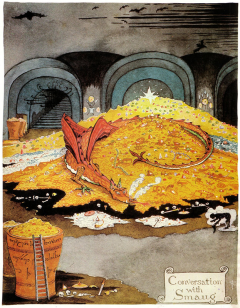
"Conversation with Smaug," by J.R.R. Tolkien ("The Hobbit"). Tolkien, who taught Anglo-Saxon at Oxford, and translated "Beowulf," drew extensively on the poem, and on the tradition to which it belongs, in his own fictional writing (image reproduced under fair usage protocols). 

[This is an Editors' Choice post, originally published on 17 August, 2017]

~~~~~~~~~~

Mark Patton blogs regularly on aspects of history and historical fiction at http://mark-patton.blogspot.co.uk. He is a published author of historical fiction and non-fiction, whose books can be purchased from Amazon.

Thursday, July 12, 2018

To Catch a Thief...

By Sarah Rayne

I’m keen on atmospheric settings and I’m very keen indeed on houses and buildings with intriguing histories.  In the early stages of drafting a new plot, looking for a hook on which to hang a building (so to speak), I came across a fragment of a very old English law.

It happened by purest chance.  One afternoon having become lost in the depths of the countryside, I drove past a field with a sign on the gate saying, ‘Infanger’s Field’. 

The English countryside is, it must be said, liberally strewn with strange and intriguing names. Quite near to where I live is a village called Coven. It’s an extremely nice place, but its name is always very deliberately pronounced ‘Coe-Ven’. Purists carefully point out that the name derives from the Anglo-Saxon, cofum¸meaning either a cove or a hut, but despite that, there are occasionally dark mutterings suggesting that the place once had witchcraft associations, and that the pronunciation was politely slurred to hide that fact. 

Then there are all those instances of Glue Works Lane and Slaughter Yard. There’s Pudding Lane where the Great Fire of London reputedly started in a baker’s shop. On the other hand, there are places whose names are open to interpretation, such as Cockshutt in Shropshire, which, despite sounding like a venue for a Carry On film, is likely to derive from fowl hunting activities. Other names are satisfyingly rooted in the past: Oxford has Brasenose College and Brasenose Lane – supposedly from the Brazen Nose door knocker of the original sixteenth century Hall. Incredibly, though, the city also once had the now-lost Shitbarn Lane, c.1290, which ran between Oriel Street and Alfred Street.

But Infanger’s Field? 

I made eager notes – I even ventured into the field itself to pace the boundaries, although it was a bit unfortunate that I dropped my notebook in the mud, (I think it was mud – I hope it was mud), and perhaps I wouldn’t have worn scarlet gloves if I had known there was a bull in the field. 

Then I dashed home to scour bookshelves and the internet.

And it seems that the word comes from the Old English infangene-þēof –  ‘Thief seized within’ or ‘in-taken-thief’.  Infangenthief or infangentheof, no matter how you spell it, was an Anglo-Saxon arrangement, supposedly from the time of Edward the Confessor – c.1003-1066, and one of the last of the royal House of Wessex. 


Infangentheof, and its sister law, outfangentheof, apparently permitted the owners of a piece of land the right to mete out justice to miscreants captured within their estates, regardless of where the poor wretches actually lived. On occasions it also allowed the culprits to be chased in other jurisdictions, and brought back for trial. The justice that was meted out was often extremely severe – there was no cheerful Gilbert & Sullivan principle of letting the punishment fit the crime in those days. People were beheaded – limbs were cut off – vagabonds were often whipped and chained in stocks. Others were forced to carry hot stones, or wear bridles over their tongues – a favoured method for troublesome wives, of course. Poisoners might be boiled alive.

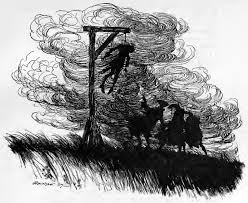
As for murderers, they risked being hung up in a cage, usually after their execution, although occasionally before it, so that people could watch their slow death. It was a day out for the ordinary people; you could take a bit of lunch with you, and it made something to tell the neighbours.
This grisly custom was sometimes useful to those unprincipled (and strong-stomached) souls who were resolved on proving the truth of the ‘Hand of Glory’ ritual – the belief that the dried hand of a hanged man had power. Writing the Ingoldsby Legends in the 1840s, the Reverend Richard Barham paints a deeply macabre image of three crones climbing up a gibbet in quest of such a gruesome fragment.
‘On the lone bleak moor, at the midnight hour,
Beneath the Gallow Tree,
Hand in hand, the Murderers stand,
By one, by two, by three!
Now mount who list, and close by the wrist,
Sever me quickly, the Dead Man’s fist.
And climb, who dare, where he swings in the air,
And pluck me five locks of the Dead Man’s hair.’
The privilege of exercising the law of infangentheof and extorting suitable punishments, was granted to feudal lords, and, inevitably, to religious houses, who generally liked to get their hands on any odds and ends of power that might be up for grabs.  When the Normans came barrelling in, they made cheerful use of most of these laws too, and they particularly liked infangentheof, which they felt helped keep the rebellious Saxons in their place.


The recipients of the privilege usually got a bit of a smorgasbord – as well as infangentheof, the king tended to throw in a few other goodies. The granting of a free borough, could be one, along with things called soke and sake, and toll and team.  Sake, despite sounding like something you’d glug down with your sushi, literally translated as ‘cause and suit’, while soke and team referred to the ‘privilege of holding court’, intended for judging people accused of wrongful possession of goods or cattle.

Toll was then, as it is today, the right granted to a landowner to impose a payment on the sale or passage of goods or cattle on his lands, or, alternatively, to be exempt from the tolls of others. So today’s motorists paying to drive along a particular stretch of motorway, and modern travellers struggling with the complexities of customs and excise (not least the present government in its wrangles with the EU), might justifiably direct their wrath towards the likes of King John. In fact, Henry III, in a Charter to the citizens of Norwich of 1229, makes ceremonious greetings to his subjects starting with bishops and archbishops and going all the way down the social scale to reeves, bailiffs, and the useful all-embracing term of ‘all faithful men’, after which, the courtesies having been observed and all Henry’s titles having been listed, (presumably in case somebody reading the edict didn’t know who he was), goes on to inform his subjects thus –
“… at the request and petition of our venerable father, John, the second [of that name], bishop of Norwich, we have granted and by this present charter confirmed to the burgesses of Lenn, that the borough of Lenn may be a free borough for ever, and they may have soke and sake, toll and team, infangenthief and outfangenthief.”
I have no idea if it was a fragment from the past I encountered with Infanger’s Field that day – perhaps a shred of some long-ago feudal baron who had named a field as a warning to miscreants.  And I’m doubtful if I could find the field again. 

The law itself fell more or less into disuse in the fourteenth century and all-but vanished from England’s history. Thankfully most of the punishments have vanished as well. But fragments of the law can still be found here and there. Such as in the name of a field that now houses only an indignant bull. 

~~~~~~~~~~

Sarah Rayne’s first novel was published in 1982, and since then she has written more than 25 books. As well as being published in America and Australia, her novels have been translated into German, Dutch, Russian, and Turkish. Much of her inspiration comes from the histories and atmospheres of old buildings, which is strongly apparent in many of her settings – Charect House in Property of a Lady, Twygrist Mill in Spider Light, and the Irish cottage,Tromloy, in Death Notes.  Music also influences a number of her plots: the music hall songs in Ghost Song, the eerie death lament ‘Thaisa’s Song’ in The Bell Tower, and the lost music in Chord of Evil that hides a devastating secret from WWII.
Connect with her at http://www.sarahrayne.co.uk/

Monday, May 28, 2018

The Enchantment of The Bayeux Tapestry

by Carol McGrath

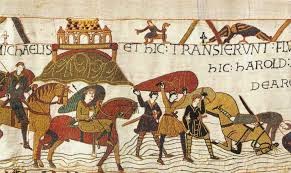
The Bayeux Tapestry has retained its enchantment and its vivid colour almost a thousand years after it was embroidered. It tells the story of The Norman Conquest through beautifully framed vignettes and long-shot depictions made in embroidery from Harold Godwinson's departure on a mysterious mission to Normandy in 1064 until his death at Hastings in October 1066.  I have often wondered about the fabric and the natural dyes used for the embroidery wools in the Tapestry's construction.

Scene from The Bayeux Tapestry

Carola Hicks wrote in her wonderful book The Bayeux Tapestry, The Life Story of a Masterpiece, "Made from the workaday fabrics of linen and wool, the Tapestry has often been described as an uncharacteristically humble artifact when compared to other works of the period, even an example of quaint folk art."

It is true that the Tapestry is not sewn with valuable gold, silver, and gems, or silk embroidery threads. It is by Anglo-Saxon standards a modest work, and yet it is a glorious feat of craftsmanship and artistry. The Tapestry is constructed in the everyday fabrics of linen and wool. Even so, its fabrics were designed and executed as the result of practice by extremely talented craftsmen.

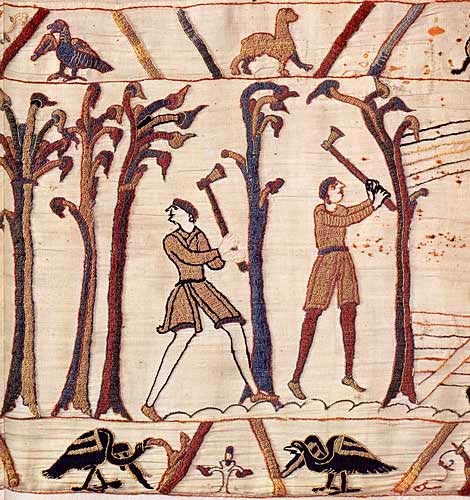
Woodland Scene from the Tapestry

Here in Tapestry the dramatic story of the Norman invasion of England is stitched out and embroidered on strips of linen. It is seventy meters in length and half a meter wide. The fact that these homely though durable fabrics, linen and wool, were used are the reason for its preservation despite its great age and fragility. Most of what we see today is original. Even where the Tapestry has been repaired we can still see the original stitch marks.

Spinning

Linen and The Tapestry

Linen has a long history. The ancient Egyptians found linen's sweat-absorbent and cooling properties divine. They attributed the invention of linen to the goddess Isis. With the advent of Christianity linen was used for priestly garments. It actually had a high status. It comes from the flax plant which was sown after Easter and harvested three months later. In the Middle-Ages the young plants were pulled by hand and never cut. Cutting might damage the stems. Plant stalks were soaked till they were decomposing, dried out, then smashed with mallets to separate the outer bark from the inner fibres. These were spun into thread on a hand spindle. Medieval women spun constantly. They attached a bundle of flax fibres to the cone-shaped top of a pole , the distaff. Then the other end was tucked under the spinner's arm. A spinner drew the fibres out from the top, twisted them onto a weighted whorl, then spun them tightly into a thread.

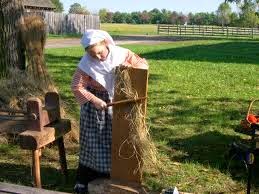
Retting (cleaning) the flax

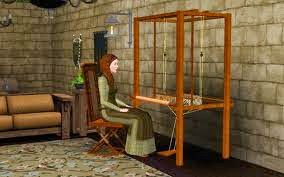
The Bayeux Tapestry consists of nine separate panels sewn together after they were embroidered. The two longest strips measure nearly 14 meters. This suggests a long warp or length setting. Other Tapestry sections are shorter. The original lengths were woven a meter wide and then cut to make strips that would be comfortable to embroider. A loom is used to weave the threads into lengths of fabric.  Carola Hicks thought that professional weavers made the linen on a horizontal treadle loom, a more advanced machine than an upright warp-weighted loom that was used to make woollen cloth.

Upright weaving frame

When the linen was woven it was a natural brown in colour. The linen was bleached by boiling it in a solution of water alkalized by the addition of wood ash, fern or seaweed. It was stretched out on frames for exposure to the light. It was still kept damp. After a period of three weeks or so the linen was soaked in a solution of sour milk fermented by rye or bran. The fabric was pounded with a piece of marble or glass to create a smooth silky texture.

Wool Embroidery on The Tapestry

It is considered by most Tapestry historians that there was a common cartoon source  for the Tapestry design. There is a similarity between the images, especially those of figures, emblems, plants, and animals, and those depicted on Canterbury manuscripts of the period. This suggests Canterbury as the location for the Tapestry's overall design. However, between three and eight workshops are suggested for the linen's weaving. There were probably several embroidery workshops involved as well. Likely contenders were Canterbury and Wilton.

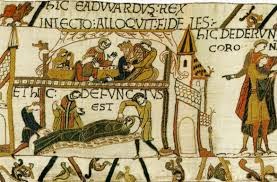
Queen Edith, the widow of Edward the Confessor, was one of the most notable embroiderers of the era, and after her husband's death she retired to Wilton Abbey which had a school for embroiderers. She may have had a hand in the execution of the Bayeux Tapestry. It is recorded in The Vita Edwardi Regis, completed around 1066-69, a few years after Edward's death, that several people were with Edward just before his death.  There were Harold Godwin and Archbishop Stigund. Edith, one of three women depicted on the Tapestry, who warmed his feet in her lap can be seen kneeling at the bottom of his bed. According to the Vita, Edward gave a prophetic vision and then said a few words to comfort Edith. Interestingly, Edward's death scene as depicted in embroidery on the Tapestry corresponds to that described in the Vita which was commissioned by Queen Edith. Wilton Abbey is, I suggest, one of the locations for the Tapestry's construction. Queen Edith may even contributed to which scenes should be included and their depiction.
 
King Edward's Death Scene

The embroidery is stitched in strands of worsted wool, the end product of an old and complicated process. An enormous amount of wool was dyed. Carola Hicks states more than 45 kilograms was used for the embroidery. The original wools remain vivid. They are also more resistant to moth than chemically dyed wools. Winchester was one of the cities that monitored the practice of dyers within its jurisdiction since dyes produced noxious waste products and hideous odours. Alum which was valuable was the favoured mordant. Dye ingredients came from animal, vegetable or mineral products acquired locally. Sometimes ingredients were imported from further afield to be smashed, boiled, and simmered, concentrated to extract the essence of a hue.

There are ten main tones on the Tapestry. They came from only three plants, woad, madder and weld. The dyes were blended into two reds, a yellow and a beige, three tones of blue and three tones of green.

Weld

Beige and yellow came from the flowers and leaves of weld.

Green also came from weld but it was mixed with the leaves of woad.

Woad produced the blues.

Woad

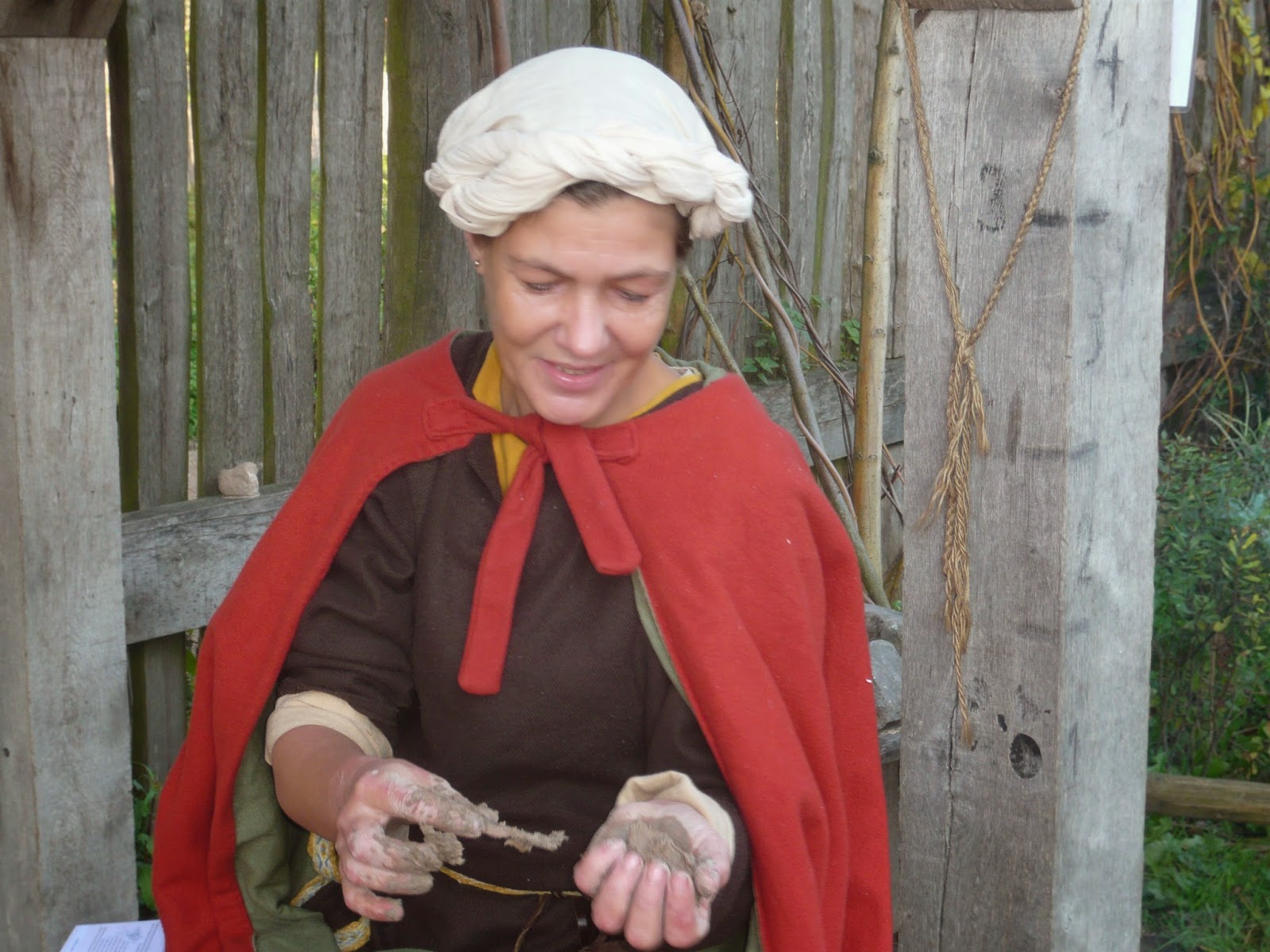
The reds came from madder. The roots of madder were ground into a powder, heated and simmered with added chalk or lime at a constant temperature for not more than two hours. Once a whole fleece was dyed to the required colours, a hand held spindle was used to turn the fibres into bales of worsted.

A friend of mine, Charles Jones, has had spinners and embroiderers working on a tapestry to tell the story of The Battle of Fulford September 1066. Here are a few of the dying recipes he has used to reproduce authentically the colours which his embroiderers used. Be careful if you try them out.

Weld

Chop lengths to boil for one and a half hours
Add wool and pinch of tartar
simmer for one hour
one hank of woad dyed wool added to light green will produce dark yellow.

Walnuts

5lbs of walnuts smashed and put to soak for twenty four hours
Tap water and a half cup of vinegar

Soak the wool for two days and then simmer for half an hour will produce a nut brown shade

Oak Gall Powder

20 gm of oak gall powder
boil for 30 minutes
teaspoon of salt
alum mordanted wool added
cook for twenty minutes
fix with salt and vinegar

Produces a light green-brown

These are just a few of the recipes used for dying wool used in embroidering a latter-day tapestry replica. I wonder if EHFA readers have had experience of creating dyes for wool using similar methods.

[This is an Editors' Choice archive post, originally published on this blog on 18th November 2014]

~~~~~~~~~~~~~

Carol McGrath is the author of The Handfasted Wife (2013) published by Accent Press and inspired by The Bayeux Tapestry.

The Swan-Daughter published by Accent Press (2014) is available now from Amazon.co.uk and from Amazon.com.


Monday, April 9, 2018

Women of the Middle Ages: Wimples, Veils, and Head-rails -Part I

By Paula Lofting                        

To Wear or not to wear a wimple

Boudicca
Public Domain
Mention women in the early middle ages and one often thinks of women wearing long silken head-rails with long braids, ribbons intertwined, but mention the dark ages, and it conjures up women with free-flowing locks that fly like banners behind them as they ride their chariots, pulled by wild, dark age ponies. This might have been so in pagan times, but even then, women would have worn some sort of head covering, especially for practical uses, like when working. These were times when long hair, if not contained, might cause life or death situations, like having your hair catch aflame when leaning over the cooking pot. I can imagine as it is now, finding long strands of hair in your stew would not have been very appealing. It was also a way of avoiding lice or getting other creepy crawlies caught up in it. However, it wasn't unknown in Christian times, when it was considered unseemly to have one's hair uncovered, to find images of unveiled women. Below is a reconstruction of Pictish stone carving with a high-status woman riding side-saddle, her hair uncovered.

 Photo Originally uploaded by
Deacon of Pndapetzim CC BY-SA 2.5 
We know that in Europe, in the medieval period, women did cover their hair, and that the origins of the moral code behind it lay in the early Christian church. This whole thing about women having to cover their hair for moralistic purposes within monotheistic religions, began in the middle-east. But what of the western nations who had only just adopted the monotheist ideology? Did they directly attempt to replicate the women of the eastern countries, or was there some other philosophy that women should cover their hair to the western provinces of the developing Christian world?

If we look back through history, the earliest documentation of the code seems to have first been promoted by St Paul. Paul, who was both a Jew and a Roman citizen, is thought to be the first apostle who spread the teachings of Christ throughout Asia Minor and Europe. He preached that women should cover their hair as submission to their husbands and when praying in church. In a letter to Timothy, he stated that women should dress modestly and not with 'broided' (meaning twined, braided) hair, or gold, or pearls, or costly array. But Paul was not the only one who lectured women on their modesty. Tertullian, a theologian writing in 200 AD, wrote that St Paul was not just referring to married women, but 'all women of age', most likely meaning those who had reached puberty. He admonishes those women who do not cover the whole of their head, leaving their ears and neck exposed. It seems that in covering the whole of one’s head, women were avoiding being gazed at, and were also encouraged to be ‘entirely’ covered, unless they were at home. Thus, it was the responsibility of women to ensure that they did not fall prey to sin, or to the lust of men, not the other way around, as according to the writings of Clement of Alexandria.

Alaric enters Rome [Public Domain]
The middle ages, it seems, started post the destruction of the Roman empire, so early 5thc, and ends, roughly, and depending on whose school of thought you prefer, the battle of Bosworth. Nice tidy dates there to follow without any blurring of boundaries. A sure beginning can be put in 410 AD, and the end, August 22nd 1485. I like those dates. So, what was happening in Britain at that time? According to the annals, Rome advised the administrators their most northern province, to look to their own defences, when they asked for help against invaders. Rome had left Britain’s shores for the last time, and they were not coming back. The barbarian was at their door. So those left behind would have been a mixture of British and Roman stock, but those Romans could have come from anywhere. They might have been retired legionnaires, settled, and married to British women. But just because a new epoch was about to start, didn’t mean that Roman life disintegrated overnight. Roman life in some semblance still continued into the 6thc as archaeological evidence shows.

When the exact date was of the arrival of Christianity in Britain, is not known, however, it is apparent both in archaeological and textual sourced that it was well established by the 5thc. Literature suggests that Roman women were required to cover their hair in public when walking out, but the evidence of images at this time in Britain suggests otherwise. Perhaps if the doctrine of hair-covering for modesty had reached these shores, it was not fully enforced.

The Pictish Hilton of Cadbol stone, in the picture above, which dates to around 800AD, has a Christian cross on one side of it, and a secular riding scene on the other, with a high-status lady riding side saddle, her hair uncovered. This is a reconstruction of the stone to show you clearer detail of what she is wearing and how her hair looks. It is not known who she is, but on her right are a mirror and a comb, indicative of her gender. It looks very much like a hunting scene, and the fact that she is riding side-on is intriguing, but the main delight is the way her hair is depicted in cascading waves down her back. It is fascinating, that even as late as this time, the Christian doctrine of wearing veils for modesty was not necessarily in play this far north, though it could be artistic licence. And it does not mean that the rule for church did not apply when it came to prayer time.

Reenactor, Rhydian Jones states, “If you’re on the east coast north of the Forth prior to 850 AD (ish) and doing Pictish (reenactment), the majority of evidence is that women wore their hair uncovered, and frequently wore a large cloak/shawl fastened in the centre of the chest with a penannular brooch… The bigger the brooch the posher you are.” The lady on the stone does seem to have a very large brooch. This cloak could have been pulled up over her head to provide extra warmth in inclement weather. Also, seperate hoods have been indicated also.
A cap showing the Sprang technique used by
Germanic women Photo by
Lyllyundfreya CC By-SA 30

In looking at the evidence for headdress in early the middle ages, in what was later to become England, it seems that the evidence, both archaeological and documented are scarce and what evidence there might be is debatable. That’s not to say that veils weren’t worn, just that there is a paucity of evidence. As I have said earlier, I believe that women wore head-coverings of some sort even in pagan times for the reasons I had previously mentioned, and not just for modesty. Among the dubious evidence found are small rings that might have been used for braid fasteners, but generally the consensus is that these are not practical for such a purpose. Gold brocaded fillets have also been found, but it is not known if they were worn to secure a veil, or worn without the veil.

To find evidence of what women in the British Isles might have worn on their heads, we need to look to their counterparts abroad: It is known that Germanic women in ancient Scandinavia wore caps, samples from bronze and iron age have been found to be woven in sprang, an ancient technique used in Denmark and other parts of the ancient world that made them look like hairnets. An example was found on the body of a girl recovered from the Arden Mose wearing hers over 2 coiled plaits of hair.

The Arden girl's hair [Public Domain]
via Wikimedia Commons
There is no evidence of sprang technique being used by Anglo-Saxon women though the technique was known in Britain. Drawstring-style caps were found to be worn on the figures of women wearing a Menimane Rhineland costume dated from the 5th/6th centuries. It is likely that these types of caps might have been worn in Anglo-Ssxon areas at this time.

Women in Iron Age Denmark regularly wore scarves. A bog body was found wearing a scarf at Huldremose, 1.37 metres long and 49 cm wide with fringed ends. Anglo-Saxon women may have worn similar types of veils/scarves and tabby-woven material has been found on the backs of brooches. The Merovingian queen, Arnegundis, was found in her tomb with a long red satin veil, secured by two small pins at her temples. This long veil was quite common in this period. Arnegundis seems to have favoured a longer, elaborate veil that might have been crossed over the breast and pinned, and hung over an arm. A parallel for this veil was found in the grave of the woman at Mill Hill, in Deal, Kent. Two clips have also been found like the Merovingian woman at the sides of a woman’s head in Cambridgeshire, showing that the fashion might have travelled to south-eastern parts of England. To view an reconstruction of Arnegundis' burial outfit, check this link

There is a considerable amount of linguistic evidence for head gear in Anglo-Saxon:

Haet, - AS for hat.
Cuffie - a loose fitting hood.
Scyfel - a hat or a cap with a projection.
Binde – a fillet. Binde may have been the name for the gold-brocaded fillet that a very few 6thc c women wore. Cloth ones would have left no trace.
Snod – Snood in AS in Old Norse - hofuthbond

So, in summarising, where the western world is concerned, it seems the nearer to Rome and the Orthodox Christian region, the more likely that head-covering was worn, mostly in respect of church teachings. We have seen that there is less evidence for wearing head-coverings than there is for not, and less archaeological evidence than documented or art. But we cannot discount the wearing of headwear for practical reasons, such as for work or for hygiene as opposed to following a religious moral code, but this does not increase the lack of finds.

The next post in the Wimples, Veils, and Head-rails, we venture down our time tunnel to focus on the centuries between the late 7th – 9th centuries. Please join me in this fascinating adventure to find out what we can about women in this time of so-called darkness, and shine a light on their lives.

References

Tertullian, The Veiling of the Virgins, The Ante-Nicene Fathers Vol.4 pp27-29,33.

Clement of Alexandria.

Rhydian Jones

Further reading

http://www.vikingage.org/wiki/wiki/Main_Page

Owen-Crocker G.R. 2004 Dress In Anglo-Saxon England The Boydell Press, UK.

~~~~~~~~~~

Paula Lofting is an author and a member of the re-enactment society Regia Anglorum, where she regularly takes part in the Battle of Hastings. Her first novel, Sons of the Wolf, is set in eleventh-century England and tells the story of Wulfhere, a man torn between family and duty. The sequel, The Wolf Banner is available now. Paula is currently working on the third book in the series, Wolf's Bane

Find Paula on her Blog
on her Amazon Author Page