Showing posts with label Chippenham. Show all posts

Tuesday, June 18, 2019

Should Alfred Be Known as the Come-back King?

By Chris Bishop

My title may seem to be rather ‘trite’ when referring to one of the truly iconic figures from English history but it is surprisingly apt.  There are many stories of great men who have lost almost everything yet managed to restore themselves and Alfred the Great must surely rank highly among them.  Let me explain why.

His story actually starts in 793 - nearly a hundred years before the era for which he is best remembered - when there was a surprise Viking attack on a monastery at Lindisfarne.  This was followed by more raids until, in circa 865, a Viking army, known as the ‘Great Heathen Army’, landed in East Anglia determined to conquer England for themselves.  This largely Danish force quickly secured most of the kingdoms which made up England at that time leaving just one, Wessex, to stand alone.

By 870 Wessex was ruled by King Aethelred who, with his younger brother, Alfred, held the Vikings off but the only significant victory they achieved was at the Battle of Ashdown in 871.  There Aethelred is said to have spent so long at Mass that Alfred pre-empted things and ordered the attack himself, thus enhancing his military reputation.  Aethelred died later that same year, probably from wounds received at the Battle of Marton.

England 878 Attribution Link

In those days there was no automatic right of succession.  Kings were ‘chosen’ and Alfred, as an accomplished warrior, was the obvious contender to succeed his brother (though not the only one).  As King, he continued his campaign against the Vikings but could not secure a decisive victory.  He also tried to buy peace by paying tribute, an act which didn’t best please the church or many of the senior Saxons.  Then, in 877, he retired to his Royal Vill in Chippenham for the winter, thinking himself safe until Spring.  But on the 10th day after Christmas (in January 878) the Vikings under Jarl Guthrum launched a surprise attack.   Alfred’s army – or at least that part of it which had remained with him - was all but annihilated.  Alfred fled with a few survivors and hid in the desolate marshes at Athelney in the Somerset Levels, a time which features strongly in my first novel, Blood and Destiny.

Given the ferocity of the attack, Alfred was lucky to escape with his life.  In fact, luck is a key element in his story.  For a start, he was ‘lucky’ that only part of the Viking army attacked his Vill.  Had it been the full force it’s doubtful he would have survived.  Also, he was ‘lucky’ to be King in the first place as, being the youngest of five brothers, he was destined for a life in the church until one by one his brothers predeceased him and he found himself as King.  

But King of what?  His kingdom was all but lost and he had nothing which could be described as an army at his disposal.  Estimates of the numbers who accompanied him vary but it’s likely that many of them would have been wounded and no doubt dejected having lost family and friends in the attack - and the marshes at Athelney were a harsh and forbidding place in which to survive the winter.  Yet it is from this miserable and wretched period that many of the stories about Alfred emanate - such as the burning of the cakes and the contention that he disguised himself as a wandering minstrel and actually returned to Chippenham to spy on the Vikings.  Make what you will of the story about the cakes (you might like to see the blog on my website ‘So, Did Alfred Really Burn the Cakes?’ www.chrisbishopauthor.com) but the idea of him returning to spy on his enemies is an unlikely proposition given that the prize for anyone prepared to betray him would have been wealth beyond reckoning.  

Undaunted, Alfred conducted what might best be described as a guerrilla campaign against the Vikings and, by Easter that same year, had somehow managed to rally the Saxon people in sufficient numbers to strike back and win a decisive victory at the Battle of Ethandune which then secured his realm of Wessex and ultimately provided the basis for a united England, albeit that didn’t happen until several generations later. 
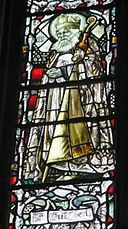
Stained-glass window in Gloucester
Cathedral depicting Cuthbert -
Attribution Link
 My novel, Blood & Destiny, offers one possible explanation of how he achieved this incredible ‘come back’ but it remains a mystery.  The Saxons had efficient mechanisms for calling their men to battle but after so many years of war it’s likely that most would have had their fill of raids and fighting, particularly as Alfred, having gone into hiding, would have been thought by many to have been slain or to have fled abroad.  If so, his reappearance at Easter may have been seen as some sort of ‘resurrection’ in itself, something which would have helped to stir many loyal Saxons into action.  After all, they were fighting not just for themselves and their families, but for their freedom, their religion and for their whole way of life. 

One other important aspect of the battle is that Alfred claimed to have had a visitation from St Cuthbert who urged him to avenge the Christian church.  The ‘support’ of such a holy and much-loved saint would have encouraged many Saxons to follow Alfred, especially as the visitation would have seemed believable given that St Cuthbert had been disinterred from his grave at Lindisfarne and moved to keep his remains safe from Viking hands.  If no longer at rest, it would have been easy and heartening for the deeply religious Saxons to think of the goodly saint supporting their cause. 

So, what do we know about this important battle? 


Memorial stone to the battle at Edington,
erected in 2000 - Attribution Link
Well, the answer is not very much.  We’re not even sure exactly where it took place – some claim it was in Somerset but more likely it was close to a place called Edington near Chippenham and is therefore sometimes called ‘The Battle of Edington.’  

We also know very little about the tactics employed that day or how the battle progressed, though my novel does include a detailed account of what I think may have happened.  This is based on the fact that typical Saxon tactics would have involved a defensive shield wall with their foes pressed up hard against them locked in desperate hand to hand combat – but on foot, not on horseback as is sometimes depicted, for at that time most warriors tended not to ride into battle.  There is a story of Alfred leading a charge at the Battle of Ashdown mounted on a white horse but I find this to be unlikely as commanders usually positioned themselves at the rear of the shield wall from where they could best direct their men using runners to ensure their orders were properly relayed to all.  Ironically, a full-scale charge on horseback was probably first used against the Saxons at the Battle of Hastings to devastating effect – but that’s another story.  

Battle reenactment scene - Attribution Link

The outcome of the battle was a surprising victory for Alfred, forcing the Vikings to retreat to Chippenham where they held out for many days before surrendering.  When they did, Alfred actually showed compassion and wisdom in agreeing the terms of a peace treaty (The Treaty of Wedmore) which eventually ceded control of lands to the Vikings to ensure they didn’t trouble Wessex again (The Danelaw).  This respite provided a period of relative and much needed peace which, although it didn’t last, enabled Alfred to instigate the many reforms and initiatives for which he is renowned.

The relevance of this surprising victory reaches deep into English culture for had King Alfred not triumphed there, virtually the whole of England would have been under Viking rule and Alfred himself either executed or slain.  Had that occurred, many of the hugely important events which followed would simply not have happened; including quite possibly the Battle of Hastings given that the Vikings had such close ties with the Normans – the name ‘Norman’ is actually derived from the ‘Norsemen’ or ‘Northmen’,  Vikings who had settled in that part of France.  Whilst not exactly brothers, they might be considered as cousins, albeit many times removed.  

There is one postscript to the battle in that recent archaeological evidence suggests that Alfred may not have stood alone at Edington.  Coins struck just after the battle depict Alfred and Ceolwulf II of Mercia sitting side by side, suggesting that he enlisted – or perhaps accepted - help from Ceolwulf to fight a common foe.  Or did it reflect the alliance between them once victory had been achieved?  
Either way, Alfred must be credited for restoring his realm and turning utter defeat into triumph – no mean achievement when you consider the forces he was up against and what he went on to accomplish. Little wonder that he is one of the few people in the history of the world to be afforded the title ‘The Great’.

[Illustrations: all sourced from Wikipedia/Commons Licence - click on attribution links for more details]

~~~~~~~~~~

Chris Bishop is the author of the Shadow of the Raven series, a trilogy set in the time of Alfred the Great.

Website: www.chrisbishopauthor.com
Twitter: @CBishop_author
Chris is a member of the Historical Novel Society and the Historical Writers' Association


Thursday, April 6, 2017

The (Almost) Forgotten Battle

by Chris Bishop

If you asked most people to name the most important battles ever fought on British soil the chances are that the Battle of Hastings would rank high on their list.  The battle most likely to be omitted altogether is the one which had an equally significant impact on all our lives and which few people have even heard of – the Battle at Ethandune in 878.

Progress of the Great Heathen Army
Image by Hel-hama - Own work, CC BY-SA 3.0

The relevance of this conflict reaches deep into English culture for had King Alfred not triumphed there, virtually the whole of England would have been under Viking rule and Alfred himself either executed or slain.  Had that occurred, many of the hugely important events which followed would simply not have happened – including quite possibly the Battle of Hastings itself given that the Vikings had such close ties with the Normans.  More importantly, we would have been denied many of Alfred’s very significant achievements - this includes the beginnings of the unification of England and cultural changes such as having important books translated and rewritten in English so they could be more readily understood (even though few people could read at that time).  He also set about creating a stronghold of fortified Burghs and establishing the beginnings of a navy as a way of securing a period of relative and much needed peace.  That is not to say that England as a whole was suddenly free from the threat of invasion or further Viking raids, but he used the respite his victory gave him to instigate administrative and legal reforms which meant a much fairer system for all, many of which are still relevant today.

So, what do we know about this important battle?  The answer is not very much.  We’re not even sure exactly where it took place except that it was probably close to a place called Edington and is therefore sometimes called ‘The Battle of Edington.’  My own interpretation of events is as follows:-
The background to the story is that having been defeated in a surprise attack on his Vill at Chippenham soon after Christmas, Alfred retreated with the remnants of his army to hide out in the desolate marshes at Athelney.  It is from this miserable and wretched period that many of the stories about Alfred emanate -  such as the burning of the cakes and the contention that he disguised himself as a wandering minstrel and actually returned to Chippenham to learn what he could of the Vikings plans – (surely an unlikely proposition given that he would have been so well known to his enemies?).  What we do know is that by Easter Alfred had managed to rally his men in sufficient numbers to strike back and win a decisive Victory at the battle of Ethandune which then secured his realm of Wessex.
England in 878 - Image Hel-Hama

Some records suggest that the Vikings, led by Lord Guthrum, held the ridge at Ethandune thereby forcing the Saxons to charge uphill.  If so, Alfred still won the day amidst terrible slaughter on both sides. I have to say I think there is an element of propaganda in this contention as, in my view, Alfred is likely to have arrived at Edington first and would therefore have had the opportunity to choose his ground.  As a skilled and experienced commander, he would surely have positioned himself on the high ground and thus held the advantage of the field.  Remember that Guthrum was safely ensconced in Chippenham (in Alfred’s own Vill) and would not have expected Alfred to have the ability to raise anything like an army after such a devastating defeat only a few months earlier. Guthrum would have therefore felt no need to rush into the battle, hoping Alfred’s men would disperse to tend their farmsteads after a long hard winter. Perhaps the suggestion that the Saxons fought uphill was a way emphasising what a great victory they achieved and what a great leader they’d found in Alfred?

To my mind, the greatest mystery of all was how Alfred, having been virtually annihilated at Chippenham, managed to raise anything resembling an army so quickly.  It would have helped that the battle was fought at Easter as this would have done much to rouse the deeply religious Saxons given that Alfred, having gone into hiding, was believed by many to have been slain or fled abroad.  Thus his reappearance at such a crucial time must have been seen as some sort of resurrection in itself, something which would have helped to stir many loyal Saxons into action even though, by then, most people probably craved peace above all else.  Also, the Saxons had their backs to the wall and so some may have felt they had nothing to lose – after all, they were fighting not just for themselves but for their freedom, their religion and for their whole way of life.  It is also said that Alfred claimed to have the support of St Cuthbert who was a much revered and well-loved saint.  A visitation by St Cuthbert may well have seemed believable to many given that his body had been disinterred and moved to keep his remains safe from Viking hands.  If no longer at rest, it would have been easy and heartening for them to think of the goodly saint supporting the Saxon cause.

Perhaps the most difficult aspect to grasp is how Alfred managed to defeat the dreaded Vikings.

Typical battle tactics would have involved a shield wall and desperate hand to hand combat – but on foot, not horseback, for at that time most warriors didn’t ride into battle.  Ironically, a charge on horseback was used against the Saxons at the Battle of Hastings to devastating effect – but that’s another story!

So who were these fearsome Vikings?  Well it would be wrong to think of a race of people who had nothing better to do than raid, rape and pillage.  For a start, the ‘Vikings’ who attacked our shores were probably second sons with no land to inherit, outcasts, men banished for crimes and – quite likely – a good number of adventurers.  Indeed the word Viking is actually a verb which means to go ‘a Viking’ rather than the name of a group of people.

Although sea farers by inclination, it took skill and courage to cross the North Sea in an open boat, so what was it that lured them to risk these dangers and sail to our shores?  Plunder is an obvious answer but, more likely, they also wanted land – hence Alfred’s plan whereby having secured victory, he ceded areas to them so long as they didn’t trouble him again.  None of this should diminish the image of battle hardened warriors who carried out some brutal attacks, choosing the fat monasteries as readily as the homes of ordinary people, usually with much bloodshed.  But these were brutal times – war was conducted very much up close and personal, with hand to hand combat being the norm.  It was also a very dangerous occupation because even minor wounds received whilst fighting might well become infected and therefore cause an agonising death sometime later.


Favourite weapons for the Saxons would have been a spear and/or a bow, items readily available to them for use when hunting.  Only the very wealthy men would have possessed a sword but quite a few would have carried a seaxe – a short singled edged sword ideal for use at such close quarters that there was little room to wield anything larger.  Logically, those in the second rank of the shield wall might have used longer handled spears to keep the Vikings at bay, though once the enemy got between these the spears would have been all but useless. A great many projectiles would have been used by both sides – arrows, javelins, throwing axes etc - but, for the Vikings particularly, the favourite weapon was probably various types of axe as these could be used to haul aside a shield and inflict terrible injuries, cutting through mail, flesh and bone.  In reality, there was probably nothing which could be described as ‘standard kit’ on either site – everyone just carrying whatever weapons they had.

Given the ferocity of the weaponry, mail vests and helmets might seem a good idea to us but they would not have been available to everyone, regardless of which side they were on.  That said they would doubtless have protected themselves as best they could with padded jackets, leather caps, gloves and such like.

So, all in all, a pretty vicious affair with a high body count and some dreadful wounds. Which brings me to the question of how they dealt with the wounded.  It might seem an anathema to us, but I suggest that warriors would have put their own badly wounded comrades to the knife rather than let them suffer a slow and lingering death - leaving their enemies to die in agony.  I confess I have no firm evidence to support this, though in my view it does make sense at a time when life was cheap, short and often pretty wretched.  That is not to say that they lacked any ability to tend their wounds for we know of many cures, not all of them entirely effective but nonetheless capable of bringing an element of relief.  Some we would find quite strange – for example, where an amputation was required, some accounts suggest that the Vikings would force the hapless victim to drink a strong broth made of leeks and herbs and the next day they would sniff the wound and, if they could smell the leeks emanating from it, the man was deemed to have little chance of survival.  What they would do then would depend on who he was or who is friends were as much as anything else.  One thing is for certain, whilst on a raid there would be little scope for carrying a wounded man without a very good reason for doing so.

Memorial to the Battle of Ethandune - Image Trish Steel

The last question is why, if battles were so brutal and so dangerous, would anyone in their right mind want to get involved in one?  The incentive for the Vikings has already been mentioned but as for the Saxons, many were sworn to support their Ealdorman and so had little choice.  They would have been trained by the Fyrd in at least the rudiments of combat though were probably no match for a fully fledged or experienced warrior.  They would have donned what war gear they had (probably passed down to them or scavenged from a previous battle), picked up whatever weapon came to hand and followed their Lord into battle.  That was the way of things then and most people had little option but to do as they were ordered.

The Battle of Ethandune itself was said to have lasted most of the day – pretty exhausting stuff when you think of wielding a heavy weapon whilst fighting at such close quarters.  Alfred’s forces eventually prevailed and the Vikings retreated to Chippenham where they were besieged for 10 days before surrendering.  Alfred must have had enough men to then surround the settlement which shows just how large the force was that he managed to muster.  This in itself is surprising given how little time he had to summon his army, particularly given that the battle took place in the Spring when many men would have been needed to tend the land so not everyone would have been available to fight.  Either way, Guthrum had not prepared himself for a siege otherwise he might have held out long enough for Alfred’s men, already laden with the booty stripped from the dead and dying Vikings, to have dispersed and returned to their long-neglected lands.

So, when Guthrum at last surrendered, the ‘almost’ forgotten battle ended – a major triumph for Alfred which led eventually to the Treaty of Wedmore and an extremely important outcome for the English.  No wonder Alfred is the only English King (indeed one of the few men in history) to be afforded the title ‘Great’, an epithet he well deserved.

~~~~~~~~~~

Chris Bishop is the author of Blood and Destiny, a novel based on the events leading up to the Battle of Ethandune.  It is his first book and forms part of a series entitled The Shadow of the Raven.