Showing posts with label silver. Show all posts

Friday, February 9, 2018

Coffee, Tea and Chocolate: A cup for every purpose

by Maria Grace

During the regency era, there were three particular luxury drinks: tea, coffee and chocolate. They were in high demand, but expensive to acquire and, in the case of chocolate, difficult to make. Now of course luxury drinks needed accessories to go with them, just like our iphones need fancy cases—gotta show off the bling, right?  
Proper hostesses would do exactly that with specialized cups and pots for each beverage. The differences between the pieces were not random though, they were based on the way the drinks were created and enjoyed. Rather scientific, if you think about it. 

Drinking chocolate was often prepared in a large saucepan and then poured into special pots, known in France as a chocolatière, designed just for serving it. At first, when chocolate was a luxury limited to only the most elite, chocolate pots were made exclusively of silver with fine hardwoods or ivory used for the finials. In the early 1700’s, porcelain chocolate pots were made in China for export to Europe. Later, sturdier (and less expensive) pots were made of pewter or earthenware. Chocolate pots tended to be tall and relatively slender, looking a lot like coffee pots, but with a few significant differences in the lid, the spout and the handle. 

Drinking chocolate was very thick and tended to settle, so it was essential to continue whipping it with the molinet. To accommodate the molinet, a chocolate pot had a very distinct lid. The top of a chocolate pot had a hole for the molinet handle to extend from, allowing the hostess to stir the chocolate without splashing herself or her guests. The hole might remain uncovered, but in many cases a special hinged or swiveling finial would cap the hole and help preserve the heat in the chocolate. Sometimes the finial might be attached by a chain to the pot so it would not get lost.

Spouts on chocolate pots were wide and set high on the pot. Both qualities relate to the froth on the top of the chocolate. Since the froth floats on top of the chocolate, locating the spout high helps to capture the foam. Similarly, a wide spout facilitates getting it into a serving cup. A high spout also helps to keep the undesirable sediments that settled to the bottom out of the serving cups. 

The earliest chocolate pots had handles set at right angles to the pot. Usually these were made of wood, with a bit of a knob at the end. After the later part of the 1730’s, chocolate pots with looping handles in line with the pouring spout were produced. 

Drinking chocolate was thick, even syrupy, very different from tea or coffee. Its thickness, and the need to preserve the froth on top meant that special cups were required to properly enjoy sipping the chocolate through the milky froth. Here's where it gets particularly interesting--to me at least.

Chocolate cups were taller and narrower than coffee or tea cups. This would force the foam into a thick layer on the top and keep it from dispersing so quickly. Their unique shape also gave them a high center of gravity, which in English means it made them more likely to spill, especially if one's hands were less than steady.

That problem gave rise to a whole new style of china. 

The trembleuse or tasse trembleuse originated in Paris in the 1690's and was designed to allow those with trembling hands to drink with greater ease. It consisted of a cup, often with a lid and two handles, and a saucer with ether a deep well or a raised rim that steadied the cup and kept it from tipping. 
In contrast, teapots tend to be short and stout (remember the kids’ song?)  The round shape allows room for the tea to move in the pot, allowing it to steep more effectively. Their short spouts come from the center of the pot and sometimes have a grate behind to keep the tea leaves from clogging the spout.  The short length makes them easier to clean if leaves get trapped inside the spout. 

Because tea steeps near boiling, it must be slightly cooled before drinking. A tea cup has a wide open rim that tapers down to a smaller base and a handle designed to hook a single finger, all purposed to help cool the tea and prevent burns.

In many ways, coffee serving pieces do the opposite. Coffee pots are designed to help maintain the heat of the beverage, which preserves its flavor. The taller, narrow shape helps minimize heat loss. The longer, low-mounted spout helps keep cool air from circulating into the pot.


Coffee tastes best when served hot. Since it brews at around 180F, burns are not as much a concern as keeping the beverage hot. So coffee cups have a more vertical, cylindrical shape and bigger handles to accommodate two or three fingers which helps them conserve the beverage's temperature.

A proper regency hostess would have had all three sorts of china in her collection and been able to identify these pots at just a glance. In all likelihood, she would not have considered serving chocolate from anything but a chocolate pot. For the rest of us though, chocolate served from another sort of pot would still be chocolate, right? And that has to be a very good thing indeed.

References

Deitz, Paula. "Chocolate Pots Brewed Ingenuity." The New York Times. February 18, 1989. Accessed May 24, 2017. http://www.nytimes.com/1989/02/19/arts/antiques-chocolate-pots-brewed-ingenuity.html.
Kane, Kathryn. "Regency Chocolate:   The Correct Accoutrements." The Regency Redingote. August 02, 2011. Accessed May 24, 2017. https://regencyredingote.wordpress.com/2011/05/20/regency-chocolate-the-correct-accoutrements/. 
Righthand, Jess. "A Brief History of the Chocolate Pot." Smithsonian.com. February 13, 2015. Accessed May 24, 2017. http://www.smithsonianmag.com/smithsonian-institution/brief-history-chocolate-pot-180954241/.


~~~~~~~~~~

Though Maria Grace has been writing fiction since she was ten years old, those early efforts happily reside in a file drawer and are unlikely to see the light of day again, for which many are grateful. 

After penning five file-drawer novels in high school, she took a break from writing to pursue college and earn her doctorate. After 16 years of university teaching, she returned to her first love, fiction writing.

Click here to find her books on Amazon. For more on her writing and other Random Bits of Fascination, visit her website. You can also like her on Facebook, or follow on Twitter.


Friday, November 4, 2016

An Extravagant Royal Mistress: Nell Gwyn's Silver

by Margaret Porter

In February 1671, King Charles II moved his mistress Nell Gwyn into a newly built brick residence at Pall Mall's western end.

Nell and her sons by King Charles II

The king granted a "long lease under the Crown," but Nell strenuously objected to these terms. She proudly declared that she had always "conveyed [her affections and body] free under the Crown and always would, and would not accept it till it was conveyed free to her by an act of Parliament." The king assented. A large property adjacent to St. James's Park, it boasted seventeen fireplaces and some furniture left by the previous occupant, Lord Scarsdale. The site, now 79 Pall Mall, is marked by a Blue Plaque denoting its association with Nell.

Nell's Blue Plaque
In March 1671, John Evelyn encountered King Charles outside his queen's rooms at Whitehall and left this immortal account of his reluctant encounter with the royal mistress:
I thence walk'd with him thro' St. James;s Parke to the garden, where I both saw and heard a very familiar discourse between [him]...and Mrs. Nellie as they cal'd an impudent comedian, she looking ouf of her garden on a terrace at the top of the wall, and [he]... standing on the green walke under it. I was heartily sorry at this scene.
At about this time Nell was being painted by Peter Lely, depicted as Venus with her year-old son Charles (as yet lacking surname or title) kneeling beside her, head bowed, in the guise of Cupid. Nell placed the portrait in her salle des miroirs (hall of mirrors).

Nell in the nude. Private collection.

By the time her second son James was born on Christmas Day, ten months after moving into her new residence, Nell had a rival for His Majesty's affections: Louise de Kerouaille, placed at the English court by King Louis XIV of France, who bore the king's son in July, 1672. A year later he bestowed on her the title Duchess of Portsmouth and provided lavish apartments in Whitehall Palace. Competition between the mistresses seems to have included precious metals as well as the monarch's affection. When word circulated that a silversmith was making a costly dinner service, the king's gift to his French mistress, Londoners visited the shop to stare at these objects and "throw out curses against the duchess." Some declared that the silver should be melted and poured down Louise's throat. And everyone believed that "it was a thousand pities His Majesty had not bestowed this bounty on Madam Ellen." Nell purchased her own dinner service of solid silver, engraved with the initials E.G. (for her full name, Ellen or Eleanor Gwyn) and paid £60 for "a dozen silver trencher plates."

The absence of any payment for Nell's double-blade silver-handle fruit knife may confirm the legend that it was given by Charles II. Its silver blade was used to cut oranges, and the steel blade was used for non-acidic fruit.

Nell's fruit knife. Private Collection.

Not content with her gleaming tableware, Nell also commissioned a silver bed, and received this bill from silversmith John Coques in 1674:

Delivered the head of ye bedstead weighing 885 ounces 12lb. and I have received 636 ounces 15 dweight so that there is over and above of me owne silver two hundred forty-eight ounces 17 dweight at 7s. l1d. per ounce . . .which comes to £98 10s. 2d.
For ye making of ye 636 ounces 15 d't at 2s. 11d. per ounce comes to £92 17s. 3d.
Delivered ye kings head weighing 197oz 5dwt
one figure weighing 445oz 15dwt
ye other figure with ye character weighing 428oz 5dwt
ye slaves and ye rest belonging unto it 255oz
ye two Eagles weighing 169oz 10dwt
one of the crowns weighing 94oz 5dwt
ye second crowne weighing 97oz 10dwt
ye third crowne weighing 90oz 2dwt
ye fourth crowne weighing 82oz
one of ye Cupids weighing 121oz 8dwt
ye second boye weighing 101oz 10dwt
ye third boye weighing 93oz 15dwt
ye fourth boye weighing 88oz 17dwt
Altogether two thousand two hundred sixty five ounces 2d. weight of sterling silver at 8s.per ounce comes to £906 0s. 10d.
Paid for ye Essayes of ye figures and other things into ye Tower £0 5s. 0d.
Paid for Jacob Hall dancing upon ye rope of wire-work £110 0d.
For ye cleansing and burnishing a sugar box, a pepper box, a mustard pot, and two kruyzes £0 12s. 0d.
For mending ye greatte silver andirons £0 10s. 0d.
Paid to ye cabinet-maker for ye greatte board for ye head of the bedstead and for ye other board that comes under it and boring the holes into ye (bedstead) head £3 0s. 0d.
Paid to Mr Consar for carving ye said board £10 0s. 0d.
For ye bettering ye solder wich was in the old bedstead £5 3s. 7d.
Paid to ye smith for ye two iron hoops and for ye 6 iron bars, krampes, and nails £1 5s. 0d.
Paid for ye woodden pedestal for one of ye figures £0 4s. 6d.
Paid ye smith for a hook to hang up a branche candlestick £0 2s. 0d.
Paid to ye smith for ye bars, kramps and nails to hold up ye slaves £0 5s. 0d.
Given to my journeyman by order of Madame Guinne £1 0s. 0d.
Paid to ye smith for ye ironwork to hold up ye Eagles and for ye two hooks to hold the bedstead against the wall £0 3s. 0d.
Paid for ye pedestal of ebony to hold up the 2 georses £1 10s. 0d.
For ye mending of y gold hourglass £0 2s. 6d.
Delivered 2 silver bottles weighing 37oz 17dwt at 8s. per ounce comes to £15 2s. 9d.
Paid for ye other foot to hold up ye other figure £0 4s. 6d.
For soldering ye holes and for repairing, mending ,and cleansing the two figures of Mr Traherne his making £3 0s. 0d.
For ye making of a crowne upon one of ye figures £10 0s. 0d.
Given to my journeyman by order of Madame Guinne £1 0s. 0d.
Delivered a handle of a knife weighing 11dwt more then ye old one which comes with ye making of it to £0 5s. 10d.
For ye cleansing of eight pictures £0 10s. 0d.
In all comes to £1135 3s. 1d.
 

The silversmith's bill.

The total is estimated to be £100-150,000 in modern currency. The symbolism of the figures adorning the bed is clear. The king's head, described by a descendant of Nell's as weighing the same as "a fully grown cat," and coronet represent her lover, the provider of house and the funds with which she purchase the magnificent bed. It is supposed that her sons were models for the cherubs or "boyes". The motif of slaves provides an exotic element, one that recurred in Restoration plays. Eagles and crowns stand for power. Most surprising of all is the figure of rope-dancer Jacob Hall balancing on a wire--he was one of Barbara Castlemaine's reputed lovers. Clearly an existing bed was re-fitted, and its structure and supports are clarified by references to the cabinetmaker who provided the headboard, the man who carved it, and the smith responsible for the ironmongery involved in its assembly. Iron hooks were necessary to secure the bedstead to the wall.

A bed so grand required an equally grand setting, so Nell hired carvers, furniture makers, and an upholsterer to improve her bedroom. The woodwork featured her E.G. monogram, window seats were added, curtained with satin. These improvements were completed by August 1675. The work must have created dust and dirt enough to spoil the windows, because she had them re-glazed. The glass came from Normandy, the finest in that period, cut into small individual panes.

By this time Nell's income was £4000 per year, paid quarterly, increasing to £5000 after her son Charles was ennobled as the Duke of St. Albans. Unlike other mistresses, whose child support payments went to trustees, Nell directly received the monies for her son's maintenance--one biographer believes this was because she was the only one deemed trustworthy enough to actually spend the money on her children. She had a supplementary Irish pension and received occasional monetary gifts--one funded her bedchamber's refurbishment.

In late 1678, Nell's house was robbed. On January 3, this advertisement appeared in the London Gazette:
All goldsmiths and others to whom our silver plate may be sold, marked with the cipher E.G., flourished, weighing about 18 ounces, are desired to apprehend the bearer thereof, till they give notice to Mr Robert Johnson, in Heathcock Alley, Strand, over against Durham Yard, or to Mrs Gwin's porter in the Pell Mell, by whom they shall be rewarded.
Notice of Nell's stolen silver in the London Gazette.
It is not recorded whether these items were recovered and the reward paid. But it was the hated Louise, Duchess of Portsmouth, who had the lion's share of silver furniture. On October 4, 1683, John Evelyn--fated to find himself in the company of the King's lewd women--reports:
Following His Majesty through thro' the galleries, I went...into the Dutchesse of Portsmouth's dressing room within her bedchamber, where she was in her morning loose garment, her maids combing her, newly out of her bed...but that which engag'd my curiosity was the rich and splendid furniture of this woman's apartment . . . plate, tables, stands, chinmey furniture, sconces, branches (candelabra), braseras (braziers), &c. all of massive silver, and out of number.
Ten years after taking delivery of her silver bed, Nell was selling certain items of silver, to be melted down, to cover her recent expenditures. As she related in a letter to one Madam Jennings: "The bill is very dear to boil the plate, but necessity hath no law."

She retained many valuables when she died, probably in that great silver bed. Her will, made a few months before her death in 1687, references "all manner of my jewels, plate, household stuff, goods, chattels, credit, and other estate whatsoever, I gave and bequeath the same...by way of trust for my said dear son...for his own sole use and peculiar benefit and advantage." Although she bequeathed her only surviving son and heir diamonds, jewels, plate, artwork, three houses (in London, Windsor, Nottinghamshire), and lesser property, mostly she left him debts. Much of her silver was held by the bankers Child & Co. as a pledge towards her overdraft. Some time after the young Duke of St. Albans came of age and before his marriage to Lady Diana de Vere, daughter of the 20th Earl of Oxford, he sold the Pall Mall house and much of his mother's jewellery. The eventual sale of her plate brought £3,791.5s.9d. A silver teapot remained with the family until 1786.

The duke's 2-piece silver spirits flask, engraved with his coat of arms, is displayed in the Victoria & Albert Museum. There's no evidence that his mother commissioned it, but she might have done in her last year. It's exactly the sort of costly personal item she loved to bestow on the beloved son who far outranked her.


The Duke of St. Albans's spirits flask

Nell's legend endures, and history remembers her as a woman endowed with wit, beauty, spirit, humour, affection--and extravagant tastes.

~~~~~~~~~~~~~
 
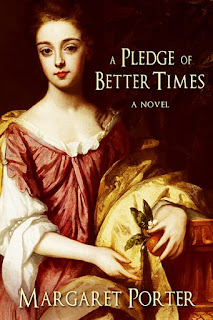
Margaret Porter is the award-winning and bestselling author of twelve period novels, whose other publication credits include nonfiction and poetry. Nell Gwyn's son is a primary character in A Pledge of Better Times, her highly acclaimed novel of 17th century courtiers Lady Diana de Vere and Charles Beauclerk, 1st Duke of St. Albans. Margaret studied British history in the UK and the US. As historian, her areas of speciality are social, theatrical, and garden history of the 17th and 18th centuries, royal courts, and portraiture. A former actress, she gave up the stage and screen to devote herself to fiction writing, travel, and her rose gardens.

Connect with Margaret:

Friday, November 27, 2015

Mrs Gaskell's Tower Part I - Historical Trails & Serendipity

By Annie Whitehead

I'm fortunate to live in a part of the world which gives me easy access to many areas of outstanding natural beauty. And I tend to veer away from the obvious spots in the English Lake District to see what else is on my doorstep.

On the northern edge of Morecambe Bay lies a little place called Silverdale, and it was here, at Lindeth Tower, that Elizabeth Gaskell, novelist and biographer of Charlotte Bronte, used to come for her holidays.


As an historian and an author, I love to go wandering along a trail, be it metaphorical or geographical. Mrs Gaskell's Tower had given me a starting point, but she is a literary, rather than historical figure. Little did I know that what started as a 'Victorian' day, would become a day when I got tantalisingly close to the Anglo-Saxons ... 

A pleasant walk down a lane strewn with autumn colours took me down to Jenny Brown's point, where a chimney stands as a reminder of this area's industrial past:


Walking back from the point, I found an old lime kiln which has been reconstructed, fenced off, and given a little placard explaining the history and uses of lime-burning. I also discovered that there was a shipwreck in the area in 1894, when a pleasure yacht, The Matchless, foundered off Jenny Brown's point with the loss of 25 souls.

The English poet Gordon Bottomley (1874-1948) lived in the village and was visited often by his friend, the artist Paul Nash.
Silverdale is noted for its wells, which used to serve the village, and Woodwell is situated, as one might guess, in an area of peaceful woodland.
photo by Zephyrine Barbarachild

It was a wonderful walk, despite the typical northern weather that day, but I left feeling that I hadn't uncovered everything that Silverdale knew ...

And then I remembered that a while ago I'd read in the local paper about the Silverdale Hoard. Now, I'm an Anglo-Saxon-ist, rather than a Viking-ist, so the Silverdale Hoard didn't initially get my pulse racing in the way that the Staffordshire Hoard is apt to do. And yet, and yet ... something drew me to investigate.

2oo pieces of Viking silver were found by a detectorist in 2011 and have been dated to around the year 900. Of the 27 coins, some are coins of Alfred the Great and some of the Danish king of Northumbria. As with the Staffordshire Hoard, it is assumed that whoever buried this stash was unable, due to the turbulent nature of the times and probably due to loss of limb, or life, or both, to come back and retrieve their retirement fund.


It's no thing of beauty compared with the ornate goldwork of the other afore-mentioned hoard, but this cache contained a silver bracelet with an unusual combination of Irish, Anglo-Saxon and Carolingian style decoration. Other pieces of jewellery were found as fragments, having been cut up to be used as 'hacksilver', an alternative form of coinage.

One coin in particular was considered note-worthy, inscribed as it was with the name AIRDECONUT, which has been translated as Harthacnut. Since the coin also bears the inscriptions DNS and REX, it has been suggested that this might identify a hitherto unnamed Danish king of Northumbria. The historian in me was interested.

Another coin, a silver penny, was inscribed  ALVVADVS, translated as Aethelwold. The author in me was excited ...

Aethelwold was the son of Alfred the Great's elder brother, King Aethelred. When Alfred died in 899 Aethelwold made a bid for the throne, taking a nun hostage (why? Don't ask me) and holing up in Wimborne, Dorset, where his father was buried, as if to establish that he, and not Alfred's son Edward, had the stronger link to the West-Saxon line of kings. From Wimborne he went to ally himself with the Northumbrian Danes, who acknowledged his claim to the kingship of Wessex. Confident of eventual victory, he must have proceeded to order coins minted in his name. He eventually met his cousin Edward in a remote part of of East-Anglia in 902, at the Battle of the Holme. The rarity of the coin bearing Aethelwold's name perhaps tells you what you need to know about the outcome.

So, from a tower favoured by a Victorian writer, via industry and shipwreck, and an interesting but not initially fascinating buried treasure, I had come, unplanned and unconsciously, to a person whom I feel I 'know' rather well. For you see, a year before this hoard was discovered, I had written a story. It's called To Be a Queen, and it features Alfred the Great, his daughter, her brother, Edward, and their cousin, one Aethelwold, or as I call him, Thelwold.

Those among you who write, and have a penchant for digging, either literally or figuratively, will understand how satisfying it was for me to find out about that tiny little silver penny.


And as for Mrs Gaskell? Well, she got me thinking, too, and Part II of my Silverdale 'wanderings' will be live on this blog on December 27th.


Annie Whitehead is an historian and author of To Be a Queen, which tells the story of Aethelflaed, Lady of the Mercians, daughter of Alfred the Great. She writes regularly for magazines and will be releasing her second novel, also set in 'Dark Ages' Mercia, in the New Year.

Find her book at AMAZON and BOOK DEPOSITORY
and find Annie on her BLOG and FACEBOOK PAGE