Showing posts with label Christmas. Show all posts

Monday, December 16, 2019

Party clothes in the 17th Century

by Deborah Swift

I wondered if my 17th century equivalent would open her closet and sigh the way I did, when someone invited me to a party and I couldn't decide what to wear. So just what would the fashionable woman about town be wearing in the 17th century?

On the left you can see the 17th century equivalent of the "little black dress" in this painting by Verceulen. Invisible in this picture is the fact that at the beginning of the 17th century women wore farthingales and whalebone corsetry beneath their clothes to emphasise a small waist and large hips. So she is probably not as comfortable as she looks. The large amount of gorgeous lace would be hand-made as Elizabethan ruffs gave way to expensive lace collars. Fancy embellished petticoats were now revealed as skirts were hooped back to display them. Perhaps she has one on, just out of view! After the restoration of the monarchy women’s clothes were elegant and colourful and made from costly fabrics such as satin and silk.

But what accessories might you choose on your night out - perhaps dining with a courtier, or attending a concert?

Well one of the oddest 17th century accessories was the mask or "vizard". These were commonly worn by women to protect their skin from the sun when they went outside, particularly for horse-riding or on carriage journeys. Women also wore masks to maintain their mystery as well as to keep their identity secret, although not many masks survive, and those that do are in poor condition.

Here is a real surviving example - this vizard was found during the renovation of an inner wall of a 16th-century stone building. The nose area is strengthened to stand out and form a case around the wearer's nose. The outer fabric is black velvet, the lining of silk, and inside it is strengthened by a pressed-paper inner. A black glass bead attached by a string to the mask was used to hold the mask in place - the wearer would hold the bead tightly in her mouth. This of course made speaking impossible, so I don't think I would have worn mine for long!

An exerpt from Phillip Stubbes Anatomie of Abuses, published in 1583:

"When they use to ride abrod, they have invisories, or masks, visors made of velvet, wherwith they cover all their faces, having holes made in them against their eyes, whereout they look. So that if a man, that knew not their guise before, should chaunce to meet one of them, he would think hee met a monster or a devil; for face hee can see none, but two brode holes against her eyes with glasses in them".

So now you have your dress and your vizard, what else might you need? Well, fans made from silk and decorated paper were widely used by wealthy people during the 17th century and the most essential accessory for women during the Stuart period. And without being able to speak you would definitely need the 'language of the fan'.
The example I show is from the Fitzwilliam Museum.

But I feel we are lacking a bit of glitz and glamour, don't you? So how about embroidered petticoats and a bit of twinkling jewellery?
There was a passion in this period for floral fabrics and jewellery, so it was likely you would put on your earrings by looking in a mirror with an engraved or enamelled back, decorated with floral motifs like the one on the left. You might be tempted to have your dressmaker make a gown, or under-dress, from flower-inspired fabric like the example below made in India for export to the English market.

Cosse-de-pois (pea pod) shapes and later flowers became very popular and many designs in this fashion were produced. Exotic flowers were immensely popular and botany became a study in its own right. In The Lady's Slipper, my main character Alice Ibbetson is a botanist and artist. Like many ladies of this era she was fascinated by new varieties of flowers.

The intensification of the trade with the near East had brought flowers and bulbs to Europe which had never been seen before, and a true craze for flowers suddenly sprang up. The Tulipomania of 1634 is a well-documented example. Flora had been fashionable in embroidery since the end of the 16th century but was now adopted by jewellery designers as well. From the 1650's on engraving in metal was another, and later preferred, way of depicting flowers.

Other popular jewellery designs were the three droplets, or ‘girandoles’, called this as they resembled the lit branches of a candlestick. Examples of these gorgeous 17th century designs for earings and pendants are from http://elogedelart.canalblog.com and http://www.langantiques.com


If you were going to go outside then the latest fashion was for Venetian "chopines" - a type of sandal or stilt designed to keep your shoes protected from the filth and dirt of the city streets, and for short ladies, to add a little height.

Constructed from carved wood and silks, they must have been as uncomfortable to wear as modern platform soles, but twice as difficult to keep on. Chopines apparently caused an unstable and inelegant gait. Women wearing them were generally accompanied by a servant or attendant on whom they could balance themselves, and even to put them on was a little like climbing onto stilts, so they were usually put on with the help of two servants.Some chopines could be as high as 50 cm, and their height became symbolic of the status of the wearer.

So now, in whalebone re-inforced black dress, gripping my vizard between my teeth, ears heavy with floral gems, I shall totter on my chopines to my sedan. Have a great Christmas party time, everyone!

This article is an Editor's Choice and was originally published December 12, 2011.

~~~~~~~~~~

Deborah Swift is the author of eight historical novels as well as the Highway Trilogy for teens (and anyone young at heart!). So far, her books have been set in the 17th Century or in WW2, but she is fascinated by all periods of the past and her new novel will be set in the Renaissance. Deborah lives on the edge of the beautiful and literary English Lake District – a place made famous by the poets Wordsworth and Coleridge.

For more information of Deborah's published work, visit her Author Page. 


Tuesday, December 19, 2017

A Silent Night


by Catherine Curzon

As Christmas approaches, we trim up our houses and trees, gather friends and family near and cook up some extra-special treats. Christmas in our household has always had its own special soundtrack too, and that enormous playlist that accompanies a Curzon December ranges from classical to rock and everything in between. Of course, carols are a huge part of any traditional Christmas and it truly feels magical to light the fire, turn out the electric light and spend an evening relaxing to the strains of Christmas carols, accompanied by a good book, a sleepy dog and something nice to drink.

One of my favourite carols is Silent Night and, appropriately given my specialist subject, it’s a piece that has its origins in the long 18th century. It’s not strictly Georgian and, though it was written in 1818, it’s not Regency either because Silent Night first rang out across the snow-flecked land of Austria, far from British shores.

In 1817 Father Joseph Mohr came from Mariapfarr in Salzburg to take up a position in a new parish. His new position was in Oberndorf bei Salzburg, where he was to serve as an assistant priest to those who worshipped at the St Nicholas parish church. Oberndorf was a small town, little more than a village, and the young priest was looking forward to his new role. A keen amateur poet, when he arrived in 1817 he was carrying in his bag a six stanza poem that would one day become famous.

The organist and choirmaster at the church of St Nicholas was a man named Franz Xaver Gruber. He and Father Mohr were soon friends and for two years they worked together harmoniously in the church, one preaching, one playing to the congregation.

In 1818, Father Mohr was planning a midnight mass for Christmas Eve when he remembered that poem he had written two years earlier. His mind kept returning to the verses and he wondered whether it might do as the basis for a brand new carol that could have its world premiere at the mass. It was a simple poem celebrating the birth of Jesus and recounting the nativity scene around the manger, and it seemed to Father Mohr as though it would be perfect for the occasion.

On a bitterly cold Christmas Eve, Father Mohr set out from Oberndorf and walked two miles to Gruber’s home in Arnsdorf bei Laufen. He showed Gruber the poem and asked if he thought he could set it to music in time for the mass that night. Together the two men went to the church of St Nicholas, where they began work. The church organ wasn’t working properly that night so Gruber sat down with his guitar - always his favourite musical instrument - and went to work. In just a few hours he had composed the melody that became famous as Silent Night. It was given the title of Stille Nacht and at the midnight mass, the choir of St Nicholas gave the first ever performance of the well-loved carol.

Soon everyone was talking about the beautiful new carol that had been performed in the small church that night. As the years passed, it became an Austrian staple and from there, new arrangements began to be heard all over the continent. Gruber was deeply involved in creating many of these new arrangements, creating versions of the song for the organ as well as guitar and writing numerous other arrangements of traditional carols, which have become staples of Austrian Christmas services. Sadly the original manuscript created on Christmas Eve 1818 has been lost, though a manuscript in Mohr’s hand dated 1820 does exist.

According to the popular story, Stille Nacht became Silent Night in 1859 when John Freeman Young, a priest in New York, translated the original German piece into English. He slowed the song down too and it’s this slightly different arrangement that is most well known today. Although it’s often heard throughout the advent period, Father Mohr actually didn’t intend for his carol to be performed on any day other than Christmas Eve and in Austrian churches, this is still the case.

However, hidden within the pages of The Morning Post for Saturday, January 6, 1855, (issue 25277), is a very tantalising report of a concert that was given at Merton College, Oxford. The extract reads:
A few evenings ago, a large party assembled in the fine old dining hall of this college to listen to a performance of Christmas carols by the entire choirs of Holywell and St-Peter's-in-the-East. [...] The carols were chiefly from the Society for Promoting Christian Knowledge's Collection, and from Mr Helmore's little publication [...] but, in addition, an American and German, "Silent Night, beautiful in both words and music, were presented.

This appears to be the first mention of the carol by its English title in the British press, and it comes four years before John Freeman Young published his famous, canonical translation. Of course, the song must have had English translations prior to Young's setting it down in print and it's likely that this was simply one of the many unofficial arrangements and translations that were doing the rounds of Europe in addition to Gruber's own Stille Nacht cottage industry. We will never know the words of the translation that were performed in Oxford that evening but the image is a compelling one, with the scholars gathered by candlelight to listen to a version of the now legendary carol. Perhaps somewhere one of those hymn sheets awaits discovery but, wishful that thought is, it's unlikely that the version performed in Oxford will ever be ascertained.

Sadly, the Church of St Nicholas where that carol first rang out no longer stands. After multiple instances of flooding, the church was demolished in 1913. In its place the Stille-Nacht-Kapelle, or Silent Night Chapel, was erected in 1937. Every year, at 5pm on Christmas Eve, a mass is held at the chapel and Silent Night is performed in a variety of languages, recognising the people who have made the pilgrimage to Oberndorf. Those who visit say it’s a magical experience and the ideal way to start the Christmas festivities.

Wherever you may be and however you may be spending the Christmas season, I hope yours will be peaceful, happy and one to remember!


Further Reading

http://www.henle.de/blog/en/2012/12/24/‘silent-night’-revisited/

http://www.bbc.co.uk/religion/religions/christianity/christmas/carols_1.shtml

Cryer, Max. Love Me Tender. Exisle Publishing: 2008.

Montgomery, June and Renfrow, Kenon. Stories of the Great Christmas Carols. Alfred Music, 2003.

Mulder John M & Roberts, F Morgan. 28 Carols to Sing at Christmas. Wipf and Stock, 2015.

Pauli, Hertha. Silent Night: The Story of a Song. Knopf, 1943.

Scott, Brian. But Do You Recall? Lulu, 2017.

All images courtesy of Wikipedia.

~~~~~~~~~~


Catherine Curzon is a royal historian. She is the author of Life in the Georgian Court, Kings of Georgian Britain, and Queens of Georgian Britain.

She has written extensively for publications including HistoryExtra.com, the official website of BBC History Magazine, Explore History, All About History, History of Royals and Jane Austen’s Regency World. Catherine has spoken at venues and events including the Stamford Georgian Festival, the Jane Austen Festival, Lichfield Guildhall, the National Maritime Museum at Greenwich and Dr Johnson’s House. In addition, she has appeared with An Evening with Jane Austen at Kenwood House, Godmersham Park, the Royal Pavilion, Brighton, the Jane Austen Festival, Bath, and the Stamford Georgian Festival.

Her novels, The Crown Spire, The Star of Versailles, and The Mistress of Blackstairs, are available now.


Catherine holds a Master’s degree in Film and lives in Yorkshire atop a ludicrously steep hill.
Connect with Catherine through her website (http://madamegilflurt.com), Facebook, Twitter (@MadameGilflurt), Google Plus, Pinterest, and Instagram.

Monday, December 18, 2017

Gift Giving Traditions of the Regency

by Maria Grace

The Coming of Father Christmas
Courtesy of the British Library 

Though gift giving was not the primary focus of the Christmastide season, gifts were commonly exchanged. St. Nicholas Day, Christmas Day, Boxing Day and Twelfth Night were the most likely days for gift exchange, although old traditions called for gifts to be exchanged on New Year’s Day.

Many gifts exchanged were gifts of obligation between unequal parties. Land owners and the well-off presented charitable gifts to beggars and the poor of the community. They also provided favors to their tenants, servants and tradesmen they patronized. These tokens might be coins, food, particularly expensive foodstuffs, or castoff clothes and goods.

Public Domain via Wikimedia Commons
Gifts might also be presented from those lower in status to those above them. Beggars offered songs, holly springs or simple handicrafts to their benefactors. Tradesmen might send special goods like Yule Candles to their best patrons. Tenants might bestow gifts of their harvest to the landowner in recognition of generosity and possibly to encourage him not to raise their rents.

Social equals like friends and family also might indulge in gift giving, though men and women did not exchange gifts unless they were married, engaged or related by blood. These gifts were generally more personal in nature than obligatory gifts.

Ladies might showcase their accomplishments in their gifts. Skilled hands prepared embroidered handkerchiefs and slippers for loved ones. Clever needles could create scarves, shawls, laces, trims and similar items. Paintings, drawings and other decorative arts graced a variety of gift items.

Gifts could be and often were purchased, with clothing and jewelry (especially that made with locks of hair) being among the most common items for both sexes. Books, sheet music, fancy boxes and supplies for activities like writing or handicrafts were also popular.

Gift giving became more prevalent toward the end of the Regency period and into the Victorian. Advertisers began to run ads in periodicals suggesting novel ideas for gifts. One 1814 advertisement in Ackermann’s Repository suggested Marston’s patent stays and corsets, designed to comfortably support the weak and debilitated were a most acceptable gift for one’s parents.

Boxing Day

"Good King Wenceslas Looked Out On The Feast Of Stephen"

The traditional Christmas carol “Good King Wenceslas” points us to a 10th century start to the Boxing Day tradition. Wenceslas, a 10th century Bohemian Duke, surveyed his land on St. Stephen’s Day (Dec. 26) and saw a peasant gathering wood in the middle of a snowstorm. Moved with compassion, Wenceslas collected food and wine from his own stores and took them through the storm to the peasant’s home. His charitable deed became associated with St. Stephan’s day, making it a day for acts of charity toward the needy.

By Arthur Gaskin [Public Domain]
via Wikimedia Commons

Medieval Connections to Boxing Day

During the Middle Ages, churches maintained collection boxes for the poor. By tradition, these boxes were opened and the contents distributed to the poor on the feast of St. Stephen, the first Christian martyr. The association with the alms boxes may have led to the appellation, Boxing Day.

Boxing Day in the Georgian Era

Servants were often given the day off to celebrate Christmas with their families since their well-off employers required their service on Christmas Day. This may not seem like much to modern sensibilities, but servants had very little time off, much less coordinated time off with other family members. The day off on Boxing Day often meant than families could visit together even though they might work at different establishments.

Old clothing and extra items were boxed up in ‘Christmas Boxes’ and handed out to servants and tradesmen on Boxing Day. Old clothing might not seem like a particularly desirable gift, however, in Jane Austen’s day, textiles (fabric and trims) were very expensive. Old clothes were only cast off if one was very wealthy. Otherwise, they were remade into other garments by taking them apart, re-cutting and possibly re-dying the fabric. When clothes could no longer be remade, they were used for cleaning clothes, rags and even made into rugs. A healthy trade in second hand garment also existed, so if the lucky recipient of the gift could use neither the garment nor its fabric, it could always be sold.

By Chris Hammond (1860-1900) - Lilly Library
[Public Domain] via Wikimedia Commons

Landowners and the well-off were expected to be especially generous on Boxing Day. Many held a kind of open house on Christmas Day or Boxing Day for tenants and less fortunate neighbors. The more fortunate often gave food or money to those less so that they might celebrate on their own. 

Churches also collected money in alms-boxes during the season and distributed it to the needy after Christmas. 

A second St. Stephen, a 9th century martyr and patron saint of horses gave rise to another Boxing Day tradition, horse racing and fox hunting.

Boxing Day also saw the start of Christmastide pantos. Rather than marking the end of the holiday season as we might consider it, Boxing Day started the festivities that would culminate on Twelfth Night.

~~~~~~~~~~

Though Maria Grace has been writing fiction since she was ten years old, those early efforts happily reside in a file drawer and are unlikely to see the light of day again, for which many are grateful.

After penning five file-drawer novels in high school, she took a break from writing to pursue college and earn her doctorate. After 16 years of university teaching, she returned to her first love, fiction writing.

Click here to find her books on Amazon. For more on her writing and other Random Bits of Fascination, visit her website. You can also like her on Facebook, or follow on Twitter.

Wednesday, December 13, 2017

The Georgian Christmas Table

by Catherine Curzon


“Wickednesse in Christmas: More mischief is that time committed then in all the here besides. What masking and mummyng, whereby robberie, whoredome, and sometyme murder and whatnot is committed? What dicying and cardyng, what eatyng and drinkyng, what banquetyng and feastyng is then used more than in all the yere besides to the great dishonour of God, and impoverishyng of the realme.”

Oliver Cromwell by Samuel Cooper
Or so said the puritans in the late 16th century. With a review like that, it’s little wonder that Christmas was not part of the Protectorate’s plan. After all, where would one be if one were to allow unbridled mumming and masking, let alone the dreaded what not?

I bet they didn’t like pulling crackers either!

When Oliver Cromwell banned Christmas in 1644, it’s probably safe to say that people weren’t happy. Yet the law was the law and there were to be no carols nor gifts, and certainly no festive gatherings, on pain of harsh penalties. Happily, these dour days weren’t to last, for we British love a party, and Cromwell’s ban was swept away when Charles II returned to the throne. By the time we reach my own era of interst, the glorious and glittering Georgian period, Christmas was in full-swing once more.

The Georgian Christmas was a long and rather drawn wonderfully drawn-out affair. It began on 6th December, St Nicholas Day, and continued for a whole month until Twelfth Night, which fell on 6th January. On the first day of the season small gifts were exchanged between friends and the month was spent in a variety of festive meet-ups and, among the rich, balls and parties such as those hosted by the Bennets in Pride and Prejudice or the ball at which Sense and Sensibility’s Willoughby dances until dawn breaks. For the poor of course things were rather different, but as far as people were able to mark and celebrate the festive period, they did.

On Christmas Day, the whole country enjoyed a national holiday just as it does today but of course, they didn’t spend it in front of the Christmas telly or bickering over the new board game. Instead, Christmas morning was spent attending church services and for those with money the afternoon was spent  in the dining room, but what did our Georgian ancestors eat?

George I by Sir Godfrey Kneller
Not Terry’s Chocolate Orange, that’s for sure.

The answer, which may or may not come as a surprise, is goose and for some, turkey. Just as it is today, food was an enormously important part of a Georgian Christmas and for those who could really afford to push the boat out, venison was often the dish of the day. It was a symbol of wealth and nobody liked to show off their wealth more than the Georgians. A plum pudding was a popular dish and legend has it that George I requested one for his first Christmas feast in England in 1714, whilst the Christmas Pye, also known as theYorkshire Pie, was hugely popular and perhaps more affordable for some.

Yet not everyone followed the path to game and goose and James Woodforde, however, a clergyman and Oxford scholar, wrote a record of a Christmas table amongst his fellow academics that groaned under the weight of, “two fine Codds boiled with fryed Souls around them and oyster sauce, a fine sirloin of Beef roasted, some peas soup and an orange Pudding for the first course, for the second we had a lease of Wild Ducks roasted, a fork of Lamb and salad and mince pies.”


James Woodforde by Samuel Woodforde
Woodforde was a man of traditional country tastes so his wasn’t an entirely typical dinner. However, it does offer us a valuable insight into what was served at the scholarly table and, just as now, not everyone toed the same line. It was a time to eat well, whatever you chose, and to indulge yourself as much as the budget might allow. For some that was humble indeed, for others it was eye-watering.

The size of one’s festive meal in the 18th century was a measure of a family’s wealth and with wealth came power and prestige. With so much time in the morning spent in church, grander feasts often included an array of cold side dishes to cut down on cooking time, whilst a vast range of meats would be served both hot and cold, alongside a huge selection of vegetables and accompaniments with which the rich piled their plates high. At the end of the meal, desert was often a plum cake alongside the plum pudding or, of course, the traditional rich fruit cake. 

For the poor, things were considerably less grand, but the rich were expected to remember those less fortunate and make gifts of food and other refreshments. Whether they did is another matter, but one can but hope!

References
http://www.independent.co.uk/life-style/christmas/food-drink/the-history-of-christmas-turkeys-a7477111.html
https://warwick.ac.uk/newsandevents/pressreleases/the_history_of/
Boyce, Charlotte & Fitzpatrick, Joan. A History of Food in Literature. Taylor & Francis, 2017.
Connelly, Mark. Christmas: A History. IB Tauris, 2012.
Crump, William. The Christmas Encyclopaedia. McFarland, 2013.
Davis, Karen. More Than a Meal. Lantern Books, 2001.
Forbes, Bruce David. Christmas: A Candid History. University of California Press, 2008.
Green, Nile. The Love of Strangers. Princeton University Press, 2015.
Macdonald, Fiona. Christmas, A Very Peculiar History. Andrews UK Limited, 2012
Midgley, Graham. University Life in Eighteenth-Century Oxford. Yale University Press, 1996.
Perry, Joe. Christmas in Germany: A Cultural History. University of North Carolina Press, 2010.
Restad, Penne L. Christmas in America: A History. Oxford University Press, 1996.
Spacks, Patricia Meyer. Privacy: Concealing the Eighteenth-Century Self. University of Chicago Press, 2003.
Stubbes, Phillip. The Anatomie of Abuses. W Pickering, 1836.
Woodforde, James. The Diary of a Country Parson, 1758-1802 Canterbury Press, 2011.

All images from Wikipedia.
~~~~~~~~~~
Catherine Curzon is a royal historian. She is the author of Life in the Georgian Court, Kings of Georgian Britain, and Queens of Georgian Britain. 

She has written extensively for publications including HistoryExtra.com, the official website of BBC History Magazine, Explore History, All About History, History of Royals and Jane Austen’s Regency World. Catherine has spoken at venues and events including the Stamford Georgian Festival, the Jane Austen Festival, Lichfield Guildhall, the National Maritime Museum at Greenwich and Dr Johnson’s House. In addition, she has appeared with An Evening with Jane Austen at Kenwood House, Godmersham Park, the Royal Pavilion, Brighton, the Jane Austen Festival, Bath, and the Stamford Georgian Festival.

Her novels, The Crown Spire, The Star of Versailles, and The Mistress of Blackstairs, are available now.

Catherine holds a Master’s degree in Film and lives in Yorkshire atop a ludicrously steep hill.


Connect with Catherine through her website (http://madamegilflurt.com), Facebook, Twitter (@MadameGilflurt), Google Plus, Pinterest, and Instagram. 

Thursday, December 7, 2017

Queen Charlotte's Christmas Tree

by Catherine Curzon

As a historian of Georgian royalty, I have to get that family from Hanover into all of my holiday celebrations. Of course, mad kings and mistresses aren’t always appropriate for Christmas but trees certainly are.

Most people believe that we have Prince Albert and Queen Victoria to thank for the tradition of Christmas trees in England, but that isn’t actually the case. In fact, for that particular tradition we should look back into the Georgian era, and Queen Charlotte of Mecklenburg-Strelitz. On 8th September 1761, George III married the 17-year-old Charlotte of Mecklenburg-Strelitz in the Chapel Royal at St. James's Palace. Their marriage was long, produced 15 children, and was filled with challenges, but when George was well, the couple were happy.

Charlotte put up the first known English tree at her home at Queen’s Lodge, Windsor, in December, 1800. It was a tradition that she brought with her from her home in Germany, where trees were a popular bit of festive decor. Legend has it that they were popularised by Martin Luther in 1536 who was strolling in a pine forest in Wittenberg one night when he glanced up through the canopy at the stars twinkling above him. Inspired, he hurried home and brought a fir red into his house, which he lit with candles. Luther hoped that this would remind his children of the heavens and, by extension, God.

Charlotte of Mecklenburg-Strelitz
by Nathiel Dance-Holland
Throughout the 17th century, trees of various types that were illuminated by candlelight became popular across Southern Germany whilst in Charlotte’s homeland of Mecklenburg-Strelitz, a single, mighty yew branch being decorated rather than a whole tree. Samuel Taylor Coleridge visited the country in 1799 and wrote of the traditions there. Among them, he noted, was the Yew branch.

"There is a Christmas custom here which pleased and interested me. The children make little presents to their parents, and to each other; and the parents to the children. For three or four months before Christmas the girls are all busy; and the boys save up their pocket money, to make or purchase these presents. What the present is to be is cautiously kept secret, and the girls have a world of contrivances to conceal it -- such as working when they are out on visits, and the others are not with them; getting up in the morning before daylight; and the like. then, on the evening before Christmas day, one of the parlours is lighted up by the children, into which the parents must not go.

A great yew bough is fastened on the table at a little distance from the wall, a multitude of little tapers are fastened in the bough, but so as not to catch it till they are nearly burnt out, and coloured paper hangs and flutters from the twings. Under this bough, the children lay out in great order the presents they mean for their parents, still concealing in their pockets what they intend for each other. Then the parents are introduced, and each presents his little gift, and then bring out the rest one by one from their pockets, and present them with kisses and embraces.

An ancient yew
Where I witnessed this scene there were eight or nine children, and the eldest daughter and the mother wept aloud for joy and tenderness; and the tears ran down the face of the father, and he clasped all his children so tight to his breast, it seemed as if he did it to stifle the sob that was rising within him. I was very much affected.

The shadow of the bough and its appendages on the wall, and arching over on the ceiling, made a pretty picture, and then the raptures of the very little ones, when at last the twings and their needles began to take fire and snap! -- Oh, it was a delight for them! On the next day, in the great parlour, the parents lay out on the table the presents for the children; a scene of more sober joy success, as on this day, after an old custom, the mother says privately to each of her daughters, and the father to his sons, that which he has observed most praiseworthy, and that which was most faulty in their conduct.

Formerly, and still in all the smaller towns and villages throughout North Germany, these presents were sent by all the parents to some one fellow, who in high buskins, a white robe, a mask, and an enormous flax wig, personate Knecht Rupert, the servant Rupert. On Christmas night he goes round to every house, and says that Jesus christ his master sent him thither, the parents and elder children receive him with great pomp of reverence, while the little ones are most terribly frightened.

Coleridge by Washington Allston
He then inquires for the children, and, according to the character which he hears from the parent, he gives them the intended presents, as if they came out of heaven from Jesus Christ. Or, if they should have been bad children, he gives the parents a rod, and in the name of his master recommends them to use it frequently. About seven or eight years old the children are let into the secret, and it is curious to observe how faithfully they keep it."

Charlotte was devoted to her homeland and when she came to England as a bride, she brought many traditions with her. Among them was the traditional Christmas yew branch. Yet as a queen, even a private one, Charlotte didn’t content herself to a quiet corner of the castle. Instead, she used it as a way to bring the royal household, from family to friends to courtiers, together.

She and her ladies-in-waiting positioned and decorated the bough in the centre of the Queen’s House’s largest room. As evening fell and the tapers were lit, the court assembled around the yew and sang carols. Then, by the light of the tree, they exchanged opulent gifts to celebrate Christmas.

This was the first, but not the last notable Christmas foliage of the Georgian era.

In 1800, Queen Charlotte was planning a Christmas Day party for the children of the most important and wealthy families in Windsor - I should say that the poor weren't forgotten either, and the 60 poorest families were given an enormous Christmas lunch too. This time, however, there would be no yew bow, but a whole tree. From it were hung the traditional decorations as well as small gifts for the children from the royal family. The children were enchanted by the sight before them, for they had never seen anything like it before. It glittered with glass and crystal and the scent of fruit and spice filled the drawing room, capturing the heart and imagination of all who saw it.

Windsor Castle
Dr John Watkins, one of the adults present, wrote:
"Sixty poor families had a substantial dinner given them and in the evening the children of the principal families in the neighbourhood were invited to an entertainment at the Lodge. Here, among other amusing objects for the gratification of the juvenile visitors, in the middle of the room stood an immense tub with a yew tree placed in it, from the branches of which hung bunches of sweetmeats, almonds and raisins in papers, fruits and toys most tastefully arranged and the whole illuminated by small wax candles. After the company had walked round and admired the tree, each child obtained a portion of the sweets which it bore together with a toy, and then all returned home quite delighted."
Thanks to the queen, the fashionable world raced to put up their Christmas trees and no one who fancied themselves anyone went without. Across high society trees were soon glittering in the most opulent drawing rooms in Britain.

So, when the adoring Prince Albert first put up his tree, he really was following in the footsteps of the glorious Georgians. Far from being first to the show, he was actually one of the last!


References

"Yew Tree - 'Taxus baccata'" Grow Wild. https://www.growwilduk.com/blog/2015/12/15/yew-tree-taxus-baccata
Anonymous. The Magazine Antiques, Volume 108. Straight Enterprises, 1975.
Anonymous. Country Life, Volume 186. Country Life, 1992.
Coleridge, Samuel Taylor. The Collected Works of Samuel Taylor Coleridge. Princeton University Press, 2015.
Craig, William Marshall. Memoir of Her Majesty Sophia Charlotte of Mecklenburg Strelitz, Queen of Great Britain. Henry Fisher, 1818.
Curzon, Catherine. Queens of Great Britain. Pen & Sword, 2017.
Delves Broughton, Vernon (ed.). Court and Private Life in the Time of Queen Charlotte. Richard Bentley, 1887.
Fitzgerald, Percy. The Good Queen Charlotte. Downey & Co, 1899.
Hadlow, Janice. The Strangest Family: The Private Lives of George III, Queen Charlotte and the Hanoverians. William Collins, 2014.
Desmond, Ray. Kew. Random House, 1998.
Foley, Daniel. The Christmas Tree. Chilton, 1960.
Groom, Suzanne & Prosser, Lee. Kew Palace. Merrell, 2006.
Harrison, Michael. The Story of Christmas. Odhams Press, 1951.
Hedley, Owen. Queen Charlotte. J Murray, 1975.
Holt, Edward. The Public and Domestic Life of George the Third, Volume I. Sherwood, Neely and Jones, 1820
Nash, Joseph. The Mansions of England in the Olden Time. TM Lean, 1869.
Pimlott, John & Pimlott, Ben. The Englishman's Christmas. Harvester Press, 1978.
Sfetcu, Nicolae. About Christmas. Sfetcu, 2014.

All images from Wikipedia.
~~~~~~~~~~~~

Catherine Curzon is a royal historian. She is the author of Life in the Georgian Court, Kings of Georgian Britain, and Queens of Georgian Britain. She has written extensively for publications including HistoryExtra.com, the official website of BBC History Magazine, Explore History, All About History, History of Royals and Jane Austen’s Regency World. Catherine has spoken at venues and events including the Stamford Georgian Festival, the Jane Austen Festival, Lichfield Guildhall, the National Maritime Museum at Greenwich and Dr Johnson’s House. In addition, she has appeared with An Evening with Jane Austen at Kenwood House, Godmersham Park, the Royal Pavilion, Brighton, the Jane Austen Festival, Bath, and the Stamford Georgian Festival.

Her novels, The Crown Spire, The Star of Versailles, and The Mistress of Blackstairs, are available now.

Catherine holds a Master’s degree in Film and lives in Yorkshire atop a ludicrously steep hill.

Connect with Catherine through her website (http://madamegilflurt.com), Facebook, Twitter (@MadameGilflurt), Google Plus, Pinterest, and Instagram.

Saturday, December 24, 2016

A Viennese Christmas, 1814

by M.M. Bennetts

Imagine it!  For over twenty years, Great Britain had been cut off from Continental travel and culture.  And when I say cut off, I mean, cut off.

War is always bad for international trade and social and cultural intercourse.  And since 1793, the Continent had been embroiled in a series of wars, first with the newly formed French Republic and subsequently with Napoleonic France.

Then, with the imposition of the Berlin Decrees in November 1806 and the 1807 Milan Decrees, the French Emperor had effectively severed all commercial ties between the Continent and Great Britain.  If things hadn't been difficult enough, now it was impossible (unless you were a smuggler, and in that case, business began to boom...)

Hence British merchants, travelers, scientists and diplomats (and their wives) had had to find other markets, other places to do business, other cities to visit and enjoy, other more exotic lands to investigate. Books, music and ideas had perhaps continued to be exchanged between the Continent and Britain--a bit--but only because these could easily be sent or smuggled without damage.

And then, finally, in 1814, came peace.  The holiday-abroad-starved Brits (who had become quite insular over the past two decades) flocked to the Continent and especially to Vienna in the autumn of 1814, where the great European Congress, the first ever international peace conference, was being held.

Great Britain's Foreign Secretary, Viscount Castlereagh arrived with his wife and brother in tow and a diplomatic mission of some 80 others.  There were fourteen assistants, including Lord Cathcart and Lord Clancarty, Edward Cooke, the undersecretary of state, and Joseph Planta, Castlereagh's private secretary.

The parties and balls that autumn were extravagant and endless as European heads of state, diplomats and their entourages, and those representing special interests such as printers and publishers, the Papal representative or the Jewish delegation engaged in a ceaseless round of business-mingling and flirtation that accomplished little.  Meanwhile, the Viennese shopkeepers, wine-sellers, brothel-owners, hoteliers, gambling dens, restauranteurs, and secret service made money hand over fist.

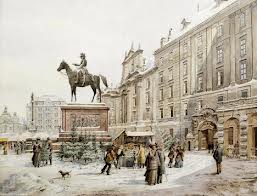
Then, as December came to Vienna, snow began to fall occasionally, the days were shorter and colder, and the city began to celebrate Advent and prepare for Christmas.  It would be the first Christmas without war in twenty years...

From the 13th century, Viennese traders had held a special December Market, the Thomasmarkt, from before Christmas through New Year, which sold wonderful gingerbread and pastries.  In the Am Hof market though, the sale of this special gingerbread (a study of contemporary invoices tells us) had expanded to include Christmas goods too for the first time--angels, silver-plated nuts, ribbons, lametta (thin strips of metallic decorative work formed into stars, snowflakes and icicles, etc.) and candles--alongside the standard market fare.

Then, just before Christmas, there was a great party at the Arnstein mansion held by Fanny von Arnstein, a prominent Viennese hostess, where guests found in the salon a great, tall fir tree, decorated all over with gifts, lametta and candles.  It was the first Christmas tree ever seen in Vienna, and it's referred to in the diaries of diplomats and the reports of the many spies of the Congress, as "the Berlin custom".

The many guests were enchanted.

The French embassy were among the first to adopt the custom as their own.  There, the French ambassador's hostess, Dorothee, Duchesse du Perigord, convinced the ambassador to decorate the mansion Berlin-style.  Nor was she content with just one tree.  In the great hallway, guests were greeted with a huge fir tree, adorned with "colourful garlands and lit candles" while another even larger tree stood near the mansion's famous staircase, and everywhere too, there were platters of German-style marzipan delicacies--formed into fruits and small animals, gingerbread and butter biscuits.

And that year, when Dorothee hosted a party on Christmas Eve, gifts were exchanged that night, again, German-style--not as they did in Catholic countries like Austria and France, on New Year's Eve...

It was the start of a whole new way of celebrating Christmas.  Imagine that...


Editors' Choice from the Archives: originally published December 18, 2012.

~~~~~~~~~~~~

M.M. Bennetts was one of the driving forces behind the EHFA blog and contributed many wonderful posts before her early demise some years ago. She was a specialist in early 19th century European history and the Napoleonic wars, and the author of two novels, May 1812 and Of Honest Fame set during the period.


Sunday, December 18, 2016

Tudor Christmas Gifts

by Deborah Swift

In Shakespeare's Day it was more usual to give gifts at New Year, but if you were lucky you might receive one at Christmas. Christmas gifts were known as Christmas Boxes and were usually given by a master to his servants, or an employer to his apprentices or workmen. They were a mark of appreciation for work done over the previous year.

New Year's gifts were a more equal exchange between friends or relations.

So what might you expect in a Tudor christmas stocking?

Maria Hubert in her book "Christmas in Shakespeare's England" suggests that Shakespeare might have enjoyed receiving paper as it was very expensive, a new quill pen, or a knife with which to sharpen it.

Well in Shakespeare's "The Winter's Tale" a pedlar is selling:

Lawn as white as driven snow,
Cyprus black as e'er was crow,
Gloves as sweet as damask roses;
Masks for faces and for noses,
Bugle bracelet, necklace amber,
Perfume for a lady's chamber;
Golden quoifs and stomachers
For my lads to give their dears."


Elizabeth herself had a liking for candies and sugar fruits. The Sergeant of the Pastry (what a great title!) gave her a christmas 'pye of quynses and wardyns guilt'. In other words a gilded pie of quince and plums.

Everyone in her household was expected to give her a gift for the New Year, the more lavish the better, as your gift indicated your status. The gifts are well documented and include a gift even from her dustman, who gave her 'two bolts of camerick' (cambric) in 1577 . In the same year Sir Philip Sidney gave her 'a smock of camerick, wrought with black silk in the collor and sleves, the square and ruffs wrought with venice golde'. It seems the dustman's gift was somewhat outclassed!

Other gifts she received were 'eighteen larkes in a cage' in 1578, and a fan of white and red feathers which included her portrait, from Sir Francis Drake in 1589.

You can see that she is wearing an amber necklace like the one described in Shakespeare's verse, and carrying embroidered gloves and a feather fan in this portrait. Were any of them Christmas gifts I wonder?

For the artisan and lower classes it was the custom to send foodstuffs to your lord or master who owned the land you tenanted. Typical gifts included pigs, fowl, eggs, dried apples, cheeses or nuts and spices such as nutmegs and almonds.

But what about the man in your life? Well, socks of course. Or hose to be more precise. On the left you can see a pair of embroidered hose made for a small boy. Thanks to www.genevieve-de-valois.com for this picture.

~~~~~~~~~~~~~

Deborah Swift's book "The Lady's Slipper" is available in the UK and in the US.
'Highly recommended.' The Historical Novels Review
'Top Pick!' RT Book Reviews
'Women's Fiction at its best' History and Women
'Brilliant saga' Romance Reviews today
''Rich and haunting' Reading the Past
'Riveting narrative' For the Love of Books

Thursday, November 24, 2016

Regency Holiday Lights

by Maria Grace

Twinkling lights are an iconic emblem of the holiday season. Even before the Christmas tree was widely in vogue, the Regency Christmastide season had its own array of holiday lights.

Yule Log 
The Yule log is perhaps the best known of the traditional holiday lights.

  Chambers Yule LogThe Yule Log, an enormous log of freshly cut wood, would be gathered by teams of farmhands, and hauled to the house with great ceremony and merriment. Once on the hearth, the log might be anointed with oil, salt and wine, with suitable prayers made.

The log was lit on Christmas Eve, with splinters saved from the log from the previous year. The fire was to last until the end of Christmas Day at least and was kept smoldering until Twelfth Night. The Yule Log was believed to bring prosperity and protection from evil. Families kept a remnant of the log all the year long so protection would remain across the seasons. Even the ashes were believed to hold power. They would be scattered over fields to promote fertility

Christmas or Yule Candle

At the end of the 18th century, it became the custom for chandlers and other merchants to present regular customers with the gift of a large candle at Christmas. This large candle would be lit at sunset on Christmas Eve and burn until Christmas service (or dawn) the next day.

Traditional superstitions said that dire consequences, ill fortune or even the death of a family member, would ensue if the candle should burn out too soon. Typically the Yule Candle would be place at the dining table and lit a sunset by the head of the household who would also be the one to extinguish it, should that be necessary. Once lit, it was not to be moved nor any other candle lit from its flame.

Christmas Eve supper was served in the light of the Yule Candle. To prevent bad luck, an even number of people had to sit down to the meal and all leave at the same time after the meal ended. Servants might be pressed to join the family at the table to ensure the desirable even number of diners.

The light of the Yule Candle was thought to convey special blessings to anyone touched by it. Holiday breads were stacked around it, so they would be kept fresh by its light. Precious possessions might also be placed within its glow so that they might be protected from harm. 

The stub of the Yule Candle and any drippings were also though to offer protection and healing. The wax might be used on cuts and sores or to mark the backs of farm animals to ensure their health and productivity in the coming year.

Plum Pudding
Christmas Pudding Flames (8307898057)
A flaming Christmas Pudding

The Sunday before advent was known as Stir Up Sunday, the day for plum puddings to be made. The day became known as “Stir Up Sunday,” not because of the great deal of stirring done, but because of This is because the opening words of the main prayer in the Book of Common Prayer of 1549 for that day are: ‘Stir up, we beseech thee, O Lord, the wills of thy faithful people...’

Christmas pudding is prepared with 13 ingredients to represent Christ and the 12 apostles then it is "stirred up". All family members must take a hand in the stirring, using a special wooden spoon (in honor of Christ's crib and stable). The stirring must be done clockwise, from east to west to honor the journey of the Magi, with eyes shut, while making a secret wish.


After the family stirred the pudding, tiny charms might be added to the pudding to reveal their finders’ fortune. The trinkets often included a thimble (for spinsterhood or thrift), a ring (for marriage), a coin (for wealth), a miniature horseshoe or a tiny wishbone for good luck, and an anchor for safe harbor. The pudding was then steamed in a cloth bag and hung up to age until Christmas Day.

When the pudding was served, a sprig of holly was placed on the top of the pudding as a reminder of Jesus' Crown of Thorns. It was then doused with brandy and lit. A portion of the pudding was saved for New Years to assure good luck.

Snapdragon

SnapDragon
Dragon playing snapdragon
Snapdragon is a parlor game. Raisins were piled in a bowl, topped with brandy and lit on fire. Players would try to snatch raisins out of the blue brandy-flames and eat them without getting burned—or lighting anything else aflame. The winner is the one with the most raisins (and I imagine least burns) and will be blessed with good luck in the following year.

While brandy burns with a relatively cool flame, I’m not sure I would suggest this for the next family Christmas party. Though not nearly so dramatic, charades is probably much safer!


References
Ayto, John. An A-Z of Food & Drink. Oxford University Press:Oxford. 2002
Broomfield, Andrea. Food and Cooking in Victorian England: A History. Praeger:Westport CT. 2007
Davidson,Alan . Oxford Companion to Food, Oxford University Press:Oxford. 2000
Glasse, Hannah .The Art of Cookery made plain and easy, 1784.
Godey's Lady's Book, Dec. 1860
Griffen ,Robert H. and Ann H. Shurgin editors. The Folklore of World Holidays,Second Edition. Gale:Detroit.1998
Knightly, Charles. The Customs and Ceremonies of Britain. London:Thames and Hudson. 1986
Revel ,Rachel. Winter Evening Pastimes or The Merry Maker’s Companion. 1825
  Yule Log
  Yule Log
  Yule Log
  The Yule Candle in the Regency

[This is an Editors' choice archive post, originally published on 14th December, 2013]

~~~~~~~~~~~~

 Maria Grace is the author of Darcy's Decision,  The Future Mrs. Darcy and All the Appearance of Goodness.  The Trouble to Check Her was released in February 2016 Click here to find her books on Amazon. For more on her writing and other Random Bits of Fascination, visit her website. You can also like her on Facebook, follow on Twitter or email her.

Most recently, Pemberley: Mr. Darcy's Dragon was released in October 2016