
By Mark Patton
The Anglo-Saxon poem, Beowulf, tells of a great hero, a prince who sails from his native Geatland (part of modern Sweden) to the court of King Hrothgar in Denmark to defeat a monster, Grendel, who has been terrorising the Danish people. Having dealt with the monster, he must also defeat its mother, who comes to Hrothgar's hall seeking revenge. Returning to Geatland in a ship laden with treasure bestowed on him by the grateful Danes, Beowulf becomes King of his people, but he will ultimately have to face a threat closer to home, a dragon that he will defeat, but only at the cost of his own life.
The poem is among the very earliest works of English literature (so early, in fact, that most of us can understand it only in translation), but that it survived at all is little short of miraculous. Previous blog-posts by Kim Rendfeld have dealt with the character of Grendel and with the blending of fiction and historical fact in the poem, but in this post I would like to explore the no-less remarkable story of the survival of the poem itself.
Beowulf survives in a single manuscript, probably created by a monk at Malmesbury Abbey in the early years of the Eleventh Century. This monk may well have copied it from an earlier manuscript, which has not survived, and which may have been as early as the Eighth Century.
The world described in the poem is clearly a Pagan one, but the poet himself (whose name we will almost certainly never know) was probably a Christian (he refers to "God" in the singular, but, doubtless as keen as any author of historical fiction to avoid anachronism, does not mention Christ). This points to the Seventh Century, when England was in transition from Paganism to Christianity, and aspects of the dialect point, more specifically, to the court of King Raedwald (reigned c599-624 AD) in East Anglia (he was born a Pagan, subsequently baptised as a Christian, but later, according to Bede, reverted to Paganism), who many believe to have been the king buried in the Sutton Hoo ship burial. The handful of historical characters mentioned in the poem, however, seem to have lived in the Sixth Century, so the "Beowulf Poet," like the Greek Homer, was almost certainly working within a pre-existing oral tradition.
The original, oral version of the poem may have been recited or sung to the accompaniment of the instrument shown above, a reconstruction of which can be heard here.
Beowulf would probably have become one of the foundation texts of English literature had it not been for 1066 and all that. In the centuries that followed, Anglo-Saxon as a written language gradually died out, replaced by Latin and Anglo-Norman. The manuscript of Beowulf remained in a monastic library, possibly at Malmesbury, possibly elsewhere; the poem did not influence the work of Chaucer or Shakespeare, Milton or Pope, since they did not know of its existence and would not have been able to read the manuscript even if they had stumbled upon it.
With Henry VIII's dissolution of the monasteries, the contents of their libraries were scattered. The most beautifully illuminated Medieval manuscripts had obvious (and very considerable) financial value, and thus are unlikely to have been lost, but Beowulf does not fall into this category; it may have survived only because it was bound together in a volume with other, elaborately decorated works. Many other manuscripts are likely to have been burned or discarded, and we will never know, either in historical or in literary terms, quite what we lost at that moment in time.
The volume containing the Beowulf manuscript was acquired by Sir Robert Bruce Cotton (1570-1631), one of the leading bibliophiles of his day, and formed part of his library at Ashburnham House close to the entrance to Westminster Abbey (the volume is referred to as "Cotton Vitellius A" because, in this library, it was on the first shelf beneath a bust of the Roman Emperor, Vitellius). Francis Bacon, Sir Walter Raleigh and James Ussher were among the scholars who worked in Cotton's library, but none of them would have been capable of reading Beowulf.
Following Cotton's death, his house, including the library, was acquired by the nation as the basis of what would become the British Library. On the 23rd of October, 1731, however, a fire broke out in the building. The Keeper of the King's Libraries, Richard Bentley, rescued what manuscripts he could, and, as luck would have it, the volume including Beowulf was among these, although it was badly damaged in the fire. Ashburnham House was entirely destroyed, and with it, a great many manuscripts.
It was only with the emergence of Anglo-Saxon and Norse scholarship in the Nineteenth and early Twentieth Centuries that Beowulf once more became readable. A full transcription was made by an Icelandic scholar, Grimur Jonsson Thorkelin, in 1815, and a verse translation into modern English by Francis Barton Gummere in 1909.
In the course of my research over the past years, I have had many priceless Medieval manuscripts on my desk at the British Library, but this one I have only ever seen behind glass. Few scholars are allowed to handle it today, because the damage done by the fire of 1731 was permanent, and even, in a sense, ongoing: some of the words that Thorkelin and Gummere were able to read are no longer legible in the manuscript today. One scholar who did have access to it was J.R.R. Tolkien, and his translation, together with his scholarly notes, has recently been published by his son, Christopher. Seamus Heaney's adaptation may, in poetic terms, be preferred by many, but Tolkien's notes are invaluable to anyone who seeks truly to understand the poem, and it is also through Tolkien's own influential fiction that Beowulf, somewhat belatedly, takes its rightful place in the canon of English literature.
~~~~~~~~~~~~~
Mark Patton blogs regularly on aspects of history and historical fiction at http://mark-patton.blogspot.co.uk. His novels, Undreamed Shores, An Accidental King, and Omphalos, are published by Crooked Cat Publications, and can be purchased from Amazon. He is currently working on The Cheapside Tales, a London-based trilogy of historical novels.
The Anglo-Saxon poem, Beowulf, tells of a great hero, a prince who sails from his native Geatland (part of modern Sweden) to the court of King Hrothgar in Denmark to defeat a monster, Grendel, who has been terrorising the Danish people. Having dealt with the monster, he must also defeat its mother, who comes to Hrothgar's hall seeking revenge. Returning to Geatland in a ship laden with treasure bestowed on him by the grateful Danes, Beowulf becomes King of his people, but he will ultimately have to face a threat closer to home, a dragon that he will defeat, but only at the cost of his own life.
The poem is among the very earliest works of English literature (so early, in fact, that most of us can understand it only in translation), but that it survived at all is little short of miraculous. Previous blog-posts by Kim Rendfeld have dealt with the character of Grendel and with the blending of fiction and historical fact in the poem, but in this post I would like to explore the no-less remarkable story of the survival of the poem itself.
 |
| The manuscript of Beowulf, British Library (image is in the Public Domain). |
Beowulf survives in a single manuscript, probably created by a monk at Malmesbury Abbey in the early years of the Eleventh Century. This monk may well have copied it from an earlier manuscript, which has not survived, and which may have been as early as the Eighth Century.
 |
| Malmesbury Abbey. Photo: Arpingstone (image is in the Public Domain). |
The world described in the poem is clearly a Pagan one, but the poet himself (whose name we will almost certainly never know) was probably a Christian (he refers to "God" in the singular, but, doubtless as keen as any author of historical fiction to avoid anachronism, does not mention Christ). This points to the Seventh Century, when England was in transition from Paganism to Christianity, and aspects of the dialect point, more specifically, to the court of King Raedwald (reigned c599-624 AD) in East Anglia (he was born a Pagan, subsequently baptised as a Christian, but later, according to Bede, reverted to Paganism), who many believe to have been the king buried in the Sutton Hoo ship burial. The handful of historical characters mentioned in the poem, however, seem to have lived in the Sixth Century, so the "Beowulf Poet," like the Greek Homer, was almost certainly working within a pre-existing oral tradition.
 |
| Excavation of the ship-burial at Sutton Hoo (image is in the Public Domain). A similar, but not identical, funerary ritual involving a ship is described in the poem itself. |
 |
| Fragments of a lyre found with the Sutton Hoo ship-burial, British Museum. Photo: Andreas Praefcke (image is in the Public Domain). |
The original, oral version of the poem may have been recited or sung to the accompaniment of the instrument shown above, a reconstruction of which can be heard here.
Beowulf would probably have become one of the foundation texts of English literature had it not been for 1066 and all that. In the centuries that followed, Anglo-Saxon as a written language gradually died out, replaced by Latin and Anglo-Norman. The manuscript of Beowulf remained in a monastic library, possibly at Malmesbury, possibly elsewhere; the poem did not influence the work of Chaucer or Shakespeare, Milton or Pope, since they did not know of its existence and would not have been able to read the manuscript even if they had stumbled upon it.
With Henry VIII's dissolution of the monasteries, the contents of their libraries were scattered. The most beautifully illuminated Medieval manuscripts had obvious (and very considerable) financial value, and thus are unlikely to have been lost, but Beowulf does not fall into this category; it may have survived only because it was bound together in a volume with other, elaborately decorated works. Many other manuscripts are likely to have been burned or discarded, and we will never know, either in historical or in literary terms, quite what we lost at that moment in time.
The volume containing the Beowulf manuscript was acquired by Sir Robert Bruce Cotton (1570-1631), one of the leading bibliophiles of his day, and formed part of his library at Ashburnham House close to the entrance to Westminster Abbey (the volume is referred to as "Cotton Vitellius A" because, in this library, it was on the first shelf beneath a bust of the Roman Emperor, Vitellius). Francis Bacon, Sir Walter Raleigh and James Ussher were among the scholars who worked in Cotton's library, but none of them would have been capable of reading Beowulf.
 |
| Sir Robert Bruce Cotton, by Cornelis Janssens van Ceulen (image is in the Public Domain). |
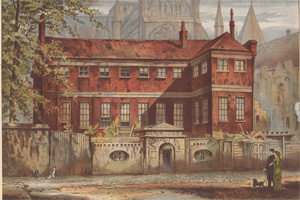 |
| Ashburnham House, Dean's Yard, Westminster (image is in the Public Domain). |
Following Cotton's death, his house, including the library, was acquired by the nation as the basis of what would become the British Library. On the 23rd of October, 1731, however, a fire broke out in the building. The Keeper of the King's Libraries, Richard Bentley, rescued what manuscripts he could, and, as luck would have it, the volume including Beowulf was among these, although it was badly damaged in the fire. Ashburnham House was entirely destroyed, and with it, a great many manuscripts.
It was only with the emergence of Anglo-Saxon and Norse scholarship in the Nineteenth and early Twentieth Centuries that Beowulf once more became readable. A full transcription was made by an Icelandic scholar, Grimur Jonsson Thorkelin, in 1815, and a verse translation into modern English by Francis Barton Gummere in 1909.
In the course of my research over the past years, I have had many priceless Medieval manuscripts on my desk at the British Library, but this one I have only ever seen behind glass. Few scholars are allowed to handle it today, because the damage done by the fire of 1731 was permanent, and even, in a sense, ongoing: some of the words that Thorkelin and Gummere were able to read are no longer legible in the manuscript today. One scholar who did have access to it was J.R.R. Tolkien, and his translation, together with his scholarly notes, has recently been published by his son, Christopher. Seamus Heaney's adaptation may, in poetic terms, be preferred by many, but Tolkien's notes are invaluable to anyone who seeks truly to understand the poem, and it is also through Tolkien's own influential fiction that Beowulf, somewhat belatedly, takes its rightful place in the canon of English literature.
~~~~~~~~~~~~~
Mark Patton blogs regularly on aspects of history and historical fiction at http://mark-patton.blogspot.co.uk. His novels, Undreamed Shores, An Accidental King, and Omphalos, are published by Crooked Cat Publications, and can be purchased from Amazon. He is currently working on The Cheapside Tales, a London-based trilogy of historical novels.

