Showing posts with label Richard II. Show all posts

Thursday, June 26, 2014

Isabelle de Valois; a highly desirable royal bride

by Anne O'Brien

On Thursday 26th October 1396 King Richard II travelled to France with a vast contingent of family, counsellors and English nobility, as well as a huge personal wardrobe, to take a new wife.  It was two years since the death of Anne of Bohemia and Richard was without an heir, a dangerous position for a medieval state.  At thirty years of age, it was essential that he marry again.  For Richard, however, the need for an heir would not appear to be his first priority, for his new bride was not quite seven years old. 
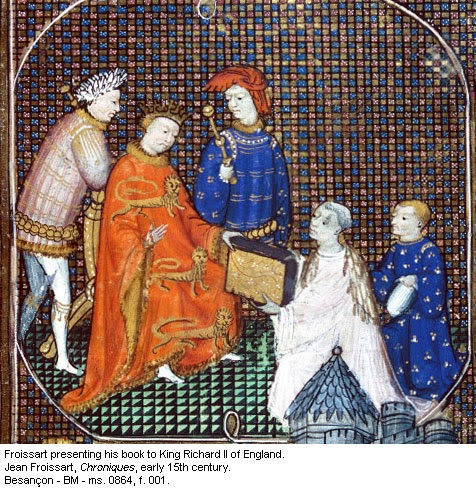
(To overcome the immediate problem, Richard was to select his cousin Edward, Earl of Rutland, as his 'brother' and heir, giving him the title Duke of Aumale.)  Here is Richard II, splendid in red with gold lions, receiving a copy of Froissart's Chronicles from the author.

But back to the marriage. Richard met with Charles VI of France (in one of his saner moments) at Ardres in France where a truce in the 100 Years War was hammered out between the two countries. For England a truce was more advantageous than a full peace treaty which would have demanded greater concessions from England. It was not a popular marriage in England but Richard saw it as an occasion on which to make his presence known on the European scene.

The poet and author Philippe de Mezieres gave Richard a beautifully illuminated manuscript, the Letter to King Richard, extolling the value of the marriage and exhorting Richard to go on Crusade, sending it to Richard from Paris on behalf of Charles VI in advance of the marriage.  Here is one of the superb illuminated pages.

Richard was persuaded; he never took up the idea of the Crusade but the marriage appealed to him, seeing an opportunity to win affection and good will from his subjects when there would be no further drain on the treasury for campaigns that brought little benefit. Furthermore he could make an superlative impression of wealth and power in Europe.  
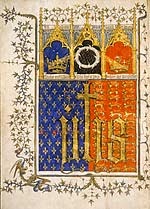
Another example of Philippe de Mezieres work in the book.

Once the truce was decided on, it was time to discuss Isabelle's dowry and the terms of her marriage. Her dowry was fixed at 800, 000 francs, 300,000 to be paid on the occasion of the marriage and the rest in annual instalments. If Richard were to die childless before her twelfth birthday, the youngest age at which Isabelle might be considered to be physically mature to fulfil her role as wife, she was to have 500,000 francs for her own disposal. Interestingly, on her twelfth birthday Isabelle would have the power to refuse consent to this marriage if she so wished, as Richard would have the right to reject her. In the event of Richard's death, Isabelle would be free to return to France with this money and all her jewellery.

A great encampment of pavilions was set up near Ardres in France and it was to this that Richard came.  On the following day the kings met, Richard in long scarlet gown bearing his own livery of the white hart, Charles clothed in similar fashion, but shorter, emblazoned - a nice touch here - in memory of Richard's late queen.  All was splendour and magnificence.  Richard gave Charles a collar of pearls and precious stones, belonging to Anne of Bohemia, worth 5,000 marks.  Many of the English royal family present - the Duchess of Lancaster, Countess of Huntingdon and Joan Beaufort - were given solid gold livery chains to wear, bearing the white hart.  There was much festivity: wine and sweetmeats, kisses and handclasps, with banquets and junketing that went on for four days. 


Comparisons have been made with the later Field of the Cloth of Gold, as shown here, between Henry VIII and Francis I, the two monarchs lavish with their gifts and good will and promises of eternal friendship, all set about with banquets and dances and lavish spectacle, but with one main difference. Henry and Francis jousted regularly. Richard and Charles did not. Neither of them had the physical attributes or love of physical sport of the later monarchs.

All this cost Richard a vast amount of money, but for him it was worth it.  This was power play at the highest level, his first ever meeting with another king, where he must not be found wanting.  No expense was spared, Richard having to borrow to offset his spending estimated between £10,000 and £15,000.  A torrential downpour during the proceedings which soaked many of the lords and swept away some of the French pavilions did nothing to dampen his enthusiasm for the marriage.

Finally the little bride was delivered to Richard on the 30th October.  She had a French governess, Madame de Courcy, but was was entrusted in England to the care of the Duchesses of Lancaster and Gloucester and the Countesses of Huntingdon and Stafford.  Richard and Isabella were married on 4th November in the church of St Nicholas in Calais.


What of Isabelle's thoughts on this marriage? Did she, at six years old, enjoy leaving family and those known to her to go to live in England, with a husband she had never before met? We have no idea. Richard seems to have treated her with much affection, rather like a sister in the brief three years of their marriage.

As for the jewels in Isabelle's dowry, we know in some detail what she brought with her. It must have been a remarkable collection of crowns and chaplets, collars and brooches and jewelled clasps, gold and silver vessels for use in her apartments and chapel. Even her dolls were packed up for her to bring to England along with their miniature silver furnishings.

The marriage was brief and tragic for Isabelle.  After Richard's imprisonment and death, she remained in England, a pawn in a political game, in spite of her father's demands that she return home, because Henry IV could not afford to repay Isabelle's dowry.  The French ambassadors had difficulty in gaining access to her.  She sailed at last for France in August 1401 where she eventually married her cousin Charles Duke of Orleans, but there was little happiness for her as she died in childbed in 1409 at the age of  19 years. 

The marriage treaty between Richard and Isabelle had stipulated that if the marriage was unconsummated, Isabelle's dowry and jewels should be returned to France with her.  The dowry received was never repaid (Henry IV continued to have his own financial problems) but almost all the jewels and plate returned with her in 1401.  The rich array of gifts, however, sent to the happy couple by King Charles and Queen Isabeau, as well as by Isabelle's two uncles the Dukes of Burgundy and Berry, were never returned.  They could still be found in the possession of the Lancastrian kings in the 15th century, doubtless a pragmatic move on the part of Henry IV.

So what do we say about Isabelle, Queen of England?  One of those brief, transient lives about which we know so little.  A prime example of the importance of royal daughters in the medieval marriage stakes, where personal happiness of a young girl weighed nothing against the demands of state connections and political alliance.  All in all, not a happy story.

~~~~~~~~~~~~~

www.anneobrienbooks.com

Saturday, November 9, 2013

The Final Tragic years of Joan of Kent: a memorable medieval woman.

by Anne O'Brien


Born in September 1328, Joan of Kent -- the above image is named as Joan, but is not an accurate representation of her -- was one of the most colourful figures of the 14th century. Her marital escapades with Thomas Holand, Earl of Kent, and William Montecute, Earl of Salisbury, have been much written about, followed by her apparent love match with Edward, the Black Prince, against the wishes of both King Edward III and Queen Philippa who doubtless looked askance at her reputation. She -- the much praised and admired Fair Maid of Kent -- was described as the most beautiful woman in England and appeared in legend as the woman whose garter exercised such a powerful attraction for King Edward. Knights jousted for her favours. This is a splendid 19th Century image of how history has portrayed her.


But what about her later years? What do we know of those? Joan was widowed in 1376 when Prince Edward finally succumbed to the appalling symptoms that had afflicted him for a number of years and prevented him from continuing his military career in Aquitaine. From that moment she devoted herself to her son Richard's care and upbringing, showing considerable political acumen, but I doubt that her later life was one of contentment or happiness for her.

We hear of her in terrible days of the Peasant's Revolt in 1381, when she was not short of courage, riding out at Richard's side to meet the rebels at Mile End.


The jeering crowds however grew too much for her so that she was escorted back to the Tower, but there she was accosted by the rebels when they forced the gates. Joan was roughly kissed and manhandled and although not harmed, still causing her to fall into a faint. Fortunately she was able to escape by river into the city where she took refuge. Some were not so fortunate, such as the Archbishop and the Chancellor, captured and executed.


In the following years, although so overweight that she could barely stand, Joan was diligent in acting in the interests of Richard, being influential in his choice of Anne of Bohemia as his bride, and in the subsequent negotiations. 

Perhaps more importantly she was a strong supporter of John of Gaunt, acting as a successful mediator to prevent a total breakdown in relations between Richard and his powerful uncle. Joan saw that Gaunt's influence over Richard was far preferable to that of Robert de Vere, Earl of Oxford. In 1384 Joan, fearing for Richard when he plotted with de Vere to have Gaunt murdered, Joan faced Richard and demanded that he make efforts to restore himself to Gaunt's favour. With some success on this occasion, Gaunt and Richard were reconciled.

The magnificent contemporary portrait of Richard in Westminster Abbey.

But success for Joan was not always possible when persuading Richard to take a diplomatic line. Joan died on 8th August, 1385 at Wallingford Castle after a particularly tragic family confrontation. This was the dispute between her two sons, Richard and Sir John Holand, Earl of Exeter, when Holand, for revenge in a personal quarrel, killed Ralph Stafford, a royal favourite, particularly with the Queen. Richard demanded that his brother John face the full penalty of the law, which was death. Joan sent messengers, begging for mercy but Richard refused any intercession from his mother. 

Joan collapsed, plunged into grief at the expectation of John's imminent death, and died within the week at the age of 57 years. Richard did ultimately pardon John, sending him on pilgrimage to the Jerusalem instead of suffering the penalty for murder, but the pardon was not given in time for his mother to rejoice. She died believing that one son would be responsible for the death of another. I wonder what she made of her family? I can only imagine her despair. What heart break she must have suffered at the end.

Joan remembered Richard in her will with fondness, describing him as her very dear son, but she chose not to be buried with his father, the Black Prince, but with Thomas Holand, the father of her other children, at Greyfriars, in Stamford, Lincolnshire. Perhaps this is where her heart always remained.  Below is the tomb of the Black Prince in Canterbury Cathedral. 


As a Postscript: how fortunate Joan was to die before the terrible year of 1400, when she would have been 72 years old (so it might have been possible). If she had lived she would have had to witness the violent destruction of some key elements in her family. 

Her son Thomas Holand, Earl of Kent, was already dead from natural causes in 1397. 

In the overthrow of Richard in 1399, her son John Holand, Duke of Exeter switched sides, thus betraying his half brother King Richard in favour of Henry Bolingbroke, even going so far as to officiate at Henry's coronation as King Henry IV. Here he is, shown in what Joan must have thought of as an act of treason, negotiating with Henry against Richard.


In 1400, after switching back again, John Holand was executed at the behest of the mob in Essex at Pleshey Castle, after the abject failure of the Revolt of the Earls to dethrone Henry IV and release Richard from captivity. 

Joan's grandson, Thomas Holand, Duke of Surrey, was executed in Cirencester in the aftermath of the same rebellion, his head sent to Henry IV in a basket with that of the Earl of Salisbury. 

And finally, of course, her son King Richard II, dethroned, imprisoned and murdered at Pontefract Castle in 1400. 

At least Joan was spared all knowledge of these terrible events that set brother against brother and destroyed much of her family.

~~~~~~~~~~~~

To keep in touch with my new novel for 2014, The Scandalous Duchess, the ever-green love story of Dame Katherine de Swynford and John, Duke of Lancaster, do visit my website.

Monday, September 23, 2013

What price a crown?

by Anna Belfrage


Henry Bolingbroke 
On July 4, 1399, a man landed at Ravenspur, Yorkshire, returning from his exile in France. With him came a handful of companions, and I suppose the man must have been nervous, no matter how determined. He was, after all, risking his life and his future. Henry Bolingbroke had come to claim the English crown.

It reads like an improbable adventure. The red-headed Henry, son of John of Gaunt, speedily took control over most of England, further helped along by the fact that Richard II was in Ireland, having taken his loyal lords with him.

By the time Richard made it back in late July, it was too late. Inexplicably, Richard left his main host in Pembrokeshire and disguised as a friar rode north, there to meet with the Earl of Salisbury, who had been charged with raising a royal army. No such army materialised. At Conwy Castle, Richard was forced to receive Henry’s messengers. On August 19, Richard II surrendered to his cousin at Flint Castle and rode in his retinue all the way back to London, no doubt most indignant at having to ride behind Henry rather than in front of him.

Henry (in black hat) claims the throne
Richard presented his abdication to Parliament on September 29, and on October 13 Henry Bolingbroke was crowned as Henry IV, the first of the Lancastrian kings. A quick and neat usurpation, taking no more than twelve weeks.

Three Plantagenet kings have been named Richard. Apart from their name, they also have in common the fact that none of them had a son to which to bequeath their throne. The first died – rather ingloriously for this embodiment of chivalric virtues – from a crossbow quarrel in his armpit. The other two share the distinction of being ousted from their thrones by a man called Henry. While Richard III’s death at Bosworth and the subsequent enthronement of Henry Tudor still inspires a lot of controversy and opinionated discussions, in general Henry IV’s usurpation back in 1399 is met with little more than a shrug. Why is that? Well, I believe it is due to Henry Bolingbroke, a man far less controversial to his future subjects than Henry Tudor.

Henry Bolingbroke was a respected man – admired for his prowess at tournaments, loved because of his largesse. A renowned warrior and leader of men, a crusader, the father of a bevy of sons where Richard II had none, Henry epitomised the male ideals of the time. Add to this a thorough education, an excellent role model in his father, and a reputation for fairness, and it is easy to understand why so many considered Henry a far more palatable choice for king than Richard II.

Richard II
Poor Richard never succeeded in living up to his subjects’ expectations of becoming like his father, the beloved Black Prince. Besides, Richard had a tendency to expend huge amounts of money on his court, himself and his beloved arts. Just like his great-grandfather, Richard II also liked handing out gifts and lands to his favourites – often at the expense of the public purse.

Besides, Henry Bolingbroke could claim he had been most unfairly treated by his royal cousin. Despite loyal and steadfast service to the crown, Richard had rewarded him by forcing him into exile, and even worse, when John of Gaunt died, Richard had refused to honour the laws of inheritance, effectively disinheriting Henry. Not a popular thing to do, not in a country where more and more of his people were beginning to consider the king petty and unreliable, prone to consider himself well above the laws and customs of the realm. Richard’s barons were even more worried; if the king chose to act so unjustly towards his first cousin, what was to stop him from acting in a similar way towards other rich and powerful noblemen?

John of Gaunt
When Henry Bolingbroke initiated his armed rebellion, he officially stated that he was in England only to claim his paternal inheritance, wrongfully denied him by the king. Smart move, as everyone could sympathise with that. He made a big show of proclaiming his desire to help reform government in England, to bring order and stability, reinstate the rule of law rather than that of royal prerogative. Not once did he say “I want the crown”, as had he voiced his intent to claim the throne, he might have had a problem rallying support. Richard’s subjects were sick of their king’s high-handed rule, but to depose a king was a grievous sin.

This presented something of a conundrum to Henry. Having once before experienced just how capable Richard was of holding a grudge (it took him more than a decade to plan his cunning revenge on the Lords Appellant, a group of men, including Henry, who had protested against the mismanagement of the government. Rumours had it he had even ordered the murder of one of the Lords Appellant, his own uncle, Thomas of Woodstock), Henry was disinclined to allow Richard to remain on the throne. Somehow, the king had to be convinced to abdicate in favour of Henry, preferably in such a way as to allow Henry to emerge untarnished from this whole sordid matter.

Richard is taken into custody 
In hindsight, that didn’t work. To ensure Richard’s cooperation, Henry’s supporters lied to him. At Conwy Castle, the Earl of Northumberland and the Earl of Westmoreland perjured themselves by swearing on holy relics that the intention was not to relieve Richard of his crown, rather to “help” him govern. Richard was an intelligent man and wasn’t convinced, but he played for time, hoping that by pretending to accept these lies, he’d get the opportunity to flee and gather support. Not to be, as next morning Richard was forcibly taken into custody by the Earl of Northumberland and transported to Flint Castle, there to wait for Henry.

Henry went out of his way to be as courteous as possible towards his unhappy cousin. A steel hand in a velvet glove, one could say, as there was no doubt in either man’s mind as to who was presently in charge, but all the same, Henry attempted to make things as comfortable as possible for Richard, treating him always with respect. I suspect Henry was uncomfortably aware of just how displeased his father, John of Gaunt, would have been with this whole mess. John would never have countenanced deposing the Lord’s anointed – but then John had died (obviously) before Richard committed the unforgiveable act of denying Henry his inheritance.

What forces were brought to bear on Richard for him to sign his abdication remain unclear. Undoubtedly, threats to his life would have been made – never by Henry personally, of course. And maybe Richard believed that signing the abdication was the only thing he could do at present, hoping no doubt to turn the tables on his cousin at a future date.

Once on his throne, it seems Henry IV was quite willing to let Richard live. This was his first cousin, and while they were too different to have much of a natural liking for each other, they were both aware of their blood-ties. Maybe Henry’s intention was to keep Richard in comfortable captivity – although choosing Pontrefact as the future home of the retired king indicates Henry didn’t want him too comfortable (or too close to London).

All that changed when several of Richard’s former favourites became involved in a plot against the new king, with the intention of murdering not only Henry but also his four sons, all of them children.  The Epiphany Rising in 1400 might not have implicated Richard per se, but it underlined the risk of keeping the former king alive, a potential rallying point to all future discontent.

Conveniently, sometime in February 1400, Richard II died. It was said he starved to death – whether voluntarily or not is still up for debate. Personally, I believe he was murdered. To have kept him alive would have been too much of a risk.

To take a crown comes at a price. Henry was never entirely comfortable on his throne, and to make matters worse his relationship with his eldest son was permanently damaged by his usurpation. Young Henry was very fond of Richard, and never quite forgave his father for having deposed him. Besides, there was the matter of guilt. By all accounts, Henry Bolingbroke was a man of tender conscience, a devout man who worked hard at being good and just. Mostly he succeeded.

But the false promises made to Richard back in August of 1399, promises that Richard would remain king, no matter that Henry would rule, gnawed at Henry for the rest of his life. Then there’s the matter of Richard’s death, a millstone of guilt for a man as upright as Henry to carry. It broke him, and over the coming years of his life, the once so powerful, so vibrant Henry Bolingbroke would transform into a sick and melancholy man. Upon his death he left no instructions as to how he was to be buried, and his will breathes of humility and guilt, in glaring contrast to most other wills of the period.

I guess the lesson is easy; never do anything that makes it difficult to meet your eyes in the mirror. Fate, however, now and then obliges us to act against our conscience. Henry Bolingbroke felt he had no choice – he had to safeguard his inheritance, for himself and for his sons. I dare say he never forgave himself; I dare say he found the price too steep.

~~~~~~~~~~~~
Anna Belfrage is the author of three published books, A Rip in the Veil , Like Chaff in the Wind and The Prodigal Son. The fourth book in The Graham Saga, A Newfound Land, will be published in the autumn of 2013. Set in seventeenth century Scotland and America, the books tell the story of Matthew and Alex, two people who should never have met – not when she was born three hundred years after him.

Thursday, July 11, 2013

The Red Lion and The King's Head - changing times

by Deborah Swift


Two of the most popular pub names in England have to be The Red Lion and The King's Head. The names of both these pubs have links to the 17th Century which is why I find them so interesting. The King's Head in Galway has a particularly well-documented history, click on the picture to go to their site and discover more.


My latest book is set in the reign of James I and some say that the emblem of the Red Lion comes from his personal crest which features the lion in its design.


Insignia of James VI Scotland

In order to curry favour with the new king, who had just become King of England as well as Scotland, many inns changed their name voluntarily. But just in case you were tempted to stick to the old name, there was even a proclamation which said the new king's emblem had to be displayed prominently to remind the English that they were now governed by a Scot. I can imagine that this prompted many a taverner to hurriedly change the name of his inn.


However, there is evidence that the name was popular even before the 17th Century as the red lion featured in John of Gaunt's coat of arms in the Middle Ages. 


John of Gaunt's Arms showing the Red Lion and Castle of Castile

This red lion became a badge of support for Bolingbroke in the battle  for allegiance between Richard II, whose crest included  the white hart as his heraldic symbol, and Henry Bolingbroke, whose emblem (via John of Gaunt) was the red lion. When Bolingbroke finally became Henry IV the red lion grew yet again in popularity as the name for an inn, as opposed to The White Hart which at one time was so popular that it came to mean an inn in the same way that we use Hoover to mean a vacuum cleaner.


Richard II's emblem of the White Hart in the Wilton Dyptich

As for The King's Head, this name was also re-popularised in the 17th century after the restoration of the king, Charles II, when the country returned to the rule of a King as a sign that the previous unrest and Parliamentary rule was over. However, it too was a well-used name even earlier as it was a name that encouraged the gentry to frequent the tavern, unlike something like 'The Black Bull' which was common in farming fraternities. It seems likely there has always been the idea of honouring royalty or the wealthy and encouraging their patronage. On carriage routes particularly  the village inns were often named after the King, Queen, or even a Duke, in the hope presumably, that they would stop by.


The Queen’s Head Inn

There are more than six hundred Red Lion pubs in England, and almost as many King's Heads. Those of you who are writers looking to name your tavern, you could do worse than choose one of these! Cheers!

Other popular Pub names - see the most popular pub names in England
Want to know more about their names and meanings? The Old Dog and Duck by Albert Jack is a book that will tell you.

~~~~~~~~~~~~
Deborah Swift is the author of A Divided Inheritance, The Lady's Slipper and The Gilded Lily. 


More about A Divided Inheritance

Friday, April 26, 2013

Rebellion in Wales ~ Owain Glyn Dŵr and Cydweli Castle - Carmarthenshire


by Judith Arnopp


Standing proud above a small village, over-looking the River Gwendraeth near Carmarthen in West Wales, is Cydweli Castle. Of Norman origin, the fortress is testament to the years of Anglo/Welsh conflict, its dominant position in the landscape making it quite clear who was in control of whom.

The earliest castle was a Norman earth and timber construction built shortly after the conquest, the village growing up around it. During the 12th century the castle fell several times into Welsh hands and by the 13th century it had been rebuilt in stone with the latest in defensive design.

Today, we see most phases of building; a square inner bailey defended by four round towers, a semi-circular outer curtain wall to protect the landward side and the massive gatehouse and jutting tower defending the riverside walls.

Cydweli (or the anglicised Kidwelly) is of concentric design with defensive walls set one within the other providing the best defence possible at the time of building. The gate house was still under construction when Owain Glyn Dŵr held it under siege during his campaign against the English.


Owain Glyn Dŵr was born around 1359 and through his parents, Gruffydd Fychan II and Elen ferch Tomas ap Llywelyn,  descended from the Welsh princes of Powys and Deheubarth.  His early life is quite unremarkable and law abiding. He was educated in London and served as a squire and a soldier, fighting for the English king in campaigns in Scotland. By the year 1400 he had become a well-respected Welsh gentlemen but events over the next few years pushed Glyn Dŵr further into rebellion.

Baron Grey de Ruthyn, a neighbour of Glyn Dŵr’s, had seized control of some land, forcing him to appeal to the English Parliament.  In 1400, Lord Grey failed to inform Glyn Dŵr in time of a royal command to levy feudal troops for service on the Scottish border. This apparent dereliction of duty enabled the Welshman to be named a traitor in London court circles

Possibly due to Lord Grey’s  personal friendship with King Henry IV, Glyn Dŵr lost the case and when, in January 1400, civil disorder broke out in Chester in support of the deposed king, Richard II, Glyn Dŵr’s relationship with Henry IV broke down completely.


In September 1400 Owain Glyn Dŵr was created Prince of Wales by the dissenting Welsh.


By 1401, after a series of confrontations between Owain’s followers and Henry IV the revolt began to spread. Welshmen studying at Oxford abandoned their studies, labourers lay down their tools, returned to Wales and flocked to Owain’s  banner. Welsh troops who had fought for the king in France and Scotland also joined the cause, Welsh archers and men-at-arms abandoned the English king to join the Welsh rebellion.

Early in the campaign the Welsh skill at guerrilla warfare gained them some notable success. They were victorious at the battle of Bryn Glas in Powys in 1402; inflicted much damage on many towns (including Cardiff) and took control of several of the strongest castles in Wales, notably Aberystwyth and Harlech.

During the fourth year of the revolt Owain Glyn Dŵr and his armies turned up in the Tywi Valley and captured a number of castles, including Dyslwyn and Carmarthen and persuaded Henry Don, a former steward of the Duchy of Lancaster and a fellow of considerable standing and power, to throw in his lot with the rebels. It was Henry Don who led the attack on Cydweli Town and castle.

However, around 1405 the rebels began to lose ground, they were defeated at Usk and sometime between 1408-9 the castles at Aberystwyth, Harlech were retaken by the crown. Owain himself was never captured but faded from history, believed to be dead by 1416. Many tales are told about the circumstances of his death.

A supporter of Glyn Dŵr,  Adam of Usk, wrote  in his Chronicle in the year 1415 that, ‘After four years in hiding, from the king and the realm, Owain Glyndŵr died, and was buried by his followers in the darkness of night. His grave was discovered by his enemies, however, so he had to be re-buried, though it is impossible to discover where he was laid.’

Adrien Jones, the president of the Owain Glyn Dŵr Society, as late as 2006 visited Sir John Scudamore who is a direct descendant of Glyndŵr and lives  near Abergavenny. He told him that Glyn Dŵr spent his last years with  his daughter Alys at Monnington Straddel in Herefordshire and eventually died there. The family kept the secret for six hundred years but Sir John claimed that Glyn Dŵr is buried beneath a mound nearby at Monnington Straddel.

Whatever the truth of the matter may be Owain Glyn Dŵr is gone but never forgotten and remains a hero in Wales, a household name and icon of Welsh nationalism.

 By AlexD (Own work) [CC-BY-SA-3.0 (http://creativecommons.org/licenses/by-sa/3.0)], via Wikimedia Commons
~~~~~~~~~~~~
Castle photos property of Judith Arnopp.
You can find out more about Judith and her historical novels on her website: www.juditharnopp.com
or on her Amazon Author page.
UK - click here
USA - click here

Wednesday, May 2, 2012

Edward 2nd Duke of York - part two

As the 1390s progressed, Edward of York gradually acquired more offices and more gifts of land, and despite his relative youth was clearly one of Richard II's most favoured advisers, being chosen to represent the King on a number of key diplomatic missions abroad, including those to negotiate Richard's marriage to the (very) young French princess Isabella of Valois. He accompanied the King on the successful military expedition to Ireland in 1394, and enjoyed an independent command during operations against Richard's Irish enemies.

Edward was one of those selected to 'appeal' the Duke of Gloucester and the earls of Warwick and Arundel in the Parliament of 1397 - in other words publicly to accuse them of treason. This process led to the deaths of Gloucester (uncle to the King and to Edward) and Arundel, and the imprisonment of Warwick. All their lands and offices were forfeited and Edward received a handsome share of the proceeds. Not least of his rewards was to be made Lord High Constable of England in succession to Gloucester. He was also created Duke of Aumale.

Gloucester seems to have been murdered (or privately executed if you prefer) at Calais, and it was later alleged that Edward sent one of his squires across the Channel to see to it that the deed was done.

A few months later, Edward's cousin, Henry Bolingbroke, the son and heir of John of Gaunt, Duke of Lancaster, accused Thomas Mowbray, Duke of Norfolk of treasonable words. Both these men had sided against Richard in 1387-1388 and with him in 1397, and it seems likely that despite fresh honours (dukedoms) laid upon them they were both worried that Richard might at some point take revenge against them for their earlier actions. Edward was one of those who stood surety for his cousin, Bolingbroke.

Since the quarrel could not be resolved by normal legal processes, because of a lack of witnesses, it was eventually referred for trial by mortal combat. Edward, in his role as Lord High Constable, presided over the trial, but as is well known, the King decided to stop it before it came to blows, and instead banished both men.

Before this event Edward had made what was (for a man in his position) a most unusual marriage. Given that he was at the peak of his political power, and had lately been suggested as a husband for another very young French princess, the most likely explanation for his choice is that he fell in love. His bride, Philippa Mohun, was at least ten years his senior and already been widowed twice. She had only a life-interest in modest dower lands and no history of successful child-bearing. As it happens, she was destined not to give Edward children either. The matter of children apart, some may see a congruence with the decision of Edward's great-nephew, Edward IV, to marry Elizabeth Woodville.
When John of Gaunt died in 1399, Richard decided to extend the term of Henry Bolingbroke's exile to life, and took the Lancastrian inheritance into his hands. Although many nobles, including Edward and his father, received custody of elements of the Lancastrian estates, there is no evidence that Richard intended the confiscation to be permanent. He continued to send his exiled cousin handsome sums of cash for his maintenance, apparently unaware that Henry (currently based in France) was planning to invade England.

On the other hand, Ian Mortimer, in The Fears of Henry IV, sets out the theory that Richard II intended to exclude the Mortimers and the Lancastrians from the succession, and appoint Edward of York as his heir. There is some evidence to support this, quite apart from the strange fact that Richard referred to Edward in his grants as 'the King's brother' and not, as was correct, 'the King's kinsman.)

Anyway, such was the King's confidence in his security that he now undertook a second expedition to Ireland. Edward of York, having been given certain tasks on the Scottish March, was late to join this expedition, and it has been suggested (particularly in the French chronicles) that he was already plotting against the King. This seems unlikely.

Edward's father, Edmund of Langley, Duke of York, was left in charge as Keeper of England, and when Henry landed in Yorkshire, Langley's attempts at resistance were feeble. It is true that many of the nobility, and perhaps even York himself, sympathised with Henry and were reluctant to fight him. York's forces eventually capitulated at Berkeley Castle, in Gloucestershire, with scarcely a blow struck. (The Bishop of Norwich, Henry Despenser, was among those who did fight, but they had no chance against the formidable force Henry had gathered.)

Meanwhile, Richard had landed in Wales. He made no urgent effort to advance, and seems to have waited for news. When it reached him, it was to the effect that York had gone over to his rebellious cousin. The King seems to have been struck by panic and misled by rumours of plotting. He abandoned his army and made his way to North Wales at the head of a small, picked band of followers. Edward was one of those left behind, doubtless because of his father's surrender.

Edward promptly made his way eastward and submitted to Henry in his turn. As a result, when King Richard was eventually run to earth at Flint Castle, he was in the victorious Henry's company. Nevertheless, he immediately lost several of his most important offices, including that of Lord Constable, and it must have been clear to him that he did not enjoy Henry's trust. Nevertheless, during the next few months he and Henry were to save each other's lives.

(Part Three to follow)