Showing posts with label Napoleon. Show all posts

Wednesday, November 8, 2017

Oh, the places you’ll go! A History of Tourism

By Jude Knight

The privileged English tourists of the late nineteenth century reached further than ever before, but they were not the first to travel for education and entertainment. Tourism is probably as old as civilisation; it is certainly as old as writing. As soon as social structures produces a class with money to spare and time on their hands, the rich have travelled as a leisure activity, and some places and times have opened the opportunities to those merely comfortably placed.

Tourism’s ancient roots
Privileged groups of Egyptians, Persians, Greeks, Chinese, and Harappans went up into the mountains for the summer, or up the river to see the newest edifice (my goodness, Cheops, take a look at the size of that pyramid), or to a famous temple to gawk at the statues and paintings, and leave an offering for the local God.


Letters of request from one king to another, requesting passage for a traveller, began at least in Babylon, and were applied intermittently from that time, eventually becoming passports.

Romans set up their own summer beach resorts, which became so crowded with the hoi polloi that the really rich took over private islands, where they could relax in peace. And with Roman roads stretching to the edges of Empire, possible destinations were limited only by the travellers’ pocket, imagination, and sense of adventure.

Pilgrimage for fun and (spiritual) profit
In medieval times, tourism took another guise. Scholars and journeymen travelled for education (and undoubtedly took in a little entertainment along the way. Pilgrims travelled for the education of their souls, and we have Chaucer’s word for it that some of them found it very entertaining.

A wealthy English pilgrim might choose to visit Rome or the Holy Land, but even the comfortably circumstanced could find an abbey or a holy well that boasted the relic of a saint.


The Grand Tour
From the sixteenth to the eighteenth century, young English noblemen took the Grand Tour, an educational journey between being recognised as a man and being expected to behave like one. Their sisters’ travel was usually much more curtailed, but they might enjoy a journey from England to Paris to attend court, refresh their wardrobes, and acquire a little foreign polish at French entertainments.

In seventeenth century France, Louis XIV required travellers to have a letter of request or passe port (literally, to pass through a port) and a visa given by his own government. Soon most of Europe had followed suit, and the age of queueing at the border had begun.

Tourism takes off
War closed much of the Continent at the end of the eighteenth century, but Napoleon’s final defeat opened it again. The English flooded out across Europe, in a tourist boom that gathered pace and continued until the First World War. From England alone, the volume of travel grew from 10,000 in 1814 to 250,000 in 1860, to one million in 1911. So great was the temporary migration of pleasure seekers that the passport system was abandoned in the mid-1860s, and not reinstituted until 1914 (as a temporary measure, but they kept it after the war).

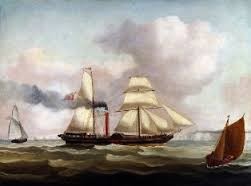
By the middle of the nineteenth century, steam engines had opened the world, near and far, facilitated by entrepreneurs like the original Thomas Cook. If you were middle class, you could go near, so the super-rich needed to go far.

The rich go far, far, away
And New Zealand was as far as you could get: a one-way trip for working people, but a six month pleasure cruise for tourists. By the 1880s, the British Medical Journal was endorsing sea voyages as a cure for whatever ailed you, and steamships made travel easier, safer, and more certain.

Travel agencies in England would extoll the sights, and travel guides in New Zealand would take you to see them. Most people would manage to fit in the hot lakes of Rotorua, the cold lakes of Queenstown, and the glacier landscapes of the Southern Alps. In the words of one English traveller, James Froude:
“We could stand on the brim and gaze as through an opening in the earth into an azure infinity beyond. Down and down, and fainter and softer as they receded, the white crystals projected from the rocky walls over the abyss, till they seemed to dissolve not into darkness but into light. The hue of the water was something which I had never seen, and shall never again see on this side of eternity. Not violet…turquoise…sapphire. Comparison could only soil such inimitable purity. The only colour I ever saw in sky or on earth in the least resembling the aspect of the extraordinary pool was the flame of burning sulphur.”
Volcanic theme parks have one disadvantage
The town of Rotorua was built by the government in the early 1880s, to accommodate tourists (mostly English and German) coming to see the hot pools and the world-famed Pink and White Terraces, hillsides with cascading silica sheets grown over millenia from limestone deposits in the ever-seeping thermal water.


Up to thirty tourists a day arrived to stay at one of the four Ohinemutu hotels (Ohinemutu was the Ngati Whakaue town next to which Rotorua had been built), having travelled overland from Auckland or Tauranga. Another four hour trip would take them to the Maori village of Te Wairoa, and from there they would be taken by canoe to the terraces.

Until the night of the volcanic eruption that is the background for my novella Forged in Fire in this year’s Bluestocking Belles’ anthology. On 10 June, 1886, Mt Tarawera erupted, utterly destroying the terraces and burying nine villages, including Te Wairoa. The descriptions given by my fictional English tourists are drawn  directly from those of witnesses who survived that terrible night. Thermal activity is only fun until someone gets hurt.


Sources:
Gyr, Ueli. The history of tourism: Structures on the Path to Modernity. Retrieved from http://ieg-ego.eu/en/threads/europe-on-the-road/the-history-of-tourism/ueli-gyr-the-history-of-tourism

The Rosbifs arrive. A review of The Smell of the Continent: The British Discover Europe, by Richard Mullen and James Munson. Retrieved from http://www.economist.com/node/13940943

History of Passports, from http://www.cic.gc.ca/english/games/teachers-corner/history-passports.asp

Various articles about tourism in New Zealand, from https://www.nzgeo.com/stories/maori-tourism/, https://nzhistory.govt.nz/keyword/tourism, and https://teara.govt.nz/

Quote from James Froud, https://teara.govt.nz/en/visitors-opinions-about-new-zealand/page-2

Images:
Women travelling: Assyrian women travelling by ox cart
Lydgatepilgrims: Pilgrims on the road, attributed to Gerard Hornbout. C. 1516 to 1523
Steamer: The P&O Paddle Steamer William Facwett
Pink and White Terraces: The beautiful Pink and White Terraces, painted by JC Hoyte in the 1870s

~~~~~~~~~~

Jude Knight’s writing goal is to transport readers to another time, another place, where they can enjoy adventure and romance, thrill to trials and challenges, uncover secrets and solve mysteries, delight in a happy ending, and return from their virtual holiday refreshed and ready for anything.
She writes historical novels, novellas, and short stories, mostly set in the early 19th Century. She writes strong determined heroines, heroes who can appreciate a clever capable woman, villains you’ll love to loathe, and all with a leavening of humour.
Website and blog: http://judeknightauthor.com/

Buy links for Never Too Late
Amazon:
US: amzn.to/2y6oBg7
AU: http://amzn.to/2fycyAx
BR: http://amzn.to/2wjyWkm
CA: http://amzn.to/2yFvxxS
DE: http://amzn.to/2xA0Udb
ES: http://amzn.to/2yFIgk4
FR: http://amzn.to/2yF7gbg
IN: http://amzn.to/2fzQkhv
IT: http://amzn.to/2xzPPbW
JP: http://amzn.to/2xK5yqS
MX: http://amzn.to/2xJTlCK
NL: http://amzn.to/2hvRYkV
UK: http://amzn.to/2fyBesx

iBooks: http://apple.co/2yY4gXC
Kobo: http://bit.ly/2fK7vJR
Smashwords: http://bit.ly/2xDMQkb
Barnes and Noble: http://bit.ly/2y0DPjd


Wednesday, July 1, 2015

The Effect of Waterloo on Europe and England

by Tom Williams

In 1814, after almost two decades of war with France, the nations of Europe made an alliance that finally defeated Napoleon. He was exiled to the island of Elba, off the coast of Italy. In retrospect, it was foolish to allow him to keep even a token military force, but the Allied powers did and, in February 1815, he sailed from Elba with around a thousand men, landing in France on 1 March.

Although many of the French remained loyal to King Louis, who had replaced Napoleon on the throne, the army defected en masse and he had enough popular support to re-establish himself as Emperor. He even organised a referendum to demonstrate French enthusiasm for his return. At first, Napoleon hoped that the Allied powers who had deposed him would be content to see him return to France provided that he did not seem to pose any threat to the rest of Europe. It quickly became apparent, though, that the Great Powers (Britain, Russia, Prussia and Austria) had no intention of leaving him in peace. Instead they declared him an outlaw (hors la loi) and mobilised their armies to attack France. The Prussians were to join British troops stationed in Belgium so that they could attack Paris from the north, while the Austrians and the Russians moved toward the city from the east.

Napoleon saw his only chance as being to strike before the Allies were ready – not that much of a problem, as the armies were moving very slowly. He decided to strike north towards Brussels. His plan was to drive his own army between the British and the Prussians, who were moving to join them from the east. He reasoned that, if he could attack each army in turn, he might be able to defeat both of them although it would be impossible for him to beat them once they had combined. In those days, when battles were generally won by the larger army, (no tanks or airpower to unbalance the straightforward clash of men) this was not a foolish approach. In fact, it almost worked. On 16 June Napoleon's forces defeated the Prussians at Ligny. The Prussians retreated and Napoleon thought that he could now move on the British, who were outnumbered and outgunned and who were relying on Belgian troops of uncertain loyalty. With some justification, he looked on victory at Waterloo as a foregone conclusion. The affair, he is reported to have said, would be like eating breakfast.

In the event, of course, Napoleon lost the day and, in consequence, his throne and his freedom. But was Waterloo, as many people claim, the decisive battle that defined the future of Europe?

The importance of Waterloo to European history seems, at least, to be somewhat overstated.

For a start, the most important battle probably took place two days earlier. While half of the French army was defeating the Prussians at Ligny, the other half was bogged down in indecisive fighting at a crossroads called Quatre Bras. Wellington had not been expecting an attack directly up that road and Quatre Bras was defended by a pathetically inadequate force of Netherlanders (made up of Dutch and Belgian regiments) under the Prince of Orange. Although many people nowadays regard the Prince as a fool and his troops as cowards, their determined defence of the crossroads against overwhelmingly superior forces allowed the British to reinforce their position and see the French army off. Napoleon had left the taking of Quatre Bras to his Marshal Ney, a heroically brave figure, but hardly a strategic genius. Ney failed to push through the Prince of Orange's defences when a determined attack would have almost inevitably succeeded. Had he done so, while British forces were still marching south to reinforce the Netherlanders, the French could have stormed north toward Brussels, brushing aside any opposition, which would not have had time to take up a proper defensive position. Brussels would have fallen by the end of the day. Indeed, many people in Brussels were fleeing toward Ghent or Antwerp, convinced that that was exactly what was going to happen. With control of Brussels – the British inevitably retreating along their lines of supply to the West – Napoleon would have succeeded in splitting the two armies and, after Ligny, the Prussians were hardly likely to take him on alone. The Battle of Waterloo, far from being won on the playing fields of Eton (something that, incidentally, Wellington almost certainly never said) was probably won at Quatre Bras.

Black Watch at the Battle of Quatre-Bras, 1815
by William Barnes Wollen

The question remains, whether, if Napoleon had captured Brussels, whether by a decisive victory at Quatre Bras or by winning at Waterloo, he could have changed the history of Europe. It seems doubtful. The Prussians, though beaten, were hardly crushed. The Austrian and Russian armies were still ready to fall on Paris from the east. Britain commanded the seas and, if required, could have put another army into the field. Napoleon had united the whole of Europe against him. He was never again going to be able to threaten countries beyond his borders. What a Napoleonic victory might have achieved was to change the future of France. Talleyrand, whose diplomatic genius had served both Napoleon and the Bourbon monarchy, would quite likely have persuaded France's enemies that Napoleon, now reinforced with Belgian troops who would probably have defected back to their old imperial regiments, was best left alone in France. Austria and Russia distrusted each other and the ties between Austria and France (remember that Napoleon's wife was the daughter of the Habsburg Emperor Francis II of Austria) could have been exploited to drive a diplomatic wedge between them. There was, therefore, a small, but real, chance that Napoleon could have been left on the throne in Paris, but with conditions that prevented him from being a threat anywhere else.

Of course, a France under Napoleon might well have served as a rallying point for radical, anti-monarchist factions in other countries – one of the reasons that the Powers would have resisted the idea. The Enlightenment values of Napoleon's rule might have been sustained, his ideas conquering Europe in the same way that his armies had earlier. But this has to be doubtful. Napoleon was, by now, almost as easily identified with the sovereigns he had so affected to despise as with any revolutionary movement. He was in any case a sick man – he was to die six years later – and hardly the energetic genius that he had been at the height of his powers.

It really does seem unlikely that Waterloo changed the history of Europe. It did, however, change the history of Britain. Although Britain in the 18th century was clearly one of the Great Powers, the idea (common amongst Empire enthusiasts) that the British Empire was pre-eminent in an era of colonial expansion is by no means clear. The Napoleonic Wars saw Britain emerge as a leading (in British eyes the leading) European power. Britain was the only country to resist Napoleon throughout the period of conflict. British diplomacy was central to the formation of the many coalitions against France, and British money had financed the wars. Yet direct British military involvement had been mainly limited to the Peninsular campaign. While this had been of crucial strategic importance, it was never the primary focus of the war, and Britain was not among the Powers that fought their way into Paris in 1814. The cataclysmic battle at Waterloo, fought under Wellington as the Allied Commander-in-Chief, left the British convinced of their pre-eminence in Europe, a conviction so strong that it generated its own reality.

Britain never looked at itself in quite the same way again. Waterloo was a powerful symbol of national unity at a time of Corn Law riots and political unrest. The sight of Scots troops fighting so decisively alongside the English led to a new view of Scotland. The Scots had so recently been considered a threat to the Union that the Scots Greys were officially the North British, lest they get ideas about nationhood. Suddenly it was acceptable, even fashionable, to be a Scot. Wellington, now the greatest of British military men, went on to become Prime Minister. There were to be ups and downs in the decades ahead, but Waterloo had both strengthened the unity of the nation and allowed it to accept some of the differences within it.

Scotland Forever! by Elizabeth Thompson

Waterloo also changed the image of the Army. During most of the Napoleonic Wars, and the wars that preceded them, it was the Navy that was, in every sense, the Senior Service. It was the wooden walls that had defended England and saved us from French tyranny. Now, suddenly, the Army took centre stage. The British had long distrusted the standing army, but after Waterloo every soldier was a hero. (It was the first conflict to be commemorated with a medal awarded to all the British participants.) The modern Army has been built on the heritage of Waterloo.

Twentieth century notions of the quintessence of Britishness - coolness under fire, holding firm in the face of overwhelming opposition, even, dare it be said, making a virtue of cobbling together a solution from the limited resources available instead of properly planning ahead - all these things started with images of the Iron Duke and his men at Waterloo and in the days preceding the battle.

Waterloo was - despite its strategic inconsequence - the decisive battle of its age. It defined Britain, it enabled the development of the modern Army and it marked the start of the British Empire. It is unlikely that it had a significant impact on the future of Europe. However those seven hours in June two hundred years ago had an enormous effect on the future of Britain.

~~~~~~~~~~~~~

Tom Williams is the author of the 'His Majesty's Confidential Agent' series, which tells the story of British spy James Burke during the Napoleonic wars. His latest adventure, published by Accent press in May, sees Burke in pursuit of a Bonapartist agent who has tried to assasinate the Duke of Wellington. The story reaches its conclusion on the field of Waterloo.

James Bond meets Richard Sharpe in a thrilling tale set against a detailed historical background. Amazon

When not reading 19th-century books or going to conferences where retired officers talk about *that* battle, Tom enjoys dancing tango and street skating. He also likes to travel and has explored the locations of Burke's adventures in Argentina, Egypt, France and Belgium, which is arguably the best thing about being a writer.

Wednesday, June 24, 2015

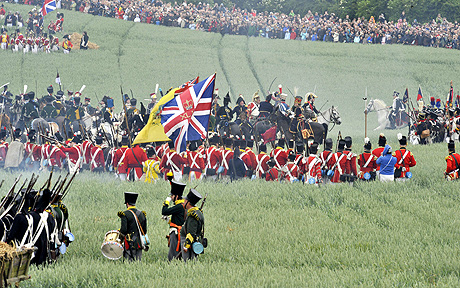
The Battle of Waterloo June 18th 1815

by Richard Denning

The Battle of Waterloo on June 18th, 1815 was the climax to over 20 years of wars that had devastated Europe. It was the moment Napoleon was finally defeated, and it is seen by many as the birth of modern Europe.


Setting the Scene


In my other article on the Battle of Quatre Bras I go into more detail on the origins of this battle. In brief, on returning from exile on Elba Napoloeon had gathered an army of veterans and marched on the combined Anglo Dutch under Wellington and Prussians under Blucher. The allies were positioned in Belgium waiting to attack France. Napoleon did not dance to their tune but attacked them first and drove into the gap between the two allies. On 16th June, at the cross roads of Quatre Bras, the French under Marshall Ney and Anglo Dutch under Wellington were locked into a stalemate battle - neither side being able to send aid to the main battlefield of the day - Ligny. At Ligny Napoleon battered the Prussians and forced them to retreat BUT because Ney had not broken through at Quatres Bras had not had enough troops to crush Blucher.

Retreat

 On the 17th June Wellington was forced to fall back to the position at Waterloo whilst waiting and hoping that the Prussians would also retreat northwards - keeping in contact and able to aid the British. Blucher did this, and as dusk fell on the 17th the scene was set for the battle of Waterloo. Napoleon was conscious that Blucher might try and rejoin Wellington and sent a third of his army under Grouchy to pursue the Prussians with strict instructions NOT to allow that to happen. Blucher left just 1 corps (a quarter of his force) to hold the French at Wavre whilst the other three set off at once towards Waterloo. Their arrival would be critical, as we shall see.

  The Battle of Waterloo

                     
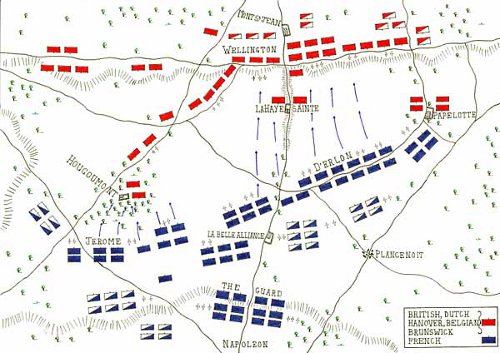
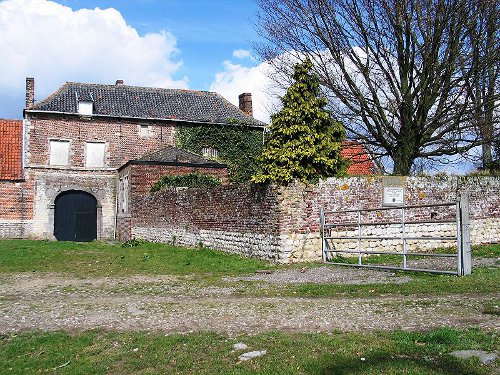
Hearing that Blucher was marching from the village of Wavre (where the Prussians had reached the night before) Wellington deployed his army on the northern side of a valley near a small Belgian village of Mount St Jean just south of the town of Waterloo. Wellington was a genius at the defensive battle and had seen that this location was perfect. The ridge itself would hide his men and forward of the slope there were three strongholds. On his right wing sat the fortress of Hougoumont. Here he deployed some of his guards companies. Covered by woods to the south (in which he placed light infantry) the Chateaux had tall stone walls and thick gates. In the centre of the position was the fortified farmhouse of La Haye Sainte.  To the left were several connected buildings at Papelotte.

11am. The French Attack Hougoumont


Napoleon opened his attacks by sending Reille's II Corps to assault Hougoumont hoping to draw the British away from their left wing where he had prepared a hammer blow. Intended as a diversion, more and more French forces were drawn into the battle around the fortress which caught fire but never fell.

1pm D'Erlon attacks

                        
Napoleon now sent forward the 16,000 infantry of D'Erlon's I Corps to try and smash through Wellington's left wing. The French attacked in dense columns and the sight must have been terrifying. But the British had seen this before many a time in Spain and calmly stood up in line, levelled muskets and blasted the French Regiments.

  2PM: Uxbridge Charges


With the French regiments in disarray Wellington committed his heavy cavalry under Uxbridge. Thought to be the finest mounted cavalry in Europe, the Heavy cavalry of the Scots Greys and other regiments thundered through the gaps in British regiments and shattered the French. D'Erlon's men ran, and the horses pursued. BUT they now made the mistake British cavalry always did: they went too far. With cries of 'Tally-Ho' - as if they were hunting fox in Leicestershire they found themselves winded and far away from the British lines when the French lancers caught them and destroyed them.

4pm Ney leads the French Cavalry forward


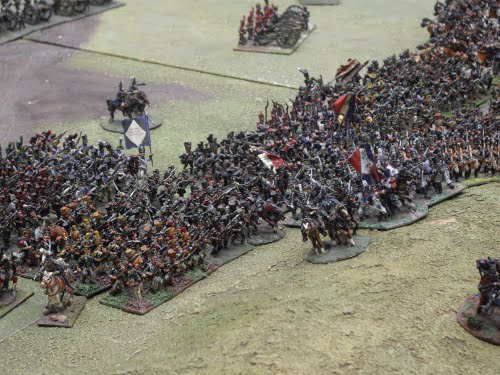
Around 4pm the British, having repelled the French attack, reorganised their lines and pulled back over the ridge. Napoleon was at this moment ill (he had a stomach ulcer) and Ney who was in charge saw this movement and thought Wellington was retreating. He ordered the entire French Cavalry reserve to attack at once. The charge by the French cavalry at Waterloo would have looked terrifying and magnificent at the same time. Initially 5000 horses charged but when they crested the ridge they found the British were NOT retreating but had formed square - the best defence against cavalry. Scattered like a chess board these squares resisted no less than 12 French charges with as many at 9000 Cavalry at once. The British endured and held on.


4pm The Prussians Arrive

The Prussian's finally started to arrive from about 4pm onwards. Napoleon sent his Guard and a reserve Corps to hold them back. To begin with they defended easily, but more and more Prussians arrived, and gradually the French fell back into Plancenoit. That town fell, and the French used the Young Guard to assault it and recapture it. Things were getting desparate though. Napoleon knew he HAD to break Wellington NOW or lose the battle.


7pm The Guard Attack - final throw of the dice.

"Give me night or give me Blucher" - Wellington at Waterloo (There us a dispute about this prayer - maybe he never said it, but he certainly felt it) Napoleon gathered all his resources. He threw forward a heavy attack to take La Haye Sainte. Then vast clouds of skirmishers supported by artillery and cavalry pounded and pulverised the Anglo-Dutch lines who could do little save stand and suffer. Wellington, trusting that the Prussians would fill the hole, abandoned Papelotte and concentrated all his men in the centre of the line. He held on and endured.

Now was the time for the thunder strike.

Napoleon sent forward his Imperial Guard, veterans of many battles, to assault the British between La Haye Sainte and Hougoumont. These were the men who had conquered Europe, and he needed them to do it one more time. They stomped up the ridge towards the British.

But what was this? The ridge seemed empty.

All they could see was a few officers. Was that Wellington up there on his own?

 This was victory ...this was glory! "En Avant. Vive L'Empereur!"

And then one phrase changed everything. One phrase spoken loud and clear by Wellington: Now Maitland. Now's your time!

One authority had him adding Up Guards, ready.

As one the British Guard's Regiment under Maitland rose from where they were kneeling in the grass. They levelled their muskets and fired. The best marksmen in the world now fired devastating volley after volley. The Imperial guard - never before defeated - wavered, fell back and RAN.

Defeat

With the Middle Guard streaming back from the ridge and the Prussians surging through Plancenoit again, the French morale cracked, and the army started to run. Wellington raised his hat and waved it forward with the words: "The whole line will advance!" The Anglo Dutch and Prussians surged forward, and the French routed, and that was that. Within an area of 2 miles by 2 miles there were 48,000 bodies and the wounded desperately crying for aid.

Wellington and Blucher met at La Belle Alliance
It was Wellington's last battle. It was a bloody and costly battle, but finally Napoleon was defeated.

~~~~~~~~~~~~~

Richard Denning is a historical fiction author whose main period of interest is the Early Anglo-Saxon Era. His Northern Crown series explores the late 6th and early 7th centuries through the eyes of a young Saxon lord.

Explore the darkest years of the dark ages with Cerdic.

www.richarddenning.co.uk


Sunday, June 21, 2015

June 16th 1815 The Battle of Quatre Bras

by Richard Denning

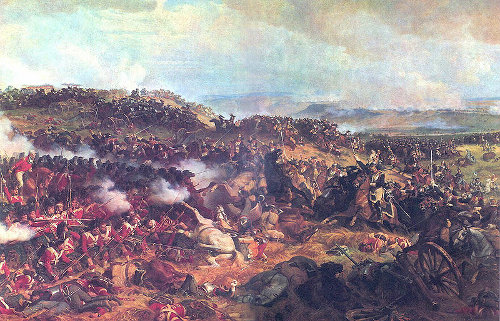
French Lancers charge the Scots at Quatres Bras

A few days ago - The 16th June was the anniversary of the Battle of Quatre Bras. Never heard of it? Well if I mention a more famous battle that happened 2 days later - The Battle of Waterloo - you maybe now understand the campaign that I am talking about.

Waterloo was the climatic battle in the wars that started shortly after the French revolution and ran through the 1790s on as far as 1815. From around 1796 onwards they became increasing focused around the ambition of one man: Napoleon Bonaparte. Napoleon had led a series of Campaigns across Europe and at one point ruled lands from Portugal to Moscow. But of course the disaster of the Russian Invasion in 1812, the unified resistance by Austria, Russia, Prussia as well as the thorn in Napoleon's side Wellington and his campaigns in Spain led to the Emperor's defeat in 1814. He was sent to Elba in exile.

A master piece. Napoleon's grand stategy  was an echo of his brilliance that won at Austerlitz ten years before.

In 1815 he was back from exile and galvanised the French nation once more under his leadership. The Allies knew they had to do something to prevent Europe being plunged into yet more years of warfare and so began to gather in the Low countries and along the Rhine ready to invade France. This process would take weeks - especially for the more distant Russians to arrive.

Napoleon's Plan

Napoleon refused to wait for that invasion. In June 1815 he assembled an army of 100,000 veterans of his wars on the Belgium Border at the city of Charleroi and attacked. He had spotted a flaw in the allied deployment. Wellington's Anglo Dutch Army was arranged in the west of Belgium - west of the Charleroi to Brussels road. Blucher's Prussians (Wellington's ally) had his army to the east of that line. Napoleon realised that if he attacked right down that road on the line that divided the allies he could cause chaos and confusion. Then he would try and destroy the Prussian army whilst keeping the British at bay. Once Blucher was running for Germany he would turn on Wellington.

So on the 15th June Napoleon attacked up the high road. He took the bulk of the French Army with him towards Ligny where the Prussians were gathering. He sent Marshall Ney to Quatre Bras with orders to capture the poorly defended cross roads, hold off any British counter attack and send the bulk of his force along the road to Ligny to fall upon the flank of the Prussians and crush them. If everything went well Blucher's Prussians would be destroyed before Wellington could react. That night Wellington was indeed distracted. He had been invited, along with the bulk of the officers, to a ball in Brussels.

That meant that at the very moment when Napoleon was marching up the road from Charleroi the British were caught entirely off guard. When news reached the ball Wellington was already 18 hours behind the pace of the campaign. He at once sent his officers to gather the men and march on Quatre Bras.

Accompanied by much hysterics and swooning the news arrives that Napoleon has invaded Belgium


The Battle

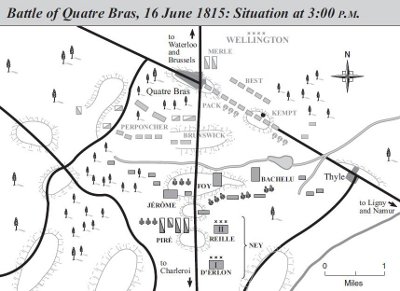
At the beginning of the battle Marshall Ney had 18,000 men and 32 guns with 2000 cavalry and faced only 8,000 infantry and 16 guns. These allied troops were Dutch regiments, and although they fought well they were forced back towards the cross roads. Fresh British troops started to arrive two hours later as well as Wellington himself who then took command. As the day went on more and more British and allied divisions arrived until at the end of the battle; around 9 pm, Wellington with 24,000 men had a numerical superiority over Ney.

In those 6 hours the battle swung back and forth. The French launched a series of attacks, some of which reached the cross roads only to be forced back by a new allied division arriving and counter attacking. One famous moment was the arrival of the Duke of Brunswick and his black uniformed cavalry complete with death's head symbols on their shakos. Their charge repelled the French once again but at the cost of the Duke's life. Another incident of note was when the Prince of Orange (a young Dutch prince with no battle experience) ordered the British to advance in line even though there were hordes of French cavalry around who promptly charged the British and slaughtered two battalions.


Battle of Ligny

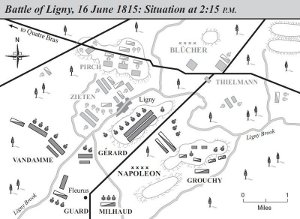
Whilst the battle was raging at Quatre Bras Napoleon had the upper hand at the nearby battle of Ligny. All he needed to complete victory was for Ney to break through at Quatre Bras and send him more troops onto the Prussian Flank. Napoleon even summoned a reserve Army corps under D'erlon to leave Quatre Bras and join him, but just as it was arriving at Ligny Ney ordered it back to Quatre Bras.

So the French missed the opportunity to use D'erlon at either battlefield as it spent most of the day marching around the Belgium country side. Wellington too was unable to help out at Ligny. Blucher had to face Napoleon alone. The French beat the Prussians at Ligny and forced them to retreat, but they had not crushed them. Never the less because the Prussian's were retreating Wellington was obliged to follow suit and spent the 17th June moving his army back northwards. However because the Prussians were able to retreat in good order, Blucher would be able to bring three Army Corps to help Wellington 2 days later at Waterloo.

So who won at Quatres Bras?

In truth both sides claimed a victory and both sides had lost about 5000 men. Ney should have broken through early in the battle, and Wellington was brilliant in defence and held him off but was unable to help Blucher himself. So it was a really a draw. Quatres Bras and Ligny left unfinished business that would only be resolved 2 days later at a battlefield just south of a small town called Waterloo.

One of my areas of interest is the Napoleonic wars. My historical fiction is set at other times, (The Saxon Period and the 17th century), but I find this period fascinating, and I have visited all the battlefield of the Hundred Days Campaign and recommend them. Waterloo in particular is ideal for tourists, but armed with a map and guide you can find much at Quatres Bras of interest.

~~~~~~~~~~~~~

Richard Denning is a historical fiction author whose main period of interest is the Early Anglo-Saxon Era. His Northern Crown series explores the late 6th and early 7th centuries through the eyes of a young Saxon lord.

Explore the darkest years of the dark ages with Cerdic.

www.richarddenning.co.uk


Thursday, February 12, 2015

Defending Britain Against Invasion, 1793 - 1815

by Jacqui Reiter

On 27 January 1794 the Times reported "very great preparations at Havre de Grace, for a descent in this country". Fifty thousand men were rumoured to be taking part in this expedition, which marked the beginning of a series of invasion scares punctuating the course of Britain's war effort against Revolutionary and Napoleonic France from 1794 to 1812.[1]

Many more invasion scares followed over the years. An unsuccessful attempt was made on Ireland in 1796, followed by an only slightly more successful invasion of Wales in 1797 and a further landing in Ireland in 1798. The most serious invasion scare, however, occurred between 1803 and 1805. Napoleon encamped his “Armée d'Angleterre” along the Channel coast, and the British government expected 145,000 men to arrive at any moment from Flushing, Boulogne, Brest, and Le Havre.[2] 


View of the Armée d'Angleterre at Boulogne, with the British blockade (Wikimedia Commons)

What force could Britain rely upon to defend her shores? The regular army was too often occupied with other concerns. In 1793, at the beginning of the wars with France, the army was about 48,000 strong. By 1814 this number had swollen to 320,000 scattered all over the globe, but this large force was, by then, mostly used for defending Britain's colonies and offensive operations against the French in Europe.

The navy had similarly grown from 130 total vessels of all classes in 1793 to over 150 ships of the line alone in 1810: British ships blockaded most of the French ports for much of the war to prevent any enemy ships escaping, but this strategy was unreliable. The French managed to escape at least seven times from Brest alone between 1794 and 1802, which led the Times to remark ironically in 1798 upon "so many repeated instances of the good luck of the French in escaping the vigilance of our squadrons".[3]

The Militia
 
The government had no alternative but to rely on auxiliary forces. In 1793 that meant the militia. Each county submitted annual returns to the Privy Council of all men aged 18 to 45, and the militia was raised by ballot from these lists to serve for five years. 

Thomas Rowlandson: review of the Northamptonshire Militia at Brackley (Wikimedia Commons)

They received uniforms, weapons, training, and a salary at government expense, but were not to be sent outside Great Britain (even Ireland was out of bounds, although exceptions were made in 1798 due to the rebellion). At the peak of the invasion scares the militia was nearly 90,000 men strong.

The militia's original raison d'etre had been to articulate the propertied citizen's right to bear arms, but the rich were able to buy themselves out of service by purchasing a substitute to serve in their place. Even so, the militia were a politically-charged body, and governments tampered with it at their peril. 

The country gentlemen, who traditionally supported government, were liable to kick up a fuss if they thought the militia principle was being challenged. "The word 'Militia' in its operations on Lord-Lieutenants & Country Gentlemen is like the fabulous effect of music on persons stung by the Tarentula [sic]," Lord Auckland remarked wryly.[4] Prime Minister Pitt was careful to meet with lords lieutenant, magistrates, mayors, and militia officers to discuss legislation that had the potential to affect the constitution of the militia. The militia officers in Parliament were well aware of their power, and not afraid to use it.

The Volunteers

In addition to the militia, the government called upon ordinary men to volunteer to defend their country. The Volunteers were originally called forth by a government circular in 1794 and were, at first, composed primarily of wealthy gentlemen who could clothe and arm themselves as a police force in times of unrest. By 1797, there were 18,000 Volunteers in Britain.

A second more broad-ranging call for Volunteers was made in 1798, and a third in 1803, when the government funded uniforms, provided weapons, and provided the Volunteers with a salary while on “permanent duty” (in other words, whenever called out to defend the country). A vast number of men flocked to serve: in 1804, at their peak, there were 450,000 Volunteers. 

Review of the London Volunteer Cavalry (1804) (Wikimedia Commons)

Women were, of course, barred from joining the Volunteers, but the women of one town, Neath, petitioned the Prime Minister to allow them to be armed with pikes to protect their children and homes from invasion.[5]

The Volunteers of 1803 were very different from their predecessors. They were much more explicitly military in character: their policing duties were largely left to the Yeomanry, who retained much of the character of the Volunteers as they had originally been intended in the 1790s. Most significantly, the Volunteers were no longer exclusively propertied, and the government now took a direct interest in the way they were raised, clothed, paid, and deployed. A series of confusing and often contradictory decrees governing their behaviour was succeeded in March 1804 by the Volunteer Consolidation Act, which definitively laid down the rules for the force and placed them squarely under the authority of the Home Secretary.

The Volunteers had many political champions, chief among them the prime ministers of the time, Pitt and Addington, both of whom commanded local corps. Others, however, doubted the Volunteers' ability to make any difference. Many felt they could not be relied on because they had offered their services out of momentary enthusiasm, and might withdraw them at any time. “I am no ways afraid of the general bugbear of arming too many people,” Henry Dundas, the Secretary of State for War, boasted in 1796. “I am much more afraid of their inertness & want of military feeling the moment the pressure of danger is past.”[6] 

As the prospect of long-term threat from invasion became increasingly likely, the political pendulum swung more firmly against the volunteers and in favour of a more permanent professional force. In 1806 William Windham, Secretary of State for War, removed government funding for the Volunteers, which effectively killed them off.

Conclusion

By 1806, of course, the immediate danger of invasion had ebbed, although this is more obvious with hindsight than it was at the time. The battle of Trafalgar effectively destroyed Napoleon's means of mounting a significant invasion of Britain, although there was always the danger that the French would build another fleet and try again. By the start of the 1810s attention was turning back towards the Continent, where Wellesley's Peninsular army was making progress against the French in Portugal and Spain. 

"The Washing-Tub Expedition": Isaac Cruickshank's take on Napoleon's threat of invasion (Wikimedia Commons)

By this time, however, Britain had been at war for nearly twenty years with only a short break in 1802-3. Perhaps a quarter of the male population had served militarily in some way, either as a soldier, militiaman, or volunteer. The social (and political) consequences of the “British Armed Nation”, as J.E. Cookson has called it, were long-ranging.

______________________________

References

[1] Times, 27 January 1794

[2] Memorandum as to Defence, 15 July 1804, Kent RO Camden MSS U840/O211/2

[3] Times, 24 September 1798; Memorandum on Instances of the escapes of the French from Brest during the Blockade, National Maritime Museum Melville MSS MEL/3

[4] Auckland to Dundas, 15 September 1799, Scottish National Library Melville MSS 9370 ff 36-7

[5] Petition from the women of Neath, 19 September 1803, Devon Record Office Sidmouth MSS 152M/C1803/OZ/94

[6] Dundas to the Duke of Montrose, 15 November 1795, Scottish National Archives Melville MSS GD51/876/2

______________________________

Governments and Acts

The politics of national defence in the 18th century was rather confusing. The following list of governments, and the major defence acts passed under them, might help:

William Pitt, 1783 - 1801
  • April 1794: Volunteer Circular calling for volunteers under local control
  • 1796: Supplementary Militia Act providing for 60,000 extra militia
  • July 1797: Scottish Militia Act introduces militia ballot to Scotland
  • April 1798: Defence Act and Circular calling for more volunteers  
Henry Addington, 1801 - 1804
  •  June 1802: Militia Act restructuring the militia (75,000 total)
  • June 1803: Circular calling for more volunteers
  • June 1803: General Defence Act preparing nation for invasion
  • July 1803: Army of Reserve Act establishing 50,000 additional auxiliary force
  • July 1803: Levy en Masse Act to train all able-bodied men aged 17-55
  • March 1804: Volunteer Consolidation Act consolidating all legislation affecting the volunteers
William Pitt, 1804 - 1806
  •  June 1804: Additional Force Act combining Army of Reserve and Supplementary Militia into 80,000 strong force raised by ballot
Lord Grenville (Ministry of All the Talents), 1806 - 1807
  •  July 1806: Training Act provides for balloting 200,000 strong force (never implemented)
Duke of Portland, 1807 - 1809
  •  June 1808: Local Militia Act: force fo 320,000 in Britain, 70,000 in Ireland, separate from the Militia and encouraged to enlist in regulars
Spencer Perceval, 1809 - 1812
Lord Liverpool, 1812 - 1827

______________________________ 

Further Reading

The most important studies of defence politics during the French Revolutionary and Napoleonic Wars are as follows:


Articles

Colley, Linda, ‘The Reach of the State, the Appeal of the Nation: Mass Arming and Political Culture in the Napoleonic Wars’, in Otto Dunn and John Dinwiddy (eds), Nationalism in the Age of the French Revolution (London, 1988), pp. 165-84

Cookson, J.E., ‘The English Volunteer Movement of the French Wars, 1793-1815: Some Contexts’, Historical Journal, 32, 4 (1989) 867-91

Haythornthwaite, Philip J., ‘The Volunteer Force, 1803-4’, Journal of the Society for Army Historical Studies, 64, 260 (1986) 193-204

Western, J.R., ‘The Volunteer Movement as an anti-Revolutionary Force, 1793-1801’, English Historical Review, 71 (1956) 603-14

Books

Colley, Linda, Britons: Forging the Nation, 1707-1837 (Yale, 1992)

Cookson, J.E., The British Armed Nation, 1793-1815 (Oxford, 1997)

Gee, Austin, The British Volunteer Movement, 1794-1814 (Oxford, 2003)

Glover, Richard, Britain at Bay: Defence against Bonaparte, 1803-14 (London, 1973)

Longmate, Norman, Island Fortress: The Defence of Great Britain, 1603-1945 (London, 1991)

Western, J.R., The English Militia in the 18th Century (London, 1965)

Wheeler, H.F.B and Broadley, A.M., Napoleon and the Invasion of England (2 v. London, 1908)

______________________________

About the Author
Jacqui Reiter has a Phd in 18th century political history. She believes she is the world expert on the life of the 2nd Earl of Chatham, and is writing a novel about his relationship with his brother Pitt the Younger. When she finds time she blogs about her historical discoveries at http://alwayswantedtobeareiter.wordpress.com/.

Friday, September 5, 2014

The Battle of Waterloo: Did the Weather Change History?

by Regina Jeffers

Background: The Battle of Waterloo was fought south of Brussels between the Allied armies commanded by the Duke of Wellington from Britain and the 72-year-old General Blücher from Prussia, and the French under the command of Napoleon Bonaparte. The French defeat at Waterloo brought an end to 23 years of war starting with the French Revolutionary wars in 1792 and continuing through the Napoleonic Wars. There was an eleven-month respite with Napoleon forced to abdicate and exiled to the island of Elba. The unpopularity of Louis XVIII, however, and the social and economic instability of France brought Napoleon back to Paris in March 1815. The Allies declared war once again. Napoleon's defeat at Waterloo marked the end of the so-called '100 Days,’ the Emperor's final bid for power, and the final chapter in his remarkable career.


Why did Napoleon lose?

The battle was closely fought; either side could have won, but mistakes in leadership, communication, and judgment led, in the end, to the French defeat. Wellington said his victory was a 'damned near-run thing.’

Communication was the key. The fastest means was sending messages with horseback riders, but this created a delay in instructions being carried out, and chances were high of messages being intercepted and not arriving. Given the numbers of soldiers and the distances involved, potential fatalities could occur if communications were disrupted, and Napoleon did not set up the means to ensure that orders had been received.

In choosing leaders, Napoleon used poor judgement. Marshal Grouchy was considered a great General, but this battle was too much for him. He was tardy in his pursuit of the Prussians, giving them time to regroup, and showed little initiative. Ney was also unreliable as a leader, not taking advantage of his situation in the Quatre-Bras precursory battle and then in leading the cavalry which was not supported by infantry and artillery at Waterloo.


47,000 soldiers died in the Battle of Waterloo in an area as small as 6.5 km by 3.5 km.

To see an hour by hour breakdown of the events, see BBC History. And, of course, the Waterloo 1815 website has intriguing details.

Something outside Napoleon’s control, but a matter that caused many of his problems was the weather during June 16-18, 1815. The French and Allies experienced the same conditions, but Napoleon's loss most likely can be attributed to his arrogance and inflated self-confidence which stood in the way of reason.

The Waterloo area experienced heavy rains on June 17 and the morning of the 18th. Some military strategists suggest that the soaked ground would have delayed the battle and given the Prussian army more time to join Wellington. Even Victor Hugo spoke of the weather's influence on the outcome of the battle. In Les Misérables, Chapter 3, the commentator says, “If it had not rained in the night between the 17th and the 18th of June, 1815, the fate of Europe would have been different. A few drops of water, more or less, decided the downfall of Napoleon. All that Providence required in order to make Waterloo the end of Austerlitz was a little more rain, and a cloud traversing the sky out of season sufficed to make a world crumble.”

The article by Dennis Wheeler and Gaston Demarée, “The weather of the Waterloo campaign 16 to 18 1815,” cites passages from those who had firsthand experience in the battle.

An excerpt from a letter written by Private William Wheeler of the 51st Kings Infantry reads, “…[a]nd as it began to rain the road soon became very heavy…the rain increased, the thunder and lightning approached nearer, and with it came the enemy…the rain beating with violence, the guns roaring, repeated bright flashes of lightning attended with tremendous volleys of Thunder that shook the very earth…”

Private John Lewis of the 95th Rifles wrote, “…[t]he rain fell so hard that the oldest soldiers there never saw the like…”

Napoleon planned his attack for 8 A.M., but some experts believe it was closer to eleven that he struck. Besides the wet ground slowing the progress of Napoleon’s heavy artillery, one must consider that cannon shot was meant to fall short of the target and skip along the ground to do the most damage. Under muddy conditions, the effectiveness of the  weapon was compromised. The cavalry could not easily move forward. Captain Cotter of the South Lincolnshire regiment spoke of, “…[m]ud through which we sank more than ankle deep….” The cavalry's charge was slowed from a gallop to a canter. A mist rose and mixed with gun smoke. Winds, however, did not sweep away the “veritable fog of war.”

The French infantry at last heading for the Anglo-Dutch lines crossed through fields of wet rye. Muskets and rifles which had been loaded before the march would no doubt have misfired because of damp powder. Napoleon’s assault would have suffered more than Wellington’s defensive lines under such conditions.


So, how do the events at Waterloo fit into one of my novels? In The Disappearance of Georgiana Darcy, Colonel Fitzwilliam returns from service under the Duke of Wellington at Waterloo to find personal disaster awaiting him. His new wife, his cousin Georgiana Darcy, was to meet him at his estate in Scotland. Georgiana, however, has been told that he did not survive the Battle of Waterloo, and in grief she has run from the manor house and is assumed to have lost her life on the unforgiving moors.

~~~~~~~~~~~~~

Shackled in the dungeon of a macabre castle with no recollection of her past, a young woman finds herself falling in love with her captor – the estate’s master. Yet, placing her trust in him before she regains her memory and unravels the castle’s wicked truths would be a catastrophe.

Far away at Pemberley, the Darcys happily gather to celebrate the marriage of Kitty Bennet. But a dark cloud sweeps through the festivities: Georgiana Darcy has disappeared without a trace. Upon receiving word of his sister’s likely demise, Darcy and wife, Elizabeth, set off across the English countryside, seeking answers in the unfamiliar and menacing Scottish moors.

How can Darcy keep his sister safe from the most sinister threat she has ever faced when he doesn’t even know if she’s alive? True to Austen’s style and rife with malicious villains, dramatic revelations and heroic gestures, this suspense-packed mystery places Darcy and Elizabeth in the most harrowing situation they have ever faced – finding Georgiana before it is too late.

Website
Blog 
Twitter - @reginajeffers
Publisher

Regina Jeffers, an English teacher for thirty-nine years, considers herself a Jane Austen enthusiast. She is the author of 13 novels, including Darcy’s Passions, Darcy’s Temptation, The Phantom of Pemberley, Christmas at Pemberley, The Scandal of Lady Eleanor, A Touch of Velvet, and A Touch of Cashémere. A Time Warner Star Teacher and Martha Holden Jennings Scholar, as well as a Smithsonian presenter, Jeffers often serves as a media literacy consultant. She resides outside of Charlotte, NC, where she spends time teaching her new grandson the joys of being a child.


Thursday, January 3, 2013

Sir William Hamilton (That Hamilton Man!)


My last post for the EHFA was on Emma Hamilton, so it seems apropos that we discuss one of her other two halves, the man who is not often discussed, Sir William Hamilton.

Sir William Hamilton

January 12 1731-April 6 1803


Now, 200 years after he has died, he is more famous for whom he was married to, than his achievements in life.


PastedGraphic-2012-12-8-08-31.jpg

For 36 years he was the British Ambassador to the Kingdom of Naples. From 1764 to 1800. Turbulent times that saw the French Revolution and the rise of Napoleon.

Hamilton was also an antiquarian, an archaeologist and vulcanologist. (DWW-being Ambassador in Naples provided was access to Vesuvius and Etna.) He was a noted collector and became a member of the Royal Society. Born the fourth son of Lord Archibald Hamilton, who was Governor of Jamica, his mother was the daughter of the sixth Earl of Aberdeen. She was a mistress of the son of George II, George the Prince of Wales, who was the father of George III. George III called Sir William his foster brother.

PastedGraphic1-2012-12-8-08-31.jpg

Sir William attended the Westminster School and then was commissioned into the 3rd Foot Guards in 1747. He was promoted to Lieutenant in 1753. He married Catherine Barlow, daughter of a politician and left the army. She died in 1782, they had no children. In 1786, when he was 55 his nephew sent him a stunning young lady who had become the muse for George Romney. Sir William cancelled his nephew, Charles Greville’s debts for the introduction. Emma Lyon (Hart) captivated Sir William. They were married in 1791. He was 60 then and she was 26.

When Horatio Nelson crossed their path, a man he admired, he encouraged the notorious affair to develop. Eventually when they abandoned Naples, the three took up living all in the same houses in both Merton Place and London. Nelson refused to seek his own divorce and marry Emma until Sir William died, for they were such good friends.

PastedGraphic2-2012-12-8-08-31.jpg

William served as an MP for Midhurst in 1761 but then left to become the Ambassador to Naples. He began his collection of Greek Vases and other antiquities selling a part of his collection to the British Museum. A second collection was lost at sea when the HMS Colossus went down. What survived was purchased by Thomas Hope.

Sir William became an author Antiquités étrusques, grecques et romaines (1766–67) and Observations on Mount Vesuvius (1772). And he was a member of the Royal Society, a Fellow of the Society of Antiquaries and a member of the Society of Dilettanti. He made more than 65 ascents to Mount Vesuvius and made a number of drawings before it’s eruption in 1765. He met Mozart during his tour of Italy in 1770. Goethe visited Hamilton in 1787. Goethe thought two chandeliers were most likely smuggled from Pompei, and a friend agreed telling the famed poet, that he should not pursue his investigations any further. Hamilton died in 1803 and is buried next to his first wife.


* * *


Mr. Wilkin writes Regency Historicals and Romances, Ruritanian (A great sub-genre that is fun to explore) and Edwardian Romances, Science Fiction and Fantasy works. He is the author of the very successful Pride & Prejudice continuation; Colonel Fitzwilliam’s Correspondence. He has several other novels set in Regency England including The End of the World and The Shattered Mirror. His most recent work is the humorous spoof; Jane Austen and Ghosts, a story of what would happen were we to make any of these Monsters and Austen stories into a movie.

And Two Peas in a Pod, a madcap tale of identical twin brothers in Regency London who find they must impersonate each other to pursue their loves.


The links for all locations selling Mr. Wilkin's work can be found at the webpage and will point you to your favorite internet bookstore: David’s Books, and at various Internet and realworld bookstores including the iBookstore, Amazon, Barnes and Noble, Smashwords.


He is published by Regency Assembly Press
And he maintains his own blog called The Things That Catch My Eye where the entire Regency Lexicon has been hosted these last months as well as the current work in progress of the full Regency Timeline is being presented.

You also may follow Mr. Wilkin on Twitter at @DWWilkin
Mr. Wilkin maintains a Pinterest page with pictures and links to all the Regency Research he uncovers at Pinterest Regency-Era