by Tom Williams
In 1814, after almost two decades of war with France, the nations of Europe made an alliance that finally defeated Napoleon. He was exiled to the island of Elba, off the coast of Italy. In retrospect, it was foolish to allow him to keep even a token military force, but the Allied powers did and, in February 1815, he sailed from Elba with around a thousand men, landing in France on 1 March.
Although many of the French remained loyal to King Louis, who had replaced Napoleon on the throne, the army defected en masse and he had enough popular support to re-establish himself as Emperor. He even organised a referendum to demonstrate French enthusiasm for his return. At first, Napoleon hoped that the Allied powers who had deposed him would be content to see him return to France provided that he did not seem to pose any threat to the rest of Europe. It quickly became apparent, though, that the Great Powers (Britain, Russia, Prussia and Austria) had no intention of leaving him in peace. Instead they declared him an outlaw (hors la loi) and mobilised their armies to attack France. The Prussians were to join British troops stationed in Belgium so that they could attack Paris from the north, while the Austrians and the Russians moved toward the city from the east.
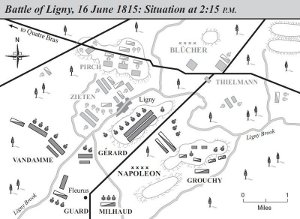
Napoleon saw his only chance as being to strike before the Allies were ready – not that much of a problem, as the armies were moving very slowly. He decided to strike north towards Brussels. His plan was to drive his own army between the British and the Prussians, who were moving to join them from the east. He reasoned that, if he could attack each army in turn, he might be able to defeat both of them although it would be impossible for him to beat them once they had combined. In those days, when battles were generally won by the larger army, (no tanks or airpower to unbalance the straightforward clash of men) this was not a foolish approach. In fact, it almost worked. On 16 June Napoleon's forces defeated the Prussians at Ligny. The Prussians retreated and Napoleon thought that he could now move on the British, who were outnumbered and outgunned and who were relying on Belgian troops of uncertain loyalty. With some justification, he looked on victory at Waterloo as a foregone conclusion. The affair, he is reported to have said, would be like eating breakfast.
In the event, of course, Napoleon lost the day and, in consequence, his throne and his freedom. But was Waterloo, as many people claim, the decisive battle that defined the future of Europe?
The importance of Waterloo to European history seems, at least, to be somewhat overstated.
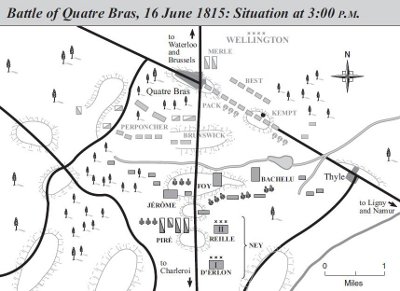
For a start, the most important battle probably took place two days earlier. While half of the French army was defeating the Prussians at Ligny, the other half was bogged down in indecisive fighting at a crossroads called Quatre Bras. Wellington had not been expecting an attack directly up that road and Quatre Bras was defended by a pathetically inadequate force of Netherlanders (made up of Dutch and Belgian regiments) under the Prince of Orange. Although many people nowadays regard the Prince as a fool and his troops as cowards, their determined defence of the crossroads against overwhelmingly superior forces allowed the British to reinforce their position and see the French army off. Napoleon had left the taking of Quatre Bras to his Marshal Ney, a heroically brave figure, but hardly a strategic genius. Ney failed to push through the Prince of Orange's defences when a determined attack would have almost inevitably succeeded. Had he done so, while British forces were still marching south to reinforce the Netherlanders, the French could have stormed north toward Brussels, brushing aside any opposition, which would not have had time to take up a proper defensive position. Brussels would have fallen by the end of the day. Indeed, many people in Brussels were fleeing toward Ghent or Antwerp, convinced that that was exactly what was going to happen. With control of Brussels – the British inevitably retreating along their lines of supply to the West – Napoleon would have succeeded in splitting the two armies and, after Ligny, the Prussians were hardly likely to take him on alone. The Battle of Waterloo, far from being won on the playing fields of Eton (something that, incidentally, Wellington almost certainly never said) was probably won at Quatre Bras.
The question remains, whether, if Napoleon had captured Brussels, whether by a decisive victory at Quatre Bras or by winning at Waterloo, he could have changed the history of Europe. It seems doubtful. The Prussians, though beaten, were hardly crushed. The Austrian and Russian armies were still ready to fall on Paris from the east. Britain commanded the seas and, if required, could have put another army into the field. Napoleon had united the whole of Europe against him. He was never again going to be able to threaten countries beyond his borders. What a Napoleonic victory might have achieved was to change the future of France. Talleyrand, whose diplomatic genius had served both Napoleon and the Bourbon monarchy, would quite likely have persuaded France's enemies that Napoleon, now reinforced with Belgian troops who would probably have defected back to their old imperial regiments, was best left alone in France. Austria and Russia distrusted each other and the ties between Austria and France (remember that Napoleon's wife was the daughter of the Habsburg Emperor Francis II of Austria) could have been exploited to drive a diplomatic wedge between them. There was, therefore, a small, but real, chance that Napoleon could have been left on the throne in Paris, but with conditions that prevented him from being a threat anywhere else.
Of course, a France under Napoleon might well have served as a rallying point for radical, anti-monarchist factions in other countries – one of the reasons that the Powers would have resisted the idea. The Enlightenment values of Napoleon's rule might have been sustained, his ideas conquering Europe in the same way that his armies had earlier. But this has to be doubtful. Napoleon was, by now, almost as easily identified with the sovereigns he had so affected to despise as with any revolutionary movement. He was in any case a sick man – he was to die six years later – and hardly the energetic genius that he had been at the height of his powers.
It really does seem unlikely that Waterloo changed the history of Europe. It did, however, change the history of Britain. Although Britain in the 18th century was clearly one of the Great Powers, the idea (common amongst Empire enthusiasts) that the British Empire was pre-eminent in an era of colonial expansion is by no means clear. The Napoleonic Wars saw Britain emerge as a leading (in British eyes the leading) European power. Britain was the only country to resist Napoleon throughout the period of conflict. British diplomacy was central to the formation of the many coalitions against France, and British money had financed the wars. Yet direct British military involvement had been mainly limited to the Peninsular campaign. While this had been of crucial strategic importance, it was never the primary focus of the war, and Britain was not among the Powers that fought their way into Paris in 1814. The cataclysmic battle at Waterloo, fought under Wellington as the Allied Commander-in-Chief, left the British convinced of their pre-eminence in Europe, a conviction so strong that it generated its own reality.
Britain never looked at itself in quite the same way again. Waterloo was a powerful symbol of national unity at a time of Corn Law riots and political unrest. The sight of Scots troops fighting so decisively alongside the English led to a new view of Scotland. The Scots had so recently been considered a threat to the Union that the Scots Greys were officially the North British, lest they get ideas about nationhood. Suddenly it was acceptable, even fashionable, to be a Scot. Wellington, now the greatest of British military men, went on to become Prime Minister. There were to be ups and downs in the decades ahead, but Waterloo had both strengthened the unity of the nation and allowed it to accept some of the differences within it.
Waterloo also changed the image of the Army. During most of the Napoleonic Wars, and the wars that preceded them, it was the Navy that was, in every sense, the Senior Service. It was the wooden walls that had defended England and saved us from French tyranny. Now, suddenly, the Army took centre stage. The British had long distrusted the standing army, but after Waterloo every soldier was a hero. (It was the first conflict to be commemorated with a medal awarded to all the British participants.) The modern Army has been built on the heritage of Waterloo.
Twentieth century notions of the quintessence of Britishness - coolness under fire, holding firm in the face of overwhelming opposition, even, dare it be said, making a virtue of cobbling together a solution from the limited resources available instead of properly planning ahead - all these things started with images of the Iron Duke and his men at Waterloo and in the days preceding the battle.
Waterloo was - despite its strategic inconsequence - the decisive battle of its age. It defined Britain, it enabled the development of the modern Army and it marked the start of the British Empire. It is unlikely that it had a significant impact on the future of Europe. However those seven hours in June two hundred years ago had an enormous effect on the future of Britain.
~~~~~~~~~~~~~
 Tom Williams is the author of the 'His Majesty's Confidential Agent' series, which tells the story of British spy James Burke during the Napoleonic wars. His latest adventure, published by Accent press in May, sees Burke in pursuit of a Bonapartist agent who has tried to assasinate the Duke of Wellington. The story reaches its conclusion on the field of Waterloo.
James Bond meets Richard Sharpe in a thrilling tale set against a detailed historical background. Amazon
When not reading 19th-century books or going to conferences where retired officers talk about *that* battle, Tom enjoys dancing tango and street skating. He also likes to travel and has explored the locations of Burke's adventures in Argentina, Egypt, France and Belgium, which is arguably the best thing about being a writer.
In 1814, after almost two decades of war with France, the nations of Europe made an alliance that finally defeated Napoleon. He was exiled to the island of Elba, off the coast of Italy. In retrospect, it was foolish to allow him to keep even a token military force, but the Allied powers did and, in February 1815, he sailed from Elba with around a thousand men, landing in France on 1 March.
Although many of the French remained loyal to King Louis, who had replaced Napoleon on the throne, the army defected en masse and he had enough popular support to re-establish himself as Emperor. He even organised a referendum to demonstrate French enthusiasm for his return. At first, Napoleon hoped that the Allied powers who had deposed him would be content to see him return to France provided that he did not seem to pose any threat to the rest of Europe. It quickly became apparent, though, that the Great Powers (Britain, Russia, Prussia and Austria) had no intention of leaving him in peace. Instead they declared him an outlaw (hors la loi) and mobilised their armies to attack France. The Prussians were to join British troops stationed in Belgium so that they could attack Paris from the north, while the Austrians and the Russians moved toward the city from the east.
Napoleon saw his only chance as being to strike before the Allies were ready – not that much of a problem, as the armies were moving very slowly. He decided to strike north towards Brussels. His plan was to drive his own army between the British and the Prussians, who were moving to join them from the east. He reasoned that, if he could attack each army in turn, he might be able to defeat both of them although it would be impossible for him to beat them once they had combined. In those days, when battles were generally won by the larger army, (no tanks or airpower to unbalance the straightforward clash of men) this was not a foolish approach. In fact, it almost worked. On 16 June Napoleon's forces defeated the Prussians at Ligny. The Prussians retreated and Napoleon thought that he could now move on the British, who were outnumbered and outgunned and who were relying on Belgian troops of uncertain loyalty. With some justification, he looked on victory at Waterloo as a foregone conclusion. The affair, he is reported to have said, would be like eating breakfast.
In the event, of course, Napoleon lost the day and, in consequence, his throne and his freedom. But was Waterloo, as many people claim, the decisive battle that defined the future of Europe?
The importance of Waterloo to European history seems, at least, to be somewhat overstated.
For a start, the most important battle probably took place two days earlier. While half of the French army was defeating the Prussians at Ligny, the other half was bogged down in indecisive fighting at a crossroads called Quatre Bras. Wellington had not been expecting an attack directly up that road and Quatre Bras was defended by a pathetically inadequate force of Netherlanders (made up of Dutch and Belgian regiments) under the Prince of Orange. Although many people nowadays regard the Prince as a fool and his troops as cowards, their determined defence of the crossroads against overwhelmingly superior forces allowed the British to reinforce their position and see the French army off. Napoleon had left the taking of Quatre Bras to his Marshal Ney, a heroically brave figure, but hardly a strategic genius. Ney failed to push through the Prince of Orange's defences when a determined attack would have almost inevitably succeeded. Had he done so, while British forces were still marching south to reinforce the Netherlanders, the French could have stormed north toward Brussels, brushing aside any opposition, which would not have had time to take up a proper defensive position. Brussels would have fallen by the end of the day. Indeed, many people in Brussels were fleeing toward Ghent or Antwerp, convinced that that was exactly what was going to happen. With control of Brussels – the British inevitably retreating along their lines of supply to the West – Napoleon would have succeeded in splitting the two armies and, after Ligny, the Prussians were hardly likely to take him on alone. The Battle of Waterloo, far from being won on the playing fields of Eton (something that, incidentally, Wellington almost certainly never said) was probably won at Quatre Bras.
 |
| Black Watch at the Battle of Quatre-Bras, 1815 by William Barnes Wollen |
The question remains, whether, if Napoleon had captured Brussels, whether by a decisive victory at Quatre Bras or by winning at Waterloo, he could have changed the history of Europe. It seems doubtful. The Prussians, though beaten, were hardly crushed. The Austrian and Russian armies were still ready to fall on Paris from the east. Britain commanded the seas and, if required, could have put another army into the field. Napoleon had united the whole of Europe against him. He was never again going to be able to threaten countries beyond his borders. What a Napoleonic victory might have achieved was to change the future of France. Talleyrand, whose diplomatic genius had served both Napoleon and the Bourbon monarchy, would quite likely have persuaded France's enemies that Napoleon, now reinforced with Belgian troops who would probably have defected back to their old imperial regiments, was best left alone in France. Austria and Russia distrusted each other and the ties between Austria and France (remember that Napoleon's wife was the daughter of the Habsburg Emperor Francis II of Austria) could have been exploited to drive a diplomatic wedge between them. There was, therefore, a small, but real, chance that Napoleon could have been left on the throne in Paris, but with conditions that prevented him from being a threat anywhere else.
Of course, a France under Napoleon might well have served as a rallying point for radical, anti-monarchist factions in other countries – one of the reasons that the Powers would have resisted the idea. The Enlightenment values of Napoleon's rule might have been sustained, his ideas conquering Europe in the same way that his armies had earlier. But this has to be doubtful. Napoleon was, by now, almost as easily identified with the sovereigns he had so affected to despise as with any revolutionary movement. He was in any case a sick man – he was to die six years later – and hardly the energetic genius that he had been at the height of his powers.
It really does seem unlikely that Waterloo changed the history of Europe. It did, however, change the history of Britain. Although Britain in the 18th century was clearly one of the Great Powers, the idea (common amongst Empire enthusiasts) that the British Empire was pre-eminent in an era of colonial expansion is by no means clear. The Napoleonic Wars saw Britain emerge as a leading (in British eyes the leading) European power. Britain was the only country to resist Napoleon throughout the period of conflict. British diplomacy was central to the formation of the many coalitions against France, and British money had financed the wars. Yet direct British military involvement had been mainly limited to the Peninsular campaign. While this had been of crucial strategic importance, it was never the primary focus of the war, and Britain was not among the Powers that fought their way into Paris in 1814. The cataclysmic battle at Waterloo, fought under Wellington as the Allied Commander-in-Chief, left the British convinced of their pre-eminence in Europe, a conviction so strong that it generated its own reality.
Britain never looked at itself in quite the same way again. Waterloo was a powerful symbol of national unity at a time of Corn Law riots and political unrest. The sight of Scots troops fighting so decisively alongside the English led to a new view of Scotland. The Scots had so recently been considered a threat to the Union that the Scots Greys were officially the North British, lest they get ideas about nationhood. Suddenly it was acceptable, even fashionable, to be a Scot. Wellington, now the greatest of British military men, went on to become Prime Minister. There were to be ups and downs in the decades ahead, but Waterloo had both strengthened the unity of the nation and allowed it to accept some of the differences within it.
 |
| Scotland Forever! by Elizabeth Thompson |
Waterloo also changed the image of the Army. During most of the Napoleonic Wars, and the wars that preceded them, it was the Navy that was, in every sense, the Senior Service. It was the wooden walls that had defended England and saved us from French tyranny. Now, suddenly, the Army took centre stage. The British had long distrusted the standing army, but after Waterloo every soldier was a hero. (It was the first conflict to be commemorated with a medal awarded to all the British participants.) The modern Army has been built on the heritage of Waterloo.
Twentieth century notions of the quintessence of Britishness - coolness under fire, holding firm in the face of overwhelming opposition, even, dare it be said, making a virtue of cobbling together a solution from the limited resources available instead of properly planning ahead - all these things started with images of the Iron Duke and his men at Waterloo and in the days preceding the battle.
Waterloo was - despite its strategic inconsequence - the decisive battle of its age. It defined Britain, it enabled the development of the modern Army and it marked the start of the British Empire. It is unlikely that it had a significant impact on the future of Europe. However those seven hours in June two hundred years ago had an enormous effect on the future of Britain.
~~~~~~~~~~~~~

James Bond meets Richard Sharpe in a thrilling tale set against a detailed historical background. Amazon
When not reading 19th-century books or going to conferences where retired officers talk about *that* battle, Tom enjoys dancing tango and street skating. He also likes to travel and has explored the locations of Burke's adventures in Argentina, Egypt, France and Belgium, which is arguably the best thing about being a writer.