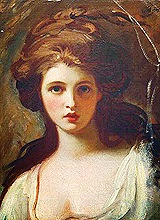
Showing posts with label William Hamilton. Show all posts

Thursday, October 13, 2016

Worcester Cathedral

by Cryssa Bazos

Severn River © Cryssa Bazos

On the banks of the Severn River stands a magnificent cathedral. Framed against a river of gliding swans, Worcester Cathedral's history has spanned centuries, serving as the final resting place for royalty and providing a backdrop for major conflicts.

Worcester Cathedral © Cryssa Bazos

Even before the present day cathedral, the site was consecrated by a priory founded in the 7th century. Nothing now remains of this original priory, but in the 10th century, a new church was built by Saint Oswald, the Bishop of Worcester. The subterranean crypt is the only part of that earlier structure still remaining. It's a hauntingly quiet niche still used for worship.

The Crypt © Cryssa Bazos

The Crypt © Cryssa Bazos

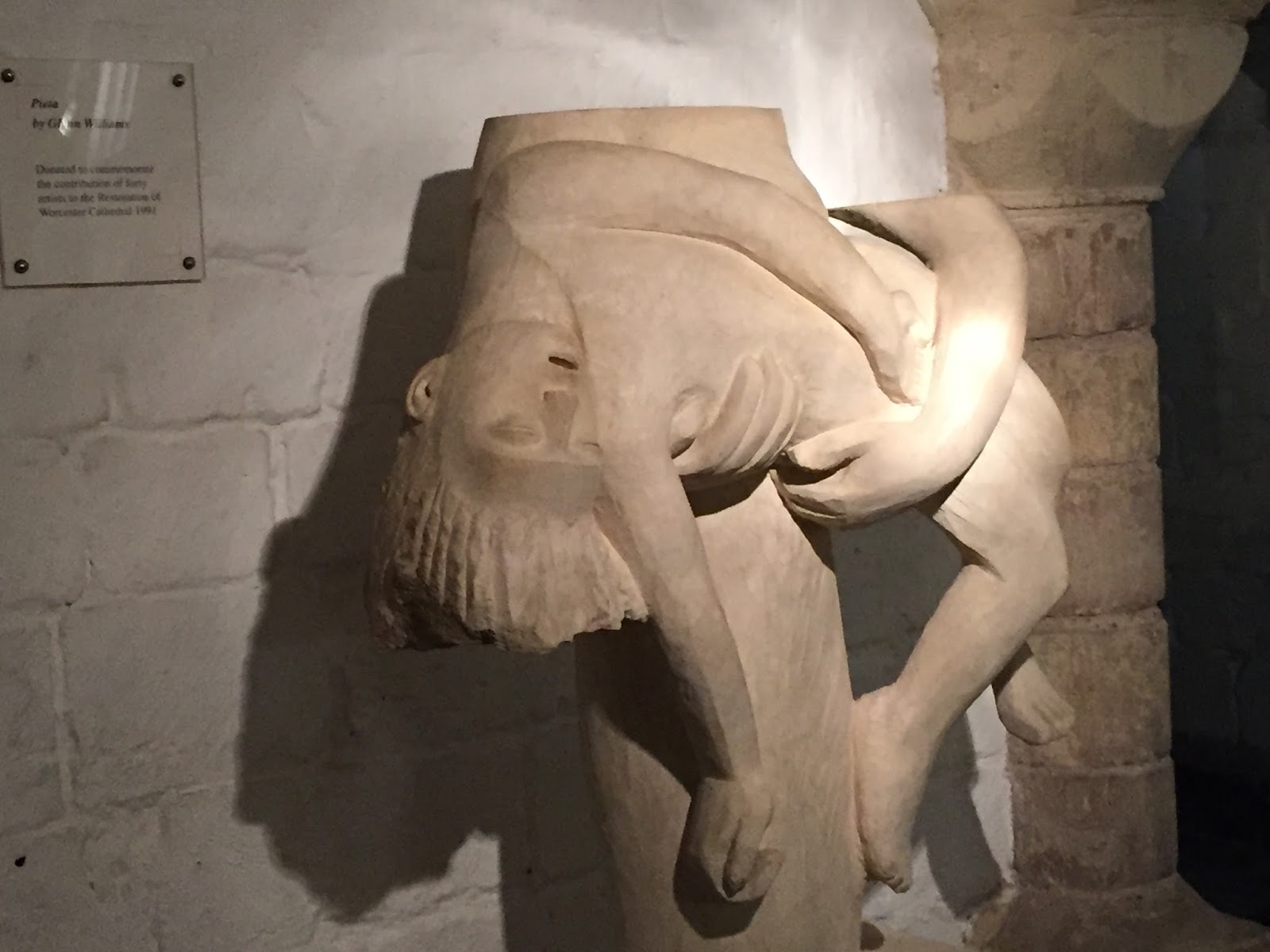
Statue in the Crypt © Cryssa Bazos

Another saint associated with Worcester was an Anglo Saxon bishop, Saint Wulfstan who held this see before and during the Norman Conquest. Despite his allegiance to Harold Godwinson (of the Battle of Hastings fame), Wulfstan held his post under William the Conqueror.

This stained glass panel commemorates both saints.

Stained glass saints © Cryssa Bazos

Work on the present day cathedral started in 1084 and was finished by 1504. It is a work of art as one can see by the magnificent vaulted quire ceiling, which is decorated with the images of saints and angels.

And now to visit the cathedral's famous residents. King John, also known as John Lackland, Prince John, and signer of the Magna Carta, is buried in Worcester Cathedral. His sarcophagus is decorated with his likeness, carved in Portland stone. At one time, the stone would have been painted, but now has darkened to the colour of agate.

King John was a poor monarch and his reign was punctuated by periods of revolt . Though he did sign the Magna Carta, he did so under duress, forced to do so by his barons who had had enough of his abuse. He died shortly after trying to launch a fresh attack on the rebel barons.

What is interesting about his effigy is that the two Worcester saints, Oswald and Wulfstan, have been included, sitting on each shoulder of the king. Proof that John Lackland needed all the help he could get for the afterlife.

Detail of King John's tomb © Cryssa Bazos

King John's tomb © Cryssa Bazos

Royal crest on King John's tomb © Cryssa Bazos

A better mourned royal in Worcester Cathedral is Prince Arthur, the older brother of Henry VIII. Prince Arthur died suddenly at the age of 15, only five months after his marriage to Catharine of Aragon. His death was a crushing blow to his father, Henry VII.

After lying in state at Ludlow castle, Prince Arthur's body was brought to Worcester Cathedral by boat. The Prince had a connection to the city since he had been baptized by the Bishop of Worcester, and as a child, he had spent time in the city. During his funeral, dirges were sung for him. His tomb lies in the chantry chapel and is decorated by the white and red roses of York and Lancaster. 

Prince Arthur's tomb © Cryssa Bazos

Heraldic motif Prince Arthur's tomb
© Cryssa Bazos

Imagine what might have happened had he lived. Henry VIII would not have been king, would not have married Arthur's widow, Catherine, and subsequently broken from the Catholic church for the sake of Anne Boleyn. The country may have gone down a different path, one perhaps not driven by religious conflicts.

The final grave I'd like to visit belongs to the Duke of Hamilton, killed during the final battle of the English Civil War.

The first battle of the civil war was fought in 1642 just south of Worcester Cathedral at Powick Bridge. The last battle of the civil war was fought at Worcester on September 2, 1651. During the week leading up to the final battle, King Charles II occupied Worcester with 12,000 - 14,000 Scottish soldiers. William Hamilton, the 2nd Duke of Hamilton, was a close friend of the king and led a regiment on his behalf.

During the early stages of the battle, King Charles observed the fighting to the south from the strategic vantage of the cathedral's tower, with its sweeping views of the area. When he gauged the time right, King Charles led an assault against Cromwell's forces at Red Hill (to the east of the city) while the Duke of Hamilton led an assault against Perry Wood.

The Duke was shot during the engagement, and his men brought him back to his lodgings in the Commandery (just outside Worcester's Sidbury Gate) which was now overrun by the victorious Parliamentary soldiers.

At the Commandery, a Royalist surgeon examined him and found a musket shot had shattered in the leg and the only way to save him would be to amputate. Cromwell's physician examined him as well, but disagreed with the prognosis and told him that he didn't need to lose the leg. Hamilton worsened and subsequently died of his injuries. Another version of this story was that Hamilton declined Cromwell's offer of his surgeon, determined not to be treated by a traitor.

On his deathbed, the Duke had barely enough energy to write a heart-wrenching farewell letter to his wife. The letter was found in his pocket after he passed away.

Dear Heart,
YOV know I have been long labouring, though in great weakness, to be prepared against this expected Change, and I thank my God I find Comfort in it, in this my day of Tryal; for my Body is not more weakned by my Wounds, then I find my Spirit Comforted and Supported by the infinite Mercies and great Love of my Blessed Redeemer, who will be with me to the end and in the end.
I am not able to say much more to you, the Lord preserve you under your Tryals, and sanctifie the use of them to the Comfort of your Soul.
I will not so much as in a Letter divide my dear Neeces and you; the Lord grant you may be constant Comforts to one another in this Life, and send you all Eternal Happiness with your Saviour in the Life to come: to both of your Cares I recommend my poor Children, let your great Work be to make them early accquainted with God, and their Duties to him; and though they may suffer many wants here before their Removal from hence, yet they will find an inexhaustible Treasure in the Love of Christ. May the Comforts of the Blessed Spirit be ever near you in all your Straits and Difficulties, and suffer not the least repining to enter into any of your Hearts for his Dispensations to|wards me, for his Mercies have been infinitely above his Iustice in the whole Pilgrimage of,
Dear Heart, Your Own, HAMILTON.
Worcester, Sept. 8. 1651.

Against his wishes for his body to be returned to Scotland, the Duke was buried in Worcester Cathedral. His servants repeatedly petitioned Cromwell to approve the transfer of the Duke's body to his wife but the request was denied. A single plaque marks where he was buried.

Duke of Hamilton plaque © Cryssa Bazos

Worcester Cathedral has a long, rich history to explore. The next time you are visiting Worcester, I encourage you to take a detour and visit the past.

Worcester Cathedral interior © Cryssa Bazos

~~~~~~~~~~
Cryssa Bazos is a historical fiction writer and 17th Century enthusiast with a particular interest in the English Civil War (ECW). For more stories about the English Civil War and the 17th Century, visit her blog.

Thursday, January 3, 2013

Sir William Hamilton (That Hamilton Man!)


My last post for the EHFA was on Emma Hamilton, so it seems apropos that we discuss one of her other two halves, the man who is not often discussed, Sir William Hamilton.

Sir William Hamilton

January 12 1731-April 6 1803


Now, 200 years after he has died, he is more famous for whom he was married to, than his achievements in life.


PastedGraphic-2012-12-8-08-31.jpg

For 36 years he was the British Ambassador to the Kingdom of Naples. From 1764 to 1800. Turbulent times that saw the French Revolution and the rise of Napoleon.

Hamilton was also an antiquarian, an archaeologist and vulcanologist. (DWW-being Ambassador in Naples provided was access to Vesuvius and Etna.) He was a noted collector and became a member of the Royal Society. Born the fourth son of Lord Archibald Hamilton, who was Governor of Jamica, his mother was the daughter of the sixth Earl of Aberdeen. She was a mistress of the son of George II, George the Prince of Wales, who was the father of George III. George III called Sir William his foster brother.

PastedGraphic1-2012-12-8-08-31.jpg

Sir William attended the Westminster School and then was commissioned into the 3rd Foot Guards in 1747. He was promoted to Lieutenant in 1753. He married Catherine Barlow, daughter of a politician and left the army. She died in 1782, they had no children. In 1786, when he was 55 his nephew sent him a stunning young lady who had become the muse for George Romney. Sir William cancelled his nephew, Charles Greville’s debts for the introduction. Emma Lyon (Hart) captivated Sir William. They were married in 1791. He was 60 then and she was 26.

When Horatio Nelson crossed their path, a man he admired, he encouraged the notorious affair to develop. Eventually when they abandoned Naples, the three took up living all in the same houses in both Merton Place and London. Nelson refused to seek his own divorce and marry Emma until Sir William died, for they were such good friends.

PastedGraphic2-2012-12-8-08-31.jpg

William served as an MP for Midhurst in 1761 but then left to become the Ambassador to Naples. He began his collection of Greek Vases and other antiquities selling a part of his collection to the British Museum. A second collection was lost at sea when the HMS Colossus went down. What survived was purchased by Thomas Hope.

Sir William became an author Antiquités étrusques, grecques et romaines (1766–67) and Observations on Mount Vesuvius (1772). And he was a member of the Royal Society, a Fellow of the Society of Antiquaries and a member of the Society of Dilettanti. He made more than 65 ascents to Mount Vesuvius and made a number of drawings before it’s eruption in 1765. He met Mozart during his tour of Italy in 1770. Goethe visited Hamilton in 1787. Goethe thought two chandeliers were most likely smuggled from Pompei, and a friend agreed telling the famed poet, that he should not pursue his investigations any further. Hamilton died in 1803 and is buried next to his first wife.


* * *


Mr. Wilkin writes Regency Historicals and Romances, Ruritanian (A great sub-genre that is fun to explore) and Edwardian Romances, Science Fiction and Fantasy works. He is the author of the very successful Pride & Prejudice continuation; Colonel Fitzwilliam’s Correspondence. He has several other novels set in Regency England including The End of the World and The Shattered Mirror. His most recent work is the humorous spoof; Jane Austen and Ghosts, a story of what would happen were we to make any of these Monsters and Austen stories into a movie.

And Two Peas in a Pod, a madcap tale of identical twin brothers in Regency London who find they must impersonate each other to pursue their loves.


The links for all locations selling Mr. Wilkin's work can be found at the webpage and will point you to your favorite internet bookstore: David’s Books, and at various Internet and realworld bookstores including the iBookstore, Amazon, Barnes and Noble, Smashwords.


He is published by Regency Assembly Press
And he maintains his own blog called The Things That Catch My Eye where the entire Regency Lexicon has been hosted these last months as well as the current work in progress of the full Regency Timeline is being presented.

You also may follow Mr. Wilkin on Twitter at @DWWilkin
Mr. Wilkin maintains a Pinterest page with pictures and links to all the Regency Research he uncovers at Pinterest Regency-Era


Friday, December 14, 2012

That Hamilton Woman!


Emma (Hart) Hamilton
April 26 1765 to January 15 1815

Born the daughter of a blacksmith, died in infamy, the avowed mistress of England’s hero, Horatio Nelson. She was born Amy Lyon and later changed her name to Emma Hart.

PastedGraphic-2012-11-18-08-46.jpg


 At the age of 12 she was a maid at the Hawarden, Wales. House of Doctor Honoratus Leigh Thomas, a surgeon in Chester. She then worked for the Budd family in Chatham place and helped a fellow maid, Jane Powell rehearse to become an actress. She then became a maid at the Theatre Royal in Drury Lane to such notables as Mary Robinson. From being a maid she advanced to model and dancer.

  At the age of 15 she met Sir Harry Featherstonhaugh. She became an entertainer for him, dancing naked on the dining room table for he and his friends. At Harry’s Uppark estate in the South Downs she met the second son of the Earl of Warwick, the honorable Charles Francis Greville. She also conceived a child by Sir Harry. (1781.)

PastedGraphic1-2012-11-18-08-46.jpg


  Emma was sent off to London until the baby was born but now she became the mistress of Greville. The child, when it was born was taken to be raised by the Blackburn family. Emma saw her daughter frequently until those periods when she was in debt. The girl became a companion or governess in her later life.

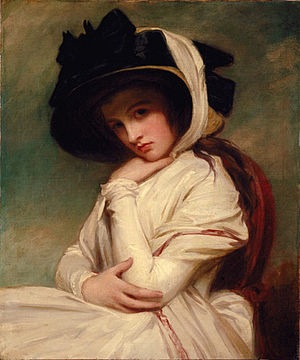
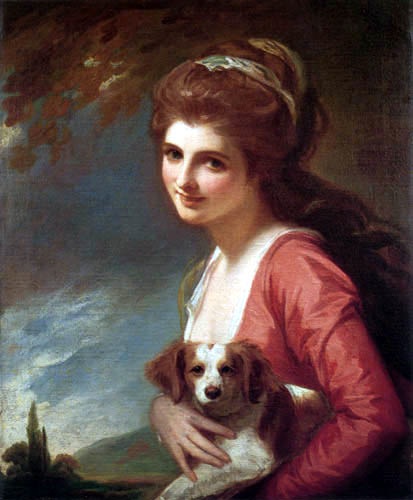
  Greville had Emma sit for George Romney and kept her as his mistress. Romney now took on Emma as one of his chief inspirations, his muse. She is in many of the most famous paintings by Romney.

PastedGraphic2-2012-11-18-08-46.jpg


  By 1783, Greville needed to find a rich wife (though another source says he never married), so he passed Emma to his uncle, Sir William Hamilton, the British Envoy to Naples. Hamilton was glad for Greville’s marriage meant he did not have to support his nephew any longer either. In a transaction, Hamilton acquired Emma much as one buys a piece of pottery. Emma had no knowledge of the transaction, and was furious about it when she found out. But she did become Hamilton’s mistress.

  She created a new art form, crossing between posture, dance and acting for his guests and it was a sensation. Other artists took on this type of performance. In 1791, Hamilton married Emma in England. He was 60 and she 26.

PastedGraphic3-2012-11-18-08-46.jpg


  And then in 1793, she met Horatio Nelson at the court of the King and Queen of Naples. Nelson came back to Naples in 1798 after the Battle of the Nile sorely wounded, and she nursed him back to health. Then for his 40th birthday she had a party with 1800 guests to celebrate it. Sir William even seems then to have tolerated and encouraged the affair that developed between Emma and Nelson.

PastedGraphic4-2012-11-18-08-46.jpg


  That Emma and Nelson could have such an endorsement may stem from the age of Sir William, and that Nelson was the most famous Briton in the world now that he had won the Battle of the Nile, and through George Romney and her founding of a new art form, and her great beauty, Emma was the most famous female Briton. (DWW-The two most important Britons, even more so than any King or Prime Minister, right at that moment) And William Hamilton was a collector. These two were under his roof, carrying on. He was able to show them off.

  Emma was now, in 1799, the close personal friend and advisor to the Queen of Naples, Marie Carolina whose sister, Marie Antoinette had been executed by the French. It was probably not too impossible to tell those of Naples, that the French were the great enemy. Those who did want the French as allies, were the aristocrats, not the people or the royals. The royal family fled to Sicily. Nelson tried to aid the Royal family and put down this aristocratic revolution. He was recalled to Britain, though he, Emma and Sir William took the longest possible route back.

  They arrived in Britain in 1800 to a hero’s welcome. They lived together openly and the affair became public knowledge. The Admiralty sent Nelson back to sea.

  Now Emma and Nelson wished to marry, but they would not do so until Sir William died, who they both cared for very much. Nor could Nelson get a divorce from his wife unless he had another great victory. In 1801, Emma gave birth to her and Nelson’s daughter, Horatia. Nelson bought a house in Wimbledon, Merton Place, where they all could live. They became the papers celebrity sensation of the day. Emma was no longer the great beauty, and they did try to live a quieter life.

  Sir William died in 1803 and Nelson left for the sea again. Emma was pregnant once more. The child died a few weeks after it was born. Emma began to spend lavishly and gamble. Then Nelson died at Trafalgar.

  Now she ran through the remaining money and became heavily in debt. Merton Place was left to her and Emma tried to maintain it as a monument to Nelson. It too sent her into further debt. She had now returned to poverty and drank herself to death in Calais. Horatia married the Reverend Phillip Ward and had ten children.


* * *


Mr. Wilkin writes Regency Historicals and Romances, Ruritanian (A great sub-genre that is fun to explore) and Edwardian Romances, Science Fiction and Fantasy works. He is the author of the very successful Pride & Prejudice continuation; Colonel Fitzwilliam’s Correspondence. He has several other novels set in Regency England including The End of the World and The Shattered Mirror. His most recent work is the humorous spoof; Jane Austen and Ghosts, a story of what would happen were we to make any of these Monsters and Austen stories into a movie.

And Two Peas in a Pod, a madcap tale of identical twin brothers in Regency London who find they must impersonate each other to pursue their loves.


The links for all locations selling Mr. Wilkin's work can be found at the webpage and will point you to your favorite internet bookstore: David’s Books, and at various Internet and realworld bookstores including the iBookstore, Amazon, Barnes and Noble, Smashwords.


He is published by Regency Assembly Press
And he maintains his own blog called The Things That Catch My Eye where the entire Regency Lexicon has been hosted these last months as well as the current work in progress of the full Regency Timeline is being presented.

You also may follow Mr. Wilkin on Twitter at @DWWilkin
Mr. Wilkin maintains a Pinterest page with pictures and links to all the Regency Research he uncovers at Pinterest Regency-Era