Monday, April 20, 2015

James Lind and the Treatment of Scurvy

by Regina Jeffers

A portrait of Scottish doctor James Lind (1716–1794)
http://en.wikipedia.org/wiki/James_Lind#/media/File:James_Lind_by_Chalmers.jpg

James Lind was a Scottish doctor who studied scurvy first hand. Born in Edinburgh in 1716, Lind became an apprentice at Edinburgh’s College of Surgeons at the age of 15. At 23, he accepted the post of surgeon’s mate and sailed throughout the Mediterranean, Guinea and the West Indies. At 31, Lind became the surgeon assigned to the HMS Salisbury. During his service to the HMS Salisbury, Lind conducted experiments on the cause and symptoms of scurvy. (BBC: History)   The Salisbury was a fourth class ship and during a 10 week stint where the Salisbury did not return to port, 80 of the 350 sailors on board lost their lives to scurvy. (The James Lind Library)
Lind selected 12 men from the ship, all suffering from scurvy, and divided them into six pairs, giving each group different additions to their basic diet. Some were given cider, others seawater, others a mixture of garlic, mustard and horseradish. Another group of two were given spoonfuls of vinegar, and the last two oranges and lemons. Those fed citrus fruits experienced a remarkable recovery. While there was nothing new about his discovery - the benefits of lime juice had been known for centuries - Lind had definitively established the superiority of citrus fruits above all other ‘remedies’. (BBC: History)

Lind’s publications include his 1753 “A Treatise of the Scurvy”; 1757 “An Essay on the Most Effectual Means of Preserving the Health of Seamen in the Royal Navy,” and 1768 “An Essay on Diseases Incidental to Europeans in Hot Climates.” His work brought attention to the deplorable living conditions and diets of the King’s navy, as well as listing the diseases found in the colonies the English claimed and ways to avoid becoming ill. In 1762, Lind proposed a simple method of supplying fresh water to those aboard ship. (The James Lind Library)

The Journal of Royal Society of Medicine cites the voyages of George Anson, 1st Baron Anson, Admiral of the Fleet, for bringing Lind’s attention to the dangers of scurvy. Anson circumnavigated the glove and oversaw the Royal Navy during the Seven Years’ War. Anson’s  A Voyage Round the World, in the Years MDCCXL, I, II, III, IV: Compiled from Papers and Other Materials of the Right Honourable George Lord Anson, and Published Under His Direction, by Richard Walter, Chaplain to His Majesty's Ship the "Centurion" piqued Lind’s interest in scurvy, a disease Lind had seen firsthand. Anson reported that he lost 380 men out of a crew of 510 to scurvy.

Lind sought more information on the disease but came away with the knowledge that those who written of scurvy’s symptoms, etc., were men who never once been to sea. Lind considered this lack of information on the causes of scurvy led to confusion among medical professionals on diagnosis, prevention, and cure.

Lind judged his relatively small number of observations on twelve patients, reported in some detail, as convincing, particularly because the differences shown were so dramatic. In fact he “confirmed” them by selected observations on other patients, but these were not as reliable as his experimental results, nor were they quantitative. In these, as well as in other experiments designed in advance, it was the quality of basic observations rather than their quantity that was important for Lind. Careful observation of a single case could even be decisive; for instance, Lind said that that he had never had a great opinion of the elixir of vitriol because he had witnessed a patient contracting scurvy to whom he had prescribed it as a "reconstituent", that is, “while under a course of medicine recommended for its prevention” (Lind 1753, p 196). Similarly, postulated treatments for scurvy had not only been debunked by Lind’s experiment, but were “contradicted by the daily experience of seamen, [and] by the journals of our sea-hospitals…” When claiming this, he seems to have such evidence in mind, although he did not quote it explicitly. (The James Lind Library)

Lind’s therapeutic findings made little impact on medical opinion in Britain: indeed, the year after their publication (1753) the Navy’s ‘Sick and Hurt Board’ rejected a proposal to provide sailors with supplies of fruit juice. In fact, aware of the storage problems for adequate amounts of fresh fruit or fruit-juice during long cruises, Lind recommended that a condensate (called “rob”) should be prepared by evaporating a dilution of fresh fruit juice in nearly boiling water over several hours. Unfortunately, as we now know, heat destroys much of the ascorbic acid in fresh juice, and it is unsurprising that subsequent observers were unable to detect any beneficial effect of the condensate. (The James Lind Library)

In hindsight the story of how Lind’s work was received, entailing a lag of 42 years between his clearly described and experimentally “proven” treatment and its actual introduction by the relevant authorities, seemed to some “one of the most foolish episodes in the whole history of medical science and practice”. However, the Navy Sick and Hurt Board did not, during the first thirty years, act unreasonably when one considers that Lind’s was only one of a great number of treatises on the subject (see Lind’s own Bibliotheca Scorbutica, an appendix to the first edition of his work); the Board was inundated with suggestions concerning scurvy; lemon juice was by no means a new cure (a fact of which Lind was perfectly aware); and not least because, together with his "rob", he also recommended a list of vegetables for preventing scurvy which, on the basis of modern analyses, were unlikely to have been effective. Lind’s recommendations thus sometimes ignored his declared rejection of unwarranted speculation and his professed reliance on carefully observed facts.
(The James Lind Library)

For more on Lind and The Rise of Preventive Medicine in the 18th Century, join me today on my blog "Every Woman Dreams."

~~~~~~~~~~~~~

Meet Regina Jeffers:

Regina Jeffers is an award-winning author of Jane-Austen inspired novels/mysteries, as well as Regency romances. A master teacher, for thirty-nine years, Regina passionately taught thousands of students English in the public schools of West Virginia, Ohio, and North Carolina. Yet, “teacher” does not define her as a person. Ask any of her students or her family, and they will tell you Regina is passionate about so many things: her son, children in need, truth, responsibility, the value of a good education, words, music, dance, the theatre, pro football, classic movies, the BBC, track and field, books, books, and more books. Holding multiple degrees, Jeffers often serves as a Language Arts or Media Literacy consultant to surrounding school districts and has served on several state and national educational commissions.

As the author of nineteen books, Jeffers is always busy writing, She has five new titles arriving in 2015, including The Prosecution of Mr. Darcy’s Cousin: A Pride and Prejudice Mystery; Elizabeth Bennet’s Deception: A Pride and Prejudice Vagary; Mr. Darcy’s Fault: A Pride and Prejudice Vagary; A Touch of Emerald: the Conclusion of the Realm Series, and Angel Comes to the Devil’s Keep.

Website: http://www.rjeffers.com
Every Woman Dreams: https://reginajeffers.wordpress.com
Join Regina on Facebook, Twitter, Google+, and Pinterest.

Saturday, April 18, 2015

Old Words!

by Scott Howard Higginbotham

When you hear the words, “Charity suffereth long, and is kind; charity envieth not; charity vaunteth not itself, is not puffed up,” something can get lost in the translation.  Our modern lexicon rarely uses such high and lofty words as seen in the King James Version of the Holy Bible.  The preceding passage comes from 1 Corinthians 13: 4 and, is more easily understood as love being patient, kind, not boastful, and not proud.  Once you break through the archaic verbiage the words come alive, bringing forth a powerful rendering of the English language.  

This does not mean that modern readers are necessarily droll.  However, words used in yesteryear seem to carry more weight.  But how do we inform, educate, and keep dozing readers from falling asleep when they read such words?  Is there a magical and contextual tension where a relatively ancient word form can be used without alienating the reader?  Indeed, and the key is finding that perfect balance.  

This post is not centering on what words to use and the balance that can be created, but focuses on what some words commonly appearing in historical novels actually mean.

Ague- malaria or a similar illness
Betimes- in good time; early
Carl- a man of low birth
Demesne- a region or domain
Ere- before
Fain- pleased or willing under the circumstances
Gallant- a young gentleman
Hie- go quickly
Howbeit- nevertheless
In sooth- actually
Knave- dishonest or unscrupulous man
Leman- lover or sweetheart
Mayhap- perhaps or possibly
Otiose- lazy or slothful
Piepowder- a traveler or an itinerant merchant or trader
Perchance- by some chance
Peradventure- perhaps
Thither- to or toward a place
Varlet- an unprincipled rogue
Withal- in addition
Wight- a person of a specified kind
Wherat- at which
Whilom- formerly
Ye- you
Yea- yes


Photo by Scott Howard Higginbotham

Indeed, reading an historical novel is a leap for the uninitiated, but creating that perfect tightrope balance of old and modern words can draw and keep those readers that have not crossed over.  Lastly, this post would not be complete without something near and dear to me.  Enjoy some sword terminology!
 
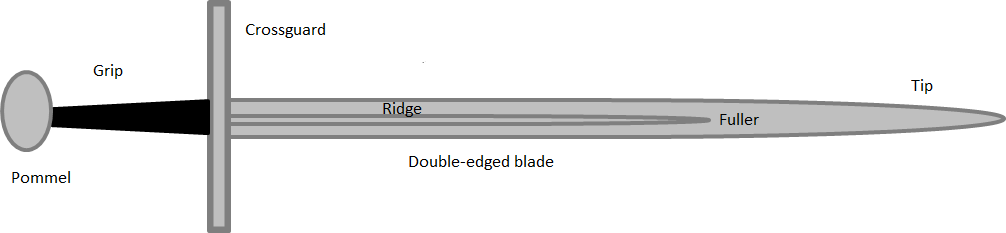
Drawing by Scott Howard Higginbotham

Pommel: a termination point for the blade’s tang. Screws onto or is otherwise secured to the tang. Also provides balance for the sword. Can be used offensively.
Crossguard: protects the user’s hand and is a transition piece between the blade and the grip. This style has religious symbolism due to its shape. Can be used offensively.
Grip: a hollow piece of wood that covers the tang; for gripping the sword. Can be wrapped in leather, brass wire, or any suitable material that aids the user or declares his status.
Fuller: a groove running down the length of the blade.  Removes weight and the two ridges at the ends of the concavity help strengthen the blade.
Double-edged blade: can cut on an upswing and a downswing.
Tip: the sharp end that no one wants to be facing; the business end.
The typical medieval sword was about 3 or 4 pounds!  Stamina played such an important role, coupling this with strength made the knight a potent force.

Photo by Scott Howard Higginbotham


~~~~~~~~~~~~~ 
http://www.amazon.com/dp/B007EHUMSC?tag=forathogen-20&camp=0&creative=0&linkCode=as1&creativeASIN=B007EHUMSC&adid=0EC3CR9J80NNHXXSP77Q
A Soul’s Ransom

 
Scott Howard Higginbotham writes under the name Scott Howard and is the author of A Soul’s Ransom, a novel set in the fourteenth century where William de Courtenay’s mettle is tested, weighed, and refined, and For a Thousand Generations where Edward Leaver navigates a world where his purpose is defined with an eye to the future.  His new release, A Matter of Honor, is a direct sequel to For a Thousand Generations.  It is within Edward Leaver's well-worn boots that Scott travels the muddy tracks of medieval England.

Friday, April 17, 2015

Sir Godfrey Kneller, the de Veres, and the Beauclerks

by Margaret Porter

Such are thy pictures, Kneller, and such thy skill,
That Nature seems obedient to thy will;
Comes out and meets thy pencil in the draught,
Lives there, and wants but words to speak her thoughts.
                                                       ~~ John Dryden

Aubrey de Vere, 20th Earl of Oxford
In 1678, two years after arriving in England with his brother, the German artist Godfrey Kneller produced a magisterial, much-admired portrait of King Charles II. As a result, "his reputation daily increased so that most noblemen and ladies would have their pictures done by him," irrespective of their political affiliation or religious preferences. Aubrey de Vere, 20th Earl of Oxford, a soldier and courtier boasting one of the longest pedigrees in the land, was among the artist's subjects. Kneller painted his illustrious client in battle armour. 

the first portrait
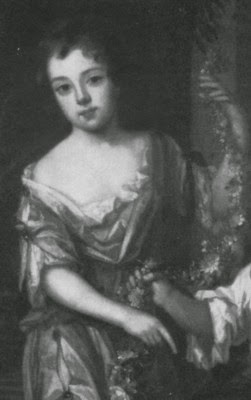
When the Earl's daughter Lady Diana de Vere first posed for Kneller, she was no more than ten years old. Holding up a floral garland, she stands beside her younger sister Mary, seated beside her. By the early 1680s, when this double portrait  was completed, the German artist was at the pinnacle of prominence.

Nell Gwyn, with her son and without, with or without her clothes on, was often painted by renowned portraitists Peter Lely and Simon Verelst. Kneller succeeded them as the most fashionable artist of the day, remaining so after Nell’s death in 1687 and the Glorious Revolution of the following year. King William III and Queen Mary II shared the deposed James II's preference for Kneller's work.

Charles Beauclerk, Duke of St Albans
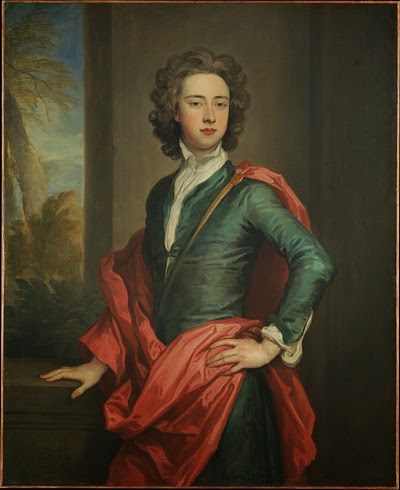
By 1690 Nell's son and heir, the Duke of St Albans, had embarked upon a military career. At about that time the handsome young man posed for a three-quarter length portrait. This would be the first of many Beauclerk portraits produced by Kneller, now a naturalised Englishman. He'd established a residence and studio in the north east corner of Covent Garden. Not only the nobility flocked there--the Duke’s father, King Charles II, had also visited the artist to sit for his portraits, a mark of great favour.

One of Kneller's most memorable and presumably enjoyable commissions came a year after the double coronation of William and Mary. As the former battled foreign enemies on the Continent, the Queen decided to imitate her own mother's gallery of beauties at Windsor Castle, produced by Lely. Mary proposed a set of paintings for Hampton Court Palace, being altered by Sir Christopher Wren to suit her and William's architectural tastes. Her plan was mocked by her father’s former mistress, Lady Dorchester, who famously quipped, "Madam, if the King was to ask for portraits of all the wits in his court, would not the rest think he called them fools?"

Diana, a Hampton Court Beauty
Undeterred, Mary put Kneller to work, and her loveliest and most virtuous attendants made their way to his studio to have their charms preserved as life-sized canvases. Of the twelve original paintings only eight remain. The most admired of the set is that of Lady Diana de Vere, who at that time was either officially or unofficially attached to the court as maid of honor. She poses with an orange tree, holding an orange in her hand—doubtless designating the de Veres’ fealty to the new rulers from the House of Orange. The paintings of Diana and the other ladies were positioned in the narrow spaces between the tall windows of Hampton Court's riverside Water Gallery (later demolished). Each was set within a blue-and-white painted frame to complement the Queen’s extensive Delftware collection. Diana's portrait currently hangs in the King’s Dining Room, and is now surrounded by giltwood frame. Duchess of St Albans, the title she gained at her marriage to Charles Beauclerk, was inscribed at a later date. (A detail of this work appears on the cover of my novel A Pledge of Better Times.)

The 20th Earl of Oxford 
in Garter Robes
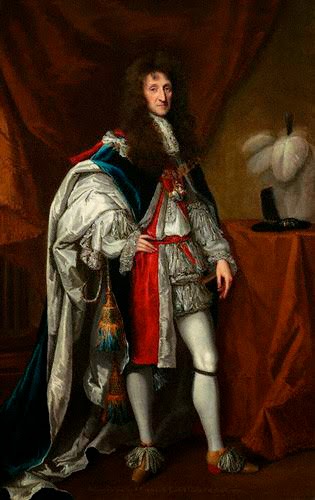
 Having pleased the monarchs with portraits of beauties and military men, on 3 March 1691/2, Kneller became Sir Godfrey. “His Majesty, to shew his Kingly approbation of his Art and Manners, was pleas’d to confer the Honour of Knighthood upon him…and as an extraordinary Mark of his Grace and Favour, Honour’d him with the Present of a Sword, by the Hands of the Right Honourable Lord Chamberlain." The artist also became a Gentleman of the Privy Chamber, and received an honorary doctorate from Oxford. An acquaintance reported, "In June 1693 Sir Godfrey Kneller told me he has had fourteen persons sett to him in a day." Some of those persons sat to him as many as a dozen times for a single portrait! Diana’s father, Lord Oxford, a Knight of the Garter, a member of the Privy Council, a Lieutenant General, and a Gentleman of the King’s Bedchamber, commissioned a splendid full-length Kneller likeness at approximately the time his daughter was posing for her Beauty portrait.

Diana, 1694
Author's collection
Upon her marriage in 1694, Diana became Duchess of St Albans and again sat to Kneller—for a third time. The painting was promptly delivered to engraver John Smith, who revised her features and hair somewhat when producing prints for public sale. One of these holds a special place in my personal art gallery!

 In 1695, the Crown granted Kneller an annuity of £200 per year. Two years afterwards he received additional proofs of William’s admiration, a large gold medal stamped with the King’s image and a golden chain worth £300. It appears in most of the later self-portraits (as seen below) and on the bust attached to his burial monument.

After her accession to the throne, Diana’s friend Queen Mary would sit only to Kneller. A copy of her portrait, or the King’s, could be purchased for the price of £50, and judging from their wide dissemination this was a reliable source of income for Kneller and his assistants. Not only were the paintings acquired for civic and government buildings, they went abroad as presents to fellow rulers, territorial governors, ambassadorial residences, and so forth. And Kneller even travelled with—or without—the King, to make portraits of foreign allies and friends in the Low Countries.

1st Duke of St Albans, 1704
Kneller produced a Kit-Kat style portrait of Charles Beauclerk wearing a blue coat in 1704, as the the Duke was falling out of favour with Queen Anne—not that he ever really had it. Probably at her husband's instigation, Kneller created additional pictures of Diana: seated in a landscape wearing “a dark blue dress with red scarf,” and an oval half-length in which she appears in a “white dress with red mantle and holding a chalice.” These two passed through auction houses and are privately owned. Lord Cholmondeley’s Houghton Hall holds another Kneller portrait of “the Duchess of St. Albans ... in a blue dress, her son in a brown coat and a purple mantle, at her side.”

Duke of St Albans
The private family apartments of a Gloucestershire castle contain large three-quarter sized portraits of both Charles and Diana, and I greatly appreciate the owners’ invitation to view and photograph these paintings. They appear to have been created in 1718, after Charles became a Knight of the Garter—he wears a handsome crimson coat crossed with a blue sash from which hangs a jewel-studded Lesser George medallion.


Diana, Duchess of St Albans


Diana sits serenely in a white dress, fingering a blue ribbon. By my count this later painting represents the seventh time she posed for Kneller, indicating that she must have got to know him rather well!


Kneller's Self-portrait
Kneller was a companion of Dryden, Addison, Swift, and Pope, most of whom wrote verses proclaiming his talent and fame and what they regarded as his genius. He died aged seventy-four on 19 October, 1723, three years ahead of his regular client the Duke of St Albans. Two days before his death his friend Pope visited him, and declared, “I believe, Sir Godfrey, if Almighty God had had your assistance, the world would have been formed more perfect.”

These laudatory lines were composed by Addison:

Thou, Kneller, long with noble pride,
The foremost of thy art hast vied
With nature in a generous strife,
And touched the canvas into life.

Though later critics were less enamoured of Kneller’s style and works than his contemporaries, I remain forever grateful to him for touching those canvases and presenting my characters as they appeared to him in life!

~~~~~~~~~~~~~
Images: thepeerage.com, National Portrait Gallery, Wikimedia Commons, author's collection and personal photo archive

Sources: Documents in the British Library; Sir Godfrey Kneller: His Life & Times, Lord Killanin; Beauty, Sex, and Power: A Story of Debauchery and Decadent Art at the Late Stuart Court, Brett Dolman, David Souden, Olivia Fryman; Oxford Dictionary of English Biography

~~~~~~~~~~~~~


Margaret Porter, who can claim a few tiny drops of de Vere blood, is the award-winning and bestselling author of several historical fiction genres, and is also published in nonfiction and poetry. A Pledge of Better Times, the story of courtiers Lady Diana de Vere and Charles Beauclerk, 1st Duke of St. Albans, and of Diana's father Aubrey de Vere, was just released in trade paperback and ebook. Margaret studied British history in the UK and the US. As historian, her areas of speciality are social, theatrical, and garden history of the 17th and 18th centuries, royal courts, and portraiture. A former actress, she gave up the stage and screen to devote herself to fiction writing, travel, and her rose gardens.

Thursday, April 16, 2015

Everyday Medieval Women

By E.M. Powell

So much of the fascination of history is accounts of kings and queens, mighty battles and events that helped shape the modern world. Medieval history is no exception. The murder of Thomas Becket, The Wars of the Roses, Magna Carta, Richard the Lionheart, the Crusades: all indeed showstoppers. But what of the everyday day life that millions of people had to lead? I confess to finding that equally, and at times, even more absorbing. When visiting re-enactments or museums, I’m less taken with sword A or helmet B, but more likely to watch as a woman makes a dish of pottage using twelfth century implements and ingredients.

Medieval Cooking Pot
© York Museums Trust used with permission.


The fascination for me is that it’s so relatable. Everyone has to make their way in the world and we (most of us, anyway) don’t do it from the battlements of a castle. Yet even in the history of the ordinary man, it tends to be just that. Men. Whatever sparse records exist tend to disappear almost entirely when it comes to women, as so many records are linked to land. We do know some of what life was like for a woman who was not at the top of the social tree: challenging is a word that springs to mind.

Amazon.co.uk

Everyday women were excluded from holding any kind of office. A woman’s legal rights were defined primarily by men throughout her life. Men defined her description. When she was a maiden, her father was in charge. As a wife, her husband. A medieval legal definition of married women from 1180 tells us that “every married woman is a sort of infant.” A wife has to agree to her husband’s sexual demands, cannot borrow money without his permission and is not able to make a will. A widow’s standing is based on her late husband’s status. This might suggest some level of independence.

Amazon.co.uk

But the widow of a villein (a tenant entirely subject to a lord) had, in reality, to remarry. She had a brief few months to make her own choice. If she did not, then the lord’s bailiff or reeve would select her next spouse for her. Refusal brought a fine, or imprisonment. Giving birth to an illegitimate child carried a fine called childwyte. This seems particularly punitive when one considers the law on rape. It was believed that conception could only occur when a woman experienced orgasm. And if she did so, then she had enjoyed the encounter with the man. And so it wasn’t rape. Blinding logic. For medieval men, that is.

Amazon.co.uk 

Childbirth was a terribly risky endeavour for medieval women, no matter what their status in society. It is estimated that for every pregnancy, a woman had a one in fifty chance of dying in childbirth. Women from the lower classes were often employed as wet-nurses for the wealthy.

The wives of peasants and villeins shared much of the agricultural labour with their husbands. They could earn money as labourers but were paid about half than men for the same work. Seasonal work paid better than service. Women’s tasks included sheep shearing, milking cows and looking after livestock and chickens, planting, winnowing and weeding. This was on top of all the domestic tasks: keeping a fire, cooking, washing.

Amazon.co.uk

The dark hours were put to good use also. Cheese making and brewing could yield a woman some extra income. Many women brewed ale. The demand for ale was high as drinking water was frequently dirty and unsafe. While the brewers were women, the tasters were male and women could be fined for sour beer. With the introduction of hops to brewing (which makes beer, rather than ale and preserves the drink for a lot longer), it became a male-dominated practice, through women continued to sell it.

With the expansion of towns and cities in the medieval period, women found other opportunities to earn an income. Many unmarried young women opted for service as it gave a yearly wage and moved from the countryside to secure a place. Women also worked as huxters. They would buy produce such as bread, eggs, vegetables or other foods and sell from baskets, either door-to-door or on foot in the increasingly busy marketplaces. The female ale sellers went by some rather wonderful names: gannockers, tapsters or tranters. The money earned in these ways was pitifully small.

Amazon.co.uk

Medieval towns also saw the rise of the apprentice, where a young person could be trained to learn a craft over many years. But there were no female guilds, and female apprenticeships do not occur in large numbers in the records. The skilled weavers, for instance, were men. The preparatory work for weaving, such as combing, carding and spinning of the wool tended to be done by women who would be paid little for this work. Silk weaving developed as an all-female craft in London, yet the silk-women only formed a collective, not a guild.

Laundry was an all-female preserve. Women did their own washing at home, often using unpleasant substances such as lye and urine as cleaning agents. They also worked as laundresses, travelling to the houses of the rich to carry out their duties. Naturally, the work in the laundry is dismissed by some chroniclers as a hot-bed of gossiping. It must in reality have been back-breaking.

Amazon.co.uk

Moving to towns and cities made women vulnerable to exploitation. Prostitution was rife. Female prostitutes were tolerated in fourteenth century London so long as they wore a yellow hood that marked them out. This was to save confusion on behalf of men who might mistake a respectable woman for a prostitute.

I like chain-mailed heroes as much as the next medieval history fan. But for me, these forgotten women were pretty darned heroic too. Speaking as an everyday woman, I'm so privileged I have my life and not theirs.

References:
Included in the post above with Amazon links: there is so much more to discover in them about ordinary life in medieval times.

~~~~~~~~~~~~~


E.M. Powell’s medieval thrillers The Fifth Knight and The Blood of the Fifth Knight have been #1 Amazon bestsellers. Born and raised in the Republic of Ireland into the family of Michael Collins (the legendary revolutionary and founder of the Irish Free State), she lives in northwest England with her husband, daughter and a Facebook-friendly dog. She blogs for English Historical Fiction Authors, reviews for the Historical Novel Society and contributes to The Big Thrill. Find out more at www.empowell.com.

Amazon.com
Amazon.co.uk
Barnes & Noble
Walmart