Wednesday, May 9, 2018

The Wards of Old London: Farringdon Within - Prisons, Friaries & Book-Stalls

By Mark Patton

In an earlier blog-post, I explored the City of London through the eyes of the 16th Century chronicler, John Stow. Stow lived through a period of tremendous change, but there is little in today's London that would be familiar to him apart from the street-pattern (and street names) and the wards, which still function as administrative units. Although medieval and modern London sit within the old Roman walls, the regular grid-pattern of the Roman streets was lost entirely as the medieval city developed piecemeal from the time of Alfred the Great.

1870 map of London wards.
Image: Doc77can (licensed under CCA).

Farringdon Within is the first intra-mural ward encountered by a visitor arriving from the west. Stow tells us that the whole district of Farringdon (the ward of Farringdon Without is much larger than Farringdon Within) was named after one William Farringdon, a goldsmith, who served as one of the Sheriffs of London in 1281. William and his son, Nicholas, also a goldsmith, between them represented the ward as Aldermen for a period of 82 years.

Farringdon Within encompasses two of the city's Medieval gates, Ludgate in the South, and Newgate in the north, neither of which survives today, but both of which served as prisons throughout the middle ages.

Newgate from the west in the 16th Century, as
imagined by the 19th Century artist, H.W. Brewer.
The gate itself is at bottom right, with the church at
the centre being that of the Franciscan friary.
The road following the right-hand edge is Newgate Street.

Beyond the walls on the western side flow the waters of the River Fleet, one of the larger tributaries of the Thames, now underground, but it was visible (and, perhaps more noticeably, smellable) well into the 19th Century. Alexander Pope describes it in his Dunciad of 1728:

To where Fleet-ditch with disemboguing streams
Rolls the large tribute of dead dogs to Thames,
The king of dykes! Than whom no sluice of mud
With deeper sable blots the silver flood.

The mouth of the River Fleet in 1750
by Samuel Scott.


The Fleet Ditch in 1844.

Archaeologists have uncovered evidence for a Roman tidal mill on an island in the mouth of the Fleet, and also several shipwrecks: a Roman cargo ship; two 16th Century ships that are believed to have collided with one another; and a 17th Century freighter that seems to have been carrying stone for Sir Christopher Wren's rebuilding of Saint Paul's Cathedral.

Two of London's monastic houses were situated within the ward: the Franciscan Greyfriars (shown above), just inside Newgate, and the Dominican Blackfriars, just inside Ludgate. Greyfriars was an important centre of Medieval learning, with a library to rival that of Oxford University, but it lay at the centre of "St Nicholas's Shambles," a butchers' quarter whose streets must have been awash with blood and offal. Our visitor from the west, long before he or she entered the city, would probably have noticed a flock of scavenging black kites (a species almost never seen in Britain today) circling above the meat market, much as they can be seen above market towns in India to this day.

Black kites circling around the market of Kolkata, India.
Photo: J.M. Garg (licensed under GNU).

Almost nothing remains of either monastery today. Following Henry VIII's dissolution of the monasteries, a hospital was established on the site of Greyfriars, and the Apothecaries Company were allowed to establish their hall on the site of the Blackfriars gatehouse.

The Apothecaries Hall,
rebuilt after the Great Fire of 1666.
Photo: R. Sones (licensed under CCA).

Walking up Ludgate Hill from Blackfriars towards Saint Paul's, one has a clear sense of the underlying topography (rather unusually, within the city). To the south of Ludgate are a series of back-streets (Pilgrim Street, Cobbs Court, Carter Lane), in which the spirit of Restoration London can be experienced. Near here stood the Blackfriars Playhouse (destroyed, of course, in the fire), where the plays of Thomas Middleton, Ben Jonson and John Fletcher were first performed, with Charles I and Henrietta Maria sometimes joining the audience. The congregation of the neighbouring church of Saint Ann's Blackfriars was, by this stage, staunchly Puritan and objected strongly to the presence of the theatre, which finally closed in 1642.

Playhouse Yard.
Photo: Basher Eyre (licensed under CCA).

In Stow's time, the ward of Farringdon Within extended as far east as Saint Paul's Cathedral, encompassing the cathedral school and part of the churchyard, where stationers and booksellers set out their stalls, and around which William Shakespeare and Christopher Marlowe would have browsed for the newly printed editions of Virgil, Ovid and Plutarch that would inspire their own works.

Old Saint Paul's Cathedral in 1560, as imagined in 1916.

Beyond the cathedral, at the point where Newgate Street becomes Cheapside, stood the Great Cross of Cheap, marking one of the resting spots of the funeral cortege of Queen Eleanor of Castile, as it moved towards Westminster Abbey in November of 1290. This prominent landmark was destroyed by the Puritans in 1643 (as was Charing Cross - London's other Eleanor Cross - the modern version of which is a Victorian recreation).

The demolition of Cheapside Cross,
as imagined in 1873, British Library.

In today's London of high finance and global retail franchises, a city in which church-bells struggle to be heard above the constant rumble of traffic, it can be difficult to imagine the density of people and animals in the London that Charles Dickens, let alone John Stow, took for granted. Many businesses, even highly significant ones, such as the book-stalls which, in the 16th Century, stocked the first English language translations of Homer's Iliad and Odyssey, operated from just a few square feet of ground, rented by the day.

This is an Editors' Choice archive post, originally published on 2 November 2015

~~~~~~~~~~~~~

Mark Patton has blogged regularly on aspects of history and historical fiction at http://mark-patton.blogspot.co.uk. His novels, Undreamed Shores, An Accidental King and Omphalos, are published by Crooked Cat Publications, and can be purchased from Amazon. He is currently working on a London-based trilogy, "The Cheapside Tales."


Sunday, May 6, 2018

Editors Weekly Round-up, May 6, 2018


by the EHFA Editors

Every week, contributors to English Historical Fiction Authors post on various aspects of British history. Enjoy this week's round-up!

by Lauren Gilbert


by Regina Jeffers
(an Editor's Choice from the Archives)


by Derek Birks


Friday, May 4, 2018

Common Myths of the Wars of the Roses: Richard III: Victim of Tudor Propaganda? Part 2


I have come to loathe the phrase ‘Tudor propaganda’ which is trotted out so regularly – especially online – that it has become a joke. It is used to stop argument and debate rather than to further it.

So, this is how I see it.

Propaganda has to be a deliberate and concerted attempt to mislead by repeatedly using information which you know or suspect to be false. So, is that what Henry Tudor – and his successors – were doing?

There is no question that Henry VII was determined to promote his own image by presenting himself as the king who brought unity to a divided land.

Young Henry VII
[Public domain via wikipedia]
It is often said that history is written by the victors, so it would be very surprising if the supporters of the victorious Henry Tudor started his reign by congratulating the late Richard III on his excellent reputation and achievements. Naturally, the very reverse was the case: King Henry was keen to emphasise the faults of his predecessor because his own claim to the throne was about as solid as the proverbial chocolate teapot. Compared to Richard, Henry was a novice for he had not even managed an estate let alone governed a country!

Thus, by painting a dark image of Richard, Henry could distract from his own major shortcomings: a weak dynastic claim and complete inexperience of government.

Inevitably, this involved blackening Richard’s name but Henry had to be careful what he said because he was pledged to marry Richard’s niece, Elizabeth of York, and thus he could not blacken the name of York entirely.

Sometimes when a country seeks unity after conflict they choose to forgive – though not forget - past acts in order to move forward.  Henry did do that to some extent and by presenting the short reign of Richard III as an aberration, he found a means of unifying the majority of political interests behind him.  Since he had pretty much appeared from nowhere, having held no high office and with no large retinue of supporters, he needed to justify his kingship. 

So, after 1485, there was indeed a concerted attempt to present Richard’s reign as a disastrous interlude which only the timely arrival of young Henry Tudor had resolved. This was where the weight of emphasis was and the early Tudor pageantry and badges – most obviously the Tudor Rose – hammered home the message of unity, made flesh by the symbolic union of Henry and Elizabeth.

Let us not forget though that most of those who inhabited the Tudor Court in Henry VII’s reign would have supported this approach because that was how they viewed the immediate past too. Many – perhaps the majority - of his supporters were men who had loyally served Edward IV, but presumably most had little love for the dead king because they had abandoned him in favour of Henry. As I indicated in the first part of this discussion, ‘the strength of their opinion is shown by their willingness to support an exile about whom they knew nothing and whose claim to the throne could not have been weaker.’

All the same, there was no guarantee that Henry Tudor could keep the throne. Many had supported Henry only because he had formally committed to marrying the Yorkist heiress, Elizabeth. However much Henry disliked this fact, it remained true. Therefore, it made sense for him to focus the heat on Richard as an individual - the usurper - not Richard, of the House of York. 

After his victory in 1485, Henry was merely making as much capital as he could out of a legacy that many folk regarded as genuine. In this approach then, Henry was pushing at an open door.

It is a very long stretch to move from the clear intention on the first Tudor king’s part to promote his own image at the expense of his predecessor, to the suggestion that throughout the entire period of the Tudor monarchy, lasting about 120 years, there was some sort of orchestrated attempt to blacken Richard’s name. Such an idea is quite simply nonsense.  So what were the contemporary writers saying?
Edward Hall's Chronicle
[Public domain]

Those who wrote about the past in the Tudor period such as Polydore Vergil, Thomas More and Edward Hall would have grown up accepting the version of events, as presented in 1485 and 1486, as fact.

Edward Hall’s Chronicle is the best example of a contemporary history because, unlike More, he was at least trying to tell the history of what we know as the Wars of the Roses in his Chronicle: The Union of the Two Noble and Illustrious Houses of Lancaster and York.  

Hall wrote in Henry VIII’s reign though his chronicle was published after his death – and Henry’s! Though Hall had many original sources to refer to and took pride in listing them, he relied heavily on Thomas More’s account of Richard’s reign. More was not especially concerned with the veracity of his work. He accepted the “received history” and used it to present moral arguments. From a twenty-first century perspective this makes More unusual but for writers of the period – all God-fearing men – separating moral judgements from history would be an alien concept. Frequently Hall made judgements on events by use of spectacular adjectives. Thus, men’s actions were “glorious” or “detestable” or “odious” but then Hall did want his work to be interesting to read!

Was Hall writing propaganda?

Not really, no.  His was the earliest attempt at a comprehensive history of the struggle between Lancaster and York. Like an awful lot of historians since his time, Hall assumed that what had been said by folk in authority was probably true.  As far as he was concerned, it was a great story with a happy ending – King Henry VIII - though we might judge Henry rather differently.

Hall was attempting to explain what had happened to cause division in the state and he traced it back to the demise of Richard II in 1399. In doing so, he laid down the traditional view of the origins of the Wars of the Roses. Reading Hall, one is astonished how little that view changed over the next four centuries. Since the second half of the twentieth century, though historians have analysed more rigorously and critically the sources available, yet in some respects Hall’s account remains largely unchallenged.

Although Hall had access to sources long since lost to us, he lacked the one thing we do have: perspective. Surely though, we cannot blame him for that.

It does make his work biased and flawed, but it does not make it propaganda. He saw Richard III through a Tudor lens, but that does not mean it was a Tudor plot – nor, crucially, does it mean that what he wrote is actually incorrect.

Hall was not attempting to deliberately twist the truth.  Although the Privy Council did make some changes to Hall’s Chronicle before publication in 1548 and again when it was republished in Elizabeth’s reign, that was normal enough and there is no suggestion that the Tudor state significantly adulterated his account.

Hall’s Chronicle is evidence enough that the line taken by Henry VII in 1485 had been successful if, fifty or more years later, it was accepted as fact. So Hall was certainly furthering the Tudor image, but that does not mean that everything he wrote about Richard III was wrong.

If the ‘Tudor propaganda’ tag is applied to one man more than any other, it is William Shakespeare. His tragedy, Richard III, is regarded as the ultimate Tudor propaganda.

William Shakespeare
[Public domain via wikipedia]
Indeed, if you Google Richard III, you’ll find a lot about the play before you discover anything much about the king! It’s certain that the play has coloured opinion over the centuries but that does not make it propaganda.

Shakespeare drew inspiration for his plays from two chronicles in particular: Hall’s and the more contemporary, Raphael Holinshed – who also drew heavily from More and Hall.

Hall would have provided him with the entire historical backdrop not just for Richard III but for all his other history plays from Richard II onwards.

Shakespeare was thus making use of the best possible source of historical information available to him at the time.

It is ludicrous to suggest that Shakespeare set out to destroy Richard III’s name – but I have seen it written many times online. The playwright was creating an interesting character – as is shown by our fascination with him ever since.

Some will say that he was ‘under pressure’ from Queen Elizabeth to blacken Richard’s reputation. No, he was not. He was under pressure not to write plays that annoyed the queen, or other prominent courtiers, because he relied on their patronage to make a living. The queen, however, was far more interested in what he wrote in Richard II than Richard III because in the former he concentrated on the theme of kingship and sovereignty. He raised the spectre of an anointed monarch being overthrown, eloquently presenting the victim’s views as well as the usurping Henry IV. For Elizabeth, who several times faced the threat of being removed, that was a far more important issue.

So, in conclusion, the writers of Tudor England reflected not simply the line taken by the victor in 1485, but the accepted ‘world view’ of Richard III. 

Are there aspects of that which we would now question? Yes, of course there are – and rightly so, but please let us banish the old red herring of ‘Tudor propaganda’.

-------------------------------------------------------------------------------------------------------------------------
Derek Birks was born in Hampshire in England but spent his teenage years in Auckland, New Zealand, where he still has strong family ties.

For many years he taught history in a secondary school but took early retirement to concentrate on writing. Apart from his writing, he spends his time gardening, travelling, walking and taking part in archaeological digs at a Roman villa. Derek is interested in a wide range of historical themes but his particular favourite is the late medieval period. He writes action-packed fiction Now the violent events of 1483 are played out in the sequel, The Blood of Princes.


Connect with Derek through his Website, Twitter (@Feud_writer), and his author sites through Amazon UK and Amazon US.

Wednesday, May 2, 2018

The Wapping Coal Riots of 1798

by Regina Jeffers


Coal was a major source of heat and an important commodity to London’s financial stability. As such, ships filled with coal called in at the various ports of London on the River Thames. Early on, officers of the West India Merchants and Planters Marine Police Institute (England’s first organized police force) patrolled the crowded Thames waters from their headquarters at Wapping New Stairs.


To understand the changes coming to the area at the turn of the 19th Century, one must realize that NO absolute authority existed to stifle the crimes, which followed the rapid growth of the area. John Harriott and Patrick Colquhoun organized their “Thames River Police” differently from what we know today of a marine police force.

For one thing, the officers were watermen, lumpers, and surveyors. Initially, only five officers patrolled the area, and Harriott and Colquhoun learned to depend on “honest” workers among those who frequented the docks along the Thames. Harriott employed lumpers and watermen to help “police” the unloading of vessels.

These men were under the protection of the Marine Police Office. They were paid extra for their diligence in stifling the crimes committed along the river. One such man was Gabriel Franks, the first “police officer” killed in the line of duty. When the coal ships were unloaded, thieves helped themselves to a substantial amount and sold it at “coal markets” along the streets of Wapping.


On 16 October 1798, three men had been accused of coal theft and were standing trial at the Thames Magistrates Court attached to the Marine Police Office. Two of the men were coal heavers, while the third was a watchman’s boy.

“They were all convicted and each fined forty shillings. As they left the building, friends arrived at the court, and paid the fines. Upon leaving, one of the three, Charles Eyers was met by his brother, James, who said, ‘Damn your long eyes, have you paid the money?’ Charles said, ‘Yes, I have.’ James then took his brother by the collar, dragged him toward the door and said, ‘Come along and we shall have the money back or else we shave have the house down!’ Within a very short period of time a hostile crowd had gathered outside the police office, and stones and rocks were being directed against the windows. The action that was to follow was to leave two men dead and another wounded.” (Thames Police Museum)

Those inside the Marine Police Office attempted to secure the building, but as the crowd and the violence continued, Officer Perry removed his pistol and fired upon the crowd. One of the rioters was killed, and the crowd outside withdrew slightly, but they did not disperse. Patrick Colquhoun took the opportunity to step into the street and to read the crowd the Riot Act. However, they refused to abandon their mission.

A man named Gabriel Franks was in a nearby public house. Upon hearing the noise of the crowd, he made his way to the Police Office and asked to be admitted, but the crowd drove him away. He retreated where he might observe the goings on. Franks instructed one of his companions (Mr Peacock) from the tavern to keep an eye on the rioters while he went to secure a cutlass for their protection. Unfortunately, before Franks could return, he was shot along the Dung Wharf.

Franks did not immediately succumb to his wounds, but lived on for several days. William Blizzard, a surgeon at the London Hospital, treated him. Assumptions are made as to the reason(s) for Franks’ attack; likely he was singled out for his association with the Police Office. Despite there being little evidence to the act, James Eyers was eventually arrested and charged with Franks’ murder. Eyers’ inciting the riot was, as a point of law, was responsible for Franks’ death, and the court agreed. He was tried and convicted of the crime and sentenced to hang.

“In passing sentence the judge, Mr Justice Heath, donned the traditional black cap and spoke the usual and well-known phrase, ‘Prisoner. May the Lord have mercy upon your soul.’ Eyers replied, “Amen, I hope he will.” (The Thames Police Museum)

The actual trial transcript can be viewed at the Old Bailey trial site: http://www.oldbaileyonline.org/browse.jsp?id=t17990109-5-person78&div=t17990109-5&terms


This is an Editors' Choice post from the archives, originally published on 9th April 2014
~~~~~~~~~~~~~

Meet Regina Jeffers: 
Regina Jeffers is the author of several Austen-inspired novels, including Darcy’s Passions, Darcy’s Temptation, Vampire Darcy’s Desire, Captain Wentworth’s Persuasion, The Phantom of Pemberley, Christmas at Pemberley, The Disappearance of Georgiana Darcy, Honor and Hope and The Mysterious Death of Mr. Darcy. She also writes Regency romances: The Scandal of Lady Eleanor, A Touch of Velvet, A Touch of Cashémere, A Touch of Grace, A Touch of Mercy, A Touch of Love and The First Wives’ Club. A Time Warner Star Teacher and Martha Holden Jennings Scholar, Jeffers often serves as a consultant in language arts and media literacy. Currently living outside Charlotte, North Carolina, she spends her time with her writing, gardening, and her adorable grandson.

Monday, April 30, 2018

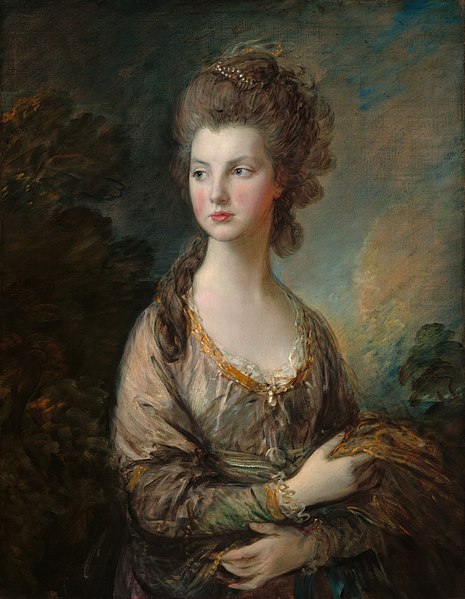
The Honourable Mrs. Graham

by Lauren Gilbert

The Hon. Mrs, Graham
(portrait exhibited at the Royal Academy)
by Thomas Gainsborough 
“The Honourable Mrs. Graham” is the name by which a portrait of Mary Cathcart Graham by Thomas Gainsborough is known. It is a beautiful portrait of a lovely woman painted in 1775, which was displayed in the Royal Academy in 1777. Gainsborough painted her more than once. She was also painted by the Scottish painter David Allan, who had been patronized by her father. Her face has appeared on biscuit tins and even in an advertisement for a Maidenform bra in the 1950’s. In her short lifetime, Mrs. Graham was known for her intelligence, her beauty and her kind nature. There was also a touching romance and tragedy in her story.

by Thomas Gainsborough
Possibly the original commissioned portrait

Charles Schaw Cathcart, 9th Baron, was born March 21, 1721. A soldier, he was against the return of the Stuart monarchs and, among other assignments, was an aide-de-camp to the Duke of Cumberland. As a result of a wound to his face, he had a scar which he covered with a black silk patch, resulting in the nickname “Patch” Cathcart. He married Jane Hamilton, the granddaughter of William, 9th Duke of Hamilton, on July 13, 1753. (Born in 1722, Jane was just a year younger than her husband). They had several children. Mary was born March 1, 1757, the second daughter. Mary’s older sister (and the oldest child of the family) Jane was born May 20, 1754. Mary’s oldest brother was William (who would become the 10th Baron Cathcart and first earl) born September 17, 1755. Mary’s next sister Louisa was born June 1, 1758. Mary also had brothers Charles Allen born December 28, 1759, Archibald-Hamilton born July 25, 1764. (Another brother died in infancy, and there was a still birth.) In 1763, Baron Cathcart received the Order of the Thistle.

In February of 1768, the 9th Baron Cathcart was appointed ambassador to Russia, at the court of Catherine the Great, and moved his family there. The youngest daughter Catherine Charlotte was born in Russia on July 8, 1770, and Catherine the Great was a sponsor at her baptism. Mary’s mother Jane died of consumption (tuberculosis) in November of 1771. Shortly after that Baron Cathcart’s appointment ended, and he returned to Scotland with his children. Mary was known to be well educated with an intellectual mind, and polished by her years in Russia with exposure to its court. She spoke French fluently, and engaged in a large correspondence with friends in English and French. She was also artistic. Because of the death of their mother, Mary became particularly close to her youngest sister Charlotte.

Thomas Graham of Balgowan (also spelled Graeme) was born October 19, 1748 to neighbouring landowners. His father Thomas Graham Esq. 6th Laird of Balgowan died December 6, 1766, and Thomas as the only surviving son inherited a healthy income and properties in Perthshire (two older brothers had died). Privately tutored, he went to Christ Church, Oxford in November of 1766 as a gentleman commoner. He left Oxford in the summer of 1768 and went on a Grand Tour. He was in Rome by Christmas of 1769, and then he went to Naples in 1769 where he received hospitality from Sir William Hamilton (this was well before Hamilton’s second marriage to Emma Hart; Sir William’s first wife Catherine was still living). He was back in Scotland at Balgowan by 1771, and decided to enter politics. He was narrowly defeated by Col. The Honourable James Murray, the brother of John, the 3rd Duke of Atholl, in a by-election in 1772 for the Perthshire seat, but ended up dropping out before the general election in 1774.

On December 26, 1774, Mary Cathcart married Thomas Graham. It was a very suitable match. As neighbours in Perthshire, their families would have been known to each other. Thomas was known to be courting her during the year of 1774, and there is every indication that theirs was a love match. They were known to be engaged in October of 1774. Shortly before their marriage, the first of several adventures occurred when highwaymen stopped Thomas while driving with Mary and Jane. Foiling the robbery attempt, Thomas held one of them, had him arrested and sent to Newgate (the ultimate fate of the robber is not known). Mary and Thomas were married on December 26, 1774 in a double wedding with Jane and her fiancé, John Atholl (whose father had just died, making John the 4th Duke). All of the families involved were delighted with both matches.

In 1775, younger sister Louisa became engaged to David Murray, Lord Stormont, whom she married May 5, 1776. Mary’s father died August 14, 1776, also of consumption. At this point, her younger brother Archibald and sister Charlotte went to live with Mary and Thomas. Louisa and her much older husband (he was over 30 years older than Louisa) travelled to Paris 6 weeks after their wedding, where Mary and Thomas arrived to visit them in January 1777. Mary and Thomas stayed in Paris until the fall. In October of 1777, Mary and Thomas went to Brighton, where Mary met and became close friends with Georgiana, Duchess of Devonshire. This friendship lasted through the rest of Mary’s life, primarily through a voluminous correspondence. 

After their marriage, Thomas and Mary lived at Brooksby in Leicestershire, as gentleman farmers, enjoying a rural life. Thomas especially enjoyed hunting, but both Thomas and Mary were interested in agricultural activities. They paid frequent visits to Scotland. In the fall of 1780, Mary was experiencing significant health problems, and it was decided that she could not spend winters in Scotland. They went to Portugal in October of 1780 and spent the winter there, and her travels continued in 1781. On a voyage, Mary and Thomas were on a ship stopped by American privateer, and taken to Spain, where they spent 10 days and were reportedly treated well by the Americans. From there they went to Portugal and on into France, from whence they returned to England in July of 1782. By 1785, they were spending summers in Balgowan, moving south to Brooksby or on to the Continent, depending on Mary’s health. In March of 1785, they visited Jane and her husband at Dunkeld, spent the autumn with Mary’s brother William (10th Baron Cathcart) at his estate, and returned to Dunkeld for Christmas, which attested to the improvement in Mary’s health.

Because they weren’t particularly fond of Balgowan, in 1787, Thomas and Mary bought the estate of Lynedoch, located near Perth. Improving this property kept them busy for some time. Charlotte remained with them. They went from Balgowan, Brooksby, Lynedoch and Dunkeld, with occasional visits to London, while Mary seemed to enjoy good health. Mary’s younger brother Charles, to whom she was very close, had a successful career in the Army and was chosen as envoy to China. En route to his post, Charles died of consumption on June 10, 1788 on the ship; he was buried on Java and the mission was abandoned. In December of 1789, Mary was to go to Louisa, to be with Louisa during Louisa’s confinement. (It is unclear which of Louisa’s two children by her second husband this may have been or if Mary actually was able to attend Louisa’s confinement.) Sadly in 1790, Mary’s older sister Jane, Duchess of Atholl, died of consumption, making four members of Mary’s immediate family lost to this disease.

In 1791, especially in light of the consumption that killed so many of Mary’s relatives, Mary’s health became an ever-increasing concern. In April of 1791, Thomas and Mary went to Hot Wells in Bristol, so Mary could take the waters. In June, Mary went to visit her brother William while Thomas went to Brooksby and then Balgowan. Later in the year, although there approved to be improvement in Mary’s health, Thomas and Mary went to Paris and on to Nice where the humid air appeared to make it easier and she was able to spend time with her friend, the Duchess of Devonshire. Unfortunately, her health continued to decline. In June of 1792, based on doctor’s recommendations, Thomas and Mary moved to Le Piol outside of Nice. A sea cruise was recommended and, on June 26, 1792, Mary died onboard ship just off Hyeres. Sadly, Thomas was on the mainland. She was just 35 years old.

By this time, France was in the throes of revolution. Thomas had the difficult job of getting her body back to Great Britain for burial. Reports indicate that, at Toulouse, soldiers insisted on the coffin being opened. Finally back in England, Thomas had Mary’s body placed in the Cathcart vault in the Audley Street Chapel (later known as the Grosvenor Chapel). A year later, it was moved to Methven, Scotland in Perth, where it was placed in a specially-built mausoleum in Methven Churchyard. No children had been born to the marriage. (There is an indication she may have had a miscarriage, but I found no details.)

After her death, Thomas could not look at her portraits which remained in storage until after his death. He never married and, after his mourning period, went on to pursue a distinguished military career, serving in the Peninsular Wars and at Waterloo. He earned a peerage in 1814 as Baron Lynedoch of Balgowan. He wore Mary’s wedding ring until his own death in 1843. He outlived her by over 50 years.

Sources:

Belsey, GAINSBOROUGH’S BEAUTIFUL MRS GRAHAM.  2003: National Gallery of Scotland, Edinburgh.

GoogleBooks.com. Delavoye, Alexander Marin. THE LIFE OF THOMAS GRAHAM, LORD LYNEDOCH. 1880: Richardson & Co, Marchant Singer Co, London.  HERE ; The Court Magazine and belle assemble (afterw.) and monthly critic and the Lady’s magazine and museum. Vol. 24.  HERE

History of Parliament online. “Graham, Thomas I. (1748-1843) of Balgowan and Lynedoch, Perth.” Ref. Volumes 1790-1820. By David R. Fisher.  HERE

Scotsman.com. “A Portrait of a Lady” (no author shown) published April 8, 2003.  HERE

Tripod.com. A BOOK OF THE GRAEMES. “Sketch XXXV. The Graemes of Balgowan, Descended of Garvock From Lord William Graeme of Kincardine Ancestor of the Earls of Montrose.” Last updated 2/20/2015.  HERE

Images: Wikimedia Commons HERE

~~~~~~~~~~

Lauren Gilbert lives in Florida with her husband. Her first published book, HEYERWOOD A Novel, was released in 2011, and her second, A RATIONAL ATTACHMENT, is in process. A long-time member of the Jane Austen Society of North America, she has long been fascinated with English history, especially the Georgian era. Find out more at her website HERE


Sunday, April 29, 2018

Editors Weekly Round-up, April 29, 2018

by the EHFA Editors

From ancient to modern, English Historical Fiction Authors brings you posts every week on different aspects of British history. Check out the articles for the week ending April 28.

Never miss a post. Join us on Facebook or follow us on Twitter. 

Saturday, April 28, 2018

Society in 17th Century England

By Trisha Hughes

This is the beginning of ‘Early Modern Britain’. It was a time of Renaissance, English and Scottish Reformation and the debilitating English Civil War. And as always, to the victor goes the spoils. It was a time of rulers who were vain, greedy and downright corrupt. It was a time of adulterers, swindlers and cowards. And it was a time in British history when war would tear the country apart.

At the time of Elizabeth I’s death, England was changing dramatically. Let’s take a quick walk around London in this era. Imagine it’s been a rainy day and you’re out for a walk. Water puddles in dark alleys and the drains have overflowed down the middle of the cobbled streets as people huddle in their bedraggled hats and cloaks under dripping eaves. A horse-drawn carriage with clattering wheels speeds past on the uneven stones and carelessly splashes water on anyone who has braved the inclement weather. Normally the streets are packed with people and carriages and most days a blanket of smoke hangs over the city. The pollution gets in your eyes and the stonework of every building is blackened with it. Many of the houses are hundreds of years old and their timbers are deeply scarred with rat holes teaming with life. The houses are so close in the narrow alleys that occupants can reach out and touch hands with their neighbours if they chose to.

London Bridge 1616 - public domain image

But there is a reason you’re out and about on this day. After a downpour, you get the clearest view of the city with the sky washed clean of smog although the city air still smells of coal smoke. But it’s not just the burning coal that affects your nostrils. There are noxious fumes coming from the parts of the city where tanning is taking place and aromatic horse dung still lies in piles in the streets. As the day wears on, the smells are intensified by the stench from cesspits in cellars and from the carts filled with dung-pots left in the streets by rakers, whose business it is to empty private cesspits. Pigeons fly out from under the eaves of the old houses and their dropping leave white streaks on everything below. Rats scavenge behind crates avoiding the rubbish collectors in their horse-drawn carts collecting rotting matter from kitchens. You will be able to smell the flocks of sheep and herds of cattle driven by hoof to the abattoirs where their dung and blood add to the aroma on the streets.

Very soon, the streets will fill, not just with permanent residents who contribute to the overcrowding feeling, but hundreds of thousands of people who come to town daily to go to markets, fairs and to do business in the city. Very soon there will be crowds of people and animals everywhere so you know not to linger.

And then you listen to the sounds of London. Oxen are led into the city and slaughtered every day and the squeals and bellows they make in their pens is considerable and disturbing. There is the sound of iron wheels of coaches grinding over the cobbles and the hammering of blacksmiths and candlestick makers. There are the bells of rakers driving their dung-carts, the yelling of those gathering around a cockfight, the shouting of vendors pushing their carts, householders leaning out their windows and shouting to neighbours and you would hear the hourly chimes of more than a hundred churches. This London is so crowded, smelly and noisy you will barely be able to hear yourself think.

Map of London 1593 - public domain image

With the increase in population, diseases lurked around every corner and in every shadow. Everyday life meant being aware of the flu, dysentery, typhoid and smallpox and then there were always outbreaks of plague to be aware of. If you had a swelling in your armpits, if you were exceedingly thirsty, had a headache and if you were vomiting, you knew you were in serious trouble. You also knew to air your bedding in case there were fleas. You were certainly aware that fleas caused the disease but if you found any or you had been bitten, it was already too late because nobody had any idea how to treat it.

Plague broke out in London in 1603, 1636 and in 1665. Each time it killed a significant part of the population but each time London recovered. Of course, other towns as well as London were also periodically devastated by the plague. However, the plague of 1665, which affected London and other towns, was the last recorded outbreak and no one is very sure why because rats still scurried through the dark streets and people were still throwing dirty water and other rubbish from their windows into those same streets.

Great Plague - public domain image

17th century London was a dangerous place to live if you were poor but if you were rich, you were lucky. Transportation was no problem for you. You could easily walk from one street to another or you could travel by boat along the Thames. You could even hire a horse-drawn carriage called a ‘hackney carriage’ to take you around London if you desired. The streets were lit for the first time and an oil lamp was hung outside every tenth house. Not that the oil lamps gave you much light but they were certainly better than nothing at all, which was a fact of life on the other side of town.

The poor lived in houses east of the city where the streets were narrow and dark, well away from the wealthy people. Unfortunately, in these overcrowded, heavily populated areas, crime and danger was ever present and in a place where so many had so little, it’s not so surprising.  Tempers and alcohol produced volatile situations and you made sure you kept a dagger close by to protect yourself. You learnt to keep your wits about you on the way home from the local pub especially as ale was the only available liquid to drink due to the unsanitary condition of the water. Looking at the rivers running with excrement, they had a good point.

London Bridge over the Thames 1632 - public domain image

However, improvements were on the way and a piped water supply was being created. Water from a reservoir travelled along elm pipes through the streets then along lead pipes to individual houses. Unfortunately, you had to pay to be connected to the supply and it was not cheap.

Because of the state of the water, keeping yourself clean wasn’t an easy task. You did that, not by washing, but by rubbing linen cloths over your body and through your hair to soak up the sweat. To take care of our body odour, you used perfume to improve the smell of your clothes.  After taking care of your body odours, you had to take care of your breath. Thankfully, the Chinese had invented the toothbrush in 17th century and it had been introduced to England so there wasn’t as much need to chew cumin seeds or aniseed anymore. However, after brushing, you still rinsed out your mouth with white wine.

In the Middle Ages, ordinary people's homes were usually made of wood. Most of the poor lived in huts of two or three rooms while some families managed to survive in just one room. Your furniture, such as it was, remained very plain and basic because enhancements in furniture were not a part of your life.

But there were some more improvements on the horizon. In the 16th century, chimneys had been a luxury only the well-off could afford. Windows however took a little longer to become commonplace. Glass was definitely a luxury so those who could not afford it made do with linen soaked in linseed oil. However, during the 17th century glass became cheaper and by the late 17th century everyone had glass windows, sometimes casement windows (ones that opened on hinges). Later on, sash windows that slid up and down vertically to open and shut, were being introduced.

In the early 17th century people began eating with forks for the first time. New foods were being introduced into England such as bananas and pineapples and new drinks such as chocolate, tea and coffee had arrived. By late 17th century, coffee houses had popped up all around town and merchants and professional men alike could meet to read newspapers and talk shop.

17th Century coffee house - public domain image

But not everyone was so lucky. Ordinary people existed on food like bread, cheese and onions and they ate pottage each and every day. This kind of strew was made by boiling grain in water to make a kind of porridge to which you added vegetables and pieces of meat or fish, if you could afford it.

Everyday life was a challenge and a hazard so it’s not surprising that the average life span in the 17th century was considerably shorter than today. Average life expectancy at birth was only 35 and many people died while they were still children. Out of all the people born, between one third and one half died before the age of about 16. However, if you could survive to your mid-teens you would probably live to your 50s or early 60s.

Stagecoaches were running regularly between the major English towns from the middle of the 17th century although the wealthy were still being carried around in sedan chairs while out and about in town. You paid dearly for the luxury of a stagecoach, and to top it off, they were very uncomfortable on the rough roads because none of them had springs. And of course, there was always the danger of highwaymen.

Dick Turpin - public domain image

The word ‘highwaymen’ conjures up characters like Dirk Turpin but these men were not so polite. If you were unlucky enough to come across these ruffians, there would also be another group cutting off your retreat. They would not only take your money and jewels, they took your clothes as well. Some killed their victims but most were left tied up in the forest in such a way that you could work yourself lose in an hour or two and make your way to the nearest inn or town in your underwear. If you survived the trip, you would be grateful to arrive unharmed but even these establishments housed thieves and unsavoury characters.

Heaven help you if you needed to see a doctor because barber-surgeons were still performing operations. Their knowledge of anatomy was improving but still left a lot to be desired. In 1628 William Harvey published his discovery of how blood circulates around the body and doctors had discovered how to treat malaria with bark from the cinchona tree.

William Harvey - public domain image

But even with these improvements, medicine was still handicapped by wrong ideas about the human body. Most doctors still thought that there were four fluids or 'humors' in the body - blood, phlegm, yellow bile and black bile. Illness resulted when you had too much of one humor. When that happened, you needed to be bled. Nevertheless, during the 17th century, a more scientific approach to medicine emerged and some doctors thankfully began to question traditional ideas.

The 17th century would contain the most religious decade Britain had ever seen since the Middle Ages and society would be dominated by Christian beliefs and a willingness to severely punish people for ungodly behaviour. Puritanism was on the horizon


~~~~~~~~~~


Trisha Hughes is an Australian author living in Hong Kong. She is the author of her memoir ‘Daughters of Nazareth’ and she has completed the first two books in her V2V trilogy, ‘Vikings to Virgin - The Hazards of being King’ and ‘Virgin to Victoria - The Queen is dead. Long live the Queen’. This second in the series is due for release on 28th April this year.

You can contact Trisha via her websites: www.trishahughesauthor.com    www.vikingstovirgin.com or via
Facebook
Twitter
Google+

Wednesday, April 25, 2018

Lately a Rebel - or a Well-intentioned Traitor

by Anna Belfrage

Most people live out their lives in obscurity—something to be grateful for, I believe, as celebrity comes with its own set of challenges. Many people live below the radar for most of their lives, but then a sequence of events propels them onto the central stage and for a while their name is on everybody’s lips. Well, in medieval times not everyone’s lips as information spread but slowly and usually rather locally. Still, today’s protagonist did achieve name recognition – especially in connection to the events that led to his death.

Andrew de Harcla or Andrew Harclay was born around 1270, close to Kirkby Stephen in Westmoreland, and was probably the eldest son of one William Harclay who held land from the Cliffords. While the Harclays were extremely minor landowners, the Cliffords were a power to be reckoned with in the north of England and little Andrew would have grown up in a relatively bellicose environment as most Englishmen this far north were constantly engaged in defending themselves against the Scots—or attacking them in return.

By the time Andrew really steps into the limelight, we’re in the year 1315. By then Sir Andrew was a battle-hardened knight, veteran of numerous campaigns against the Scots. It was just over a year since the English had been routed by the Scots at Bannockburn and now here was a huge Scottish army, led by Robert Bruce himself, intent on taking the town of Carlisle. It is estimated the Scottish host numbered around 10 000 men. Defending Carlisle’s two-mile wall perimeter were approximately 600 men. An easy picking, the Scots may have thought.

At the time, the Scots, led by James Douglas, had just done some serious raiding as far south as Hartlepool. In general, northern England lay defenceless before the confident Scots, in part due to the resounding defeat a year earlier, in part because England in 1315 was a kingdom at odds with itself, King Edward II not seeing eye-to-eye on anything with his cousin Thomas of Lancaster, who effectively ruled most of the north. The Scottish leaders were quick to capitalise on this inertia, and as Carlisle lay only a few miles south of the border, I imagine Robert Bruce felt it would make a nice little addition to his lands.

Contemporary depiction of Sir Andrew
In charge of defending Carlisle was Sir Andrew, and I dare say he swallowed somewhat at this challenging task: not only were the Scots far superior in number, but the defendants were short of supplies of all kinds—including weapons. This, however, Andrew did his best to remedy. He had Carlisle's smiths and craftsmen produce arrows and javelins and stockpiled these, along with heaps of rocks, along the walls, knowing the Scots would try to scale the walls. The Scots, in turn, were confident they’d overrun the walls. Robert Bruce had almost done so in 1311 but because he had other pressing concerns he’d allowed the town of Carlisle to ransom itself and gone on to do other things. Thing is, in 1311, Sir Andrew was not in charge of Carlisle’s defences.

For close to two weeks, Andrew and his few men held the walls, rebutting every attempt made by the Scots to scale them. The weather conspired against the Scots, miring their siege engines, and after yet another attempt to scale the walls led by James Douglas failed, the Scottish leaders decided to give up. There were rumours of an English army hastening towards Carlisle and Robert the Bruce decided to return home. Had they persisted, it is likely Carlisle would have fallen, as no matter how brilliant a commander Andrew was, his few men must have been borderline exhausted after ten days of being constantly on their toes.

The defence of Carlisle earned Sir Andrew some well-deserved fame, personal praise and a nice heavy purse from the king—and a lot of jealousy from other well-born knights in the region who did not exactly warm to this scruffy upstart.

Later in 1315 Andrew was captured by the Scots who demanded a substantial ransom for him. The king contributed to the ransom, but Andrew’s absence gave those who disliked his rise to prominence an opportunity to whisper their opinion in the royal ear—or at least in that of the up-and-coming royal favourite Hugh Despenser.

Still: Andrew was restored to his post as constable of Carlisle, was named sheriff of Cumberland in 1319 and things were as calm as they could be this close to the Scottish border. Or maybe not, as the infected relationship between King Edward and Thomas of Lancaster exploded into a full-blown rebellion. Sir Andrew was ordered to ride south in haste and in March of 1322 he commanded the royalist forces that defeated Thomas of Lancaster and Humphrey de Bohun at the Battle of Boroughbridge. The rebellion was crushed, the king was victorious and generously inclined towards his loyal knight. Sir Andrew was rewarded with the title of Earl of Carlisle, and the king himself belted him. Life, it seemed, was good.

Truth be told, life wasn’t that good. The Scots continued to raid with impunity, Robert Bruce determined to use violence to force Edward II to the negotiating table. For the people living along the Scottish border, life was difficult and frightening—and Andrew seems to genuinely have cared for them.

Edward II
Edward II, meanwhile, was meting out harsh justice to those who had participated in the rebellion against him. Many were the men who over the coming months lost their lives, most through hanging, a handful through the substantially more gruesome death of being hanged, drawn and quartered. The king was in no mood to be conciliatory, neither against his internal enemies or his external enemies, among which he included the Scots. Edward, just like his father, considered himself overlord of Scotland, declaring Robert the Bruce a traitor rather than a fellow king. And as to the Scots’ demands that Edward recognise Scotland a truly independent nation—pshaw!

At some point, Andrew despaired of ever seeing some sort of permanent peace in his neck of the woods. The king just didn’t want it. So what did our Andrew do? Well, he began his own, very private negotiations with Robert Bruce. Early in January of 1323, Sir Andrew rode to meet Robert Bruce in person and a treaty was signed. I suppose it is indicative of just how much respect Robert Bruce had for Sir Andrew that he entered into negotiations with him. What is also very apparent is that Andrew must have been a political fool: to enter into an agreement with Robert Bruce on behalf of England was, in effect, treason. It doesn’t matter that his main concern seems to have been to create some sort of lasting peace and thereby allow the people of the north some respite from continuous raids and violence.

Within a week or so after the treaty was signed, Edward was informed of its existence. There followed some weeks of pussy-footing about—after all, Edward did have a lot to thank Andrew for—but ultimately no medieval king could tolerate such an affront to their authority. Up in the north, many of the men disgruntled by Andrew’s rising star saw their chance. One of them was Sir Anthony Lucy, who, by all accounts, was a man Sir Andrew trusted. More fool he, one could say, as in early February Lucy arrested Harclay. A month later, Sir Andrew was arraigned for treason before the royal justices.

He was not allowed to speak for himself. Instead, he was ungirded of his earl’s belt and had his spurs struck off. No longer neither a knight nor an earl, Andrew Harclay was condemned to die a traitor’s death. As he stood by the gallows he expressed what he had not been allowed to express at his trial, namely that he had done what he did for the sake of the greater good, wanting somehow to broker a permanent peace between Scotland and England. The contemporary Lanercost Chronicle seems to agree that these were his primary motivations, but as Edward II would likely have said it was not Andrew’s place to force the king’s hand.

A hanged, drawn and quartered man in the
background (in this case being Hugh Despenser)
Once he’d said his piece, Andrew turned himself over into the hands of the executioner. By all
accounts, he died well—or as well as one can die when you are first hanged, cut down while alive, disembowelled in such a way that you are still alive to see your intestines burned before you, and then beheaded.

Some years later, Andrew’s nephew approached Edward III in the hopes of having his uncle’s conviction overturned. It didn’t happen, and so Andrew Harclay’s epitaph in the royal rolls is simply “lately the king’s enemy and rebel”. It does not, IMO, do this man justice. But it is, unfortunately, the truth.


All pictures in public domain and/or licensed under Wikimedia Creative Commons

~~~~~~~~~~~

Had Anna Belfrage been allowed to choose, she’d have become a professional time-traveller. As such a profession does not exist, she became a financial professional with two absorbing interests, namely history and writing.

Presently, Anna is hard at work with The King’s Greatest Enemy, a series set in the 1320s featuring Adam de Guirande, his wife Kit, and their adventures and misfortunes in connection with Roger Mortimer’s rise to power. And yes, Edmund of Woodstock appears quite frequently. The first book, In The Shadow of the Storm was published in 2015, the second, Days of Sun and Glory, was published in July 2016, and the third, Under the Approaching Dark, was published in April 2017. The fourth instalment, The Cold Light of Dawn, was published in February 2018.


When Anna is not stuck in the 14th century, she's probably visiting in the 17th century, specifically with Alex(andra) and Matthew Graham, the protagonists of the acclaimed The Graham Saga. This is the story of two people who should never have met – not when she was born three centuries after him. The ninth book, There is Always a Tomorrow, was published in November 2017.