By Mark Patton
In an earlier blog-post, I explored the City of London through the eyes of the 16th Century chronicler, John Stow. Stow lived through a period of tremendous change, but there is little in today's London that would be familiar to him apart from the street-pattern (and street names) and the wards, which still function as administrative units. Although medieval and modern London sit within the old Roman walls, the regular grid-pattern of the Roman streets was lost entirely as the medieval city developed piecemeal from the time of Alfred the Great.
Farringdon Within is the first intra-mural ward encountered by a visitor arriving from the west. Stow tells us that the whole district of Farringdon (the ward of Farringdon Without is much larger than Farringdon Within) was named after one William Farringdon, a goldsmith, who served as one of the Sheriffs of London in 1281. William and his son, Nicholas, also a goldsmith, between them represented the ward as Aldermen for a period of 82 years.
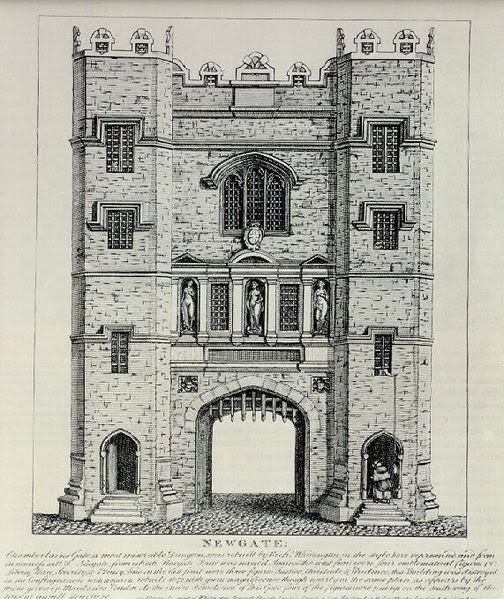
Farringdon Within encompasses two of the city's Medieval gates, Ludgate in the South, and Newgate in the north, neither of which survives today, but both of which served as prisons throughout the middle ages.
Beyond the walls on the western side flow the waters of the River Fleet, one of the larger tributaries of the Thames, now underground, but it was visible (and, perhaps more noticeably, smellable) well into the 19th Century. Alexander Pope describes it in his Dunciad of 1728:
Archaeologists have uncovered evidence for a Roman tidal mill on an island in the mouth of the Fleet, and also several shipwrecks: a Roman cargo ship; two 16th Century ships that are believed to have collided with one another; and a 17th Century freighter that seems to have been carrying stone for Sir Christopher Wren's rebuilding of Saint Paul's Cathedral.
Two of London's monastic houses were situated within the ward: the Franciscan Greyfriars (shown above), just inside Newgate, and the Dominican Blackfriars, just inside Ludgate. Greyfriars was an important centre of Medieval learning, with a library to rival that of Oxford University, but it lay at the centre of "St Nicholas's Shambles," a butchers' quarter whose streets must have been awash with blood and offal. Our visitor from the west, long before he or she entered the city, would probably have noticed a flock of scavenging black kites (a species almost never seen in Britain today) circling above the meat market, much as they can be seen above market towns in India to this day.
Almost nothing remains of either monastery today. Following Henry VIII's dissolution of the monasteries, a hospital was established on the site of Greyfriars, and the Apothecaries Company were allowed to establish their hall on the site of the Blackfriars gatehouse.
Walking up Ludgate Hill from Blackfriars towards Saint Paul's, one has a clear sense of the underlying topography (rather unusually, within the city). To the south of Ludgate are a series of back-streets (Pilgrim Street, Cobbs Court, Carter Lane), in which the spirit of Restoration London can be experienced. Near here stood the Blackfriars Playhouse (destroyed, of course, in the fire), where the plays of Thomas Middleton, Ben Jonson and John Fletcher were first performed, with Charles I and Henrietta Maria sometimes joining the audience. The congregation of the neighbouring church of Saint Ann's Blackfriars was, by this stage, staunchly Puritan and objected strongly to the presence of the theatre, which finally closed in 1642.
In Stow's time, the ward of Farringdon Within extended as far east as Saint Paul's Cathedral, encompassing the cathedral school and part of the churchyard, where stationers and booksellers set out their stalls, and around which William Shakespeare and Christopher Marlowe would have browsed for the newly printed editions of Virgil, Ovid and Plutarch that would inspire their own works.
Beyond the cathedral, at the point where Newgate Street becomes Cheapside, stood the Great Cross of Cheap, marking one of the resting spots of the funeral cortege of Queen Eleanor of Castile, as it moved towards Westminster Abbey in November of 1290. This prominent landmark was destroyed by the Puritans in 1643 (as was Charing Cross - London's other Eleanor Cross - the modern version of which is a Victorian recreation).
In today's London of high finance and global retail franchises, a city in which church-bells struggle to be heard above the constant rumble of traffic, it can be difficult to imagine the density of people and animals in the London that Charles Dickens, let alone John Stow, took for granted. Many businesses, even highly significant ones, such as the book-stalls which, in the 16th Century, stocked the first English language translations of Homer's Iliad and Odyssey, operated from just a few square feet of ground, rented by the day.
This is an Editors' Choice archive post, originally published on 2 November 2015
Mark Patton has blogged regularly on aspects of history and historical fiction at http://mark-patton.blogspot.co.uk. His novels, Undreamed Shores, An Accidental King and Omphalos, are published by Crooked Cat Publications, and can be purchased from Amazon. He is currently working on a London-based trilogy, "The Cheapside Tales."

In an earlier blog-post, I explored the City of London through the eyes of the 16th Century chronicler, John Stow. Stow lived through a period of tremendous change, but there is little in today's London that would be familiar to him apart from the street-pattern (and street names) and the wards, which still function as administrative units. Although medieval and modern London sit within the old Roman walls, the regular grid-pattern of the Roman streets was lost entirely as the medieval city developed piecemeal from the time of Alfred the Great.
 |
| 1870 map of London wards. Image: Doc77can (licensed under CCA). |
Farringdon Within is the first intra-mural ward encountered by a visitor arriving from the west. Stow tells us that the whole district of Farringdon (the ward of Farringdon Without is much larger than Farringdon Within) was named after one William Farringdon, a goldsmith, who served as one of the Sheriffs of London in 1281. William and his son, Nicholas, also a goldsmith, between them represented the ward as Aldermen for a period of 82 years.
Farringdon Within encompasses two of the city's Medieval gates, Ludgate in the South, and Newgate in the north, neither of which survives today, but both of which served as prisons throughout the middle ages.
 |
| Newgate from the west in the 16th Century, as imagined by the 19th Century artist, H.W. Brewer. The gate itself is at bottom right, with the church at the centre being that of the Franciscan friary. The road following the right-hand edge is Newgate Street. |
To where Fleet-ditch with disemboguing streams
Rolls the large tribute of dead dogs to Thames,
The king of dykes! Than whom no sluice of mud
With deeper sable blots the silver flood.
 |
| The mouth of the River Fleet in 1750 by Samuel Scott. |
 |
| The Fleet Ditch in 1844. |
Archaeologists have uncovered evidence for a Roman tidal mill on an island in the mouth of the Fleet, and also several shipwrecks: a Roman cargo ship; two 16th Century ships that are believed to have collided with one another; and a 17th Century freighter that seems to have been carrying stone for Sir Christopher Wren's rebuilding of Saint Paul's Cathedral.
Two of London's monastic houses were situated within the ward: the Franciscan Greyfriars (shown above), just inside Newgate, and the Dominican Blackfriars, just inside Ludgate. Greyfriars was an important centre of Medieval learning, with a library to rival that of Oxford University, but it lay at the centre of "St Nicholas's Shambles," a butchers' quarter whose streets must have been awash with blood and offal. Our visitor from the west, long before he or she entered the city, would probably have noticed a flock of scavenging black kites (a species almost never seen in Britain today) circling above the meat market, much as they can be seen above market towns in India to this day.
 |
| Black kites circling around the market of Kolkata, India. Photo: J.M. Garg (licensed under GNU). |
Almost nothing remains of either monastery today. Following Henry VIII's dissolution of the monasteries, a hospital was established on the site of Greyfriars, and the Apothecaries Company were allowed to establish their hall on the site of the Blackfriars gatehouse.
 |
| The Apothecaries Hall, rebuilt after the Great Fire of 1666. Photo: R. Sones (licensed under CCA). |
Walking up Ludgate Hill from Blackfriars towards Saint Paul's, one has a clear sense of the underlying topography (rather unusually, within the city). To the south of Ludgate are a series of back-streets (Pilgrim Street, Cobbs Court, Carter Lane), in which the spirit of Restoration London can be experienced. Near here stood the Blackfriars Playhouse (destroyed, of course, in the fire), where the plays of Thomas Middleton, Ben Jonson and John Fletcher were first performed, with Charles I and Henrietta Maria sometimes joining the audience. The congregation of the neighbouring church of Saint Ann's Blackfriars was, by this stage, staunchly Puritan and objected strongly to the presence of the theatre, which finally closed in 1642.
 |
| Playhouse Yard. Photo: Basher Eyre (licensed under CCA). |
In Stow's time, the ward of Farringdon Within extended as far east as Saint Paul's Cathedral, encompassing the cathedral school and part of the churchyard, where stationers and booksellers set out their stalls, and around which William Shakespeare and Christopher Marlowe would have browsed for the newly printed editions of Virgil, Ovid and Plutarch that would inspire their own works.
 |
| Old Saint Paul's Cathedral in 1560, as imagined in 1916. |
Beyond the cathedral, at the point where Newgate Street becomes Cheapside, stood the Great Cross of Cheap, marking one of the resting spots of the funeral cortege of Queen Eleanor of Castile, as it moved towards Westminster Abbey in November of 1290. This prominent landmark was destroyed by the Puritans in 1643 (as was Charing Cross - London's other Eleanor Cross - the modern version of which is a Victorian recreation).
 |
| The demolition of Cheapside Cross, as imagined in 1873, British Library. |
In today's London of high finance and global retail franchises, a city in which church-bells struggle to be heard above the constant rumble of traffic, it can be difficult to imagine the density of people and animals in the London that Charles Dickens, let alone John Stow, took for granted. Many businesses, even highly significant ones, such as the book-stalls which, in the 16th Century, stocked the first English language translations of Homer's Iliad and Odyssey, operated from just a few square feet of ground, rented by the day.
This is an Editors' Choice archive post, originally published on 2 November 2015
~~~~~~~~~~~~~
Mark Patton has blogged regularly on aspects of history and historical fiction at http://mark-patton.blogspot.co.uk. His novels, Undreamed Shores, An Accidental King and Omphalos, are published by Crooked Cat Publications, and can be purchased from Amazon. He is currently working on a London-based trilogy, "The Cheapside Tales."