Showing posts with label Stuart era. Show all posts

Saturday, April 28, 2018

Society in 17th Century England

By Trisha Hughes

This is the beginning of ‘Early Modern Britain’. It was a time of Renaissance, English and Scottish Reformation and the debilitating English Civil War. And as always, to the victor goes the spoils. It was a time of rulers who were vain, greedy and downright corrupt. It was a time of adulterers, swindlers and cowards. And it was a time in British history when war would tear the country apart.

At the time of Elizabeth I’s death, England was changing dramatically. Let’s take a quick walk around London in this era. Imagine it’s been a rainy day and you’re out for a walk. Water puddles in dark alleys and the drains have overflowed down the middle of the cobbled streets as people huddle in their bedraggled hats and cloaks under dripping eaves. A horse-drawn carriage with clattering wheels speeds past on the uneven stones and carelessly splashes water on anyone who has braved the inclement weather. Normally the streets are packed with people and carriages and most days a blanket of smoke hangs over the city. The pollution gets in your eyes and the stonework of every building is blackened with it. Many of the houses are hundreds of years old and their timbers are deeply scarred with rat holes teaming with life. The houses are so close in the narrow alleys that occupants can reach out and touch hands with their neighbours if they chose to.

London Bridge 1616 - public domain image

But there is a reason you’re out and about on this day. After a downpour, you get the clearest view of the city with the sky washed clean of smog although the city air still smells of coal smoke. But it’s not just the burning coal that affects your nostrils. There are noxious fumes coming from the parts of the city where tanning is taking place and aromatic horse dung still lies in piles in the streets. As the day wears on, the smells are intensified by the stench from cesspits in cellars and from the carts filled with dung-pots left in the streets by rakers, whose business it is to empty private cesspits. Pigeons fly out from under the eaves of the old houses and their dropping leave white streaks on everything below. Rats scavenge behind crates avoiding the rubbish collectors in their horse-drawn carts collecting rotting matter from kitchens. You will be able to smell the flocks of sheep and herds of cattle driven by hoof to the abattoirs where their dung and blood add to the aroma on the streets.

Very soon, the streets will fill, not just with permanent residents who contribute to the overcrowding feeling, but hundreds of thousands of people who come to town daily to go to markets, fairs and to do business in the city. Very soon there will be crowds of people and animals everywhere so you know not to linger.

And then you listen to the sounds of London. Oxen are led into the city and slaughtered every day and the squeals and bellows they make in their pens is considerable and disturbing. There is the sound of iron wheels of coaches grinding over the cobbles and the hammering of blacksmiths and candlestick makers. There are the bells of rakers driving their dung-carts, the yelling of those gathering around a cockfight, the shouting of vendors pushing their carts, householders leaning out their windows and shouting to neighbours and you would hear the hourly chimes of more than a hundred churches. This London is so crowded, smelly and noisy you will barely be able to hear yourself think.

Map of London 1593 - public domain image

With the increase in population, diseases lurked around every corner and in every shadow. Everyday life meant being aware of the flu, dysentery, typhoid and smallpox and then there were always outbreaks of plague to be aware of. If you had a swelling in your armpits, if you were exceedingly thirsty, had a headache and if you were vomiting, you knew you were in serious trouble. You also knew to air your bedding in case there were fleas. You were certainly aware that fleas caused the disease but if you found any or you had been bitten, it was already too late because nobody had any idea how to treat it.

Plague broke out in London in 1603, 1636 and in 1665. Each time it killed a significant part of the population but each time London recovered. Of course, other towns as well as London were also periodically devastated by the plague. However, the plague of 1665, which affected London and other towns, was the last recorded outbreak and no one is very sure why because rats still scurried through the dark streets and people were still throwing dirty water and other rubbish from their windows into those same streets.

Great Plague - public domain image

17th century London was a dangerous place to live if you were poor but if you were rich, you were lucky. Transportation was no problem for you. You could easily walk from one street to another or you could travel by boat along the Thames. You could even hire a horse-drawn carriage called a ‘hackney carriage’ to take you around London if you desired. The streets were lit for the first time and an oil lamp was hung outside every tenth house. Not that the oil lamps gave you much light but they were certainly better than nothing at all, which was a fact of life on the other side of town.

The poor lived in houses east of the city where the streets were narrow and dark, well away from the wealthy people. Unfortunately, in these overcrowded, heavily populated areas, crime and danger was ever present and in a place where so many had so little, it’s not so surprising.  Tempers and alcohol produced volatile situations and you made sure you kept a dagger close by to protect yourself. You learnt to keep your wits about you on the way home from the local pub especially as ale was the only available liquid to drink due to the unsanitary condition of the water. Looking at the rivers running with excrement, they had a good point.

London Bridge over the Thames 1632 - public domain image

However, improvements were on the way and a piped water supply was being created. Water from a reservoir travelled along elm pipes through the streets then along lead pipes to individual houses. Unfortunately, you had to pay to be connected to the supply and it was not cheap.

Because of the state of the water, keeping yourself clean wasn’t an easy task. You did that, not by washing, but by rubbing linen cloths over your body and through your hair to soak up the sweat. To take care of our body odour, you used perfume to improve the smell of your clothes.  After taking care of your body odours, you had to take care of your breath. Thankfully, the Chinese had invented the toothbrush in 17th century and it had been introduced to England so there wasn’t as much need to chew cumin seeds or aniseed anymore. However, after brushing, you still rinsed out your mouth with white wine.

In the Middle Ages, ordinary people's homes were usually made of wood. Most of the poor lived in huts of two or three rooms while some families managed to survive in just one room. Your furniture, such as it was, remained very plain and basic because enhancements in furniture were not a part of your life.

But there were some more improvements on the horizon. In the 16th century, chimneys had been a luxury only the well-off could afford. Windows however took a little longer to become commonplace. Glass was definitely a luxury so those who could not afford it made do with linen soaked in linseed oil. However, during the 17th century glass became cheaper and by the late 17th century everyone had glass windows, sometimes casement windows (ones that opened on hinges). Later on, sash windows that slid up and down vertically to open and shut, were being introduced.

In the early 17th century people began eating with forks for the first time. New foods were being introduced into England such as bananas and pineapples and new drinks such as chocolate, tea and coffee had arrived. By late 17th century, coffee houses had popped up all around town and merchants and professional men alike could meet to read newspapers and talk shop.

17th Century coffee house - public domain image

But not everyone was so lucky. Ordinary people existed on food like bread, cheese and onions and they ate pottage each and every day. This kind of strew was made by boiling grain in water to make a kind of porridge to which you added vegetables and pieces of meat or fish, if you could afford it.

Everyday life was a challenge and a hazard so it’s not surprising that the average life span in the 17th century was considerably shorter than today. Average life expectancy at birth was only 35 and many people died while they were still children. Out of all the people born, between one third and one half died before the age of about 16. However, if you could survive to your mid-teens you would probably live to your 50s or early 60s.

Stagecoaches were running regularly between the major English towns from the middle of the 17th century although the wealthy were still being carried around in sedan chairs while out and about in town. You paid dearly for the luxury of a stagecoach, and to top it off, they were very uncomfortable on the rough roads because none of them had springs. And of course, there was always the danger of highwaymen.

Dick Turpin - public domain image

The word ‘highwaymen’ conjures up characters like Dirk Turpin but these men were not so polite. If you were unlucky enough to come across these ruffians, there would also be another group cutting off your retreat. They would not only take your money and jewels, they took your clothes as well. Some killed their victims but most were left tied up in the forest in such a way that you could work yourself lose in an hour or two and make your way to the nearest inn or town in your underwear. If you survived the trip, you would be grateful to arrive unharmed but even these establishments housed thieves and unsavoury characters.

Heaven help you if you needed to see a doctor because barber-surgeons were still performing operations. Their knowledge of anatomy was improving but still left a lot to be desired. In 1628 William Harvey published his discovery of how blood circulates around the body and doctors had discovered how to treat malaria with bark from the cinchona tree.

William Harvey - public domain image

But even with these improvements, medicine was still handicapped by wrong ideas about the human body. Most doctors still thought that there were four fluids or 'humors' in the body - blood, phlegm, yellow bile and black bile. Illness resulted when you had too much of one humor. When that happened, you needed to be bled. Nevertheless, during the 17th century, a more scientific approach to medicine emerged and some doctors thankfully began to question traditional ideas.

The 17th century would contain the most religious decade Britain had ever seen since the Middle Ages and society would be dominated by Christian beliefs and a willingness to severely punish people for ungodly behaviour. Puritanism was on the horizon


~~~~~~~~~~


Trisha Hughes is an Australian author living in Hong Kong. She is the author of her memoir ‘Daughters of Nazareth’ and she has completed the first two books in her V2V trilogy, ‘Vikings to Virgin - The Hazards of being King’ and ‘Virgin to Victoria - The Queen is dead. Long live the Queen’. This second in the series is due for release on 28th April this year.

You can contact Trisha via her websites: www.trishahughesauthor.com    www.vikingstovirgin.com or via
Facebook
Twitter
Google+

Thursday, October 20, 2016

The Great Stuart Bake Off: What They Ate

by Margaret Porter


Typically a person of the Stuart era ate three meals per day. Early risers and those who had the leisure for it--aristocrats, gentry, the merchant and professional classes--ate breakfast. Laborers and farm workers broke their fast, at a very early hour, before beginning their daily work. Heavy with protein, it consisted mainly of cold meat, fish, cheese, washed down with ale or small beer. Dinner, the principal meal, occurred midday or early afternoon, gradually shifting to mid-afternoon, and included any number of dishes. In general, few vegetables were consumed but the table was spread with a vast array of meats, fish, cheeses, pies, and puddings. Many dishes were flavored with common herbs--sage, thyme, rosemary--or costly spices such as saffron, mace, and nutmeg. Supper was a light meal taken before bedtime.

At certain times of the year--and particularly during the Interregnum--fast days were designated. Each year Lent brought restrictions on meat-eating. During one week in Lent, 1661, Lord Bedford's household record indicates the purchase of salted fish, fresh cod, a quartern of smelts, twenty flounders, a chine of salmon, two pairs of soles, and four quarts of oysters. In summertime, fruit was purchased in quantity, for eating but also for preserving in some fashion for later use.
The seasons ordained the substance of meals. Fresh foods were eaten when fresh, and stored as feasible for later consumption. Chief methods of food preservation were pickling, potting, drying, and salting. Fruits were used as sweeting agents, as was honey. Sugar came in loaves, dark in colour, that were cut with snippers and then ground into granules or powder. A drop in price during the century resulted in an expansion of sweet puddings in addition to savoury ones.
The foreign visitor is always a valuable source of information that the resident takes for granted. Monsieur Henri Misson of France was highly enthusiastic about puddings:
The pudding is a Dish very difficult to be describ'd because of the several Sorts there are of it; Flower [flour], Milk, Eggs, Butter, Sugar, Suet, Marrow, Raisins, &c &c are the most common Ingredients of a Pudding. They bake them in an Oven, they boil them with Meat, they make them fifty several Ways. Blessed be he that invented Pudding, for it is a Manna that hits the Palates of all Sorts of People . . . the People are never weary of it. Ah, what an excellent Thing is an English Pudding!
During his stay Misson encountered people who never or seldom ate any bread. He further describes the eating habits of various classes:

They chew the Meat by whole Mouthfuls. Generally speaking the English Tables are not delicately serv'd. There are some Noblemen that have both French and English Cooks and these eat much after the French Manner: But among the middling Sort of People (which are those I spoke of before) they have ten or twelve Sorts of common Meats which infallibly take their Turns at their Tables and two Dishes are their Dinners, a Pudding for instance, and a Piece of roast Beef. Another time they will have a Piece of boil'd Beef, and then they salt it some Days beforehand and besiege it with five or six Heaps of Cabbage, Carrots, Turnips, or some other Herbs or Roots, well pepper'd and salted and swimming in Butter. A Leg of roast or boil'd Mutton dish'd up with the same Dainties, Fowls, Pigs, Ox tripes, and Tongues, Rabbits, Pidgeons, all well moisten'd with Butter without larding. Two of these Dishes always serv'd up one after the other make the usual Dinner of a substantial Gentleman, or wealthy Citizen.


Samuel Pepys by Godfrey Kneller
Anyone interested in a London gentleman's food habits should seek out Samuel Pepys's Diary, in which he recounts various feasts, fasts, 'frolicks'. Every year he threw a party to celebrate the successful removal of the 'stone' from his bladder. (He preserved said object in a leather case, and displayed it to visitors!) It has been observed that his record of dinners and such is sketchy at best, considering the vast amounts of food that the average Stuart gentleman consumed in the course of his day--he remarks only on what is, to him, noteworthy or particularly delectable.

Then, as ever, children were especially fond of sweets and treats. In May and June of 1655, Lord Bedford's account books contain these line items: For six sweet oranges and cherries for my Lady Anne, 1s. 6d. To one that brought a cake for my Lady Anne, 1s.

Those possessed of great estates, like his lordship, could rely upon the produce of his own lands, and tenant farmers fed their families from their grounds and gardens. Residents of county towns obtained their food from weekly markets, and in cities from butchers, fishmongers, poulterers, cookshops, etc.

Kitchen Scene www.metmuseum.org

During the 17th century, the surge in printing presses in England led to increased production of books on food and cookery--the nation was far behind Italy, Germany, and France in that respect. Gervase Markham produced The English Hus-wife in 1615, but it is much more a guide for housekeeping and other skills though it includes recipes.

The 1st English Cookery Book

In 1660, shortly after the Restoration, The Accomplish't Cook or the Art and Mystery of Cookery by Robert May appeared, regarded as the very first English cookery book. The author, son of a cook ('one of the ablest cooks in his time' asserts May in his preface), learned much from his parent, who worked for Lady Dormer. Her ladyship sent the youth to France to train, and during his five years there he had access to the wealth of French cookery books. Following his London apprenticeship, he returned to Lady Dormer's household. During the course of his career he was employed by a number of lords and ladies: The Countess of Kent, Lord Lovelace, Sir Kenelm Digby, Lord Montagu, and more. In addition to the recipes, May helpfully provides menu suggestions for holiday feasts and fasting-days, as well as recommended bills of fare for each month in the year.

The next important tome is Will Rabisha's The Whole Body of Cookery Dissected (1662), a title that bestows a medical and scientific imprimatur upon the subject. Sir Kenelm Digby (one of May's employers) published the first edition of his book of cookery and 'receipts' (recipes) in 1669. Here we have Digby's version of Puffs:
Take new milk Curds, strained well from the whey; then rub them very well; season them with Nutmeg, Mace, Rose water and Sugar; then take an Egg or two, a good piece of Butter, and a handful of flower; work all together, and make them into Balls; bake them in an overn, upon sheets of Paper; when they are baked, serve them up with butter melted and beaten with Rose-water and Sugar.

About 1679 John Evelyn, the diarist, began composing a treatise titled Acetaria: A Discourse of Sallets (1699), in which he primarily discusses garden plans, plants, and gardens. His description of produce to be used in salads includes many which are familiar to the modern diner:

--Lettuce, Lactuca...ever was, and still continues the principal Foundation of the universal Tribe of Sallets; which is to Cool and Refresh, besides its other Properties
--Cucumber, Cucumis; tho' very cold and moist, the most approved Sallet alone, or in Composition, of all the Vinaigrets, to sharpen the Appetite, and cool the Liver,
--Endive, Endivium, Intubum Sativum; the largest, whitest, and tenderest Leaves best boil'd, and less crude.
--Cabbage, Brassica (and its several kinds)
--Beet, Beta; of which there is both Red, Black, and White
--Artichaux, Cinara, (Carduus Sativus) hot and dry. The Heads being slit in quarters first eaten raw, with Oyl, a little Vinegar, Salt, and Pepper.
--Carrots
--Basil, Ocimum (as Baulm) imparts a grateful Flavour, if not too strong, somewhat offensive to the Eyes; and therefore the tender Tops to be very sparingly us'd in our Sallet.
--Borrage, Borrago hot and kindly moist, purifying the Blood, is an exhilarating Cordial, of a pleasant Flavour.
--Cresses, Nasturtium, Garden Cresses; But above all the Indian, moderately hot, and aromatick, quicken the torpent Spirits, and purge the Brain.
--Garlick, Allium; dry towards Excess; and tho' both by Spaniards and Italians, and the more Southern People, familiarly eaten, with almost every thing, and esteem'd of such singular Vertue to help Conception, and thought a Charm against all Infection and Poyson.

Title page of Evelyn's book on Sallets


Edward Kidder (born 1665) was not only a skillful pastry cook, he's acknowledged as the proprietor of ones of the first cookery schools in England. Apparently he had several London schools, at Holborn and near Furnival's Inn and at St. Martin's Le Grand, which might have operated simultaneously. Late in his career, after the dawn of the Georgian era, he had his recipes printed and bound as a handbook for his pupils--several copies of which are extant. His students were male--females were privately instructed, as indicated by a note in some editions that 'Ladies may be taught at their own Houses.' Lady Mary Pierrepont (after her marriage Wortley Montagu), who kept house for her widower father, received thrice weekly carving lessons from a master of the art.

Kidder's book is valuable for its detailed account of table arrangement and specific dishes that could be included in each course.

Arrangement of the Table
First Dishes: Pottages of all sorts, a dish of fish, beans & bacon, ham & chickens, pullets & oysters, boiled tongues & udders, a leg of veal, a calves head, a goose or turkey, haunch of venison, leg of mutton & tunips, piece of salt beef, boiled fowls & marrow bones, a turbot & small fish

Bottom Dishes: A chine of veal or mutton, a neck of veal, pigeons in saffron, puddings, roast beef minced pies, cold ham, sliced tongue, venison pasty, potted meats or fowls, cold lobster or salmon or sturgeon, haunch of venison roast, let of mutton roast, hens with eggs, chicken & asparagus, a roast pike, calve's head roasted

Side Dishes: Bombarded veal, Scotch collops, leg of lamb, fricasees white or brown, ragout of any sort, a tart or tansy, scalloped oysters, carp in a ragout, pigeons and asparagus, lamb stones & sweet breads, stewed carp, chickens

For the middle of the table: a grand salad of pickles, a salad & butter, hot or cold pie, tarts, cheesecakes, puffs & custards, jellies, creams, blanc manges, a dish of fruit, sweetmeat tart, patty of lobsters, cold lobsters

Second Course: A dish of wild fowl, green geese or ducklings, roast chicken or pigeons, lamb joint, fried fish, turkey, leverets, partridges or cocks or snipes, pheasants or quails or larks, buttered lobsters or crabs, scalloped oysters, tart or tansy, tarts, cheesecakes, puffs, custards, dish of peas, ragout of mushrooms, lobsters ragout or roast

Plates: Oyster loaves, artichokes in cream, Portugal eggs, cutlets of veal, patties of oysters, crawfish, prawns, shrimp, apricot fritters, Polonia sausages, salmagundy, pickles of any sort, marrow or spinach toast, veal puffs, sweetbreads.

The most elaborate meals, as one would expect, were enjoyed by royalty--who regularly dined in public, so lesser persons could enter the palace to witness this spectacle. Immediately after a monarch's coronation, a massive feast took place in London's Westminster Hall, with all the nobility seated at tables heaped with delicacies. For a description of the foods served at King James II's coronation feast, see my earlier post for EHFA here.


Tables at the Coronation Feast

~~~~~~~~~~~~~~

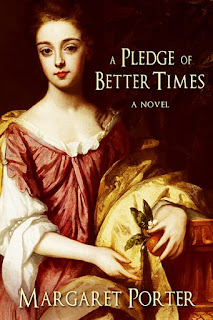
Margaret Porter is the award-winning and bestselling author of twelve period novels, whose other publication credits include nonfiction and poetry. James II's coronation feast is depicted in A Pledge of Better Times, her highly acclaimed novel of 17th century courtiers Lady Diana de Vere and Charles Beauclerk, 1st Duke of St. Albans. Margaret studied British history in the UK and the US. As historian, her areas of speciality are social, theatrical, and garden history of the 17th and 18th centuries, royal courts, and portraiture. A former actress, she gave up the stage and screen to devote herself to fiction writing, travel, and her rose gardens.

Connect with Margaret:

Website | Blog | Facebook | Twitter | Amazon

Thursday, December 3, 2015

The Trouble with Duchesses in Queen Anne's Court

by Margaret Porter

'Perhaps . . . in the reign of Queen Anne ’tis a sign the power of women will increase.' Sarah Cowper, April 1702


Queen Anne by Godfrey Kneller
The average follower of English history, when confronted with the equation Queen Anne + Duchess + Trouble, would assume the resulting total to be Sarah Churchill, Duchess of Marlborough. Of all the non-royal females of her era, she is surely the most famous--or infamous. Sarah published various editions of her memoirs (a form of self-justification and self-defence), she's the subject of scholarly biographies and entertaining novels, she was the heroine of the television series The First Churchills, she and Anne are currently the main characters in a play on the London stage, and a film about their relationship is reportedly on the horizon.


But Anne's childhood friend, confidante, and eventual enemy was not the only duchess frequenting her court. Although the others did not leave so indelible a mark on the historic record, they are worthy of interest and scrutiny.

Elizabeth, Duchess of Somerset


Duchess of Somerset by Kneller
Young Elizabeth Percy seemed destined to challenge Sarah for Most Interesting Courtier. At age twelve she became Countess of Ogle, and was widowed the following year. The year after that the immensely wealthy Thomas Thynne lured her into a secret marriage. Not long afterwards he was murdered at the instigation of Count von Konigsmark, a Swede who was infatuated with Elizabeth. Within five months the double widow married again. Her third husband was Charles Seymour, Duke of Somerset, 'The Proud Duke'--a dynastic marriage rather than a love match. After that her marital history was far from scandalous, and probably not the happiest.

During Princess Anne's quarrels with her sister Mary II and brother-in-law William III, when they demanded she dismiss Sarah from her household, the Somersets were her firmest allies. Forced to relinquish her Whitehall lodgings, Anne accepted her friends' offer to take sanctuary with them at Syon House, where she suffered through one of her many stillbirths. She remained forever grateful for their support.

On Anne's accession in 1702, Elizabeth joined the royal household as a Lady of the Bedchamber. She was a witness to the protracted and nasty breakdown in Anne's relationship with Sarah Churchill, and was ultimately a beneficiary. In 1710/11 she succeeded Sarah as Mistress of the Robes and Groom of the Stole. Her prominence stirred up old scandals--her unusual and colourful past had for many years provoked rumour and innuendo. Because of her red hair, she was sometimes lampooned as 'Carrots.' The cruelest accusation--that she might do harm to the Queen--was penned by Jonathan Swift in The Windsor Prophecy:


Beware of Carrots from Northumberlond.
Carrots sown Thynne a deep root may get,
If so be they are in Somer set:
Their Conyngs mark thou; for I have been told,
They assassine when younge, and poison when old.

Although the Duke incurred the Queen's displeasure and was removed from office, Elizabeth retained the royal favour, vying with Abigail Masham as chief confidante. Wisely she refrained from employing Sarah's bullying tactics. According to one observer, 'She never pressed the Queen hard; nothing makes the Queen more uneasy than that.' A daughter of the ancient aristocracy, she maintained a graciousness and dignity that the Queen must have appreciated greatly after the strife Sarah stirred up.

She retained her positions of authority until Anne's death in 1714, and was present as the Queen lay dying. A witness described the 'soft, courteous way of the Duchess's speaking to the Queen, and her majesty's look and motion of her face in receiving it, though so ill.' Elizabeth was designated chief mourner for the funeral but was herself indisposed and unable to participate.

Mary, Duchess of Ormonde


Duchess of Ormonde by Michael Dahl
Following the death of his first wife, whom he mourned deeply, the 2nd Duke of Ormonde married Lady Mary Somerset, the Duke of Beaufort's daughter, in 1685. Like the Duchess of Somerset, she was named a Lady of the Bedchamber at the outset of Anne's reign and held that position till its end.  


She allegedly lined her pockets by brokering places in the royal household. When selecting her maids of honour, the young unmarried women who attended the Queen, Anne wanted girls who 'had good education and beauty.' The stipend and the visibility to prospective husbands was tempting, and parents were very eager to place their daughters at court. Christian Temple's entire marriage portion was £2000, and apparently £1200 of it was paid to Mary as a bribe to obtain her place. The duchess then paid the all-powerful Sarah £500 for acquiescing to the appointment!

Mary was in waiting at Kensington when the Queen suffered the convulsions and stroke that resulted in death. It was she who replaced the ailing Duchess of Somerset as chief mourner at Anne's funeral. Her life changed drastically the following year when her husband was impeached for high treason, as a supporter of the Jacobite rebellion of 1715. He fled to France rather than stand trial in Parliament. Subsequently he was attainted, and his estate was forfeited.


Catherine, Duchess of Buckingham


Duchess of Buckingham
Catherine Darnley was the illegitimate daughter of James II by his mistress Catherine Sedley, and she was therefore Queen Anne's half-sister. She first married the Earl of Anglesey, and the union did not prosper--in 1701 she petitioned the House of Lords for a separation, on the grounds of cruelty. The next year he died. Her second husband was John Sheffield, 1st Duke of Buckingham and Normanby, and she was his third wife. At one time he had courted Anne, resulting in his dismissal from court. Anne was fond of her former suitor Buckingham, who had proved himself a fast friend of her father's prior to his exile. He also shared her strongly Tory sympathies. She merely tolerated Catherine.

Though born on the wrong side of the blanket, Catherine was ever at pains to remind everyone of her royal blood, 'exhibiting a love of display, a violent temper,' and frequently travelling to France to kneel at the tomb of her father, 'shedding tears over the threadbare pall which covered his remains.' Because of her husband's position as Lord Privy Seal (prior to 1703) and later Lord President of Council, Catherine frequented the court. At the Queen's birthday celebration in January 1711, 'The Duchess of Buckingham and Lady Paulet were scarce able to move under the load of jewels they had on.'

After Anne's death, Catherine's drawing room was a magnet for Tories and Jacobites, as she was in regular contact with her legitimate half-brother James, the Old Pretender, and would doubtless have preferred him as King to George I. She was buried with other Stuarts at Westminster Abbey, where her splendid funeral effigy can be found in the museum.


Adelhida, Duchess of Shrewsbury


Duchess of Shrewsbury
This lady's father was Marquis Andrea Paleotti and her mother was Maria Cristina Dudley, daughter of the titular Duke of Northumberland--an Englishman who was also a Tuscan nobleman. She grew up in Italy and was apparently an engaging and accomplished young woman, but also a scandalous one. She might or might not have been married to Count Brachiano, and she might or might not have been the Duke of Shrewsbury's mistress before their 1705 marriage in Rome. (Lady Cowper spitefully recorded that her brother forced the nobleman to wed her 'after an intrigue together.')

Shrewsbury, a one-eyed aristocrat known as the 'Duke of Hearts' for his good looks, brought his duchess to England, where she caused a stir in society. She won the favour of the newly widowed Queen Anne by expressing her sympathy: 'Oh, my poor Queen, I see how much you do miss your dear husband.' This was in contrast to Sarah, who was very unfeeling towards her grieving mistress.

In 1712 Shrewsbury served as Ambassador to Paris, where his duchess was appreciated for her hospitality and conversation, though she was also regarded as an eccentric. This did not prevent her becoming a Lady of the Bedchamber to Caroline, Princess of Wales, after the accession of George I, a post she held until her death in 1726.


Diana, Duchess of St Albans


Duchess of St Albans by Kneller
The eldest daughter of Aubrey de Vere, 20th and last Earl of Oxford, Diana was very much a child of the court. During her infancy, her father and Charles II supposedly discussed a possible marriage between Diana and Charles Beauclerk, Duke of St Albans, the King's illegitimate son by Nell Gwyn. Diana grew up to be an ornament of Queen Mary II's court. At the same time, the young duke won the favour and patronage of of William III. Neither fact would have endeared them to Anne, who was estranged from her sister and loathed her brother-in-law. But the de Veres were courtiers for centuries. And the Duke was a Whig, the party in power at the outset of Anne's reign, so he held various appointments.
 

In the course of researching my latest novel, I stumbled upon an intriguing mystery. On 26 March, 1702, Luttrell the diarist reports, 'The dutchesses [sic] of Ormonde and St Albans are made ladies of the bedchamber to the Queen.' Yet Diana's name never appears again, and cannot be found in the official or unofficial lists of Anne's attendants. If Anne reconsidered, it could have been for any of four reasons, or a combination. Diana and her husband supported William and Mary in their quarrels with Anne, doubtless provoking her resentment. As well, Anne never much cared for her uncle's bastard offspring and that attitude might have extended to their wives. Alternatively, Sarah 's enmity towards one or both Beauclerks (she famously feuded with their son and heir) was such that she persuaded Anne to revoke the appointment. Or else Diana declined the position after rumours about it circulated--which is the unlikeliest explanation, as it was a prestigious and salaried post, ensuring access to the monarch.

With a change from Whig to Tory government in the last years of Anne's reign, the duke lost his court position. At the accession of George I, the Beauclerks were restored to high favour. Diana was chosen by Caroline, Princess of Wales, as First Lady of the Bedchamber and Groom of the Stole, and her husband was a Gentleman of the Bedchamber and captain of the King's personal guard.

Conclusion

When the meddlesome, overbearing, battle-tested, impulsive Sarah toppled from her perch, the Duke of Beaufort told Anne, 'Now is your Majesty Queen indeed!' None of the other duchesses who served in her household or who appeared at court attempted to rival or rule the ruler as Sarah had done for so long. Consequently, they are far less familiar--the price they paid for their discretion, submissiveness, and loyalty turned out to be their obscurity!

Sarah, Duchess of Marlborough by Kneller

~~~~~~~~~~~~

Image credits: Petworth House, The National Trust; Wikipedia/Wikimedia Commons; www.thepeerage.com; Private Collection
 ~~~~~~~~~~~~

Margaret Porter is the award-winning and bestselling author of twelve period novels, nonfiction and poetry. Lady Diana de Vere's association with Queen Mary's court, and Queen Anne, is featured in A Pledge of Better Times, her highly acclaimed novel of 17th century courtiers the 1st Duke and Duchess of St. Albans (available in trade paperback and ebook). Margaret studied British history in the UK and the US. As historian, her areas of speciality are social, theatrical, and garden history of the 17th and 18th centuries, royal courts, and portraiture. A former actress, she gave up the stage and screen to devote herself to fiction writing, travel, and her rose gardens.


Wednesday, August 26, 2015

Lucy Russell, Countess of Bedford ~ The Many Faceted Jewel of the Early Stuart Court

by Linda Root

A painting believed to be Lucy Russell

I have a growing list of books to write before I die—my personal bucket list. I am past the midpoint in my eighth decade, so I’d best hurry. Most are parts of a series.

Before I began this post, I had no plan to delve into the research for a piece of standalone historical fiction centered on an actual character about whom much is suspected, but little proved. I am not speaking of Elizabeth Tudor, who etched something of that sort on a glass windowpane at Woodstock. I am speaking of Lucy Russell, Countess of Bedford, one of the 17th century’s most compelling non-conformists. I stumbled upon Lucy quite by accident.  She appears as a minor character in my recent book.  Her role merits no more than two paragraphs. A quick trip to Wikimedia should have sufficed.  Then I stumbled upon a piece of information, and I was hooked.  More works of poetry and drama were dedicated or inspired by Lucy Russell than any women living in her day, including the Queen, Anne of Denmark, a well-known patron of the arts.

Who is Lucy Russell?

I had not expected the Countess to be a courtesan.  In using that definition, I am attaching the meaning given the term in the Italian Renaissance, from which the word was adopted by the English. Its original meaning lacked the sexual implications attached to it by historians. Lucy was certainly not a prostitute or mistress, but she was very much a high profile attraction at the Stuart Court. Somehow I had associated her with her husband’s holdings at Berwick-on-Tweed, not exactly a backwater, but certainly not London.  She was the daughter of Sir John Harington, Earl of Exton. Her husband Edward, 3rd Earl of Bedford, was nine years older than she was. She married him in 1594 when she was thirteen. Some sources refer to him as an invalid and advance that as the reason he and Lucy led separate lives.

Attributing the unusual living arrangement of the Earl and Countess of Bedford to Edward’s health lacks credibility. Infirmity did not keep him from taking up arms against his aging queen during the Essex Rebellion of 1601.  It seems he was sufficiently robust to get himself in serious trouble long before he suffered a horseback riding accident in 1612 which left him partially paralyzed and with impaired speech.  He and Lucy had been living separately for most of their married lives.

At the time of Essex’s treason in 1601, Lucy’s loyalties would have been as suspect as her husband.  She had been a member of the Sidney-Essex Inner Circle by virtue of her birth. The Sidneys were her father Baron Harington's first cousins and were firmly in the Essex camp. Her best friends included Robert Devereux’s sisters, Dorothy Percy, Countess of Northumberland and her sister Penelope, Lady Rich. The latter was implicated by Devereux in a statement he made before his beheading.

The Devereux sisters
Dorothy was innocent of any part in her brother's treachery, but she got into trouble on her own by marrying her first husband without the Queen's permission. Her second marriage to Henry Percy was  arranged by the Queen, but it did not entirely erase the stigma of Lady Dorothy’s history, and it did not insulate her close friend Lucy from Elizabeth’s distain. Small wonder the Countess of Bedford and her husband were out of favor during the waning days of Elizabeth Tudor’s reign. Then, in February 1603, Elizabeth Tudor died, and the Harington and Bedford fortunes changed.

Lucy Russell in Stuart England

Lucy Russell’s lot in life improved with the ascension of King James. As soon as word of Elizabeth Tudor’s death reached the family estates at Coombes Abbey,  Lucy’s mother Anne took off for Edinburgh with her daughter in tow. Lady Harington was only one of several ladies to head north to prostrate herself before the King and Queen of Scotland, but she was among the first. Soon her daughter Lucy was fast friends with James of Scotland's colorful consort Anne of Denmark and had become a Lady of the Queen's bedchamber.

Her father, John Harington of Exton, had a distinguished and varied career during Elizabeth Tudor’s reign. His mother was a Sidney, and he had an on-going association with the Dudleys. He had served in the Netherlands with Elizabeth's favorite Robert Dudley,  Earl of Leicester.  His family was reputed to be the most extensive landholders in Rutland. He served several terms as sheriff and was an M.P. from both Rutland and from Warwick. In one of his official capacities in Warwickshire, he was appointed to escort  Marie Stuart on her sad journey to Fotheringhay in 1586.  He apparently had come to the attention of King James before his ascension. The new King James I of England granted him the earldom of Exton on the day of the king’s coronation. What is more, he was made the guardian of Princess Elizabeth upon her arrival in England in the summer of 1603.

Young Princess Elizabeth Stuart
Lucy’s  brother John ( later 2nd Earl of Exton) was Prince Henry Frederick’s closest friend.


They appear in one of the most widely viewed paintings of the Prince in which the Prince is shown sheathing his sword rather than killing the stag he has wounded while his friend John Harington watches.

Henry Frederick 
with Master John Harington
Early in the reign of James I, Lucy was a frequent visitor at her family estates at Coombe Abbey where the princess was ensconced. She appears in my novel while visiting there at the time of the Gunpowder Plot. 

Lucy Russell was  unusually well-educated for a woman of her era and was literate in French, Spanish, and Italian as well as English. She likely played a role in schooling the princess. She would have been in an ideal position to assist in both the academic and spiritual guidance of a Stuart royal. Both Lucy and Princess Elizabeth, like Henry Frederick, were avid Calvinists. It is in that role I paint her in my novel In the Shadow of the Gallows.

Coombe Abbey

Lucy Russell as a Patron

But Lucy was much more than a companion and educator of the princess, and it was this part of her life for which she is best known. Within a year of Queen Anne’s settling in at Somerset House and renaming it Denmark House, the Countess of Bedford was dancing in the Queen’s extravagant masques. She starred in many of Inigo Jones' productions, and although she apparently appeared topless in one or more the extravaganzas presented by Queen Anne, she remained a committed Calvinist and a borderline Puritan.

Inigo Jones, a man of many talents

Anne of Denmark
Producing and performing in Queen Anne’s masques was only one of Lucy’s many talents. To many of the most noteworthy names in Jacobean poetry and music, she was a patron and a goddess. As for patronage, she did not give her client artists money or financial support. Her gift was her incredible influence, and not just with the Queen. The king and his advisers took note. Her patronage often conveyed royal favor. 
The list of luminaries who benefited from her sponsorship included Ben Jonson, Inigo Jones, and John Donne, to name three of the better-known recipients of her sponsorship and friendship.
 
Woman in Masquing Costume
believed to be Lucy Russell
  
John Donne
Ben Jonson

It is said more works were dedicated to Lucy Russell than any other woman of her era. Donne spoke of her as "The first good Angell... That ever did in womans shape appeare."…for whom "morning breaks at night".  Most of the poems he wrote during his middle years are believed to be about her.  In Drayton's play Endimion and Phobe, he is Endimion, and she is his Phoebe. These are but a few examples of the many works in which she appears. The list is long, and the implication is that at the very least, John Donne and  Michael Drayton were in her thrall.

During this phase of her life, her husband acquired a magnificent residence for her in a suburb called Twickenham Park where she lived in exquisite splendor. She maintained a grand salon, but most of her guests were only visitors, and not all of them received her enduring favor. She shared her soul with men like Donne, but not her home. Michael Drayton, for one, soon disappeared from gatherings at Twickenham. Historians speculate he may have bored her. It is equally arguable that his devotion may have become tedious. As strange as it seems, there is no evidence she wished to replace her husband.

Michae
While Lucy’s friend and benefactor Queen Anne is famous for her excesses, her lady was not to be outdone. The 18th century antiquarian Thomas Pennant accused her of being a woman "whose vanity and extravagance knew no check."

To some degree, in time, her excesses were tempered by necessity. She and her husband were both saddled with mind-boggling debts. Edward Russell had been impaired since 1612. Then, in 1619, Lucy contracted a severe case of smallpox which left her face disfigured and very likely nearly blind in one eye. That and the death of Queen Anne curtailed the most colorful of her activities, but it did not stop her from exerting influence, primarily in the political sphere. During her later life, she became an activist in support of the Princess Elizabeth Stuart, ousted Queen of Bohemia’s effort to regain her throne. Both Lucy and her husband died during May 1627, each deeply in debt. None of her children survived infancy. Her legacy is found in the words of the poems men like Donne and in the music of John Dowland, who dedicated his Second Book of Songs to her.

John Dowland
According to writer Margaret M. Byard in The Trade of Courtierhsip: The Countess of Bedford, there is a dark side to the countess’s story. Recently, documents called the Bedford Memorials have become available for review. Apparently they had been sealed at the time of the Earl of Bedford's death and are yet to be studied. In the interests of time and the economics of acquiring scholarly words, I shall leave that for another post, or perhaps for the book I did not intend to write but which I find a tempting delicacy.

For now, I prefer to let the Lucy Russell of this post appear as Donne described her, as the "First good Angell... That ever did in womans shape appeare." There are indeed some qualities commending her to that role.

She was a loyal loving daughter, and a steadfast friend to Elizabeth Stuart, Queen of Bohemia, the tragic Winter Queen. Whatever their relationship, she and her husband were sensitive to the needs of one another. Like her kinswoman by marriage, Mary Dudley, Lady Sidney, she was a great beauty whose face was ruined by smallpox during the same year she  lost her close friend Anne of Denmark to an untimely death.  Yet, she did not yield.

Nor did she avoid the brush of portraitists. She merely covered part of her face with her hand and struck a different, more pensive pose.

At the time of her death, she was contemplating selling the estates at Coombe Abbey to pay her debts and moving on. She ends her one extant poem, which follows the format of Donne’s poems and addresses 1 Corinthians 5:15.

Calm the rough seas, by which she sayles to rest,
From sorrowes here, to a kingdom ever blest;
And teach this hymne of her with joy, and sing,
The grave no conquest gets, Death hath no sting.

Thank you for joining me in a brief glimpse at a most intriguing woman.

~Linda Root

References of note
The Trade of Courtiership: The Countess of Bedford by Margaret M. Byard, Published in History Today Volume 29 Issue 1 January 1979
And: 4. Lucy, Countess of Bedford: Images of a Jacobean Courtier, Barbara K.Lewalski
Politics of Discourse: The Literature and History of Seventeenth-century England by Kevin Sharpe
Illustrations from  Wikimedia Commons, Public domain.

LINDA Root is the author of The First Marie and the Queen of Scots, The Last Knight and the Queen of Scots, The Midwife’s Secret:The Mystery of the Hidden Princess: The Midwife’s Secret II,  The Other Daughter, 1603: The Queen’s Revenge, and In the Shadow of the Gallows. The latter four are in the Legacy of the Queen of Scots series. She is a contributing author in the anthology Castle, Customs and Kings: True Tales by English Historical Fiction Authors, Vol II, coming this autumn. Her books are available on Amazon in paperback and Kindle e-books.  Root is a member of the State Bar of California (inactive) and the Bar of the Supreme Court of the United States.She is a member of the Marie Stuart Society, a member and frequent contributor to the English Historical Fiction Author’s blog and Facebook Page, a review team member of The Review Blog and Facebook page and a Board Member of the M.M. Bennetts Award. She lives in Yucca Valley, California with her husband Chris.