Tuesday, April 3, 2018

Robert Hood of Wakefield

by Chris Thorndycroft


Much has been written on the possible historical basis of the Robin Hood legends and the search is problematic to say the least. Even if we accept the idea that England’s famous forest-dwelling outlaw was a real person and not a literary character or a mythological archetype, the name Robin/Robert Hood was hardly an uncommon one in medieval England. To even be in the same ballpark we need to look for specific Robin Hoods whose lives bear at least a passing resemblance to the figure of the legends. And the search has turned up some interesting candidates.

First of all we need to reacquaint ourselves with the Robin Hood of the medieval ballads in which he makes his first appearance. Forget Prince John trying to usurp the throne while his brother King Richard the Lionheart is a prisoner on his way home from the crusades. The only king mentioned in the early ballads is an unspecified King Edward. There were three Edwards who ruled in succession in the Middle Ages which indicates a timeframe of 1272 to 1377; a good hundred years after the Lionheart’s reign. Sherwood Forest also has to go. The stomping ground of Robin Hood in the ballads is Barnsdale which once took up a sizable portion of West Yorkshire.

With the aforementioned facts in mind, a possible candidate has been put forward in the form of Robert Hood of Wakefield who lived during the reign of Edward II. Aside from his name and era, there is one other thing about him that makes him a possibility; his hometown.

Wakefield was a manor ruled by Earl John de Warenne until around 1317 when Earl Thomas of Lancaster took it from him as a result of a bitter feud. The previous spring Lancaster’s wife, Alice de Lacy, was purportedly abducted by de Warenne’s men (although rumour had it that she and de Warenne were lovers). Immensely powerful and more or less ruler of the north, Lancaster also had a falling out with his cousin, King Edward II. Lancaster drew support from the Marcher Lords who resented the king and his relationship with the hated royal favourites; the Desepnsers. What began as an attack on the Despensers’ lands soon turned into open rebellion and ended with the Battle of Boroughbridge in 1322 and the subsequent execution of Lancaster for treason.


It is interesting to find a Robert Hood living in Wakefield at this time because the forest of Barnsdale encroached upon that very manor and was a natural hiding place for any outlaw on the run. The antiquarian Joseph Hunter was the first to put Robert Hood forward as the real Robin Hood and his findings were largely culled from the Wakefield Court Rolls(1). Subsequent historians like J. W. Walker(2) and J. C. Holt(3) found additional entries and bolstered his brief biography. What follows is a basic outline of Robert Hood’s life according to Hunter, Holt and Walker.
  • On Jan 25th, 1316 Robertus Hood, son of Adam Hood (who hailed from nearby Stanley and was a forester for Earl de Warenne) and his wife Matilda gave 2 shillings for leave to take one piece of the lord's waste on Bichill (the market place in Wakefield) between the houses of Phillip Damyson and Thomas Alayn.
  • In 1316, Robert Hood's handmaid was fined for taking wood from Old Park. In the same year, Hood himself was fined 3d for not obeying Earl de Warenne’s summons to join the forces of Edward II's Scottish invasion.
  • After the Battle of Boroughbridge and Lancaster’s execution in 1322, his followers were outlawed and their properties seized. One property seized in 1322 was a ‘building of five rooms of a new construction on Bichill, Wakefield’.
Hunter’s hypothesis is that Robert Hood was outlawed after taking part in Lancaster’s rebellion against the king and fled to nearby Barnsdale to begin his life of crime. But that’s not all. Hunter also found a ‘Robyn Hode’ serving in the chamber of King Edward II not long after. That these two people could be one and the same sounds highly unlikely were it not for the events in the earliest ballad; A Gest of Robyn Hode. In this story, King Edward travels to Nottingham and, furious at the poaching of the deer in his royal parks, tracks Robin and his companions down. Impressed by his honour and skill, the king takes Robin into his service where he remains at court for ‘twelve months and three’. Then, longing for the greenwood, Robin returns to Barnsdale and lives there for a further twenty-two years until his death at the hands of the treacherous Prioress of Kirklees.

King Edward II did indeed tour the north of England after the defeat of Lancaster’s rebellion and was particularly interested in the state of his forests such as Pickering and Knaresborough which had seen many trespasses during the war. He stayed at Nottingham in November, 1323 and Hunter remarks that from April, 1324, several payments were made to a porter of the chamber named Robyn Hode. On the 22nd November, 1324 – a year after the king visited Nottingham – Hode is given five shillings as a gift because he is ‘no longer able to work’ and nothing further is heard of him.

Later research by J. C. Holt shows that Robyn Hode was already in the king's service from June 27th, 1323, a good five months before the king arrived in Nottingham. This has weakened Hunter’s hypothesis in the eyes of many but it is interesting to note that on June 27th the itinerary of King Edward II places him at Chapel Haddlesey; a village roughly ten miles east of Barnsdale.

Hunter calculated the year of Hood’s death as 1347; twenty-two years after he left the service of the king. Interestingly there is a grave at Kirklees Priory (in the Wakefield manor) inscribed with Hood’s name and the date of 1247; exactly a century earlier than Hunter’s prediction. The grave is a relatively recent replacement for a previous monument and its inscription makes it clear that Robin Hood of legend is meant. That the date is a century earlier than Robert Hood of Wakefield’s death (according to Hunter) either means that the Robin Hood buried at Kirklees is not Robert Hood of Wakefield or, it is and a scribal error was made on the part of the engraver.

It’s tempting to consider Robert Hood of Wakefield (and possibly Robyn Hode of the king’s chamber) as the real life Robin Hood. After all, he has the right name and lived in the right place at the right time. However, not only is it pure conjecture that Robert Hood of Wakefeld and Robyn Hode of the king’s chamber are the same man but there is also no evidence that either were ever outlawed. Nevertheless, of all the possible candidates for the historical Robin Hood, Robert Hood of Wakefield provides both name, location and a tantalising correspondence to the Gest ballad in the appearance of a similarly named man in the chamber records of King Edward II who is also known to have been in the area at the right time. Coincidences maybe, but intriguing ones at that.

In my recent novel Lords of the Greenwood, Robert Hood of Wakefield, or more correctly, his son (also called Robert), is the Robin Hood of legend. Robert Hood the Elder (the one who was married to a Matilda in the Wakefield court rolls) was killed by the Scots at the Battle of Myton as a result of Lancaster’s treachery. His son, Robert the Younger, finds himself outlawed for murder and has only his bitter enemy Will Shacklock for company in the woods of Barnsdale (the Wakefield court rolls show a Schackelock family living at nearby Crigglestone at this time(4) and the name bears a similarity to the variants of Will Scarlet’s original surname in the ballads). Robert and Will learn to put aside their differences and begin recruiting a band of outlaws fleeing the chaos of Lancaster’s rebellion. Their actions eventually draw the attention of the king himself who comes to them with a proposition…
Sources
  1. Joseph Hunter. The Great Hero of the Ancient Minstrelsy of England, “Robin Hood”: His Period, Real Character, Etc. Investigated, and Perhaps Ascertained. 1883
  2. J. W. Walker. Robin Hood Identified in The Yorkshire archaeological journal vol. 36 (1944)
  3. J. C. Holt. Robin Hood. 1982
  4. P. Valentine Harris. The truth about Robin Hood : a refutation of the mythologists’ theories, with new evidence of the hero’s actual existence. 1952
~~~~~~~~~~

Chris Thorndycroft is a British writer of historical fiction, horror and fantasy. His early short stories appeared in magazines and anthologies such as Dark Moon Digest and American Nightmare. His first novel under his own name was A Brother’s Oath; the first book in the Hengest and Horsa Trilogy. He also writes under the pseudonym P. J. Thorndyke.

His recent novel, Lords of the Greenwood, blends history with medieval ballads. This is the entwined saga of two men, separated by a generation and united by legend, who inspired the tales of England’s famous hooded outlaw. Lords of the Greenwood is available through Amazon.

For more information, please visit Chris Thorndycroft’s website. You can also find him on Twitter and Goodreads.

Monday, April 2, 2018

Sutton Who? Who is buried at Sutton Hoo?

by Matthew Harffy

Sutton Hoo is one of the most important historical sites of Great Britain. The name derives from the Old English (Sutton = South farmstead and Hoo = someone who lives on a spur of a hill).

Sutton Hoo is situated near the village of Woodbridge on the River Deben in the county of Suffolk, the southern part of East Anglia. The history of the place can be split into two distinct eras: recent (from 1930s to the present day), and early medieval (from the early seventh century).

Mound 2 at Sutton Hoo

Before the owner of the house at Sutton Hoo, Mrs Edith Pretty, invited local archaeologist, Basil Brown, to dig into the many mounds that dotted an area of her land, there was nothing much to make Sutton Hoo stand out from a historical point of view. But, as the archaeologists dug into the sandy soil in 1939, uncovering perfect lines of rivets showing the shape of the overlapping planks of a great clinker-built ship buried beneath the largest mound, it quickly became apparent that Sutton Hoo had a historical importance none had imagined before then.

The village of Woodbridge and the river Deben
in the distance (viewed from Sutton Hoo)

All of the mounds had been disturbed over the centuries and most of the treasures that lay within had been stolen. But amazingly, although the largest mound (known as Mound 1) had suffered from the attentions of grave robbers in the sixteenth century (possibly the infamous Dr John Dee, who obtained a royal permit to dig for treasure in burial mounds in East Anglia), Brown found in 1939 that the main burial chamber that had been erected over the ship was largely undisturbed.

Reconstruction of the inside of Mound 1

At least it had not been disturbed by men; the earth had fallen in centuries ago, crushing the items stored within and damaging many of them. And of course, the passing of time had wreaked havoc with the organic materials and iron. However, the treasures that were pulled forth from the earth showed that the man buried in the ship was hugely wealthy, a pagan and almost certainly a king.

Basil Brown during the dig of Mound 1 in 1939

The most recognisable artefact is of course the Sutton Hoo helmet, the remains of which are now on display in the British Museum. Time has taken its toll on the helmet, but when we see a replica showing it as it would have been when worn and buried with its owner, we can but marvel at the workmanship and artistry.

Replica of the Sutton Hoo Helmet (by Ivor Lawton)

There were many other important pieces that came from the grave, each providing invaluable insight into the customs of the time and the identity of the man buried.

Among many other items of value, the following are a few of the most important finds from Mound 1:

  • a large Byzantine silver bowl, which had travelled over 1,500 miles to reach its resting place
  • thirty-seven gold coins 
  • an ornate golden belt buckle 


Replica of the gold belt buckle
  • two gold and garnet shoulder clasps 
  • a harp 
  • nine spears 
  • a whetstone sceptre 

Replica of the whetstone sceptre
  • a shield with intricate gold fittings

Replica of the shield and gold fittings

The excavation of the mounds was halted during the Second World War, but since that time the investigations of the site has continued to the present day, first under the direction of Rupert Bruce-Mitford (1965-71), then Martin Carver (1983-92). In subsequent digs since the war, many other graves have been found in the area around the mounds. It is believed that these newly-discovered bodies, which were buried with no grave goods, in shallow graves are from a later time. Looking at the evidence, they were probably criminals who had been hanged from a gallows near the highway that ran past the mounds.


The mounds at Sutton Hoo

Other mounds have also been excavated, shining more light into the darkness of the time when these mounds were erected. A young warrior is buried alongside his horse in Mound 17 and Mound 14 probably held the body of a woman, given the grave goods found.


Replica pattern welded sword

We will almost certainly never know who each of these people were due to the period when they were buried and the lack of documentary evidence in what is commonly known as the Dark Ages.

Nevertheless, there is enough evidence to pinpoint the age of the ship burial of Mound 1 as between 590 and 640. Weighing up the finds of such riches, along with the location of the mounds, only four miles from Rendlesham, where Bede says the King of East Anglia had his great hall, and the fact that the burial is pagan, it seems overwhelmingly likely that Mound 1 at Sutton Hoo is the ship burial of the great King Rædwald of East Anglia, who died in 624 or 625.

Artist's impression of King Rædwald

This of course takes us into the second historical era of Sutton Hoo. The early seventh century, when Christianity had yet to be adopted by all the kingdoms of Britain. A time when warrior kings of the Angles and the Saxons held sway over retinues of thegns and vied for power and territory with neighbouring kings in a way that could be compared to the gangs of modern-day cities or the cattle barons of the American West in the nineteenth century.

Such a man was Rædwald, ruler over East Anglia, one of the richest kingdoms of Britain. He had supposedly converted to Christianity when visiting Kent, but apostatised once more on his return to East Anglia where, instead of destroying the shrines to the old gods, he built new Christian shrines alongside them. Claiming Woden as one of his ancestors, as did all of the Anglo-Saxon kings of the time, he would have worn the great helmet that was buried with him into combat, not only as protection but as an indication of his wealth and extreme power.

Artist's impression of the interior of an Anglo-Saxon great hall

Rædwald’s power stretched well beyond the borders of East Anglia. When the young Edwin of Deira fled from his enemies in Northumberland, he ended up finding a safe haven in the hall of Rædwald. Edwin’s sworn enemy, King Æthelfrith, would rather avoid a war with a king as mighty as Rædwald but he clearly believed that the King of East Anglia could be swayed by gold. For we are told in Bede’s History of the English Church and People that Æthelfrith sent Rædwald increasingly large bribes in the form of coins in exchange for Edwin. It seems Rædwald was tempted by the offer until his wife famously told him that it was “altogether unworthy of so great a king to sell his good friend in such distress for gold, and to sacrifice his honour, which is more valuable than all other adornments, for the love of money”. And so, listening to his wife and recognising the wisdom of her words, Rædwald not only rejected Æthelfrith’s offer but instead lent his aid to Edwin and marched with him northward where together they defeated Æthelfrith. Thus Rædwald installed Edwin as King of Northumbria.

The National Trust Exhibition Hall at Sutton Hoo

Visiting the site today and seeing in the National Trust Exhibition Hall the stunning replicas of the grave goods that were buried with Rædwald to be carried into the afterlife in his great ship, one gets an idea of the powerful hold this man must have had on his people. And I think we must consider ourselves extremely fortunate that after 1,400 years and numerous attempts to rob the graves of Sutton Hoo, these most fabulous, iconic artefacts have been recovered and kept safe, allowing them to be witnessed and studied by history lovers for generations to come.

Image attribution:

All photos copyright Matthew Harffy, unless otherwise stated.
The image of the 1939 dig is by Harold John Phillips - Screen capture of image from home movie, Public Domain, https://commons.wikimedia.org/w/index.php?curid=14677136

~~~~~~~~~~

Matthew Harffy is the author of the Bernicia Chronicles, a series of novels set in seventh century Britain. The latest book in the series, Warrior of Woden was released on 1st April 2018.

The previous books in the series, The Serpent Sword, The Cross and theCurse, Blood and Blade and Killer of Kings are available on Amazon, Kobo, Google Play, and all good bookstores.

Kin of Cain, a standalone prequel novella, is currently free on Amazon worldwide.

Twitter: @MatthewHarffy

Sunday, April 1, 2018

Editors Weekly Round-up, April 1, 2018

by the EHFA Editors

English Historical Fiction Authors brings you great posts like these every week on all aspects of British history...

by Lauren Gilbert


by Helen Hollick


by Anna Belfrage

Saturday, March 31, 2018

The Abducted Nun or What Happened when the Abbess became an Heiress

by Anna Belfrage

In medieval times, women of high birth essentially only had two “career” options: marry or become a nun. Not that the choice was theirs—in medieval times the future fate of a child was decided by his/her father—but a young woman who openly expressed a vocation to serve God could often sway her father. Becoming a nun was a way of avoiding the uncertainties of childbirth, plus, of course, it allowed the lady in question to theoretically lead a somewhat more tranquil life.

In some cases, women who had every desire to marry and have babies still ended up as nuns, usually because their father felt this was a good idea. Take, for example, the case of the three de Geneville sisters in the late 13th century, where it was decided the family would best benefit by concentrating the sizeable dower on the eldest girl, thereby making Joan de Geneville a most attractive bride (snatched up by Roger Mortimer, no less). The two younger girls were sent off to a nunnery to take the veil. What they might have thought of all this we don’t know.

There were also cases when girls were forcibly veiled by others than their family so as to get rid of them. Such was the fate of Llewellyn the Last’s daughter Gwenllian of Wales, whom Edward I had locked away with the nuns at Sempringham Priory. Such was the fate of Hugh Despenser’s three young daughters, who in 1327 were sent off to three different convents and there veiled, thereby removing them for ever from the marital market.

Sometimes, however, a nun ended up being a marital pawn no matter what vows she had taken. At times, it may have been the nun herself who regretted her choices and absconded (but to do so was to risk everlasting hellfires). More often, the nun in question ended up being the sole heiress to lands and wealth, thereby attracting ambitious suitors who were willing to risk the opprobrium of the church to feather their nests.

King Stephen
One such nun was Marie of Blois. She was also one of those girls who’d had little say in how her life was ordered, seeing as she was destined for the cloisters already as a young child. Her parents, King Stephen of England and Matilda of Boulogne, were devout and what better gift to God than their own precious daughter?

Marie was very young when she was placed in a convent. Whether she was delighted at the idea or not, she seems to have adapted, and by the time her father died in 1154, she was about twenty years old and the Abbess of Romsey. Had things gone according to plan, likely Marie would have remained there for the rest of her life, capably managing her little universe.

Marie lived in uncertain times. Prior to her father’s death, England had for decades been submerged in a bloody civil war between King Stephen (who effectively usurped the crown) and Stephen’s cousin, Empress Matilda. Initially, Matilda fought to claim the crown for herself. Over time, her son, the future Henry II, took over her claims and managed to force through a treaty with Stephen whereby Henry would inherit upon Stephen’s death. I imagine this did not please Marie—after all, she had a surviving brother who also had a claim on the crown. However, William of Blois was no fool. He swallowed his pride, submitted to Henry and was rewarded with a nice heiress and the earldom of Warenne.

None of the above would have had much of an impact on Marie’s life. But in 1160, William died—childless. In one fell swoop, Abbess Marie became a major landowner, inheriting the substantial Boulogne lands that came from her mother. Having said lands under the control of a woman sat somewhat uncomfortably with Henry II, who preferred his lords to be adequately beholden to him for their fiefs and grants: besides, what was a woman—and a nun to boot—to do with all that wealth, all that power?

Henry wasn’t the only one thinking along those lines. One of those considering the possibilities offered by William’s demise was Matthew of Alsace, younger son to the Count of Flanders. Being a man of action Matthew decided to make a grab for the prize in the literal sense. Marie, Abbess of Romsey, was therefore forcibly abducted in 1160 and carried off by Matthew who was determined to make her his wife.

According to most contemporary sources, Marie was anything but delighted by this turn of events. No matter her reluctance, soon enough she was hauled before an altar and wed. I suppose by then her virtue had been compromised, as demonstrated by the birth of a daughter, Ida, in 1160/61. I’m thinking Marie derived some pleasure from presenting her husband with a girl and not a boy, but truth be told I have no idea what her feelings were for Matthew. She seems to have actively disliked Henry II, thereby indicating he may have given Matthew a discreet go-ahead, this despite the fact that abducting an abbess was a serious breach of canon law. So serious, in fact, that Matthew was placed under interdict.

I suppose a marriage that began with an abduction was not destined to be successful. Or maybe it was – after all, Marie stayed with Matthew. This may have been because she had nowhere else to go, but it could also indicate some level of affection. Whatever her thoughts, the Church was not about to let this go: a nun had promised herself to Christ, and unless she received a papal dispensation, those vows were binding unto death.

There was no papal dispensation—or at least we can’t find any records of one. Besides, would the Church have kept up the pressure had there been one? But keep up the pressure they did, and by 1170, Matthew’s father was beginning to have serious fears for his son’s eternal soul. So much so, in fact, that the ailing Count of Flanders urged Matthew to accept the Church’s demands that the marriage be annulled.

Suddenly, Marie was neither married nor a nun. The man who had once imperilled his own soul—and hers—no longer wanted her enough to risk the Church’s wrath. Poor Marie was in limbo, but the Church offered to welcome her back, and whether this was what she wanted (she had just been delivered of a little girl, so one would have thought she might have wanted to stay with her baby) this was what she did. Obviously, her forays into the outside world had left her religious reputation torn to shreds, which meant Marie returned to her cloistered life as a plain nun. Not for her the lofty station of abbess, not anymore.

As to Matthew, he continued to rule Boulogne on behalf of his eldest daughter, Ida. I’m betting there’d been some horse-trading behind the scenes, along the lines of “yes, I can send my wife back to the convent, but my daughters must be declared legitimate”. After all, this was what Matthew had always wanted: to pass Boulogne down to his heirs. Yes, he’d have preferred male heirs, but any heirs were better than no heirs.

Matthew died in 1173. Marie remained in her convent, and her daughters were raised by their paternal uncle, the new Count of Flanders. In 1182, Marie died, no doubt relieved to know her eldest daughter was already safely married. Not for her Ida an existence as tumultuous as her own, Marie probably thought, sending off a prayer or two of gratitude to God for having arranged it thus. Turns out all that gratitude was premature, as Ida of Boulogne’s private life would eclipse her mother’s, featuring various husbands and one well-orchestrated abduction. But that, I think, is a subject for another post.

All pictures in public domain and/or licensed under Wikimedia Creative Commons

~~~~~~~~~~~

Had Anna Belfrage been allowed to choose, she’d have become a professional time-traveller. As such a profession does not exist, she became a financial professional with two absorbing interests, namely history and writing.

Presently, Anna is hard at work with The King’s Greatest Enemy, a series set in the 1320s featuring Adam de Guirande, his wife Kit, and their adventures and misfortunes in connection with Roger Mortimer’s rise to power. And yes, Edmund of Woodstock appears quite frequently. The first book, In The Shadow of the Storm was published in 2015, the second, Days of Sun and Glory, was published in July 2016, and the third, Under the Approaching Dark, was published in April 2017. The fourth instalment, The Cold Light of Dawn, was published in February 2018.


When Anna is not stuck in the 14th century, she's probably visiting in the 17th century, specifically with Alex(andra) and Matthew Graham, the protagonists of the acclaimed The Graham Saga. This is the story of two people who should never have met – not when she was born three centuries after him. The ninth book, There is Always a Tomorrow, was published in November 2017.


Thursday, March 29, 2018

‘Watch the Wall my Darling, While the Gentlemen Go By…’

by Helen Hollick

Gentleman - or smuggler?
image purchased from ©Adobe Stock
 A Smuggler's Song by Rudyard Kipling

IF you wake at midnight, and hear a horse's feet,
Don't go drawing back the blind, or looking in the street.
Them that ask no questions isn't told a lie.
Watch the wall my darling while the Gentlemen go by.

Five and twenty ponies,
Trotting through the dark –
Brandy for the parson, 'baccy for the clerk.
Laces for a lady; letters for a spy,
Watch the wall my darling while the Gentlemen go by!

Running round the woodlump if you chance to find
Little barrels, roped and tarred, all full of brandy-wine,
Don't you shout to come and look, nor use 'em for your play.
Put the brishwood back again –  and they'll be gone next day!

If you see the stable-door setting open wide,
If you see a tired horse lying down inside;
If your mother mends a coat cut about and tore,
If the lining's wet and warm –  don't you ask no more!

If you meet King George's men, dressed in blue and red,
You be careful what you say, and mindful what is said.
If they call you ‘pretty maid,’ and chuck you 'neath the chin,
Don't you tell where no one is, nor yet where no one's been!

Knocks and footsteps round the house –  whistles after dark –
You've no call for running out till the house-dogs bark.
Trusty's here, and Pincher's here, and see how dumb they lie
They don't fret to follow when the Gentlemen go by!

'If you do as you've been told, likely there's a chance,
You'll be give a dainty doll, all the way from France,
With a cap of Valenciennes, and a velvet hood –
A present from the Gentlemen, along o’ being good!

Five and twenty ponies,
Trotting through the dark –
Brandy for the parson, 'baccy for the clerk.
Them that asks no questions isn't told a lie –
Watch the wall my darling while the Gentlemen go by!
                       Copyright permission by courtesy United Artists, London

Joseph Rudyard Kipling was born in India on the 30th December 1865. He was awarded the Nobel Prize for Literature in 1907 and died in London at the age of seventy on the 18th January 1936. He is buried in Poets’ Corner in Westminster Abbey. Initially, he was a journalist but his penchant for storytelling and evocative poetry is what we remember him for – who does not love Mowgli’s adventures in the Jungle Book, chuckle at the Just So stories, recite lines such as “If you can keep your head when all about you are losing theirs…” or quote the final line of Gunga Din: "You're a better man than I am, Gunga Din"?

Rudyard Kipling, by Elliott & Fry
(Wikimedia Commons media repository)
Kipling’s children’s book, Puck of Pook’s Hill is a collection of short stories set in varying periods of English history and narrated by two children and an elf, Puck. One of the items included is the above poem, A Smuggler’s Song.

Written as a smuggler issuing a warning to curious children to keep what they have seen secret, the poem uses different rhythms and rhymes to enhance the feeling of mystery and imminent danger: “Knocks and footsteps round the house - whistles after dark…”. It conjures the atmosphere and detail of a smuggling run by using stanzas with each concentrating on a particular topic, which in turn emphasises the need for secretiveness. “If you meet King George's men, dressed in blue and red, you be careful what you say, and mindful what is said.” The repetitive chorus highlights the emphasis of the poem: keep quiet when the smugglers are about their business.

Smuggling. The word conjures an image of a moonlit night, a tall ship rocking gently at anchor in a wind-ruffled bay, and men wearing three-cornered hats making their swift, but silent, way along remote West Country lanes that zigzag between high banks and thick, foxglove and cow parsley-strewn hedgerows. The men are leading a string of pack ponies tied nose-to-tail, their hooves muffled by rough sacking. On their backs, casks of brandy or kegs of tobacco… 

But is that how smuggling really happened? Is Kipling's poem nothing but fancy romance? 

Exmoor ponies were used
as smugglers' pack ponies in Devon
photo © Kathy Hollick-Blee 
Contraband goods were brought in on moonless nights and taken away as swiftly as possible via pack pony or ‘tubmen’ who carried small kegs on chest and back strapped together across the shoulders. A cargo could be landed and on its way within the space of a few hours – secretively and in the dark. Or if it could not be moved quickly it was hidden safely until the next night - church crypts made a good hiding place ('brandy for the parson...') or in the hayloft above the stables where tired horses dozed, or in the wood pile... Thomas Hardy, as a boy, recalled his grandfather stowing mysterious kegs in the cupboard under the stairs, and hearing muffled calls and whistles.

image purchased from © Adobe Stock
Smuggling, however, despite the romance, is the illegal importation of goods to avoid paying tax and, ultimately, to make a decent profit. The smugglers of the past would argue a different way to look at things. They bought and paid for the goods, so these were not stolen items. The contraband was transported, carried and delivered at the smugglers’ own expense so there was nothing illegal there. The items were in high demand by the majority of the population, many of whom could not afford the legal cost of purchase. The smugglers’ conviction was that to refuse to pay government duties on prohibited goods such as fine French lace, tea, tobacco and brandy, (or wool in the Medieval period,) was justified because of the right to buy or sell with the freedom of choice, unrestricted by laws, and that ‘freedom of choice’ should not be a crime. After all, the only ones who suffered from the effects of smuggling (leaving aside the aspect of violence where organised gangs were concerned,) was the government who did not collect the required taxes. Few of us, I think, would lose much sleep about that small fact!

But were smugglers ‘Gentlemen’? Samuel Johnson’s Dictionary of the English Language describes the smuggler as: ‘A wretch who, in defiance of justice and the laws, imports or exports goods as either contraband or without payment of the customs.’ It seems he was not impressed by the Gentlemen Free Traders. On the other hand, the eighteenth-century economist and supporter of Free Trade, Adam Smith, proclaimed: ‘The smuggler is a person who … would have been in every respect an excellent citizen had not the laws of his country made that a crime which nature never meant to be so.’

We tend to ignore the fact that the smugglers of the past were, from fisherman to country gent, lawbreakers. Except, how many of us occasionally break the law by speeding, or paying the gardener or handyman in cash to avoid paying V.A.T? Minor things, but to many a historical smuggler bringing in a few kegs of brandy, or packets of tobacco, was equally as minor. All well and good, except, unfortunately, rogues and ruffians often corrupt the subtle bending of the law to new extremes of outright criminality to suit their own mind. What started with the relatively harmless smuggling of everyday items by a small group of villagers and quiet-minded fisher-folk was soon swept aside by ‘big business’ and the greed of making money.

The smuggling business was not just a few men out for a lark after an inebriating tot or two at the local pub, with a sudden fancy to row across to France, pick up a couple of half-ankers of grog and row back again. Smuggling was highly organised and many of the men thought nothing of violence to gain that essential profit. When one of King George's men came sniffing round, one gang member from East Sussex, without any hesitation, calmly sent the customs official to his death over a cliff… So, alas, derring-do romantic rebels and ‘gentlemen’, most smugglers were not. So take Mr Kipling's advice - best to watch the wall, m'dears, and not look out of the windows... just in case.

‘Baccy: short for tobacco
Brishwood: Sussex dialect for brushwood
Laces: this can either mean French Lace, or silk threads for tying stays
Woodlump: a woodpile
Valenciennes: French lace from the town of the same name

Next time: Some of the more notorious smuggling gangs.


Bibliography
Smuggling In The British Isles by Richard Platt
Smuggling: A History 1700-1970 David Phillipson
Smuggling In Fact and Fiction Helen Hollick (not yet published)
The Kipling Society http://www.kiplingsociety.co.uk/


~~~~~~~~~~

Helen Hollick lives on a thirteen-acre farm in Devon, England. Born in London, she wrote pony stories as a teenager, moved to science-fiction and fantasy, and then discovered historical fiction. Published for over twenty years with her Arthurian Trilogy, and the 1066 era, she became a USA Today bestseller with her novel about Queen Emma The Forever Queen (UK title A Hollow Crown.) She also writes the Sea Witch Voyages, pirate-based nautical adventures with a touch of fantasy. She has written a non-fiction about pirates and one about smugglers in fact and fiction which is due to be published in 2018.

Newsletter Subscription: http://tinyletter.com/HelenHollick
Twitter: @HelenHollick

Amazon Author Page (Universal Link) viewAuthor.at/HelenHollick
Helen is also the founder of Discovering Diamonds, a review blog for historical fiction

Wednesday, March 28, 2018

Grosvenor Chapel


By Lauren Gilbert


Current Exterior of Grosvenor Chapel

St. George’s, Hanover Square was (and still is) the most venerable church in Mayfair, the most fashionable district of London by the end of the 18th century. This district was home to the bluest of blood. Consequently, St. George’s, Hanover Square was the chief site of baptisms, burials and, most importantly, weddings for the highest society in London during the Georgian era and beyond. (Over 1000 marriages were conducted there in 1816 alone.) Grosvenor Chapel, located nearby at 24 South Audley Street, is not as well known.


Sir Thomas Grosvenor, 3rd Baronet


Sir Thomas Grosvenor, 3rd Baronet, was the head of a family long established in Cheshire, whose wealth came primarily from Welsh mines. He significantly increased that wealth when he married Mary Davies, the heiress to the Ebury estates in 1677. The property he acquired through this marriage covered a large area of what is now Mayfair, Pimlico and Belgravia. Sir Thomas started building in the 1660s but died July 2, 1700. His son Richard inherited his title, becoming Sir Richard Grosvenor, 4th Baronet. He pursued the development of the Mayfair area, including Grosvenor Square. A church or chapel at the Audley Street location had been considered as early as 1723. He signed a 99-year lease on the property with four builder-proprietors (also referred to as “under-takers”), one of whom was Richard Timbrell, a well-known builder, and the first stone was laid April 7, 1730 by Sir Richard Grosvenor himself. He had previously sold 1 ½ acre of land on Mount St. (neighbouring property) to St. George’s, Hanover Square, for burial purposes, and the original plan required that the vaults under the chapel not be used for burial purposes. The design of the chapel was similar to St. Peter’s, Vere St., which was not surprising considering Richard Timbrell was involved with the construction of both.

The chapel was finished in about a year, two ministers were appointed, and the rector of the parish was petitioned to open the chapel in April of 1731. Originally called the Audley Chapel, the name evolved to the Grosvenor Chapel. The chapel was constructed as a commercial enterprise for the landlords and builder-proprietors based on pew rentals and additional income generated by people moving to the area due to further development. (For example, in 1873, pew rentals at Grosvenor Chapel generated over 1000 pounds for the year.) At some point, in exchange for 500 pounds, Sir Richard gave the rector and churchwardens immediate freehold of the vaults and the land between the chapel and burial grounds, and gave up the rent for the site. In 1732, at Sir Richard’s expense, the original organ was built by Abraham Jordan and installed. Sir Richard died July 12, 1732.

A font was installed in 1790. Residents in the neighbourhood attended services, and the chapel was frequently used as a burial chapel. When the lease expired in 1829, the chapel was brought under the parochial system, and the freehold of the chapel itself reverted to the parish. By this time, the chapel was in poor condition, so extensive repairs and some changes were initiated. The Act of 1831 caused Grosvenor Chapel to be consecrated as a chapel of ease to St George’s, Hanover Square. This allowed the rector to appoint the priest in charge (also called the perpetual curate) to serve the congregation. Evan Nepean was the first minister so appointed, and he served at Grosvenor Chapel until his death in 1873. St. George’s benefited by having additional space for the congregation, as the seating in St. George’s was limited to approximately 1200 souls, in a district which housed roughly 36,000 people by 1850. Grosvenor Chapel added almost 1000 seats to St. George’s communicants.


Interior-note font to the left

In 1841, the font was replaced. Additional building and repairs were started in 1873 by R. H. Burden. In 1877, the pulpit was made smaller and moved from the center to the side, box pews were cut down to benches, and choir stalls were installed. Rebuilding the entire chapel was proposed but the Duke of Westminster refused to entertain the project. (Over time, the Grosvenor family were further ennobled; in 1874, the head of the family was made Duke of Westminster, the title being created by Queen Victoria. The Grosvenor family still owned land and buildings in Mayfair, and their connection to the chapel was maintained.) The churchyard at the rear of the chapel (land originally sold to be St. George’s burial ground) became a public garden in 1899, now known at the Mount Street Gardens. Significant renovations to the interior were proposed, and some carried out between 1890-1920, and the organ was reconstructed and enlarged by J. W. Walker and sons and moved in 1930. Exterior work was done in 1951-52, 1966 and 1969. A new organ was installed in the original Georgian organ case in 1990.


View of organ

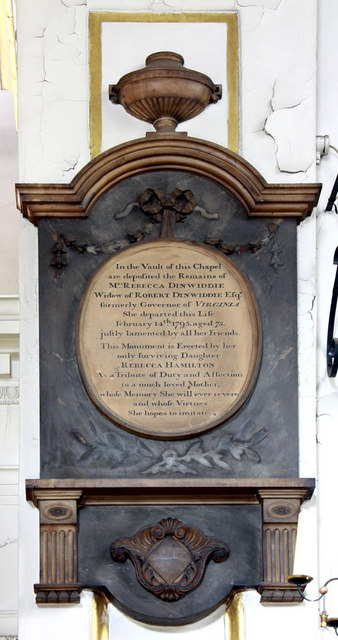
The pew rent books were lost, so few of the regular congregants during the Georgian era are known. However, Arthur Wellesley, 1st Duke of Wellington, was known to have attended services at Grosvenor Chapel regularly. His parents, the 1st Earl and Countess of Mornington, were buried there (the earl in 1781 and the countess in 1831). The walls have numerous memorial tablets. Burials in the chapel include Lady Mary Wortley Montague in 1762, Lord Chesterfield in 1773, and John Wilkes (the radical MP) in 1797. Ehrengard Melusine von der Schulenburg (mistress of George I) was also buried here in 1743. The vaults were sealed in the 19th century, so are no longer accessible for burials.


Wall monument

The chapel continues to offer services as chapel at ease to St. George’s, Hanover Square, serving nearby residents and members of Parliament. American troops stationed in Britain during World War II, including General Dwight D. Eisenhower, attended there, and the chapel continues to be popular with American tourists and visitors from other countries as well as other parts of London.


Sources include:

Callendar, Ann, ed. GODLY MAYFAIR. (London: Grosvenor Chapel, 1980).

British History Online. “South Audley Street-East Side.” HERE

GettyImages.com. ENTERTAINMENT-Elizabeth Taylor Baby Christening-Grosvenor Chapel, London. HERE

The Grosvenor Chapel website. HERE

History of Parliament Online. “Sir Richard Grosvenor, 4th Baronet (1689-1732), of Eaton Hall, Cheshire” by Eveline Cruikshanks. HERE ; “Sir Thomas Grosvenor, 3rd Baronet (1655-1700), of Eaton Hall, Cheshire” by Gillian Hampson and Basil Duke Henning. HERE

ProjectGutenberg.org. Mitten, Geraldine Edith. MAYFAIR, BELGRAVIA AND BAYSWATER

The Fascination of London. Sir Walter Besant, ed. (London: Adam & Charles Black, 1903). HERE

RegencyHistory.net. “St George’s Hanover Square-A Regency History Guide” by Rachel Knowles. Posted September 24, 2015. HERE

All images from Wikimedia Commons.

Exterior-by John Salmon, Creative Commons license, here

Sir Thomas Grosvenor, 3rd Baronet, here

Interior showing font-by John Salmon, Creative Commons license, here

Interior showing organ-by John Salmon, Creative Commons license, here

Interior of wall monument-by John Salmon, Creative Commons license, here


~~~~~~~~~~


Lauren Gilbert holds a degree in English, is a long-time member of the Jane Austen Society of North America, and lives in Florida with her husband.  Her first published book is HEYERWOOD: A Novel.
Her second novel, A RATIONAL ATTACHMENT, is in progress.  Please visit her website here for more information.