Saturday, April 9, 2016

Greek Mythology in British Literature

by Glyn Iliffe
“Let me not think on't! Frailty, thy name is woman— A little month, or ere those shoes were old with which she follow'd my poor father's body Like Niobe, all tears—why she, even she— O God! a beast that wants discourse of reason Would have mourn'd longer—married with my uncle” (Hamlet, Act 1, Scene 2, 145-151)
Many writers spent their childhoods reading one book after another, totally absorbed in imaginary worlds as they tried to escape the reality of being small and helpless. I wasn’t one of them. The books I was given at primary school to read were so dull that I lost interest and looked to films and toys to provide my flights of fancy instead.

This all changed when I read The Lord of the Rings at the age of 14, after which I became an avid bookworm. But as my reading became wider and began to include more literary classics, I felt gaps appearing in my understanding of the texts. These gaps included the many biblical references in older books (I wasn’t brought up in a church-going family, so my knowledge of the Bible was poor), and the frequent, almost throwaway, mentions of mythological names, such as Shakespeare’s “like Niobe, all tears” quoted above.

Like pretty shells scattered across a beach, they had, for me, a romantic sense of mystery. Who was Niobe and why was she crying? But Shakespeare doesn’t say. Neither do the other giants of literature—Chaucer, Spenser, Milton, Wilde, Joyce, Eliot—as they name-drop the heroes and demi-gods of Greek mythology with the assumption that their audiences will be familiar with them. So it both frustrated and intrigued me as I encountered glimpses of characters and stories that British state education in the 70s and 80s hadn’t prepared me for.

Niobid Painter: Artemis and Apollo killing Niobe's children
In short, Niobe was the proud mother of fourteen children. She made the mistake of boasting about it to Leto, who only had two. But Leto’s children were the divine Apollo and Artemis, probably the most lethal brother/sister act in mythology. In answer to their mother’s plea for vengeance, they murdered all of Niobe’s offspring. Devastated at their deaths, Niobe wept ceaselessly until she was turned into stone, after which her tears continued to flow in the form of a spring. It’s a tale typical of Greek mythology—mortal encounters immortal and suffers tragic consequences -- and one that I did not learn in full until I studied Classics at university.

By opting for a “classical” education - wanting to scratch the itch that had been left by Shakespeare and others years before—I was embarking on a study of something ancient, foreign and exotic, but at the same time quintessentially British. There is a deep affinity between the British and the ancient Greeks. It’s so normal we barely even notice it: the Doric style columns that adorn Victorian railway stations, the Greek words that smatter our language, and the fact we’re a democracy. But there are similarities in our national experience, too, especially with the Classical Athenians. Our language has become universal. Our wealth once came from maritime trade, protected by a powerful navy. We had an empire that moulded the modern world

It seems natural, then, that the British have a special appreciation for the ancient Greeks. This is never more obvious than in our literature. Many of our greatest writers were classically educated and were familiar with the history, culture, politics and art of the ancient world, as well as being able to read Greek and Latin texts. I’ve already mentioned the habit of British authors, playwrights and poets of liberally referring to characters from Greek mythology. It’s a way of conversing on another level with readers and audiences who, in those days, understood the references.

Name-dropping of this kind is useful for contrasting and comparing, such as the distinction Hamlet makes between his mother’s false tears and those of Niobe. To evoke such characters and their stories gives depth to the scene that the writer is trying to convey. By merely naming Niobe, Shakespeare puts an image in his audience’s mind of a woman devastated by grief (and thus shows the falseness of Gertrude’s tears, at least in Hamlet’s eyes). It wasn’t so long ago that audiences understood the references.

Such is the authority given by the Classics that some of our greatest writers have often begun their works by calling on one of the Greek Muses - the nine goddesses who symbolised the arts and sciences (Milton’s in Paradise Lost is Urania, the Muse of Astronomy).

But this authority is well-deserved. The stories of Greek mythology draw upon the whole spectrum of human experience. There are few emotions or themes that have not already been powerfully explored in the ancient writings of Hesiod, Aeschylus, Sophocles and other Greek playwrights. This is why Freud referred to Oedipus and Electra complexes - because the subconscious desire to sleep with a parent appeared in Greek drama twenty-five centuries earlier. But it is literature that remains most enthralled by the ancient Greeks, a tradition that was revived by the Renaissance in the 14th-century, though which had probably continued uninterrupted since the days of the Roman Empire.

One of the greatest influences on British literature from Greek mythology is Homer and the Trojan War. George Chapman’s partial translation of the Iliad in 1598 inspired Shakespeare’s Troilus and Cressida. One of the most famous quotes about the Trojan War, “Was this the face that launch’d a thousand ships,” came from Marlowe’s Dr Faustus in 1604. Fast-forwarding, the Iliad was a favourite of the Great War poets, some of whom read Homer’s epic in the Dardanelles while waiting to storm the beaches of Gallipoli. Considered by some to be the greatest literary work of the 20th century, James Joyce’s Ulysses sets the characters and incidents of the Odyssey in modern Dublin. More recently, Derek Walcott’s Omeros — a loose retelling of the Odyssey set in St Lucia — effectively won him the Nobel Prize for Literature. Among the less direct references are Lyra’s descent into the land of the dead in Phillip Pullman’s The Amber Spyglass - an allusion to Book 11 of the Odyssey.

James Joyce, by Ohne
Wikimedia Commons [Public Domain]
But what of the popular novel? Sadly, considering the wide appeal of Homer and the storytelling possibilities offered by the Trojan War, there have been very few novels dedicated to the subject. Strangely though, to my way of thinking, there haven’t been nearly as many novels about ancient Greece as there have been about Rome. Authors writing in this era include Lindsay Clarke, Greg Tobin and Valerio Manfredi, David Gemmell’s popular trilogy, and The Song of Achilles by Madeline Miller in 2012, which won the Orange Prize for Fiction.

The fifth and penultimate volume in my Adventures of Odysseus series has now been released in paperback and e-book formats. I’ve thoroughly enjoyed recreating the Trojan War, using a blend of historical accuracy and Homeric liberties, but not shying away from the mythical elements (after all, Greek mythology without the myth is just Greek!) I’ve tried to make these ancient stories accessible to readers with little or no prior understanding of the subject, and ultimately hope that my small chapter in the long British (or perhaps I should say English-speaking) homage to Homer will encourage a few more people to read his original works.

~~~~~~~~~~~~~

Glyn Iliffe studied English and Classics at Reading University, where he developed a passion for the stories of ancient Greek mythology. Well-travelled, Glyn has visited nearly forty countries, trekked in the Himalayas, spent six weeks hitchhiking across North America and had his collarbone broken by a bull in Pamplona.

King of Ithaca was Glyn’s first novel, followed by The Gates of Troy, The Armour of Achilles, and The Oracles of Troy. All are available for sale in the UK through Amazon. He is currently working on the fifth book in the series, The Voyage of Odysseus.


For more information about his work, check out Glyn's website, Facebook or follow him on Twitter.


Friday, April 8, 2016

Frankenstein & the Earl of Surrey

By Nancy Bilyeau

This is a story of magic and monsters, of poets and parents, and writers with enormous dreams and very little money.

Picture this: Young Henry Howard, earl of Surrey, known as the "poet earl" for his brilliant literary innovations in the mid-16th century, wanders through Europe in great style, tended to by servants and accompanied by learned and amusing friends. Nonetheless, Surrey pines for his ravishing mistress, Geraldine, left behind in England.

Henry Howard, earl of Surrey

In a sonnet, Surrey had written :
"Bright is her hue, and Geraldine she hight:
Hampton me taught to wish her first for mine:
And Windsor, alas, doth chase me from her sight.
Her beauty of kind, her virtues from above;
Happy is he that can obtain her love."
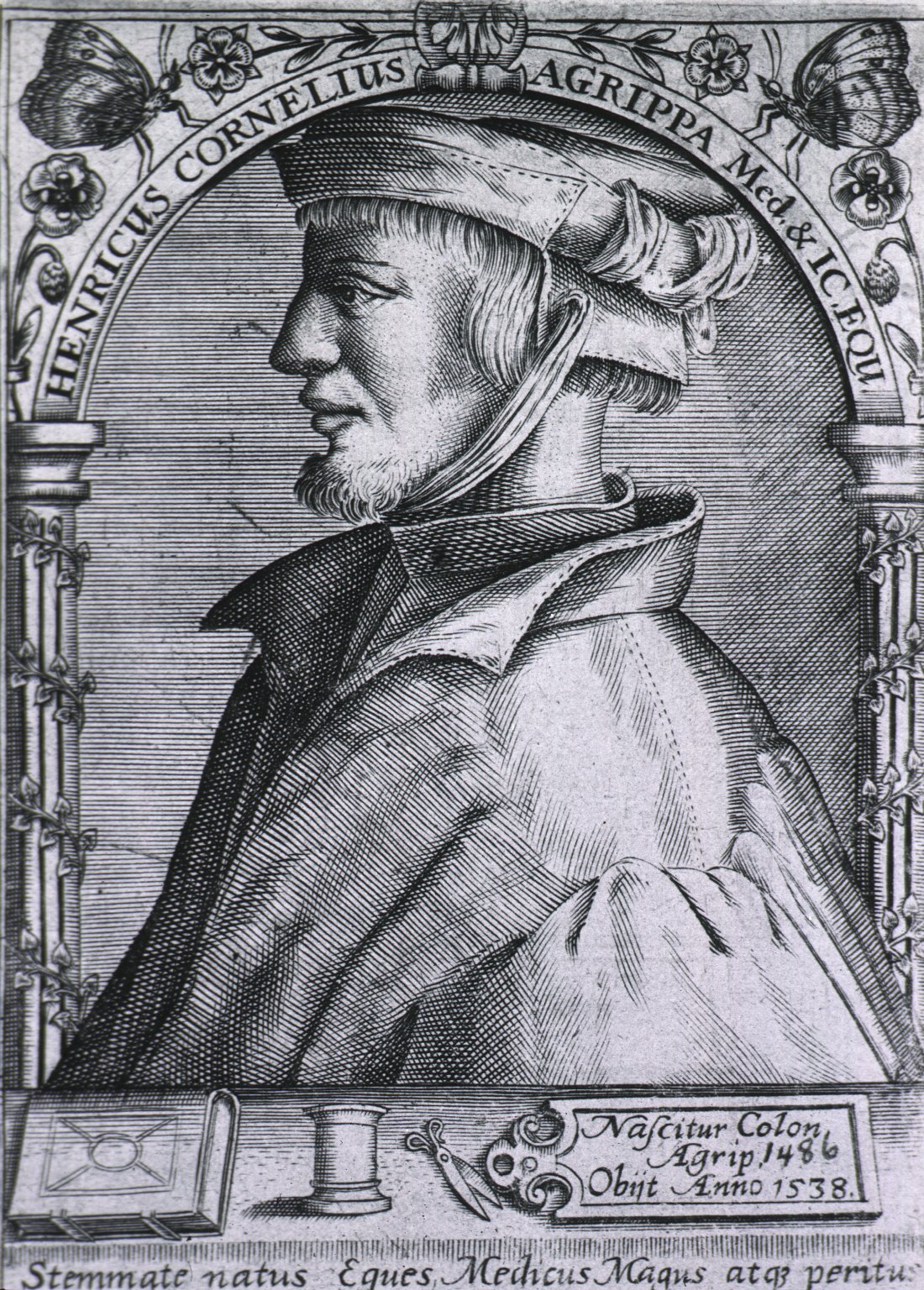
One day, in Italy, the lovesick Surrey turned for a cure to one of his companions, German-born Cornelius Agrippa, who, besides being a scholar, physician and soldier, was an astrologer and student of the occult. Agrippa "was one of the most celebrated men of his time...but he was a man of the most violent passions and of great instability of temper."

Heinrich Cornelius Agrippa

Agrippa possessed the ability to summon up apparitions for his friends, often displaying them in a crystal glass. One day, to please the Renaissance humanist Erasmus, he'd summoned an image of Tully, giving an oration in ancient Rome. For Sir Thomas More, Agrippa delivered "the whole destruction of Troy in a dream."

Surrey longed to see the faraway Geraldine, and Agrippa complied. In the "magical glass," Surrey saw the "beautiful dame, sick, weeping upon her bed, and inconsolable for the absence of her admirer." The Howard heir was distraught.

This is a story that appeared in a chapter devoted to Agrippa in William Godwin's Lives of the Necromancers, published in 1834. And ever since, puzzled historians and biographers and literary critics have tried to figure out if there is one true thing in it.

A necromancer is a wizard, a seer, someone who can conjure the spirits of the dead for purposes of magically revealing the future or influencing the course of events. Godwin's book begins with divination from the ancient times, moves through the Old Testament seers, Roman oracles and the "Arabian Nights," picks up speed in medieval times with Bacon and Magnus before concentrating on the Renaissance necromancers: Agrippa, Paracelsus, Faustus, John Dee, Nostradamus. Then it's time for the Lancashire witches and King James I's demonology before finishing up with the witches of New England. Whew.

The fact that Godwin, the revered writer of the book Political Justice and the novel Caleb Williams, wrote a tome about centuries of necromancers is bizarre. But that's not the only strange and remarkable aspect. Godwin was the devoted father of Mary Shelley, author of Frankenstein. And in that famous horror novel, it is the 16th century writings of Agrippa that obsess a young student named Victor Frankenstein, leading him to create a living man from the parts of the dead.

 
             This first edition of Shelley's 'Frankenstein' sold for $175,000 in auction in 2015.

Before we continue, it must be acknowledged: The story of Agrippa revealing Geraldine to Surrey is fishy. Not that they weren't real people. Surrey, the first cousin of Anne Boleyn and Catherine Howard, is famous in his own right: He and his friend Sir Thomas Wyatt were the first English poets to write in the sonnet form.

As for Agrippa, born in Cologne, he mastered six languages and studied medicine and law as well as the work of the Humanists. Alchemy was his passion, and he believed "magic comprises the most profound contemplation of the most secret things, their nature, power, quality, substance and virtues." He published De Occulta Philosophia, three volumes on magic. The lives of Agrippa and Surrey overlapped by 19 years, but the story of their meeting and traveling together in Italy is almost certainly not true. Moreover, Godwin may have known that ... but found it impossible to resist throwing it in the pot. More on Godwin later!

The facts: The charismatic Surrey was executed for treason in 1546. Henry VIII had grown acutely paranoid about the Howard family's pretensions to the throne. Surrey was the biggest threat because he had royal blood through his mother, Elizabeth Stafford, the oldest daughter of the third Duke of Buckingham, another arrogant charmer who lost his head to Bluff King Hal.

The sonnet "Description and Praise of His Love Geraldine" is one of Surrey's finest. Sir Walter Scott and Michael Drayton would later pay homage to its romantic power. But their being a real, devouring love behind the poem is also just too good to be true. The girl in the poem is thought to be based on a real female: Elizabeth Fitzgerald, daughter of Gerald Fitzgerald, ninth earl of Kildare. But when he wrote it, she was at most 10 years of age.

Elizabeth Fitzgerald, aka Geraldine, after marrying

The aristocratic Fitzgerald family came from Ireland to London in 1533, when Elizabeth was six years old, and she and her brother became playmates to Henry VIII's children. Her father, however, was imprisoned in the Tower of London for corruption; he died there "of grief" in 1534. It is thought that a sympathetic Surrey wrote the sonnet in 1537 for the 10-year-old girl to improve her chances of someday making a good marriage.

So Surrey and Genevieve weren't really in love and Surrey never traveled through Italy. It's settled. Yet, nonetheless, Agrippa conjuring up Geraldine in a magic glass for Surrey is a story that kept showing up in art and letters. Watercolour painter Edward Corbould, favorite of Prince Albert, was the toast of London with his "The Earl of Surrey Beholding the Fayre Geraldine in the Magic Mirror."
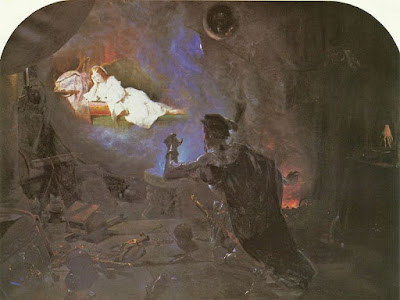
Corbould's famous painting


The origin of this story can be traced to a book written after Surrey's death, from the quill of another author of the 16th century, the sort of talented rapscallion that keeps surfacing in our narrative. Thomas Nashe, a parson's son, became a leading Elizabethan playwright, poet and satirical pamphleteer. In his book The Unfortunate Traveller, published in 1594, a man named Jack Wilton rollicks through Europe, surviving many adventures and meeting famous people as if he were a Tudor-era Zelig. Some of the stories in the novel are based on real events, such as the Peasant Revolt in Germany. One of the people Wilton meets is the Earl of Surrey, and while traveling together they encounter Agrippa and his magic crystal. Geraldine revealed!

Nashe, a friend of Ben Johnson's, is thought to be one of the contributors to Henry VI, Part 1, published under William Shakespeare's name. On the opposite end of the prestige spectrum, he wrote erotica such as the notorious The Choice of Valentines, about a trip to a brothel. In response to the outraged criticism over his writing the 50 Shades of its day, Nashe penned this: "When the bottom of my purse is turned downward and my conduit of ink will no flower flow for want of reparations, I am faine to let my Plow stand still in the midst of a furrow."

Nashe was dead by 1601. A friend's epitaph: 
 "Let all his faults sleepe with his mournful chest/And there forever with his ashes rest/His style was wittie, though it had some gall/Some things he might have mended, so may all/Yet this I say, that for a mother witt/Few men have ever seene the like of it."
Surrey's stature grew in the pantheon of Renaissance literature over the next two hundred years ... and so did doubts about the Agrippa anecdote described by Nashe.  One early Surrey biographer pointed out that, aside from Geraldine being nine years old when the sonnet was being composed, "it is unlikely Howard was ever in Italy because he never made any mention of it." In the 16th century--no surprise--traveling around Europe was difficult even if you had money. The promise of the Grand Tour dangled far in the future.

And so we come to the Godwin family.


William Godwin's early life was a bit like Nashe's.  His austere Calvinist father was a Nonconformist minister in Norwich; Godwin was the seventh of thirteen children. He made his way to London in his twenties and, living hand to mouth,  joined a circle of young philosophers, poets and revolutionaries such as William Blake and Thomas Paine. In 1793 he published Enquiry Concerning Political Justice and Its Influence on Morals and Happiness, an enormously influential book that decried government and urged people to use their own reason to plan their actions. Godwin is today considered the founder of political anarchism.

Godwin fell in love with a fellow author and spirited revolutionary, Mary Wollstonecraft, a passionate believer in the rights of women who had an illegitimate child and suicide attempts in her own past. She died days after giving birth to their only child, the future Mary Shelley.

As the death toll of the French Revolution became more known, those who called for anarchy became less popular. Godwin, remarried, saw sales of his books begin to decline. He started a publishing business but it failed, nearly sending Godwin, a hopeless businessman, to debtors' prison. Friends rescued him with loans.
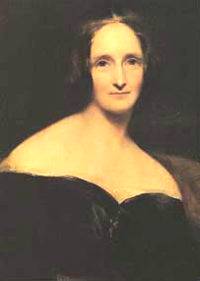
Mary Godwin Shelley

Through it all, he devoted himself to the education of his daughter. Mary not only studied literature and languages but was surrounded by her father's scientist friends, chemists and surgeons who were fascinated by the notion of "animal electricity," also known as "galvanism," the study of muscle contractions causing an electrical current.

Godwin was furious and heartbroken when Mary, 17, ran away with the married poet Percy Shelley. London gossip snickered that Godwin had courted Shelley, heir to a fortune, because he was desperate for a patron for his strained writing life, and "sold" his child to the dissolute young man. It was definitely untrue.

It's well known that when Mary, Shelley, Lord Byron and John Polidori gathered at the Villa Diodati  in 1816, competing to see who could pen  the best ghost story, the talk was of the occult, of alchemists and necromancers. In Frankenstein, Mary Shelley gave direct credit to Agrippa for setting things in motion. She wrote of her main character, a young student, coming across a book:
"Natural philosophy is the genius that has regulated my fate. I desire, therefore, in this narration, to state those facts which led to my predilection for that science. When I was thirteen years old, we all went on a party of pleasure to the Baths near Thoneo. The inclemency of the weather obliged us to remain a day confined to this inn. In this house I chanced to find a volume of the works of Cornelius Agrippa. I opened it with apathy; the theory which he attempts to demonstrate, and the wonderful facts which he relates, soon changed this feeling into enthusiasm. A new light seemed to dawn upon my mind..."
The student's fate was set. One day Victor Frankenstein would use "natural philosophy" to create life.

In mid-April 1817, Mary Shelley finished her fair copy of the novel. Frankenstein: A Modern Prometheus was published in 1818, to mixed reviews. After her husband drowned in 1822, Mary returned to England. She became close again with her father, whose book sales foundered further as Frankenstein gained strength. Mary thrived as a writer and editor, and eventually helped to support her father financially. She wrote a friend in 1831 she was "full of disquietude for my father, who lives by his pen."

William Godwin, in later life

Godwin, although he'd written more than a dozen books, did not have a publisher when he created Lives of the Necromancers. It took him two years to find one for it, even though Mary was exerting personal pressure on editors and publishers she knew. Everyone rejected it. Finally, an obscure London publisher, Andrew Mason, took the book in 1834. (In his chapter on Agrippa, Godwin conceded that the "sole authority" for the Surrey section was Nashe. The episode is followed by tales of black-cat familiars and dangerous potions.)

The book found fans on both sides of the Atlantic. Washington Irving and Edgar Allan Poe,in particular, enjoyed its treatment of magic and superstition.

Poe, who hated just about everything, praised Lives of the Necromancers in Southern Literary Messenger, saying, "No English writer with whom we have any acquaintance, with the single exception of Coleridge, has a fuller appreciation of the value of words." Poe continued:
"Unlike the work of Brewster, the Necromancy of Mr. Godwin is not a Treatise on Natural Magic. It does not pretend to show the manner in which delusion acts upon mankind — at all events, this is not the object of the book. The design, if we understand it, is to display in their widest extent, the great range and wild extravagancy of the imagination of man. It is almost superfluous to say that in this he has fully succeeded. His compilation is an invaluable work, evincing much labor and research, and full of absorbing interest."
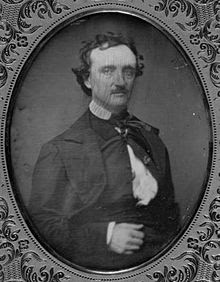

Edgar Allan Poe

(More recently, biographers have studied the book as proof of the shared interests of Mary Shelley and William Godwin. Some critics are rather baffled, trying to decide whether Godwin was mocking the gullible or celebrating mystical beliefs.)

Lives of the Necromancers was the last book written by William Godwin. In 1833, in recognition of his body of work, the Whig government granted him a pension of 200 pounds a year and a modest home in New Palace Yard. In April 1834, at the age of 80, he caught a cough and died, his daughter by his side. At his request, Godwin was buried next to his long-dead first wife, Mary Wollstonecraft.

The books of William Godwin, Mary Wollstonecraft and Mary Shelley have never gone out of print.

And neither have the books of magic written by Heinrich Cornelius Agrippa.

-------------------------------------------------------------------------------------

Nancy Bilyeau is the author of a trilogy of mysteries set in the 16th century: The Crown, The Chalice, and The Tapestry. for sale in North America, the United Kingdom, Germany and Spain. The Crown was an Oprah pick: "The real draw of this suspenseful novel is its juicy blend of murder, lust, conspiracy and betrayal."  The Chalice won the RT Reviewers Award for Best Historical Mystery. The Tapestry was released in paperback in March 2016. For more information, go here.


Thursday, April 7, 2016

A Taste for Pineapple....

By Lauren Gilbert

One of the blessings of living in south Florida is having the ability to grow fruit at home. Right now, I am looking forward to fresh pineapple in my refrigerator. It's spring and several of my plants are in the process of producing fruit. There is nothing more delicious than fresh, sweet pineapple, and it's even better when you can pick it in your own garden!

The taste for pineapple and citrus is by no means a modern taste. Explorers were bringing specimens of exotic plants from all over the world during the age of exploration. Portuguese explorers are credited with bringing sweet orange trees back from the orient to the Mediterranean area about 1500, although the Persian orange (which is bitter) was known in Italy as early as 1100. Orange trees became a popular plant widely sought for terraces and formal gardens in France, Italy, Germany and England, and needed special protection from the northern climates. Buildings called “orangeries” were constructed in France in the 17th century at Versailles and other sites.. At Kew Gardens in England, an orangery was built in 1761 by Sir William Chambers, which was the largest glass house in England at that time.

The Orangery in Kew Gardens

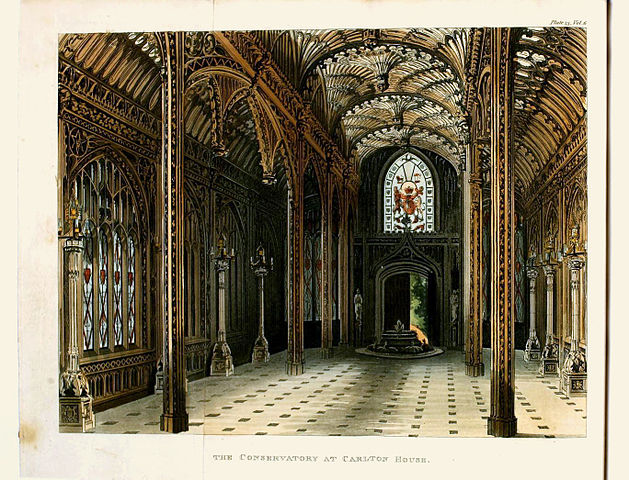
A beautiful conservatory was also built for Carlton House by Thomas Hopper in 1807. As you can see, these were restricted to royalty, the aristocracy and the very rich because of the price of glass, and taxes on glass. Conservatories and orangeries at that time could be free-standing buildings, or glassed rooms attached to a stately home. Because of cost, for all but the wealthiest, these structures did not contain nearly as much glass as a greenhouse would contain today. Roofs were frequently solid (although possibly removable) or inset with only a glass panel, and the walls were more solid, inset with larger windows. During the Regency era, the garden room was increasingly popular, as a transition from interior to exterior space. The conservatory reached its hey-day in the Victorian era.

A View of the Conservatory at Carlton House, Ackermann's Repository of Arts 1811

The pineapple was introduced after Christopher Columbus first encountered it in 1493, and became hugely fashionable to display and enjoy for dinners by 18th century royalty and aristocracy. This craze filtered down to the gentry. However, the pineapple had certain special issues for cultivation: as a tropical fruit, it was not sufficient to protect them from frost; they also required more light than orange trees and most other exotics and a source of heat. Pineapple cultivation was originally successful in the Netherlands, and English gardeners went to study the methods used there.

Heating was a real challenge. Conservatories and orangeries were built facing south, to maximize exposure. Angled glass was used to catch morning and afternoon sun, while deflecting the intensity of the mid-day sun. However, pineapples required more warmth. Early attempts with furnaces were not successful as fumes were toxic to the plants. Hot air flues built into the walls were more successful, but the furnaces required constant attention and fires frequently broke out due to the build-up of soot and other material in the flues. One solution was putting the potted plants into pits which were filled with a source of heat. One substance used in these pits was manure, which generated heat but too intensely initially and then cooled too rapidly. Oak bark in water resulted in a fermentation process which released heat at a slow and steady rate and allowed for more success. Because of the special needs of the pineapple, a pinery could be located in an orangery or conservatory, with a door allowing it to be closed off, or in a completely separate structure.

I became interested in pineries because one appears in my work in progress (as well as the fact that I have pineapple plants myself!). Although the term “pinery” is sometimes considered virtually interchangeable with “conservatory” and “orangery”, they are not in fact identical structures, although all are forerunners of the modern greenhouse. The idea of a special structure in which to grow plants that require protection from cold weather has existed for centuries. The Roman emperor Tiberius had a “specularium” designed specifically to grow cucumbers out of season, with windows created from fragments of mica. In France, records indicate a south-facing glass structure existed as early as 1385.

Sources include:

GardenGuides.com. "The History of Greenhouses." Here.

VictoriaHinshaw.com. "Orangeries, Conservatories, Greenhouses and Glass Gardens." (as viewed 3/24/2012, the page is no longer available. (as appeared in The Regency Plume, V. 12, N.3, P. 3 Sept.-Oct. 2002)). http://www.victoriahinshaw.com./default.aspx?page=conservatories

BuildingConservation.com. Lausen-Higgins, Johanna. “A TASTE FOR THE EXOTIC Pineapple cultivation in Britain.” Here.

The Free Library.com. Surchin, Anne. “The beauty around us: from fad building to pleasure palace.” (Date 3/22/2007, Publication: VOX) Here.

University of Vermont Extension website. Perry, Dr. Leonard. “Orangeries and Greenhouses.” Here.

Images from Wikimedia Commons: Conservatory at Kew Here and Conservatory at Carlton House Here

This is an updated reblog of an article that appeared on my own blog Here.


Lauren Gilbert lives in south Florida with pineapples, roses, and her husband. A member of JASNA and the Florida Writers Association, her first book HEYERWOOD: A Novel was released in 2011. Her second, A Rational Attachment, is in process. Visit her website Here.


Wednesday, April 6, 2016

The Drift to War in Europe

By James MacManus

No one in America watched the drift to war in Europe in 1939 with more frustration and concern than President Franklin Roosevelt.

The appeasement policies of Britain and France, shaped by the slaughter in the trenches a generation earlier, had merely encouraged rather than deterred Adolf Hitler. The Nazi regime was bent on war—that much was obvious to the White House even if in London, in the spring of that year, Prime Minister Neville Chamberlain still clung to the belief that somehow the Fuhrer would yield to peaceful diplomacy.

It was equally obvious to Roosevelt that he had limited room for manoeuvre as he sought to bolster those European nations opposed to Hitler. Opinion polls showed eighty percent of Americans were against any involvement in another European war, a sentiment which was reflected across the politician divide in Congress.

Defying his own Secretary of War, Harry H. Woodring, an ardent isolationist, President Roosevelt ordered a massive aircraft production program in 1938 with the stated aim of strengthening US defences but with the less publicized objective of supplying light bombers to France.

Fearing Nazi penetration of Latin America, Roosevelt also announced a plan for “hemispheric defence” involving a collective security declaration for all nations in the Americas—something with which the isolationists could hardly argue.

Looking back at those frantic months as the world lurched towards war in early 1939, one only wishes Franklin Roosevelt had known of a covert initiative put to the British government which, if authorized and successfully implemented, would certainly have prevented the outbreak of war that year and changed the history of the 20th century.

For in March 1939, the British government was secretly presented with two credible opportunities to halt Nazi aggression in Europe.

The first was a plan to have the War Office launch an immediate pre-emptive attack on the Nazi regime by way of a naval blockade of the German North Seaports.

Hitler would be caught off guard, so the thinking went. The Wehrmacht’s best armoured divisions were mostly scattered across Eastern Czechoslovakia after the invasion of that country early that month. Germany was a net importer of food, oil and raw materials although the resources made available after Hitler’s land grab in the east would soon alter that.

Despite the weakened state of his armed forces due to the murderous purges of the officer class, Stalin would surely be tempted to join in a war against his most dangerous enemy. Thus Hitler would be faced with a nightmare that his generals feared most—a two front war against armies to the East and West.

This was the logic behind a plan that was dismissed as irresponsible war mongering by a government in London intent on appeasing Hitler at all costs.

The second plan was more straightforward and a great deal more practical; the assassination of Adolf Hitler on his 50th birthday, April 20, while reviewing a military parade in the centre of Berlin. The reviewing stand on the main east-west avenue in the city was just 100 metres from the windows of the British military attaché’s first floor apartment.

It was an easy rifle shot, so the plan went. The noise of the parade and the cheering of the crowds would mask the location of the sniper. By the time the Gestapo worked out who had killed the Fuhrer, the Wehrmacht would have moved against the Nazi regime. The Prussian officer class in the army command had long been distrustful of, and distrusted by, Adolf Hitler. This would be their opportunity.

The man who fiercely argued the case for both plans to Neville Chamberlain’s government was the military attaché himself. Colonel Noel Mason-MacFarlane was a decorated veteran of the First War, an excellent shot and a man who saw all too clearly what Downing Street refused to recognize: that Hitler was bent on war and that the government’s appeasement policy, always a failure, had now become an actual incentive for conflict.

In 1938, Mason-MacFarlane had taken up his post in Berlin the previous year and quickly made his views on appeasement known. The Nazi leadership was a group of gangsters who had gulled an entire nation with racist propaganda and expansionist claptrap as far as the attaché was concerned.

The British ambassador, Sir Neville Henderson, was both an enthusiastic proponent of the “do nothing to offend Hitler” thinking in London and friendly with leading Nazi figures such as Goering whose invitations to the opera or to shooting weekends he would eagerly accept. It was inevitable that the ambassador fell out with his new attaché from the moment they met.

Such was the animosity between the two men that after the war Mason-MacFarlane revealed he had been forced to deceive his ambassador and smuggle a briefing document into the British diplomatic bag at Templehof airport. The document, sent to the Foreign Office with a copy to the War Office on March 28, 1939, argued the case for an immediate pre-emptive war against the Nazi regime.

Although German rearmament had proceeded apace in the thirties, breaking the terms of The Treaty of Versailles, the one area in which Britain still held the advantage was naval power. The great German battle ships, Tirpitz and Bismarck, had yet to enter service and the Royal Navy heavily outnumbered the German Kriegsmarine in ships and firepower.

Mason-Macfarlane argued that a blockade of the German ports would be enough to force Hitler to go to war at a time when he was least prepared and militarily and economically vulnerable.

In London, the military attaché’s document crossed various Foreign Office desks, no doubt to the amazement of their occupants, before it reached the pinnacle of mandarin authority, Lord Halifax, the Foreign Secretary. The noble lord dismissed the idea with contempt.

However at that point, at the end of March 1939, Mason-MacFarlane’s radical views attracted the attention of the British Secret Intelligence Service (SIS) headed by Sir Stewart Menzies. Mason-MacFarlane was called to London and it is there that he presented his carefully worked out plan for the assassination of Hitler.

The details were simple and compelling. On April 20, Hitler’s 50th birthday, the Fuhrer would mount the reviewing stand on Berlin’s main avenue at 11a.m. in the morning. With a high-powered rifle Mason-MacFarlane would place himself on the landing of his apartment, 30 feet from the bathroom window to avoid muzzle flash and blanket the sound. Firing through the window, he would kill Hitler with a single head shot. As he said at the time, in remarks later reported by his biographer, it would have been “an easy rifle shot. I could pick the bastard off from here easy as winking.”

The Fuhrer’s birthday parade, organized by Joseph Goebbels, was to be the largest Nazi celebration city had seen. The parade would last for at least five hours. Every leading Nazi was to be present and would remain at Hitler’s side for several hours, all within sight of the British diplomat’s apartment.

Mason-MacFarlane argued that the risk of savage reprisals against British embassy staff should the Gestapo pinpoint the assassin would be nullified by a swift military coup that would remove the entire Nazi regime.

There was strength in this argument. British intelligence had learnt that the German chief of staff, General Franz Halder, had discussed with other Wehrmacht conspirators the idea of removing Hitler the previous autumn. Halder was said to have spoken of the Fuhrer as a criminal and a bloodsucker. By the spring of 1939 such plans had been put aside as the chief of staff and his senior officers busied themselves planning a short and brutal campaign to eliminate Poland.

But Mason-MacFarlane argued that with Hitler dead the chief of staff would certainly move against the heirs apparent to the Nazi leadership—Goering and Goebbels. Both men, especially the latter, were loathed by the German high command.

Sir Stuart Menzies was said to be “cautiously interested” in such unorthodox methods despite the code of gentlemanly conduct that had governed intelligence operations in the past.

Senior members of the cabinet were told of the plan and were swift in their dismissal. Lord Halifax summed up the official distaste for such action saying: “We have not reached that stage ... when we have to use assassination as a substitute for diplomacy.”

Behind those words lay the inner thinking of Chamberlain and his ministers. Conditioned by the social snobbery of those educated at the same schools, married to the same type of women and members of the same clubs, these were men who believed that Englishmen played the game and did not cheat.

The assassination of the German leader “would not be sportsmanlike behaviour” was the general view and it reflected the opinion that no gentleman would have suggested such a scurrilous act. The remark was made dismissively to Mason-MacFarlane who returned to Berlin to be told that he was to be replaced and given a staff posting back in the UK.

After 18 months in Berlin, the military attaché had effectively been sacked although his dismissal had been arranged, no doubt by an infuriated ambassador, even before the assassination plan reached Whitehall.

The removal of a military attaché from Berlin within months of the outbreak of war was comment enough on the poisonous atmosphere within the British embassy where Neville Henderson’s cosy relations with the Nazis had alienated many other staff and drawn trenchant criticism from sections of the British press.

The Gestapo were well aware of Mason-MacFarlane’s extreme hostility to the regime and had in fact been working to compromise him and force his removal for some time. In August 1938 a retired captain in a famous German cavalry unit held a long meeting with the attaché and revealed plans for a military coup in which he tried to involve the British diplomat.

Such crude agent provocateur tactics were easily avoided but there is no doubt that the Gestapo had singled out Mason-MacFarlane as a target for blackmail from the moment he arrived in Berlin.

Ironically Mason-MacFarlane remained in the capital long enough to attend the very military parade at which he intended to shoot Hitler. Goebbels ordered a photographic record of all those present at the birthday parade to be given in a bound volume as a gift to his beloved Fuhrer. Bemedalled with many honours, including the French Croix de Guerre, Mason-MacFarlane was captured on the reviewing stand scowling ferociously at the camera.

There the story might well have ended. But the publication of British Foreign Policy documents by the Stationer’s Office in 1952 revealed the pre-war plans presented to Whitehall for a pre-emptive strike against Germany. In an interview in January the following year, Mason-MacFarlane, then seriously ill, also revealed for the first time how strongly he had urged the British government to seize a golden opportunity to assassinate Hitler.

General Mason-MacFarlane died that year, 1953, aged 63. In 1969 Spiegel magazine in Berlin gained access to the general’s papers in the Imperial War Museum in London and learnt of the assassination plan. The magazine interviewed his daughter, Mrs. Mona Hall, and reported how Chamberlain’s government had spurned the plan because “this would not be sportsmanlike behaviour.”

   ***********

Midnight in Berlin by James MacManus, to be published by St Martins Press in New York on April 19, is a historical novel dedicated to General Mason-MacFarlane. His courage and vision inspired a story woven around the plan to assassinate Hitler in Berlin in 1939 and the Gestapo’s efforts to compromise the intended assassin.


James MacManus  joined the Daily Express in Manchester as a trainee reporter in 1966 and moved to The Guardian in 1972, working first as a reporter in the London office and then as a foreign correspondent in France, Africa and the Middle East for 12 years. In 1985 he joined the Diplomatic staff of the Daily Telegraph in London, before joining The Times in November 1992. He became Managing Director of The Times Literary Supplement in April 1997, a position he still holds.


In 2010 James’ first novel was published by Harper Collins in London. On the Broken Shore won critical acclaim and was published by Thomas Dunne Books, an imprint of St. Martin’s Press in New York. His second book, Black Venus, was followed by Sleep in Peace Tonight. Midnight in Berlin is his fourth novel. For more information, visit His Website


Tuesday, April 5, 2016

Grendel: Pagan or Christian?

By Kim Rendfeld


Grendel and his mother, the first two monsters Beowulf faces in the poem bearing his name, are both frightening and fascinating—and their creator blends pagan beliefs with a deep understanding of Christianity.

We might never know who penned the oldest English epic poem between the middle of the seventh century and end of the 10th, but it is proof that its author had a great intellect and great imagination, even though most people who lived in the Dark Ages could not read or write. (And like many medieval writers, Beowulf’s creator included a healthy dose of gore.)


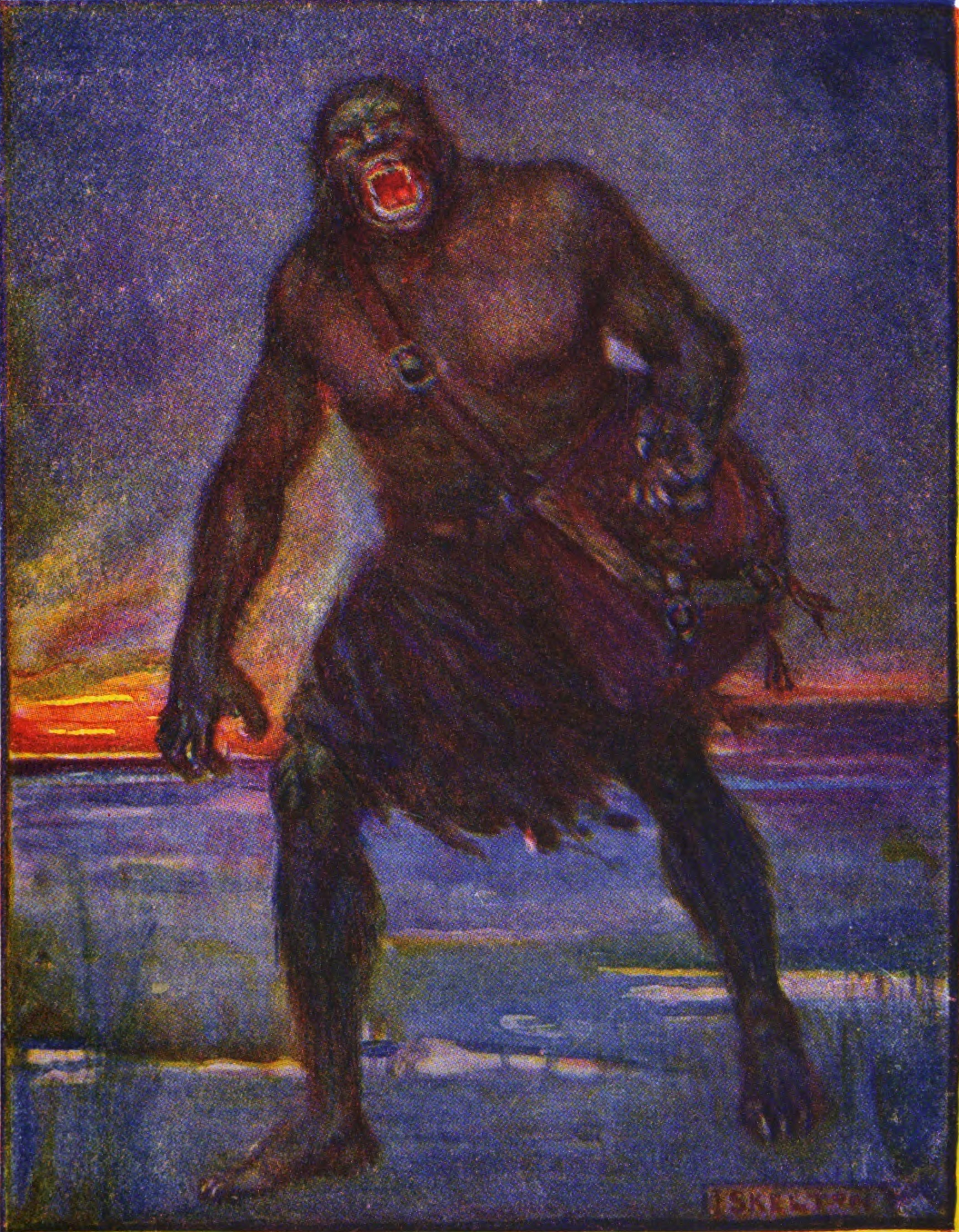
Called a “demon,” “fiend out of hell,” and “shadow stalker,” Grendel shares many of traits of a draugr, an undead creature from Scandinavian mythology. He resents the living, wreaks murderous havoc, cannot be placated, and cannot be slain by ordinary weapons. Otherworldly beings were so real to an early medieval audience, the folk took precautions to appease or hinder them such as having a wake for the dead or burying a corpse with a Host—the presence of Christ—in their mouth.

However, Grendel is living enemy. Instead of a burial mound, he inhabits a fen.

Yet the poet bases his explanation for Grendel’s monstrosity on Christian beliefs by saying Grendel is a descendant of Cain. The poet might have read a letter from the Apostle John, who exhorts Christians to love one another and not be like Cain, not only because the character is murderous but because by that act, he became more like Satan than Adam.

So Grendel is not only the bane of Heorot Hall; he is an enemy of God. The poet calls him “God-cursed” and says he bears God’s wrath. The only way to stop Grendel is to kill him. Beowulf delivers the fatal blow by tearing off the monster’s arm while they wrestle. Grendel flees home. In the morning, the men get a good look at the disembodied limb, which is like “barbed steel,” and they realize none of their weapons would have worked.


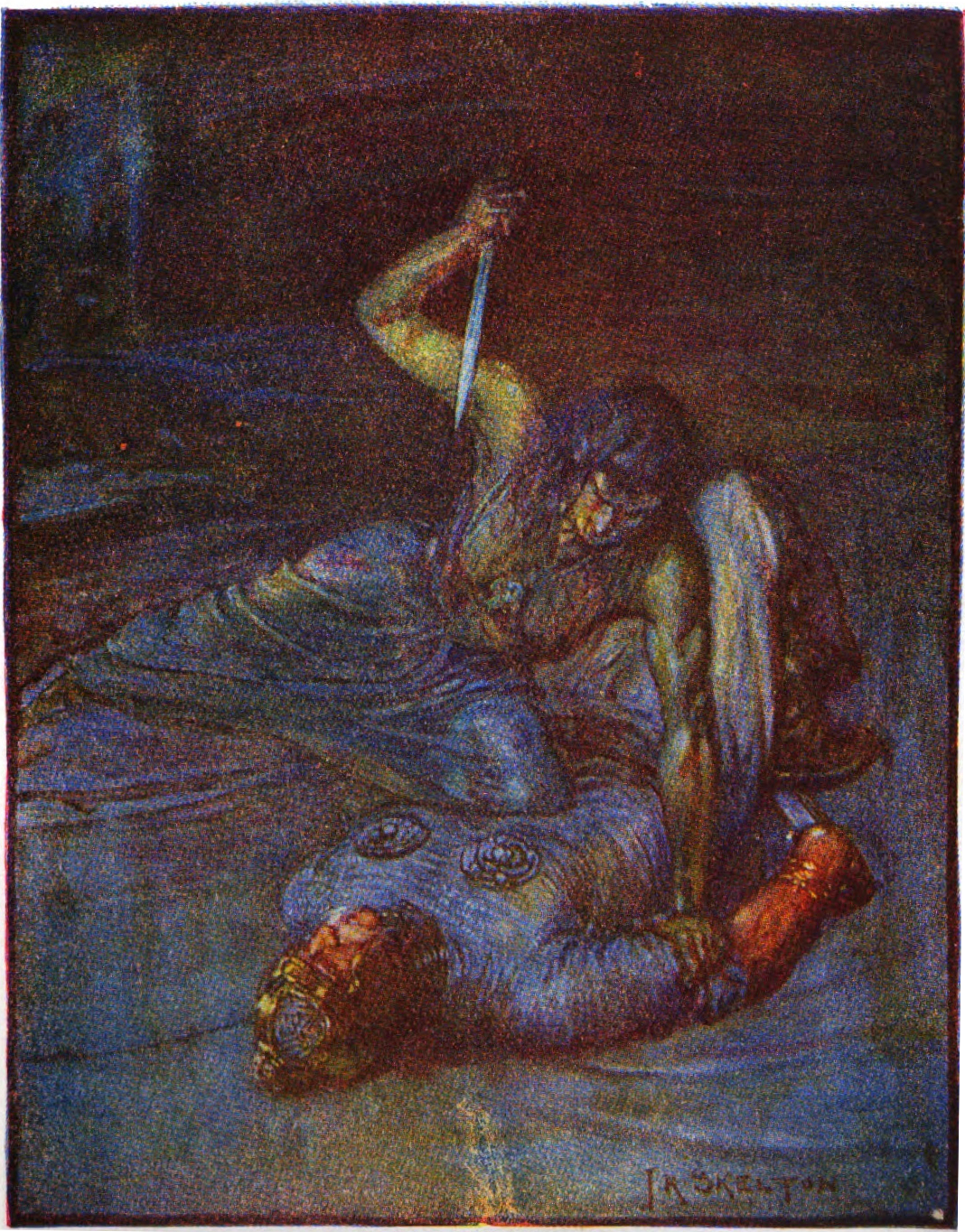
Like some draugrs, Grendel has a mother, and in her grief, she is more dangerous than her son. She doesn’t have a name, which makes her even more fearsome. In one sense, the reader can sympathize with her. Sure her only child was a monster (literally), but he was still her son. And she, like the humans, will avenge her dead loved one. She claims the king's right-hand man the very night Heorot Hall celebrates Grendel’s demise.

The only way for Beowulf to stop her is to pursue her to her underwater lair and kill her with a weapon in her hoard, another element of pagan mythology. The sword is so heavy only Beowulf can wield it, and when he uses it to claim Grendel's head a trophy, the monster’s blood is so toxic it melts the weapon to the hilt. Like a good Christian warrior, Beowulf credits God for the victory when he later recounts the fight.

With these monsters and other elements, Beowulf gives modern readers a glimpse how Christian and pagan beliefs coexisted in early medieval times.

Illustrations by J.R. Skelton (public domain, via Wikimedia Commons)

Sources

“The Walking Dead: draugr and Aptrgangr in Old Norse Literature,” The Viking Answer Lady

“Beowulf’s Monsters: Comparing the Mythology of Grendel, Cain, and Satan" by Sean Hadley

Beowulf, translated by Seamus Heaney

Kim Rendfeld reread Beowulf while researching her second novel, The Ashes of Heaven’s Pillar, and she continues to be fascinated by the poem. She is also the author The Cross and the Dragon and is working on Queen of the Darkest Hour. For more about Kim and her fiction, visit kimrendfeld.com or her blog, Outtakes. You can also connect with her on Facebook and Twitter.

Monday, April 4, 2016

Henry VIII and the Break with Rome

Judith Arnopp

There are many unanswered questions about the Tudors but probably the most asked is ‘What makes the Tudors so fascinating?’ It could be that they are seldom out of the media. There are numerous films, shows, documentaries, books, articles, websites but there seems to be no definitive answer to their appeal. We have portraits (as discussed in my previous blog which can be read here), we have records of their actions, some good, many bad. We can visit their palaces, see surviving fragments of their clothing, pieces of furniture; examples of their handwriting, craft work, letters. We even have the wreck of Henry’s favourite flag ship. So, all this considered, we should know just about all there is to know about them.  But we don’t, or perhaps it would be better to say, we don’t know as much about them as we would like.

Everyone is an expert when it comes to the Tudors (myself included). We think we know them because we can recognise their faces, count off the names of Henry’s wives on our fingers, and tentatively find our way through the complexities of the Reformation. I am often asked questions about the Tudors that are impossible to answer but the most elusive of all are: ‘What made them tick?’ 'How did their minds work?' What did they think and why did they think it? My favourite question received this week is ‘What did Henry VIII really feel when he broke with Rome?’ I've  been thinking about it ever since but it is one of those questions we can never really answer. Henry is so many things to so many people. A monster, a bigot, a bully ... I could go on but I prefer to try to be objective.


The distance between the Renaissance and the world we know today is unfathomable; even the most astute of us can never begin to really understand the workings of the Tudor mind. Religion today is, in comparison, lax. Few of us are ruled by the teachings of the church as they were then. People of the period, even kings, lived by the dictates of religion; the hours of the day were divided by bells calling them to prayer, the months were marked by feast and saint’s days. Even their diet and sex life was ruled by the church. I don’t believe we can even begin to realise the magnitude of Henry’s break with Rome or the effect it had on society, or more importantly for the purposes of this blog, the impact it had on Henry himself.

In becoming God’s representative on Earth in place of the Pope, Henry must have feared deep down that he was in fact taking one step closer to hell rather than Heaven. His deep-seated Catholic upbringing taught that the Pope was unassailable; snubbing Rome was tantamount to snubbing God himself. Henry was stubborn, he refused the directives of the Pope yet, secretly, he must have trembled. Against his religious scruple, and despite the fact that he found many facets of continental reform troublesome, he was convinced by those eager for reform that a break with Rome was the only way to secure his dynasty. To convince the people, he allowed a bible to be printed, in the vernacular.


The Great Bible issued in 1539 was the first to be printed in English and we have only to turn to the frontispiece to see the change that has taken place. Gone is Christ in majesty; He is rather rudely ousted to the top margins of the page where He whispers God’s word into the King Henry’s ear. Henry, seated just below him, passes on the word of God.


The king is holding two copies of the scriptures, he gives one into the keeping of Cranmer and one into the hands of Cromwell, who in turn pass the word to the clergy and laymen, and so on to the masses (some of whom seem to be in gaol). Comic style speech bubbles give voice to the proceedings, ‘Vivat Rex’ they cry, ‘God save the King,’ praising Henry who is now the main conduit of the word of God.

Copies of this Bible were sent to parishes across the country and Thomas Cromwell ordered one to be placed in every church in England, a crucial tool in the campaign to subliminally persuade the nation of Royal Supremacy and to follow the dictates of their king.

This frontispiece is often used as an example of Henry’s megalomania yet although it was undoubtedly designed to flatter him, he had little to do with it other than to sanction its publication. It was designed by Myles Coverdale working under commission of Thomas Cromwell, whose agenda was to promote reformation and flatter his king.

Henry took his role of Christian King seriously; he was a theologian, the one-time Defender of the Faith, a title conferred on him by Pope Leo X for a pamphlet Henry wrote against Martin Luther. Yet the lesson imprinted on him by his father, Henry VII, on the importance of heirs seems to have obliterated his religious teaching. When the Pope refused to countenance Henry’s divorce from Catherine of Aragon, Henry was cornered. He believed he had to marry Anne Boleyn and secure the Tudor dynasty by getting himself an heir. The Pope’s refusal to favour Henry’s suit made the break with Rome inevitable.

Many, many innocent people died for their refusal to follow Henry’s dictates, his quest for a son with Anne failed, and the subsequent marriage to Jane Seymour bore fruit but she died shortly after bearing him a son. Even having obtained his heir Henry could not forget the untimely death of his elder brother, Arthur, a death that made Henry heir to the throne. Terrified that history would repeat itself, Henry never gave up hope of more sons but, although the king married a further three times, Edward was his last child.

Contrary to the belief of many, Henry never abandoned Catholicism. After the break with Rome he became head of the Catholic Church in England, a reformed church, that dispensed with the Pope and the monastic institutions that rivalled his magnificence in England. Henry maintained his Catholic beliefs to the end and died in the faith. Protestantism was not established in England until the reign of Henry’s much cherished son, King Edward VI. It is my belief that Henry was not eager for reform. it was Catherine he really wanted to be rid of, not Rome but the Pope left him no choice. Had the marriage to Catherine of Aragon been annulled the reformation would never have taken place during Henry's reign but the wave of religious change in Europe was unstoppable and it would have come sooner or later, with or without Henry.

Illustrations from  Wikimedia commons 

***

Judith is the author of eight historical novels and is currently working on Book Two of The Beaufort Chronicles: the life of Margaret Beaufort. You can find out more here.


Sunday, April 3, 2016

The Establishment of William the Conqueror as King

by Emily Murdoch

It is very rare that we ever get to celebrate the millennial anniversary of anything. After all, anything before 950 is generally considered to be the ‘Dark Ages’, a horrible misnomer that most historians hate but do not seem to be able to dismiss. That is what makes the 950 year anniversary of the Norman Conquest of England so fascinating – because this is probably the longest anniversary of anything that most people have ever commemorated.

And yet, so little is really known about that fateful year, the year known as the year of the three Kings. Most would not even be able to name all those who fought to claim that sparkling crown of the English, a nation that could really only be described as in its infant stages, and yet had somehow managed to impress itself so weightily on politics hundreds of miles north and thousands of miles east.

The English had barely established themselves as a people when the Normans invaded along the south coast that fateful autumn of 1066, and they had already been battered and bruised by the constant civil war and fighting that had continued from the moment that King Edward the Confessor, beloved by his people but completely without biological heirs, died on Christmas Day. It did not take long for his brother-in-law Harold, one of his wife Edith’s many brothers, to claim the throne for himself.

Whether or not you believe Harold Godwineson to have been the legitimate heir to the throne does not really matter. In Harold’s mind, it seems, it did not really matter if anyone believed he was the legitimate heir to the throne. It was not until three to four hundred years later that the right of succession through the patriarchal line was the accepted method of passing on kingship. For the inhabitants of the world in 1066, the primary method of accession was not birth, but battle.

Harold was a tried and tested warrior, one who many feared and many respected. His familial ties to Edward the Confessor were but footnotes in his claim of conquest, and he probably believed, for a short time, that he had been successful.

It did not last long. When a crown could pass to any man, as long as he was strong enough to reach out and take it, there were plenty of others that believed it was their right to rule England. William the Conqueror, or Duke William of Normandy as he was known then, is usually the one that most people recall – and yet there were two others that often slip through the gaps of history, all of them with their own claims, partly familial, partly fantastical.

Harald Hardraada was the King of Norway and by 1066 already had a history of claiming other people’s thrones. Denmark was his first country of choice, but when that failed and the English throne became, in his eyes, vacant, he decided to act. He was helped by the betrayal of Tostig, Harold Godwineson’s brother, who sent a personal invitation to Harald Hardraada to take the English throne. Whether Tostig believed that he would then gain the chance to rule in his stead when he returned to his throne in Norway is unclear.

Edgar Æthling had only lived in England for the last nine years when Edward the Confessor died in 1066, but his claim was better than most. The last male heir of an ancient English line of kings, his grandfather had been King Edmund II of England. Edgar’s father Edward had considered England too dangerous and so had fled to the continent, where he married and had three children. The trouble was, Edgar was probably only around sixteen years of age, with his father deceased, and absolutely no battle experience whatsoever.

So how does Duke William of Normandy fit into this? Well, his aunt Emma was Edward the Confessor’s mother, and so they had a strong family tie that was compounded by Edward’s obsession with Norman architecture and culture. It was argued by William – both before and after his invasion of English shores – that Edward had promised him the English throne many years before he died, and that any promises that he made thereafter were null and void by his first promise.

It is hard to imagine, for many of us living in a country that is torn apart by civil war, each family torn apart by different loyalties, each city forced to take a stand, choosing their champion, each day another day that could bring war and death for those you loved. The battles – both large and small – raged for the full year, until finally William became the Conqueror.

But real life is never as tidy as history makes it out to be. It is not possible for one man, no matter how large his army, to saunter into a new land and expect loyalty, admiration, and trust from each and every one of his subjects. William the Conqueror may have become King of England in 1066, but he spent the next twenty one years trying to keep it, battling foes both inside and outside his new kingdom. He had the problem of language, of different politics, and of different justice systems. He had the problem of ruling two lands separated by the sea, and the distrust of all who did not speak Norman French. Perhaps greatest of all, he had the problem of creating a new ruling class, a new nobility that blended the best of both cultures.

William the Conqueror’s solution was one that would shock most of us, and that was enforced marriage between his trusted Norman noblemen and warriors and widowed or orphaned Anglo-Saxon women. This generation would change the way the world was seen, understood, and even written, as the Anglo-Normans became the English.

~~~~~~~~~~~~~

Emily Murdoch is a medieval historian and writer. Her medieval series Conquered Hearts follows Avis, an Anglo-Saxon woman orphaned by the Conquest who is forced to marry a Norman man – and both had to decide on their loyalties when William the Conqueror decides to punish his people’s disobedience with the Harrying of the North.

Throughout her career so far she has examined a codex and transcribed medieval sermons at the Bodleian Library in Oxford, designed part of an exhibition for the Yorkshire Museum, worked as a researcher for a BBC documentary presented by Ian Hislop, and worked at Polesden Lacey with the National Trust. She has a degree in History and English, and a Masters in Medieval Studies, both from the University of York. You can follow her on Facebook, Twitter, and Instagram, and read her blog here.


Saturday, April 2, 2016

Fictional 18th Century Inns and their Real-Life Inspirations

By Chris Thorndycroft

There's something about a good pub scene in an English historical novel that strikes a cosy chord with most readers. Perhaps it is because England's old inns and coaching houses have remained largely unchanged through the ages that the atmosphere is instantly identifiable. The low, smoke-stained ceilings, the glint of light on dark bottles, the smell of home cooked food and the crackle of the open hearth are recognisable to just about every English person and have been so for centuries. This post will take a look at several inns in historical novels and their real life inspirations.    

The Why Not
moonfleet
From: Moonfleet by J. M. Falkner
Based on: The Lugger Inn (Chickerell, Weymouth)

The Why Not lies at the bottom of J. M Falkner's fictional village of Moonfleet. It's real name is the Mohune Arms. The Mohunes were once a powerful family that owned all of Moonfleet, but have since fallen into ruin. Their shield is white with a black 'Y' (in fact a cross-pall) which inspires the humorous local name of the inn where young hero John Trenchard comes to live after being thrown out by his stern old aunt. The owner of the Why Not is Elzevir Block, a shady character at odds with the local Customs Officers and John Trenchard quickly learns about the mysterious nighttime activities of his new master.

"On singing nights the room grew hot, and the steam stood so thick on the glass inside that one could not see in; but at other times, when there was no company, I have peeped through the red curtains and watched Elzevir Block and Ratsey playing backgammon at the trestle table by the fire."
THE LUGGER
The Why Not is widely believed to have been based on the Lugger Inn at Chickerell, Weymouth. The photo on the right is an old family picture (my dad used to live nearby) from about 1959. It has been extensively expanded in recent years.

You can visit its website here.

The Admiral Benbow
treasure island2 From: Treasure Island by Robert Louis Stevenson
Based on: Various inns
Any number of inns on the North Devon and Somerset coast could have inspired the home of Jim Hawkins and his recently widowed mother. This is the 'handy cove' that retired buccaneer Billy Bones washes up in before drinking himself to death and leaving young Jim in the possession of a treasure map to pirate gold.

"The man who came with the barrow told us the mail had set him down the morning before at the Royal George, that he had inquired what inns there were along the coast, and hearing ours well spoken of, I suppose, and described as lonely, had chosen it from the others for his place of residence."
While the inn itself may not be based on any real establishment, its namesake was certainly a real fellow.

Admiral John Benbow is something of a naval legend. Born in 1653, he entered the navy at 25 and fought Barbary pirates before becoming a merchant trader. He again encountered pirates (reportedly cutting off the heads of his Moorish attackers, salting them and taking them to Spain for a reward).

Benbow returned to the navy in 1689 and took part in bomb flotillas against France. His fearlessness (which his peers often disputed) earned him a promotion to admiral and his commission in the Caribbean saw perhaps his greatest exploit.

Spotting several French ships off Santa Marta in 1702, Benbow pursued them for five days while four of his captains lagged behind (earning two of them court martials and executions). His leg shattered by French fire, Admiral Benbow remained on deck but later died of his wounds in Jamaica.

His courageous exploits earned him fame and three ships of the Royal Navy have been named HMS Benbow in his honour as well as the shanty 'Brave Benbow' which you can listen to here.

The Spyglass


From: Treasure Island by Robert Louis Stevenson
Based on: The Llandoger Trow (Bristol)

For a novel about pirate treasure buried on a desert island, there are a large amount of English pub scenes in Treasure Island. The second inn from that novel is the Bristol tavern and place of business for the wily seacook Long John Silver.

"It was a bright enough little place of entertainment. The sign was newly painted; the windows had neat red curtains; the floor was cleanly sanded. There was a street on each side and an open door on both, which made large, low room pretty clear to see in, in spite of clouds of tobacco smoke."

Source: Swamp Dragon
Some say the Hole in the Wall is the inspiration for the Spyglass and that the Llandoger Trow is actually the Admiral Benbow. Its city location makes that a little unlikely and, having spent more than a couple of evenings in its crowded, cheerful rooms myself, I can see the Llandoger Trow as a better candidate for Silver's haven.

It was built as early as 1664, its name coming from the flat-bottomed barges that came across the Severn Estuary from the Welsh village of Llandogo. Only three of its five original gables remain, the other two being bombed during the Second World War.

Robert Louis Stevenson wasn't the only writer who knew those low ceilings and black beams. Robinson Crusoe author Daniel Defoe allegedly met Alexander Selkirk there - the real life castaway who inspired the novel. The Llandoger Trow now trades as a Brewers Fayre and you can visit their website here.

Jamaica Inn

From: Jamaica Inn by Daphne du Maurier
Based on: Jamaica Inn (Bodmin Moor, Cornwall)

Although set in 1820, du Maurier's gothic romance features a real inn built in 1750 which has since become a tourist attraction. The lonely, windswept inn on Bodmin Moor receives orphaned farm girl Mary Yellan, come to live with her aunt; the long-suffering Patience. Patience's husband, Joss Merlyn is the owner of the inn and a gargantuan monster of a man with a violent temper. By falling in with Joss's younger brother, Jem, Mary learns the sinister truth behind Jamaica Inn and its odious owner.

"She could see tall chimneys, murky dim in the darkness. There was no other house, no other cottage. If this was Jamaica, it stood alone in glory, four-square to the winds."

Jamaica Inn allegedly derives its name from the nearby Trelawney family (take note, Treasure Island fans), of which two members were governors of Jamaica. It was extended into a coach house in 1778.

Cornwall and Devon were rife with smuggling in the 18th century and Jamaica Inn has more than its share of legends concerning smugglers and wreckers that inspired du Maurier's novel. Due to the novel's success and the resulting Hitchcock film, the inn is now a popular tourist attraction and even has a smuggling museum attached.

You can take a look here. In another literary link, author Alistair MacLean owned the inn in the early seventies.


The White Hart


The Rebel and the Runaway
From: The Rebel and the Runaway, by Chris Thorndycroft
Based on: The White Hart (Rowlands Castle, Hampshire)

A bit cheeky, including one from my own novel, but there you go.

The White Hart is the inn that the protagonist Alice Sinclair takes up work in after running away from home. On the border between Hampshire and West Sussex, the White Hart is a meeting point for members of the Hawkhurst Gang; the most feared and violent gang of smugglers in all England.

Dark events unfold in the autumn of 1748 when revenue officer William Galley and his charge, Daniel Chater (a witness he is escorting to trial to testify against the smugglers), stop by the White Hart for refreshment. Alice watches in horror as the two men are plied with drink and spirited off into the night, never to be heard from again.

"The common room had a low ceiling stained with tobacco smoke. Rows of mugs, jugs and bottles were lined up on the other side of a vast oak bar the surface of which was greatly marked and stained. A huge fireplace dominated the far side of the room and the wall above it was decorated with a variety of villainous looking implements; pistols, pikes and rusty farming tools. The chairs and tables that dotted the room were rough, crude and mismatched."

The White Hart is mentioned in several contemporary sources pertaining to the murders of Galley and Chater.

Little further is known about it as the inn was torn down around 1859 to make room for the railway. A new inn was constructed on the site (purportedly using the same materials) and still stands today as the Castle Inn. Visit it here.

~~~~~~~~~~~~~

Chris Thorndycroft is the author of The Rebel and the Runaway as well as the Hengest and Horsa Trilogy and the ghost story novella The Visitor at Anningley Hall (a prequel to M. R. James’s ‘The Mezzotint’). He also writes Steampunk and Retropulp under the pseudonym P. J. Thorndyke.