Showing posts with label women writers. Show all posts

Friday, April 24, 2020

The Countess Dowager of Carlisle

by Lauren Gilbert

Coat of arms of Henry Howard, 4th Earl of Carlisle, KG
by Rs-nourse / CC BY-SA

The Honourable Isabella Byron was born either October 11 or November 10, 1721; her place of birth is shown as Lancashire, England, possibly in Clayton. Her father was William Byron, 4th Baron Byron of Rochdale, born January 4, 1669/70 Newstead, Nottinghamshire. He died August 8, 1736 Newstead, Nottinghamshire and was buried at Hucknall, Nottinghamshire. Her mother was the Hon. Frances Berkeley, who was born c 1702. Sir William and Frances Berkeley were married December 3, 1720. She was his third wife. They had at least five children prior to Sir William’s death. Lady Byron married again to Sir Thomas Hay, Baronet. She died sometime in September 1757, and was buried September 21, 1757 in Twickenham, Middlesex, England. Sources indicate the family had financial difficulties.

Isabella had four younger brothers (her father had had children by his second wife, but they seem to have all died young). She was described as pretty and charming. Apparently, she was considered rather exotic with her black hair and dark eyes. As a young lady with an aristocratic background, she acquired accomplishments: writing, music, drawing and etching (she primarily made copies of Rembrandt’s works). She may have been taught with her brother by artist Joseph Goupy. Her known works were done mostly during her marriage to Earl of Carlisle.

Isabella's first marriage occurred on June 8, 1743 at St. George’s Hanover Square, London. The groom was Henry Howard, 4th Earl of Carlisle. He was born in 1694. He was much older: about 49 to her 21, and she was his second wife. (He had had four children by his first wife: two sons who had died and two daughters who survived.) Lady Mary Wortley Montagu seemed somewhat taken aback by the marriage, describing the new Lady Carlisle as very agreeable and very gay. Note that, at that time “gay” meant merry and light-hearted, but also had a connotation of wantonness and lasciviousness, so Lady Mary was not necessarily being complimentary. To see portraits of Henry, Earl of Carlisle and Isabella, visit the Castle Howard website.

Isabella and Henry had four living daughters and one surviving son. Lady Anne was born in 1744, and went on to become a Lady of the Bedchamber to Princess Amelia, aunt of George III. She died about 1799. Lady Frances was born in 1745. She married John Radcliffe Esq. in April 1768. He died in April 1808 and she died Sept 4, 1825. Lady Elizabeth was born in 1746. She married twice: first, in 1769 to Peter Delme’ Esq. who died in 1789; second, on Jan 13, 1794 to Charles Garnier Esq., Captain in the Navy, who died in 1796. She died in June 1813.

Their only son Frederick was born May 28, 1748 in Westminster, London, England. He became the 5th Earl. He was a close friend of Charles James Fox, Lord Fitzwilliam and George Selwyn. He married Lady Margaret Leveson Gore and had children. He built a career in politics. He died Sept 4, 1825. The youngest surviving child was Lady Juliana, born in 1750. She died unmarried on Jan 22, 1849. She was very involved with Isabella in Isabella’s old age.

The Peerage of England of 1768 listed a fifth daughter, Margaretta, but showed no details of birth, marriage or death. Most other sources do not mention her at all. The Peerage may have been in error, or possibly she died in infancy and her dates were not captured. There is also an indication that Isabella may have had a miscarriage in 1749.

As a wife and the mistress of Castle Howard, a large Yorkshire estate, as well as a London home, Isabella dealt with household accounts, and was interested in the gardens, including fruits and vegetables. She was reputedly not above getting her hands dirty, and was interested in how the products were used. She compiled a book of receipts for culinary dishes and medicinals. Available data indicates she was happy at Castle Howard.
AdCastle Howard, Stately Home in Yorkshire, UK
by jcw1967 from Leeds, UK (CC BY-SA
)

Lord Carlisle died September 3, 1758, leaving Isabella a jointure of 2000 pounds and control of her children and the estate. These arrangements also specified that remarriage would cost her custody of the children and loss of the estate (leaving her only the income). He was buried in the Castle Howard mausoleum. His heirs were left considerable debt. Her son Frederick, who was now the fifth Earl, was only ten years old.

Her second marriage, which was considered rather shocking as her husband had been dead just over a year, occurred on December 10, 1759 at St Margaret’s, Westminster, London. The groom was Sir William Musgrave, 6th Baronet of Hayton Castle. Sir William was born c. 1737, making him much younger than Isabella. He had no other marriages. Her remarriage cost her the custody of her children and the estate; it also resulted in a reduction of her income, in spite of the fact that such a reduction was not required by the late Earl of Carlisle’s will. (Her son and the trustees of the estate obtained this reduction. Apparently, it was considered that, it now being her new husband’s responsibility to support her, she was not entitled to the full amount.)

Sir William was interested in history and art (he assembled a number of biographical papers, and a collection of lists of portraits), which presumably attracted Isabella, but was also of a rather cold and bookish character, which led to conflicts. Such incompatibility resulted in her leaving Sir William. They were living apart by March 10, 1769. They had a separation agreement of March 15, 1769, which protected what she brought to the marriage.

Isabella went abroad to live, spending time in France, Italy and Switzerland. She also spent time in Cologne in the 1770’s. She was reputed to have had many affairs, particularly a long-running relationship with a man known as “Baron de Weinheim” is documented. (He was not a baron, just plain Monsieur Larcher.) Apparently they socialised with an artistic set, and she turned her attention to writing. Her poem “The Fairy’s Answer to Mrs. Greville” c. 1770, which has also been attributed to the Margravine of Anspach (Elizabeth Craven), was a response to a poem by Mrs. Frances Greville titled “Prayer for Indifference”, c. 1770.

Isabella also wrote THOUGHTS IN THE FORM OF MAXIMS ADDRESSED TO YOUNG LADIES ON THEIR FIRST ESTABLISHMENT IN THE WORLD (published in 1789-90). This was a book on conduct and household management. According to World Cat, fifty editions have been published between 1789 and 2018. Her collection of receipts for culinary dishes and medicinals, and some household hints, titled My Book of Receipts, was held in the Castle Howard Archives. She included some French remedies acquired during her time abroad, as well as some requested from England in her correspondence, in this compilation. It can be read on line.

Isabella’s expenses exceeded her income and she accumulated significant debt. In the late 1770s, Frederick and the family sent Rev. John Warner to settle things (a sale of her jewellery and personal possessions was held) and conduct her back to England. She managed to evade returning to England, citing various excuses, and remained in Europe. Her credit was publicly ruined and, as a result of action taken by her family and the trustees, her income was reduced again. Embroidery became an interest during this trying period. She was reputed to be reclusive and eccentric as well. She left her home in Moulins, France when she chose to return to England in November, 1783. Fanny Burney was reluctant to meet her, considering her a “demi-rep”, (a woman who intrigues with men; compromised).

At some point, she returned to France to rejoin her baron. Subsequently, her second and final return to England happened in 1787. Her relationships with her children had been difficult after leaving Sir William Musgrave. Upon her return, she lived with her daughters or in the London house. Her finances were poor. Her children supported her but were reluctant to relinquish any of their own funds to provide her additional income, although they did look into establishing a pension for her. They were determined that she would not ruin the family, financially or otherwise.

It is interesting to note that, when THOUGHTS IN THE FORM OF MAXIMS ADDRESSED TO YOUNG LADIES ON THEIR FIRST ESTABLISHMENT IN THE WORLD was published in 1789, Isabella’s name as author was shown as Countess Dowager of Carlisle. I found no indication that she used Sir William’s name after she left, nor that either of them made any attempt at contact or reconciliation. She died on Jan 22, 1795, age 73. I was unable to determine the site of her burial. Sir William survived her, passing away January 3, 1800. She is not mentioned in his obituary in THE GENTLEMAN’s MAGAZINE.

SOURCES INCLUDE:

THESES: (A lot of information was gleaned from these works.)

Larsen, Ruth M. “Dynastic Domesticity: The Role of Elite Women in the Yorkshire Country House, 1685-1858.” 2003: University of York, Department of History. HERE

Day, Julie. “Elite Women and Household Management: Yorkshire, 1680-1810.” 2007: University of Leeds, School of History. HERE

Duncan, Andrew I. M. “A Study of the Life and Public Career of Frederick Howard, Fifth Earl of Carlisle, 1748-l825.” 1981: University College, Oxford. HERE

OTHER SOURCES:

Archives.org Thoughts in the Form of Maxims Addressed to Young Ladies on Their First Establishment in the World by Carlisle, Isabella Howard, Countess of, 1721-1795. Pre-1801 Imprint Collection (Library of Congress) DLC. HERE

Britishmuseum.org “Isabella Musgrave (Biographical details).” Sloan (Cat. No. 159). HERE

Castlehoward.co.uk HERE

GoogleBooks.com Troide, Lars E. and Cooke, Stewart J. THE EARLY JOURNALS AND LETTERS OF FANNY BURNEY, Volume V. 1782-1783. P. 449. 2012: McGill-Queen’s University Press. HERE; Roscoe, E. S. and Clergue, Helen, ed. GEORGE SELWYN: His Letters and His Life. 1899: T. Fisher Unwin, London. HERE; THE NEW PEERAGE; Or, Present State of the Nobility of England, Scotland, and Ireland: Containing an Account of the Peers, Their Descent and Collateral Branches, Their Births, Marriages and Issue, Also Their Paternal Coats of Arms, Crests, Supporters and Mottoes, Volume 1. 1769: R. Davis, London. HERE; Burke, John Esq. A GENERAL AND HERALDIC DICTIONARY OF THE PEERAGE AND BARONETAGE OF THE BRITISH EMPIRE, 4th edition, Volume I. 1832: Henry Colburn and Richard Bentley, London. HERE; Collins, Arthur Esq. THE PEERAGE OF ENGLAND; Containing a Genealogical and Historical Account of All of the Peers of the Kingdom, Now existing by Tenure, Summons or Creation. Volume III. 1768: London. HERE

Hathitrust.org THE GENTLEMAN’S MAGAZINE Vol. 70 Part I. 1800. P. 87. HERE ; Wharcliffe, Lord, ed. THE LETTERS AND WORKS OF LADY MARY WORTLEY MONTAGUE, 1689-1762, Vol. 2, 3rd edition. P. 120-121. 1861: Henry G. Bohn, London. HERE

Elizabethberkeleycraven.blogspot.com “A Question of Disputed Authorship?” posted November 10, 2017 by Julia Gasper. HERE

Womensprinthistoryproject.com “THOUGHTS IN THE FORM OF MAXIMS TO YOUNG LADIES, ON THEIR FIRST ESTABLISHMENT IN THE WORLD. BY THE COUNTESS DOWAGER OF CARLISLE.” HERE

~~~~~~~~~~~~~
Lauren Gilbert was introduced to English authors early in life, and the passion has never left. An avid reader, she earned a Bachelor of Arts degree in liberal arts English with a minor in Art History. She is a contributing writer to both volumes of CASTLES, CUSTOMS AND KINGS: True Tales by English Historical Fiction Authors. She has written two novels, including her new release, A RATIONAL ATTACHMENT. She is working on a non-fiction book about powerful women in Regency Europe, and is also researching material for another novel. Visit her website for more information.

Sunday, January 24, 2016

The Berry Sisters: Mary and Agnes Berry


My introduction to the Berry sisters came when they were mentioned in a novel.  In looking them up, I discovered that Mary, the older of the two, was a well-known author, and that the two sisters were personalities in society of their day, which spanned the Regency era.

Mary and Agnes Berry


Their father, Robert Berry, was the nephew of a successful and wealthy merchant, named Ferguson.  Mr. Ferguson achieved great success in London and Robert and his younger brother William were taken into his business.  Unfortunately, Robert Berry appears to have been something of a dreamer with a keener interest in literature than commerce, while William seemed to have a head for business.    Robert married a distant cousin, Elizabeth Seaton,  for love in 1762, despite the fact that she had no portion.  Robert’s income at that time was 300 pounds per year.  Mary, the couple’s first child, was born March 16, 1763 in Kirkbridge, Yorkshire.  Agnes was born May 29, 1764.  Sadly, Elizabeth Berry died in childbed in 1767 at the age of 23, and the baby died as well.   Their Grandmother Seaton cared for the two girls in Yorkshire, until they were moved to Chiswick in 1770.  Their governess’s marriage in 1775 ended their formal education.  There is an indication that, when Mary was 16, she was in love with a Mr. Bowman (or Bowden) but the relationship was disapproved and came to nothing.

In 1781, Robert Berry’s uncle died, leaving the bulk of his fortune and estate to William Berry, who took the last name of Ferguson, and a legacy of 10,000 pounds to Robert.  William, however, established an annuity for Robert of 1000 pounds per year.  Even though some sources suggest that Robert Berry’s reduced status of 300 pounds per year was a permanent state, at the time, it was still an income that allowed a comfortable life and, once Mr. Ferguson died, the family’s status definitely changed to a much higher standard of living. At this time, Mary and Agnes would have been young ladies of approximately 19 and 18 years of age.  In 1783, Mr. Berry took his daughters on a tour of Holland, Switzerland and Italy.  During this tour, the older daughter Mary took on the responsibility of acting as her sister’s and her father’s guardian.  Also in 1783, Mary began writing her journal in Florence, Italy, which became a lifelong activity.   The family returned to England via France in June of 1785.  While in Italy, Mary met General Charles O’Hara, governor of Gibraltar.


Agnes Berry


Subsequently, upon the family’s return to England, they spent some time in London and visited friends.  Attractive, well-informed, and charming, the young ladies became popular in society.  During the winter of 1787, Mary and Agnes became acquainted with Horace Walpole.  According to some sources, Mr. Walpole saw them but, because of their lack of social status, declined to be introduced them.  However, Mr. Walpole heard so many favourable comments about them that he allowed the introduction at their second meeting, and speedily became an admirer of the girls, especially of Mary.  This was the beginning of a significant and intimate friendship.  Mr. Walpole, who was in his 70’s, and the young ladies, both in their twenties, became very devoted, Mr. Walpole even referring to them as his “twin wives” (1).  He introduced them to many of his friends, and obtained a house for the Berry’s in 1789.


Mary Berry


In 1790, the Berry family went abroad for a year, maintaining a correspondence with Mr. Walpole.  On their return, he convinced them to take up residence near him in Little Strawberry Hill.  Subsequently, gossip arose about the nature of Mr. Walpole’s relationship with the Berry’s, and Mary tried to cancel the arrangement, but, citing his age, Mr. Walpole convinced her to disregard the gossip, and the family remained at Little Strawberry Hill.  Horace Walpole became the Earl of Orford in December, 1791.  There are indications that he thought of asking Mary Berry to marry him, but no indication that he ever did so.

At some point during this time, General O’Hara returned to England, and renewed his acquaintance with Mary Berry.  He became engaged to Mary before he returned to Gibralter in November of 1795.  Horace Walpole, Earl of Orford apparently liked General O’Hara, but was not aware of their engagement, which was apparently kept secret from everyone.  Mary and General O’Hara corresponded, but the engagement was broken off in June of 1796, at least in part because Mary could not make up her mind to announce their engagement out of concern for the Earl’s feelings.  This was a great sorrow to Mary for the rest of her life.

The Earl died March 2, 1797.  He left Mary and Agnes each 4000 pounds, and the house, garden and long meadow of Strawberry Hill jointly for their lives.   The earl left to Mr. Berry, Mary and Agnes his printed works and his manuscripts, to be published at their discretion with any income thereof to go to them.  Although Mr. Berry was supposed to be the editor, Mary actually did all of the work.  Mr. Berry’s contribution was a paragraph praising his daughter’s efforts in the preface.  The WORKS OF HORACE WALPOLE was published in 1798, the year after the earl’s death. 

Sometime after the Peace of Amiens in 1802, the Berry family went to Paris again.  During this visit, Mary was supposedly presented to Napoleon.     She returned to England just before her published play “Fashionable Friends” was put on at Drury Lane Theatre but failed.  (It had been a success in amateur performances at Strawberry Hill.)   Apparently, there were questions of the play’s morality.  Interestingly, Mary implied that the play had been written by Walpole.  Equally interesting, when editing Walpole’s works, she had included a play entitled “Mysterious Mother” with his work even though she had written it herself.  A third play by Mary called “The Martins” was not published or performed.  After the failure of her play at Drury Lane, she went back to France with Agnes and their father, where they travelled through the south of France into Switzerland and Germany.  The family returned to England in the fall of 1803.

At some point in this period of time, Agnes fell in love with and became engaged to a cousin, Colonel Robert Ferguson (the son of Robert Berry’s brother William).  However, the marriage did not occur.  There are indications of her uncle’s disapproval and of her own reluctance to take the final step.  At any rate, she stayed with her family.  In many respects, Agnes seems to have been in her sister’s shadow, less attractive, less lively and definitely in second place in Horace Walpole’s affections, even though Mary was proud of her sister’s artistic talent and abilities.

Mary Berry went on to publish in 1810 an annotated edition of the letters of Madame du Deffand to Horace Walpole written between 1766 and 1780 and Madame du Deffand’s correspondence with Voltaire between 1759 and 1775, for which she received 200 pounds.  Their father died May 18, 1817 at Genoa, and his annuity stopped, which resulted in Mary and Agnes having to live on their own income.   They gave up Little Strawberry Hill at this time, and took residence at Devonshire Lodge in Petersham.   In 1819, Mary produced a work on Rachel Wriothesley, Lady Russell, which included letters from Lady Russell to her husband Lord William Russell written between 1672 and 1682 as well as some other letters by Lady Russell.  Mary and Agnes became personalities, known for their gatherings in their London lodgings, where they attracted artists, writers, politicians and society’s elite, including the writers Maria Edgeworth and William Makepeace Thackeray, Lord Colchester,  the Devonshires, and the Duke of Sutherland, and the artist Thomas Lawrence.  Mary seems to have been the main draw with her liveliness and literary talent, but Agnes seemed to have a talent in arrange seating in a way that encouraged the flow of conversation.
  
Mary Berry, later in life

Mary’s most ambitious work was a major effort and became her most famous.  The first volume, titled “A Comparative View of the Social Life of England and France from the Restoration of Charles the Second to the French Revolution” was published in 1828.  The second volume “Social Life in England and France from the French Revolution in 1789 to that of July of 1830” came out in 1831.  These two volumes were reissued as a single volume under the title “England and France: a comparative View of the Social  Condition of both Countries” in the complete edition of her “Works” in 1844. 

Mary and Agnes seem to have maintained their social lifestyle as time went on, even as Agnes’ health began to deteriorate, noticeably by 1849.  She survived until her death in January 1852.  Mary did not long survive her sister, passing away November 20, 1852.  They are buried in the same grave in St. Peter’s churchyard, Petersham.  In 1865, Lady Theresa Lewis edited and published “Extracts from the Journals and Correspondence of Miss Berry from 1783 to 1852.”

(1)   Melville, Lewis.  REGENCY LADIES. P. 95
  
Sources include:
Melville, Lewis.  REGENCY LADIES.  New York: George H. Doran Company, 1926

Twickenham Museum.  “The Berry Sisters” (no author or publication date). Here.

A Web of English History.  “Mary Berry (1753-1852)” by Charles Kent, published 1885.  Website is the intellectual property of Dr. Marjory Bloy.  Here.

 Richmond.gov.uk.  “Local History Notes.  St. Peter’s Church, Petersham” (no author or publication date).   Here.

GoogleBooks.com.  ENCYCLOPEDIA OF BRITISH WRITERS, 16th, 17th and 18th CENTURIES, Alan Hager, ed.  “Berry, Mary.”  P. 20. New York: Book Builders LLC, Facts on File, 2005.  Here.

GoogleBooks.com. HORACE WALPOLE by Austin Dobson, 1893.   Here.  

Bartlebys.com.  EXTRACTS OF THE JOURNALS AND CORRESPONDENCE OF MISS BERRY.  Mary Berry (1763-1852).  Here.

Photos courtesy of Margaret Evans Porter, used with permission.

Lauren Gilbert's first published book, HEYERWOOD, A Novel, was released in 1991.  A second book, A RATIONAL ATTACHMENT, is in process.  She lives in Florida, and will be attending the Amelia Island Book Festival in February.  Find out more about her by visiting her website Here:


Saturday, August 29, 2015

Influences of the New World, Asia and Africa in Jane Austen's Novels

by Lauren Gilbert


Jane Austen was not obliging enough to leave footnotes or other references to her ideas and her writings.  Looking for outside influences on Austen’s writing was a challenge because, in my preliminary research, I found tantalizing hints but little concrete material.  As I studied more, I found more hints, more links, and more ideas and have managed to form certain conclusions.  Although influenced by the materials I’ve covered, these conclusions are my own, and no one else is to blame for any errors, misinterpretations and contradictions you may detect.

England during Jane Austen’s time reflected the culture of empire. Even though the American colonies were lost, England was just approaching the golden age of the empire on which the sun never set. England’s presence in Asia, India, the West Indies, Africa and other parts of the world brought influences from many areas and many viewpoints together.

In Miss Austen’s time, the issues of slavery and the abolishment of the slave trade in Britain were significant, even though the practice of owning slaves was not yet abolished. Slavery, empire and marriage (at least to some degree, in Miss Austen's era) involve relationships of "superior beings" with "inferior beings"--all three conditions require that the dominant (i.e. stronger, better educated, richer--superior or male) being takes care of the subordinate or inferior being (or female) for his or her own good as well as the dominant being’s profit (whether monetary, emotional or other). The abolition of the slave trade in 1807 reflects the changing views of society.

The rise of female authors, such as Mary Wollstonecraft, also reflects change. Miss Austen’s letter to Cassandra of 1/24/1813 refers to an author Clarkson--this author is considered to have been Thomas Clarkson who in 1808 wrote a history of the slave trade, among other things. Much has been made of the mentions of Antigua and slavery in Mansfield Park. It’s difficult from a 21st century perspective to consider these issues from the perspective of Jane Austen’s time. However, I don’t think it’s too much to consider the possibility that Fanny’s lowly, subservient  (slave-like) position in the household initially, and her elevation as her value (and the flaws of other, more highly-regarded persons) becomes clear is a metaphor for the changing order of things in society. The subordinate role of women in the late Georgian era is a topic Austen explores repeatedly.

In considering the influences of Asia, I took the obvious approach by starting with Miss Austen's link to India in the form of her aunt, Philadelphia Austen, who (after being a milliners apprentice for 5 years) sailed to India in 1752, married Tyso Saul Hancock on Feb. 22, 1753, and had a daughter, Jane’s cousin, Eliza de Feuillide. Although no letters written by Philadelphia detailing her life and adventures seem to exist, it’s difficult to believe that no information was shared among the family regarding her experiences and life in India, if not from Philadelphia herself, at least through Eliza.

The fashions of the time heavily involved muslin, calico and silk from India. India and the Orient were the source of trade goods, and information (whether true or otherwise) would have travelled with these goods. Park Honan’s biography of Jane Austen specifically refers to an exotic play, The Sultan, or a Peep into the Seraglio (attributed to Isaac Bickerstaff), as a play in which Miss Austen's brother Henry played the part of the Sultan in 1790 at Steventon, when Jane was 14.  The plot of this play presents a plucky English slave woman resisting the role specified for her by Islam, winning over the sultan, becoming queen and freeing the rest of the harem from bondage.

Jane Austen wrote of the plight the poor young woman in need of a husband going to India in Catherine, or The Bower, written in 1792: a friend of Catherine’s, upon the death of her father, accepted the offer of a cousin to send her to India (against her own inclinations) and was “splendidly, yet unhappily married.”, an obvious reaction to her aunt’s situation. Even before her own circumstances were an immediate issue, Miss Austen had obviously given a great deal of thought to the difficulties of a young woman with little money, and the ramifications of marriage seen solely as a solution to that problem. The choices made by Charlotte Lucas and Elizabeth Bennet, and their subsequent rewards in Pride and Prejudice, as well as Jane’s own decision to break her engagement to Mr. Bigg-Wither clearly illustrate Jane Austen’s views on marriage and concerns with the results of a woman marrying solely for an establishment versus a marriage based on affection and respect.

Even the word “sopha” used in Persuasion and her own letters shows an eastern influence.  Laurie Kaplan pointed out that the words “couch” or “settee” would have been more common during this time.  The word sopha derived in part “from a part of the floor in Eastern countries raised a foot or two, covered with rich carpets and cushions”, a couch for reclining. She quotes Ackerman’s Repository for 1809 that “the sofa is recommended ‘when tired and fatigued with study, writing and reading’”. Mary Musgrove and Lady Bertram are pictured vividly on their sofas, languid or bored or dissatisfied or idle or ill, as the case may be. Miss Austen uses the sofa specifically to illustrate certain ideas about her characters’ qualities. In letters where she refers to her illness, she refers to her own sofa.

The influence of America (as an important part of the New World) was, for me, harder to trace. In her letter to Martha Lloyd of 9/2/1814, Miss Austen does not reflect a favorable view of America (“…I place my hope of better things on a claim to the protection of Heaven, as a Religious Nation, a Nation inspite of much Evil improving in Religion, which I cannot believe the Americans to possess.”)  In considering the West Indies as part of the  Americas as the New World, it is somewhat different--her aunt Mrs. Leigh-Perrot brought a plantation in Barbados with her when she married Jane Austen's uncle, so the issues of slavery and income as discussed in relation to Mansfield Park would have had a great deal of immediacy for her family. The War of 1812 (the circumstance under discussion in the letter previously cited) would have been a concern but does not make an appearance in her novels (as with so many other politically-charged events of her time).

The ideals of democracy espoused by America, and later in the French Revolution, were a more direct influence on earlier authors with whom Miss Austen was familiar, such as Edmund Burke and Charlotte Turner Smith, but suffered an eclipse when in France the Terror erupted and the King and Queen were executed.  Park Honan wrote that, in The Loiterer, Jane’s brother James printed a story reflecting the Tory view of France and America in which a Scottish soldier fighting against Washington becomes a democratic  fool, loses his values, marries a rich vicious mean-born widow, and becomes miserable, ruined by the American Revolution. There is a strong probability that Miss Austen would have read the story. Her novels reflect a more prudent, Tory approach to advancement: her heroines who make advantageous marriages, and heroes who successfully advance clearly have worth of their own in terms not only of character, but also of birth. Elizabeth Bennet is a “gentleman’s daughter”, so her marriage to Mr. Darcy is not totally inappropriate. Fanny and William Price’s mother is Lady Bertram’s sister, so there is good blood there (however diluted) to supplement their individual merits. In spite of Emma’s improvements, Harriet (who is, we discover, the illegitimate daughter of a tradesman) is matched appropriately with the farmer Mr. Martin, and her friendship with Emma evolves into a more suitable relationship. Captain Wentworth's brother is a clergyman which argues a family of at least a respectable level. A case could be made for America being a negative influence, in Miss Austen's view. She tends to uphold the traditional values and structures, even while she makes her concerns about women’s role and place in life apparent.

Even though Jane Austen set her tales on a small stage and never referred directly to the great political and military events of her time, it is a mistake to conclude that her view was a narrow or restricted view. She was observant and read widely. Her own family exemplified the issues and upheavals of the time and encouraged her to develop her talent, in itself an anomaly. She was also very subtle. The activities and events that took place on the broader stage were absorbed and distilled to blend the colors with which she painted her little bits of ivory.

Sources include:
Honan, Park.  Jane Austen Her Life.  Ballantine Books Edition, New York, NY: May 1989.
LeFaye, Deirdre.  Jane Austen The World of Her NovelsFrances Lincoln Ltd, London, UK: 2002.
Le Faye, Deirdre, ed.  Jane Austen's Letters (Third Edition) Oxford University Press, Oxford UK, 1997.
MacDonagh, Oliver.  Jane Austen Real and Imagined Worlds.  Bath Press, Avon, UK: 1991.
Mitton, G. E. Jane Austen and Her Times, 1775-1817. (Originally published 1905) Barnes & Noble, Inc., New York, NY: 2007 (reprint).
Tomalin, Claire.  Jane Austen A Life.  First Vintage Books  Edition, division of Random House, New York, NY: May 1999.

On-Line Research:
Persuasions On-Line : Numerous articles read, including:
http://www.jasna.org/persuasions/on-line/vol26no1/ray.htm  Vol. 26, No. 1  Ray, Joan Klingel.  “The Amiable Prejudices of a Young  [Writer’s] Mind”: The Problems of Sense and Sensibility”.
http://www.jasna.org/persuasions/on-line/vol27no2/ailwood.htm  Vol. 27, No. 2  Ailwood, Sarah.   “”What are men to rocks and mountains?” Romanticism in Joe Wright’s Pride and Prejudice”.
http://www.jasna.org/persuasions/on-line/vol27no1/tontiplaphol.htm  Vol. 27, No. 1  Tontiplaphol, Betsy Winakur.  “Justice in Epistolary Matters: Revised Rights and Deconstructed Duties in Austen’s Lady Susan.”

http://www.jasna.org/persuasions/on-line/vol25no1/sheehan.html  Vol. 25, No. 1  Sheehan, Colleen A.  “To Govern the Winds: Dangerous Acquaintances at Mansfield Park”.
http://www.jasna.org/persuasions/on-line/vol24no1/ellwood.html  Vol.24, No. 1  Ellwood, Gracia Fay.  “”Such a Dead Silence:” Cultural Evil, Challenge, Deliberate Evil and Metanoia in Mansfield Park”.
http://www.jasna.org/persuasions/on-line/vol25no1/kaplan.html  Vol 25, No. 1  Kaplan, Laurie.  “Sir Walter Elliot’s Looking Glass, Mary Musgrove’s Sofa, and Anne Elliot’s Chair: Exteriority/Interiority, Intimacy/Society.”
http://www.jasna.org/persuasions/on-line/vol26no1/ford.htm  Vol. 26, No. 1  Ford, Susan Allen.  “”No business with politics”: Writing the Sentimental Heroine in Desmond and Lady Susan”.
http://www.jasna.org/persuasions/printed/opno1/mosel.htm  Mosel, Tad.  “Jane Austen’s Two Inches of Ivory”.
Persuasions (Printed):
Showalter, Elaine.  “Retrenchment.”, Persuasions, No. 15, pp. 101-110, 1993.
Kaplan, Laurie (PhD) and Richard S. (MD, FACP). “What is Wrong with Marianne? Medicine and Disease in Jane Austen’s England.”  Persuasions, No. 12, pp. 117-130, 1990.
King, Gaye.  “Jane Austen’s Staffordshire Cousin:  Edward Cooper and His Circle.” Persuasions, No. 15, pp. 252-259, 1993.
Other On-Line Sources:
BBC HISTORY:
http://www.bbc.co.uk/history/british/empire_seapower/paine_print.html Belchem, Professor John.  “Thomas Paine: Citizen of the World.”
http://www.bbc.co.uk/history/historic_figures/burke_edmund.shtml  “Edmund Burke (1729-1797)”
The Literary Encyclopedia:
http://www.litencyc.com/php/speople.php?rec=true&UID=4112   “Charlotte Smith (1749-1806)”First Published June 23 2003.  Citation: Antje Blank, University of Glasgow.
Other:
http://en.wikipedia.org/wiki/Charlotte_Turner_Smith  “Charlotte Turner Smith”
http://www.jasna.org/persuasions/on-line/vol24no1/ellwood.html  Vol.24, No. 1  Ellwood, Gracia Fay.  “”Such a Dead Silence:” Cultural Evil, Challenge, Deliberate Evil and Metanoia in Mansfield Park”.
http://www.tilneysandtrapdoors.com/mollands/etexts/jasb/jasb7.html

~~~~~~~~~~~~~

Lauren Gilbert is a member of JASNA and lives in Florida with her husband. Her first published book HEYERWOOD: A Novel is available at Amazon.com, Jane Austen Books, and other sources.


Wednesday, July 29, 2015

"Mad Madge" - Margaret Cavendish, Duchess of Newcastle

By Lauren Gilbert


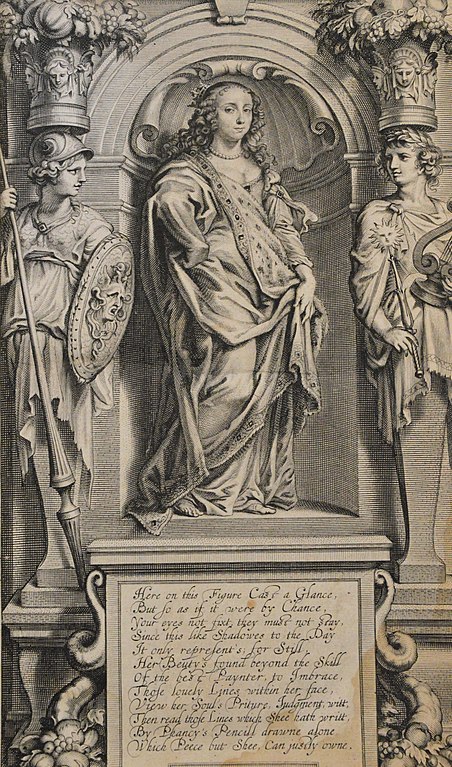
Portrait of Margaret Cavendish, 
Lady Newcastle, from the frontispiece 
to her 'Poems and Fancies', 1653

I'm currently taking an on-line class and was recently introduced to a fascinating author whose work I had never read. Margaret Cavendish, Duchess of Newcastle was a prolific writer, and she was also known as "Mad Madge." I had to know more...

Margaret Lucas was born about 1623 at St. John’s Abbey, the youngest of 8 children of Thomas and Elizabeth Lucas, a wealthy family but not titled, according to her autobiography.  The family was of Royalist sympathies.  Her father died when she was 2 years old.  Margaret was educated at home: taught reading and writing, singing and dancing, needlework and music (lute and virginals).  As a child, she showed an interest in writing, composing what she called her “baby books”, 16 in all.   The family seems to have been somewhat aloof from their neighbours, an attitude attributed to their Royalist views. 

In 1640, the Civil War broke out.  At some point, Margaret’s family home was attacked by Parliamentarians and, by some accounts, the family tomb destroyed.  She and her mother fled to Oxford in 1642 when Charles I and his court were living to live with her married sisters.  Margaret became a maid of honour to Queen Henrietta Maria and accompanied her to Paris in 1644.  This was her first real separation from her family.

In Paris, Margaret met William Cavendish, Marquess (later Duke) of Newcastle in the spring of 1645. A recent widower and fellow exiled Royalist who was about 30 years her senior, William apparently found her attractive and cast out lures.  Margaret, however, wanted marriage, even though some felt her status was too low to be worthy of the honour. Besides being an English peer (even though in exile), William was a patron of the arts, while his brother Charles was a scholar. He seems to have appreciated her mind and her talent, sharing her interest in literature.  She became his second wife in December of 1645. During their exile, they lived in Paris, Rotterdam and Antwerp, throughout which time Margaret wrote.  She also acquired a reputation for eccentricity: in addition to her writing, she designed her own clothes, cursed and flirted.  She became known as “Mad Madge” because of her unusual fashions and outrageous behaviour.

During her marriage, Margaret was a prolific author and, most unusually for a woman, published under her own name.  William encouraged her and paid for her publishing.  Her interests were wide-ranging: philosophy, rhetoric, poetry, science fiction, plays.   She also wrote a biography of her husband, and her own autobiography.   In November of 1651, Margaret returned to England and attempted to claim a portion of William’s estate.  While there, she published her first book POEMS AND FANCIES in 1653.  The book caused something of a sensation; praised by some for its originality, it was criticized by others for its shaky grammar and spelling.  Her second book, PHILOSOPHICALL FANCIES, was also published in 1653.  Margaret stayed in England 18 months and returned to Antwerp.

In 1660, William and Margaret returned to England with the Restoration and retired to their estate at Welbeck.  She resumed her writing and also studied philosophy and other subjects.  She published plays in 1662, and her book CCXI SOCIABLE LETTERS was published in 1664.  (This is the book I am currently exploring.)  In the guise of personal letters supposedly written between two women living in the country, she delivered candid, shrewd comments on daily life and personal relationships in a conversational tone.  I have only read a bit of this so far but am really enjoying it.  In her own time, although Samuel Pepys and John Evelyn made fun of her, others admired her and enjoyed her work then as well.

Margaret died suddenly at the age of fifty on December 15, 1673.  She was buried in Westminster Abbey.  William was too ill to attend her funeral.  Proud of her to the end, he died two years later and was buried with her at Westminster Abbey on January 22, 1676.

Sources include:
Cavendish, Margaret.  Sociable Letters.  James Fitzmaurice, editor.  2004: Broadview Editions, Peterborough, Ontario, Canada


The University of Notthingham on line.  Manuscripts and Special Collections.   "Biography of Margaret Cavendish, Duchess of Newcastle upon Tyne, c. 1623-1673."  https://www.nottingham.ac.uk/manuscriptsandspecialcollections/collectionsindepth/family/newcastle/biographies/biographyofmargaretcavendish,duchessofnewcastleupontyne%28c1623-1673%29.aspx   

Poetry Foundation.  "Margaret Cavendish (1623-1673).  http://www.poetryfoundation.org/bio/margaret-cavendish   

Luminarium.org.  "Margaret (Lucas) Cavendish, Duchess of Newcastle (1623-1673)." by Ron Cooley et al.  1998.  http://www.luminarium.org/sevenlit/cavendish/cavendishbio.htm  

International Margaret Cavendish Society.  http://internationalmargaretcavendishsociety.org/resources.html   

Project Vox.   "CAVENDISH (1623-1673)  Margaret Cavendish [nee' Lucas], Duchess of Newcastle-upon-Tyne."  http://projectvox.library.duke.edu/pg/?q=node/4  

~~~~~~~~~~~~~

Lauren lives in Florida with her husband.  Her first published work is Heyerwood: A Novel, and a second book is due out later this year.  Visit her website at http://www.lauren-gilbert.com to find out more.