By Lauren Gilbert
I'm currently taking an on-line class and was recently introduced to a fascinating author whose work I had never read. Margaret Cavendish, Duchess of Newcastle was a prolific writer, and she was also known as "Mad Madge." I had to know more...
Margaret Lucas was born about 1623 at St. John’s Abbey, the youngest of 8 children of Thomas and Elizabeth Lucas, a wealthy family but not titled, according to her autobiography. The family was of Royalist sympathies. Her father died when she was 2 years old. Margaret was educated at home: taught reading and writing, singing and dancing, needlework and music (lute and virginals). As a child, she showed an interest in writing, composing what she called her “baby books”, 16 in all. The family seems to have been somewhat aloof from their neighbours, an attitude attributed to their Royalist views.
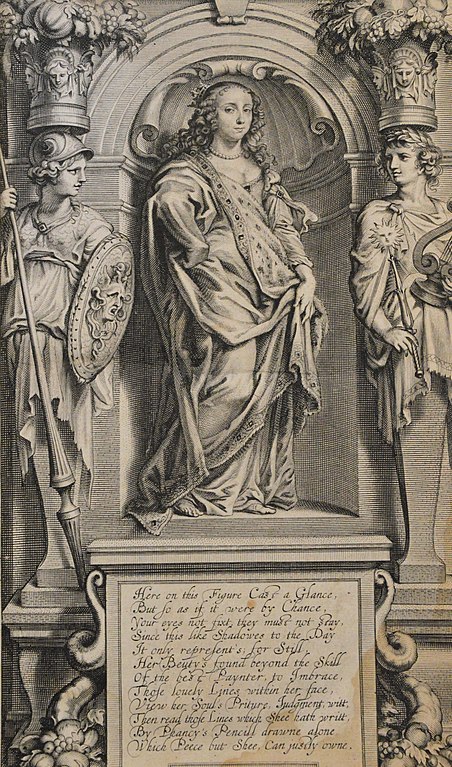 |
| Portrait of Margaret
Cavendish, Lady Newcastle, from the frontispiece to her 'Poems and Fancies', 1653 |
I'm currently taking an on-line class and was recently introduced to a fascinating author whose work I had never read. Margaret Cavendish, Duchess of Newcastle was a prolific writer, and she was also known as "Mad Madge." I had to know more...
Margaret Lucas was born about 1623 at St. John’s Abbey, the youngest of 8 children of Thomas and Elizabeth Lucas, a wealthy family but not titled, according to her autobiography. The family was of Royalist sympathies. Her father died when she was 2 years old. Margaret was educated at home: taught reading and writing, singing and dancing, needlework and music (lute and virginals). As a child, she showed an interest in writing, composing what she called her “baby books”, 16 in all. The family seems to have been somewhat aloof from their neighbours, an attitude attributed to their Royalist views.
In
1640, the Civil War broke out. At some
point, Margaret’s family home was attacked by Parliamentarians and, by some
accounts, the family tomb destroyed. She
and her mother fled to Oxford in 1642 when Charles I and his court were living to live with her married sisters.
Margaret became a maid of honour to Queen Henrietta Maria and
accompanied her to Paris in 1644. This
was her first real separation from her family.
In
Paris, Margaret met William Cavendish, Marquess (later Duke) of Newcastle in
the spring of 1645. A recent widower and fellow exiled Royalist who was about
30 years her senior, William apparently found her attractive and cast out
lures. Margaret, however, wanted
marriage, even though some felt her status was too low to be worthy of the
honour. Besides being an English peer (even though in
exile), William was a patron of the arts, while his brother Charles was a
scholar. He seems to have appreciated
her mind and her talent, sharing her interest in literature. She
became his second wife in December of 1645. During their exile, they lived in Paris,
Rotterdam and Antwerp, throughout which time Margaret wrote. She also acquired a reputation for
eccentricity: in addition to her writing, she designed her own clothes, cursed
and flirted. She became known as “Mad
Madge” because of her unusual fashions and outrageous behaviour.
During
her marriage, Margaret was a prolific author and, most unusually for a woman,
published under her own name. William
encouraged her and paid for her publishing.
Her interests were wide-ranging: philosophy, rhetoric, poetry, science
fiction, plays. She also wrote a
biography of her husband, and her own autobiography. In November of 1651, Margaret returned to
England and attempted to claim a portion of William’s estate. While there, she published her first book POEMS AND FANCIES in 1653. The book caused something of a sensation; praised by some for its originality, it was criticized by others for its shaky
grammar and spelling. Her second book, PHILOSOPHICALL FANCIES, was also
published in 1653. Margaret stayed in England
18 months and returned to Antwerp.
In 1660,
William and Margaret returned to England with the Restoration and retired to
their estate at Welbeck. She resumed her
writing and also studied philosophy and other subjects. She published plays in 1662, and her book CCXI SOCIABLE LETTERS was published in
1664. (This is the book I am currently
exploring.) In the guise of personal
letters supposedly written between two women living in the country, she
delivered candid, shrewd comments on daily life and personal relationships in a
conversational tone. I have only read a
bit of this so far but am really enjoying it. In
her own time, although Samuel Pepys and John Evelyn made fun of her, others
admired her and enjoyed her work then as well.
Margaret
died suddenly at the age of fifty on December 15, 1673. She was buried in Westminster Abbey. William was too ill to attend her
funeral. Proud of her to the end, he
died two years later and was buried with her at Westminster Abbey on January 22,
1676.
Sources
include:
Cavendish,
Margaret. Sociable Letters. James
Fitzmaurice, editor. 2004: Broadview
Editions, Peterborough, Ontario, Canada
Image: Wikimedia Commons, https://upload.wikimedia.org/wikipedia/commons/thumb/0/08/MargaretCavendish.JPG/452px-MargaretCavendish.JPG
The University of Notthingham on line. Manuscripts and Special Collections. "Biography of Margaret Cavendish, Duchess of Newcastle upon Tyne, c. 1623-1673." https://www.nottingham.ac.uk/manuscriptsandspecialcollections/collectionsindepth/family/newcastle/biographies/biographyofmargaretcavendish,duchessofnewcastleupontyne%28c1623-1673%29.aspx
Poetry Foundation. "Margaret Cavendish (1623-1673). http://www.poetryfoundation.org/bio/margaret-cavendish
Luminarium.org. "Margaret (Lucas) Cavendish, Duchess of Newcastle (1623-1673)." by Ron Cooley et al. 1998. http://www.luminarium.org/sevenlit/cavendish/cavendishbio.htm
International Margaret Cavendish Society. http://internationalmargaretcavendishsociety.org/resources.html
Project Vox. "CAVENDISH (1623-1673) Margaret Cavendish [nee' Lucas], Duchess of Newcastle-upon-Tyne." http://projectvox.library.duke.edu/pg/?q=node/4
~~~~~~~~~~~~~
~~~~~~~~~~~~~
Lauren lives in Florida with her husband. Her first published work is Heyerwood: A Novel, and a second book is due out later this year. Visit her website at http://www.lauren-gilbert.com to find out more.