Showing posts with label weaving. Show all posts

Saturday, April 19, 2014

Retting and Rippling - The Story of Linen

By Deborah Swift

My novels often include references to the growing of flax and also to linen, which is the cloth produced from it. It became less popular in the early twentieth century because it creases so easily, though it is now more widely used. But in the 17th century it was one of the most commonly used fabrics,and the flax plant was native to English, Scottish and Irish soil.

Sowing of flax was done after the winter frosts, and the growing season was about three months during which time the stalks would grow to three feet high. Sometimes one patch would be left uncut to provide seed for the next year's harvest. The stalks were pulled up by hand and gathered into bundles which were then stacked in stooks.

Fig. 104.   The stooks of flax.
Field of linen stooks

Next the stalks were laid out to decompose - called retting. Spread out on the grass they would rest there for thirty days or so to get the morning dew. If there was not enouigh dew or rain, then the flax would be watered. Sometimes flax was left in steams or ponds but this polluted the water, and clean water was a valuable resource. Once the woody part has decomposed then the flax was dried by turning it regularly in the sun.

Dressing the Flax

The straw had to be broken by a flax breaker, a wooden paddle to bash the stalks. Then the shoves (broken straw ) was removed, and scutching could take place. Scutching was separating the fibres by beating then still further and then dragging the fibres through a long comb (riddling) to take out any remaining straw and smooth the fibres.

Turning flax into linen takes work. This is a hackle. Some call it a heckle - and it is used to comb short fibers out. Moo Dog Knits Magazine.

Line and Tow

Line is the finest threads of flax, and tow the coarsest. Line (from which we get the word linen) produced a cloth suitable for wearing - shirts for example. Tow produced a harder wearing cloth for awnings, sacks and sails.

Spinning and Weaving

Dutch spinning wheels were introduced into Ireland in 1632 by the Earl of Strafford. Ireland was a big centre of flax production in the 17th and 18th centuries, employing thousands of women and the spinning wheel and distaff. (Shakespeare describes one of his characters as having hair 'like flax upon a distaff').

Bleach Green

Linen Garments

Once woven into cloth, linen was widely used for nightclothes and shirts because of its ability to absorb water (sweat) so it was very hygenic to wear next to the skin. Linen was often used for pleated cloths where it would be folded and dried into pleats. If it was ever washed it then had to be re-pleated, as the water would remove the pleats. Kerchiefs to cover the head were usually of fine linen. In England wool was the main industry, so the linen trade is often overlooked in historical novels. In the period I like to write about, tithes were often paid in bolts of linen cloth which, if the cloth was fine, were costlier than wool. White linen was much prized by the aristocracy for bed linen and table cloths. In Ireland the cloth was bleached by laying out the woven lengths on bleach greens, a  custom that actually continued right up until the 1930's.

1640's nighshirt in linen - Fashion Museum, Bath

One of my favourite parts of learning about old crafts is to learn the particular vocabulary associated with them, vocabulary that has almost disappeared from modern English.

And - here are my books! - You can find out more about them by clicking, which will take you to my website.

Deborah


Wednesday, October 5, 2011

Fabulous Fabrics of the 17th century


In the 17th century all yarn for fabric was combed and spun by hand using a drop spindle and then woven into cloth. The immense amount of work that went into this process is often forgotten. Linen, wool and silk were all spun and combined in different ways to give different effects.
Coloured fabrics were usually called "stuffs" and were very popular after the Restoration and the end of Puritan rule when bold colours could be worn again. Many English fabrics sought to imitate those of France and Italy and were characterised by elaborate finishing techniques such as glossing, hot-pressing and watering. Weaving and finishing was a specialised craft operated typically by one or two journeyman-weavers in small independently owned workshops. At this period blue was not very fashionable as many servants were uniformed in blue. Orange and yellow were in vogue for women's clothes. Some fabrics were woven and then cut with decorative slashes as in the picture above. Each slash had to be buttonhole-edged by hand to achieve the effect. Thanks to Nicole Kipar for this picture.

Very desirable too were fabrics embroidered by hand, with what came to be known as "crewel" work, the more opulent the better, as long as you were not in servitude to somebody else, in which case you had to obey the "sumptuary laws" and dress according to your station.


This fabric from a 1630's jacket from the V&A museum features a fanciful bird woven in red wool on a linen twill. Later this sort of work was more often seen on furnishings and drapes for the house.
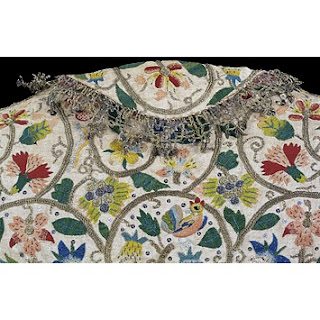
If you imagine how much time it would have taken you will be even more amazed by this example below. Another linen jacket made in about 1610 and lined with coral silk taffeta. The embroidery includes spider-knots, stemstitch, chainstitch and buttonhole stitches. The edging is silver gilt bobbin lace. Uniquely, on the V&A website you can see a picture of the jacket being worn in a portrait of the wearer. http://collections.vam.ac.uk/item/O11095/jacket/
Even handkerchiefs, purses, chemises, and shoes were embroidered, not to mention household linens and drapes for beds and windows. Above you can see women teaching young girls the art of embroidery and lace-making. The lady on the right has a lace-makers pad, and is working the pinned individual threads into lace.
Below is a pair of embroidered shoes, I do not know if they embroidered the fabric first and then made up the shoes, or did it the other way around. In any case, they are lovely. There are many other examples in the Northampton Shoe Museum. I used the shoes as part of the inspiration for my book, The Lady's Slipper, which features beautiful embroidered shoes like these. You can read an extract here

The Lady's Slipper
"The novel grips from the opening lines and carries the interest throughout. The several plot strands are seamlessly blended and come together in a wholly satisfying conclusion. Her characters are so real that they linger in the mind long after the book is back on the shelf.

Highly recommended."

The Historical Novels Review