Showing posts with label cookery books. Show all posts

Thursday, April 25, 2019

Elizabeth Raffald: The Martha Stewart of the Georgian Era

by Lauren Gilbert

Elizabeth Raffald,  From the 1782 edition of The Experienced English Housekeeper published by Baldwin

Elizabeth was born about 1733 in Doncaster, near York, and may have been baptized July 8, 1733. Her father was Joshua Whitaker, school teacher, taught her and siblings (4 sisters) including French. In the introduction to his work, Roy Shipperbottom indicates that her mother’s name was Elizabeth. However, in other data, there was a suggestion that her mother may be someone else. Little is known about Joshua. Shipperbottom’s introduction states that Joshua and Elizabeth moved from Wadwoth to Doncaster by the time the infant Elizabeth was baptized on July 8th, 1733. The Dictionary of National Biography does not mention her mother’s name, which could certainly lead one to speculate. Shipperbottom lists Elizabeth's sisters: Jane, Sarah, Ann and Mary. One learned confectionery (Mary) and another married a flax grower.

She went into service at age 15, about 1748. She was familiar with and developed contacts in the city of York. There are indications that she worked for several families in Yorkshire. John Raffald, born around 1724, was from a family with market garden stalls in Manchester and that owned land where they grew plants in Stockport with links to Salford. (John was the oldest but signed his share over to his brother George.) John was working in Pontefract for a firm of nurserymen called Perfects of Pontefract, which sold plants. There are hints that Elizabeth may have worked for a family in Pontefract (in Yorkshire, less than 100 mi from York) at the same time. There is speculation that Elizabeth met John there. John was shown in employee records as head gardener at Arley Hall in Cheshire in January 1760 with earnings of 20 pounds per year (worth roughly $3822.85 US today*).

In December 1760, Elizabeth went to Arley Hall as housekeeper (Arley Hall records indicate that she came from Doncaster-it is unclear if it means that she travelled to Arley Hall from Doncaster or that her family was from that area), earning 16 pounds per year (worth roughly $3058.28 US today*). Arley Hall was owned by Sir Peter Warburton, 4th baronet, and his wife Lady Elizabeth. Her duties included managing the female servants, buying certain comestibles from travelling vendors and keeping accounts of the money spent (she received cash monthly, turned her accounts in to the steward monthly). She would have had duties in the kitchen as well, including making wine, pickling and preserving, baking special cakes, and making table decorations. She apparently developed an excellent relationship with Lady Elizabeth.

After serving three years as housekeeper, Elizabeth married John Raffald on March 3, 1763 at Great Budworth in Cheshire (a village near to and dependent on the Warburtons of Arley Hall). Because house rules did not allow married couples, Elizabeth and John had to leave. Arley Hall records show their marriage and that they both departed some weeks afterwards, in April 1763. Some sources indicate they were given a year’s salary at that time. The couple moved to Manchester were John’s family had two market stalls were they sold plants, vegetables and flowers. The Raffald family were an established family and ran market gardens near the market place, and also owned land near Stockport, a town roughly seven miles away. Sources indicate John went to work in his family’s business. This left Elizabeth to her own devices.

Manchester was a thriving market town, with a growing textile trade. There was a commodities market and warehouses for fabrics produced in the surrounding area. Money was being made, and there were those with ambitions to rise to the gentry class. From their home in Fennel Street, Elizabeth sold food products, including Yorkshire hams and other prepared foods, sweets, and “portable soup”, and rented out space in the cellar. She also made table decorations and catered dinners. In 1764, she established a Register Office where people could find servants seeking work.

Elizabeth and John moved to a location at Market Place (later number 12 Market Place) in August 1766, which was near the Bull’s Head Inn and the town center (convenient to the newspaper, the Exchange and the market where John and his brothers sold produce). She opened a confectioner’s shop, where she sold cakes and other sweets, tea, coffee, chocolate, and condiments. She also took orders for christening and bride cakes. In addition to these ventures, she taught cooking. She maintained her ties with Arley Hall, as receipts show purchases from her. Her wares expanded, including perfumes and other items. She and John took on the running of the Bull’s Head. Apparently, Elizabeth’s culinary skills paid off: the officers of military stationed in the area transferred their mess to the Bull’s Head.

During this time period, they also started their family. Daughter Sarah may have been born in January of 1765. Mr. Shipperbottom’s and Ms. Appleton’s research showed daughters as follows: Emma was born March of 1766, Grace November 1767, Betty January 1769, Anna (or Hannah) January of 1770 and Harriot (or Harriet) September of 1774. Another child Mary was born in February of 1771, with a male child who apparently did not survive. Although some sources indicate she had nine or even sixteen children, these seven daughters and one male child are the ones who are known.

In addition to caring for her family and her business enterprises, Elizabeth was also working on her cookbook. She dedicated it to Lady Elizabeth Warburton (whom she visited in 1766 and from whom she presumably got a blessing on the cookbook and its dedication) and included clear instructions for her recipes (numbering about eight hundred, and shown as her own), based on her experience and designed to be of benefit for novice cooks. She provided information on when what foods were in season, and how to set an elegant table (including diagrams). Interestingly, she did not include recipes for medicinals, a deliberate exclusion as she preferred to defer to “...the physician’s superior judgement, whose proper province they are.” (1)

Foldout engraving of table layout for an elegant second course, from Elizabeth Raffald's The Experienced English Housekeeper, 4th Edition, 1775


The cookbook was published in 1769 on a local basis, by subscription. Eight hundred copies were sold in advance, and she signed the first page of each first edition. It was extremely popular and went into multiple editions. It is worth noting that in the second and later editions, new recipes were included that were not Elizabeth’s own. In another venture, Elizabeth gave Mr. Harrop of Harrop’s Manchester Mercury newspaper financial backing that allowed the paper to continue to be published. She entered into a similar venture in 1771 when she assisted in establishing Prescott’s Journal in Salford, a town near Stockport. She may have written articles for Prescott’s Journal. (Elizabeth had an appreciation for newspapers, as she advertised her wares in local periodicals on a regular basis.) Sometime between 1771-1773, she sold the copyright to Richard Baldwin of Paternoster Row in London for 1400 pounds (roughly $267,599.65 US today*).

Also in 1772, she produced THE MANCHESTER DIRECTORY FOR THE YEAR 1772, a trade directory of 60 pages listing local businesses and inhabitants in alphabetical order and the first of its kind for the city of Manchester. She included the Raffalds but not herself in this directory. It was designed to benefit business people and customers alike by making it possible for them to discover the locations of businesses and residents alike. (It certainly was beneficial to her employees charged with deliveries.) She published new and updated editions in 1772, 1773 and 1781. Each edition was published in a limited run of one hundred copies.

In 1772, John and Elizabeth advertised that they were closing their respective businesses, and advertised on August 25, 1772 that they were taking over the King’s Head in Salford. The King’s Head was a coaching inn with accommodations (including meals), an assembly room and stables. They held entertainments, including cards and public dinners. The officers’ mess followed them from the Bull’s Head to the King’s Head. John was the host, and appears to have been the mastermind of the Florists’ Feasts. In 1774, Elizabeth went into partnership with a Mr. Swaine in hiring out carriages from the inn. Unfortunately, the carriage rentals were not successful.

At this point, there appears to be difficulties arising. John and Elizabeth were carrying a load of debt and John acquired a reputation for heavy drinking and inconsistent behaviour. There were problems with thefts. In spite of the income from her books, including the large lump sum from Mr. Baldwin, and encouragement of her sister Mary Whitaker who moved nearby in 1776 and opened her own confectioners shop, their debt load became excessive. They ended up having to assign all of their business effects to their creditors by December 1778 and leave the King’s Head.

Their next venture was the Exchange Coffee House, for which John received the license as master in October of 1779. The coffee house was a come-down from their previous establishment, and offered much less scope for Elizabeth’s talents as the food offerings were quite limited. Subsequently, she sold hot beverages and small treats from a stand to ladies and gentlemen at the Kersal Moor racecourse nearby in the summer of 1780. There are indications that she was co-author of a book on midwifery with physician Charles White during this period as well. The stand at Kersal Moor was apparently her last independent venture.

Elizabeth Raffald died suddenly, possibly of a stroke, April 19, 1781 aged approximately 48 years. She was buried in St. Mary’s churchyard, in Stockport, in a family vault belonging to the Raffald family. She was survived by John and three daughters, her youngest Anna and two of her four older girls (Grace is known to have died in March of 1770, but it is not clear whether Sarah, Emma or Betty died young). . Some accounts indicate she was buried in haste, as her name was not engraved on the stone. There is speculation that John simply could not afford to pay for the engraving. After her death, creditors closed in and John fled to London, where it is believed that he sold the manuscript of the midwifery book. He died in 1809 at the age of 85. He was buried in Salford.

Because of the fame of her cookbook, Elizabeth Raffald has been compared variously to Mrs. Beaton of Victorian Fame and today’s Mary Berry. However, because of her entrepreneurial spirit, head for business, and wide-ranging talents, I prefer a comparison to today’s Martha Stewart. Elizabeth not only cooked the food, she created table decorations and established guidelines for setting an elegant table. She branched out beyond cooking and her cookbook into other areas, including starting an employment register, publishing her Manchester Directories, running inns and leasing carriages. She was a fascinating woman. It is worth noting that, in 2013, some of her recipes were re-introduced at Arley Hall, when the general manager announced that her pea soup, lamb pie and rice pudding would be served in the hall’s restaurant. I think she would have been pleased.

* Currency converter: I used the converter using a base year of 1770 at this site: HERE

FOOTNOTES:

(1) Raffald, Elizabeth. THE EXPERIENCED ENGLISH HOUSEKEEPER. P. 3

Sources include:

Appleton, Suze. THE COMPLETE ELIZABETH RAFFALD Author, Innovator and More from Manchester’s 18th Century. 2017: Suze Appleton.

Raffald, Elizabeth. THE EXPERIENCED ENGLISH HOUSEKEEPER, with an Introduction by Roy Shipperton. Ann Bagnall, editor. 1997: Southover Press, Lewes.

Stephen, Sir Leslie, ed. DICTIONARY OF NATIONAL BIOGRAPHY, Vol. 1-22, 1921-1922: Oxford University Press, London.

Arley Hall Archives. HERE

BBC.com “Georgian chef Elizabeth Raffald’s return to Arley Hall menu” posted April 6, 2013 (no author shown). HERE

Chesterfield Life. “Elizabeth Raffald-Arley Hall’s Domestic Goddess” by Paul Mackenzie, posted May 20, 2013 and updated Feb. 6, 2018. HERE

Museum of Fine Arts Houston. “Keeping House: The Story of Elizabeth Raffald” by Caroline Cole, posted Sept. 30, 2011. HERE

Sheroes of History. “Elizabeth Raffald: The Original Domestic Goddess and Celebrity Chef” by Naomi Wilcox-Lee, posted Dec. 10, 2015.HERE

The Elizabeth Raffald Society. HERE

Images:

Elizabeth, from the 1782 edition of THE EXPERIENCED HOUSEKEEPER, Wikimedia Commons (public domain).    HERE

2nd Course Table Layout, from the 4th edition of THE EXPERIENCED HOUSEKEEPER, Wikimedia Commons (public domain). HERE

~~~~~~~~~~

Lauren Gilbert is a dedicated reader and student of English literature and history, holding a BA in liberal arts English with a minor in Art History.  A long-time member of the Jane Austen Society of North America, she has done several presentations for the local region, and delivered a break out session at the 2011 Annual General Meeting.  Her first book, HEYERWOOD: A Novel was published in 2011, and her second, A RATIONAL ATTACHMENT, will be released (finally!) later this year.  She lives in Florida with her husband, and is researching material for a biography.  For more information, visit her website here


Thursday, October 20, 2016

The Great Stuart Bake Off: What They Ate

by Margaret Porter


Typically a person of the Stuart era ate three meals per day. Early risers and those who had the leisure for it--aristocrats, gentry, the merchant and professional classes--ate breakfast. Laborers and farm workers broke their fast, at a very early hour, before beginning their daily work. Heavy with protein, it consisted mainly of cold meat, fish, cheese, washed down with ale or small beer. Dinner, the principal meal, occurred midday or early afternoon, gradually shifting to mid-afternoon, and included any number of dishes. In general, few vegetables were consumed but the table was spread with a vast array of meats, fish, cheeses, pies, and puddings. Many dishes were flavored with common herbs--sage, thyme, rosemary--or costly spices such as saffron, mace, and nutmeg. Supper was a light meal taken before bedtime.

At certain times of the year--and particularly during the Interregnum--fast days were designated. Each year Lent brought restrictions on meat-eating. During one week in Lent, 1661, Lord Bedford's household record indicates the purchase of salted fish, fresh cod, a quartern of smelts, twenty flounders, a chine of salmon, two pairs of soles, and four quarts of oysters. In summertime, fruit was purchased in quantity, for eating but also for preserving in some fashion for later use.
The seasons ordained the substance of meals. Fresh foods were eaten when fresh, and stored as feasible for later consumption. Chief methods of food preservation were pickling, potting, drying, and salting. Fruits were used as sweeting agents, as was honey. Sugar came in loaves, dark in colour, that were cut with snippers and then ground into granules or powder. A drop in price during the century resulted in an expansion of sweet puddings in addition to savoury ones.
The foreign visitor is always a valuable source of information that the resident takes for granted. Monsieur Henri Misson of France was highly enthusiastic about puddings:
The pudding is a Dish very difficult to be describ'd because of the several Sorts there are of it; Flower [flour], Milk, Eggs, Butter, Sugar, Suet, Marrow, Raisins, &c &c are the most common Ingredients of a Pudding. They bake them in an Oven, they boil them with Meat, they make them fifty several Ways. Blessed be he that invented Pudding, for it is a Manna that hits the Palates of all Sorts of People . . . the People are never weary of it. Ah, what an excellent Thing is an English Pudding!
During his stay Misson encountered people who never or seldom ate any bread. He further describes the eating habits of various classes:

They chew the Meat by whole Mouthfuls. Generally speaking the English Tables are not delicately serv'd. There are some Noblemen that have both French and English Cooks and these eat much after the French Manner: But among the middling Sort of People (which are those I spoke of before) they have ten or twelve Sorts of common Meats which infallibly take their Turns at their Tables and two Dishes are their Dinners, a Pudding for instance, and a Piece of roast Beef. Another time they will have a Piece of boil'd Beef, and then they salt it some Days beforehand and besiege it with five or six Heaps of Cabbage, Carrots, Turnips, or some other Herbs or Roots, well pepper'd and salted and swimming in Butter. A Leg of roast or boil'd Mutton dish'd up with the same Dainties, Fowls, Pigs, Ox tripes, and Tongues, Rabbits, Pidgeons, all well moisten'd with Butter without larding. Two of these Dishes always serv'd up one after the other make the usual Dinner of a substantial Gentleman, or wealthy Citizen.


Samuel Pepys by Godfrey Kneller
Anyone interested in a London gentleman's food habits should seek out Samuel Pepys's Diary, in which he recounts various feasts, fasts, 'frolicks'. Every year he threw a party to celebrate the successful removal of the 'stone' from his bladder. (He preserved said object in a leather case, and displayed it to visitors!) It has been observed that his record of dinners and such is sketchy at best, considering the vast amounts of food that the average Stuart gentleman consumed in the course of his day--he remarks only on what is, to him, noteworthy or particularly delectable.

Then, as ever, children were especially fond of sweets and treats. In May and June of 1655, Lord Bedford's account books contain these line items: For six sweet oranges and cherries for my Lady Anne, 1s. 6d. To one that brought a cake for my Lady Anne, 1s.

Those possessed of great estates, like his lordship, could rely upon the produce of his own lands, and tenant farmers fed their families from their grounds and gardens. Residents of county towns obtained their food from weekly markets, and in cities from butchers, fishmongers, poulterers, cookshops, etc.

Kitchen Scene www.metmuseum.org

During the 17th century, the surge in printing presses in England led to increased production of books on food and cookery--the nation was far behind Italy, Germany, and France in that respect. Gervase Markham produced The English Hus-wife in 1615, but it is much more a guide for housekeeping and other skills though it includes recipes.

The 1st English Cookery Book

In 1660, shortly after the Restoration, The Accomplish't Cook or the Art and Mystery of Cookery by Robert May appeared, regarded as the very first English cookery book. The author, son of a cook ('one of the ablest cooks in his time' asserts May in his preface), learned much from his parent, who worked for Lady Dormer. Her ladyship sent the youth to France to train, and during his five years there he had access to the wealth of French cookery books. Following his London apprenticeship, he returned to Lady Dormer's household. During the course of his career he was employed by a number of lords and ladies: The Countess of Kent, Lord Lovelace, Sir Kenelm Digby, Lord Montagu, and more. In addition to the recipes, May helpfully provides menu suggestions for holiday feasts and fasting-days, as well as recommended bills of fare for each month in the year.

The next important tome is Will Rabisha's The Whole Body of Cookery Dissected (1662), a title that bestows a medical and scientific imprimatur upon the subject. Sir Kenelm Digby (one of May's employers) published the first edition of his book of cookery and 'receipts' (recipes) in 1669. Here we have Digby's version of Puffs:
Take new milk Curds, strained well from the whey; then rub them very well; season them with Nutmeg, Mace, Rose water and Sugar; then take an Egg or two, a good piece of Butter, and a handful of flower; work all together, and make them into Balls; bake them in an overn, upon sheets of Paper; when they are baked, serve them up with butter melted and beaten with Rose-water and Sugar.

About 1679 John Evelyn, the diarist, began composing a treatise titled Acetaria: A Discourse of Sallets (1699), in which he primarily discusses garden plans, plants, and gardens. His description of produce to be used in salads includes many which are familiar to the modern diner:

--Lettuce, Lactuca...ever was, and still continues the principal Foundation of the universal Tribe of Sallets; which is to Cool and Refresh, besides its other Properties
--Cucumber, Cucumis; tho' very cold and moist, the most approved Sallet alone, or in Composition, of all the Vinaigrets, to sharpen the Appetite, and cool the Liver,
--Endive, Endivium, Intubum Sativum; the largest, whitest, and tenderest Leaves best boil'd, and less crude.
--Cabbage, Brassica (and its several kinds)
--Beet, Beta; of which there is both Red, Black, and White
--Artichaux, Cinara, (Carduus Sativus) hot and dry. The Heads being slit in quarters first eaten raw, with Oyl, a little Vinegar, Salt, and Pepper.
--Carrots
--Basil, Ocimum (as Baulm) imparts a grateful Flavour, if not too strong, somewhat offensive to the Eyes; and therefore the tender Tops to be very sparingly us'd in our Sallet.
--Borrage, Borrago hot and kindly moist, purifying the Blood, is an exhilarating Cordial, of a pleasant Flavour.
--Cresses, Nasturtium, Garden Cresses; But above all the Indian, moderately hot, and aromatick, quicken the torpent Spirits, and purge the Brain.
--Garlick, Allium; dry towards Excess; and tho' both by Spaniards and Italians, and the more Southern People, familiarly eaten, with almost every thing, and esteem'd of such singular Vertue to help Conception, and thought a Charm against all Infection and Poyson.

Title page of Evelyn's book on Sallets


Edward Kidder (born 1665) was not only a skillful pastry cook, he's acknowledged as the proprietor of ones of the first cookery schools in England. Apparently he had several London schools, at Holborn and near Furnival's Inn and at St. Martin's Le Grand, which might have operated simultaneously. Late in his career, after the dawn of the Georgian era, he had his recipes printed and bound as a handbook for his pupils--several copies of which are extant. His students were male--females were privately instructed, as indicated by a note in some editions that 'Ladies may be taught at their own Houses.' Lady Mary Pierrepont (after her marriage Wortley Montagu), who kept house for her widower father, received thrice weekly carving lessons from a master of the art.

Kidder's book is valuable for its detailed account of table arrangement and specific dishes that could be included in each course.

Arrangement of the Table
First Dishes: Pottages of all sorts, a dish of fish, beans & bacon, ham & chickens, pullets & oysters, boiled tongues & udders, a leg of veal, a calves head, a goose or turkey, haunch of venison, leg of mutton & tunips, piece of salt beef, boiled fowls & marrow bones, a turbot & small fish

Bottom Dishes: A chine of veal or mutton, a neck of veal, pigeons in saffron, puddings, roast beef minced pies, cold ham, sliced tongue, venison pasty, potted meats or fowls, cold lobster or salmon or sturgeon, haunch of venison roast, let of mutton roast, hens with eggs, chicken & asparagus, a roast pike, calve's head roasted

Side Dishes: Bombarded veal, Scotch collops, leg of lamb, fricasees white or brown, ragout of any sort, a tart or tansy, scalloped oysters, carp in a ragout, pigeons and asparagus, lamb stones & sweet breads, stewed carp, chickens

For the middle of the table: a grand salad of pickles, a salad & butter, hot or cold pie, tarts, cheesecakes, puffs & custards, jellies, creams, blanc manges, a dish of fruit, sweetmeat tart, patty of lobsters, cold lobsters

Second Course: A dish of wild fowl, green geese or ducklings, roast chicken or pigeons, lamb joint, fried fish, turkey, leverets, partridges or cocks or snipes, pheasants or quails or larks, buttered lobsters or crabs, scalloped oysters, tart or tansy, tarts, cheesecakes, puffs, custards, dish of peas, ragout of mushrooms, lobsters ragout or roast

Plates: Oyster loaves, artichokes in cream, Portugal eggs, cutlets of veal, patties of oysters, crawfish, prawns, shrimp, apricot fritters, Polonia sausages, salmagundy, pickles of any sort, marrow or spinach toast, veal puffs, sweetbreads.

The most elaborate meals, as one would expect, were enjoyed by royalty--who regularly dined in public, so lesser persons could enter the palace to witness this spectacle. Immediately after a monarch's coronation, a massive feast took place in London's Westminster Hall, with all the nobility seated at tables heaped with delicacies. For a description of the foods served at King James II's coronation feast, see my earlier post for EHFA here.


Tables at the Coronation Feast

~~~~~~~~~~~~~~

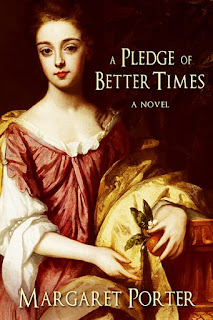
Margaret Porter is the award-winning and bestselling author of twelve period novels, whose other publication credits include nonfiction and poetry. James II's coronation feast is depicted in A Pledge of Better Times, her highly acclaimed novel of 17th century courtiers Lady Diana de Vere and Charles Beauclerk, 1st Duke of St. Albans. Margaret studied British history in the UK and the US. As historian, her areas of speciality are social, theatrical, and garden history of the 17th and 18th centuries, royal courts, and portraiture. A former actress, she gave up the stage and screen to devote herself to fiction writing, travel, and her rose gardens.

Connect with Margaret:

Website | Blog | Facebook | Twitter | Amazon