Showing posts with label Naval History. Show all posts

Monday, September 28, 2015

Sir Thomas Trowbridge

by Lauren Gilbert

Sir Thomas Trowbridge (Wikimedia Commons)

A snippet of news from 1807 as noted in Jane Austen's Regency World Magazine caught my eye.
Admiral Drury is to proceed immediately to India, in the Monmouth, on which vessel he has hosted his flag.  The Admiral has been appointed to succeed the gallant, but unfortunate Sir Thomas Trowbridge in the command of the East India Station, there being now too much reason to believe that the Blenheim is lost. (1)
I was immediately curious as to who Sir Thomas Trowbridge was and what happened to the Blenheim.

He was the son of Richard Trowbridge, esq, of  Cavendish Street, in Marylebone.  Thomas spent the bulk of his life in the Navy, starting out under the tutelage of Admiral Sir Edward Hughes, K. B. in the East Indies.  He obtained his lieutenancy in 1780 and proceeded to rise steadily through the ranks.  As captain, he was sent to support Lord Nelson and participated in the Battle of the Nile under the Admiral, in which the French navy was destroyed August 1, 1798.  Nelson wrote in praise of Captain Trowbridge's conduct in the battle to the Admiralty.  Thomas subsequently became a commodore, then Rear Admiral of the White and continued to serve.  He was made Sir Thomas Trowbridge, Baronet in November of 1799, because of his action in the Battle of the Nile.  Sir Thomas continued to rise in profession and was appointed a Lord of the Admiralty.

On the personal side, he married Mrs. Frances Richardson (described in one source as "relict" so she appears to have been a widow).  They had a son, Edward-Thomas, who became the 2nd Baronet, and followed his father into the Navy, and a daughter Charlotte, who married Major-General Egerton (brother of Sir Philip-Grey Egerton, Baronet).  Sadly, there appears to be no record of Sir Thomas's date of birth, any additional information about his wife, or their marriage date.There is also no annotation of the birth dates of his children, only their marriage dates.

On April 23, 1804, Sir Thomas was promoted to admiral and was sent in 1805 to the East Indies, where he was assigned to the Cape of Good Hope as commander-in-chief of the east portion of the East India Command.  His ship was the Blenheim, which had 74 guns but had seen much service and was in poor condition following damage in the Straits of Malacca. Although Sir Thomas sailed the Blenheim successfully from Pulo Penang to Madras (after some badly-needed repairs), the ship was still in very bad shape.  Sir Thomas was told of the ship's condition, but would not alter his plan to sail her to the Cape.  The Blenheim was accompanied by the Java and the Harrier.  On February 1, 1806, they were caught in a severe gale, and the last sight of the Blenheim revealed her to be sitting low in the water in obvious distress. The ships were separated, and the Harrier made it to the Cape on February 28, 1806.  The Blenheim and the Java were lost. Captain Edward-Thomas Trowbridge was sent to look for his father, but no trace was found.


Sources:
Jane Austen's Regency World Magazine.  "What Made the News In Sept and Oct 1807." Compiled by Judy Boyd.  Sep/Oct 2015 Issue 77, p. 34  (Footnote 1)

Google Books.  Debrett, John and Courthope, William.  Debrett's Baronetage of England: with alphabetical lists of such baronetcies as have merged in the peerage, or have become extinct, and also of the existing baronets of Nova Scotia and Ireland, edited. p. 282.  1835: J.G. & F. Rivington, HERE

GoogleBooks. Lysons, Rev. Daniel and Lysons, Samuel.   MAGNA BRITANNIA: Being a Concise, Topical Account of the Several Counties of Great Britain, Volume the Sixth containing Devonshire, p. cxxxi (131).  1822: Thomas Cadell, London,  HERE

GoogleBooks.  The Picture Magazine, Volume 7.  "Portraits." page 74. January -June.  1896: George Newnes Ltd., London., HERE


Image: Wikimedia Commons,  from Thomas Mante's NAVAL AND MILITARY HISTORY OF THE WARS OF ENGLAND, including those of Scotland and Ireland, 1795(?)-1807, Vol. 8, published in London, HERE

~~~~~~~~~~~~~

Lauren Gilbert is the author of Heyerwood: A Novel. Her second book, A Rational Attachment, is due out this winter. She will attend the Jane Austen Society of North America's Annual General Meeting in Louisville, and will be participating in the author signing. Stop by and say hello! She lives in Florida with her husband. Visit her website at http://www.lauren-gilbert.com for  more information about her.
Tuesday, July 16, 2013

The Mary Rose

by Judith Arnopp


The Mary Rose
Portsmouth 19th July 1545

It is a bright July morning, the sort of morning that can only promise victory. In the air the sound of jingling horse harness, pennants snapping in the sharp Solent breeze, and from far off comes a shouted command from the royal fleet. King Henry VIII and his entourage stand watching on the green English hillside as the Tudor ships prepare to do battle against the much larger invading French fleet.  Slowly, led by the Great Harry and the Mary Rose, the royal ships manoeuvre into battle position and the first guns begin to sound.  


The Mary Rose fires first from the starboard side. On the hillside the watching women flinch and cover their ears and the King and his friend, Charles Brandon, smile indulgently at their womanly ways. The king looks out to sea again as the pride of his navy slowly turns to offer broadside attack.

A sudden gust of wind, seemingly from nowhere, lifts the King’s cloak, making him shudder.“Someone walking over my grave,” he says as he pulls it closer to his body. He glances at his wife, Catherine, and misses the moment when the Mary Rose first falters. 

When he looks again the action is stilled, the great ship momentarily balanced on the cusp of fate. The king, sensing danger, holds his breath, sends up a prayer.  But, in a heartbeat, the ship is heeling over, her open gun ports filling with water.  On the snapping breeze the screams of the stricken men are borne toward the royal party and the old king watches transfixed as the massive cannon break free, bursting through the sides of the ship, surging into the waves.  The tilting deck is a chaos of fleeing men. They are screaming, leaping from assured death to certain drowning and, as they run, they cast off their clothing, kick off their shoes in the futile hope that they will float when once the swelling sea engulfs them.

The end is quick. Henry can scarce believe what has happened. He sits amazed while around him on the hillside, women are weeping, wailing, praying. Charles Brandon and Anthony Browne are shouting, waving their arms, fighting to mount terrified horses, although there is nothing to be done. It is far too late to prevent disaster.  Henry knows it in his heart.  Now, the only visible sign of the pride of his navy are the top of the masts, the mainsail foundering in the waves like a great fish of jelly.  Just a few survivors are clinging to the fighting tops, while all around in the balmy sea, the remnants of his fighting crew are flotsam.

***

On July 19th 1545, with the loss of more than 400 lives, the royal flagship The Mary Rose sank beneath the waves, settled into the silt of the Solent, and became history. Four hundred years later, in 1982, when archaeologists successfully raised her from the seabed, I was watching. I may have been glued to the television screen seventy miles away from Portsmouth but, in my heart, I was there with the team, experiencing one of the most profound moments of my life.


In the intervening years I have visited the museum several times and closely followed the Mary Rose Trust in its unstinting efforts to salvage not just the wreck, but the thousands of artefacts found alongside it.  For the past nineteen years the timbers of the wreck have been constantly sprayed with polyethylene glycol to preserve and reinforce the structure, but now the time has come to turn off the spray and begin drying her out. It is also time for the wreck and its artefacts to be brought back together and housed in one fabulous exhibition.

The Mary Rose is the only 16th century warship on display anywhere in the world. She offers an invaluable resource for historians, illustrating in minute detail, life as it was on a Tudor warship. Artefacts that, in normal circumstances would have been lost to us have been preserved for five hundred years in the Solent silt. They can now be viewed in situ in a new museum which opened in Portsmouth in May 2013. Visitors to the museum are able to walk along a central gangway and view the original wreck on one side while, on the other side, see a reconstruction of how experts believe the interior of the Mary Rose may have looked on the day she sank.

Henry VIII’s obsessive war with France left England a legacy of isolation in Europe, religious conflict, inflation, national penury and social upheaval, and what little gains he did make were short lived. In the 1550’s Boulogne was given back to France, and in 1558 Calais, England’s last possession on the continent, was lost.

Today, in hindsight, we can see the loss of the Mary Rose as the one positive outcome of his war with France. What was undoubtedly a tragedy and a huge blow to Henry VIII has now become a gift to us as a nation, and every single person who went down with her that day did not die in vain. They are not forgotten. The wreck of the Mary Rose provides precious insight into life on a Tudor warship, an aspect of 16th century life that would otherwise be completely closed.

It is not just the salvaged cannon or the armour and weapons that are invaluable, it is the small, everyday things. They have become the greatest treasures. There is no thrill on this earth like looking at a handful of dice last thrown by a sailor in 1545, or a leather shoe last worn by a man defending our shores from French invasion five hundred years ago, or a nit comb still thick with 16th century lice. To me, and other peculiar people like me, those things are rarer, and more thrilling, than the crown jewels.

The Mary Rose Trust requires constant funding to maintain the upkeep of the wreck and the museum so donations are always welcome. Should you ever have the opportunity to visit the Mary Rose exhibition in Portsmouth you should let nothing stand in your way.

The link to information and tickets is here.

Judith Arnopp is the author of historical fiction set in the medieval and Tudor period. For more information on her work please visit her webpage. http://www.juditharnopp.com


Pictures from Wikimedia commons

Friday, December 14, 2012

That Hamilton Woman!


Emma (Hart) Hamilton
April 26 1765 to January 15 1815

Born the daughter of a blacksmith, died in infamy, the avowed mistress of England’s hero, Horatio Nelson. She was born Amy Lyon and later changed her name to Emma Hart.

PastedGraphic-2012-11-18-08-46.jpg


 At the age of 12 she was a maid at the Hawarden, Wales. House of Doctor Honoratus Leigh Thomas, a surgeon in Chester. She then worked for the Budd family in Chatham place and helped a fellow maid, Jane Powell rehearse to become an actress. She then became a maid at the Theatre Royal in Drury Lane to such notables as Mary Robinson. From being a maid she advanced to model and dancer.

  At the age of 15 she met Sir Harry Featherstonhaugh. She became an entertainer for him, dancing naked on the dining room table for he and his friends. At Harry’s Uppark estate in the South Downs she met the second son of the Earl of Warwick, the honorable Charles Francis Greville. She also conceived a child by Sir Harry. (1781.)

PastedGraphic1-2012-11-18-08-46.jpg


  Emma was sent off to London until the baby was born but now she became the mistress of Greville. The child, when it was born was taken to be raised by the Blackburn family. Emma saw her daughter frequently until those periods when she was in debt. The girl became a companion or governess in her later life.

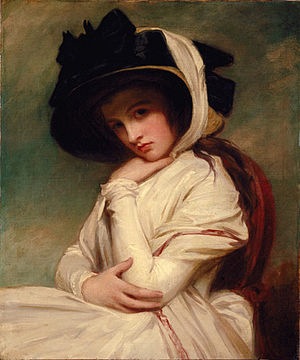
  Greville had Emma sit for George Romney and kept her as his mistress. Romney now took on Emma as one of his chief inspirations, his muse. She is in many of the most famous paintings by Romney.

PastedGraphic2-2012-11-18-08-46.jpg


  By 1783, Greville needed to find a rich wife (though another source says he never married), so he passed Emma to his uncle, Sir William Hamilton, the British Envoy to Naples. Hamilton was glad for Greville’s marriage meant he did not have to support his nephew any longer either. In a transaction, Hamilton acquired Emma much as one buys a piece of pottery. Emma had no knowledge of the transaction, and was furious about it when she found out. But she did become Hamilton’s mistress.

  She created a new art form, crossing between posture, dance and acting for his guests and it was a sensation. Other artists took on this type of performance. In 1791, Hamilton married Emma in England. He was 60 and she 26.

PastedGraphic3-2012-11-18-08-46.jpg


  And then in 1793, she met Horatio Nelson at the court of the King and Queen of Naples. Nelson came back to Naples in 1798 after the Battle of the Nile sorely wounded, and she nursed him back to health. Then for his 40th birthday she had a party with 1800 guests to celebrate it. Sir William even seems then to have tolerated and encouraged the affair that developed between Emma and Nelson.

PastedGraphic4-2012-11-18-08-46.jpg


  That Emma and Nelson could have such an endorsement may stem from the age of Sir William, and that Nelson was the most famous Briton in the world now that he had won the Battle of the Nile, and through George Romney and her founding of a new art form, and her great beauty, Emma was the most famous female Briton. (DWW-The two most important Britons, even more so than any King or Prime Minister, right at that moment) And William Hamilton was a collector. These two were under his roof, carrying on. He was able to show them off.

  Emma was now, in 1799, the close personal friend and advisor to the Queen of Naples, Marie Carolina whose sister, Marie Antoinette had been executed by the French. It was probably not too impossible to tell those of Naples, that the French were the great enemy. Those who did want the French as allies, were the aristocrats, not the people or the royals. The royal family fled to Sicily. Nelson tried to aid the Royal family and put down this aristocratic revolution. He was recalled to Britain, though he, Emma and Sir William took the longest possible route back.

  They arrived in Britain in 1800 to a hero’s welcome. They lived together openly and the affair became public knowledge. The Admiralty sent Nelson back to sea.

  Now Emma and Nelson wished to marry, but they would not do so until Sir William died, who they both cared for very much. Nor could Nelson get a divorce from his wife unless he had another great victory. In 1801, Emma gave birth to her and Nelson’s daughter, Horatia. Nelson bought a house in Wimbledon, Merton Place, where they all could live. They became the papers celebrity sensation of the day. Emma was no longer the great beauty, and they did try to live a quieter life.

  Sir William died in 1803 and Nelson left for the sea again. Emma was pregnant once more. The child died a few weeks after it was born. Emma began to spend lavishly and gamble. Then Nelson died at Trafalgar.

  Now she ran through the remaining money and became heavily in debt. Merton Place was left to her and Emma tried to maintain it as a monument to Nelson. It too sent her into further debt. She had now returned to poverty and drank herself to death in Calais. Horatia married the Reverend Phillip Ward and had ten children.


* * *


Mr. Wilkin writes Regency Historicals and Romances, Ruritanian (A great sub-genre that is fun to explore) and Edwardian Romances, Science Fiction and Fantasy works. He is the author of the very successful Pride & Prejudice continuation; Colonel Fitzwilliam’s Correspondence. He has several other novels set in Regency England including The End of the World and The Shattered Mirror. His most recent work is the humorous spoof; Jane Austen and Ghostsa story of what would happen were we to make any of these Monsters and Austen stories into a movie.

And Two Peas in a Pod, a madcap tale of identical twin brothers in Regency London who find they must impersonate each other to pursue their loves.


The links for all locations selling Mr. Wilkin's work can be found at the webpage and will point you to your favorite internet bookstore: David’s Books, and at various Internet and realworld bookstores including the iBookstoreAmazonBarnes and NobleSmashwords.


He is published by Regency Assembly Press
And he maintains his own blog called The Things That Catch My Eye where the entire Regency Lexicon has been hosted these last months as well as the current work in progress of the full Regency Timeline is being presented.

You also may follow Mr. Wilkin on Twitter at @DWWilkin
Mr. Wilkin maintains a Pinterest page with pictures and links to all the Regency Research he uncovers at Pinterest Regency-Era