Showing posts with label Royal Navy. Show all posts

Saturday, July 8, 2023

British Women at War: The Women's Royal Navy Service

 The smallest and most elite of the women's services in the U.K. was undoubtedly the Women's Royal Naval Service or WRNS. Because its numbers never exceeded 75,000, the WRNS was never dependent upon conscription; volunteers were sufficient to fill its needs. It also cultivated and maintained a reputation as being exclusive and having higher standards.

Like the other women's services, the Women's Royal Naval Service had its roots in the First World War when it was created in late 1917 to help meet manpower shortages. The women were used to free up male ratings from shore-based duties primarily cooking, cleaning and clerical work, and in both world wars the Admiralty insisted that women would not serve at sea. The first WRNS was both small and short-lived. Roughly 7,000 women served in it during the less than two years of its existence; it was disbanded in 1919. Twenty years later,  in August 1939 the WRNS was reformed. Again, its mandate was to "free men for the fleet" by putting women in shore-based jobs, such as cleaning, cooking and clerical work.

Yet from the very start, the WRNS was different. For a start, it was technically part of the the Royal Navy services but not part of the Royal Navy. Legally, this meant it was a civilian support service and the WRNS did not technically come under the Naval Discipline Act until 1977!  Second, during the early years applicants needed "recommendations" -- preferably from RN personnel -- to be considered at all. Many of the first WRNS were the wives, sisters and daughters of naval officers. Furthermore, recruiting was at first confined to residents of the major naval ports of Portsmouth, Plymouth, Chatham and Rosyth, and the WRNS were expected to live at home!

Furthermore, from its inception in WWI (which followed the scandals that had plagued the WAAC), the WRNS were jealous of their reputation. The leadership was explicit in dictating that "WRNS must ... avoid any behavior which, though not incriminating in itself, may be undesirable...." The catalogue of such undesirable behavior included smoking in public, drinking alcohol in public, and  loitering around with men. Already in WWI, the WRNS were known as the "prigs and prudes" -- and were proud of it. When the service was resurrected in WWII, this tradition was continued. 


On the other hand, the WWII leadership came from a younger generation -- a generation of professional women who sought to fill the ranks with not just "the right sort" of woman, but women capable of doing the job. Unlike the leadership of the ATS, the WRNS leadership was composed of women with a more egalitarian outlook than the service to which they were attached. The WRNS leadership adopted a policy of strict meritocracy. A key component of this policy was that no woman could become an officer without first being a rating and proving herself. This policy did much to improve morale -- and was notably lacking from the ATS where most officers were appointed directly, often without qualifications, on the basis of their accent or social status.

Although the WRNS started the war with seven limited categories of work which can be summarized as clerical, cleaning and cooking, the war rapidly forced changes. Soon the duties assigned WRNS expanded to motor transport, storekeepers, messengers, mechanics, telegraphists and R/T operators, signalers and small-boat handlers.  Eventually there were 129 trades including plotters, radar operators. meteorologists, codes and cipher specialists, intelligence officers and anti-aircraft crew. Fundamentally, from 1941 onwards, the WRNS took on all shore-based jobs that did not require physical strength or sea experience, including training RN personnel for their duties at sea.


Particularly striking was the degree to which the extremely conservative and hidebound "senior service" eventually handed over significant responsibility to WRNS. For example, WRNS were largely responsible for the dispatch of RN vessels. WRNS issued sailing orders and allocated berths. They also sent, received and decoded messages. Meanwhile, WRNS were required to be mobile and go where needed rather than live at home. The chic, feminine uniform distinctly different from the RN uniform and designed especially for women, was soon supplemented by overalls, bell bottom trousers, and other forms of practical clothing depending on the job performed.  Silently, the requirement for recommendations in order to apply also went by the board. 


Meanwhile, the WRNS particularly distinguished themselves as linguists and in the field of code-breaking and cypher work. It is noteworthy that the Admiralty had unofficially identified these areas as potential fields for women before the outbreak of the war. Dispatch riders was another category of work in which WRNS earned praise and recognition. The work entailed riding powerful (and very heavy) motorbikes at speed, often over long distances, on unmarked roads with inadequate headlights (due to wartime blackout requirements). Inevitably, a number of women had serious motor accidents, and recruitment for the trade was discontinued, but those who had already qualified were allowed to continue, several earning mentions in dispatches or medals for their work.


Although the Admiralty never allowed women to serve "with the fleet," starting in 1941, small harbor craft were "manned" by WRNS.  Although the boat crews never numbered more than 573 altogether, it was the most popular of all categories and some WRNS preferred to give up their petty officer status for the sake of being an ordinary deck hand on a boat.  There was also one small but notable exception to the otherwise rigid rule about women not serving "with the fleet." WRNS cipher officers were sent aboard the large troop transports such as the Queen Mary and Queen Elizabeth

Finally, WRNS were deployed overseas, which required them traveling for the most part by RN vessel to their new overseas assignments. WRNS were sent overseas starting in 1942 and by the end of the war 6,000 WRNS were serving in 37 overseas locations. In the course of the war, WRNS served in Alexandria, Port Said, Cairo and Suez, Durban, Kilindini (Kenya), Colombo (Cylon) and Singapore. 

At its peak in late 1944, the WRNS numbered 74,620 who served in all theaters of the war. In the course of the war, they had made themselves so useful and demonstrated the capabilities of women so effectively that the WRNS was not disbanded after WWII but continued until it was fully integrated into the RN in 1993.

Award-winning novelist Helena P. Schrader is the author of three books set in Britain during WWII: Where Eagles Never Flew, Grounded Eagles and Moral Fibre.  You can find out more about them, their awards and read excerpts at: https://CrossSeasPress.com.


Monday, August 1, 2016

The Royal Spy ~ Prince William Henry

by M.M. Bennetts


Spies.  We love them.  We love the idea of them.  So daring.  So intelligent.  So clever.  So wily.  What's not to love?  From Walsingham in the 16th century to Sidney Reilly in the early 20th (credited with being the first modern spy) to the world of John le Carre's George Smiley to Ian Fleming's James Bond, we cannot get enough of them.

Yet, for a long period, there was almost an official denial about not just their role in war or international relations but about their very existence--a very British stiff upper lip "we would never do anything so dishonourable as spying..." response to any attempt to properly investigate the subject.

However, over the last two decades, a great deal of new information has been fossicked out by some very determined historians leading to the conclusion that not just were the British spying their cotton socks off over the centuries, they were good at it--excellent at it, one might say.  Moreover, as with the 18th and early 19th century Russians, individuals of the highest birth were employed by the British government to act as spies.  And the highest ranking of them all was Prince William Henry, third son of King George III.

In 1778, when he was twelve, Prince William's concerned parents conceived the idea that he should be educated at sea in the service of the Royal Navy, as a sort of royal "leading from the front" kind of exercise.  As a dutiful parent, King George visited Portsmouth and boarded the 90-gun flagship, Prince George, to see for himself the accommodation; he "visited the three Decks to see the Men exercise as in action..." and decided firmly that the Navy was an ideal environment for the education of this starting-to-be-dangerously-wild third son.

Coincidentally, Prince William's embarkation on a naval career would also have the effect of stirring up patriotic support for the Navy during this awkward period of war with the American colonies.  A win-win situation in the king's mind.

Thus on 15 June 1779, Prince William Henry boarded the Prince George to begin his new life at sea.  He'd been kitted out with the finest naval uniform by his father--including some 3 dozen shirts and stocks, a mattress, bolster and pillows, pens, ink powder and paper, log books and journal books and a number of weighty tomes on navigation and mathematics--and a special tutor, a Cantabrigian, by the name of Mr. Majendie.  Both the Prince and his tutor were given the rank of Midshipman.

The Prince was, by all accounts, quite eager to fit in with his fellows, learning their slang and fulfilling his duties with the all the application and occasional silliness one expects from a 12-year old.  If his father had thought that the Navy would cure all Prince William's wayward tendancies, he was to be disappointed.  Even so, within two months of being at sea, William was pleased to write in his logbook that at last he had seen the decks "cleared for action," though that came to nothing as the Spanish fleet avoided them and confrontation.

Again on 8 January 1780, more enemy ships were sighted and this time Prince William was not disappointed.  He took his place beside Admiral Digby on the Quarterdeck and saw action against a Spanish fleet of merchantmen.  The Royal Navy gave chase and took prizes, much to William's glee as he "received from Captain MacBride the Colours and Pendant of the Spanish 64-gun ship named the Prince William Henry..." [It was customary to rename the ships taken as prizes...]

A few days later, his logbook recorded another encounter with a Spanish ship, this time a full-scale bombardment which led to total disintegration of the ship.  He wrote: "a most shocking and dreadful sight. Being not certain whether it was enemy or friend, I felt horror all over me..." 

Yet the Prince had just seen action in one of the great naval victories of the day, the Battle of Cape St Vincent!  During the course of the action, seven Spanish ships had surrendered to the British fleet, whilst several others had been blown up or sunk, and the Spanish admiral, Don Juan de Langara, had been taken prisoner.  And when the Prince returned home two months later, the public saw him as having led the fleet to victory and he was the hero of the hour--a very young one at that.

However, at home, the King and Queen were having to digest the unpleasant information that was filtering through about their heroic son's less-than-heroic behaviour during shore leave, which included tales of carousing and brawling in the streets of Gibralter, spending the night in the town lock-up, arrest by military patrol...And of course, now the young tearaway was starting to keep company with his dangerously dissolute elder brother, the Prince of Wales.

So his father conceived of a new plan for Prince William Henry: the war with the Colonies in North America had been dragging on now for several years and the British weren't doing all that well, so sending the young hero there would allow for the young hothead to see further action, which he craved, and rally the loyalists with the royal presence.

And, significantly, the prince was now to embark upon a further mission--after a brief schooling in the art of intelligence gathering courtesy of Mr. Majendie and others--he was to provide his father with reliable intelligence on everything he saw and everyone he met and all that he read... (Remember, the Prince was only 16...)

On 24 September 1781, the British fleet, with the Prince aboard the Prince George, arrived at Sandy Hook, the gateway to the harbour of New York.

Prince William Henry was the first member of the royal family ever to visit North America and the loyalists received him with rapturous delight, and indeed--just as the king had hoped--rallied to the royal banner.  He was feted and flocked to, he attended a council of war, and by the 28th he was dispatching to his father the following intelligence:

"...they had intelligence that Mon. de Graves' fleet from the West Indies were anchored in order to assist and cooperate with the Rebel Army against Earl Cornwallis [and] would soon reduce Lord Cornwallis to the utmost distress if he were not soon relieved...There is but one Church, all the others being converted either into magazines or Barracks...[the navy is] in a most wretched condition...The inhabitants of the town are in number 25,000.  They have 3,000 Militia, besides which there are about 1000 men raised at their own expense...There is a very great disunion between the French and American...the French treat the Americans with a great deal of hauteur."

A fortnight later, the Prince was back aboard the Prince George as the fleet was sailing to relieve Yorktown, having learned that Lord Cornwallis had surrendered on the 19th...

But still, the war dragged on and the loyalists in New York were not ready to yield.  The Prince, meanwhile, had returned to New York and was frequently to be seen over the winter, on or near "a small freshwater lake in the vicinity of the city, which presented a frozen sheet of many acres: and was thronged by the younger part of the population for the amusement of skating."  A pastime at which the young Prince apparently didn't excel, hence "as the Prince was unskilled in that exercise, he would sit in a chair fixed on runners, a crowd of officers environed on him, and the youthful multitude made the air ring with their shouts for Prince William Henry."

And then, things got interesting.  By March 1782, General George Washington was tired of waiting, tired of the winter, tired of the long war and was looking for some way to finish it and throw the British out of North America once and for all.  Across the river from New York, one Colonel Ogden, commander of the 1st Jersey regiment, conceived the breathtaking plan:

"First -- Two men with a guide, seconded by two others, for the purpose of seizing the sentinels, these men to be armed with naked bayonets and dressed in sailors' habits: they are not to wait for anything but immediately to execute their orders.

"Second -- Eight men, including guides, with myself, preceded by two men with each a crow-bar, and two with each an axe --  these for the purpose of forcing the doors, should they be fast -- and followed by four men entering the house and seizing the young Prince, the Admiral..."

It was a brilliant if daring plan.  But Washington thought it just might work.  And, he was ready to try anything.  And if it succeeded, he would trade the life of the Prince for the liberty of the American colonies. Win-win.

Unfortunately for Washington--remember those British spies that allegedly didn't exist?--the British spy network got wind of Ogden's plan and doubled the guard assigned to protecting the Prince.  With some reluctance, Washington abandoned the plot to seize the Prince...

With the signing of the Peace of Versailles in January 1783 and the freeing of the American colonies, Prince William Henry returned home to Britain, his fighting and spying career at an end. Still, no doubt it served him well in preparing him for his future as King William IV.

This Editor's Choice Post was originally published on July 19, 2013. Sadly, M.M. Bennetts is no longer with us to share her immense erudition and wit - but her words still live on! 


~~~~~~~~~~~~
M.M. Bennetts was a specialist in early 19th century British and European history and the Napoleonic wars and is the author of two novels (both coincidentally about spies), May 1812 and Of Honest Fame set during the period.  

Wednesday, January 14, 2015

England’s First Fleet

by Helena P. Schrader

For much of Britain’s history, certainly since the defeat of the Spanish Armada in the reign of Elizabeth I through the Second World War, England was considered a naval power. The Royal Navy enjoyed the prestige of the “Senior Service” and Britain was proud to “rule the waves.” But the roots of British naval traditions are largely lost in time.

The Vikings, of course, ruled much of the north of England, and William of Normandy, the last man to launch a successful invasion of the British Isles, was dependent upon an amphibious landing entailing a substantial fleet. But the longships that went “Viking” from England’s shores were not exactly serving a central English government and even the Conqueror’s ships were more transports than navy. David Miller, a retired British Army officer and journalist, argues that England’s first fleet was the fleet Richard I assembled for the Third Crusade (“Richard the Lionheart: The Mighty Crusader).


Richard’s fleet was not only commissioned by an English king to serve English policy (as opposed to personal gain), it was also largely built in England and manned by Englishmen. It was deployed for transport, in amphibious operations, as logistical support and in naval engagements. It was composed of a variety of vessels from the large “dromons,” which set lateen sails on up to three masts and could carry a thousand men, to small open ships (enescas, or snakes), descendent from the Viking longship, with a crew of sixty to man the oars and a single square sail. In between were “busses” with a thirty oars and a single mast capable of carrying 40 knights and their horses and “galleys,” propelled by oars alone. Altogether, including the ships Richard hired in his French territories and was loaned by the King of Sicily, Richard deployed a fleet to the Holy Land that numbered 216 ships, of which 125 were English.


What makes this a “fleet” is the fact that for all its diversity, it was clearly under a unified command and deployed as a single instrument in support of the King of England.  Richard commissioned the fleet from a variety of ports across England in 1189, almost immediately after he came to the throne, and he set delivery dates and assembly points which were respected. Richard even issued a naval disciplinary code which included very explicit punishments for offenses (e.g. that a murderer be tied to the body of his victim and either buried with him or tossed overboard, depending on whether the crime was committed on land or sea).  The code was evidently necessary. When the English fleet put into Lisbon on their way to rendezvous with the English king, who was travelling overland to Marseilles, the English sailors behaved so injudiciously that 700 were arrested on a single night!

Richard’s fleet assembled from various points and in varying numbers in the ports of Sicily and wintered there, as the Mediterranean was treacherous was infamous for violent storms that destroyed ships from October to March.  (Remember the fleet returning from Troy was “scattered” and Ulysses took ten years to get home, while the Romans advised against sailing between November 10 and March 10 and considered their ocean unsafe for galleys from September 14 to May 26.)  

Richard set sail from Sicily for the Holy Land on April 4, 1191, with his fleet organized into a crude formation of eight lines of ship that were supposed to maintain visual contact with their neighbors.  The entire formation was led by three dromons, one of which carried Richard’s betrothed and sister, followed by lines 13, 14, 20, 40 and 60 across.  At the rear of the fleet was a line of 36 galleys, the fastest and most maneuverable ships in the fleet, with the clear task of “herding” the entire convoy like the destroyers and corvettes of the Royal Navy in WWII.  Richard was in that last line of galleys, ready to shoot forward to put himself between his ships and pirates or to round up stranglers.


 While his formation offered protection against pirates and enabled the best navigators to lead the less adept (or those less familiar with the Mediterranean), it was no protection against wind and weather and just three days after leaving Sicily, Richard’s fleet encountered a violent storm that scattered it an sank a score.  The three largest dromons, including the one with the Richard’s sisters and finance, had been swept all the way to Cyprus. Richard meanwhile reassembled the bulk of his fleet Crete and Rhodes and then continued on to Cyprus, arriving May 6.  On discovering that the crusaders and crews of two of his dromons had been captured, mishandled and/or enslaved by the tyrant of Cyprus, while his sister and fiancé had been afraid to leave their damaged ship for fear of being held to ransom, Richard resolved upon teaching Isaac Comnenos a lesson. He deployed his galleys for the first time as amphibious landing craft.

On the next leg of his voyage to the Holy Land, Richard personally commanded a naval engagement: the attack of a three-masted dromon carrying 1,000 men and well-armed with archers and Greek fire. Richard attacked with no less than 40 galleys that, however, found it almost impossible to come alongside and board due to the overwhelming superiority of fire-power on the dromon, and the fact that the freeboard of the large sailing ship was so much greater than that of the galleys. The dromon was crippled by English sailors swimming under the dromon and tying the rudder down causing the ship to sail in circles. Taking advantage of the confusion caused, some English sailors managed to scale up the side of the ship and attempt to seize control. The Saracens, however, had such an overwhelming superiority of fighting men, however, that the English were driven back.  At this point, Richard apparently ordered his galleys to line up and ram the disabled ship simultaneously. According to English accounts this tactic succeeded, but Saracen accounts the dromon was scuttled by her own crew after they realized the situation was hopeless.

In the next stage of the Third Crusade the fleet provided vital support and protection for the army as it marched south from Acre to retain the coastal cities of Jaffa and Ascalon. A portion of the fleet moved down the coast at the same pace as the army, while other ships served as dispatch, ambulance and supply vessels that could shuttle back and forth between the army’s position and the secure base at Acre. Because of the presence of the fleet, Richard’s right flank was protected throughout the advance and that meant that the most vulnerable elements could be positioned on his right and his infantry could provide protection to landward. Even more important, the fleet insured adequate supplies of food, fodder and water, relieving the troops of the necessity to carry these on their person or to drag them in cumbersome and notoriously slow wagons. It is by no means certain that Richard would have been able to defeat Saladin — again and again — if his army had been exhausted from carrying their own supplies or weakened by inadequate food, fodder or water. In short, Richard’s successes in the Third Crusader were in part a function of his intelligent use of the fleet.


~~~~~~~~~~~~~

Helena P. Schrader is the author of numerous works of history and historical fiction.  She holds a PhD in History from the University of Hamburg.  The first book of a three-part biographical novel of Balian d’Ibelin, who defended Jerusalem against Saladin in 1187 and later took part in the Third Crusade, is now available for sale.  Read more at: http://helenapschrader.com or follow Helena’s blogs: Schrader’s Historical Fiction and Defending the Crusader Kingdoms.

A Biographical Novel of Balian d’Ibelin
Book I


A landless knight,
                A leper King
                                And the struggle for Jerusalem.


Buy now in Paperback or Kindle format!


Thursday, October 3, 2013

Jack Tar

by Julian Stockwin


One of the most familiar icons of British maritime history is Jack Tar, the sailor.

Jack Tar
We don’t know for sure where the moniker ‘Jack Tar’ come from. The word ‘tar’ as a familiar term for a sailor probably dates back to the seventeenth century. It was sometimes prefixed by ‘jolly’.

Tar, of course, was pretty pervasive on board ship, used as a waterproofing agent and by a seaman to dress his queue, his clubbed plait of hair. ‘Jack’ was frequently a generic name for the common man.

The term ‘Jack the Tar’ was used in an engraving of 1756 about the Seven Years War. And in 1770 an essay compares someone to ‘a Jack-tar on the quarter-deck.’

A Jack Tar was said to be:


Begotten in the galley and born under a gun
Every hair a rope yarn
Every tooth a marline spike
Every finger a fishhook
And his blood right good Stockholm tar

Sign up, sign up!
The period in which I’m particularly interested, and which is the setting for my Thomas Kydd series, is the zenith of the Age of Sail (1793-1815). It coincides with the monumental struggle for empire between Britain and Napoleonic France.

In the bitter French wars at the end of the 18th century, there were, out of the six hundred thousand or so seamen in the Royal Navy over that time, only about 120, who by their own courage, resolution and brute tenacity made the awe inspiring journey from the fo’c’sle as common seaman to King’s officer on the quarterdeck. This meant of course that they changed from common folk to gentry; each became a gentleman. And that was no mean thing in the 18th century.

And of those 120, a total of about 22 became captains of their own ship – and a miraculous three, possibly five, flew their own flag as admiral!

It’s important to take account of the historical context in which Jar Tar lived. Conditions aboard were hard, but for the times by no means extreme. On the land there was no real security for the working man; a full belly at the end of a hard day was never certain, and food was generally of poor quality. At sea, the meanest hand could rely on three square meals a day and grog twice – and free of charge, something a ploughman in the field or redcoat on the march could only dream about.

Accommodation at sea was far cleaner than the crowded bothies and stews of the city and with half the men on watch it has been remarked that the 28 inches of hammock space per man compares favourably with that of a modern double bed. It may be a life we couldn’t tolerate today, but for the eighteenth century it was not horrific.

I can personally attest to the comfort of a hammock at sea!
Jack Tar’s world, the lower deck, was a unique, colourful and deeply traditional way of life, with customs and attitudes hallowed over the centuries. A young sailor learned many things along with his sea skills: handicrafts ranging from scrimshaw to ships-in-a-bottle, well-honed yarns whose ancestry is lost in mists of superstition, and most valuable, the social aptitudes to get on with his fellow man under sustained hard conditions.

Individualism – a trait shared by all nations in a universal sea ethos – made for strong characters and sturdy views and makes a nonsense of portrayals that have them otherwise. There could be no doubts about the man next to you on the yard or standing by your side to repel boarders; they were your shipmates, and a tight and supportive sense of community arose which only deepened on a long commission, far waters and shared danger. Then, as now, the sea was a place to find resources of courage and endurance from within yourself, to discover the limits, both in you and in others.

Forty years’ pay in one day for Jack Tar!
Prize money was an obvious incentive to Jack Tar – all seamen would have before them the example of the capture of the Spanish Hermione, which left the humblest seaman with forty years’ pay for just a few hours work. Such riches were rare, but by no means unknown – yet this does not explain why the blockading squadrons, storm-tossed and lonely with never a chance of a prize, still performed their sea duties to a level that has rarely been seen, leagues out to sea and out of sight, executing complex manoeuvres without ever an admiring audience.

A more universal reason is perhaps the fact that there was a simple and sturdy patriotism at work; in the years since Drake, the seamen had evolved a contempt for those foreigners who dared a challenge at sea, and in the years of success that followed, it became a given that the Royal Navy would prevail, whatever the odds.

In the century up to Nelson this became a ‘habit of victory’ that gave an unshakable confidence in battle, every man aware that he was a member of an elite with a splendid past that it would be unthinkable to betray. This habit of victory produced some incredible results. For example, in the whole 22 years of the war, the Royal Navy lost 166 ships to the enemy. In the same period no less than 1,204 of the enemy hauled down their colours in return – seven times their number!

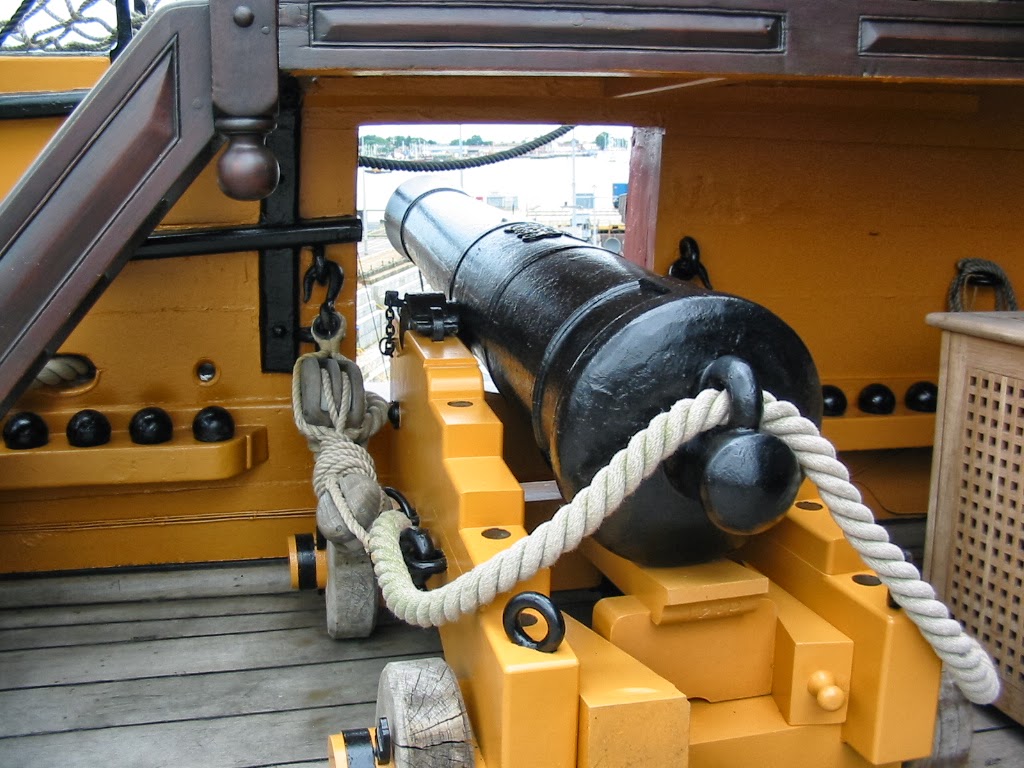
Cannon: Jack Tar’s prowess in firing was legendary
The men on the lower deck who helped achieve these odds were exceptional seamen, tough and loyal characters who have contributed to a sea culture that has flowered and endured over the centuries. They’ve often been painted as mere brutes but that is certainly not the case.

It’s time for the real Jack Tars to step out from the shadows and take their place among the heroes of the age. Nelson was adamant, and I have his words as the dedication to my first book, speaking of the officers aft on the quarterdeck and the men forward in the fo’c’sle; ‘Aft the more honour, forward the better man!’

As an aside, one of my most abiding images of Jack Tar is something that happened just before Nelson was finally laid to rest in St Paul’s Cathedral. Early in the morning of January 9th 1806 – a bright, fine, winter’s day – the funeral procession assembled in Hyde Park. The marshalled coaches snaked across Piccadilly and into St James Park, through Horse Guards and all the way to the Admiralty.

The huge funeral procession moved off at midday, preceded by companies of light dragoons, infantry, cavalry, artillery and grenadiers. 10,000 soldiers in all. They were followed by pensioners from Greenwich Hospital and seamen and marines from Victory, walking in pairs in their ordinary sea rig, but with black kerchiefs and stockings, and black crepe in their hats. And the sailors carried aloft the very white ensign the ship had flown off Cape Trafalgar.

The procession wound through silent streets to the slow beat of the Death March.

The funeral service lasted over four hours. Beneath the dome of St Paul’s hung a chandelier of 130 lamps, and below the floor of the aisle a special lift had been built to lower the coffin into the crypt. The procession had been ordered, the crowds reverent, the service solemn.

Then, at the last moment, when the 48 seamen from Victory were to fold the battle ensign and lay it upon the coffin they turned on the flag and tore it into pieces, as a remembrance for each man. An impulsive, emotional initiative worthy of Nelson himself.


Nelson’s funeral service

~~~~~~~~~~~~
Julian Stockwin was sent at the age of fourteen to Indefatigable, a tough sea-training school. He joined the Royal Navy at fifteen before transferring to the Royal Australian Navy, where he served in the Far East, Antarctic waters and the South Seas. In Vietnam he saw active service in a carrier task force. After leaving the Navy Julian attended university; he became a teacher and later practised as an educational psychologist. Julian lived for some time in Hong Kong, where he was commissioned into the Royal Naval Reserve. He was awarded the MBE and retired with the rank of Lieutenant Commander. He now lives in Devon with his wife and literary partner Kathy. More information can be found on his website . Julian also posts his own blog, BigJules and is on Facebook, Twitter and Pinterest.

He has written thirteen books to date in his Thomas Kydd historical action adventure fiction series. Although they form a series each title can be read as a stand-alone novel. The titles, in order are KYDD, ARTEMIS, SEAFLOWER, MUTINY, QUARTERDECK, TENACIOUS, COMMAND, THE ADMIRAL’S DAUGHTER, TREACHERY (published in the US as THE PRIVATEER’S REVENGE), TREACHERY, INVASION, VICTORY, CONQUEST AND BETRAYAL. Julian has also written a non-fiction book, STOCKWIN’S MARITIME MISCELLANY.

His next book is CARIBBEE, out on October 24.


Friday, July 26, 2013

Sir Francis Beaufort - The Man Who Caught the Wind


by Arthur Russell


Portrait of Sir Francis Beaufort
The Beaufort Scale for measuring the strength of wind was developed by Sir Francis Beaufort who was born in Navan, Co. Meath, Ireland on 27th May 1774. He was the son of Daniel Augustus Beaufort, a Protestant clergyman and member of the Royal Irish Academy who had himself created a new map of Ireland in 1792. 

The Beaufort household into which Francis was born was located on Flower Hill in the provincial town of Navan. The old house where he was born and reared survived until very recently but eventually succumbed to the “development mania” that plagued Celtic Tiger Ireland in the last decades of the twentieth century. A modern apartment complex now occupies part of the site where the rambling Beaufort house once stood. All that now shows where the scientist was born is a simple plaque which has been erected under a large tree in front of a school which has also been erected on the site.

The Beauforts of Navan were descended from French Huguenot refugees who had come to Ireland in the aftermath of the Massacre of St Bartholomew’s Day during the 17th century religious wars in France.

As a young man, Francis showed early interest in the sea and joined the British Navy. By the time he had reached his 16th birthday, he had already experienced shipwreck. The fact that this was caused by faulty charts fuelled his interest in hydrography and the creation of accurate nautical charts. 

He saw his share of action in the Napoleonic Wars and was seriously wounded on HMS Phaeton in the course of the capture of the 14-gun polocca Calpe near Malaga in 1800.  During his convalescence from this, he spent 2 years helping his brother-in-law, Richard Lovell Edgeworth (father of Maria Edgeworth, authoress of Castle Rackrent), in the construction of a semaphore line between Dublin and Galway which was capable of transmitting messages across the breadth of Ireland in 8 minutes. He refused to be paid for this work, preferring to subsist on the meagre naval pension being paid to him.  

When he recovered his health, he returned to active naval duty and was quickly made ship’s captain. During his time at sea, he immersed himself in taking readings at sea, updating and creating new charts and he virtually educated himself to the point where he became recognized as a leading expert in sea charts and nautical maps.

Plaque in front of school on 
Flower Hill, Navan, Co Meath
It was during these years that Beaufort developed his earliest version of a wind force scale and weather notation coding which he continued to use and perfect during his scientific career. 

Where his colleagues sought leisurely pursuits, Beaufort spent his leisure time taking soundings and bearings, making astronomical observations to determine latitude and longitude, and measuring shorelines, which he assiduously applied to new improved chart. Beaufort’s first ship command, HMS Woolwich, afforded him a unique opportunity to conduct a detailed hydrographic survey of the Rio de la Plata estuary in  South America

Experts in the British Admiralty were very impressed by the completed survey that Beaufort brought back to them. Most notably, Alexander Dalrymple, the first hydrographer of the British Admiralty, remarked in a note to the Admiralty in March 1808: 

"‘Captain Beaufort did more in the month he was in the Plate to acquire a correct knowledge of its dangers, than was done by everyone together before. We have few officers (indeed I do not know one) in our Service who have half his professional knowledge and ability, and in zeal and perseverance he cannot be excelled".

What was most remarkable about all this was the fact that Beaufort was largely self-educated and demonstrated masterly knowledge and had established himself as a pioneer in his chosen field. As such he was destined to rub shoulders with some of the greatest scientists and mathematicians of his time. Among these were John Herschel, George Airy, and Charles Babbage.

The Beaufort Wind Scale
Perhaps his most enduring and well known legacy is the Beaufort Windscale which is a methodology for measuring the strength of the wind as it impacted on sailing ships and later steam ships which replaced them during the 19th century. Ways of measuring wind was not a new idea in nautical circles. Beaufort’s achievement was the fact that he was able to have his system universally accepted; where no standardised system existed before.

The first proposed scale presented in 1806, ranged from calm (0) up to storm force (level 13) in which wind strength was correlated with the amount of sail a full-rigged ship would carry appropriate to the wind conditions. It was first used officially by Robert Fitzroy in 1831 and thereafter adopted by the British Admiralty in 1838. As sail gave way to steam the scale was modified by defining levels in terms of the state of the sea or wind speed.

A long and distinguished career
In 1811–1812, shortly after being promoted to Captain, Beaufort charted and explored southern Anatolia in Turkey and succeeded in locating many classical ruins there. An attack on the crew of his boat at Ayas, near Adana, by Turks in which he sustained a serious bullet wound in the hip, interrupted his work. He returned to England and drew up the charts based on records and readings taken during his time there. He also published his book, Karamania, in 1817, which is a brief description of the South Coast of Asia Minor and of the remains of Antiquity he had explored.

Chief Hydographer of the Admiralty
In 1829, at the relatively late age of 55 years, when most seamen would be expected to retire from active service, Beaufort was appointed British Admiralty Hydographer of the Navy, a post he held for a further 25 years. During this period of his long and distinguished career, Beaufort converted what had been a minor chart repository into the finest surveying and charting institution in the world. Some of the excellent charts the Office produced during Beaufort’s time are still in use. 

One of the practices he introduced to the office he led for so long and which is still meticulously followed, is that no chart or other document may ever be published by the Hydrographic Office without first undergoing the Chief Hydrographer’s personal scrutiny. He took also over the administration of the great astronomical  observatories at Greenwich, London and at the Cape of Good Hope in Africa and directed some of the major maritime explorations and experiments of the time. Among these, he directed the Arctic Council during its search for the explorer, Sir John Franklin, who was tragically lost in his last polar voyage in search of the North-west Passage between the North Atlantic and the Pacific Oceans.

Beaufort’s link with the voyage of HMS Beagle
Beaufort trained Robert Fitzroy, who was put in temporary command of the survey ship HMS Beagle after the ship’s previous captain had committed suicide. When FitzRoy was reappointed as Commander for the famous second voyage of the Beagle he requested Beaufort "that a well-educated and scientific gentleman be sought" to accompany the voyage. Beaufort's enquiries led to an invitation to Charles Darwin, who subsequently drew on observations made during the voyage to formulate his theory of evolution which he presented in his book, The Origin of Species.

As a council member of the Royal Society, the Royal Observatory, and the Royal Geographic Society, of which he was a founder member, Beaufort used his administrative position to interact with the most prominent scientists of his time. Beaufort recommended the geographers, astronomers, oceanographers, geodesists, and meteorologists to the Hydrographic Office, and gave significant support to many research projects.

Overcoming many objections, Beaufort obtained government support for the Antarctic voyage of 1839–1843 by James Clark Ross, which investigated the Earth’s Magnetic forces.

Plaque marks Beaufort's birth
He also promoted the development of reliable tide tables for Great Britain and Ireland which motivated similar research elsewhere in Europe and North America. He supported his friend William Whewell, and attracted the support of the Prime Minister, the Duke of Wellington, in expanding record-keeping at 200 British Coast Guard stations. Beaufort gave enthusiastic support to his friend, the Astronomer Royal and noted mathematician Sir George Airy in achieving a historic period of measurements by the Greenwich and Good Hope observatories.

It is a measure of the regard in which he was held, that he finally retired from the Royal Navy with the rank of Rear Admiral on 1st October 1846, at the relatively advanced age of 72 years. Two years later, in April 1848 he was appointed Knight Commander of the Bath (KCB) and was henceforth known as Sir Francis Beaufort.

Beaufort’s private life had its share of scandal which did not become public until after his death when portions of his private memoirs, written in a cipher developed by himself, were deciphered. It appears that from 1835, until he married Honora Edgeworth in November 1839; he had an incestuous relationship with his sister Harriet. The entries also show he was tortured by guilt over the relationship.

This son of Navan, Co. Meath, who contributed so much to the world of nautical science, as well as to our understanding of the oceans and seas which occupies 71% of the surface of the planet on which we live, died on Dec 17th 1857 and is buried in St John’s Church Gardens in London.

~~~~~~~~~~~~
Arthur Russell lives in Navan, Co Meath where the subject of this post, Sir Francis Beaufort, was born in 1774. He is author of the historical fiction book Morgallion which was published in April 2012 and is available in paperback and e-book format. (Ref - www.morgallion.com). Morgallion is set in the 14th century at the time of the Edward Bruce led Scottish invasion of Ireland to claim the High-Kingship of Ireland and establish an Irish Bruce dynasty.