Showing posts with label World War II. Show all posts

Saturday, August 19, 2023

The British Women who Flew in World War Two

 The Second World War was the first in which women played a role in aviation. Russian women flew combat missions as bomber and fighter pilots, but in Great Britain and the United States the role of women pilots was supportive rather than direct. Below is a short description of the important role of British women pilots in WWII.


In the U.K. women flew with the Air Transport Auxiliary (ATA), which was founded almost immediately after the start of WWII by senior executives of British Overseas Airways Corporation (BOAC) to employ pilots not fit for military service in supporting roles for the RAF and Fleet Air Arm (FAA). Although it became the sole ferrying organization of the British armed forces, it responded flexibly to other requests and also provided air ambulance, VIP transport and cargo service on an ad hoc basis.

From the start, the ATA was an organization dedicated to providing services, not proving a point, and it was open to both men and women. Indeed, throughout its existence, men pilots out-numbered women pilots by a significant margin. For example, the first pilots of the organization were 30 men and 8 women. At its peak in 1944, the ATA employed nearly 700 pilots of which only a little over 100 were women. (Source: The Forgotten Pilots. Lettice Curtis (who was herself an ATA pilot). Appendix 1.) Below the founder Gerard d'Erlanger.

The ATA was established by aviation professionals, and initially only accepted pilots with 500 hours of solo time. By the end of 1940, the needs of the organization were so great that the recruiting requirements were reduced to just 50 hours solo, and by 1942 the first candidates without any flying experience were accepted into the organization’s training program. The latter had started in 1941, when the reduction in flying hours required for application had been instituted. Pilots with just 50 hours solo needed additional training to fulfill the tasks assigned.

Rather than duplicating RAF or airline training, however, the ATA inventively developed a pilot training program designed to train pilots precisely for the tasks required by the ATA in a minimum amount of time. Pilots were first trained only on light, training aircraft and then put to work ferrying these aircraft to RAF training establishments. In doing the work, the pilots were already earning their keep, contributing directly to the war effort (relieving RAF pilots from ferrying), and also gaining flying time, experience and confidence.

                           An ATA pilot in a training aircraft. (Photo courtesy of Michael Fahie)

Once they had fully mastered these aircraft, the ATA pilots (whether men or women) advanced to more powerful single-engine aircraft including fighters, and step-by-step at their own pace to twin-engine aircraft and eventually heavy bombers. At no time were ATA pilots trained on aerobatics, air gunnery, formation flying or other military training irrelevant to ferrying and transport service. Indeed, they were given only minimal training on instrument flying, as ATA pilots were expected to fly “visual.” By keeping the topics of training to the minimum, training time was significantly reduced.

Furthermore, by allowing the pilots to progress at their own pace, no pilots were forced beyond their capabilities. There was no need for all pilots to qualify on all classes of aircraft, a policy that ensured all pilots contributed according to their abilities, reducing accidents and losses. Notably this training scheme was evolved and initially managed by some of the world's finest flying instructors -- instructors that had previously been with the British Overseas Airways Corporation (BOAC).


An British woman pilot in cockpit of a Sterling four-engine bomber (Photo courtesy of Maidenhead Heritage Centre)

In the course of the war, the women with the ATA steadily won the same privileges and status as their male counterparts. They wore the same uniforms, underwent the same training at the same centralized flying school, and performed the same duties as their male colleagues as they qualified successively on the classes of aircraft from training bi-planes to four-engine bombers. From 1943 onwards, they broke ground by being awarded equal pay for equal work at a time when other women's auxiliaries (such as the Women's Auxiliary Air Force (WAAF)) were not. Last but not least, women in the ATA were promoted on merit and could exercise command authority over male colleagues.

Pauline Gower, the Commander of Women in ATA, whose gentle persistence and diplomatic handling of politicians and generals brought about these successes.

Furthermore, throughout the war, the women in the ATA were recognized and praised both officially and publicly for their contribution to the war effort. Five women and 31 male ATA pilots won the MBE. Four women ATA pilots and two male colleagues earned the BEM. One woman Flight Captain received a Commendation alongside five male ATA officers, and two women ATA pilots along with 16 male ATA pilots received the King’s Commendation for Valuable Service in the Air.


Dr. Helena P. Schader is the author of a comparative study of women pilots in the US and UK published by Pen & Sword, Sisters in Arms: The Women who Flew in WWII.  A former ATA pilot is the leading female protagonist in her series of novels on the Berlin Airlift, Bridge to Tomorrow. Find out more about Book I in the series, Cold Peace, here.


Saturday, July 8, 2023

British Women at War: The Women's Royal Navy Service

 The smallest and most elite of the women's services in the U.K. was undoubtedly the Women's Royal Naval Service or WRNS. Because its numbers never exceeded 75,000, the WRNS was never dependent upon conscription; volunteers were sufficient to fill its needs. It also cultivated and maintained a reputation as being exclusive and having higher standards.

Like the other women's services, the Women's Royal Naval Service had its roots in the First World War when it was created in late 1917 to help meet manpower shortages. The women were used to free up male ratings from shore-based duties primarily cooking, cleaning and clerical work, and in both world wars the Admiralty insisted that women would not serve at sea. The first WRNS was both small and short-lived. Roughly 7,000 women served in it during the less than two years of its existence; it was disbanded in 1919. Twenty years later,  in August 1939 the WRNS was reformed. Again, its mandate was to "free men for the fleet" by putting women in shore-based jobs, such as cleaning, cooking and clerical work.

Yet from the very start, the WRNS was different. For a start, it was technically part of the the Royal Navy services but not part of the Royal Navy. Legally, this meant it was a civilian support service and the WRNS did not technically come under the Naval Discipline Act until 1977!  Second, during the early years applicants needed "recommendations" -- preferably from RN personnel -- to be considered at all. Many of the first WRNS were the wives, sisters and daughters of naval officers. Furthermore, recruiting was at first confined to residents of the major naval ports of Portsmouth, Plymouth, Chatham and Rosyth, and the WRNS were expected to live at home!

Furthermore, from its inception in WWI (which followed the scandals that had plagued the WAAC), the WRNS were jealous of their reputation. The leadership was explicit in dictating that "WRNS must ... avoid any behavior which, though not incriminating in itself, may be undesirable...." The catalogue of such undesirable behavior included smoking in public, drinking alcohol in public, and  loitering around with men. Already in WWI, the WRNS were known as the "prigs and prudes" -- and were proud of it. When the service was resurrected in WWII, this tradition was continued. 


On the other hand, the WWII leadership came from a younger generation -- a generation of professional women who sought to fill the ranks with not just "the right sort" of woman, but women capable of doing the job. Unlike the leadership of the ATS, the WRNS leadership was composed of women with a more egalitarian outlook than the service to which they were attached. The WRNS leadership adopted a policy of strict meritocracy. A key component of this policy was that no woman could become an officer without first being a rating and proving herself. This policy did much to improve morale -- and was notably lacking from the ATS where most officers were appointed directly, often without qualifications, on the basis of their accent or social status.

Although the WRNS started the war with seven limited categories of work which can be summarized as clerical, cleaning and cooking, the war rapidly forced changes. Soon the duties assigned WRNS expanded to motor transport, storekeepers, messengers, mechanics, telegraphists and R/T operators, signalers and small-boat handlers.  Eventually there were 129 trades including plotters, radar operators. meteorologists, codes and cipher specialists, intelligence officers and anti-aircraft crew. Fundamentally, from 1941 onwards, the WRNS took on all shore-based jobs that did not require physical strength or sea experience, including training RN personnel for their duties at sea.


Particularly striking was the degree to which the extremely conservative and hidebound "senior service" eventually handed over significant responsibility to WRNS. For example, WRNS were largely responsible for the dispatch of RN vessels. WRNS issued sailing orders and allocated berths. They also sent, received and decoded messages. Meanwhile, WRNS were required to be mobile and go where needed rather than live at home. The chic, feminine uniform distinctly different from the RN uniform and designed especially for women, was soon supplemented by overalls, bell bottom trousers, and other forms of practical clothing depending on the job performed.  Silently, the requirement for recommendations in order to apply also went by the board. 


Meanwhile, the WRNS particularly distinguished themselves as linguists and in the field of code-breaking and cypher work. It is noteworthy that the Admiralty had unofficially identified these areas as potential fields for women before the outbreak of the war. Dispatch riders was another category of work in which WRNS earned praise and recognition. The work entailed riding powerful (and very heavy) motorbikes at speed, often over long distances, on unmarked roads with inadequate headlights (due to wartime blackout requirements). Inevitably, a number of women had serious motor accidents, and recruitment for the trade was discontinued, but those who had already qualified were allowed to continue, several earning mentions in dispatches or medals for their work.


Although the Admiralty never allowed women to serve "with the fleet," starting in 1941, small harbor craft were "manned" by WRNS.  Although the boat crews never numbered more than 573 altogether, it was the most popular of all categories and some WRNS preferred to give up their petty officer status for the sake of being an ordinary deck hand on a boat.  There was also one small but notable exception to the otherwise rigid rule about women not serving "with the fleet." WRNS cipher officers were sent aboard the large troop transports such as the Queen Mary and Queen Elizabeth

Finally, WRNS were deployed overseas, which required them traveling for the most part by RN vessel to their new overseas assignments. WRNS were sent overseas starting in 1942 and by the end of the war 6,000 WRNS were serving in 37 overseas locations. In the course of the war, WRNS served in Alexandria, Port Said, Cairo and Suez, Durban, Kilindini (Kenya), Colombo (Cylon) and Singapore. 

At its peak in late 1944, the WRNS numbered 74,620 who served in all theaters of the war. In the course of the war, they had made themselves so useful and demonstrated the capabilities of women so effectively that the WRNS was not disbanded after WWII but continued until it was fully integrated into the RN in 1993.

Award-winning novelist Helena P. Schrader is the author of three books set in Britain during WWII: Where Eagles Never Flew, Grounded Eagles and Moral Fibre.  You can find out more about them, their awards and read excerpts at: https://CrossSeasPress.com.


Thursday, September 15, 2016

Weird War II

by Richard Denham

The Second World War has captured the imagination like no other in history. It was the first ‘People’s War’, in which, because of technology, women and children were in the front line along with the men. The generation who fought it are still with us, although their ranks are thinning daily, and the world in which we live today is shaped to a huge extent by the events of 1939-45.

I have used ‘weird’ to mean extraordinary and have selected topics from that war which I think, for a variety of reasons, are astonishing. Let me be clear, however. I am not, in any sense, laughing at the men, women and children of World War Two. The fact that they could laugh at each other – and themselves – at the time, is in itself, astonishing. Scared to death, they found something – anything – to laugh at. So, bombed shops in London had cardboard signs reading, ‘We’re even more open than usual.’ The arrival of the American GIs in Britain in 1942 gave rise to, ‘Have you heard about the new Utility knickers? One Yank and they’re off!’ In the Reich, there was the German glance, making sure that no one saw you not making the Hitler salute (which American schoolchildren, by the way, had already adopted, by innocent coincidence).

In a bid to end the war against Japan, the Americans perfected the atom bomb, which had the desired effect but created an uneasy nightmare ‘peace’ we live with today. By no means as deadly were the parachuting sheep, the rat bombs, the cat and dog commandos, the ship made entirely of ice, the rifle that could shoot around corners, the tank that was only twelve inches high. All of these were being experimented with and developed by intelligent men and women backed by serious money and even more serious governments. And some of them actually worked!

Then there were the rumours, some spread by black propaganda, some the result of hysteria. Britain, in particular, was paranoid. Winston Churchill believed in 1940 that there were 20,000 members of the Fifth Column, working secretly for Hitler’s Germany behind the scenes. People were known to be signalling to the Luftwaffe with cigarette lighters. German parachutists were floating down over the countryside dressed as nuns. Messerschmitt pilots wore lipstick and rouge. Rudolf Hess, Hitler’s deputy, was actually Hitler’s niece. The nonsense went on and on.

Some of the bizarre tales in Weird War Two are actually true. Operation Mincemeat, placing a dead man in the sea off Spain to fool the Germans, really did make them believe an assault would take place miles from where it really happened. A Japanese soldier, unaware that the war was over, actually did surrender on his tiny Pacific island thirty years later. In the Isle of Wight, a middle-aged landlady was really sentenced to death for espionage, even if the penalty was never carried out.

~~~~~~~~~~~~~

With so many millions caught up in the terrifying events of the 1940s, it is not surprising that weird and wonderful stories and events should come to light. I have tried to be even-handed. Britain, Germany, the United States, Japan, the USSR (as Russia then was) all have the spotlight thrown onto them. And what that light reveals will astonish you.

For more information or to purchase please visit:

http://www.tsquaredbooks.co.uk/weird-war-two 


Saturday, May 10, 2014

Cymraeg Am Byth - Welsh Forever

by Beth von Staats

Roma Toman Condon with her father, Albert Toman
September 28, 1944

Along with the vast majority of teenagers living in World War II war torn Great Britain, like Her Royal Highness Princess Elizabeth, Roma Toman had strength of purpose. In a generation where "all gave some, and some gave all", as everyone else did around her, this young woman rolled up her sleeves to do the work that needed to be done to win the war so crucial to preserve a nation, to preserve an empire, to preserve a way of life going back a millennium.

Roma Toman's contribution to the war effort saw her working for the Navy, Army and Air Force Institutes, commonly known as the NAAFI. Created by the British government in 1921, the NAAFI ran recreational establishments for the British Armed Forces, as well as selling goods to British servicemen. During World War II, over 96,000 personnel operated over 7,000 canteens, providing critical supports to the British military. To soften the load and support the British servicemen, primarily Navy enlisted men based in her home of Milford Haven, Wales, Roma Toman sold supplies needed for the local British Navy Base and ships moored in the harbor. As the war progressed, Americans, Australians, Free French and Canadians joined the ranks stationed in Milford Haven, most predominantly "the Yanks from across the pond". The NAAFI stepped things up a notch further and served the entire Allied Forces as richly as their own men, a service well received by those so far from home.
____________________________________________

"I like a man who smokes a pipe."
- Roma Toman -
____________________________________________

Everett Condon, an American hailing from Fairhaven, Massachusetts, made a life changing decision after the Attack on Pearl Harbor. He left high school before graduating and enlisted into the United States Navy. Far more fortunate than most serving during World War II, he saw very little action, instead assigned to be a Storekeeper, Third Class at an American military hospital in Hakin, Pembrokeshire, Wales. In this role, Mr. Condon insured the soldiers and sailors in need of urgent medical care, as well as their care takers, were adequately provisioned by picking up and then inventorying and storing supplies ordered by Naval Officers on the base. Replacing a Storekeeper imprisoned for selling provisions on the black market, Mr. Condon was meticulous in his duties.

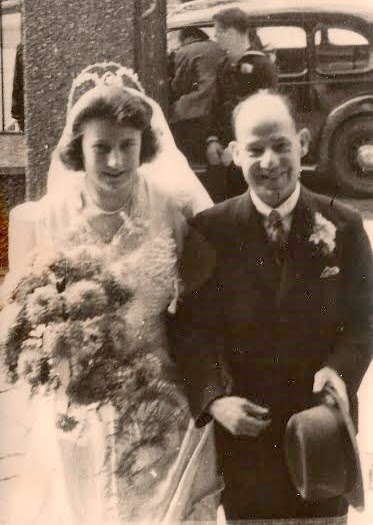
Roma Toman Condon and Everett Condon
St. Catherine's Anglican Church
Milford Haven,  Pembrokeshire, Wales
The U.S. Navy found the easiest way to secure supplies needed for the military hospital was from the efficient services afforded by the NAAFI, located nearby at the Milford Haven docks. On one visit to simply secure two boxes of matches to light his own cigarettes, Mr. Condon met a Welsh teenager, who smugly informed him that she preferred a man who smoked a pipe. By the time they met again at a local dance, Mr. Condon had changed his smoking habits, and so began their shared life journey and 60 years of marriage together.

At age 19, Roma Toman Condon became one of a diaspora of approximately 100,000 British women, many accompanying over 11,000 infants and children, to leave the United Kingdom after marrying Allied Servicemen during World War II. Most were bound for Canada, South Africa, Australia, New Zealand, and like Mrs. Condon, the United States of America.

Mrs. Condon was one of over 2,300 British women, along with their infants and children, aboard the former luxury liner Queen Mary on it's maiden voyage of War Brides transported from Southampton, England to New York City. As a "beneficiary" of the War Brides Act of 1944, a law that enabled "foreign non-Asian" spouses and children of American military personnel to enter the United States, Mrs. Condon became one of over 105,000 women from around the world to join their American husbands after the conclusion of hostilities.

Tidworth Army Base
Although Roma Toman Condon traveled at the expense of the American government in deference to her husband's military service, her journey was far from extravagant. Leaving her home, her family, her friends, her support network, and all that normally grounds a teenager, Mrs. Condon ventured alone from Milford Haven, Wales to London. In London, she reported to an American route transportation officer, who shipped her off by train to Tidworth Army Base in Hampshire, where British War Brides venturing to the United States were "processed".

War Brides at Tidworth Army Base were warehoused in military style bunkers, with little privacy afforded. Offered "lectures on life in the United States" and "travel instructions", War Brides were finger printed, immunized and compelled to undergo intrusive medical examinations. The War Brides' British pounds were converted to American currency. Once the flurry of initial activities were complete, boredom set in, with the mud, crying babies and uncomfortable accommodations weighing the women down and emotionally exhausting them. As Mrs. Condon vividly recalls, the youngest War Bride at Tidworth was only two years younger than she was, the oldest 65 years old. Her saddest recollection of her stay is of a young woman who after being processed for travel was served divorce papers that her husband filed in the United States.

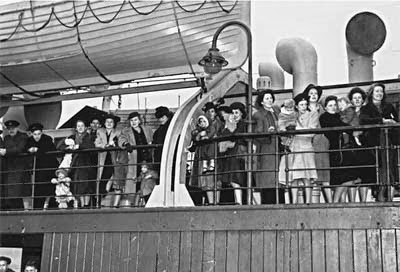
British War Brides on Route to the United States
On February 1, 1946, the 2,300 War Brides, infants and children warehoused at Tidworth Army Base finally made their way to Southampton, England, their last stop on their British home soil. Unfortunately, the comfortable tour buses filled quickly, so Mrs. Condon and five other young women were compelled ride on a military bus with hard and shaky wooden benches. At nearly age 88, Roma Toman Condon recalls the experience as if it were yesterday. "It was a wild Army drive that hit every bump." Still, as uncomfortable and downright scary as the two hour ride to Southampton was, later the same day, Mrs. Condon boarded the Queen Mary. After two long days waiting on the ship for strong winter gales to pass, her voyage to a new life with her American husband was finally under way.

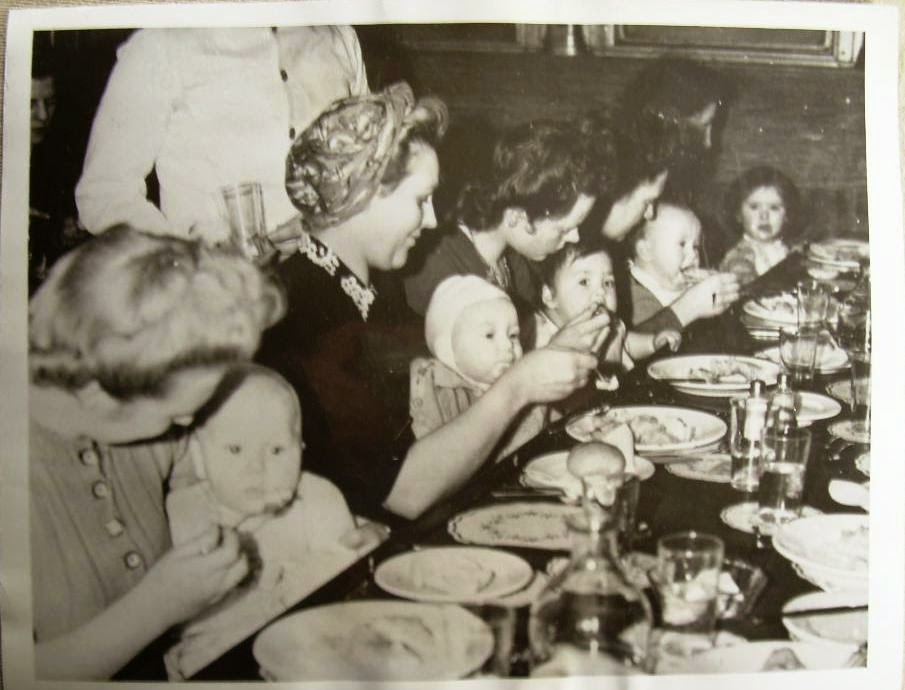
British Mothers Feed Their Infants Aboard the Queen Mary
Like most of the women and children on board the Queen Mary, Roma Toman Condon had never traveled by ship.With winter squalls bordering on gales rocking the ship endlessly, seasickness was rampant. "Oh yes, I was one of the patients," Mrs. Condon recalls with no fondness. Although sick the first two days of the voyage, Mrs. Condon remembers the mid-journey to be relatively enjoyable. "We had movies aboard the ship and other entertainment." Unfortunately, the last two days journeying on the Queen Mary mirrored the first two. Heavy land swells caused the ship to roll considerably, and Mrs. Condon was heavily seasick yet again. In short, the trip "across the pond" was down right miserable for the teenager.

Finally on February 9, 1946, the Queen Mary arrived with her precious cargo in New York City. Eager to debark, all British women and children were confined to their staterooms until a thorough inspection of the liner was completed, a process that took over seven hours. Finally, groups organized alphabetically were taken by bus to the New York City Military Armory. Mrs. Condon vividly recalls, "It looked like a cattle inspection when we entered the Armory. I was afraid I would miss my husband, and I would be lost there." The husbands were brought to a balcony area to await sight of their wives, and the women were "checked off" one by one. The women, some with infants and small children in tow, were then seated in a bleacher area.

Everett and Roma Condon with Jillian, 1947
Everett Condon waited anxiously in the balcony area for several hours watching the women and children pass by him. He remained attentive in fear he might miss Mrs. Condon in the organized confusion. Finally, following the alphabetical system used, he knew his wife would arrive soon, so he moved downstairs, looking for her. In spite of all of Mr. Condon's best efforts, it was his wife who sighted him first, and they hurriedly reunited.

In an interview the next day with a newspaper reporter from the New Bedford Standard-Times, Everett Condon was asked what his wife said to him upon their initial reunion. Mr. Condon replied simply, "She didn't say a word. She just kissed me."
________________________________________


Although Roma Condon ventured home several times
through the years, it was over 40 years before the
couple returned to Milford Haven together. Here,
Everett and Roma Condon stand before Hubberston
Fort, a pipe still nestled in Mr. Condon's hand. Although
Everett Condon died in 2004, Roma Condon continues
to enjoy her friends and growing family, to whom she
gifts her Welsh heritage in Dennis, Massachusetts.
________________________________________

SOURCES:

The Oral History of my beloved mother, Roma Toman Condon

The American War Bride Experience, Foreign Born GI Brides of World War II

The New Bedford Standard-Times, First War Bride in Area Makes Tour Hunting Clothes, Has Silk Hose Supply, February 10, 1946.

NAAFI, History
___________________________________________


Beth von Staats is a short story historical fiction writer and administrator of 
Queen Anne Boleyn Historical Writers.

___________________________________________


___________________________________________


___________________________________________