Showing posts with label Julian Stockwin. Show all posts

Friday, May 1, 2020

The Thames: England’s Liquid History

by Julian Stockwin

Customs House
My particular interest in the River Thames is its role in the Georgian age. London at the turn of the eighteenth century was much smaller than it is now of course. Upstream of Westminster Abbey and the Houses of Parliament were green fields and the country, while downstream the great city spread out, mostly on the left side. The river did a single bend to the right, and on the way was Whitehall, the Bank of England, St Paul's. Then it was the Tower of London, and before the Thames had time for another wiggle it was all over, green fields again.

The Port of London

But the real heart of London, its real reason for being there, was the Port of London. This was the biggest in the world at the time, a wonder of the age. It was the undisputed centre for handling cargoes to and from all over the newly explored world. If you were to stand on London Bridge looking downstream you’d see the most amazing sight. In a space of water not a couple of hundred yards across was crammed a great mass of shipping – snows, galliots, hermaphrodite barques, cats, tilt boats; every conceivable type under every kind of flag. There were 8000 ship movements in and out of port in 1793, these increased to 16,000 by 1824, all in this one part of the river. One great forest of masts. From big ocean going East Indiamen to colliers from the north, they all rafted up together, for there were no quays to come alongside. The ships would tie up to each other, and lighters would come out to load or take out the cargo.

The Port of London was not all that big, in fact the whole thing was really concentrated at the point which was as far up the Thames as big ships could go. This was the impassable barrier of London Bridge (that’s the one next up from present day Tower Bridge). And here they all arrived, handily right in the centre of the capital. The Port of London is a stretch of river from London Bridge a couple of miles down river to the first bend. The ships would have to make their way up from Tilbury at the mouth about 25 miles upstream and through a dozen sweeping bends, crammed with other ships all moving in either direction and with fluky winds. Most were square riggers which could only keep within six points of the wind – a tough sail. A foul wind could hold up arrivals for weeks, and the Bank of England fitted a special wind dial indicator in the main dealing room so bankers could tell at a glance whether a sighted vessel would make it to London in time to land cargo to meet the terms of a Bill of Exchange. It’s still there to this day.

London and the Thames were, right up until the middle of the twentieth century, totally mutually dependent. It was the port in Britain to action the economic basis for the coming Industrial Revolution. But in the Georgian era it was more – we’re used to taxis, buses, trains and so on. In the eighteenth century you thought long and hard about even the smallest journey, and in London that meant sedan chair or slow stage coach or carriage through muddy streets and appalling traffic jams. The only practical method was by river, and this was the main highway of the time.

There were many other maritime features—the great marine observatories at Greenwich, the gun foundry at Woolwich Arsenal which is still occupied by the Ministry of Defence, and Henry VIII’s Trinity House which looked after buoys and lighthouses and still does to this day, and there were shipbuilders up and down the river. At Blackwall many famous frigates were built for the French wars. Rotherhithe, Deptford, was known for king’s ships since Shakespeare’s day. The radically designed HMS Warrior, now on show in Portsmouth, was a Thames vessel.

Support for these ships had to be on an industrial scale. If you think of the kind of stores a single ship had to load for a voyage of over a year to far places, you get an idea of what was needed - multiplied by 1000s of ships. Breweries to make the small beer that was taken instead of water, ship’s biscuits, the hard tack – the list goes on and on. There were skilled men everywhere – such as coopers making great casks who were there on dockside right up to the 1960s. The men who manned the lighters or barges, the lightermen, were also very skilled, steering with 20 foot long oars they could bring a lighter from the ship to the wharf by tide power alone.

River Scene

But the real professionals, and it took a full seven year apprenticeship, were the river taxi drivers, the watermen. In the eighteenth century they would gather their red or green wherries (a sharp bowed skiff) around one of the many ‘stairs’ or boarding points, like Horseferry stairs, Puddle dock, King’s stairs. A passenger would approach and they’d shout ‘oars, oars’. The passenger would point at one, and the others would turn on the lucky one and abuse him loudly. They were very independent, often garrulous, uncouth and arrogant, happily screeching insults at passing rivals, but they were very good at what they did, especially at ‘shooting the bridge’ which was what they called passing through London Bridge. This was like a weir, so fast were the tides. Passengers could get their money back if they were tipped into the river, or they could prudently take precautions, landing before the bridge and boarding again after. The oldest sporting event in the world is the Doggetts coat and badge race for first year watermen and runs to this day. In fact there are still watermen, and one of their privileges is delivering the Royal Crown from the Tower of London to Westminster at the state opening of parliament. If the Thames froze, a Frost Fair would be held on the ice. Gentlemen and their ladies would stroll arm in arm, there’d be plenty of entertainment, with bear baiting, an ox roast, cricket match and so on, all on the ice. The watermen couldn’t ply for hire, so they had races in which their boats were hauled over the ice by horses.

The Thames was smelly then but actually not as much as later – people were still catching salmon in the City in 1800. In the eighteenth century the practice was for night soil men to take away the liquid waste for industrial uses, and the other for manure, it was just too valuable to throw away. It wasn’t until the huge explosion of population in Victorian times coinciding with the invention of the flush toilet that the stinks and health hazards really came. In 1800 for drinking water they still relied on a big waterwheel next to London Bridge to pump up water direct from the Thames.

The river would smell rank, but this would be overlaid by other fragrances. Writers of the time use the word ‘spicy’ a lot, the scent of cargoes – cinnabar, ginger, tea, sandalwood, hemp – and of course the unmistakable rich whiff of sea worn ropes and tar. Downstream there were other smells. The ink and dye works at Deptford had very pungent copper salts, and Berger paints were nearby. The worst were the leather tanneries around Bermondsey – 30 of them! They started a vinegar factory in the middle with the idea of countering one smell with another, and miraculously, it was still going in 1991. Around the bend in the river are the Greenland docks. This was well into the country, for there the whalers used to return and the oil was processed. This caused a stink so bad that people choked. But back in the city the main smell was that of horses and their dung – uncountable thousands of horses. And the sea coal – you could see where London was from the Downs because of the big brown cloud hanging over it from the sea coal fires.

When a sailor returned after a voyage he’d be on the ran tan ashore just as fast as he could. The main area was Wapping, roughly from where the Tower of London is until the river bends. It was a maze of tiny streets and alleys, with names like Cat’s Hole, Shovel Alley, the Rookery, Dark Entry and so on. A wider road called Ratcliffe Highway ran through it, lined with shops, taverns, ship’s chandlers, doss houses and so on. It still exists, now called simply ‘The Highway.’

Every shop had a sailor’s lodgings above it and every kind of sharp practice was used to part the sailor from his hard earned silver. Across the river in Southwark and Rotherhithe it was the same, and we know from Chaucer that it has a pretty long history. There are still some of the old pubs – the Prospect Of Whitby in Wapping, a fine old place, the Town Of Ramsgate in Rotherhithethese - were named after ships that regularly tied up outside. The Grapes in Limehouse gets a mention in Dickens and the Mayflower pub stands on the spot where the Pilgrim fathers sailed for America.


Thames sailing barges with their distinctive sails
by Canthusus, CC BY-SA 3.0,
https://en.wikipedia.org/w/index.php?title=File:Thames_Barges-Canthusus.JPG


It’s thought that in the eighteenth century between a quarter and a third of all cargoes arriving were stolen. It varied a lot in seriousness. At one end of the scale their would be scams such as a fake agent meeting a ship and bargaining with the captain to ease the task of landing his cargo, organising lighters, customs clearance, porters and so on. The captain would agree and the cargo would be landed alright – but that would be the last he saw of it. At the other end of the scale were the mudlarks or scuffle hunters. These were young scamps who would skip aboard a vessel working cargo and suddenly throw something overboard before escaping. This article they could then retrieve from the mud later when the tide went out. River pirates were a real menace, so when they were caught they paid the penalty – and then their bodies were hung in chains in Execution dock until their skeletons had disarticulated. You can still see the sea wall near St Katherine’s dock.

The docks changed the face of the Thames. We think today of the Pool of London and the endless docks, but before the Napoleonic wars there was not even one! Then in 1802, and only to combat the thieving of cargo, out in the country the West India dock was built, with high walls and controlled security. Ships would come to a stop outside, lower their sails, and then be pulled inside by powerful land capstans. It was an instant success, and other docks were quickly dug. This brought more support services and soon London had doubled in size, and only just in time, for the number of ship movements would double as well in just 22 years.

Canaletto's painting of the Lord Mayor's Procession
This is an Editor's Choice, originally published November 23, 2014.
~~~~~~~~~~~~~


Julian Stockwin was sent at the age of fourteen to Indefatigable, a tough sea-training school. He joined the Royal Navy at fifteen before transferring to the Royal Australian Navy, where he served in the Far East, Antarctic waters and the South Seas. In Vietnam he saw active service in a carrier task force. After leaving the Navy Julian attended university; he became a teacher and later practised as an educational psychologist. Julian lived for some time in Hong Kong, where he was commissioned into the Royal Naval Reserve. He was awarded the MBE and retired with the rank of Lieutenant Commander. He now lives in Devon with his wife and literary partner Kathy. More information can be found on his website. Julian also posts his own blog, BigJules and is on Facebook, Twitter and Pinterest.

He has written twenty-two books to date in his Thomas Kydd historical action adventure fiction series. (Book 23 will be released in Fall 2020). Although they form a series each title can be read as a stand-alone novel. Julian has also written a non-fiction book, Stockwin's Maritime Miscellany. And in a departure from the ongoing adventures of Kydd and Renzi, Julian also brought out a standalone historical novel set in the time of Justinian, The Silk Tree.


Sunday, June 10, 2018

Wednesday, June 6, 2018

Sailors and Their Superstitions

by Julian Stockwin

Over two decades of researching my Thomas Kydd series I’ve learned much about the rich sea lore of the seaman. In my latest book THE IBERIAN FLAME the appearance of a mermaid evokes age-old fears of sirens luring sailors to their doom. Those who followed the sea then were far more superstitious than landlubbers. Some notions, such as those about the weather often did have an element of truth in them. And the fabled Fiddler’s Green no doubt provided comfort to sailors that they would not end up in Davy Jones’ Locker as food for fishes but go to a better place.

• The caul

One superstition that borders on the macabre is the reverence in which a birth-related piece of human tissue was held.

The caul, the thin membrane covering the heads of some new born children was believed by mariners to bring good luck, in particular to guard against drowning – the sailor’s great fear.

Those born with the caul were considered immune from drowning. In one story, a baby born with the caul was so powerful ‘that when his mother tried to bathe him he sat on the surface of the water, and if forced down, came up again like a cork.’

In fact the caul was highly prized not just by mariners but by landlubbers as well, and there are references in literature from the bible onwards, even in the works of Charles Dickens. David Copperfield describes feeling uncomfortable and confused at the auction of his own caul. (The winning bid was from an old lady who went on to live to ninety-two, and died in her own bed.)

As long as the individual born with a caul kept it on his person the magical powers remained with him but if the caul was sold its properties passed to the buyer, as in Copperfield’s experience. An advertisement in The Times in February 1813 offered a caul for 12 guineas. Another paper announced the sale of a caul – ‘having been afloat with its late owner forty years, through the periods of a seaman’s life and he died at last in his bed at his place of birth.’

A Punch cartoon of
Davy Jones sitting on his locker
Sailors would often sew their cauls into their canvas trousers. One old sailor with a caul secreted on his person this way was admonished that his amulet was a ‘vulgar error’. He was said to reply: ‘A vulgar error saving me from Davy Jones is as good as any other.’
Cauls were advertised in British newspapers all the way until World War I. One ad, posted in the Bristol Times and Mirror in 1874, appealed specifically to sailors. “TO SEA CAPTAINS: For sale, a Child’s Caul in perfect condition. £5.”

• Mermaids and Mermen

Mermaid,
lurer of sailors to their doom
Legends of creatures with the head and trunk of a man or woman and the lower torso of a fish abound. Mermen, often thought to be the spirits of sailors lost at sea, were depicted as ugly old men with straggly black beards and hair. Mermaids, by contrast were young, attractive creatures with long gold hair. It was believed that mermaids longed for an immortal soul but could only attain this by physical union with a human.

Mermaids would sing to sailors, distracting them from their work and causing shipwrecks, sometimes inadvertly squeezing the life out of drowing men while trying to rescue them.

We have a number of recorded historical ‘sightings’ of mermaids, including Columbus who wrote in his log about seeing three mermaids on his first voyage to the Americas. ‘[they] rose high out of the sea, but were not as beautiful as they are represented.’

• Mother Nature

Far more seamen died at sea in storms than in engagement with the enemy. It is not surprising, then, that mariners had many superstitions about the weather.

Sometimes a horse-shoe was nailed upside down to the mast of a ship to avert storms. Nelson was said to have had one on the mainmast of HMS Victory.

Seamen were particularly anxious about squalls. It would certainly bring bad luck not to follow the advice of the old ditty:
‘When the rain’s before the wind, Strike your tops’ls, reef your main ... When the wind’s before the rain, Shake 'em out and go again.’

Under certain atmospheric conditions there is an electrical discharge around the mastheads and yardarms of ships, St. Elmo’s Fire.

Superstition holds that the fourteenth century St Elmo was rescued from drowning by a sailor. As a token of his gratitude St. Elmo promised to send a light to warn those at sea of approaching storms. The appearance of St. Elmo's Fire was thus regarded as a good omen. Its appearance preceding a storm portended that the guiding hand of St. Elmo would be present. However many older mariners believed that if the eerie shimmering light fell upon a man’s face he would die within twenty-four hours.

Among American sailors felines were thought creatures of ill omen: should cats frolic aboard this was a sure sign of a storm; if they washed behind their ears this would bring rain, and if one was seen climbing the rigging the ship was doomed.

A ‘cat’s paw’ is a ruffle on the water during a calm that moves as silently as a cat. On seeing cats’ paws old salts would rub the ship’s backstay, part of the standing rigging, as though stroking a cat, and whistle for a wind to come to the ship.

But whistling at sea when the wind was blowing was banned; it would mock the devil who would retaliate by sending gale-force winds. An exception to this injunction was given to the cook preparing the duff, steamed pudding. He was supposed to whistle while he worked so that he couldn’t surreptitiously pop raisins intended for the sweet treat into his mouth!

• When a Sailor Tops His Boom

Sailors had a number of colourful expressions for death at sea, mostly involving nautical terms. Some sails need a long spar, or boom, to spread their foot. When the boom is topped, the vessel is ready to start the voyage. Sailors adopted the expression ‘to top your boom’ to refer to the journey to the afterlife.

A mariner might talk about meeting Davy Jones, the spirit of the deep, thought to be in all storms and sometimes seen as a being of great height with three rows of sharp teeth in an enormous mouth and blue flames coming from his mouth. The name may be a corruption of ‘Duffy Jonah’, a West Indian sailors’ name for the devil.

Davy Jones’ Locker was the bottom of the sea, a repository for everything that went overboard, from masts to men.

Then there was Fiddler’s Green. This was an Elysium, a paradise populated by countless willing ladies, rum casks that never emptied – and always a fair wind and flying fish weather. To go to Fiddler’s Green the departed sailor first became a seagull and then flew to the South Pole where the entrance awaited him in the form of an open hatch. Sailors had a horror of molesting sea birds, especially the albatross, as they were thought to be the spirits of dead sailors who had not yet found their way to Fiddler's Green.

The albatross, the spirit of a dead sailor

Unless the ship was very close to land, burial was at sea for most sailors. The body was sewn up in the man’s hammock and weighted down with a cannon ball. At the last minute a stitch through the nose confirmed that he was really dead!

Jack Tar was uneasy about having a corpse on board ship, believing it would attract bad luck. If a corpse was carried on board there were some things that could be done to minimise the impact: it must always lie athwart the vessel, never end on, and when the home port was reached it must leave the ship before any member of the crew.

• Women on Board

Female mariners were not common in the age of sail but life at sea was not completely a male preserve. Some wives of standing officers went to sea; they assisted with the care of the sick and wounded and even acted as powder monkeys during battle. However to have a woman on board was generally thought to bring bad luck to the ship in the form of a terrible storm that would destroy the ship and all in her. Curiously, a half-naked woman was believed to be able to charm a storm at sea, hence the practice of figureheads with a bare-breasted female torso.

• Friday Sail, Friday Fail

For a sailor the day of his ship’s departure was important. Wednesday was the best day to begin and end a voyage – possibly because the name derives from the Anglo-Saxon god Woden, a protector of mariners. Friday, however, was to be avoided at all costs. The Temptation and Banishment from the Garden of Eden, the Flood and the Crucifixion were all believed to have occurred on a Friday.

One admiral once remarked: ‘Why, I was once fool enough to believe that it was all nonsense and did once sail on a Friday, much to the annoyance of the men. The consequence was that I run my ship aground and nearly lost her... nothing will induce me to sail on a Friday again!’

And while we are perhaps more sceptical today some of these beliefs linger on in those who venture upon Neptune’s kingdom.

The injunction never to sail on a Friday is known to sailors in today's fleet. I remember during my time at sea that mysterious faults in the engine room were known to develop on Friday that were not rectified until the next day!

~~~~~~~

The Iberian Flame,
the latest title in
the Thomas Kydd series
Julian Stockwin  has written twenty books to date in his Thomas Kydd historical action adventure fiction series, set in the Age of Fighting Sail. Although they form a series each title can be read as a stand-alone novel. These are in order: KYDD, ARTEMIS, SEAFLOWER, MUTINY, QUARTERDECK, TENACIOUS, COMMAND, THE ADMIRAL’S DAUGHTER, TREACHERY (published in the US as THE PRIVATEER’S REVENGE), INVASION, VICTORY, CONQUEST, BETRAYAL, CARIBBEE, PASHA, TYGER, INFERNO, PERSEPHONE, THE BALTIC PRIZE and THE IBERIAN FLAME. In parallel to the Kydd novels, he is writing a series of standalone novels, based on pivotal points in history. Two titles have been published: THE SILK TREE and THE POWDER OF DEATH. Julian has also written a non-fiction book, STOCKWIN’S MARITIME MISCELLANY. More information can be found on his website julianstockwin.com. Julian also posts to his own blog, BigJules, and is on Facebook, Twitter and Pinterest.


For a chance to win a signed copy of THE IBERIAN FLAME email julian@julianstockwin.com with 'IBERIAN FLAME' in the subject line. Please include your full postal address. Contest closes June 20, and the winner will be notified by email. Open worldwide. 

Wednesday, October 7, 2015

Aft through the Hawse!

by Julian Stockwin

In the Royal Navy in the Age of Sail, an officer who had served as a seaman before being promoted was said to have ‘come aft through the hawse.’ A typically colourful mariner’s term! In a ship the hawse is right forward, where the anchor cable comes in at the bow, a tough way of crawling aboard and all the way aft to the quarterdeck...

Officers risen from the ranks of seamen were also known as ‘tarpaulins’, after the canvas cloth impregnated with tar sailors used to waterproof their clothing, the smell of which was said never to leave them.

Richard Gere famously overcame modern day hurdles to become an officer and a gentleman, but they were nothing compared to the almost impossible odds two hundred years ago of moving from one social class to another! The Royal Navy (unlike the Army in which commissions could be bought) although steeped in custom and tradition, did provide a rare means for someone low born to achieve high status – to become a gentleman.

When they first joined a ship, sailors, whether pressed men or volunteers, were all ‘rated’ according to their experience – landmen, the lowest of all and with no useful sea skills; ordinary seamen, the first rung on the ladder for men who knew enough to be useful on deck and then the able seaman who could be trusted aloft and could ‘hand, reef and steer’, the best of these being an elite topman. After this there was opportunity for sailors with leadership skills to become petty officers, then as now the backbone of the Navy.

Of the six hundred thousand or so British seamen who fought in the Napoleonic wars, amazingly, around 120 became officers, crossing the great divide between officers and seamen. Of these, perhaps twenty or so were promoted to captain of their own ship – and five made admiral! History has left us little record of these achievers, but I’ve been able to glean details of some who started their career this way, a number of whom were even press-ganged into the Navy and took to the life.

The Press Gang

There are many misconceptions about the Press Gang. Impressment actually goes back to Anglo-Saxon times, but it reached its heyday in the French wars from 1793-1815. Despite the cartoons by Cruikshank and the like, pressing the general public was in theory off limits. The gangs could only legally seize able-bodied seamen or watermen, who had to be British subjects between 18 and 55, and not carrying a certificate of exemption – these applied to apprentices, masters and mates of merchantmen, crews of merchant men outward bound and Trinity House vessels. Each gang had to be led by a commissioned officer, bearing a warrant signed by a magistrate. There were some abuses of this, and in fact I have my hero, a wig-maker, being caught up in a hot press and being whisked away before anyone could object. Impressment ceased for all intents and purposes with the end of the war in 1815 but the right to operate press gangs remained until modern times. In point of fact this restriction to trained seamen was intended to seize men in the merchant service who could earn anything up to four times the wages of the Navy and who would be immediately effective. If anything, conscription these days, which takes all and every, is much less fair.

As an aside, Georgian terminology has possibly confused the issue of the size of the press gang haul with ‘prest man’ vs. ‘pressed man.’ A prest man received a prest sum of money as an advancement to join; a pressed man was one taken against his will.

Hero from the Isle of Man

John Quilliam, a farmer’s son from the Isle of Man was impressed into the Royal Navy in 1794. He rose rapidly in the Service. Like my hero Tom Kydd he first came into notice at the Battle of Camperdown in 1797, when he was made a lieutenant. At the Battle of Copenhagen, in 1801, he was in a frigate under very heavy fire and all his superior officers were killed; he was left in command. At this juncture, Horatio Nelson came on board and enquired who was in charge of her, when a voice, that of Quilliam, was heard, ‘I am,’ and, on the further question, ‘How are you getting on below?’ the answer to the unknown inquisitor was “middlin’ ”.

This apparently amused Nelson, and appreciating Quilliam’s coolness, Nelson took an early opportunity of appointing him to his own ship Victory, where he was first lieutenant. After Trafalgar Quilliam was promoted to captain and placed in command of HMS Ildefonso. He returned to the Isle of Man for a time but went back to sea in various ships until the defeat of Napoleon in 1815.

Simply the best

There have been many outstanding maritime explorers – Columbus had great practical skill, Magellan pushed the bounds of discovery to unknown lands, Dampier was a keen observer of natural history and native peoples. But in Captain James Cook, these skills were united to a degree unmatched by any other in history. Cook was born in very humble circumstances, a labourer’s son who began his sea career as an ordinary seaman – and later joined the exalted ranks of those few who had come aft through the hawse.

In 1776 he was made commander of HM Bark Endeavour for the first of his famous three voyages of discovery. Among his many achievements: he dispelled the myth of a Great Southern Continent, established that New Zealand was two islands and discovered and charted the eastern coast of Australia to a high degree of accuracy. Tragically, Cook lost his life in Hawaii, killed ashore in Kealakekua Bay by natives.

Ninety Six Years of Service!

Only a fraction of those who came aft through the hawse made admiral, but one in particular stands out for a Service record that will never be beaten. Provo Wallis joined the Royal Navy as an able seamen in 1795 and died in 1892 an admiral of the fleet. How was this possible? In 1795 his father managed to get Provo, then aged four, registered as an able seaman on the 36-gun frigate HMS Oiseau. In 1796, young Provo became a volunteer in the 40-gun frigate Prévoyante where he remained (on paper at least) for two years, before returning in the 64-gun Asia where he served until 1800, then was promoted as a midshipman into the 32-gun frigate Cleopatra. It was in the War of 1812, during the now-famous Shannon and Chesapeake action that Provo showed his real mettle. HMS Shannon captured USS Chesapeake off Boston on 1 June 1813. Shannon‘s captain, Philip Bowes Vere Broke, was badly wounded during the action and her first lieutenant was killed.

Second Lieutenant Wallis found himself in command of not one but two ships crowded with dead and wounded – as well as prisoners – and close to the enemy coast. In deference to Captain Broke, lying near death in his cabin, Wallis ordered a silent ship. He then sorted out the most pressing concerns, including organising essential repairs, and set course for Halifax. Such was the burden of this command that he did not change his clothes during the six-day voyage and scarcely slept.

Provo went on to serve in various theatres and eventually became admiral of the fleet in 1877. By having commanded a warship between 1793 and 1815 he had the right to remain on the active list as long as he wished. The Admiralty suggested he might wish to voluntarily resign so as not to have to worry about having to be sent to sea again – but Provo would have nothing of the idea and carried on as the navy’s oldest active service officer into the age of steam and steel, electricity and torpedoes as our own age began.

~~~~~~~~~~~~~

Julian Stockwin was sent at the age of fourteen to Indefatigable, a tough sea-training school. He joined the Royal Navy at fifteen before transferring to the Royal Australian Navy, where he served in the Far East, Antarctic waters and the South Seas. In Vietnam he saw active service in a carrier task force. After leaving the Navy Julian attended university; he became a teacher and later practised as an educational psychologist. Julian lived for some time in Hong Kong, where he was commissioned into the Royal Naval Reserve. He was awarded the MBE and retired with the rank of Lieutenant Commander. He now lives in Devon with his wife and literary partner Kathy. More information can be found on his website julianstockwin.com. Julian also posts to his own blog, BigJules, and is on Facebook, Twitter and Pinterest.

He has written sixteen books to date in his Thomas Kydd historical action adventure fiction series. Although they form a series each title can be read as a stand-alone novel. These are in order: KYDD, ARTEMIS, SEAFLOWER, MUTINY, QUARTERDECK, TENACIOUS, COMMAND, THE ADMIRAL’S DAUGHTER, TREACHERY (published in the US as THE PRIVATEER’S REVENGE), INVASION, VICTORY, CONQUEST, BETRAYAL, CARIBBEE, PASHA and TYGER. In parallel to the Kydd novels, he is writing a series of standalone novels, based on pivotal points in history. THE SILK TREE is the first of these; the second, THE CRAKYS OF WAR, is scheduled for publication in 2016. Julian has also written a non-fiction book, STOCKWIN’S MARITIME MISCELLANY.

Amazon
___

Captions and illustrations copyright notices:-

Pressgang Caption: Contemporary caricature of the press gang. Image credit: By Unspecified (scanned from Vaisseau de Ligne, Time Life, 1979) [Public domain], via Wikimedia Commons

Quilliam Caption: John Quilliam. Image: Courtesy of Manx National Heritage

Cook Caption: Captain Cook. Image credit: Nathaniel Dance-Holland [Public domain], via Wikimedia Commons

Wallis Caption: Provo Wallis

Victory Caption: Julian Stockwin at HMS ‘Victory’

[Giveaways: 1 hardback of TYGER UK edition, 1 hardback of TYGER US edition]


Monday, June 1, 2015

One Magical City, Two Books...

by Julian Stockwin

This magical city has inspired
artists over the centuries
Forget Lady Luck, I’ll take serendipity any day. It’s not often that an author finds himself in the position of being inspired to write two books following one location research trip... But that’s what happened to me after visiting Istanbul (formerly known as Constantinople).

While there researching the latest book in my Thomas Kydd Series my wife Kathy discovered a rather lovely silk scarf in the Grand Bazaar. As she was chatting with the merchant I idly wondered just how silk in times past was brought from China to the West. Intrigued, I did some ferreting around and the creative juices started flowing – and I knew I had another story I just had to tell…

Thus it was in an exotic Turkish bazaar that The Silk Tree began its journey from inception to publication.

My current books Pasha and The Silk Tree are set in very different time periods, over a millennium apart. Pasha is the latest in my ongoing Kydd Series, one man’s journey from pressed man to admiral in the Great Age of Fighting Sail. It deals with the new and deadly sphere of influence for England: the Dardenelles, connecting the Mediterranean Sea to the Black Sea and providing a coveted trade route to India. The Silk Tree is a standalone, an epic adventure to unravel China’s most guarded secret and set in the time of Emperor Justinian.

My literary partner on our last night in Istanbul!
My Kydd tales are based in the Georgian era, 200-odd years ago. I now know that period pretty well and can mentally go back in time there with reasonable ease. However, when I decided to write The Silk Tree I faced a huge challenge: I would need to get my head around a time not 200 but 1500 years in the past, and across two very different great civilisations – China and Byzantium! I have to admit I was somewhat nervous as to whether I could pull it off. But I do have a secret weapon: my wife Kathy. She’s an ex-magazine editor and we work together as a collaborative team.

I guess the hardest part of getting a historical mind set for The Silk Tree was to internalise the perceived boundaries of the known world in those far far away times. I had to strip away the trappings of modernity and develop an empathy with my main characters – a canny Greek merchant, Nicander and a fearless Roman legionary, Marius – and understand their personal horizons. This demanded deep research but I always especially enjoy this part of the writing process.

For me historical fiction must be character-led. Both my current books offered the opportunity to delve into the lives of a number of fascinating real-life characters who lived in Constantinople. I’ve picked two, one from each of my books.

Emporer Justinian I
Emperor Justinian I, traditionally known as Justinian the Great and also Saint Justinian in the Orthodox Church, was a towering figure in antiquity who did much to restore the respect and standing of the Roman Empire in the East, and his codifying of laws is the basis of much jurisprudence today. He was, incidentally, the last emperor to speak Latin as a native first language.

He was in power from 527 to 565. His reign marked a blossoming of Byzantine culture and his building program yielded such masterpieces as the church of Hagia Sophia.

Justinian was a man of large views and great ambitions, of fecund activity of mind, tireless energy, and a relentless grasp of detail. I would have loved to have spent some time with him!

Sultan Selim III
Another character I found intriguing is Sultan Selim III, who features in Pasha. Selim was very fond of literature and calligraphy; a poet, a musician, a devotee of all the fine arts. Sixty-four compositions by Selim are known today, some of which are part of the regular repertoire of Turkish classical music performance.

In many ways he was also very modern and a reformist ruler. Selim introduced domestic reforms: he opened schools, encouraged the printing and circulation of Western translations, and young Turks were sent to Europe for further study. The most significant reforms involved the military. The navy was strengthened, and a navigation school was opened. The army commissariat was changed, officer training was improved, the Bosphorus forts were strengthened, the artillery was revitalized, and the new engineering school was reorganized. The major innovation was the founding of a new body of regular troops known as the Nizam-i-Cedid.

I have a lot of sympathy for Selim, a cultured and sensitive man who’s delicacy and love of learning were no match for the titantic struggles around him. He dithered in the face of a need for resolution and firm decision and his temporising ways led directly to his early death.

But getting back to that location research trip...Istanbul is the largest city in Turkey, uniquely lying partly in Europe, partly in Asia. It straddles the Bosphorus strait in northwestern Turkey, between the Sea of Marmara and the Black Sea. Founded on the Sarayburnu promontory around 660 BC as Byzantium, the city officially known as Istanbul since 1930 can lay claim to having been one of the most significant cities in history.

Of all the location research places I’ve visited in the course of my writing career Istanbul ranks as probably the most magical!

There are so many iconic sights in Istanbul but I had to strictly focus on those that I would write about in either or both of the books.

I’ll never forget standing on the Galata bridge as the sun was setting and looking up the whole length of the Golden Horn, gradually taking my mind back in time through the vistas of history it must have seen. I saw beautiful and mysterious goods from all over the known and unknown world arriving in ships of all kinds: red sails, tripod masts, galleys. Then my eyes travelled to the city itself, first founded by Byzas in 667 BC and having seen the Athenians, Lysander, the pax romana – it gives you pause to know that when the Roman empire was moved there by Constantine, the city was already a thousand years old.

The glorious Hagia Sophia
The glorious Hagia Sophia features in both Pasha and The Silk Tree. It’s regarded by many as the eighth wonder of the world. No-one visiting this icon of antiquity will fail to be overwhelmed with its atmosphere of ageless beauty and astonishing dimensions. Originally dedicated to the Wisdom of God (the Logos, the second person of the Holy Trinity), Hagia Sophia translates from the Greek as ‘sacred wisdom’. In Latin it was known as the Church of Sancta Sapientia.

When Hagia Sophia was completed in 537 AD Constantinople was the world’s largest city. Commissioned by the great Emperor Justinian I, Hagia Sophia was built in just six years. One hundred master builders supervised 10,000 workers in its construction.

Justinian wished to build an edifice to rival the legendary Solomon’s Temple. When he finally entered the finished building he uttered the words, "Solomon, I’ve surpassed you!"

Selim III receiving dignatories
at Topkapi palace
The Topkapi Palace was not built at the time in which The Silk Tree is set but it features prominently in Pasha. Situated on Seraglio Point, a promontory overlooking the Golden Horn and the Sea of Marmara, it’s truly memorable with still the haunting mystery of sultans and harems about it, and I made it the centre for Renzi’s exotic adventure in Pasha. One of my most vivid memories of my visit to Istanbul is looking out from a wing of the sultan’s private quarters at Topkapi. To the left is Europe, to the right Asia. Directly in front is the Bosporus leading to Russia. Turn around and there’s the Sea of Marmara leading to Mediterranean and western world. And at your feet the Golden Horn...

I feel truly privileged to be able to travel the world in the course of research for my books.

Copyright acknowledgments
Selim III: By Joseph Warnia-Zarzecki 1850 (French) (Details of artist on Google Art Project) [Public domain or Public domain], via Wikimedia Commons
Justinian: By Meister von San Vitale in Ravenna [Public domain], via Wikimedia Commons
Hagia Sophia: By Arild Vågen (Own work) [CC BY-SA 3.0 (http://creativecommons.org/licenses/by-sa/3.0)], via Wikimedia Commons
Topkapi reception: By Konstantin_Kapidagli_001.jpg: Konstantin Kapıdağlı derivative work: Isl@m (Konstantin_Kapidagli_001.jpg) [Public domain or Public domain], via Wikimedia Commons
Constantinople painting: Ivan Aivazovsky [Public domain], via Wikimedia Commons

~~~~~~~~~~~~~

An epic adventure
to unravel the
secret of silk
Julian Stockwin was sent at the age of fourteen to Indefatigable, a tough sea-training school. He joined the Royal Navy at fifteen before transferring to the Royal Australian Navy, where he served in the Far East, Antarctic waters and the South Seas. In Vietnam he saw active service in a carrier task force. After leaving the Navy Julian attended university; he became a teacher and later practised as an educational psychologist. Julian lived for some time in Hong Kong, where he was commissioned into the Royal Naval Reserve. He was awarded the MBE and retired with the rank of Lieutenant Commander. He now lives in Devon with his wife and literary partner Kathy. More information can be found on his website www.julianstockwin.com. Julian also posts to his own blog, BigJules, and is on Facebook, Twitter and Pinterest.

The latest title in
the Kydd series
He has written fifteen books to date in his Thomas Kydd historical action adventure fiction series. Although they form a series each title can be read as a stand-alone novel. The titles, in order are KYDD, ARTEMIS, SEAFLOWER, MUTINY, QUARTERDECK, TENACIOUS, COMMAND, THE ADMIRAL’S DAUGHTER, TREACHERY (published in the US as THE PRIVATEER’S REVENGE), TREACHERY, INVASION, VICTORY, CONQUEST, BETRAYAL, CARIBBEE and PASHA. He is also writing a series of historical standalones based on pivotal points in history. THE SILK TREE is the first of these novels; the second, THE CRAKYS OF WAR, is scheduled for publication in 2016. Julian has also written a non-fiction book, STOCKWIN’S MARITIME MISCELLANY.
His next Kydd series book is TYGER, out on October 8.

Thursday, October 3, 2013

Jack Tar

by Julian Stockwin


One of the most familiar icons of British maritime history is Jack Tar, the sailor.

Jack Tar
We don’t know for sure where the moniker ‘Jack Tar’ come from. The word ‘tar’ as a familiar term for a sailor probably dates back to the seventeenth century. It was sometimes prefixed by ‘jolly’.

Tar, of course, was pretty pervasive on board ship, used as a waterproofing agent and by a seaman to dress his queue, his clubbed plait of hair. ‘Jack’ was frequently a generic name for the common man.

The term ‘Jack the Tar’ was used in an engraving of 1756 about the Seven Years War. And in 1770 an essay compares someone to ‘a Jack-tar on the quarter-deck.’

A Jack Tar was said to be:


Begotten in the galley and born under a gun
Every hair a rope yarn
Every tooth a marline spike
Every finger a fishhook
And his blood right good Stockholm tar

Sign up, sign up!
The period in which I’m particularly interested, and which is the setting for my Thomas Kydd series, is the zenith of the Age of Sail (1793-1815). It coincides with the monumental struggle for empire between Britain and Napoleonic France.

In the bitter French wars at the end of the 18th century, there were, out of the six hundred thousand or so seamen in the Royal Navy over that time, only about 120, who by their own courage, resolution and brute tenacity made the awe inspiring journey from the fo’c’sle as common seaman to King’s officer on the quarterdeck. This meant of course that they changed from common folk to gentry; each became a gentleman. And that was no mean thing in the 18th century.

And of those 120, a total of about 22 became captains of their own ship – and a miraculous three, possibly five, flew their own flag as admiral!

It’s important to take account of the historical context in which Jar Tar lived. Conditions aboard were hard, but for the times by no means extreme. On the land there was no real security for the working man; a full belly at the end of a hard day was never certain, and food was generally of poor quality. At sea, the meanest hand could rely on three square meals a day and grog twice – and free of charge, something a ploughman in the field or redcoat on the march could only dream about.

Accommodation at sea was far cleaner than the crowded bothies and stews of the city and with half the men on watch it has been remarked that the 28 inches of hammock space per man compares favourably with that of a modern double bed. It may be a life we couldn’t tolerate today, but for the eighteenth century it was not horrific.

I can personally attest to the comfort of a hammock at sea!
Jack Tar’s world, the lower deck, was a unique, colourful and deeply traditional way of life, with customs and attitudes hallowed over the centuries. A young sailor learned many things along with his sea skills: handicrafts ranging from scrimshaw to ships-in-a-bottle, well-honed yarns whose ancestry is lost in mists of superstition, and most valuable, the social aptitudes to get on with his fellow man under sustained hard conditions.

Individualism – a trait shared by all nations in a universal sea ethos – made for strong characters and sturdy views and makes a nonsense of portrayals that have them otherwise. There could be no doubts about the man next to you on the yard or standing by your side to repel boarders; they were your shipmates, and a tight and supportive sense of community arose which only deepened on a long commission, far waters and shared danger. Then, as now, the sea was a place to find resources of courage and endurance from within yourself, to discover the limits, both in you and in others.

Forty years’ pay in one day for Jack Tar!
Prize money was an obvious incentive to Jack Tar – all seamen would have before them the example of the capture of the Spanish Hermione, which left the humblest seaman with forty years’ pay for just a few hours work. Such riches were rare, but by no means unknown – yet this does not explain why the blockading squadrons, storm-tossed and lonely with never a chance of a prize, still performed their sea duties to a level that has rarely been seen, leagues out to sea and out of sight, executing complex manoeuvres without ever an admiring audience.

A more universal reason is perhaps the fact that there was a simple and sturdy patriotism at work; in the years since Drake, the seamen had evolved a contempt for those foreigners who dared a challenge at sea, and in the years of success that followed, it became a given that the Royal Navy would prevail, whatever the odds.

In the century up to Nelson this became a ‘habit of victory’ that gave an unshakable confidence in battle, every man aware that he was a member of an elite with a splendid past that it would be unthinkable to betray. This habit of victory produced some incredible results. For example, in the whole 22 years of the war, the Royal Navy lost 166 ships to the enemy. In the same period no less than 1,204 of the enemy hauled down their colours in return – seven times their number!

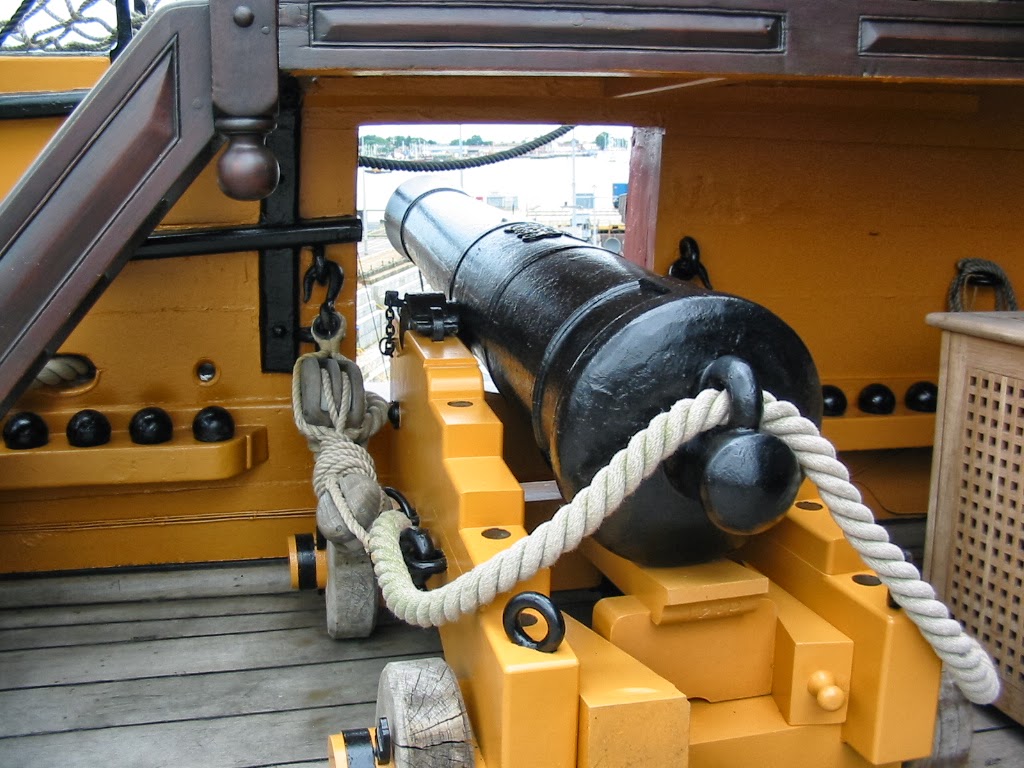
Cannon: Jack Tar’s prowess in firing was legendary
The men on the lower deck who helped achieve these odds were exceptional seamen, tough and loyal characters who have contributed to a sea culture that has flowered and endured over the centuries. They’ve often been painted as mere brutes but that is certainly not the case.

It’s time for the real Jack Tars to step out from the shadows and take their place among the heroes of the age. Nelson was adamant, and I have his words as the dedication to my first book, speaking of the officers aft on the quarterdeck and the men forward in the fo’c’sle; ‘Aft the more honour, forward the better man!’

As an aside, one of my most abiding images of Jack Tar is something that happened just before Nelson was finally laid to rest in St Paul’s Cathedral. Early in the morning of January 9th 1806 – a bright, fine, winter’s day – the funeral procession assembled in Hyde Park. The marshalled coaches snaked across Piccadilly and into St James Park, through Horse Guards and all the way to the Admiralty.

The huge funeral procession moved off at midday, preceded by companies of light dragoons, infantry, cavalry, artillery and grenadiers. 10,000 soldiers in all. They were followed by pensioners from Greenwich Hospital and seamen and marines from Victory, walking in pairs in their ordinary sea rig, but with black kerchiefs and stockings, and black crepe in their hats. And the sailors carried aloft the very white ensign the ship had flown off Cape Trafalgar.

The procession wound through silent streets to the slow beat of the Death March.

The funeral service lasted over four hours. Beneath the dome of St Paul’s hung a chandelier of 130 lamps, and below the floor of the aisle a special lift had been built to lower the coffin into the crypt. The procession had been ordered, the crowds reverent, the service solemn.

Then, at the last moment, when the 48 seamen from Victory were to fold the battle ensign and lay it upon the coffin they turned on the flag and tore it into pieces, as a remembrance for each man. An impulsive, emotional initiative worthy of Nelson himself.


Nelson’s funeral service

~~~~~~~~~~~~
Julian Stockwin was sent at the age of fourteen to Indefatigable, a tough sea-training school. He joined the Royal Navy at fifteen before transferring to the Royal Australian Navy, where he served in the Far East, Antarctic waters and the South Seas. In Vietnam he saw active service in a carrier task force. After leaving the Navy Julian attended university; he became a teacher and later practised as an educational psychologist. Julian lived for some time in Hong Kong, where he was commissioned into the Royal Naval Reserve. He was awarded the MBE and retired with the rank of Lieutenant Commander. He now lives in Devon with his wife and literary partner Kathy. More information can be found on his website . Julian also posts his own blog, BigJules and is on Facebook, Twitter and Pinterest.

He has written thirteen books to date in his Thomas Kydd historical action adventure fiction series. Although they form a series each title can be read as a stand-alone novel. The titles, in order are KYDD, ARTEMIS, SEAFLOWER, MUTINY, QUARTERDECK, TENACIOUS, COMMAND, THE ADMIRAL’S DAUGHTER, TREACHERY (published in the US as THE PRIVATEER’S REVENGE), TREACHERY, INVASION, VICTORY, CONQUEST AND BETRAYAL. Julian has also written a non-fiction book, STOCKWIN’S MARITIME MISCELLANY.

His next book is CARIBBEE, out on October 24.


Thursday, August 1, 2013

HMS Victory

by Julian Stockwin


Julian Stockwin in front of the HMS Victory
There have been many famous ship’s in Britain’s long history – Mary Rose, Golden Hinde, Cutty Sark, Trincomalee, Great Britain, Discovery – to name just a few. But one ship stands head and shoulders above the rest, I’m referring of course to HMS Victory, now in Portsmouth Historic Dockyard, and currently undergoing a major restoration to ensure her preservation for unborn generations.

England’s – and the world’s – most iconic ship already had a quite a number of years’ service before her most famous role as Nelson’s flagship at the Battle of Trafalgar, October 21, 1805.

In 1797 she returned to England, 32 years old, scarred and battle-weary. Late in that year, considered unfit for service, it was ordered she be converted into a hospital ship and eventual disposal. But Fate intervened – as it would several times in her career – and when the first rate Impregnable was lost in Chichester Harbour there was an urgent need for another three- decker for the Channel Fleet. Victory was to be given a new lease of life! Refitting commenced at Chatham Dockyard in late 1800.

Over the course of her active service she was flagship to many famous admirals – Keppel, Hyde Parker, Kempenfelt, Howe, Hood, Jervis, Saumarez – and Nelson.

Her keel was laid at Chatham Dockyard in 1759, the year of victories, annus mirabilis, probably the most significant year in British history since 1066. Admiral Boscawen defeated the French off the southern coast of Portugal; on the other side of the globe Wolfe took Quebec and Hawke saw a magnificent victory at Quiberon Bay. And in that year a young Horatio Nelson celebrated his first birthday.

The ship was officially christened Victory on 30 October 1760 in recognition of the victories of the previous year, although some had misgivings as the previous ship of that name had been wrecked with the loss of all hands!

A ship of the line like Victory required a great deal of timber for her construction; around 6000 trees were felled for the cause, mainly oak from the Wealden forests of Kent and Sussex. Her statistics are impressive: the vast amount of canvas that could be set meant a maximum sail area a third larger than a football pitch; if laid end for end, cordage used for her rigging would stretch 26 miles.

Despite her age, she once stayed at sea for two years and three months without entering port.

Victory’s magnificent figurehead is two cupids supporting the royal coat of arms surmounted with the royal crown. The arms bear the inscription of the Order of the Garter: ‘Shame to him who evil thinks.’ The current figurehead is a replica of the original one carved in 1801 at a cost of £50, which was damaged during the Battle of Trafalgar.


The Figurehead of HMS Victory
When I began to think about writing my Thomas Kydd series I came across some incredible statistics. In the bitter French wars at the end of the 18th century, there were, out of the six hundred thousand or more seamen in the Navy over that time, only 120, who, by their own courage, resolution and brute tenacity, made the awe inspiring journey from the fo’c’sle as common seaman to King’s officer on the quarterdeck. This meant of course that they changed from common folk to the gentry; they became – gentlemen. And that was no mean feat in the eighteenth century. 

Of those 120, a total of 22 became captains of their own ship – and a miraculous 3 became admirals! After Nelson and Hardy the two most important men aboard Victory at Trafalgar were of this mould, both originally common seamen – John Quilliam, first lieutenant and John Pascoe, the signal lieutenant.

Nelson was fatally shot at 1.15 pm October 21, 1805 by a French sharpshooter in the mizzen mast of Redoubtable.

Victory suffered the highest casualties of the British ships. Including Nelson, 57 were killed and 102 wounded.

The day after Trafalgar, Collingwood summoned Lieutenant John Lapenotiere in command of the schooner Pickle, the fastest vessel then at his disposal, and ordered him to sail to Plymouth with dispatches and then with all haste proceed to the Admiralty.

Lapenotiere was forced by weather conditions to land at the Cornish port of Falmouth. From there, his journey to London, 425 km, took 21 changes of horses and carriages and his expenses amounted to £46 19s 1d - nearly half his annual salary. Finally, the coach clattered into the Admiralty courtyard at 1 am in the morning of 6 November, 1805. Most of the officials had retired for the night but William Marsden, secretary to the Navy board, was on his way to his private apartments, having just finished work in the board room. Lapenotiere handed over the dispatches with the simple words, ‘Sir, we have gained a great victory. But we have lost Lord Nelson.’


Captain Hardy's Day Cabin in HMS Victory
Victory took Nelson’s body back to England for a state funeral. Myth persists that after he died he was preserved in a cask of rum and that on the way home some of the sailors drilled a small hole in the cask and drank the rum, hoping to imbibe some of his strength and courage. To this day, Royal Navy rum is known as ‘Nelsons blood’.

Nelson had made it clear that he did not wish his body to be committed to the deep. Surgeon Beatty was faced with the task of preserving the body. There wasn’t sufficient lead on board to make an airtight coffin and he had neither the knowledge or equipment for embalming. After cutting a lock of his hair for Lady Hamilton, Beatty placed Nelson’s shirt-clad body in a water leaguer, the largest barrel aboard. He then filled this with brandy, probably taken from a French prize and lashed the barrel to the mainmast in the middle of the deck, guarded 24/7 by an armed marine.

En route to Gibraltar a sentry got the fright of his life when the lid of the barrel began to rise, no doubt as result of release of internal gases. At Gibraltar Beatty found that the body had absorbed a quantity of the brandy, which was replaced by spirits of wine, a better preservative. The journey, owing to bad weather, took more than four weeks and over the course of it the cask was renewed twice with two parts brandy to one part spirit of wine.


Horatio Nelson
Back in England, Nelson’s body was placed in the L’Orient coffin, then sealed into an ornate outer coffin to lie in state. The L’Orient coffin is one of the most unusual battle trophies of all time. Captain Hallowell of HMS Swiftsure made it from wreckage of L’Orient, the French flagship that blew up at the Battle of the Nile in 1798. He presented it to Nelson with a covering letter: ‘My Lord, herewith I send you a coffin made of part of the L’Orient’s mainmast that when you are tired of this life you may be buried in one of your own trophies – may that period be far distant is the sincere wish of your obedient servant.’

Although his officers were shocked, Nelson was amused and for some time had the coffin standing upright against the bulkhead of his cabin. Subsequently it was stored with his agent. During a brief period of leave just before Trafalgar Nelson instructed that a certificate of authenticity be engraved on the lid adding, ‘I think it is highly probable that I may want it on my return.’ Was this a presentiment of his early death?

Although she was now well over 40 years old, considerably past the normal life span of a ship-of-the-line, Victory went on to further service in the Baltic and other areas. Her career as a fighting ship effectively ended in 1812. Ironically, she was 47 years old, the same age as Nelson had been when he died.

In 1831 Victory was listed for disposal but when the First Sea Lord Thomas Hardy told his wife that he had just signed an order for this, Lady Hardy is said to have burst into tears and sent him straight back to the Admiralty to rescind the order. Curiously, the page of the duty log containing the orders for that day is missing.

Victory
was permanently saved for posterity in the 1920s by a national appeal led by the Society of National Research.


Restoring HMS Victory, by William Lionel Wyllie
To this day Victory is manned by officers and ratings of the Royal Navy and now proudly fulfils a dual role as flagship of the First Sea Lord and a living museum of the Georgian navy.

It was my great privilege to have been given virtually unlimited access to the ship when I wrote my book VICTORY. Of course this was by no means my first visit, I must have toured over her a dozen times before!

HMS Victory Website

~~~~~~~~~~~~

Julian Stockwin was sent at the age of fourteen to Indefatigable, a tough sea-training school. He joined the Royal Navy at fifteen before transferring to the Royal Australian Navy, where he served in the Far East, Antarctic waters and the South Seas. In Vietnam he saw active service in a carrier task force. After leaving the Navy Julian attended university; he became a teacher and later practised as an educational psychologist. Julian lived for some time in Hong Kong, where he was commissioned into the Royal Naval Reserve. He was awarded the MBE and retired with the rank of Lieutenant Commander. He now lives in Devon with his wife and literary partner Kathy. More information can be found on his website. Julian also posts his own blog, BigJules and is on Facebook, Twitter and Pinterest.

He has written thirteen books to date in his Thomas Kydd historical action adventure fiction series. Although they form a series each title can be read as a stand-alone novel. The titles, in order are KYDD, ARTEMIS, SEAFLOWER, MUTINY, QUARTERDECK, TENACIOUS, COMMAND, THE ADMIRAL’S DAUGHTER, TREACHERY (published in the US as THE PRIVATEER’S REVENGE), TREACHERY, INVASION, VICTORY, CONQUEST AND BETRAYAL. Julian has also written a non-fiction book, STOCKWIN’S MARITIME MISCELLANY.
His next book is CARIBBEE, out in October.