Showing posts with label Queen Elizabeth. Show all posts

Saturday, January 7, 2017

Crawfie and The Little Princesses

by Linda Fetterly Root

The Little Princesses, First Edition 1950

In February 1988, a few months short of her 79th birthday, a somewhat reclusive Scottish woman died in Aberdeen. Her online obituary is skeletal. Considering her background, that should not have been the case. It was as if she had disappeared in the mid-1950’s, never to be seen again. Her name was Marion Crawford, and while her young adulthood had been spent in the service of the House of Windsor, her claim to either fame or infamy, depending on one’s viewpoint, was because of a book.

Marion Crawford, Associated Press, 1949
Until a surprise move by the Queen in releasing her 90th Birthday video, the most noteworthy acknowledgment of Marion Crawford as having lived at all has been the five-page Foreword to a 2003 edition of a book first published in 1950. The author of the Foreword to the newest edition of The Little Princesses by Marion Crawford is BBC Royal Correspondent Jennie Bond, who gently memorializes its author as a woman who had served the Windsors long and well, and parted with the Royals under a cloud of controversy and hints of treachery. Other writers have characterized her as'The Palace Ogre'.  Since the publication of the first edition of her book, Crawford has literally been erased from subsequently authorized accounts of the youth of the Princesses Elizabeth and Margaret. Her apologist, journalist Jennie Bond is far more famous than the woman whom she eulogizes.

Yet, it was the elusive Miss Crawford, born in Ayrshire in 1909, who influenced the life of a sixth-grade student at Euclid Park Elementary School in Cleveland, when the school principal gave me a copy of The Little Princesses as a going-away gift when we left for California in 1951. Miss Crawford, you see, had spent the past 14 years of her life as governess to the British Royal Family. The princesses in the story were not characters in a fairy tale. They were flesh and blood. I had seen them on the Pathe Newsreels at the movies.

The book sold relatively well in the thriving American market and was the first notable post-war Best Seller in Britain. That is not the least surprising, since, in the post-WWII years, there was considerable curiosity about the members of the current Royal Family and the King who had never been expected to wear the crown. Rather than the handsome, dashing David Windsor, also known as Edward VIII, who in 1936 abdicated for the American divorcee-times-two, Wallis Warfield Simpson, his younger brother Bertie, known as George VI, and his Scottish wife and sweet daughters were rather commonplace. The book has been called both romantic and sympathetic. Only the most jaded reviewer would call it an expose. The current edition is acknowledged as suitable for all ages.The day to day life of tidy Lillibet,( the way the Queen pronounced her name when she was small) and the antics of rambunctious Margaret are described with affection and discretion. Birmingham Mail reporter Maureen Messent, in an article published in 2012 hinted that even today the book was probably the closest glimpse the reading public would ever get of the Windsors.

2003 Edition with forward by Jenny Bond
Yet, from the day it was published, neither Crawfie’s close friend, the consort, Queen Elizabeth (later, the Queen Mother), or either of the princesses spoke to her again. She was totally ostracized by the members of the royal family, and even now, her role in the childhood of the Queen is not mentioned in most accounts. This might be expected of a British Press that had not covered the pre-abdication rumors of Edward VIII’s affair with Wallis Warfield Simpson, which was world news, but even the much more liberal press had little to say when Marion Crawford died in 1988.

‘Crawfie,’ as Marion Crawford had been dubbed by the Queen Consort, had joined the household when she was only 24, and the present Queen was six. Marion had been living in Dunfermline, an ancestral home of Scottish kings. She received her education there and dreamed of a career teaching underprivileged children. Half of her wish came true when friends called her to the attention of the future Queen Consort, then the Duchess of York, who was visiting Edinburgh. At the time, the Yorks were living modestly in Piccadilly with their two young daughters, and had no aspirations of wearing a crown. It is believed the Duke was enthusiastic over the appointment because of Miss Crawford’s youth. He had unpleasant memories of a childhood populated with stiff-necked governesses and tutors and wanted better for his cherished daughters.

Crawfie made a practice of taking the girls to public places and encouraged them to partake in functions appropriate to their station. She was instrumental in having a group of Girl Guides installed in the royal household and was proud of Elizabeth’s activities in support of the war effort. Marion was a shy, pleasant woman, and not without a life of her own. But when the man she later married first proposed and she discussed it with the Queen Consort, it was war time. “You cannot leave us now, Crawfie, not when we need you,' Queen consort Elizabeth is alleged to have said. Marion postponed the wedding until just before she retired in 1948. Like the Royals themselves, she had a strong sense of duty.She put her personal life on hold.
And therein lies the mystery of Marion Crawford. She always claimed she had the permission of the Royal Family to write about them. They, on the other hand, swore she had betrayed a special trust. She never once conceded that the publication of her book was unauthorized. In her book, she writes of the great price the princesses paid for their high positions in terms of a loss of privacy. Even in their public outings, access to the princesses was closely guarded. Crawfie was outraged at the intrusion of the press into discussions of Elizabeth's betrothal to Philip Mountbatten. Never once had she showed a tendency to profit from her position in the household. And yet, two years after her retirement, the book hit the presses, and a relationship that had endured for 14 years ended. From that time hence, when those close to the Crown speak out of school, their behavior is referred to as ‘doing a Crawfie.’ Other than as a subject of scorn, and a symbol of betrayal, Marion Crawford became a non-person in the Queen's childhood.

The inference she violated her position of trust for fame and fortune would appear self-evident if it were not so contrary to her behavior over the years. Recently, reports have surfaced of a plan to permit those closest to the Royal Family during the war years to comment to the American news media, as part of an effort to solidify the alliance between the United States and the Commonwealth. There was, however, a stipulation that those in service of the House of Windsor who published statements or gave interviews do so anonymously. Some of Marion Crawford’s apologists among the press suggest she interpreted the license to speak to be much broader than the Royals intended. But on the other hand, it is hard to picture her as that naive. Some say she felt slighted when other members of the Royal Household had received greater honors than she did when she retired. It is likely we shall never know.

Even her greatest critics agree that nothing in her strong-selling book did anything but elevate the position of the British Royal Family in the minds of those who read it. It certainly did so for me. If popularizing the British Crown with Americans who are both attracted and repulsed by the concept of a monarchy was the objective, the book should have been applauded, and its author should have been made a Dame.

The Final Chapter

The last bit of news on the topic of Marion Crawford comes from a video clip released on the Queen’s 90th Birthday. On January 5, 2017, the on-line edition of the Daily Mail reviews segments of the video and reports a thaw. In posting the queen's video, the Mail displays the film clip with the caption: ' Crawford, who was known as Crawfie and pictured here with the young Elizabeth, is featured in two royal home-movie clips used in BBC1’s Elizabeth At 90 this week — and was, crucially, acknowledged and named by a smiling Queen.’


~~~~~~~~~~
Linda Root is the author of the novels The First Marie and the Queen of Scots; The Last Knight and the Queen of Scots, and the Legacy of the Queen of Scots series, including Unknown Princess; The Last Knight's Daughter; 1603 The Queen's Revenge; and In the Shadow of the Gallows. It's sequel, The Deliverance of the Lamb is coming this summer.


Wednesday, October 24, 2012

Sir Francis Drake, the Hellburners of Holland, and the Sea of Horses

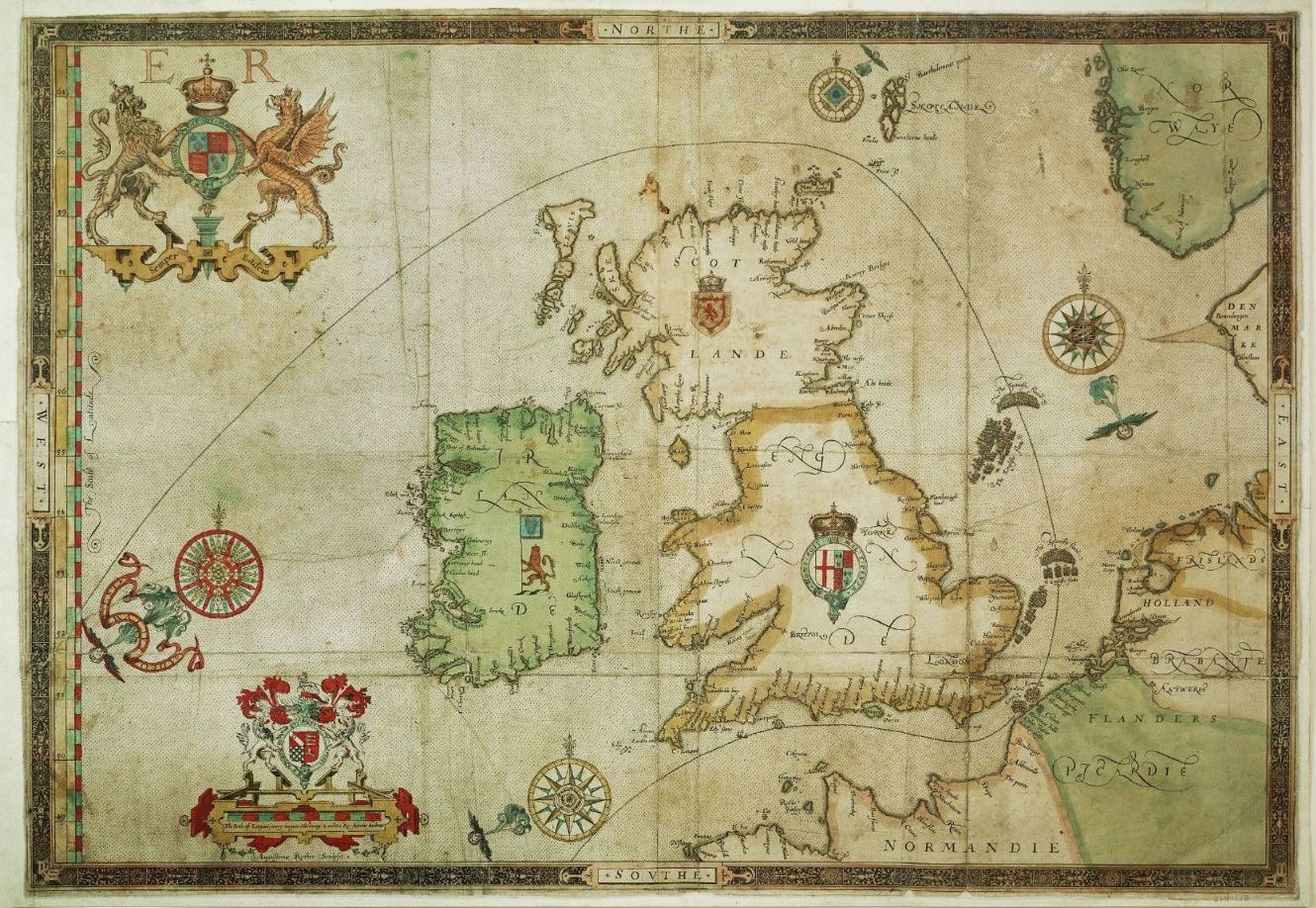
What defeated the Spanish Armada? Well, the English navy, of course, and Lord Howard, Francis Drake, John Hawkins. They sailed out of Plymouth in their gallant little ships and harried the Spanish galleons all along the Channel from the Lizard to Calais until the Spaniards had had enough. It was a great naval victory.
Well, yes, up to a point. The English ships – many of which were as big or even bigger than the Spanish – did all of that. It was a continuous naval battle lasting – with intervals – over a week. There was lots of cannon fire – particularly from the English, who probably fired about three times as many cannon balls as the Spanish. It was a major naval battle – 150 ships in the Spanish fleet, about the same in the English.
But – here’s a strange thing. Despite all those guns, and all those cannon balls, not a single ship was sunk by enemy fire on either side. Not one. Because naval gunnery simply wasn’t good enough.  And anyway, wooden ships were notoriously difficult to sink. Even in the battle of Trafalgar, when naval cannons were much more powerful, most ships were dismasted and battered into hulks, rather than being actually sunk.
So in 1588, the Armada made it all the way along the English Channel to Calais, battered, but unbeaten. The English ships were a nuisance, but the mighty Spanish fleet was still as much of a threat as it had been a week earlier. More so, in fact, because it was very close to achieving its first objective.
It’s important to understand that the Armada itself wasn’t an invasion fleet. Even though it had lots of soldiers and horses on board (more about those later) the Armada’s job was to act as an escort for another Spanish army, led by the duke of Parma, which was in Holland. Parma’s men (and horses) were supposed to cross the Channel on flat-bottomed barges, while the galleons of the Spanish Armada protected them from the English navy. The same plan that Napoleon and Hitler tried to use later.
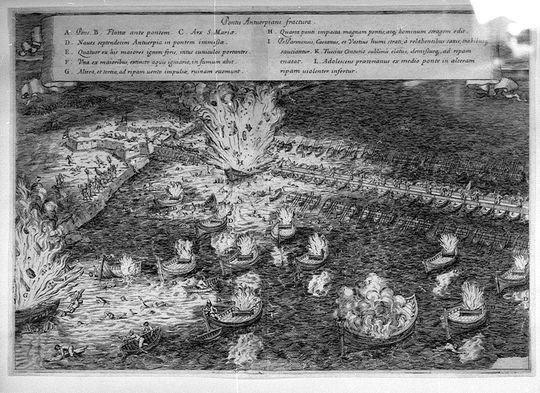
So why did it fail?   Well, that’s where the secret weapon comes in - the terrible Hellburners of Holland. These were really scarey – the nuclear weapons of the sixteenth century. They had first appeared in 1585, at the siege of Antwerp. The Spanish army had blocked access to the city with an 800 metre long bridge made of ships tied together across the river. The Dutch needed to break this blockade, or they would starve. So on the night of 4th-5th April 1585 they sent a fleet of 32 fireships floating downstream towards the bridge. The Spanish soldiers laughed. They didn’t think it would work.
But two of these fireships, the Fortuyn and the Hoop, were different. An Italian engineer, Federigo Giambelli, had made them into bombs. Inside each ship he had built an oblong chamber with a brick floor, walls five feet thick, and a roof made of lead with tombstones piled on top. He filled each chamber with 7000 pounds of high quality gunpowder. Then he fitted a delayed action clockwork fuse, and covered the chamber with a wooden deck so the ship looked normal.
The first ship, Fortuyn, ran aground before it reached the bridge, but the Hoop crunched straight into it. Then it exploded. All that gunpowder confined in a chamber produced a COLOSSAL explosion. According to the historian John Lothrop
            ‘The Hoop disappeared, together with the men (Spanish soldiers) who had boarded her, and the blockhouse, against which she had struck, with all its garrison, while a large portion of the bridge, with all the troops stationed on it, had vanished into air. It was the work of a single instant. The Scheldt yawned to its lowest depth, and then cast its waters across the dykes … and far across the land. The earth shook as with the throb of a volcano … Houses were toppled down miles away and not a living thing … could keep its feet. The air was filled with a rain of ploughshares, grave-stones, and marble balls, intermixed with the heads, limbs and bodies of what had been human beings. Slabs of granite, vomited by the flaming ship, were found afterwards at league’s distance, buried deep in the earth. A thousand soldiers were destroyed in a second of time; many of them were torn to shreds, beyond even the semblance of humanity.’

What has this got to do with the Armada? Well, three years later, when the Spanish Armada was anchored off Calais, waiting for the Duke of Parma’s army, the English admiral, Lord Howard, sent a fleet of 8 fireships floating towards them. This was a fairly desperate measure, after a week of inconclusive bombardment. Probably he hoped to set some Spanish ships on fire. But if he did, he was about to be disappointed.
Disappointed, because not a single Spanish ship was set on fire. The English fireships drifted harmlessly through the Spanish fleet, and burnt themselves out on the shore. All of them. So Howard had just wasted 8 of his own ships.
But he probably didn’t care – in fact he must have been delighted with the result. Because what the fireships did cause was chaos, and total, utter panic. The Spanish captains cut their cables, sailed into each other, crashed their ships on the shore, or fled out to sea. The next day there was a major battle off Gravelines, which scattered them further. Despite all the Spanish admiral’s appeals, the Armada never assembled as a disciplined force again. They gave up the idea of waiting for the Duke of Parma’s invasion force, and fled into the North Sea, losing touch with each other, and each surviving ship began its long desperate journey north, around Scotland and Ireland to their Spanish home. Lord Howard had finally won the victory which had eluded him for so long.
But what caused it? Why did the Spanish captains – all experienced seamen – panic like that? Why not just dodge the fireships and laugh at the English for wasting their own ships? Well, the answer lies in the Hellburners. Everyone had heard the horror story of the Siege of Antwerp, and the Italian engineer, Giambelli, was known to be working for Queen Elizabeth. So when the Spanish sailors saw those fireships bearing down on them, they thought they were looking at weapons of mass destruction. They were about to be vaporized.
It was a mistake, because none of the fireships were hellburners. The English navy had almost run out of gunpowder; they couldn’t have made one even if they’d wanted. But the Spanish didn’t know that. So they panicked and fled.
And the sea of horses? That’s a really sad story. Many of the Spanish ships didn’t just have men on board, they had horses too, for their officers to ride when they landed in England. But on the long journey home, they didn’t need the horses. Everyone on board was starving, and short of water. So …
A week or two after this battle, the skipper of a Hansa merchant vessel reported a strange, terrible sight. He’d sailed through an empty sea, he said, but everywhere he looked, it was alive with horses and mules, swimming desperately for their lives.
Tim Vicary writes historical novels and legal thrillers. You can read about them on his website and blog.
All images from Wikimedia commons


Tuesday, May 8, 2012

Elizabeth & Mary, Rival Queens: A Study of Leadership

by Barbara Kyle

Should we act from the head or from the heart? Deliberation or passion? In fiction, the Dashwood sisters in Jane Austen's Sense and Sensibility personify this choice in matters of love. Elinor carefully considers her desires, weighing them against her responsibilities, holding her deepest feelings in check. Marianne scoffs at such reserve and acts boldly on her passions.

When it comes to ruling a country, with stakes infinitely higher, two queens have immortalized this crucial choice. Elizabeth Tudor of England planned her moves with Machiavellian care, keeping her ambitious nobles in line and her kingdom safe from foreign attack. Her peaceful reign spanned over forty years. Mary Stuart, Queen of Scots, followed her desires, making impetuous decisions that enraged her nobles. She ruled for less than seven years, created turmoil and civil war, boldly gambled her kingdom by hazarding all on the battlefield, and lost.

Mary Queen of Scots
Elizabeth I of England

The two women were cousins. Yet they never met. When Mary fled to England to escape the Protestant lords who had deposed her she begged Elizabeth for protection and an army to fight her enemies. Elizabeth, however, needed Protestant Scotland as a bulwark against possible invasion by Catholic France or Spain, and so decided it was prudent to keep Mary in England under house arrest. Mary's captivity continued for nineteen years - a comfortable captivity befitting her status as a queen - during which she plotted ceaselessly to overthrow Elizabeth with the help of Spain and take her crown. Elizabeth waited out those nineteen years and finally, after the last plot almost succeeded, executed Mary.

It's a story that has enthralled the world for over four hundred years, sparking plays, operas, an endless stream of biographies, and several movies. (The latest starred Scarlett Johansson as Mary.) In 1895 one of the first movies ever made was an 18-second-long film of Mary's execution produced by Thomas Edison.

Edison's 1895 film The Execution of Mary Queen of Scots
In Edison's brief film the actress playing Mary lays her head across the executioner's block. He raises his axe. An edit occurs during which the actress is replaced by a mannequin. The mannequin's head is chopped off and the executioner holds it high in the air. It was filmdom's first special effect.

What is it about these two queens that so perennially fascinates us? I think it's that primal divide of head vs heart, of sense vs sensibility. Elizabeth, though passionate, acted with forethought. Mary, though intelligent, acted on her desires.

Francis and Mary
Partly it stemmed from their upbringing. Mary became queen of Scotland just days after her birth. Her French mother, Mary of Guise, ruled in her daughter's name and sent Mary at the age of five to France to join the French king's family in preparation for marriage to his son and heir, Francis. Growing up in the most glittering court in Europe, Mary was pampered and petted and loved by the French royal family. She married Francis when they were both in their teens, and when his father died a year later the young couple became king and queen of France. At age sixteen Mary had reached the pinnacle.

Elizabeth at about age thirteen
Elizabeth's upbringing could not have been more different. Hers was a childhood of uncertainty and fear. Her father, Henry VIII, beheaded her mother, Anne Boleyn, for adultery when Elizabeth was three. He disinherited Elizabeth. Her half-sister Mary came to the throne when Elizabeth was twenty-one and sent her to the Tower where Elizabeth, terrified, fully expected to be executed. But Mary died and Elizabeth, who had never thought she would rule, became queen at the age of twenty-five. In those perilous years she had learned to watch and wait, and never to act rashly.

It was a lesson Mary never learned.

These two queens, raised so differently, had very divergent outlooks on three aspects of monarchy. The first is what we today might call patriotism. Mary, formed by France, was not much interested in Scotland, which she considered an unsophisticated backwater. In 1560 her husband, the young King Francis, died and so did her mother, who had ruled Scotland in Mary's name. Mary was therefore free to return to her homeland and take up her birthright as its reigning queen. Instead, she chose to stay in France where life was pleasant, and spent many months casting about for a new European husband. Finding none to her liking, she grudgingly returned to Scotland.

Mary landing in Scotland

Elizabeth, on the other hand, loved her country and its people with a sincerity in her words and actions that rings to us down the centuries. She was proud of being "mere English" ("mere" in those days meaning "purely"). She enjoyed meeting common people on her journeys through the shires, and bantering with them with a familiarity that shocked the European aristocracy. She said often that her people were her family. Her people loved her in return.

Secondly, nowhere was the head-or-heart divide more apparent than in the choices these women made about marriage. For a queen, marriage was a crucial matter of state. After four years on the Scottish throne Mary fell passionately in love with an English nobleman, Lord Darnley, and despite the vociferous disapproval of her nobles she hastily married him. She even used her power as monarch to name him king.

Mary Queen of Scots and Lord Darnley
This splintered her court into factions - for and against Darnley - a situation that diminished much of Mary's power and led to a simmering civil war. Mary bore a son, James. But the marriage quickly soured when Darnley proved to be an arrogant, charmless wastrel. Mary turned to a tough military man on her council, the Earl of Bothwell, and there was gossip that they were lovers. Seventeen months after marrying the queen, Darnley was murdered. (The house he was sleeping in was blown up.)
James Hepburn, Earl of Bothwell

Bothwell was accused of the murder, tried, and acquitted. Three months later, Mary took him as her third husband. The people suspected her of having colluded with him to murder Darnley. When she rode back into Edinburgh the townsfolk hissed at her and called her "whore."

Elizabeth, famously, never married. She knew the danger if she did: her husband would be considered king, creating warring factions in her realm and eclipsing her power. For two decades foreign princes vied for her hand in marriage, and Elizabeth used them to negotiate alliances, and to disrupt foreign alliances that endangered England. She frustrated her councilors, who constantly urged her to marry to produce an heir. Elizabeth was acutely aware of the succession problem: a monarch who left no heir consigned their realm to likely civil war. And, with no heir of her body, her throne would pass to none other than Mary, her cousin. Elizabeth's decision to stay single was a hard one that brought her considerable personal anguish. She was heard to say, when Mary's son was born, that she envied Mary the baby "while I am barren stock." But she knew her decision was wise.

Thirdly, the head-or-heart divide had its greatest impact in how the two women ruled. The business of governance did not interest Mary. She rarely attended the meetings of her council, and when she did she sat and sewed. She enraged Darnley and her nobles by ignoring them and spending her time with her young Italian secretary, Rizzio.

Elizabeth was what we would call a "hands-on" leader, involving herself in every aspect of governance. Furthermore, on the eve of a possible invasion by the terrifying Spanish Armada she rode out to her troops assembled at Tilbury and inspired them to face the foe, giving an address so stirring that Winston Churchill quoted it to steel England's people to face a possible invasion by the Nazis.

Elizabeth addressing her troops at Tilbury
"Let tyrants fear . . . I have placed my chiefest strength and safeguard in the loyal hearts and good-will of my subjects. And therefore I am come amongst you ... being resolved, in the midst and heat of the battle, to live and die amongst you all." (Elizabeth at Tilbury)

Mary Stuart is to be pitied. She spent nineteen years under house arrest and died a gruesome death, beheaded at Elizabeth's order. But before she reached England it was her incompetence as a ruler in Scotland, her disastrous decisions in leadership, that led to her downfall there. If peace, prosperity, religious tolerance, and increased international respect are the fruits of successful leadership, Elizabeth Tudor remains one of England's greatest rulers.

_________________


Barbara Kyle is the author of the acclaimed "Thornleigh" novels set in Tudor England. Her latest release is The Queen's Gamble. 

She welcomes visitors to her website: www.BarbaraKyle.com   


Thursday, February 16, 2012

Elizabeth I's Royal Progresses and Kenilworth Castle


Nonsuch Palace

It’s well-known that Queen Elizabeth I moved her court away from her great palaces during the summer months, visiting the homes of various favoured courtiers in turn. This was largely to allow the palaces to be ‘purged’ after several months of residency, especially once the stench of human ordure had become too much to tolerate.

In the Queen’s absence, the royal apartments would be swept and scrubbed clean, with aromatic herbs burnt to dispel bad smells and the palace cesspits dug out. But a very real fear of plague was also behind this mass exodus. It was widely believed that fresh country air was a protection against plague, and that diseases could be caught from the polluted stench of towns and cities. Elizabeth herself always carried or wore a pomander of herbs and spices that she sniffed at constantly when the air was bad.

Elizabeth I, the Rainbow portrait

What is less well-known is the sheer scale of Elizabeth’s removals from court. Not only did the Queen take the bulk of her courtiers with her on these annual ‘Progresses’, as her trips around the country were known, but she was also accompanied by a fleet of her own household servants, including laundresses, seamstresses, cooks and grooms, plus all the usual accoutrements of a court on the move. These included selections of gowns and finery for the Queen and her ladies, hats, shoes, jewellery, goblets and tableware, precious books, even a selection of her palace furniture in case the house she visited was too humble for her taste. All this was transported in a vast convoy of carts laden with great wooden chests and dozens of servants. Sometimes as many as three hundred carts would set off in advance of the Queen's party.

Further servants would be on hand to tend to the courtiers, and in particular those members of the Privy Council who had been ordered to accompany the Queen. A few courtiers were permitted to bring their wives and children, so an array of wetnurses, maids and tutors might be added to the tally. The unfortunate courtier whose home was hosting the Queen’s Progress would be expected to bear the cost of almost every expense incurred by housing, feeding, and entertaining this vast travelling circus. Yet to host the Queen's Progress was considered a great honour, and many courtiers no doubt hoped to recoup their losses by increasing their status at court.

When Elizabeth I descended on Kenilworth Castle in July 1575, she arrived with such a vast entourage that Robert Dudley, Earl of Leicester, her court favourite and host for the next few weeks, was left nearly bankrupt for the rest of his life. Nonetheless, the stakes he was playing were equally high. For the ambitious Earl had not yet given up hope of persuading Elizabeth to marry him, and had planned every detail of her stay to underpin his final – and most desperate – proposal.

Robert even had the castle clock stopped at the moment of Elizabeth's arrival, a romantic gesture to indicate she had now entered a ‘magical world’ where outside time and reality ceased to matter. The theme of his entertainments rather daringly suggested that Kenilworth had become a kind of Camelot for her visit, with the Earl promoted to the status of King Arthur - and Elizabeth as his Queen.

Kenilworth Castle, Warwickshire: J.D. Forrester

The Earl’s entertainments were among the most lavish and elaborate ever seen in Tudor England, with giants playing trumpets on her arrival, nymphs and a Lady of the Lake on a floating island, outrageously extravagant banquets with goblets made of golden sugar and a gigantic salt cellar in the shape of a silver galleon, plays and mummers offered at every turn, even a staged attack by a Green Man in the forests where she loved to hunt every fine afternoon. Small wonder he was left bankrupt!

And the Queen and her courtiers were not the only ones to benefit from these amazing entertainments. It is widely believed that the young William Shakespeare, then a boy of eleven living in nearby Stratford, may have been brought to Kenilworth to witness one particularly spectacular firework display, since references to it crop up in his plays.

We know the Earl’s proposal was not successful. Something occurred to upset the Virgin Queen during those idyllic weeks at Kenilworth, for Elizabeth cut short her intended stay and remained at the castle only nineteen days before abruptly departing for the north. One tale goes that the Earl sent his friends to ride after the Queen, begging her not to miss the final entertainments that still awaited her, but Elizabeth ignored them and rode on. We can only speculate as to why.

Victoria Lamb’s debut historical novel "The Queen’s Secret" is set entirely at Kenilworth Castle during Elizabeth I’s visit in July 1575. It is available as a hardback and ebook in the UK, and as an ebook in the US.

Thursday, November 3, 2011

Religious Uncertainty of the Middle Ages by Felicia Rogers

In 1505, on a stormy night, a law student rode his horse through Germany on his way back to the University of Erfurt. Lightning flashed and thunder boomed, a crack of lightning landing ever close to his own physical person. Terrified of death, the young man cried out, "Help! Saint Anna, I will become a monk!" His life was spared and in return he left the study of law and became an Augustine monk. This man’s name was Martin Luther.


That fateful night was the catalyst for the Protestant Reformation. By the 1550s, it had already provoked religious uncertainty in England.

Until Henry VIII’s reign in the 16th century, England held Catholicism as its religion. This stayed true until Henry declared himself Supreme head of the Church of England in 1534. Most believe the reason Henry took this position was to divorce his first wife, Catherine of Aragon. But this was only one reason. Another was Henry’s disgust with the “Italians” controlling what the English were allowed to do. The pope’s role in the secular affairs of the country was a driving force in the separating of the church.

This separation of the two churches led to years of torment and persecution. The back-and-forth religious affiliations of the monarchy convinced many sincere Christians that their heads will be the next on the chopping block--or if not the block, then the funeral pyres.


After the death of King Henry VIII, his only son Edward took the throne. At age nine, the young lad with the help of his council kept the Protestant faith of his father alive. During his time on the throne, he placed Protestants in charge. Like Thomas Cranmer, who wrote the Common Book of Prayer, from which we get our wedding ceremony. Cranmer, the Archbishop of Canterbury, enacted many reforms, but this time was brief. Soon King Edward IV became ill. As the threat of his death loomed, fear for the Protestant way of life soared.

Mary, the first daughter of King Henry VIII and Catherine of Aragon, was next in line for the throne. Mary was a staunch Catholic. No matter the church reforms Edward had set in place, with his death they would no doubt be undone.


In fear for their lives, a plan was enacted. To keep the Protestant faith alive and the heads on the shoulders of the Protestant leaders, Edward and his council drew up an agreement placing his cousin, Lady Jane Grey, on the throne. Unfortunately this only lasted for nine days before Mary was crowned Queen of England anyway.

When Mary took control the religious dynamics changed. Catholic from birth, and blaming the break-away English church for her mother’s death, Mary used her power and authority for vengeance. She ordered the death of countless Protestant Christians starting with the John Rogers, who was responsible for a popular English Bible translation. She also ordered the death of Thomas Cramner, whom she blamed most of all. Under her rule, close to three hundred Protestants were martyred.

All this led to Mary’s nickname of Bloody Mary. Fortunately for the Protestants, Mary only ruled for five years before she passed. Upon her death, Elizabeth, her younger half-sister, and a proponent of the Protestant faith took over the throne. Her rule changed things yet again. Roman Catholicism was no longer in style. All those who had converted to please Mary could now themselves be under fire.

Although not widely known, history records Queen Elizabeth ordered the execution of quite a few Roman Catholics once she took the throne. One of the most notable was Mary Queen of Scots. Her Catholicism was considered a threat. Elizabeth ordered her death in February 1587. Despite these acts, Queen Elizabeth sat on the English throne for over fifty years and was popular among her people.


This religious upheaval is the time frame of my newest series of novels. The first one, There Your Heart Will Be Also, is a historical suspense romance which was recently published by Astraea Press. It is set in 1550s England against a backdrop of turmoil and uncertainty. To find out more about my book visit my website. While you are there feel free to leave a comment for a chance to win a free copy of my historical novel.