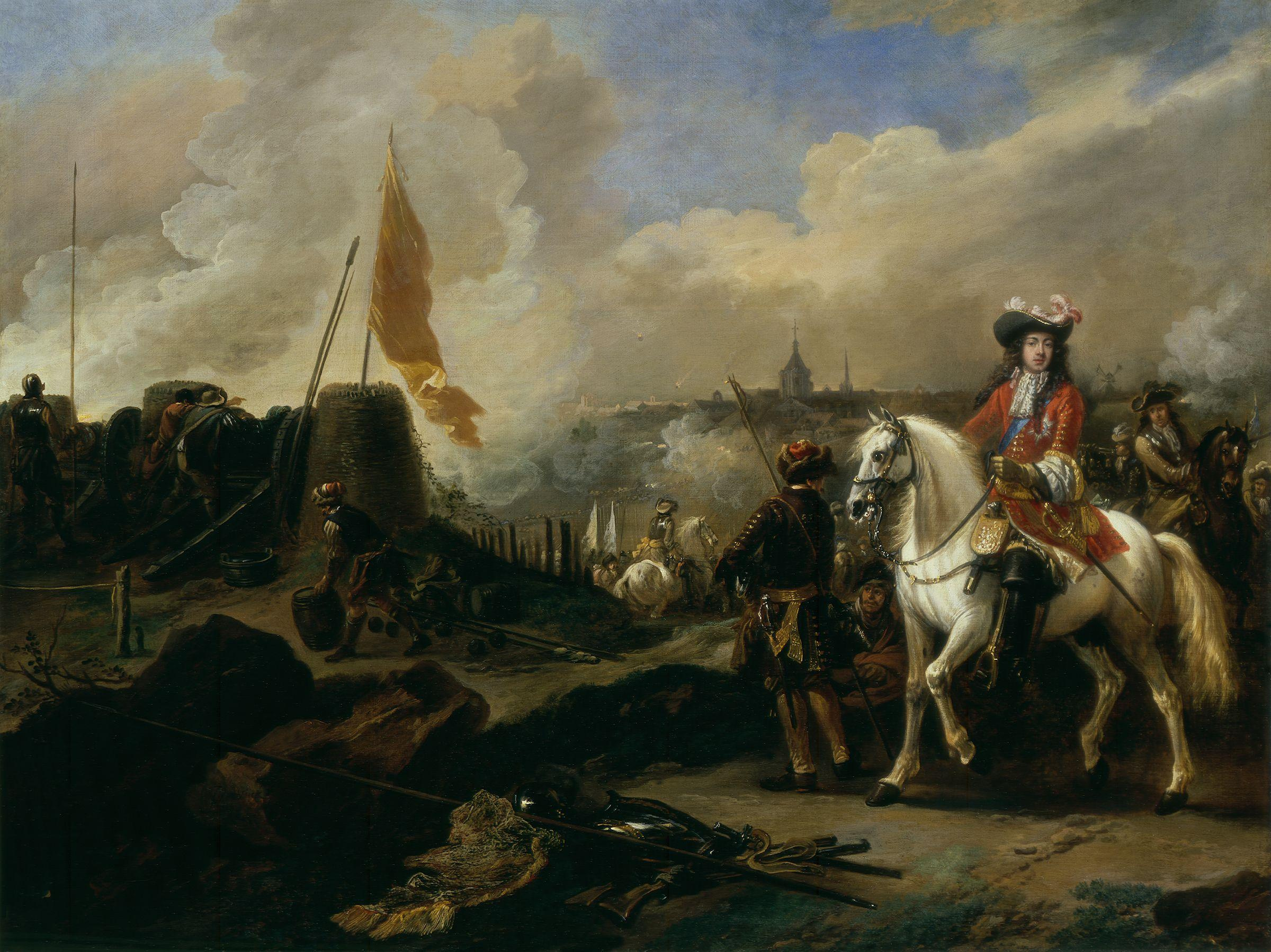
By then, Lucy’s prince had become a king. King Charles 1 had been executed three months before, so the baby’s father was now King Charles II – although still exiled from his kingdom. Charles liked the baby, but his love for Lucy did not last. There were plenty of other girls in Holland, after all, and he was a young king with time on his hands. Lucy died in 1658, not particularly mourned by Charles. But he was fond of young James, whom he openly acknowledged as his royal bastard, first of many.
In 1660 Charles II was triumphantly restored to his throne, and two years later he invited his son to join him at court. The thirteen year old boy was created Duke of Monmouth, and a year later was married to Ann Scott, the twelve-year old daughter of the Duke of Buccleuch. He adopted his wife’s surname, and was henceforth known as James Scott, Duke of Monmouth.
At this time it was perfectly clear what his status was – the beloved ‘natural son’ of the King. True, there were a few stories of how the young Charles, living in poverty in Holland, had once persuaded his threadbare courtiers to bow down before ‘Queen’ Lucy Walters, but no one took such tales as serious evidence that he’d actually married the girl. It was just play-acting, at a drunken party, in a foreign land, long ago. And besides, the wench was dead.
Anyway, Charles had a real wife. In 1662 he married Catherine of Braganza, a Portuguese princess. Catherine was 23, young and beautiful, Charles was virile, and everyone looked forward to the birth of a future Prince of Wales.
Charles was fond of his wife, but in his own way. Morals at his court were notoriously loose. He insisted, right from the start, that his mistress, Barbara Palmer, would be a lady of the Queen’s Bedchamber, and over the years he had many more mistresses, several of whom – like Nell Gwyn - bore his children. But unfortunately, Catherine did not. And so, as time passed, people began to wonder who might succeed Charles when he died. The obvious answer was his brother James.
But unfortunately, James was a Catholic. And that was unacceptable to many people in England. Parliament passed the Test Acts, insisting that all holders of public offices swear an oath to accept the doctrines of the Church of England – and the King, of course, was the head of that church. James refused, so people began to look for an alternative. And their eyes fell upon another James – James Scott, Duke of Monmouth.
Young Monmouth wasn’t interested in religion. He was an energetic, hearty young man, interested in physical sports. Samuel Pepys described him as ‘the most leaping gallant, that I ever saw; always in action, vaulting, leaping or clambering.’ He was an excellent horseman who loved hunting. He loved dancing too, the one interest he shared with his wife, until - perhaps trying to keep up with his energetic leaps – she hurt her leg and became lame. But that didn’t matter to Monmouth, who, like his father, had several mistresses, with whom he had children.
He frequented brothels like his father, too, with scandalous results. Once, at a brothel called Whetstone Park, a watchman asked him and his companions – two other dukes – to keep the noise down. Laughing, Monmouth gaily drew his sword and ran the man through, killing him. Even for Restoration England this murder of a law officer was a bit much, but the King didn’t mind. He granted:
‘A gracious pardon unto our dear son James, Duke of Monmouth, of all Murders, Homicides, and Felonies whatsoever at any time before the 28th day of February last past, committed either by himself alone, or together with any other person or persons.'
Amazingly, despite all this, the young Duke of Monmouth became a hero to – of all people – the English Puritans! Those who had once supported the ‘good old cause’ of Oliver Cromwell! Why? Well, partly because many people forgive sins a lord that they would never accept in their own family – why else is Charles II so popular? But also because Monmouth was, quite simply, a Protestant – and therefore better than his Catholic uncle James, whom they didn’t want as King at any price.
Also, like his father, Monmouth had the common touch – the ability to speak to ordinary people and make them like him. A bit like Prince Harry today, perhaps. Monmouth was a soldier too. He’d fought with reckless bravery in several campaigns in Holland, and in 1679 led the royal forces against a rebellion in Scotland. His victory was swift, decisive and merciful – only a few leaders being hanged, the rest transported to the West Indies.
So why did it all go wrong? Put simply, it was because the Exclusionist Party – those who wanted to stop his uncle James from becoming king – puffed up Monmouth to make him believe he was something he was not – the legitimate son and heir of Charles II. Lucy Waters and Charles had been married, they claimed; lost certificates in a Black Box would prove it. Vast crowds cheered Monmouth in the West Country. He even laid on hands to cure the King’s Evil. (Something only a King could do) The trouble was, nobody could find this Black Box, and the King resolutely denied the story:
‘I do here declare, in the presence of Almighty God, that I never was married nor gave any contract whatsoever but to my wife, Queen Catherine.’
If only Queen Catherine, like Charles’s mistresses, would have a son! But she didn’t. This annoyed the Duke of Buckingham so much that he urged the King to have her kidnapped and sent to Virginia. Then he could divorce her on the grounds of desertion and marry someone else. But unlike Henry VIII, Charles was loyal to his barren wife. He might have dozens of mistresses, but she was his Queen and that was how it was going to stay. Maybe one day, she might even get pregnant …
And then, quite suddenly, he died. His brother, Monmouth’s uncle, became King James II – the first openly Catholic monarch since Bloody Mary.
What was Monmouth to do? Well, rashly, bravely, he sailed from Holland with just three ships to claim the throne. He landed at Lyme Regis, and raised an army of Protestant clothworkers and artisans. ‘Fear Nothing But God’ his standard read – a motto that appealed to his sober, God-fearing followers. In Taunton he declared himself King – a little awkward, since his name, James, was the same as that of the other king, his uncle.
Did he expect to win? Well, yes, presumably. He hoped and believed that his friends, young nobles and soliders with whom he’d shared battlefields and brothels a-plenty, would ride in to join him with regiments of skilled, well-equipped cavalrymen.
But none did. And at the battle of Sedgemoor his brave, half-trained levies were slaughtered by well-trained professionals. Monmouth fled, but was captured in a field in Dorset, and dragged before his grim-faced, merciless uncle. Despite pleading on his knees for his life, he was beheaded on Tower Hill next day.
Would he have made a good king, if he’d won? Unlikely. He’d inherited his father’s love of women, horses, and wild adventures, but none of Charles II’s political skill and cunning. Lord Bruce described him as ‘most charming both as to his person and engaging behavior, a fine courtier, but of a most poor understanding as to cabinet and politics, and given up wholly to flatterers and knaves by consequence.’
That was why his wiser friends did not join him. He was being used by others for their own ends. The tale of Lucy Waters’ marriage and the Black Box was just that; a story his supporters had invented to suit themselves. They knew he wasn’t a real king, and his father knew that too. Once you break the principle of legitimacy, it’s hard to get it back. You’re not far from electing your rulers, and deposing those you don’t like. If Monmouth had become king, he’d have been in a shaky, uncertain position, challenged by critics on all sides. It had been hard enough for his father, and he was a real king.
James Scott was a handsome playboy, who gambled and lost. Not a Protestant prince after all.
*****
Tim Vicary’s novel, The Monmouth Summer, is available on Amazon US and Amazon UK as an ebook and a paperback. You can read about his other books on his website and his blog.


 Chucking a bastard son or two into the mix is always bound to muddy the waters - there are those who argue vociferously that Richard I, he with the Lionheart, was homosexual. And yet, Phillip of Cognac was his illegitimate son and may not have been the only one.
 Conjecture also surrounds the legitimacy of Charles II's most famous 'bastard', James, Duke of Monmouth. Charles was not above acknowledging his offspring and handsomely endowing his children and mistresses with lands and titles. But, like Henry I, he had no legitimate male heir, he was getting old, and trouble was brewing. The problem hinged upon the details of Charles' relationship with Monmouth's mother, Lucy Walter, and the existence, or not, of a piece of paper that would prove the couple was officially married - a marriage certificate kept in a secret Black Box, the existence of which was denied by Charles. Whether or not he believed himself to be illegitimate, (he claimed he wasn't), it didn't stop Monmouth making a bid for the throne upon the death of Charles II. Religion being another 'slight' problem, many people preferred the 'bastard protestant' Monmouth to any legitimate but Catholic offspring of Charles' legal heir, his brother James II.
 Of course, a few weeks ago in October, we 'celebrated' the anniversary of one of the most famous battles in English history, and we can say without doubt that illegitimacy was no hindrance to William the Conqueror, or William the Bastard, to give him his proper name. A couple of days ago it was Christmas Day, a significant date for William, for that was when he was crowned in Westminster.


_-_Google_Art_Project.jpg)