Showing posts with label Lord Mohun. Show all posts

Tuesday, September 18, 2018

Mistress of More Variety: Actress Susanna Verbruggen

by Margaret Porter


Drury Lane Theatre in the late 17th century

Susanna/h Percival was likely born in 1667. Her father, Thomas Percival, was a lesser actor in the Duke's Company of players, and as did many a young person of her era, she entered the family business. Her initial stage appearances may have taken place during her childhood but by 1681, when she was about 14, she was performing with the King's Company in Drury Lane. Her first known role was the vulgar character Welsh Winnifred in Thomas D'Urfey's play Sir Barnaby Whig. In 1683, as a member of the United Company at the Dorset Garden Theatre, she was seen in a breeches role, listed in the bill as Mrs Percival--actresses, whether wed or not, were typically referred to as "Mrs". From the start of her career her skill for comedy and her attractiveness in male costume were apparent to playgoers, and managers and playwrights exploited these assets.

She married a handsome and popular fellow player, William Mountfort/Mountford, on 2 July, 1686, at the church of St. Giles in the Field. Apparently she was one of the rare respectable actresses who maintained her virtue until her wedding day, for Sir George Etheredge observed that, "Mrs Percivall [sic] had only her youth and a maidenhead to recommend her." He, along with Dryden, thought little of Mrs Mountford's talents in these early years--perhaps because of the limited, low-comedy nature of her parts.

Over time, however, she was given more sophisticated roles, often performing opposite her charming husband. Playwrights sometimes relied on the couple's marital partnership as inspiration. Mountford, who wrote as well as performed in plays, included his wife in his compositions,  creating more of the breeches roles for which she was so popular. He is also credited with inventing the immortal phrase "be still my beating heart," a line in his play Zelmane.


Thomas Southerne
In 1690, Thomas Southerne provided Susanna's most successful character in his play Sir Anthony Love. Its principal character Lucia disguises herself as "Sir Anthony" in order to live as freely as the male rakes. The epilogue contained a reference to Susanna: "You'll hear with Patience a dull Scene, to see,/In a contented lazy waggery,/The Female Mountford bare above the knee." Not only were her legs admired. According to Anthony Aston, she was a "fine, fair woman, plump, full-featured; her face of a fine, smooth Oval, full of beautiful and well-disposed Moles on it, and on her Neck and Breast… Whatever she did was not to be called acting; no, no, it was what she represented. She was neither more nor less, and was the most easy actress in the world."

Her home life must have been as taxing as her professional life. She bore three children in quick succession: Susannah (b. 1690); an infant son who died (1691); and Elizabeth, who suffered the same early death as her brother (1692). By late 1692 she was pregnant once more, but tragedy prevented her husband from meeting his fourth child.

Captain Richard Hill was an admirer of the popular and outwardly chaste actress Anne Bracegirdle, who frequently appeared opposite William Mountford. When she rebuffed Hill's overtures, he jumped to the mistaken conclusion that she granted her favours to her on-stage lover Mountford. Madly jealous, he and his crony Lord
Charles, 4th Baron Mohun
Mohun, aged only fifteen, concocted a plan to kidnap the actress from the theatre and force her into marriage. The intended abduction was prevented at the last minute, further provoking Hill's rage, and he hastened to Mountford's house in Howard Street to lie in wait. The actor returned home from the theatre quite unaware that his life was in peril. As he conversed with Mohun, Hill moved forward with sword brandished. After stabbing his supposed rival, he promptly fled. Lord Mohun was seized. The wounded Mountford was carried to his bed, where he died the next morning.


A thousand people attended the actor's funeral at St Clement Danes. His popularity with the monarchs was such that the Royal Chapel choristers sang at the service, and court musician Henry Purcell played the organ. On that sorrowful occasion, the great church bell cracked from repeated tolling.
 
Susanna gave birth to a fatherless daughter the following April and christened her Mary at St Clement's. Captain Hill had escaped, first to the Channel Islands and then to the Continent, and thus could not be tried for the actor's murder. But the House of Lords did hear the case against his conspirator Lord Mohun, and promptly voted acquittal. Susanna fully intended to appeal what she regarded as a most unjust verdict, but was prevented by another family tragedy.

On 17 Oct ’93 her father, Thomas Percival, was sentenced to death for clipping coins—a capital offence. Only by abandoning her appeal, she was told, could she save him from hanging. One account indicates that that she directly petitioned Queen Mary II:


Under this most unparalleled affliction she was introduced to Queen Mary, who being as she was pleased to say struck to the heart upon receiving Mrs Mountfort's petition, immediately granted all that was in her power, a remission of her father's execution, and afterwards was graciously pleased to procure a mitigation of his sentence, which was changed to that of banishment [transportation]. But Mr Percival being weakened by his long imprisonment fell ill upon the road and died at Portsmouth.

Susanna's widowhood was brief, for on 31 January, 1694, she married her fellow actor John Baptista Verbruggen at St Clement Danes. He had previously performed under the stage name Alexander, and first appeared at Drury Lane in 1688. This was apparently a union of necessity at worst, convenience at best, rather than a romantic one. Verbruggen was an energetic and skillful actor, for according to Aston, "That rough diamond shone more bright than all the artful polished brilliants that ever sparkled on our stage...nature without extravagance, freedom without licentiousness, and vociferous without bellowing." He was also  rough of speech,  short-tempered, and prone to violence. As for Susanna, “She was cautious, lest fiery Jack should so resent it, as to breed a quarrel--for he would often say--‘Damme! tho’ I don’t much value my wife, yet nobody shall affront her!’ and his sword was drawn on the least occasion.”


Thomas Betterton, actor and manager
The United Company with which they performed became disunited late in 1694. Hoping for better pay, the Verbruggens were tempted to desert managers Rich and Skipworth and follow Thomas Betterton into a new acting company. But they would not have had as many leading parts, and the Lord Chamberlain urged them to continue with their Drury Lane employers. Jack's pay was raised from £2 to £4 per week, with a share of profits, placing him at the highest tier of the pay scale, and articles drawn up in the spring of 1695 indicate Susanna's salary:
1. John Verbruggen agrees that, for a payment of £75, his wife will act in the theatre.
2. Susanna Verbruggen to have £4 out of £20 ... if this does not amount to £105 per year (i.e £3 a week for 35 weeks) this sum shall be made up to her. At the end of every 6 acting days (except when the young actors play for their own benefit) she shall have £3 till the whole £105 is completed. If, on the other hand, her share comes to more than £105 she shall be allowed to keep it.

Charles Beauclerk, 1st Duke of St Albans
Later that year a backstage scandal threatened the Verbruggens' livelihood. One evening after a Drury Lane performance of Southerne's Oronooko, the Duke of St Albans (illegitimate son of King Charles II and actress Nell Gwyn) visited Susanna's dressing room. This infuriated her husband, who struck the duke and called him the "son of a whore." Assualting and insulting a peer of the realm was a most unwise action, considering that players were royal servants. And the duke, though illegitimate, was by blood first cousin of the King and the Queen.

On learning of the incident, the Lord Chamberlain advised Verbruggen to make a public apology to St Albans from the stage, or else lose his place in the company. The next evening the actor complied, however his apology was couched in such terms that it hardly negated the insult. He retained his place at Drury Lane. Susanna's opinion of what occurred, and her precise relationship with the duke, if any, remain a matter of speculation.

In 1697 Verbruggen broke with Drury Lane, after verbally abusing Skipworth, striking another individual, and breaking the peace. When he left to join Betterton's troupe at Lincoln's Inn Fields, Susanna remained at Drury Lane--fortunate for its proprietors.  Her importance and popularity was as considerable as her talents. She played society coquettes, ladies disguised as men, and low-life characters with equal flair and success.

One of Susanna's greatest admirers was Colley Cibber, as proved by his descriptions of her in his memoirs.


Mrs Mountfort, whose second marriage gave her the name of Verbruggen, was mistress of more variety of humour than I ever knew in any one woman actress. This variety too was attended with an equal vivacity, which made her excellent in characters extremely different. As she was naturally a pleasant mimic, she had the skill to make that talent useful on the stage a talent which may be surprising in a conversation and yet be lost when brought to the theatre….But where the elocution is round, distinct, voluble, and various as Mrs Mountfort's was, the mimic there is a great assistant to the actor. Nothing, though ever so barren, if within the bounds of nature, could be flat in her hands. She gave many heightening touches to characters but coldly written, and often made an author vain of his work that in itself had but little merit. She was so fond of humour, in what low part soever to be found, that she would make no scruple of defacing her fair form to come heartily into it….

Colley Cibber, actor and dramatist

In the summer of 1703 she failed to accompany her fellow players to Bath, pleading illness--she was pregnant. She went into labour on 2 September, and died in childbirth. Her husband, who after her death performed with various London companies and in Dublin, outlived her by just five years.

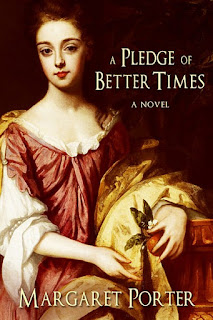
One hopes that she found satisfaction in the artistry that pleased her audiences so well. Several incidents described above appear in my recent novel about the Duke and Duchess of St Albans, and in researching Susanna I both liked and pitied her. On stage she portrayed independent women of spirit, yet it seems that the men in her offstage life--to whom she was so valuable--held the balance of power. And it is these men only whose portraits survive, and illustrate this article.

[This article is an Editors' Choice, originally published on 21 April 2016]
~~~~~~~~~~


Margaret Porter is the award-winning and bestselling author of twelve period novels, whose other publication credits include nonfiction and poetry. A Pledge of Better Times, her highly acclaimed novel of 17th century courtiers Lady Diana de Vere and Charles Beauclerk, 1st Duke of St. Albans, is her latest release, available in trade paperback and ebook. Margaret studied British history in the UK and the US. As historian, her areas of speciality are social, theatrical, and garden history of the 17th and 18th centuries, royal courts, and portraiture. A former actress, she gave up the stage and screen to devote herself to fiction writing, travel, and her rose gardens.
Margaret's latest novel is A Beautiful Invention: A Novel of Hedy Lamarr, available fore pre-order HERE 


Wednesday, September 21, 2016

The Dangerous Duellist: Charles, Baron Mohun

by Margaret Porter

The 4th Baron Mohun
Charles Mohun, the 4th Baron Mohun, was born about 1675 to the 3rd Baron Mohun of Okehampton and his wife Lady Phillipa Annesley. Through the latter the infant was grandson of the 1st Earl of Angelsey, who served as Lord Privy Seal and produced political and religious treatises. Pepys referred to Anglesey as 'one of the greatest knaves in the world,' and during his life little Charles would exceed his grandsire's reputation.


His father had inherited substantial lands in Cornwall and Devon--as well as considerable debts. The marriage to Lady Phillipa was entirely mercenary, she was a termagant, and the union neither prospered nor lasted. Shortly after his heir's birth, the 3rd Baron served as Lord Cavendish's second in a duel with an Irish officer. At the conclusion of the contest Mohun insulted his friend's opponent, resulting in a second swordfight, and the brawling baron died from his severe wounds.
The infant 4th Baron and his two-year old sister Elizabeth were left to the care of a cruel, careless, and quarrelsome mother. His upbringing was hardly the sort to bestow virtue, patience, and manners. Unlike most young men of noble birth, he did not attend university. He married in 1691, aged just fifteen. His bride was Charlotte Orby, his guardian's daughter and the niece of his close friend Lord Macclesfield, and she had no dowry. In November of 1692 she bore a stillborn son.

Several weeks after this distressing event, the sixteen-year old baron fought his first duel. After a night of drinking he quarreled with Lord Kennedy, four years his senior. King William III, hearing of it, feared that a duel might ensue, and commanded both young gentlemen to remain at home. They chose not to obey their monarch's edict. In the course of their battle, each received a minor wound.

Two days later Mohun assisted his closest friend, the equally wild Captain Richard Hill, in the failed abduction of the actress Mrs Bracegirdle. Hill, who regarded actor William Mountfort as his rival for the lady's affection--quite mistakenly--ran him through with a sword late at night in the middle of a London residential street. Hill fled the country. Mohun was arrested. His response: 'Goddamme, I am glad he's not taken, but I am sorry he has no money about him, I wish he had some of mine. I do not care a farthing if I hang for him.'

The magistrates charged him with murder but after a single night in jail his bail was paid and he was released. Judged a flight risk by the House of Lords, he was confined to the Tower of London to await his fate.

In a sensational trial, the House of Lords tried the baron as an accessory to the crime, and in February 1693 he was acquitted and released. Either the weeks of his imprisonment impaired his health, or his celebrations after gaining his freedom, because by October that year it was reported that he 'lies very ill at Bath.' Mountford's outraged widow attempted to appeal what was, from her perspective, a most unjust verdict. Her father had recently been convicted of a capital crime--clipping coins--and by dropping her intended action she was able have her parent sentenced to transportation rather than execution.

Recovered from his ailment and back in London, Mohun returned to form. Drawing his sword against a hackney coachman, he was prevented from slaying the man by a member of Parliament, whom he then challenged to a duel which never actually took place.

Deciding to use his fighting instincts in the service of king and country, he joined the military. On March 10, 1694 the diarist Luttrell records, 'The Lord Mohun is made a captain of a troop of horse in Lord Macclesfield's [sic] regiment.' Three days later he noted, 'The Earl of Macclesfield goes with his majestie to Flanders, as a major general, and the Earl of Warwick and Lord Mohun as volunteers.' Warwick was one of Mohun's cronies, a partner in drinking and debauchery.

Whatever discipline the baron absorbed in the ranks, it didn't improve his behaviour. In spring 1695, he battered a member of the press in a London coffee house. Two years later his next duel took place in St James's Park. His opponent, Captain Bingham, survived the encounter--park keepers intervened--and Mohun sustained a wound to his hand.

In September of that same year, 1697, at the Rummer Tavern in Charing Cross, he engaged in a drunken quarrel with a Captain Hill. This was not the perpetrator of the Mountford murder, but another of that name and rank serving in the Coldstream Guards. Mohun stabbed him and fled; the captain later died. Mohun took refuge in the Earl of Warwick's house, where the constables seized him. At the coroner's inquest he was judged guilty of manslaughter.

According to a contemporary account, 'Yesterday [27th November] the lord Mohun appeared upon his recognizance at the King's Bench bar, and there being an indictment of murther found against him by the grand jury of Middlesex for killing Capt Hill, the court committed him to prison in order to be tryed for the same.' His place of confinement was not to his liking or  suitable to his status, and on the 13th of December 'the lord Mohun petitioned the house of peers to be removed from the King's Bench where he was committed last term for the murder of Captain Hill, to the Tower, which was granted.'

This time, however, he avoided trial--most likely because he'd reached his majority. Now twenty-one, he was entitled to take his seat in the House of Lords, and the King needed his support. At the 11th hour he received a royal pardon, which he duly presented to the House. Within days he was seated with his fellow peers as a Whig lord with good reason to approve all of His Majesty's demands for additional war funding.

Never one to learn from past crimes, Mohun committed another in late October of the very same year:


On Sunday about 3 in the morning a quarrel happened at Locket's [a tavern] near Charing Crosse between Captain Coot [sic] son to Sir Richard Coot, and Mr French of the Temple, who thereupon went and fought in Leicester Feilds. The Earl of Warwick and Lord Mohun were for the first, and Captain James and Ensign Dockwra for the 2d. Coot was killed upon the spott, and it's said French dangerously wounded but made his escape with the rest.

The House chose to try Mohun and Warwick separately, but it was uncertain which of the five men present at the altercation had struck the fatal blow. In January Mohun returned to the Tower to await trial and remained there for several months. On 28th March, 1699, 'the earl of Warwick and lord Mohun were brought by the lord Lucas from the Tower to Westminster the axe being carried before them they are now on their tryalls on account of the death of captain Coot [sic] which is like to last long.' On that day the earl was convicted of manslaughter and given the mildest of punishments: a cold branding iron in the shape of 'F' for 'felon' was applied to his hand, leaving no permanent mark upon it. The following day Mohun was unanimously acquitted but received a severe warning from Lord Chancellor Somers that he could not expect mercy in future if he continued on his disastrous path.

In 1701 the Act of Settlement designated the Protestant Sophia, Electress of Hanover, and her heirs as William III's successors to England's crown. Lord Macclesfield was the King's choice to deliver a ceremonial copy of the decree, and Lord Mohun accompanied him to Hanover. Within days of their return to London, Mohun stood at his gravely ill friend's bedside. The earl's death on 4th November was followed by the discovery that he'd disinherited his entire family in Mohun's favour.


James, 4th Duke of Hamilton
As possessor of a fortune between £40-100,000 and now a visible, active, and useful member of the House of Lords, Mohun's problems ought to have been behind him. Unfortunately, he had an enemy--James, the Scottish 4th Duke of Hamilton, husband of another of Lord Macclesfield's nieces. The duke, in desperate financial need, felt entitled to Macclesfield's estate, and legal battles ensued. Bills were filed. Chancery suits were begun. The King died. A Queen was crowned. Under the new regime, Hamilton's sometime support of the Catholic Pretender did not work in his favour. As for Mohun--he was a Whig, and Queen Anne a staunch Tory.

In 1711, Mohun, by then a widower, took his mistress as his second wife. She was Elizabeth Griffith, widow of a colonel and a daughter of Sir Thomas Lawrence, a physician to the Queen. He had hardly installed her in his residence, Macclesfield House, than he departed it to take up lodgings in Great Marlborough Street.

Not until 8th February, 1712, was his inheritance dispute with Hamilton heard by the Committee of Privileges in the House of Lords. A tie vote resulted--Mohun voting in his own interests, Hamilton absent. When proxies were counted, Mohun prevailed in a vote of 40 to 36. And still they waited for the ruling from Chancery.

But it wasn't the courts that put an end to a dispute. It was, of course, a duel. Not a polite, mannerly affair between a pair of nobleman who deemed honour at risk. What occurred in Hyde Park on the early morning of 15th November was a brutal and decisive battle between bitter adversaries.


When the Duke of Hamilton, Lord Mohun, and Macartney [Mohun's second] came to the place agreed on them to fight, the Duke and Lord Mohun had no sooner drawn their swords than Macartney drew his, as Colonel Hamilton did the same . . . he [the Colonel] striking down Macartney's sword...closed with Macartney and took his sword from him, by which time Lord Mohun was down on the ground and His Grace upon him. The Colonel, the better to help the Duke up, flung both swords upon the ground . . . Macartney came with a sword in his hand, and gave a thrust into the duke's left breast . . . the Duke at the same time saying, I am wounded, and whilst the said Colonel Hamilton was helping him Macartney escaped.


A representation of the doubly fatal duel in Hyde Park

The stab wound to the duke's chest was superfluous; one of Mohun's blows had severed the artery in his wrist. The two enemies lay dead, their blood seeping into the grass.

The Colonel stood trial, was convicted of manslaughter, branded with the cold iron, and went free. General Macartney fled England and tried to exonerate himself through pamphlets. While in Europe he gained an ally in the future George I and wished to follow the new King to England. He sought to have his outlawed status altered in order to belatedly stand trial for his role in the duel.

Two years later, when the case was finally heard, Hamilton said he couldn't swear that the accused had actually murdered the duke. Macartney likewise received a non-branding and went free--as the bad baron had done so many times in the course of his duelling career.

~~~~~~~~~~~~~~

Margaret Porter is the award-winning and bestselling author of twelve period novels, whose other publication credits include nonfiction and poetry. One notorious incident in which Lord Mohun participated appears in A Pledge of Better Times, her highly acclaimed novel of 17th century courtiers Lady Diana de Vere and Charles Beauclerk, 1st Duke of St. Albans. Margaret studied British history in the UK and the US. As historian, her areas of speciality are social, theatrical, and garden history of the 17th and 18th centuries, royal courts, and portraiture. A former actress, she gave up the stage and screen to devote herself to fiction writing, travel, and her rose gardens.
Connect with Margaret:
Website | Blog | Facebook | Twitter | Amazon