Showing posts with label William III. Show all posts

Monday, June 29, 2020

When Kensington Palace became a Royal Residence

by Andrea Zuvich

There’s something about Kensington Palace that immediately conjures up the word glamorous. Perhaps it is because in recent memory, it has been the home of notable, glamorous royals such as the late Princess Margaret, the late Diana, Princess of Wales, and also because of its current inhabitant, Catherine, Duchess of Cambridge. But what we now know of Kensington Palace is very different from what it once was. As I had the great honour to have been on the original team that developed the Garden History Tours at Kensington Palace, I learned first-hand about the history and rather more humble origins of the great royal palace – and I hope to share some of that here with you all today. 

Before modern Kensington became the playground of the world’s richest people, it was a sleepy verdant little village renowned for its purity of air. Royals have only inhabited the house since the late 17th-century, when William III and Mary II moved in. But the history of the land goes back farther than that. According to Kensington Palace by W.J. Loftie, a late Victorian historian, the land upon which Kensington Palace now lies was (in the 14th century) on an area called Neyt Manor, one of three manorial estates owned by the Abbey of Westminster. Indeed, archival documents and archaeological assessments from the Royal Borough of Kensington and Chelsea state there was a Neyt Manor in 1386. Whatever building was left standing is believed to have been demolished in 1602.

A Jacobean house was built in 1605 for Sir George Coppin three years after the Neyt Manor structure was razed. Following Coppin’s death in 1619, it was purchased by the Finch family. Much later on, the house was named “Nottingham House” because Sir Heneage Finch was the Earl of Nottingham (since 1681).

In 1688, what is known as the “Glorious Revolution” occurred in which James II was ousted from power by his nephew/son-in-law William of Orange and James’s daughter/William’s wife and cousin, Mary. In 1689, William and Mary were crowned King and Queen, and they soon set out to find where to live. Why? You may well wonder, considering that they already had St. James’s Palace and Whitehall Palace. But Whitehall rested in an area by the River Thames that was full of fog, smoke, and generally unpleasant air. This wreaked havoc with King William’s chronic asthma and so more verdant climes were sought. They soon purchased Nottingham House from Daniel Finch, the 2nd Earl of Nottingham (who happened to be his Secretary of State), for a whopping £14,000-18,000.

After this, they hired Sir Christopher Wren to expand and modernise the Jacobean building into something bigger and more fashionable. Construction work went on between 1689-1690. Unfortunately, Mary was a bit impatient with what she perceived to be the slow progress of the building. This can probably be attributed to her desire to make a comfortable home for William. She wrote to her beloved:

“the schafolds are up, the windows must be boarded up, but as soon as it is done, your own apartment may be furnished.”

Her over-eagerness to get the building works completed meant that the workman built too quickly, and so the quality of their work became a secondary consideration. Mary wrote (original spelling maintained): “This made me go often to Kinsington to hasten the worckmen, and I was so impatient to beat that place, imagining to find more ease there.”

As a result of this, sadly, November 1689 saw part of the newly-built building fall down ‘killing seven or eight workman’ – and this tragedy also occurred during renovation work to Hampton Court Palace. Mary characteristically blamed herself for these deaths.

Her diary continues: “This I often reproved my self for and at last it pleased God to shew me the uncertainty of all things…All this much as it was the fault of the worckmen, humanly speacking, yet shewed me the hand of God plainly in it, and I was truly humbled.”

The gardens were redone at this time as well, with heavily manicured box hedging – elaborately formed in the formal Baroque (modern) style which was then so popular. William and Mary spent nearly the same amount on these magnificent gardens as they did on the house! They both loved gardening and their previous homes in the Dutch Republic (The Netherlands), especially Paleis Het Loo, also had wonderfully symmetrical parterres in this elegant style. Sadly, none of their Kensington gardens exist to this day!

In 1690, the interior of the house began to be decorated with glorious woodcarvings from Baroque carver Grinling Gibbons. Visitors to Kensington Palace’s State Apartments can see these for themselves, in the King’s Presence Chamber and in Queen Mary’s Gallery. Outside the Queen’s Entrance, the monogram (entwined initials) of William and Mary is clearly visible above the doorway.


Mary died from haemorrhagic smallpox in 1694, plunging her husband into a deep grief. John Evelyn, the diarist and courtier, visited the now-sole-monarch William in 1696 at Kensington House and said of it:

“I went to the King’s house at Kensington with some Ladys: The House is very noble, tho not greate; the Gallerys furnished with all the best Pictures of all the Houses, of Titian, Raphael, Correggio, Holbein, Julio Romano, Bassan, V. Dyke: Tintoret, & others, with a world of Porcelain; a pretty private Library; the Garden about it very delicious.”

King William III died in 1702, leaving the throne to his sister-in-law, Anne, who became the last of the Stuarts. The famous statue of William III that faces High Street Kensington is a 20th-century addition – a gift from Kaiser Wilhelm of Germany in 1907. I hope that those who are able to visit Kensington Palace in the future will take a moment and think about this – about the time when Kensington Palace first became a royal residence.

All photos © Andrea Zuvich.
           
Sources:
·         Ashworth, Helen. York Place Kensington. The Heritage Network, via Royal Borough of Kensington and Chelsea. Access date: 27/02/2015.
·         Beard, Geoffrey. The Works of Grinling Gibbons. John Murray Publishers Ltd, London, 1989.
·         Evelyn, John. Diary.
·         Faulkner, Patrick A. Nottingham House: John Thorpe and his Relation to Kensington Palace.  Archaeology Data Service. Access date: 27/02/2015.
·         Howard, Philip. The Royal Palaces. Hamish Hamilton, London, 1970.
·         Loftie, W.J. Kensington Palace. 1898.
·         Mary II, Queen. Letters & Memoirs, 1689.
·         Tinniswood, Adrian. His Invention So Fertile: A Life of Christopher Wren. Pimlico, London, 2002.
·         Williams, Neville. Royal Homes of Great Britain from Medieval to Modern Times. Lutterworth Press, London, 1971.
·        WORK 38/428. Sir George Coppin’s House, Kensington. National Archives, Kew, UK.


This is an Editor’s Choice from the #EHFA archives, originally published February 28, 2015.

~~~~~~~~~~

Andrea Zuvich is an independent seventeenth-century historian and anthropologist specialising in the House of Stuart (1603-1714). Zuvich obtained degrees in History and Anthropology at the University of Central Florida and is the host of the popular ‘The Seventeenth Century Lady’ blog. Zuvich is also a historical consultant for TV, film, and radio. She most recently appeared in BBC Four’s ‘Charles I: Downfall of a King’. She was one of the original developers of and leaders on the award-winning Garden History Tours at Kensington Palace and has written six books about the Stuart period. Zuvich is also a trained actress and professional voice-over artist, narrating audiobooks and providing voice work for several mobile apps.

Connect with Andrea on social media:


Monday, September 24, 2018

The Jacobite Rebellion of 1715

by Morag Edwards

James II of England and VII of Scotland had two Protestant daughters with his first wife but following his second marriage to the teenage Mary Beatrice of Modena, the birth of a son in 1688 meant that there was now a Catholic heir to the throne. The baby was sickly and expected to die, but his survival led to rumours that the royal baby had been swapped for another in a warming pan.
James’ inconsistent domestic and foreign policy meant that friends and foes were suspicious of him. Louis XIV of France, who should have been his greatest ally, was puzzled by his vacillating support for France and had never forgiven James for agreeing to a marriage between his eldest daughter Mary and William III of Orange, instead of to the dauphin.

James II by Peter Lely - Public Domain Image

William of Orange had been preparing to invade England since June and invited by parliament, he landed with his army in Devon in November 1688. James made a half-hearted attempt to resist but distraught that his son-in-law would take such action against him and deserted by his other son-in-law, Prince George of Denmark, he returned to Whitehall. Determined to save his young wife and baby son, he sent them to France, into the protection of an unprepared Louis XIV. James tried to follow and was captured but he was allowed to make a second successful escape to France. To all but his most loyal supporters, he was widely regarded to have willingly renouncing his right to rule, in other words to have abdicated.

Had he been more astute, James could have saved the Stuart dynasty in Scotland, as Scotland did not have to accept the new English monarch. The Scottish Convention of Estates asked both candidates to promote their suitability by letter. William of Orange promised the Scottish people that he would respect and maintain the Protestant faith, while James’ appeal was considered arrogant and threatening. The Convention invited William and Mary to accede to the Scottish throne.

William & Mary Engraving

The exiled court of James II settled at the chateau of St. Germain-en-Laye, just outside Paris, as guests of Louis XIV. Louis’ relationship with the exiled court was courteous and hospitable but often tense. Numbers varied from 1,000 to almost 2,000 residents, who had to be supported financially by the French king. Louis XIV had great concerns about the unreliability of the Jacobite court and maintained high levels of surveillance of their movements and communications. Privately, Louis felt that few men of ability had joined the court in exile. Mary Beatrice of Modena had considerable influence on Louis XIV through her lively intelligence, her social confidence and her beauty. Despite the tension between the men, the royal families met often.

Château de Saint-Germain-en-Laye Attribution Link

Frustrations arose on both sides as James II continued to pursue unrealistic ambitions to regain his throne, while Louis XIV used the Jacobites’ hopes to support French interests. James pressed for an invasion of England or Scotland, while Louis thought that a Jacobite presence in Ireland, supported by French military strength, would divert English attention from the French. James’ reluctant expedition to Ireland to fight the Williamite forces was financed by the French and ended in a rout at the Battle of the Boyne in 1690. James II fled the battlefield and once back in France he asked Louis to support an immediate invasion of England. Louis refused, maintaining that a rebellion must already be underway in England before he would agree.

In 1692, Louis was finally persuaded to support an invasion of England as James’ sources reported rising Jacobite support in England and it was believed that Admiral Russell of the English fleet would desert to the French. However, news of the invasion leaked and at the same time James II published an ill-timed proclamation that destroyed public support for him in England. When James reached Cherbourg, he found the French fleet damaged by a storm. Tourville, the commander of the French fleet, advised against the attempted invasion but was ignored. In May 1692, the French fleet was destroyed at Cap La Hogue by a combined Anglo-Dutch fleet, the greatest military disaster of Louis’ reign. Preoccupied by the birth of his baby daughter, James made an error of judgement in sending the insensitive Earl of Melfort to account for the failure of intelligence. Louis was furious and in 1693, the French recognised William III as king of England. Thereafter, there were fewer social contacts between the courts.

James planned another invasion in 1696 but Louis remained adamant that there would only be French support if there was an active rebellion in England. At the same time, the Jacobite conspirators hoped the landing of a French army might awaken the English people to their cause. Unfortunately, the conspiracy was uncovered and linked with a plot to assassinate William III. The plotters were arrested, and both James II and Louis XIV were implicated. Louis was again enraged and his relationship with the exiled court became even more distant. He let it be known through his wife Madame de Maintenon that he would never again rely on intelligence from the Jacobite court. The remaining years of James II’s life were dominated by failing health and there were no further invasion attempts.

James II died in 1701 and Louis recognised his son, James Francis Edward Stuart (later nicknamed The Old Pretender) as the true heir to the English throne. However, there was little enthusiasm in England for a boy who had been raised in France and was a stranger to his native land.

For the Scottish people, the end of the Stuart dynasty had brought a decade of natural and political disasters. There were ten years of failed harvests and the struggle between France and England for dominance in Europe, severely affected Scottish exports. Young men were drafted from the fields to supply the Scots regiments fighting the wars in Europe, depleting Scottish agriculture of men to work the land. The failure of the Darien Scheme contributed significantly to Scotland’s financial ruin, since half the nation’s capital had been invested. Originally, the scheme was a joint English/Scottish enterprise to establish new trading colonies in Caledonia and the English were widely blamed in Scotland for the failure of the project.

When William of Orange died in 1702, his successor Queen Anne pushed hard for parliamentary union between England and Scotland. The view from Westminster was that the Scottish parliament was beyond control. A joint Anglo-Scottish parliamentary commission drew up a draft Treaty of Union in 1706 but the union was opposed by both the Jacobites and the Church of Scotland; an uncomfortable political liaison. The Jacobites feared that political union would end the dream of a Stuart restoration and the church feared the undermining of Scots Protestant tradition. The Act of Union was ratified in 1707, through a combination of reasoned argument, bribery and political coercion but was universally unpopular with ordinary people.

Queen Anne Public Domain Image

The Jacobites’ exploited Scottish unrest following the Act of Union and promoted their cause as one of Scottish nationalism. The words ‘No Union’ now appeared on their banners. In 1708, mindful as ever of the possibilities of using the Jacobite cause to distract the English government from the campaign in Europe, Louis XIV financed another attempted invasion of Scotland. A combination of young James’s ill health, bad weather and navigation problems meant that the French fleet could not make land and the conspirators were arrested long before the French ships appeared in the Firth of Forth. The English parliament believed that the Scots failed to adequately punish the conspirators and a series of provocative legislative acts were passed that threatened to undermine the promises of the union. Huge taxes were exacted on key Scottish exports such as linen, salt, cattle and Scotland was forbidden to trade with the English Colonies. In England too, there was little enthusiasm for their difficult neighbours to the north and in 1713 an attempt to repeal the Act of Union was defeated by only a narrow margin. Had it been successful, the political fervour that led to the Jacobite uprising of 1715 might have been avoided.

George of Hanover came to the throne in 1714. John Erskine, the Earl of Mar had been Secretary of State for Scotland under Queen Anne and had played a key role in preparing the Articles of Union. He anticipated a similar political role under George 1st and when this was not forthcoming, he became a militant Jacobite almost overnight. This sudden change of heart, combined with a cautious and indecisive nature, earned him the nickname ‘Bobbing John’.

Earl of Mar - Pubic Domain Image

In September 1715, Mar called together the clans and lowland lairds of Scotland on the pretext of a hunting party. The Stuart standard was raised on the Braes of Mar and war declared on the union. It was estimated that Mar had control of 10,000 men, the strongest ever Jacobite force, formed from an extraordinary alliance of Catholics, Episcopalians and Presbyterians, Lowland lairds and Highland chiefs. The support of peers from the English border regions, represented by the Earl of Derwentwater, was crucial.

The Jacobite force remained in Perth and Inverness until October 1715, allowing the government forces ample time to arm, while Bobbing John waited for support from the French. Finally, he sent two thousand men south under the command of an experienced soldier, Mackintosh of Borlum. Borlum reached Kelso and Jedburgh where he was joined by a few hundred English soldiers led by Thomas Forster, MP for Northumberland. Forster wanted to head for Liverpool, where he believed there was popular support, but disagreement led to further delays and prevarication. The force did eventually aim for Liverpool but they met nothing but hostility on their way. By the time they reached Preston, five hundred clansmen and borderers had gone home. On November 12th, the Jacobite army fought with great bravery and held Preston against the Hanoverian battalions. The next day, facing a reinforced Hanoverian army, Forster surrendered. Nineteen Scots and two English peers were arrested and condemned to death.  Twenty-two ordinary soldiers were hung at Preston and hundreds more soldiers and officers transported to the colonies.

John Campbell, 2nd Duke of Argyll 

On the same day as the defeat at Preston, the Earl of Mar fought against the Duke of Argyll’s force at Sherriffmuir. Despite Mar’s military superiority the outcome was inconclusive, and Mar retreated to Perth. There, he waited until December 17th when James, once again in poor health, landed at Peterborough. Although James marched in triumph into Perth and Dundee, faced with the Duke of Argyll’s advancing army, he gave the order to burn all the land, animals and homes ahead of Argyll’s troops, leaving ordinary people to starve through the Scottish winter. James retreated to Montrose and left for France in February 1716, his reserved and aloof manner having disappointed all who met him.  The Jacobite cause fell silent for thirty years until the young Charles Edward Stuart (Bonnie Prince Charlie) attempted a second Jacobite rebellion in 1745.

[all images Public Domain unless otherwise stated]

~~~~~~~~~~

After trying many different forms of writing, in 2005 Morag Edwards decided to focus on the novel and took a leave of absence from her work to do a full-time M.A in creative writing. The Jacobite’s Wife is her first published novel and is a fictionalised account of the life of Winifred, Countess of Nithsdale from the ‘Glorious Revolution’ of 1688 to the aftermath of the Jacobite uprising of 1715. Winifred aided her husband’s escape from the Tower of London on the eve of his execution in 1716.

Researching Winifred’s life story revealed a headstrong, impulsive and ultimately wise woman whose turbulent life story needed to be told. As a child psychologist, Morag used her knowledge of child development and adult relationships to try and understand what drove Winifred but there remains much room for conjecture. She looks forward to hearing the views of readers!

Connect with her on Facebook and Twitter 

Saturday, October 8, 2016

Mary II of England: A Queen of Gardens

by Margaret Porter

“Her rooms should be abundantly furnished each day with all kinds of flowers.” – Prince William of Orange (later King William III), to his gardener Charles du Boisson.

“In Gardn’ing, especially Exoticks, she was particularly skilled.”– Stephen Switzer.

Mary of Orange, with citrus tree & pet parrot
Princess Mary of York, eventually Princess Mary of Orange, and ultimately England’s Queen Mary II was an enthusiastic plantswoman and garden-maker. From her early years, when her education was supervised by the botanically-minded cleric Henry Compton, she was an avid gardener. During her years in Holland she and her husband created extensive gardens at their palaces. And when the Glorious Revolution placed the couple on her deposed father’s throne, they imported Dutch styles for gardens and architecture to England.

From 1689 to 1696, the monarchs’ expenditure on their royal gardens totaled £83,000, in modern currency approximately £7,275,000 or $11,471,000. Three-fourths of the sum was spent at Hampton Court alone.

Hampton Court Palace, Surrey

Hampton Court Palace and Gardens, late 17th century

Because King William, an asthmatic, could not live comfortably at damp and draughty Whitehall Palace, he and Mary immediately settled on Hampton Court as their country palace.

They commissioned extensive alterations from Sir Christopher Wren. They also designated William’s Dutch confidant and Mary’s fellow plant collector, Willem Bentinck, Earl of Portland, as Superintendent of the Royal Gardens.

One of the Cibber urns
In 1689 Daniel Marot, responsible for some of the couple’s garden designs in Holland, and nurseryman George London laid out the first parterre on the East Front, filled with grass or coloured gravel in imitation of Le Notre’s work at Versailles. The large semi-circle was edged with lime trees for shade. The wrought iron gates by Tjou and great stone urns carved by Caius Gabriel Cibber remain, as does the Queen’s Bower, created by training wych elms over an arched tunnel one hundred yards in length, twenty feet tall, and twelve feet wide. The landscape was further adorned with thirteen fountains and numerous sculptures. The Privy Garden received a new parterre design. Names of the adjacent series of walled gardens indicate what grew there: the auricula quarter, the orange quarter, the flower garden, and so on. Tropicals and “exoticks” resided in specially designed glass cases.

Large sums were spent and great efforts made to fill the new hothouses and flower beds. As an example, records reveal a payment to “Jas. Road, Gardiner, for going to Virginia to make collections of plants, £234 11s 9d.” Dr. Leonard Plukenet, the botanical curator, received £200 per year, as specialist in “tropical and foreign plants, cuttings, roots or seeds.” In January 1691, the gardens consisted of patterns “laid in grass plats and borders…narrow rows of dwarf box in figures like lace patterns. In one of the lesser gardens a large greenhouse divided into several rooms, and all of them with stoves under them.”

Summer display of citrus and exotics, as in Mary's lifetime
These hothouses also contained the tender items brought over from Holland. The death of Gaspar Fagel, one of William’s advisors, coincided with the Glorious Revolution. His family sold the contents of his garden collection to William and Mary, which were transferred to Hampton Court over a period of two years. By September 1692 the last of the “orange trees, lemon trees, and other … trees” arrived in England. In 1892 some of the oranges were removed to Windsor. The rest of the collection survived in situ until 1921.

From mid-May throughout the summer Mary's arrangement of citrus trees, oleanders, olives, yuccas, and agaves—grown in large wooden tubs or in blue-and-white ceramic vases—is recreated on the terrace beside the former orangery. In colder months these are replaced with bay, laurustinus, holly, Portugal laurel, and Spanish broom.

Agave growing in 17th century reproduction tub

No attempt has been made to recreate Mary’s aviaries. She collected exotic birds as well as exotic plants—she had a pet parrot—and alleys of her bird cages were an attractive and melodic feature of her gardens.

Hampton Court Gardens in springtime, showing Queen Mary's Bower.

Kensington House, Kensington

From their joint desire for a compact “country palace” like the ones they had known and loved in Holland, William and Mary purchased Lord Nottingham’s residence at the edge of Hyde Park. As at Hampton Court, they commissioned alterations undertaken by Sir Christopher Wren. Mary expanded the original gardens to twelve acres, with flower beds arranged in formal Dutch style. New paths were laid and filled with gravel. The cost of adding trees, plants and flowers was £700, and the total cost of garden improvements (exclusive of labour) was £12,495. The house—not yet designated a palace—had a kitchen garden and an adjacent orchard. A visitor in the winter of 1691 reported that the grounds were not “abounding with fine plants,” as the citrus trees spent the cold months in Mr. London’s Brompton greenhouses a mile away, “But the walks and grass are laid very fine.”

Kensington House gardens, as they were circa 1690-91, in a later print.

Here, in the waning days of 1694, Mary died of smallpox. Her sister Queen Anne later added the orangery, now a popular restaurant. In Queen Victoria’s reign Kensington Gardens was developed as the extensive public park we know today, with water features and walkways and monuments.

Whitehall Palace, London

Despite their preference for other locations, this palace served as the monarchs’ official residence. Its Privy Garden, devised by Cardinal Wolsey, had been improved by Henry VIII and subsequent Tudor monarchs. Partly destroyed during the Interregnum, it was repaired and enhanced by the Stuarts. A typical pleasure ground, it consisted of grass squares with paths between, and contained a sundial of which Charles II was very proud. His mistress Barbara, Lady Castlemaine (later Duchess of Cleveland) spread her freshly laundered underthings there to dry, as noticed and remarked upon by Samuel Pepys.

When living at Whitehall, Mary seldom had leisure time for garden improvements. She served as Regent during her husband’s long absences in summer and autumn, when he waged annual war against Louis XIV’s armies in Flanders. Her days were filled with burdensome official duties and council meetings.

The King was abroad in April 1691 when fire consumed a portion of the palace. Stones and building material were salvaged to carry out a plan of Mary’s, as reported by Luttrell the diarist: “There is orders given for building a fine terras walk under the lodgings at Whitehall, toward the waterside.” In 1693 he writes, “The Queen’s terras walk . . . facing the Thames is now finished, and curiously adorn’d with greens which cost some thousands of pounds.” No matter the state of the Treasury, there was always money for Mary’s plants! During the winter of 1698 a far worse conflagration consumed the entire palace, leaving behind only the Banqueting House as a remnant and reminder of its former glories.


Arrangements and Art

Queen Mary’s fondness for flowers was evident not only in her gardens, but also in the elegant rooms of her residences. She and her husband patronised the great Dutch and Flemish botanical and floral artists, whose lush and colourful still life paintings decorated her rooms and became part of the royal art collection. She was sometimes observed watching Jean-Baptiste Monnoyer paint floral decorations at Kensington. And Mary’s own portraits often contain urns overflowing with flowers, or an orange tree.

Still life by Jean-Baptiste Monnoyer

Delft pagoda vases and planter, Kensington Palace
Mary was an innovator in flower display as well, commissioning various containers from the ceramic factory in Delft—in traditional forms and others made to her specifications. Samples of these distinctive blue-and-white glazed vessels can be seen at Hampton Court and Kensington Palace. Huge ceramic tubs held shrubs. Pyramids and pagodas were used to show off individual blooms—not only tulips, but all varieties of flowers. Arrangements in bowls tended to be asymmetrical and free-flowing, as seen in the botanical paintings, with only the leaves of the flower stalks as greenery.

Many Stuart-era formal gardens were eradicated by Capability Brown and his followers in the late 18th century—at Hampton Court and elsewhere. Garden historians have made great strides replicating the designs that Mary and her artisans created, to the delight of palace visitors in every season.

Delft planter at Hampton Court

All photos from the author's personal archives. Period prints and paintings via Wikimedia Commons and Google Images.

This is an Editor's Choice, originally published August 24, 2015.

 ~~~~~~~~~~~~

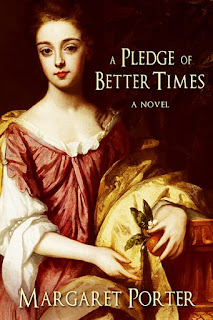
Margaret Porter is the award-winning and bestselling author of twelve period novels, nonfiction and poetry. Queen Mary's garden pursuits are featured in A Pledge of Better Times, her highly acclaimed novel of 17th century courtiers Lady Diana de Vere and Charles Beauclerk, 1st Duke of St. Albans (available in trade paperback and ebook). Margaret studied British history in the UK and the US. As historian, her areas of speciality are social, theatrical, and garden history of the 17th and 18th centuries, royal courts, and portraiture. A former actress, she gave up the stage and screen to devote herself to fiction writing, travel, and her rose gardens.


Wednesday, September 21, 2016

The Dangerous Duellist: Charles, Baron Mohun

by Margaret Porter

The 4th Baron Mohun
Charles Mohun, the 4th Baron Mohun, was born about 1675 to the 3rd Baron Mohun of Okehampton and his wife Lady Phillipa Annesley. Through the latter the infant was grandson of the 1st Earl of Angelsey, who served as Lord Privy Seal and produced political and religious treatises. Pepys referred to Anglesey as 'one of the greatest knaves in the world,' and during his life little Charles would exceed his grandsire's reputation.


His father had inherited substantial lands in Cornwall and Devon--as well as considerable debts. The marriage to Lady Phillipa was entirely mercenary, she was a termagant, and the union neither prospered nor lasted. Shortly after his heir's birth, the 3rd Baron served as Lord Cavendish's second in a duel with an Irish officer. At the conclusion of the contest Mohun insulted his friend's opponent, resulting in a second swordfight, and the brawling baron died from his severe wounds.
The infant 4th Baron and his two-year old sister Elizabeth were left to the care of a cruel, careless, and quarrelsome mother. His upbringing was hardly the sort to bestow virtue, patience, and manners. Unlike most young men of noble birth, he did not attend university. He married in 1691, aged just fifteen. His bride was Charlotte Orby, his guardian's daughter and the niece of his close friend Lord Macclesfield, and she had no dowry. In November of 1692 she bore a stillborn son.

Several weeks after this distressing event, the sixteen-year old baron fought his first duel. After a night of drinking he quarreled with Lord Kennedy, four years his senior. King William III, hearing of it, feared that a duel might ensue, and commanded both young gentlemen to remain at home. They chose not to obey their monarch's edict. In the course of their battle, each received a minor wound.

Two days later Mohun assisted his closest friend, the equally wild Captain Richard Hill, in the failed abduction of the actress Mrs Bracegirdle. Hill, who regarded actor William Mountfort as his rival for the lady's affection--quite mistakenly--ran him through with a sword late at night in the middle of a London residential street. Hill fled the country. Mohun was arrested. His response: 'Goddamme, I am glad he's not taken, but I am sorry he has no money about him, I wish he had some of mine. I do not care a farthing if I hang for him.'

The magistrates charged him with murder but after a single night in jail his bail was paid and he was released. Judged a flight risk by the House of Lords, he was confined to the Tower of London to await his fate.

In a sensational trial, the House of Lords tried the baron as an accessory to the crime, and in February 1693 he was acquitted and released. Either the weeks of his imprisonment impaired his health, or his celebrations after gaining his freedom, because by October that year it was reported that he 'lies very ill at Bath.' Mountford's outraged widow attempted to appeal what was, from her perspective, a most unjust verdict. Her father had recently been convicted of a capital crime--clipping coins--and by dropping her intended action she was able have her parent sentenced to transportation rather than execution.

Recovered from his ailment and back in London, Mohun returned to form. Drawing his sword against a hackney coachman, he was prevented from slaying the man by a member of Parliament, whom he then challenged to a duel which never actually took place.

Deciding to use his fighting instincts in the service of king and country, he joined the military. On March 10, 1694 the diarist Luttrell records, 'The Lord Mohun is made a captain of a troop of horse in Lord Macclesfield's [sic] regiment.' Three days later he noted, 'The Earl of Macclesfield goes with his majestie to Flanders, as a major general, and the Earl of Warwick and Lord Mohun as volunteers.' Warwick was one of Mohun's cronies, a partner in drinking and debauchery.

Whatever discipline the baron absorbed in the ranks, it didn't improve his behaviour. In spring 1695, he battered a member of the press in a London coffee house. Two years later his next duel took place in St James's Park. His opponent, Captain Bingham, survived the encounter--park keepers intervened--and Mohun sustained a wound to his hand.

In September of that same year, 1697, at the Rummer Tavern in Charing Cross, he engaged in a drunken quarrel with a Captain Hill. This was not the perpetrator of the Mountford murder, but another of that name and rank serving in the Coldstream Guards. Mohun stabbed him and fled; the captain later died. Mohun took refuge in the Earl of Warwick's house, where the constables seized him. At the coroner's inquest he was judged guilty of manslaughter.

According to a contemporary account, 'Yesterday [27th November] the lord Mohun appeared upon his recognizance at the King's Bench bar, and there being an indictment of murther found against him by the grand jury of Middlesex for killing Capt Hill, the court committed him to prison in order to be tryed for the same.' His place of confinement was not to his liking or  suitable to his status, and on the 13th of December 'the lord Mohun petitioned the house of peers to be removed from the King's Bench where he was committed last term for the murder of Captain Hill, to the Tower, which was granted.'

This time, however, he avoided trial--most likely because he'd reached his majority. Now twenty-one, he was entitled to take his seat in the House of Lords, and the King needed his support. At the 11th hour he received a royal pardon, which he duly presented to the House. Within days he was seated with his fellow peers as a Whig lord with good reason to approve all of His Majesty's demands for additional war funding.

Never one to learn from past crimes, Mohun committed another in late October of the very same year:


On Sunday about 3 in the morning a quarrel happened at Locket's [a tavern] near Charing Crosse between Captain Coot [sic] son to Sir Richard Coot, and Mr French of the Temple, who thereupon went and fought in Leicester Feilds. The Earl of Warwick and Lord Mohun were for the first, and Captain James and Ensign Dockwra for the 2d. Coot was killed upon the spott, and it's said French dangerously wounded but made his escape with the rest.

The House chose to try Mohun and Warwick separately, but it was uncertain which of the five men present at the altercation had struck the fatal blow. In January Mohun returned to the Tower to await trial and remained there for several months. On 28th March, 1699, 'the earl of Warwick and lord Mohun were brought by the lord Lucas from the Tower to Westminster the axe being carried before them they are now on their tryalls on account of the death of captain Coot [sic] which is like to last long.' On that day the earl was convicted of manslaughter and given the mildest of punishments: a cold branding iron in the shape of 'F' for 'felon' was applied to his hand, leaving no permanent mark upon it. The following day Mohun was unanimously acquitted but received a severe warning from Lord Chancellor Somers that he could not expect mercy in future if he continued on his disastrous path.

In 1701 the Act of Settlement designated the Protestant Sophia, Electress of Hanover, and her heirs as William III's successors to England's crown. Lord Macclesfield was the King's choice to deliver a ceremonial copy of the decree, and Lord Mohun accompanied him to Hanover. Within days of their return to London, Mohun stood at his gravely ill friend's bedside. The earl's death on 4th November was followed by the discovery that he'd disinherited his entire family in Mohun's favour.


James, 4th Duke of Hamilton
As possessor of a fortune between £40-100,000 and now a visible, active, and useful member of the House of Lords, Mohun's problems ought to have been behind him. Unfortunately, he had an enemy--James, the Scottish 4th Duke of Hamilton, husband of another of Lord Macclesfield's nieces. The duke, in desperate financial need, felt entitled to Macclesfield's estate, and legal battles ensued. Bills were filed. Chancery suits were begun. The King died. A Queen was crowned. Under the new regime, Hamilton's sometime support of the Catholic Pretender did not work in his favour. As for Mohun--he was a Whig, and Queen Anne a staunch Tory.

In 1711, Mohun, by then a widower, took his mistress as his second wife. She was Elizabeth Griffith, widow of a colonel and a daughter of Sir Thomas Lawrence, a physician to the Queen. He had hardly installed her in his residence, Macclesfield House, than he departed it to take up lodgings in Great Marlborough Street.

Not until 8th February, 1712, was his inheritance dispute with Hamilton heard by the Committee of Privileges in the House of Lords. A tie vote resulted--Mohun voting in his own interests, Hamilton absent. When proxies were counted, Mohun prevailed in a vote of 40 to 36. And still they waited for the ruling from Chancery.

But it wasn't the courts that put an end to a dispute. It was, of course, a duel. Not a polite, mannerly affair between a pair of nobleman who deemed honour at risk. What occurred in Hyde Park on the early morning of 15th November was a brutal and decisive battle between bitter adversaries.


When the Duke of Hamilton, Lord Mohun, and Macartney [Mohun's second] came to the place agreed on them to fight, the Duke and Lord Mohun had no sooner drawn their swords than Macartney drew his, as Colonel Hamilton did the same . . . he [the Colonel] striking down Macartney's sword...closed with Macartney and took his sword from him, by which time Lord Mohun was down on the ground and His Grace upon him. The Colonel, the better to help the Duke up, flung both swords upon the ground . . . Macartney came with a sword in his hand, and gave a thrust into the duke's left breast . . . the Duke at the same time saying, I am wounded, and whilst the said Colonel Hamilton was helping him Macartney escaped.


A representation of the doubly fatal duel in Hyde Park

The stab wound to the duke's chest was superfluous; one of Mohun's blows had severed the artery in his wrist. The two enemies lay dead, their blood seeping into the grass.

The Colonel stood trial, was convicted of manslaughter, branded with the cold iron, and went free. General Macartney fled England and tried to exonerate himself through pamphlets. While in Europe he gained an ally in the future George I and wished to follow the new King to England. He sought to have his outlawed status altered in order to belatedly stand trial for his role in the duel.

Two years later, when the case was finally heard, Hamilton said he couldn't swear that the accused had actually murdered the duke. Macartney likewise received a non-branding and went free--as the bad baron had done so many times in the course of his duelling career.

~~~~~~~~~~~~~~

Margaret Porter is the award-winning and bestselling author of twelve period novels, whose other publication credits include nonfiction and poetry. One notorious incident in which Lord Mohun participated appears in A Pledge of Better Times, her highly acclaimed novel of 17th century courtiers Lady Diana de Vere and Charles Beauclerk, 1st Duke of St. Albans. Margaret studied British history in the UK and the US. As historian, her areas of speciality are social, theatrical, and garden history of the 17th and 18th centuries, royal courts, and portraiture. A former actress, she gave up the stage and screen to devote herself to fiction writing, travel, and her rose gardens.
Connect with Margaret:
Website | Blog | Facebook | Twitter | Amazon 

Wednesday, March 25, 2015

Religious persecution and Glorious revolution

by Anna Belfrage

Louis XIV
In 1685, Louis XIV of France revoked the Edict of Nantes, thereby indirectly laying the foundation to what would become the so called Glorious Revolution in England.

“Eh, what?” I hear some of you say, brows rising as you consider just how the revocation of the Edict of Nantes could lead to the events that ousted England’s rightful king. Well, dear people, as so many events in the 17th century, it comes down to religion – or rather, to religion as a political instrument.

Louis XIV was, as we all know, French. King since childhood, he was a firm believer in the divine right of kings and in his own capacity to rule. He was equally determined to expand French interests and territories and therefore promoted an expansive – aggressive – foreign policy. Plus there was the ever present issue of religion, a hot potato that had temporarily been set on a back-burner by Henri IVs 1598 Edict whereby all Frenchmen were allowed to worship according to their own conscience.

Louis was no big fan of this tolerant approach to heretics. It irked him that there should be close to a million such heretics living in his France, a country that should in its entirety belong to the Holy Church. (Here dear Louis was being somewhat hypocritical, turning a blind eye to the fact that France, this oh so Catholic nation, had happily bankrolled the Swedish Protestant Army under Gustav II Adolf as it laid waste to the Holy Roman Empire during the Thirty Years' War. Bygones, he probably said, waving a perfumed handkerchief...)

To Louis, his Protestant subjects were a personal affront – they should take heed, listen to their King and convert. And when milder forms of coercion didn’t help, Louis launched the dragonnades in the early 1680’s whereby dragoons were forcibly billed with Protestant families, there to constantly persecute them and hound them until the poor people either converted or fled. Many of them fled, and the surrounding European nations saw a huge influx of Huguenot refugees.

And yet, Louis was not satisfied. Egged on by his pious wife, Madame de Maintenon, he took the drastic step of revoking the Edict of Nantes, thereby making it illegal to adhere to any other faith than the Catholic one. Over the coming months, France suffered a major brain drain as an entire generation of Protestant tradesmen, merchants, and skilled labourers left – no doubt to Louis’ personal joy. By early 1686, less than 2 000 Protestants remained in France.

James
For Protestants in the surrounding countries, Louis XIV’s measures just went to prove the point that Catholic rulers were dangerous, intolerant creatures. In countries such as England, the anti-papist sentiments that were a constant presence throughout the 17th century were further strengthened by the terrifying stories told by the Huguenot refugees. Unfortunately – at least in the eyes of some of the more bigoted Englishmen – the English king was a Catholic. Even worse, James II was Louis XIV’s cousin, and as we all know, blood will tell…

James is second from the left
James II didn’t begin his life as a Catholic. His father, Charles I, was raised an Anglican, remained an Anglican, and ensured his children were raised as Anglicans, no matter their Catholic mother, Henriette Marie of France. As we all know, Charles I hit the dust in 1649 – in his case almost in the literal sense, given that he was beheaded. At the time, James II was not quite sixteen, and he was to spend the coming decade in either the French or the Spanish army where he served with distinction - and came into contact with various men of Catholic faith.

Like his older brother, James had an eye for pretty women. In 1659 he seduced Anne Hyde by promising to marry her, and to his credit he followed through on his promise, even if no one expected a prince to do so. Sometime during his marriage to Anne, James and his wife converted to Catholicism, even if he kept this secret. His surviving daughters by Anne, however, were raised as Anglicans as ordered by their royal uncle, Charles II.

Mary of Modena
When the English Parliament introduced a new Test Act in 1673, it became impossible for James to keep his conversion a secret. The Test Act was one in a series of laws put in place to stop Catholics from holding higher office, either in government or the military, by requiring all such officers to take an oath by which they disavowed certain central tenets of Catholic faith, and also to take communion under Anglican rites. James refused to do so, stepping down from his post as Lord High Admiral. He didn’t exactly improve his popularity ratings when he then went on to marry Mary of Modena, a fifteen-year-old Catholic Italian princess.

Over the coming years, Parliament and King were locked in a constant power struggle, with Charles II adamantly refusing to sign anything that would potentially exclude his brother from the line of succession, the so called Exclusion Crisis. When tensions were at their highest, James was recommended to leave the country, which he did, spending a number of years in Scotland.

In 1685, Charles II died – and a pretty awful death it was. On his deathbed, he converted to Catholicism, allowing himself the privilege to die professing the faith he must have held to in secret for years. With no legitimate heirs of his body, Charles was succeeded by James, and the powers that were in England were not pleased – at all.

It was unfortunate that in this self-same year Louis XIV upped the persecution of the Huguenots by revoking the Edict. It was also unfortunate that James II lacked that streak of pragmatism that had always guided his older brother. Had James but taken the time to stop and think he would have realised that for a newly crowned Catholic king in a country so mistrustful of Catholics, it made sense to take things slow. Instead, the man immediately set off on his own personal crusade to revoke all legislation that made it impossible for Catholics to hold office. Not, to put it mildly, a popular move.

James II
At the time, James was accused of wanting to return England in its entirety to the Catholic Church. These days, historians agree that James’ purpose was to create a more tolerant approach to his co-religionists. They also agree that James was somewhat inept – call it heavy-handed – in his attempts, thereby alienating former supporters. Whatever the case, while Parliament may have grumbled and Protestant Peers protested, there were never any plans to depose James. Deposing kings was simply not done, and the English public did not want a repeat on the royal execution not quite forty years ago.

So, what have we here? On the one side, a disgruntled English populace, angry with their king for promoting his Catholic friends, even angrier when he initiated a massive conversion campaign. On the other, a bewildered monarch, who didn't understand why everyone misinterpreted him so. (A simplification, of course. And I haven’t even touched upon James’ attempts at fiscal reform, but seeing as most people find taxes boring, let’s not go there…)

On the other side of the Channel, Louis XIV was more than thrilled to see his Catholic cousin on the English throne, while further north William III and his wife Mary, James’ oldest daughter, bided their time. Unless James had a son, the English crown would revert to their staunchly Protestant hands upon his death. The probability of James ever having a son was deemed as low. So far, Mary of Modena and James had been singularly unfortunate when it came to children. She’d been pregnant close to ten times, but as yet there was not one surviving child. And yes, I do feel this is a good moment to feel sorry for poor Mary – and her husband.

It was indicative of how out of touch James was with his people that throughout 1686 he tried very hard to influence the Anglican faction into accepting his more lenient approach to Catholics. England was a hotbed of anti-papist emotions, nurtured over several decades, first by the Parliamentarian forces, then by the Restoration government and their anti-Catholic legislation. Well, if we’re going to be quite correct, the anti-papist sentiments went back further than that, to the reign of Elizabeth I and onwards. No, in England of the 17th century a good Catholic was a dead Catholic – or at least a Catholic who had the sense to stay well away from the green fields of fair England.

In 1687, a frustrated James decided he needed new allies to pursue his political ambitions, and so he started flirting with the Protestant Dissenters so as to undermine the Anglican Church. To win their support, in April of 1687 he announced a Declaration of Indulgence whereby all penal laws and the Test and Corporation Acts were suspended. Suddenly, religious freedom raised its head in England. Suddenly, one could openly be a Quaker, or a Baptist, or a Presbyterian – hang on, even a Presbyterian? Hmm. James was no major fan of the Scottish Kirk, but yes, they were also included, albeit after some pressure – or a Catholic. We rarely give James II the credit he deserves for this attempt at creating a society where people could worship as they pleased. Was it self-serving? Of course it was, but for the thousands upon thousands that had been oppressed by the Anglican Church, the Declaration of Indulgence provided quite a breath of fresh air.

William 
This innovative piece of legislation was not greeted with spontaneous outbursts of joy. Most people were sceptical of the King’s motives, and besides, there was a bigger concern. The Queen was pregnant, and should she be delivered of a healthy boy child, England would face a succession of Catholic kings. The Protestant nobility gulped. Combining a potentially healthy baby boy with the King’s recent legislation would, over time, erode their power base. No, this needed to be stopped before it went too far, and where else to go for support than to William of Orange in the United Provinces? After all, should the Queen be delivered of a boy child that would not be good for William’s aspirations.

It was a boy. Delirious with joy, James wanted to embrace the entire world. A son, he had a son, and even the cruel stories whereby it was insinuated that the boy was a changeling, smuggled into the royal apartments in a warming pan, could not quench his joy – even if it must have hurt that his elder daughters were implicated in this gossip-mongering. James Frances Edward Stuart was born on June 10th of 1688 – less than six months later, the baby would begin his lifelong exile.

On June 30th, seven protestant grandees sent a letter to William III, inviting him to invade – not to depose James, but to curb his policies. All the same, the letter signed by Edward Russel, the earls of Shrewsbury, Devonshire and Danby, Bishop Compton, Lord Lumley and Henry Sidney cannot be described as anything but high treason. However, the large majority of the political establishment in England did not support this move. Yes, they wanted to restrain James, but far too many had far too recent memories of the consequences of plunging England into a civil war to risk taking up arms against their king.

This is where we have to return to Louis XIV and his revocation of the Edict of Nantes, this in an attempt to understand William’s motivations in invading England. If we’re going to be honest, no one does know the man’s motivations – William was a man who mostly kept his own counsel. One thing that is very apparent, however, is that William’s lifelong ambition was to halt France’s expansion, especially into his own territories. He found little support at home for his bellicose activities – the Dutch states depended on trade with France and saw no reason to antagonise this huge market, no matter that it was nibbling at the borders of the United Provinces.

Spain was no help at all, the Holy Roman Empire had its hands full with the Turks, and William all on his own was no match for Louis XIV. However, should one combine England with the United Provinces, well then…Whatever the case, as long as the pacifists remained in power in the United Provinces, William was without the funds required to do more than gnash his teeth when the French took Strasbourg (1681) and Luxembourg (1684) And then came the revocation.

Horrified Dutch Protestants opened their homes to the refugees from Louis XIV’s France. They listened, aghast, to stories of bloodshed, to being forced to leave all their wealth behind (with which the wealthy Dutch traders could more than relate), to being beaten and whipped, murdered even, by angry Catholic mobs. Which is when William coughed and said “ahem”. Now he was given funds – plenty of funds. Even more fortuitously, the Holy Roman Emperor beat off the Turks and was more than happy to join the coalition against France. Only England, ruled by Louis XIVs cousin, remained loyal to France. The invitation from the seven grandees therefore came at an opportune time. By invading, William hoped to strong-arm his father-in-law into supporting his efforts to contain France. Whether his initial ambitions extended beyond that, we don't know.

William landed in Torbay on November 5, 1688. William was hailed as a liberator. James dithered, uncertain as to what to do – William was family, and James was more than aware of how much his eldest daughter loved her husband. Besides, he was unnerved by the last year’s outbreak of violent anti-Catholic riots throughout the north of England, and he definitely did not want to be the one who started a new Civil War – he was as beset by spectres as his peers.

On November 23, James took the decision to retire to London rather than meet William on the field. A capable military leader, an experienced battle commander, James could probably have held his own – and his was the larger force. So why did he retreat? Why did he attempt to flee to France rather than defend his crown? We will never know – but chances are that had he stayed and fought, he would have carried the day, thereby rewriting history as we know it. But then, history is full of ‘what if’s’, isn’t it?

Mary II
Captured by William's troops in December of 1688 while making for France, James then managed to escape - and one suspects he was allowed to escape - and fled to his powerful French cousin. In 1689, William and Mary were confirmed by Parliament as the new King and Queen.

James made one serious attempt to regain his throne that ended at the Battle of the Boyne in 1690. His son would go on to make his own attempts, as would his son, the famous Bonnie Prince Charlie who for a short while in 1745-46 actually seemed to be carrying the day. Until the disaster at Culloden, that is.

These days, James II is often considered a parenthesis, a king who is remembered mainly because he lost it all. I do believe the man deserves a somewhat grander epitaph than that, however ineptly he handled the single most momentous event in his life. James Stuart was a loyal son, a loyal brother. He was brave and honourable, served his country as well as he could and was allowed to. He was a loving father – doting, even – a caring husband and a man who stood by his friends and his word. He was also a Catholic, and somehow the matter of his faith overshadows all his qualities. After all, it is because of his faith and his pig-headed efforts to make life easier for his co-religionists that he lost his throne. A high price to pay for his faith, although personally I think James considered his daughter’s betrayal and defection the far heavier price. The lesser me must admit to hoping Mary suffered endless sleepless nights as a consequence, but on the other hand, her life was not exactly a bed of roses either, and who are we to sit in the comfort of hindsight and judge those that went before?

The events of 1688 and 1689 play an important role in the recently released To Catch a Falling Star, the eighth book in The Graham Saga.

~~~~~~~~~~~~~


Anna Belfrage is the successful author of seven published books, all of them part of The Graham Saga. Set in 17th century Scotland, Virginia and Maryland, this is the story of Matthew Graham and his wife, Alex Lind - two people who should never have met, not when she was born three centuries after him.

Anna's books have won several awards and are available on Amazon US,  Amazon UK, or wherever else good books are sold.
For more information about Anna and her books, please visit her website. If not on her website, Anna can mostly be found on her blog.