Showing posts with label Henry Percy. Show all posts

Monday, August 3, 2020

The Battle of Shrewsbury, 1403

By Annie Whitehead

Last time, I explored the history of the medieval town of Shrewsbury. My visit there also included a walk round the site of a bloody battle which took place in 1403, between royal forces and rebellious nobility.


Just four years earlier, in 1399, Richard II was ousted as king of England by his ambitious cousin, Henry Bolingbroke, who then became Henry IV. Usurpations haven’t happened all that often in English history, and Henry couldn’t have done it without help. Among those who assisted him were the powerful northern Marcher lords, the Percy family of Northumberland.

Still, even if you are the richest in the land, wars don’t come cheap. The Percys claimed that the king owed them £20,000 and they were also peeved that Scottish nobles who’d been captured at the battle of Homildon Hill in 1402 had not been ransomed. This meant, of course, that Henry Percy, earl of Northumberland, was also being denied a source of income.

It was Percy’s son, also Henry but nicknamed ‘Hotspur’, who was instrumental in the battle of Shrewsbury. He had been given high office in Wales, where he’d been busy trying to bring the Welsh rebel Owain Glyndŵr to heel. But yet again, payment was withheld and Hotspur did a ‘u-turn’, entering into alliance with Glyndŵr and Edward Mortimer, a powerful Marcher lord. Their claims superficially rested on the financial injustices, but Henry IV saw this as a bid for his crown, and an attempt to replace him. Their proposed candidate for the throne was the earl of March, nephew of Mortimer.

The battle at Shrewsbury was fought on 21 July. Rebel troops had gathered in Cheshire, where Hotspur issued a proclamation which suggested that Henry IV was not king but merely ‘Henry of Lancaster’ and that Richard II was in fact still alive. The rebels marched south and Hotspur was accompanied by his uncle, Thomas Percy, 1st earl of Worcester and Archibald Douglas, 4th earl of Douglas.

Shrewsbury was garrisoned by the eldest son of the king, whose name was ‘Harry’ and who would go on to make a bit of a name for himself at Agincourt as Henry V. Here, though, he was not leading the battle. King Henry IV managed to intercept Hotspur before he could join forces with Glyndŵr. Henry got to Shrewsbury before Hotspur on 20th July and this left Hotspur stuck on the north side of the town, and with the king’s army and the River Severn between him and the Welsh.

The next morning, with no sign of Glyndŵr and with the king’s troops advancing from the town, there was nothing for it but to stand and fight. Several hours of parlaying preceded the fighting, but it could not stave off the inevitable. The picture below shows the suggested positions of the armies, with the Percys on the ridge and the king’s troops having to force their way up the slope. The fighting lasted until nightfall.


Estimates suggest that the king had at his command some 14,000 men while the rebels had 10,000.*

Both sides seem to have had difficulty in recognising coats of arms and there was a great deal of confusion during the battle. It was rumoured that Henry IV had died, but in fact the king was removed to safety. Nevertheless, royal casualties were heavy. The losses have not been calculated with certainty but to walk round the site is to get some idea of the scale of the fighting and, indeed, the numbers of casualties. Estimates are that the dead numbered around 1,600 on both sides, with at least 3,000 wounded subsequently dying from their injuries or killed by looters seeking booty.

The longbow played an important and decisive role in the fighting. The battle began with an archery onslaught, in which Hotspur’s Cheshire bowmen appeared superior and the English Chronicler, Thomas Walsingham, said that the royal troops fell “like leaves in Autumn, every one [arrow] struck a mortal man". ** Famously, the Prince of Wales was struck in the face by an arrow and it is incredible that he survived. The arrow sank into his cheek (the surgeon stated that it was the left, although I have seen debates in which people argue that he might have meant the left as he looked at it.) That the prince survived was down to the skills of his surgeon, John Bradmore, who later described in detail how he used a specially designed implement, using a sort of corkscrew motion, to extract the arrow-head and then treated the wound with honey and alcohol.

Prince Henry survived, and no doubt learned a great deal about the effectiveness of the longbow in battle, but the other leaders involved were not so lucky. Hotspur led a charge directly at the king and was surrounded and killed. Other rebel leaders survived, but not for long. Thomas Percy was tried and beheaded. The earl of Northumberland, Hotspur’s father, was not executed but was stripped of his office as Constable and of several castles, which were thenceforth to be controlled by royal officers.

Hotspur’s body, first buried at Whitchurch, was exhumed and put on display at Shrewsbury, and then was cut up, the parts being sent to various cities and his head sent to York and displayed at Micklegate Bar.


Battlefield Church was constructed on the orders of the king, to commemorate the fallen, and it has been suggested that it stands on ground where most of the fighting took place. There is an area of the churchyard which does look as if it might be the site of a mass grave, but archaeology has not confirmed this.


The church itself is no longer open to the public. It was dedicated to St Mary Magdalene as the battle took place on the eve of her saint's day. In 1410 the chapel was converted into a college of chaplains, where a master and five chaplains said daily mass for the dead. The existing church is the only chapel building to survive and in 1548 the college was closed. In 1982 the church was declared redundant.

There are two visitors’ points. The first is at the southern side of the battle area, and gives views across to the church and offers a walking trail. The area is still agricultural land and is easy to imagine the forces lined up, and to envisage where the fighting might have taken place. On the northern side of the site, the Battlefield 1403 complex houses an exhibition which gives information about the battle and a walk back down to the church. Slightly further north is a village called Upper Battlefield, suggesting to me that the fighting might have extended further still.

Top- from the south. Bottom - from the north

I was there on a sunny September day, and presumably it would have been warmer still in the month of July when the battle was fought. It all looks very bucolic now, but not for nothing did Edith Pargeter call this A Bloody Field by Shrewsbury.***


*The Annales Henrici Quarti offers the figure of 14,000 Royal troops, while Jean de Waurin, a medieval French chronicler, estimated 60,000. It seems that Henry's army was the larger, but in his Chronicle of England John Capgrave suggested that Hotspur had, "as is wrytyn, XIIII thousand men".

**The Chronica Maiora of Thomas Walsingham (1376-1422) by David Preest (Translator), James G. Clark (Translator)

*** Her novel about the battle, and the events leading up to it.

[All photos by and copyright of the author]

This is an Editor’s Choice from the #EHFA archives, originally published October 1, 2019.
~~~~~~~~~~

Annie Whitehead
studied History under the eminent Medievalist Ann Williams. She is a member of the Royal Historical Society and an editor for EHFA. She has written three award-winning novels set in Anglo-Saxon England, one of which was long-listed for the Historical Novel Society (HNS) Indie Book of the year 2016, and a full-length nonfiction book, Mercia: The Rise and Fall of a Kingdom. She has contributed to fiction and nonfiction anthologies and written for various magazines, including winning the New Writer Magazine Prose Competition. She was the winner of the inaugural Historical Writers’ Association/Dorothy Dunnett Prize 2017. She has recently been a judge for that same competition, and for the HNS Short Story Competition. Annie’s new book, Women of Power in Anglo-Saxon England, is published by Pen & Sword Books.

For more information, visit Annie's Website or her Author Page. Also connect with Annie through her Blog and Twitter (@AnnieWHistory)

Friday, July 17, 2020

Castles, Fortified Houses and Family Homes ~ a Distinction Without a Difference

By Linda Root

When is a Castle not a Palace?


Recently I circulated a photograph taken by my colleague Ron Morrison showing his wife Maryanne, our mutual friend Ian Lumsdaine, and me approaching Ferniehirst Caste, located on the east bank of the Jed Water near Jedburgh. My friends from the MarieStuartSociety gifted me with a visit there, knowing it was the number one destination on my Bucket List. One of my friends who saw the picture in an email replied, ‘You must have been sorely disappointed. It is so plain.

I could not disagree with my friend’s assessment. Ferniehirst was designed not to attract visitors but to repel them. [1] In those days, Ferniehirst was strategically placed at the top of a steep ravine, on land so heavily forested that invading English forces often did not see it until pikes tossed from the battlements pierced their armor. Its defenders were known for their ruthlessness-- a trait celebrated in Laidlaw's poem, the Reprisal. The invaders were not always English. From time to time, the Kers of Ferniehirst squared off against their Cessford cousins. In spite of their service to the Scottish crown and relative success in policing the Borders, at heart, the Kers were among the most feared surnames among the Reivers. They had their share of enemies.

The castle is arguably the best preserved of the Border fortresses along the Middle Marches, and presently owned and occupied by indirect descendants of the Kers of Ferniehirst, who built it on what may have been a Roman ruin. It exists much as it appeared after its reconstruction by Sir Andrew Ker of Ferniehirst in 1598, five years before James VI of Scotland became James I of England and declared the Borders ‘pacified.' It was James who had leveled it a few years prior when Sir Andrew Ker of Feriehirst aligned himself with the king’s rebellious cousin Lord Francis Stewart, 5th Earl of Bothwell. In the transpiring four hundred years, the woodlands above the Jed have been deforested, and a modern visitor sees Ferniehirst as a castle built on fertile farmland, not as the 16th Century fortress from whence a mighty band of reivers rode.

'Queen Mary's House - Jedburgh
The Kers were known for a statistically improbable degree of left-handedness. The stairways at Ferniehirst were counterclockwise, to give the advantage to the Kers in a close-quarters fight. At least a segment of one of them survives. Other examples of the counterclockwise stairs exist at the residence the Laird of Ferniehirst maintained in Jedburgh known as Queen Mary's House. Marie Stuart stayed there when she visited Jedburgh for the Assizes held in the fall of 1566. She fell ill during her stay there and nearly died. In spite of its name, Marie Stuart never owned the house but leased it when the Spread Eagle Inn where she had been lodged suffered a suspicious fire. There is speculation Marie Stuart may have stayed at Ferniehirst, but no evidence to support it other than the strong ties she had to Sir Thomas Ker and his son Andrew, who remained her loyal supporters long after she was forced to abdicate.

As it stands, Ferniehirst remains much as it was at the time of the Union of the Crowns in 1603. And yes, it lacks the elaborate façade and mullion windows of a northern palace like Linlithgow or Sterling. It was a formidable Border Tower, not a palace. One of the beauties of Ferniehirst is the castle’s integrity with its past. Thus, my answer to my friend is, ‘No. I am not the least disappointed in Ferniehirst, and I thank the later generations of Kers for resisting any urge to embellish it with the trapping of a palace. [2]

Hogwarts/Alnwick?


Unlike Ferniehirst, Alnwick Castle (pronounced ah-nick) in Northumberland is very much a tourist destination. For an armchair historian to enjoy it, one must squint and imagine it as it was. For tourists unaccustomed to turnabouts and vehicles with right-hand steering and the roads to match, the easiest way to access the ancestral seat of the mighty Northern Earls of Northumberland is by tour bus. My point of embarkation was a coffee house in Old Town Edinburgh, and the tour was ideal. For the price of a ticket to the gardens and the castle, one could wander about at will for three hours. For someone already familiar with the castle’s history, this is indeed ideal.

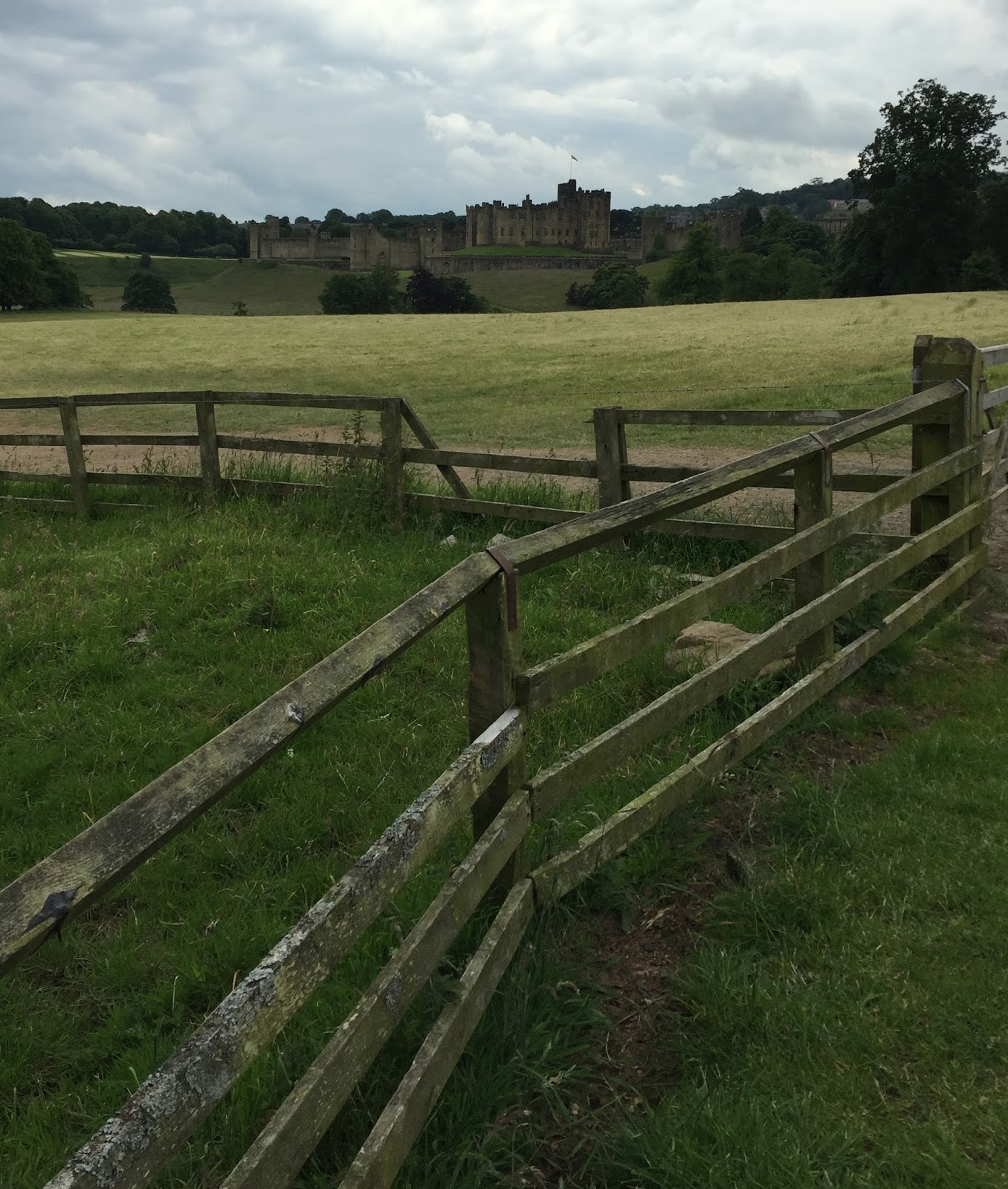
The difficulty with Alnwick is navigating the hordes who come to visit Hogwarts or the rooms at Downtown Abbey. But, like Ferniehirst, the Alnwick of Marie Stuart’s reign and that of the early Stuart kings of England was also a fortress. In my novel In the Shadow of the Gallows, my protagonists approach it from the direction depicted in this photograph, which shows how strategically it was placed.

It was a mere 25 miles from Flodden, and 32 miles from the Tweed at Coldstream. Unlike the Alnwick in my novel, the actual castle was largely uninhabited from 1572 until the 18th century. Except for the more than one-hundred-year hiatus, it has been a residence for the Percys from 1309 to the present. Its basic structure has not changed significantly since the12th Century, but the castle has been embellished and renovated many times. It retained a significant military flavor until the Borders were actually pacified. During the Civil War, Cromwell used it to stable horses and as a Prisoner-of-War camp. The Earl of Northumberland, Algernon Percy, served as guardian of ill-fated Charles I’s children, who lived with the Percys at Warkworth and later, at Syon House in Metropolitan London. The present castle’s interior has largely been redesigned in a palatial style credited to Anthony Salvin, who in 1852 began a large-scale restoration of Alnwick, removing the Strawberry Hill Gothic interior created a hundred years earlier by Robert Adam, replacing one of the towers, and creating the present exquisite interior.


During Victoria’s reign, interior rooms opened to the public were given an Italianate flair by architect Luigi Canina. Thus, unlike Ferniehirst, the present Alnwick may structurally resemble the original border castle to one who has studied it, but it lacks the austerity of a military structure such as Ferniehirst.

There is a seductive link between Ferniehirst and Alnwick tempting to any historical novelist captivated by the Border Lore that evolved during the days when steel-bonneted Reivers ruled the Marches, and later romanticized by Sir Walter Scott. ‘Every valley has its battle, and every stream its song,’ he wrote in a letter to a friend. Students of Border politics during the latter Sixteenth Century will recall the existence of a body of law unique to the Borders, and not especially centered on such concepts and nationalism and sovereignty. Thus, it is not surprising that the leaders of the ill-fated Northern Rebellion of 1569, the Earls of Northumberland and Westmoreland and their ladies, fled to the Borders just ahead of Elizabeth Tudor’s army. When the powerful Armstrong Border family considered betraying the fugitives to the English if the price was right, Sir Thomas Ker of Ferniehirst rescued both of the countesses and the Earl of Westmoreland. The entire affair went against the Reiver’s Creed, in which political fugitives entering the Borders were given sanctuary. Lord and Lady Ferniehirst gave them safe haven at Ferniehirst Castle, and eventually orchestrated their escape to the Low Countries.

The Earl of Northumberland, who was not as canny as the others and had more derring-do than his situation warranted, fell into the clutches of the Scottish Earl of Morton, an act which enraged most Borderers and ultimately contributed to Morton's fall. In 1572 when Morton was the Scottish Regent, he traded Northumberland to Elizabeth as part of a deal in which she sent her siege guns to dislodge forces loyal to the Queen of Scots from Edinburgh Castle. Tommy Ker of Ferniehirst was among the great castle’s defenders whose life was spared, but to punish him for aiding and abetting men whom Elizabeth considered traitors, he was forfeited and sent into exile, and Ferniehirst was leveled. After Sir Thomas died, his son Andrew Ker had barely restored it when it was reduced to ruin again in 1593, the third time in a century when Ferniehirst was reduced to a rock pile. And yet, the castle stands, a sentinel on the east bank of the Jed.

Across the Border to the South, the Percy stronghold of Alnwick ranks among the top English historical homes open to tourists. The 12th Duke of Northumberland, Lord Ralph Percy and his family live in a portion of the castle not open to the public.

Neither Ferniehirst nor Alnwick is a fairytale castle the likes of Mont San Michel on the French Coast or Neuschwanstein in Germany, but they have the unique distinction of not only remaining habitable but pridefully occupied by descendants of those who defended them nearly five hundred years ago. 


Notes:
[1] Ferniehirst is not a tourist destination in the wider sense. It is a private residence of Lord Ralph Kerr,(the modern spelling of the name), heir presumptive to the Marquisate of Lothian, (a title held by the Ancrum Kerrs)  whom I had the pleasure of meeting.  Its cultural significance is in the able hands of its curator, Bob Lawson. The site is open for tours Tuesday through Sunday during the month of July, and are hosted by the curator.  His stage presence and knowledge of the topic make it well worth the price of the 5GBP ticket.
[2]  Two excellent sources on Ferniehirst and Kers include 1) Lawson, Bob, The Kerrs of Ferniehirst 1205-1692, a limited edition publication available from the author, and 2) Kerr, Anthony, Ferniehirst Castle, Scotlands Frontier Stronghold, Kelso, 1985, currently out of print.  Thankfully, I have two copies

For a deeper understanding of the evolution of the early keeps to the versatile British fortified houses and beyond, 

see: Emery, Anthony (1996), Greater Medieval Houses of England and Wales, 1300–1500, Volume I: Northern England, Cambridge University Press, ISBN 978-0-521-49723-7

This is an Editor's Choice from the #EHFA Archives, originally published August 10, 2016.
~~~~~~~~~~
Linda Root is an author of historical novels set in Marie Stuart's Scotland or during the reign of her son James VI and I. She is a retired major crimes prosecutor living in the hi-desert above Palm Springs. She also writes fantasy fiction under the name of J.D. Root, of which The Green Woman, set at Ferniehirst, is her debut. Her historical novels can be found on Amazon.

Monday, November 5, 2018

The Man in the Tower Suite ~ Henry Percy, the Ninth Earl of Northumberland

by Linda Root

Henry Percy, Ninth Earl of Northumberland, {{PD-Art}}

For seventeen years (1605-1622)  the Martin Tower Suite in the Tower of London complex housed a most illustrious guest. He was a gentleman of high fashion,  undisputed good looks, and a keen intellect, loyal to his friends and congenial to his hosts. We can hardly call his keepers jailers since they went to considerable lengths to assure his comfort and entertainment.

There are 21 towers in the complex known as the Tower of London and vague records as to which prisoners were housed in which ones. However, the Ninth Earl of Northumberland Henry Percy's occupancy of the Martin Tower was well known. Apparently, his rooms occupied most if not all of it.  He entertained often and lavishly and used it as the center of operations for his widespread business enterprises. Among his frequent guests were his son and heir, his pet fox and Sir Walter Raleigh. From his arrival at his lodgings on the 27th of November, 1605, the man his contemporaries called The Wizard Earl made himself very much at home. November 1605 was the month of the Gunpowder Treason, which brought Northumberland to the Tower. If rumors circulating in 1622 held a modicum of truth, when he was released, he was loathed to leave.

At one point the Northumberland apartment housed much of his celebrated library. His was one of the largest collections of books in Britain. They covered a broad range of topics, many related to his strong interest in alchemy.  His interest in natural philosophy, what we call science, earned him the moniker The Wizard Earl.

By the time of his arrest in 1605, Percy had adopted an urban lifestyle and made Sion House in Isleworth, a London suburb, his principal residence.  The magnificent mansion was inherited through his wife Dorothy Devereux, daughter of the Earl of Essex.  It remains in the family to this day.

Wikimedia-{{PD-Art}}

Earlier, as a young man living in Paris, he had been captured by a young man's traditional fancies--the riding, the hunt, the gaming, and the many mistresses, he confessed.  But he professed to having returned to  England with only one mistress claiming him, and that was Knowledge.

Northumberland was drawn into the Gunpowder Treason investigation due to his association with his second cousin Thomas Percy, indisputably one of the principals in the plot.  1605 was not the first time the earl's conduct regarding Cousin Tom got him into trouble.  He had made him Constable of Alnwyck, the Percy ancestral home in Northumberland, with it many acres of adjoining farm land. Alnwyck was but one of many of his real estate holdings in Northumberland, an income producing enterprise for the Earl.

Wikimedia Commons

No one is quite certain as to why Northumberland chose Thomas Percy as its overseer. In addition to making him his Constable, he gave Thomas Percy control over his accounts and the responsibility for collecting revenues and land rents.  Accusations from the tenants of misappropriation of rents and other acts of overreaching abounded, but the earl did not investigate. Charges were actually brought against Thomas by his benefactor's tenants, and they, too, were overlooked.

J.M.W. Turner -Wikimedia Commons -{{PD-=Art}}

Tom Percy was also involved with Robert Devereux, Earl of Essex in a failed murder plot targeting the warden of the Scottish Middle Marches, none other than the firebrand reiver laird Robert Kerr of Cessford, who later became Baron Roxburghe, one of King James I's favorites. Sir Robert Kerr of Cessford was both anti-Catholic and anti-Marian, which put him at odds with Percy and Essex.

In spite of his controversial conduct, in 1601 Thomas accompanied Northumberland on a military expedition to the Low Countries where he is said to have comported himself well. Northumberland received some criticism, possibly from Lord Robert Cecil, for having given Percy positions for which he should have been vetted without requiring him to attest to his religion or sign a Declaration of Faith. Thus, even before the Gunpowder Treason was uncovered, Northumberland's lenient treatment of his cousin had placed him at odds with Cecil, an avid anti-papist like his father Lord Burghley had been.

Northumberland had been raised in his aunt's house as a Protestant but was believed by many to be sympathetic to the Catholic cause. There were also rumors that Cousin Thomas was more than a cousin, perhaps an illegitimate brother. Thomas Percy, like the other principals in the Gunpowder Treason, was a militant Papist to a degree his powerful cousin either did not admit or truly did not realize.

For those unfamiliar with the scheme, the purpose behind the Gunpowder Plot was to replace King James I with a sovereign sympathetic to the Catholic cause but palatable enough to English Protestants to avoid civil war. That pointed to another Stuart. There is no direct evidence that Northumberland was personally involved in the conspiracy, but there is a strong suspicion the plotters had reserved a role for him in their pro-Catholic post-Jacobean government.

The Gunpowder plotters had settled on the king's daughter Elisabeth, who was nine as a replacement for her father.  Her older brother Henry Frederick, Prince of Wales, was eleven, a student at Oxford, and already an outspoken Protestant with a priggish moral sense, critical of his father's religious tolerance and his mother's thinly veiled Catholicism. The conspirators expected him to be in the royal entourage at the opening of Parliament and would die along with his father. The nine-year-old princess lived in the country and was not expected to attend. Her younger brother Charles, Duke of York was a slow-developing child who failed to thrive at birth and at age five had only recently begun to walk and talk, albeit with a shuffle and a stutter,  living in relative seclusion in the home of Robert Carey. He was sufficiently lackluster to earn no consideration from anyone, including the plotters.  Elisabeth, being female, could be made a puppet of the Catholic faction and eventually married off to an appropriate Catholic European prince.  While she was herself a Protestant, so young a female would be malleable and easily controlled by an appropriate Regent. Northumberland was the logical nominee.

The question perplexing modern scholars is the same one that kept him in the Tower Suite instead of laying headless on the Tower Green. No one could prove he was in on it.

Without revisiting the failure of the plot, what confined Northumberland to the Tower of London was not so much what happened on the infamous November 5, but what happened on the day before, November 4, 1605. On that day, Thomas Percy visited the earl at Sion House, ostensibly on business.  He had all of those cumbersome accounts from Northumberlandshire to review.  Whether he was really there to warn his kinsman from attending the opening of Parliament is open to conjecture. It is difficult to believe that he was spending the day before the big event reviewing ledgers with his kinsman, but there is no proof to the contrary.

When Percy arrived,  Northumberland was entertaining another guest, Thomas Hariot, a noted scholar, mathematician and astronomer who lived at Sion House and enjoyed Northumberland's patronage.  The three gentlemen had a pleasant late lunch together and thereafter, Percy left.  He next met with Catesby, the mastermind behind the plot, and thereafter left for the country to kidnap Princess Elisabeth. That evening Guy Fawkes, the plotter with the most military experience and knowledge of explosives, was discovered with the gunpowder in a search of the underpinnings of the Houses of Parliament, and the jig was up. When news reached the countryside, Tom Percy found himself running for his life, which did not last long.
When the law caught up with Thomas Percy and a cluster of the others who escaped the city, he soon was dead of a sniper's shot and unavailable to confirm or deny his cousin's complicity. Astute Northumberland was admitting nothing.

Engraving of Henry Percy-{{PD-Art}}
Fortunately for the earl,  his friend Thomas Hariot confirmed Northumberland's averments concerning the subject matter discussed at lunch on November 4th. There had been no talk of explosions or plots to kill the king. It may well be Hariot's presence thwarted Thomas's plan to warn his cousin off. Whatever the truth may have been, by the end of the week Thomas Percy's tongue was silenced. Thus, what ultimately saved Northumberland from the headsman was a lack of evidence. No one could dispute his planned attendance at the opening of Parliament on the following day.

The Earl remained out of custody until November 27th while he and others, including his personal secretary, his wife, and his friends, were interrogated. By December, Robert Cecil's focus had shifted to blaming the plot on Jesuits. When Northumberland was finally charged it was not with treason, but contempt. And there he languished.
Or did he?

Richard Lomas in A Power In The Land (Tuckwell Press, 1999) and other sources on the fate of the Gunpowder plotters speaks of the Earl's suite in the Martin Tower as having multiple dining rooms, a drawing room, gardens with access to a  tennis court, and enough space to accommodate twenty servants. And of course, there was the essential addition of a bowling alley.  His scholarly friends including Thomas Hariot maintained apartments at Sion House so they could appropriately tutor Northumberland's children.  Servants ran from Sion House to the Martin Tower with the latest imported delicacies.

While the Earl of Northumberland perfected his games of Ten Pins and read his beloved books, poured fine wine and smoked tobacco with Walter Raleigh and later dined and gambled with his fellow prisoners Lord Robert Carr, Earl of Somerset and his murderous countess Lady Frances Howard, Jesuit priests were convicted on scant evidence often gleaned from torture and treated to grisly deaths. Cecil had his scapegoats, the plotters got their just deserts, and the Earl had spare time to devote to the pursuit of knowledge and the management of his vast estates, and when he needed a distraction, he played tennis.

This article is an Editor's Choice and was originally published on August 19, 2014.

~~~~~~~~~~~~~

Linda Root is the author of The First Marie and the Queen of Scots, a tale of the life and love of Lady Marie Flemyng, The Last Knight and the Queen of Scots,  the fictionalized adventures of the colorful Sir William Kirkcaldy of Grange to whom the queen surrendered at Carberry, and the books in The Legacy of the Queen of  Scots Series, The Midwife's Secret: the Mystery of the Hidden Princess,  The Other Daughter, and 1603: The Queen's Revenge. 
She recently has written a paranormal historical fantasy The Green Woman under the name J.D. Root.
Root lives in the high desert community of Yucca Valley, above Palm Springs, with her husband Chris and her two mixed giant woolly Alaskan Malamutes. The Legacy of the Queen of Scots, and is presently working on the fourth book in the legacy series, In the Shadow of the Gallows.


Saturday, August 5, 2017

The Battle of Otterburn, 5th August 1388

by Annie Whitehead

It fell about the Lammas tide,
When the muir-men win their hay,
The doughty Earl of Douglas rode
Into England, to catch a prey.*

On this day, in 1388 (according to the Scots) the Battle of Otterburn took place, between the forces of the English, led by Harry Hotspur and his brother Sir Ralph Percy, and the Scots, led by James, 2nd Earl of Douglas.


The battle was a famous victory for the Scots in an ongoing series of border disputes and skirmishes. But it had wider implications for Scotland, causing long-lasting political ripples.

The king of Scotland at the time of the battle was Robert II. He was fifty-five when he unexpectedly became king, and his rule was undermined by the fact that, like John Balliol before him, he was considered by the Scottish nobles to be only their equal, not their superior.

Robert, though, was courageous and ambitious. The expectation was that he would take up the honorary title of High Steward of Scotland, but in 1326 a parliamentary act of succession named him as heir behind prince David and thus the most important magnate in Scotland.

When Edward III of England threatened war, Robert, aged just sixteen in 1333, led an army against him at the Battle of Halidon Hill. Then in 1334 he narrowly escaped capture when his lands were overrun by Anglo-Balliol enemies. David was taken into exile, but Robert stayed to fight, and gained many followers. Thus, when David returned to rule, he could never completely shake off the powerful Robert. When David died unexpectedly in 1371 he was succeeded, as per the arrangement, by Robert.

England still controlled a large area of Lothian and the border country, so it made sense for Robert to allow his southern earls to agitate to regain their lost territories. He also halted trade with England and renewed treaties with France. By 1384, the Scots had retaken most of occupied lands, but when the English and French began to talk of peace, Robert was reluctant to commit to all-out war and obtained Scottish inclusion in the peace treaty. This peace strategy was a factor in a virtual coup in 1384, when Robert lost control, first to his eldest son, John, earl of Carrick, and then from 1388 onwards, John’s younger brother, Robert, earl of Fife.

In a council at Holyrood in November 1384 is was recorded that “because our lord the king, for certain causes, is not able to attend himself personally to the execution of justice and the law of the kingdom, he has willed…that his first-born son and heir…is to administer the common-law everywhere throughout the kingdom."

Carrick’s rule brought control of foreign policy to a coalition of powerful magnates headed by James, 2nd earl of Douglas. Robert’s refusal to initiate war led to his removal from power altogether. Carrick, Douglas, and the king’s third son, Robert Stewart, earl of Fife, joined the French on campaign in 1385. The Scots and French quarrelled, the English burned Lothian, including Edinburgh, and the Scots had no choice but to accept truce until 1388. For Robert II, back in his lands in the west, this had little import, but Carrick began to struggle with lawlessness in the north, particularly with the ambition of Alexander Stewart.

What has this to do with the battle of Otterburn?

The 'modern' Otterburn Castle

On 5th August, or the 19th, depending on which sources you opt to believe, Douglas decided to lead a raid into England. The earl of Northumberland sent his two sons to engage with Douglas while he himself stayed at Alnwick

According to the chronicler Froissart,** the first fighting included a meeting of the earl of Douglas and Henry Percy in hand-to-hand combat, in which Percy's pennon was captured.
Froissart ~  There were many proper feats of arms done and achieved: there was fighting hand to hand : among other there fought hand to hand the earl Douglas and sir Henry Percy, and by force of arms the earl Douglas won the pennon of sir Henry Percy's, wherewith he was sore displeased and so were all the Englishmen. And the earl Douglas said to sir Henry Percy: ‘Sir, I shall bear this token of your prowess into Scotland and shall set it on high on my castle of Dalkeith, that it may be seen far off.'


Douglas then destroyed the castle at Ponteland and besieged Otterburn Castle (now Otterburn Tower).
Froissart ~ from thence the Scots went to the town and castle of Otterburn, an eight English mile from Newcastle*** and there lodged. That day they made none assault, but the next morning they blew their horns and made ready to assail the castle, which was strong, for it stood in the marish. 
Percy attacked Douglas's encampment with a surprise attack in the late afternoon:
Froissart ~ It was shewed to sir Henry Percy and to his brother and to the other knights and squires that were there, by such as had followed the Scots from Newcastle and had well advised their doing, who said to sir Henry and to sir Ralph : ' Sirs, we have followed the Scots privily and have dis- covered all the country. The Scots be at Pontland and have taken sir Edmund Alphel in his own castle, and from thence they be gone to Otterburn and there they lay this night. What they will do to- morrow we know not : they are ordained to abide there : and, sirs, surely their great host is not with them, for in all they pass not there a three thousand men.' When sir Henry heard that, he was joyful and said : ‘Sirs, let us leap on our horses, for by the faith I owe to God and to my lord my father I will go seek for my pennon and dislodge them this same night.'
During the battle, Douglas led the left wing, while John Dunbar, earl of Moray, commanded the right. Hotspur’s men, having ridden up from Newcastle, were tired and disorganised as they made their way onto the field. Hotspur was so overly confident that he attacked the Scots while the rest of his force was still marching up through Otterburn.

The banner of Douglas
Despite Percy's force being around three times the size of the Scottish force, Froissart said that 1040 English were captured and 1860 killed, against the Scottish losses of  200 Scots captured and 100 killed. The Westminster Chronicle estimated the Scottish casualties at around 500. When the bishop of Durham advanced from Newcastle with 10,000 men, he was apparently so impressed by the ordered appearance of the Scottish force, the 'din they set up with their horns', and their seemingly unassailable position, that he declined to attack.
Froissart ~ The same evening the bishop of Durham came thither with a good company, for he heard at Durham how the Scots were before Newcastle and how that the lord Percy's sons with other lords and knights should fight with the Scots : therefore the bishop of Durham to come to the rescue had assembled up all the country and so was coming to Newcastle. But sir Henry Percy would not abide his coming, for he had with him six hundred spears, knights and squires, and an eight thousand foot- men. They thought that sufficient number to fight with the Scots, if they were not but three hundred spears and three thousand of other.

the battle site)

During the battle on a 'moonlit night', Douglas was killed. His death made no difference to the outcome of the battle and was not noticed until much later. It was a victory for the Scots; the Percys were both captured, with the remaining English force retreating to Newcastle.


 (the monument at the battle site - made from a lintel taken from the kitchens at Otterburn Castle (the second picture shows the iron hooks where cooking pots were hung)


The death of James caused the Douglas inheritance to fall into dispute, Carrick became isolated, and another coup was inevitable. On 1 December Carrick was forced to sign the lieutenancy over to his brother Robert, earl of Fife. Fife vowed to deal harshly with Alexander Stewart in the north, and Robert II was once more under the control of one of his own sons, called upon to appear at council only to confirm grants to Fife and his followers. Robert died in 1387.

His reputation has been sullied, by chroniclers who either support David before 1371 or who favoured Carrick and Fife in the later years of the reign. In 1521 John Mair wrote that he could not hold Robert ‘to have been a skilful warrior or wise in counsel.'


From the Ballad of Otterburn 

** Froissart claimed to have spoken to eye-witnesses:
It was shewed me by such as had been at the same battle, as well by knights and squires of England as of Scotland, at the house of the earl of Foix, — for anon after this battle was done I met at Orthez two squires of England called John of Chateau- neuf and John of Cantiron 
***The distance is much greater – about 30 miles.

[all illustrations - public domain images. Photographs by and copyright of the author]

~~~~~~~~~~

Annie Whitehead is an author and historian, and a member of the Royal Historical Society. Her first two novels are set in tenth-century Mercia, chronicling the lives of Æthelflæd, Lady of the Mercians, who ruled a country in all but name, and Earl Alvar who served King Edgar and his son Æthelred the Unready who were both embroiled in murderous scandals. Her third novel, also set in Mercia, is scheduled for release later this year, and she is currently working on a history of Mercia for Amberley Publishing, to be released in 2018.
Amazon Page
Website
Blog