Showing posts with label Darcy and Fitzwilliam. Show all posts

Sunday, April 7, 2013

Sir John Fielding, "The Blind Beak of Bow Street"

by Karen V. Wasylowski


Sir John Fielding, the younger half-brother of the great English novelist Henry Fielding, was one of the first, and one of the finest, of London policemen.  Born in 1721, his vision was lost through an accident by the age of nineteen.  There were no radios, no tapes—no known way for a blind person to be able to read.

So what did John Fielding do? He opened a business which he called the Universal Register Office. This was a combination labor exchange, travel agency, information office, real estate agency, and insurance company. John ran it single-handed. In his spare time, his brother Henry taught him law.

Big brother, Henry Fielding, when not writing novels such as Tom Jones, had become a magistrate with the power to investigate crimes, question suspects, and then either release them or order them held for trial. He was so successful that he was given the title of Chief Magistrate, head of law enforcement - except that London of the 1750's had no organized police force at all.

Imagine a city of over half a million people, terrible slums, a high crime rate, and no real police force. The few parish constables were chosen by lot, much as we choose juries today, to serve for one year. Most paid substitutes to take their place, and many of the substitutes were as dishonest as the criminals they were supposed to control. Most of the rest, along with the night watchmen, were too disorganized, too feeble, or too frightened of the powerful street gangs to be of any use.

Henry Fielding tried to change all this. He drew up plans for controlling crime, turned his house in Bow Street into a kind of police station, and hired a few of the best constables to serve as more or less permanent police officers—"Bow Street Runners" was the name by which they would soon be known.

In 1754 Henry's health began to fail him enough to force him into retirement, before he was able to put his plan into action.  His position, which would become known as Chief of the Metropolitan Police, was offered to his brother John, a position John held until his death in 1780. John immediately set out to put Henry's plans to work.

The Bow Street Runners were very effective, breaking up most of the gangs of London street robbers within two years.  After than John concentrated on organizing horse patrols to combat highwaymen, printed descriptions of wanted criminals and stolen goods.  He was at his best in questioning witnesses and suspects, weeding out the truth from the lies, allegedly being able to recognize three thousand criminals by the sounds of their voices.  He was the brains and his runners did the legwork.

In 1761 John was knighted for his services, becoming Sir John Fielding.  However, he was already respectfully known by another title - "The Blind Beak of Bow Street." ("Beak" was the 18th century slang for anyone in a position of authority.)

A contemporary described Sir John as wearing a black bandage over his eyes and carrying a switch, which he flicked in front of him as he entered or left his courtroom. He was strict with hardened criminals and was responsible for sending many men (and some women) to the gallows. But he was lenient with young people, especially first-time offenders.

However there were downsides to his reforms- and they are interesting to reflect upon. For example, scandals about Press coverage of cases didn't begin in Cambridge or in the United States, they began largely (though, of course, not exclusively) with Fielding's court.

He encouraged press coverage of cases to bring new accusers forward- but that led to the exploration of evidence in public by the press and the worry that trials might be retarded or even prejudiced. The words of the Attorney General, James Wallace, in 1780 warned (the words are from a contemporary press report):

"...that the PUBLIC examination[s] at Bow-street were productive of the most mischievous consequences to society. The injury done to individuals, who might be innocent, was such for which no possible compensation would be made; the evidence for the Crown was given up; the prisoner came to his trial without the possibility of a fair enquiry; the minds of the people were influenced; the jury prejudiced; and, where any possible guilt lodged, the prisoner hardly stood the chance of a fair acquittal."

What impresses me most is his concern for children.  With no social services network to protect children, they were probably the most vulnerable, the most mistreated and the most heartbreaking segment of that society, the boys turning to crime and the girls to prostitution in order to survive.   He helped organize charities to feed and clothe abandoned children, and institutions to teach them reading, writing, and some kind of a trade. As a police official, he saw that the best way to stop criminals was to get to them before they became criminals. In this he was almost two hundred years ahead of his time.

Years after Sir John Fielding's death London finally had an organized police force, born through his early efforts and his infamous "runners".   And, many of the procedures set up by Sir John Fielding are still used in  police manuals today.

~~~~~~~~~~~~

 John Dashney,

Visit her blog The League of British Artists or League of British Artists Pinterest


Sunday, November 11, 2012

Sailing to America - passenger travel by sea, from the Sirius to the Titanic

By Karen V. Wasylowski


On 15 April, 1912, on her maiden voyage, the magnificent Olympic Class Ocean Liner, RMS Titanic, struck an iceberg and sank, causing the deaths of 1,502 people.  One of three majestic ships owned by the White Star Line, built by the Harland and Wolff shipyard in Belfast, Ireland, she was the epitome of elegance, the grandest of her kind, and ultimately doomed to pass into history as the largest peacetime maritime disaster in modern history.

However, Titanic wasn't the first steam engine to cross the 'pond' - by far.  Nearly one hundred years before, in May 1819, the Savannah, a sailing packet with an auxiliary engine and collapsible paddle wheels, sailed from Georgia, USA, to make the first crossing of the Atlantic. She reached Liverpool in 633 hours, having steamed for only 80 of those hours, but her achievement greatly encouraged support for the steamship. By 1833 the Atlantic crossing time had been reduced to 22 days, a considerable improvement from the two month crossing on a strictly sail powered ship.  Steamships began to operate on the major imperial routes to India, South Africa and Australia as well.

In the 1830's three major shipping companies were formed.  The British and American Steam Navigation Company, the Peninsular Steam Navigation Company and the Great Western Steamship Company. The Sirius, a small chartered steamship owned by the British and American Steam Navigation Company, was the first vessel to cross the Atlantic with passengers - forty brave souls leaving from Queenstown in Ireland on April 4.  Four days later a ship from the Great Western also sailed across from Bristol, entering New York harbor only four hours after the Sirius arrived, completing a fourteen day crossing that had usually taken at least six weeks.

It was the beginning of the steamship era and also the beginning of the Blue Riband contest for the fastest crossing by passenger ships.  The race was on.

Enter Nova Scotia's Samuel Cunard.  Cunard had won the shipping rights to carry the mails between America and England and on 10 July, 1839, the 1000 ton Royal Victoria, renamed the British Queen, made her maiden voyage, London to New York, spurring his rival, Isambard Kingdom Brunel, the dynamic engineer of the Great Western Steamship Company, to create a 3700 ton vessel called The Mammoth.

Brunel equipped his ship, the renamed Great Britain, with 350 staterooms as well as a luxurious dining room, setting the standard of ocean liners for years to come.  On 17 July, 1840 she docked in Halifax, having crossed the Atlantic in 11 days and 4 hours.

During the 1850's Cunard's ships were fast and punctual, but not very conducive to passenger travel. They were still more commercial at the time - no rival to the Great Britain, encouraging the mighty Brunel to design an even bigger ship. In 1854 he began work on the Great Eastern, a ship large enough to carry 4,000 passengers and enough coal to sail to Australia.  At 693 feet long, 120 feet wide and weighing over 18,900 tons, it's like would not be seen again until the creation of the Lusitania in 1907 and the Titanic in 1912.

The Great Eastern never could fill her berths, unfortunately, and as strong and safe as she was (Brunel pioneered the double hull system) her maiden voyage had only thirty-eight passengers.  In 1863, she was refitted as a commercial vessel and later was used as an amusement park in ports around Britain.

The Scotia
The last paddle steamer

It was around 1856 that Cunard began to rise.  His liners included the Persia, sailing across the Atlantic in nine days, and the Scotia, the last paddle steamer - both these ships often won the Blue Riband award for speed of crossing.

More and more shipping lines were founded over the following years.  Harland and Wolffe built and launched 16 ships, backing the White Star Line and their magnificent ship The Oceanic in 1871.  Cunard took back it's lead ten years later with the Servia, a ship of 17 knots and electric lights.

The British reigned supreme in the steamship industry but competition began rising from Italy, German, France, Holland.  The competition to be the fastest was fierce, with the Blue Riband award switching shipping lines year to year.  Then, disaster struck.

Capital Edward Smith, Titanic

Was it the long ingrained competitive nature within the industry then that caused the Captain of White Star Line's Titanic to ignore danger 15 April, 1912 ?  More than likely.  Titanic had received a series of warnings from other ships about the drifting ice in the area of the Grand Banks of Newfoundland; however, her Captain, Edward Smith, felt confident his ship was indestructible, and the rest, as they say, is history.

Titanic survivors aboard the Carpathia

The RMS Carpathia, carrying the survivors, arrived three days later in New York at 9:30 p.m., 18 April, with 40,000 people waiting at the dock.  Immediate assistance in the form of food, clothing and shelter was provided by the Travelers' Aid Society of New York, the Women's Relief Committee, and The Council of Jewish Women, among others.

The disaster was greeted with worldwide shock and outrage at the huge loss of life and the regulatory and operational failures that had led to it. Public inquiries in Britain and the United States led to major improvements in maritime safety. One of their most important legacies was the establishment in 1914 of the International Convention for the Safety of Life at Sea (SOLAS), which still governs maritime safety today.


The Blue Riband award to the fastest crossing of a passenger liner in the Atlantic is still alive today as well.


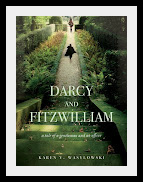
Karen V. Wasylowski's first book, 'Darcy and Fitzwilliam', was a continuation of Jane Austen's wonderful 'Pride and Prejudice', and is the only 'bromance' in Jane Austen Fan Fiction telling the story of the two cousins, the iconic Fitzwilliam Darcy and Colonel Fitzwilliam, their friendship and their battles.  A review in Jane Austen World and Jane Austen Today said of 'Darcy and Fitzwilliam' - "It is absorbing.  It is intoxicating.  It is excellent."

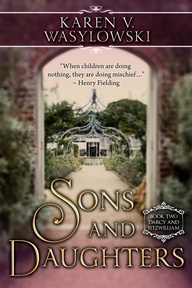
On 1 October, 2012, the family saga begun in 'Pride and Prejudice', continues with 'Sons and Daughters', Karen Wasylowski's Book Two of the Darcy and Fitzwilliam Tales.  The cousins are older now, married with children, and a bit wiser - but not by much.  The book follows their lives and the growth of their families through good times and bad.  A recent review in Amazon said "I read almost all of the continuing stories and 'what ifs' of Pride and Prejudice. This was my favorite.  I laughed all through this book"

To order either "Darcy and Fitzwilliam" or "Sons and Daughters" click here


And visit her blog too, for all the latest on British actors, plays and television


Thursday, September 6, 2012

Our Love Affair With Mr. Darcy - And The Worst Marriage Proposal in History

By Karen V. Wasylowski

What is this fascination we women have for Mr. Darcy?

Tom Lefroy
Jane Austen's true love and possibly the model for Darcy
(actually, and unfortunately for Jane, he was more of a Willoughby)

Apparently, there was a poll conducted years ago by the Orange Prize for Fiction.  Now I don't know exactly what the subject matter of the poll was, or exactly what the Orange Prize for Fiction is; however,1,900 women, across generational lines, selected Fitzwilliam Darcy as the man with whom they'd most like to go on a date.  He was also chosen as the man they'd most like to have attend their dinner party, which is odd since he'd probably not want to associate with most of those women - depending upon, of course,  just who their 'people' were.

He's kind of a prig when you think of it.  Just think of how he treats the woman he loves, most ardently...


 The Worst Proposal in Literary History, PRIDE AND PREJUDICE style


Mr Darcy: `In vain have I struggled. It will not do. My feelings will not be repressed. You must allow me to tell you how ardently I admire and love you.'

He continues on:  His sense of her inferiority -- of its being a degradation -- of the family obstacles which judgment had always opposed to inclination, were dwelt on with a warmth which seemed due to the consequence he was wounding, but was very unlikely to recommend his suit.  He spoke of apprehension and anxiety, but his countenance expressed real security. 


(Could that mean the lovely, lively Bennet girls won't be invited to Pemberley for weekend house parties very often?  And what of Mrs. Bennet?)


Elizabeth Bennet responds: "In such cases as this, it is, I believe, the established mode to express a sense of obligation for the sentiments avowed, however unequally they may be returned. It is natural that obligation should be felt, and if I could feel gratitude, I would now thank you. But I cannot -- I have never desired your good opinion, and you have certainly bestowed it most unwillingly. I am sorry to have occasioned pain to any one.

It has been most unconsciously done, however, and I hope will be of short duration. The feelings which, you tell me, have long prevented the acknowledgment of your regard, can have little difficulty in overcoming it after this explanation."


Jane Austen
The art of the put-down

Darcy is described as smug and defensive when she rejects him, he becomes pale with anger .  He is becoming unraveled now, however, and he struggles for composure.

Darcy:  ``And this is all the reply which I am to have the honour of expecting! I might, perhaps, wish to be informed why, with so little endeavour at civility, I am thus rejected. But it is of small importance.''

He simply can't believe that she doesn't understand how really scummy her family is compared to his:

Darcy again: (the poor guys doesn't realize - when you find yourself in a hole - stop digging!) Could you expect me to rejoice in the inferiority of your connections? To congratulate myself on the hope of relations, whose condition in life is so decidedly beneath my own?"

Can you imagine, in your wildest dreams, accepting a proposal like that?  I can't.

Unless he was really, really rich and owned Pemberley....but I digress.


Elizabeth confronts his part in ruining her sister's happiness and future: `Can you deny that you have done it?'' she repeated.

Darcy:  ``I have no wish of denying that I did every thing in my power to separate my friend from your sister, or that I rejoice in my success. Towards him I have been kinder than towards myself.''


That's when she gives him the final blow:

"From the very beginning, from the first moment I may almost say, of my acquaintance with you, your manners, impressing me with the fullest belief of your arrogance, your conceit, and your selfish disdain of the feelings of others, were such as to form that ground-work of disapprobation, on which succeeding events have built so immovable a dislike; and I had not known you a month before I felt that you were the last man in the world whom I could ever be prevailed on to marry."

A direct hit!  What a put down!  We women adore Darcy for his non-attainability, his self confidence, his superiority; then, oddly enough, we love to see him brought to his knees for the very same reasons.  Puzzling and very possibly schizophrenic; but, I have to admit, I too get a kick out of this scene each and every time I read it.

And we still love him!  Fitzwilliam Darcy's character is so artfully written that he is popular two hundred years after his inception,  he is so broadly drawn that he adapts to every age, he can fulfill every woman's fantasy of the 'perfect' man. Whether or not  any of us could actually live with a husband like this, a man who would say such things to a woman he supposedly loves - well, that's problematic.  Each generation seems to embrace it's own ideal romantic hero - it's own Darcy - employing the norms for that age.

And I wonder what our current film interpretations of this novel says about 'our' age.  I can't imagine Jane Austen's Darcy emerging soaking wet from the lake, or strolling toward Lizzy across a field shrouded in mist, his shirt undone, his hair wild...

No, I don't think that would have been acceptable in Jane Austen's age, but in ours...my, my, my.

Here it is - THE WORST PROPOSAL IN HISTORY, followed by the greatest put down


My book, DARCY AND FITZWILLIAM, is a continuation of Jane Austen's wonderful novel, PRIDE AND PREJUDICE.  The two cousins from the Jane Austen book, the iconic Fitzwilliam Darcy and Colonel Fitzwilliam are best friends and share some very funny, and very poignant adventures.  They're the Regency Era's answer to Butch Cassidy and The Sundance Kid.


COMING October 1, 2012, is my sequel to Darcy and Fitzwilliam, SONS AND DAUGHTERS.  The Family Saga begun in 'Pride and Prejudice'
continued in 'Darcy and Fitzwilliam'
now goes on with 'Sons and Daughters'.  
The men are fathers now and their families are growing, getting into mischief, and loving life.


Look for a contest all through October on 
to enter and win a Free Kindle, with 
"Sons and Daughters" 
or one of two copies of
"Darcy and Fitzwilliam"


Sunday, May 13, 2012

Flirting With Fans - A Victorian Tradition

By Karen V. Wasylowski


With so many restrictions regarding proper behavior between a lady and the gentleman of her choosing, during the Victorian Age, how was a girl ever to express her interest in a young man?  The Regency Era and it's overt sexual freedoms were a thing of the past (supposedly); nice young ladies no longer could dampen their gowns (tell me another one) to show off their lovely figures, nor could they rouge their nipples (perhaps).


Pity the poor Victorian lady.  Without the allurements allowed in the past, these pioneering women were reduced to using props.  Parasols, gloves - anything with which to flirt; these sisters of ours were desperate.  

And the most interesting, the most useful of all, was THE FAN.  Position, posture and pressure - the three keys.  Flirting with Fans was an artform.  It should be reinstated and pursued during our lifetime.  I wonder if Snookie ever considered one...?


Here are some of the popular fan signals and what they mean.  Perhaps one can practice at home on husbands?

The fan placed near the heart: “You have won my love”
A closed fan touching the right eye: “When may I be allowed to see you?”
The number of sticks shown answered the question: “At what hour?”
Threatening movements with a fan closed: “Do not be so imprudent”
Half-opened fan pressed to the lips: “You may kiss me”
Hands clasped together holding an open fan: “Forgive me”
Covering the left ear with an open fan: “Do not betray our secret”
Hiding the eyes behind an open fan: “I love you”
Shutting a fully opened fan slowly: “I promise to marry you”
Drawing the fan across the eyes: “I am sorry”
Touching the finger to the tip of the fan: “I wish to speak with you”
Letting the fan rest on the right cheek: “Yes”
Letting the fan rest on the left cheek: “No”
Opening and closing the fan several times: “You are cruel”
Dropping the fan: “We will be friends”
Fanning slowly: “I am married”
Fanning quickly: “I am engaged”
Putting the fan handle to the lips: “Kiss me”
Opening a fan wide: “Wait for me”
Placing the fan behind the head: “Do not forget me”
Placing the fan behind the head with finger extended: “Goodbye”
Fan in right hand in front of face: “Follow me”
Fan in left hand in front of face: “I am desirous of your acquaintance”
Fan held over left ear: “I wish to get rid of you”
Drawing the fan across the forehead: “You have changed”
Twirling the fan in the left hand: “We are being watched”
Twirling the fan in the right hand: “I love another”
Carrying the open fan in the right hand: “You are too willing”
Carrying the open fan in the left hand: “Come and talk to me”
Drawing the fan through the hand: “I hate you!”
Drawing the fan across the cheek: “I love you!”
Presenting the fan shut: “Do you love me?”

If there are too many here to remember I propose little cheat sheets...stuffed into white gloves...and the gloves should definitely hold onto a lovely pink parasol!


(special thanks to The Language of the Fan, by Micki Gaffney)


Karen V. Wasylowski is the author of "Darcy and Fitzwilliam: the Tale of a Gentleman and an Officer," Pride and Prejudice Continues!


Visit my other sites


Monday, March 19, 2012

St. Patrick, Patron Saint of Ireland

Posted by Karen V. Wasylowski
(FROM HISTORY.COM)

St. Patrick, the patron saint of Ireland, is one of Christianity's most widely known figures. But for all his celebrity, his life remains somewhat of a mystery. Many of the stories traditionally associated with St. Patrick, including the famous account of his banishing all the snakes from Ireland, are false, the products of hundreds of years of exaggerated storytelling.


"It is known that St. Patrick was born in Britain to wealthy parents near the end of the fourth century. He is believed to have died on March 17, around 460 A.D. Although his father was a Christian deacon, it has been suggested that he probably took on the role because of tax incentives and there is no evidence that Patrick came from a particularly religious family.

At the age of 16, Patrick was taken prisoner by a group of Irish raiders who were attacking his family's estate. They transported him to Ireland where he spent six years in captivity. (There is some dispute over where this captivity took place. Although many believe he was taken to live in Mount Slemish in County Antrim, it is more likely that he was held in County Mayo near Killala.) During this time, he worked as a shepherd, outdoors and away from people. Lonely and afraid, he turned to his religion for solace, becoming a devout Christian. (It is also believed that Patrick first began to dream of converting the Irish people to Christianity during his captivity.)

After more than six years as a prisoner, Patrick escaped. According to his writing, a voice—which he believed to be God's—spoke to him in a dream, telling him it was time to leave Ireland. To do so, Patrick walked nearly 200 miles from County Mayo, where it is believed he was held, to the Irish coast.

After escaping to Britain, Patrick reported that he experienced a second revelation—an angel in a dream tells him to return to Ireland as a missionary. Soon after, Patrick began religious training, a course of study that lasted more than 15 years. After his ordination as a priest, he was sent to Ireland with a dual mission: to minister to Christians already living in Ireland and to begin to convert the Irish. (Interestingly, this mission contradicts the widely held notion that Patrick introduced Christianity to Ireland.)

Familiar with the Irish language and culture, Patrick chose to incorporate traditional ritual into his lessons of Christianity instead of attempting to eradicate native Irish beliefs. For instance, he used bonfires to celebrate Easter since the Irish were used to honoring their gods with fire. He also superimposed a sun, a powerful Irish symbol, onto the Christian cross to create what is now called a Celtic cross, so that veneration of the symbol would seem more natural to the Irish.

Although there were a small number of Christians on the island when Patrick arrived, most Irish practiced a nature-based pagan religion. The Irish culture centered around a rich tradition of oral legend and myth. When this is considered, it is no surprise that the story of Patrick's life became exaggerated over the centuries—spinning exciting tales to remember history has always been a part of the Irish way of life."


Karen V. Wasylowski is the author of "Darcy and Fitzwilliam" (a riotous continuation of Jane Austen's Pride and Prejudice) "...a Regency Era 'Butch and Sundance'."  Purchase on-line in print or e-books, and at all major bookstores.


To purchase 

Monday, December 19, 2011

A Victorian Christmas Carol

By Karen V. Wasylowski


I have always thought of Christmas time…as a good time: a kind, forgiving, charitable, pleasant time: the only time I know of, in the long calendar of the year, when men and women seem by one consent to open their shut-up hearts freely, and to think of people below them as if they were really fellow-passengers to the grave and not another race of creatures bound on other journeys.

- Nephew Fred from 'A Christmas Carol'

There is nothing in this world that evokes Christmas more for me than Victorian England and Charles Dickens' A Christmas Carol.  How many times have I seen this movie, and in how many versions?   Well, it's hard to keep track - the story is similar to Pride and Prejudice in that Hollywood feels the need to keep retelling the tale, change the locale, modernize the message.  My brother and I watched and waited each year for it, hoping for the 1951 version starring Alastair Sims and complaining bitterly if it was the 1938 Reginald Owen film.  In 1970 Albert Finney starred in 'Scrooge' but I never did take to his performance.  It was like Tom Jones on crack cocaine or something and then in 1988 Bill Murray got 'Scrooged' and that just made me nervous.  I never for one moment believed Scrooge was reformed in the end.  I mean, it was Bill Murray after all. 

The Christmas festivities described in A Christmas Carol were a good deal different from the old Puritan Christmas that had been the norm for years.  Puritans, Quakers and others strongly disapproved of the mingling of liquor and merriment with a sacred holiday, were disturbed by some of the tradition’s origins in pagan ritual. Writing in 1871, G.K. Chesterton provides an insight into the mid-19th century mindset with his claim that

...in fighting for Christmas [Dickens] was fighting for the old European festival, Pagan and Christian, for that trinity of eating, drinking and praying which to moderns appears irreverent, for the holy day which is really a holiday.

In spite of its detractors, the New Christmas gradually took hold, and the Victorians established many of the customs that are at the center of today’s traditional Christmas celebration. In 1840, when Prince Albert celebrated the holiday at Windsor Castle by presenting his family with the “German” Christmas tree, all of England followed suit. The festival began to focus predominantly on the family, particularly on children. The first Christmas cards appeared in 1843, the year that A Christmas Carol was published. The originally pagan ritual of caroling was revived, gift giving grew in importance, and the traditional Christmas dinner began to take shape.


And still it grows - there are new traditions added every year, cultural preferences, family blending.  Christmas itself remains the same though, a blessed time of peace, family and remembrance.   I pray you have a joyful day, but remember others less fortunate.  May you help the poor, love your neighbor, forgive your enemies. 

And settle in for another year of "A Christmas Carol."


Preface to A Christmas Carol 
        "I have endeavoured in this Ghostly little book, to raise the Ghost of an Idea, which shall not put my readers out of humour with themselves, with each other, with the season, or with me. May it haunt their houses pleasantly, and no one wish to lay it.
 Their faithful Friend and Servant, C.D. "

 Merry Christmas, and God Bless us,
One and All

Hope you take a moment and visit my other blog -
"The League of British Artists"

'Darcy and Fitzwilliam' By Karen V. Wasylowski
"It is absorbing.  It is Intoxicating.  It is excellent..."  Jane Austen's World and Jane Austen Today


.

.

Monday, September 26, 2011

Giveaway: Darcy and Fitzwilliam

A signed copy of Darcy and Fitzwilliam is being offered by author Karen Wasylowski. You can read about the book HERE, and then return to this post to leave a comment with your contact information to enter the drawing.

This contest ended at midnight Sunday, Oct. 2, 2011, EST.