Showing posts with label literature. Show all posts

Thursday, February 7, 2019

84, Charing Cross Road - The love story of a New York City woman and a London bookshop

by Stephanie Cowell

In New York 1949, in the years not long following the terrible losses in the world from the War, a young writer who had never gone to college sent a letter to a bookshop called Marks and Co. in Charing Cross Road, London. She was determined to be self-educated. She wanted a number of classic books, then only available in old editions; the great cheap reprints of today had not yet been envisioned. She sent the bookshop a list of what she wanted. Back came a letter from one FPD (Frank Doel) for Marks & Co. saying they had copies of a few things on her list and would send them book mail. The invoice would be enclosed with the books. Yes, there really was a world when you could order anything and the seller did not doubt you would pay for it. In England Lyons Tea Shops were all over, and Elizabeth would not ascend the throne for three more years.

Through the mail, Helene Hanff wrote, “I enclose $4 to cover the $3.88 due you, buy yourself a cup of coffee with the 12 cents…Now, do you have….” And back came more estate-quality editions so beautiful she hardly dared read them.

Helene Hanff,who fell in love with an English bookshop
But she was a writer and writers are often poor. The bookshop staff wanted her to visit, but Helene could not afford to go. Instead her best friend went and wrote back to her: “It is the loveliest old shop straight out of Dickens; you would go absolutely out of your mind over it. ….It’s dim inside, and you smell the shop before you see it; it’s a lovely smell….it combines must and dust and age, and walls of wood and floors of wood…the shelves go on forever; they go up to the ceiling….”

You never know what happens when you write a first letter to someone. “Gentlemen” which was the first salutation evolved into “Dear Frankie.” The request for books developed into a friendship with the whole bookshop staff. It led to her sending boxes of meat and dried egg and nylon stockings, things unavailable then in England except under the strictest rationing. 

The correspondence of Ms. Hanff and bookseller Frank Doel continued for twenty years. Their letters were collected into a small book call 84,Charing Cross Road which became an underground classic and earned Helene Hanff hundreds of fan letters from strangers in English-speaking countries around the world. It became a BBC live television play. It became a West End play and a Broadway play and eventually a movie with Anne Bancroft and Anthony Hopkins.

Anthony Hopkins as bookseller Frank Doel in the film
But Helene never met her friend Frankie; he died suddenly in 1968 . Almost the whole of the London antiquarian book trade attended his funeral on a bitterly cold day.

When Helene finally sold enough television scripts to go to England, she found to her great sadness that the bookstore she had made so famous in her little book had closed. Someone had saved the sign for her though. She subsequently wrote two charming small memoirs about her adventures seeing London and England at last, hosted by her huge number of fans and her English publisher. It was a dream come true. The books are The Duchess of Bloomsbury Street and Q’s Legacy, which is also about how an American girl who could not afford college fell in love with English literature.

Many people love the 1987 movie version but I feel it pales next to the vivid writing of the actual letters. So if you have not read the actual 84, Charing Cross Road, you can do it in much less than an hour and it will transport you back to the time when you wrote snail mail to bookshops for what you wanted if not available here and didn’t have to pay until after it came and when a London book shop could keep a staff of six or eight employees while selling books through the mail for about two dollars each and probably a lot less if you went in person.

Charing Cross Road as seen in the film

In 1997 my husband and I made our own pilgrimage to 84, Charing Cross Road. At that point, the shop was empty and there was nothing but the plaque commemorating it (see above) and the book Helene had written about it. It was very sad, but there were still a number of second-hand bookshops on the street, and I bought a book in one which I still have today. It was not an antiquarian book but a used paperback, but still I love it.

A few years before I had written Helene Hanff a fan letter; she still lived in the Manhattan apartment house whose address was listed in her books. She was then about 80 years old. She wrote me a lovely handwritten letter back which lies buried in one of the many boxes of papers or I would hope to scan it for this article. I was perfectly thrilled to receive it.

the original edition of the book of letters
I own almost all her books. Mostly they are the story of how one woman loved English literature so much that she made an ordinary Charing Cross antiquarian bookshop into one of the most loved bookshops in the world ever. And so it remains in people’s minds many years after the world it celebrated has changed forever.

This article is an Editors' Choice, originally published on Aug 13, 2015
~~~~~~~~~~~~

Stephanie Cowell is the author of Nicholas Cooke, The Physician of London, The Players: a novel of the young Shakespeare, Marrying Mozart and Claude & Camille: a novel of Monet. She is the recipient of an American Book Award. Her next novel is on the love story of Elizabeth Barrett and Robert Browning to be followed by the conclusion of the Nicholas trilogy and an Edwardian love story between two men in the English midlands. Her work has been translated into nine languages. Her website is http://www.stephaniecowell.com. e-mail: StephanieCowell@nyc.rr.com

Wednesday, March 27, 2013

Ann Radcliffe, The Mighty Enchantress

by J.A. Beard


Reading, that oh-so-wonderful pleasure, was of course appreciated by many in Georgian England. The expansion of literacy among women during the period  also helped to provide new popularity for many types of fiction.

In the later decades of Georgian England, the rise of the Gothic novel particularly stands out. Crumbling castles, brooding noblemen, virtuous women terrorized by supernatural wickedness in the darkness. These are all part of the the early tradition of Gothic fiction. Fixated on atmosphere, the Gothic tradition was a mix of horror, melodrama, and romantic elements. Whenever Gothic fiction is considered, there's one woman who helped to shape and popularize the genre, Ann Radcliffe.

An excerpt:

While Emily gazed with awe upon the scene, footsteps were heard within the gates, and the undrawing of bolts; after which an ancient servant of the castle appeared, forcing back the huge folds of the portal, to admit his lord. As the carriage-wheels rolled heavily under the portcullis, Emily's heart sunk, and she seemed, as if she was going into her prison; the gloomy court, into which she passed, served to confirm the idea, and her imagination, ever awake to circumstance, suggested even more terrors, than her reason could justify.

Another gate delivered them into the second court, grass-grown, and more wild than the first, where, as she surveyed through the twilight its desolation—its lofty walls, overtopt with briony, moss and nightshade, and the embattled towers that rose above,—long-suffering and murder came to her thoughts. One of those instantaneous and unaccountable convictions, which sometimes conquer even strong minds, impressed her with its horror. The sentiment was not diminished, when she entered an extensive gothic hall, obscured by the gloom of evening, which a light, glimmering at a distance through a long perspective of arches, only rendered more striking. As a servant brought the lamp nearer partial gleams fell upon the pillars and the pointed arches, forming a strong contrast with their shadows, that stretched along the pavement and the walls.

-- The Mysteries of Udolpho, 1794.

While not the first author to write what we would now consider a Gothic novel, Radcliffe helped to popularize and bring Gothic novels into the literary mainstream. For this reason, she's often considered the true definer of the genre.

Although she was wildly successful during her lifetime, she wrote only a book of poetry and six novels: The Castles of Athlin and Dunbayne (1789), A Sicilian Romance (1790), The Romance of the Forest (1791), The Mysteries of Udolpho (1794), The Italian (1797), and Gaston de Blondeville (1826). If you're wondering about the large number of years between her fifth and sixth novels, the last was actually posthumously published by her husband.

Her works tended to focus on virtuous and imperiled heroines of breeding dealing with the aforementioned brooding noblemen, mysterious exotic castles, and supernatural elements. Radcliffe, however, in contrast to many other Gothic writers was rather explicit (with one exception, Gaston de Blondville, though as noted above, it would only be published after her death) in showing that the supernatural elements in her stories all actually had rational, non-supernatural explanations.

One of the continuing elements in her works is a heroine desperately resisting an onslaught of emotion and instead, eventually, applying reason to the situation. For the time, especially given many people's sentiments about women in general, this was actually somewhat feminist, though a type of feminism considered mostly acceptable by late Georgian society.

Indeed, her combination of sensible heroines, lack of true supernatural elements, and virtue allowed her brand of Gothic novels to be acceptable for the literary mainstream. Critics at the time hailed her as the "mighty enchantress."

Surprisingly, at the height of her popularity at the age of 32, she stopped writing. As she kept a rather low personal profile, it's not certain her exact reasons for quitting, but many literary historians attribute it to her personal disgust with the direction Gothic fiction was taken, particularly in terms of then-prurient disreputable supernatural content. For example, The Monk, published in 1796, gained some popularity. The novel features and references, among other things, demon pacts, rape, and incest.

Radcliffe's works remained popular and influential throughout the 19th century both in England and the United States. She would influence many other authors who would go on to influence their own literary descendants. So, even if she isn't a household name anymore, her influence lingers.

Her 19th-century popularity is easily attested by the direct references to her works in period works and later fiction. One of the more famous and familiar to modern readers would be the several references to her work, particularly The Mysteries of Udolpho, in Jane Austen's Northanger Abbey (1817), a parody of many elements popular in Gothic fiction and Radcliffe's books. I should note that Ms. Austen was far from the only one parodying Gothic excess at the time.

So, whenever you read a book where some young woman is running down a spooky mansion/castle corridor or watch a similar movie, take a moment to think of Ann Radcliffe.

-----

J.A. Beard is a scientific editor and the author of A Woman of Proper Accomplishments, which, though not very Gothic, does feature  a virtuous and rational Georgian young woman threatened by supernatural forces. 

Thursday, September 6, 2012

Our Love Affair With Mr. Darcy - And The Worst Marriage Proposal in History

By Karen V. Wasylowski

What is this fascination we women have for Mr. Darcy?

Tom Lefroy
Jane Austen's true love and possibly the model for Darcy
(actually, and unfortunately for Jane, he was more of a Willoughby)

Apparently, there was a poll conducted years ago by the Orange Prize for Fiction.  Now I don't know exactly what the subject matter of the poll was, or exactly what the Orange Prize for Fiction is; however,1,900 women, across generational lines, selected Fitzwilliam Darcy as the man with whom they'd most like to go on a date.  He was also chosen as the man they'd most like to have attend their dinner party, which is odd since he'd probably not want to associate with most of those women - depending upon, of course,  just who their 'people' were.

He's kind of a prig when you think of it.  Just think of how he treats the woman he loves, most ardently...


 The Worst Proposal in Literary History, PRIDE AND PREJUDICE style


Mr Darcy: `In vain have I struggled. It will not do. My feelings will not be repressed. You must allow me to tell you how ardently I admire and love you.'

He continues on:  His sense of her inferiority -- of its being a degradation -- of the family obstacles which judgment had always opposed to inclination, were dwelt on with a warmth which seemed due to the consequence he was wounding, but was very unlikely to recommend his suit.  He spoke of apprehension and anxiety, but his countenance expressed real security. 


(Could that mean the lovely, lively Bennet girls won't be invited to Pemberley for weekend house parties very often?  And what of Mrs. Bennet?)


Elizabeth Bennet responds: "In such cases as this, it is, I believe, the established mode to express a sense of obligation for the sentiments avowed, however unequally they may be returned. It is natural that obligation should be felt, and if I could feel gratitude, I would now thank you. But I cannot -- I have never desired your good opinion, and you have certainly bestowed it most unwillingly. I am sorry to have occasioned pain to any one.

It has been most unconsciously done, however, and I hope will be of short duration. The feelings which, you tell me, have long prevented the acknowledgment of your regard, can have little difficulty in overcoming it after this explanation."


Jane Austen
The art of the put-down

Darcy is described as smug and defensive when she rejects him, he becomes pale with anger .  He is becoming unraveled now, however, and he struggles for composure.

Darcy:  ``And this is all the reply which I am to have the honour of expecting! I might, perhaps, wish to be informed why, with so little endeavour at civility, I am thus rejected. But it is of small importance.''

He simply can't believe that she doesn't understand how really scummy her family is compared to his:

Darcy again: (the poor guys doesn't realize - when you find yourself in a hole - stop digging!) Could you expect me to rejoice in the inferiority of your connections? To congratulate myself on the hope of relations, whose condition in life is so decidedly beneath my own?"

Can you imagine, in your wildest dreams, accepting a proposal like that?  I can't.

Unless he was really, really rich and owned Pemberley....but I digress.


Elizabeth confronts his part in ruining her sister's happiness and future: `Can you deny that you have done it?'' she repeated.

Darcy:  ``I have no wish of denying that I did every thing in my power to separate my friend from your sister, or that I rejoice in my success. Towards him I have been kinder than towards myself.''


That's when she gives him the final blow:

"From the very beginning, from the first moment I may almost say, of my acquaintance with you, your manners, impressing me with the fullest belief of your arrogance, your conceit, and your selfish disdain of the feelings of others, were such as to form that ground-work of disapprobation, on which succeeding events have built so immovable a dislike; and I had not known you a month before I felt that you were the last man in the world whom I could ever be prevailed on to marry."

A direct hit!  What a put down!  We women adore Darcy for his non-attainability, his self confidence, his superiority; then, oddly enough, we love to see him brought to his knees for the very same reasons.  Puzzling and very possibly schizophrenic; but, I have to admit, I too get a kick out of this scene each and every time I read it.

And we still love him!  Fitzwilliam Darcy's character is so artfully written that he is popular two hundred years after his inception,  he is so broadly drawn that he adapts to every age, he can fulfill every woman's fantasy of the 'perfect' man. Whether or not  any of us could actually live with a husband like this, a man who would say such things to a woman he supposedly loves - well, that's problematic.  Each generation seems to embrace it's own ideal romantic hero - it's own Darcy - employing the norms for that age.

And I wonder what our current film interpretations of this novel says about 'our' age.  I can't imagine Jane Austen's Darcy emerging soaking wet from the lake, or strolling toward Lizzy across a field shrouded in mist, his shirt undone, his hair wild...

No, I don't think that would have been acceptable in Jane Austen's age, but in ours...my, my, my.

Here it is - THE WORST PROPOSAL IN HISTORY, followed by the greatest put down


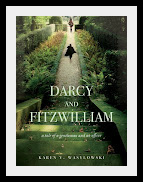
My book, DARCY AND FITZWILLIAM, is a continuation of Jane Austen's wonderful novel, PRIDE AND PREJUDICE.  The two cousins from the Jane Austen book, the iconic Fitzwilliam Darcy and Colonel Fitzwilliam are best friends and share some very funny, and very poignant adventures.  They're the Regency Era's answer to Butch Cassidy and The Sundance Kid.


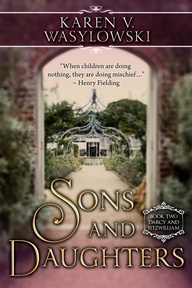
COMING October 1, 2012, is my sequel to Darcy and Fitzwilliam, SONS AND DAUGHTERS.  The Family Saga begun in 'Pride and Prejudice'
continued in 'Darcy and Fitzwilliam'
now goes on with 'Sons and Daughters'.  
The men are fathers now and their families are growing, getting into mischief, and loving life.


Look for a contest all through October on 
to enter and win a Free Kindle, with 
"Sons and Daughters" 
or one of two copies of
"Darcy and Fitzwilliam"