By Karen V. Wasylowski
What is this fascination we women have for Mr. Darcy?
Tom Lefroy
Jane Austen's true love and possibly the model for Darcy
(actually, and unfortunately for Jane, he was more of a Willoughby)
Apparently, there was a poll conducted years ago by the Orange Prize for Fiction. Now I don't know exactly what the subject matter of the poll was, or exactly what the Orange Prize for Fiction is; however,1,900 women, across generational lines, selected Fitzwilliam Darcy as the man with whom they'd most like to go on a date. He was also chosen as the man they'd most like to have attend their dinner party, which is odd since he'd probably not want to associate with most of those women - depending upon, of course, just who their
'people' were.
He's kind of a prig when you think of it. Just think of how he treats the woman he loves, most ardently...
The Worst Proposal in Literary History, PRIDE AND PREJUDICE style
Mr Darcy: `In vain have I struggled. It will not do. My feelings will not be repressed. You must allow me to tell you how ardently I admire and love you.'
He continues on:
His sense of her inferiority -- of its being a degradation -- of the family obstacles which judgment had always opposed to inclination, were dwelt on with a warmth which seemed due to the consequence he was wounding, but was very unlikely to recommend his suit. He spoke of apprehension and anxiety, but his countenance expressed real security.
(Could that mean the lovely, lively Bennet girls won't be invited to Pemberley for weekend house parties very often? And what of Mrs. Bennet?)
Elizabeth Bennet responds:
"In such cases as this, it is, I believe, the established mode to express a sense of obligation for the sentiments avowed, however unequally they may be returned. It is natural that obligation should be felt, and if I could feel gratitude, I would now thank you. But I cannot -- I have never desired your good opinion, and you have certainly bestowed it most unwillingly. I am sorry to have occasioned pain to any one.
It has been most unconsciously done, however, and I hope will be of short duration. The feelings which, you tell me, have long prevented the acknowledgment of your regard, can have little difficulty in overcoming it after this explanation."
Jane Austen
The art of the put-down
Darcy is described as smug and defensive when she rejects him, he becomes pale with anger . He is becoming unraveled now, however, and he struggles for composure.
Darcy:
``And this is all the reply which I am to have the honour of expecting! I might, perhaps, wish to be informed why, with so little endeavour at civility, I am thus rejected. But it is of small importance.''
He simply can't believe that she doesn't understand how really scummy her family is compared to his:
Darcy again: (the poor guys doesn't realize - when you find yourself in a hole - stop digging!)
Could you expect me to rejoice in the inferiority of your connections? To congratulate myself on the hope of relations, whose condition in life is so decidedly beneath my own?"
Can you imagine, in your wildest dreams, accepting a proposal like that? I can't.
Unless he was really, really rich and owned Pemberley....but I digress.
Elizabeth confronts his part in ruining her sister's happiness and future:
`Can you deny that you have done it?'' she repeated.
Darcy:
``I have no wish of denying that I did every thing in my power to separate my friend from your sister, or that I rejoice in my success. Towards him I have been kinder than towards myself.''
That's when she gives him the final blow:
"From the very beginning, from the first moment I may almost say, of my acquaintance with you, your manners, impressing me with the fullest belief of your arrogance, your conceit, and your selfish disdain of the feelings of others, were such as to form that ground-work of disapprobation, on which succeeding events have built so immovable a dislike; and I had not known you a month before I felt that you were the last man in the world whom I could ever be prevailed on to marry."
A direct hit! What a put down! We women adore Darcy for his non-attainability, his self confidence, his superiority; then, oddly enough, we love to see him brought to his knees for the very same reasons. Puzzling and very possibly schizophrenic; but, I have to admit, I too get a kick out of this scene each and every time I read it.
And we still love him! Fitzwilliam Darcy's character is so artfully written that he is popular two hundred years after his inception, he is so broadly drawn that he adapts to every age, he can fulfill every woman's fantasy of the 'perfect' man. Whether or not any of us could actually live with a husband like this, a man who would say such things to a woman he supposedly loves - well, that's problematic. Each generation seems to embrace it's own ideal romantic hero - it's own Darcy - employing the norms for that age.
And I wonder what our current film interpretations of this novel says about 'our' age. I can't imagine Jane Austen's Darcy emerging soaking wet from the lake, or strolling toward Lizzy across a field shrouded in mist, his shirt undone, his hair wild...
No, I don't think that would have been acceptable in Jane Austen's age, but in ours...my, my, my.
Here it is - THE WORST PROPOSAL IN HISTORY, followed by the greatest put down
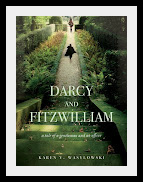
My book, DARCY AND FITZWILLIAM, is a continuation of Jane Austen's wonderful novel, PRIDE AND PREJUDICE. The two cousins from the Jane Austen book, the iconic Fitzwilliam Darcy and Colonel Fitzwilliam are best friends and share some very funny, and very poignant adventures. They're the Regency Era's answer to Butch Cassidy and The Sundance Kid.
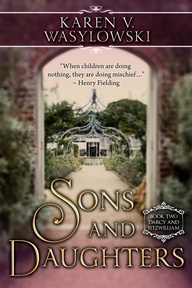
COMING October 1, 2012, is my sequel to Darcy and Fitzwilliam, SONS AND DAUGHTERS. The Family Saga begun in 'Pride and Prejudice',
continued in 'Darcy and Fitzwilliam',
now goes on with 'Sons and Daughters'.
The men are fathers now and their families are growing, getting into mischief, and loving life.
Look for a contest all through October on
to enter and win a Free Kindle, with
"Sons and Daughters"
or one of two copies of
"Darcy and Fitzwilliam"